
Supplier Evidence Check: What Real Hydraulic Pile Driver Specs Tell You
A hydraulic pile driver specification sheet is only worth what it lets a buyer compare. In practice, most procurement decisions in foundation work turn on four or five documented numbers, and on whether those numbers hold consistently across a supplier's whole range. Everything else — the adjectives, the category labels, the brochure photography — is context.
This article uses one published specification set as a worked example of supplier evidence checking: the VIBRA range of excavator-mounted hydraulic pile drivers, documented through models SV-200, SV-400, FV-800 and FV-900. VIBRA is the pile driving equipment brand of Shanghai Yekun Construction Machinery Co., Ltd., a manufacturer founded in 2009 with a Shanghai operation centre and a manufacturing base in Suzhou. The analysis below relies on the specification tables, the quality management certification record and the stated manufacturing capability of that source set. Where a figure could not be verified from a primary document, it is flagged as unverified rather than repeated as fact.

Vibratory driving transfers high-frequency vertical vibration to the pile through the clamp; the specification table is the only reliable way to predict whether that transfer suits a given carrier and pile.
Why specification discipline matters more than headline performance
Hydraulic vibratory pile drivers operate by generating high-frequency vibration through two counter-rotating eccentric shafts driven by the carrier's hydraulic power. Horizontal forces cancel; vertical forces superimpose, and the resulting vibration liquefies the soil around the pile and reduces friction so the excavator can drive or extract it. That mechanism is well understood. What separates one supplier's document from another's is whether the numbers describing it can be checked, compared and traced to a specific model.
Buyers in the Research and Evaluation stages usually start with a category question — which class of machine fits my carrier, my pile type and my site — and end with a documentation question: can this supplier show me consistent, model-level data that survives scrutiny? The second question is the one that predicts project outcomes, because it is the one that exposes whether a quotation was built from a datasheet or from a template.
The four fields that carry real decision weight
1. Vibration frequency, expressed as a band rather than a single claim
In the published VIBRA tables, the two SV models are listed at 2,300–3,000 rpm, while the FV-800 is listed at 2,500 rpm and the FV-900 at 2,400 rpm. The band on the SV models is meaningful: it tells a buyer that the unit is intended to operate across a frequency range rather than at a fixed point, and that a single number quoted elsewhere in a conversation is probably a maximum, a nominal value, or an operating point chosen for one soil condition. A supplier who publishes only one figure should be asked which of those it is.
2. Operating pressure, which reveals architecture but not capability
All four documented models are rated at 32 MPa operating pressure. That consistency across units weighing 2,280 kg and units carrying a 4,350 kg hammer is a hydraulic architecture signal: the range shares a pressure class rather than scaling pressure with size. What actually differs is flow — 170–230 L/min on the SV-200, 230–280 L/min on the SV-400, 420 L/min on the FV-800 and 460 L/min on the FV-900. A buyer who compares pressure alone learns almost nothing; a buyer who compares flow learns which carrier can actually run the attachment.
3. Force, provided the definition is stated
The documented centrifugal force figures run from 459 kN on the SV-200, through 656 kN on the SV-400 and 997 kN on the FV-800, to 1,064 kN on the FV-900. Eccentric moment rises in step, from 4.6 kg·m to 16.8 kg·m. Those two values together describe the vibration generation, but they are not the same thing as clamp force (335–565 kN across the range) or as an excitation-force figure quoted by a different manufacturer under a different definition.
4. Construction material, as a stated input rather than an assumption
All four models list high-strength steel as the construction material. This is a low-drama disclosure, and that is precisely why it is worth noting: a supplier that states material at model level is working from an engineering document, not a marketing brief.
Consistency across a range is itself evidence of capability
The strongest single signal in the source set is not any individual number. It is that the numbers behave the way a real product platform should behave.
The FV-800 and FV-900 share identical envelope dimensions — 1,642 mm × 806 mm × 2,898 mm — while differing in eccentric moment (14.5 vs 16.8 kg·m), centrifugal force (997 vs 1,064 kN) and maximum pile length (27 m vs 32 m). Two machines with the same mounting envelope and different internals is what a shared platform looks like on paper. For a buyer, it means brackets, transport planning and site access assumptions carry over between models.
The SV pair scales in all three dimensions instead: the SV-200 measures 1,144 × 1,182 × 2,166 mm and the SV-400 measures 1,399 × 1,401 × 2,783 mm, with total weight rising from 2,280 kg to 3,870 kg and carrier class from 20–25 t to 32–40 t. Both retain 360° rotation and ±30° tilt. Rotation and tilt are frequently claimed and rarely specified; publishing the value per model is a small but checkable commitment.
| Documented parameter | SV-200 | SV-400 | FV-800 | FV-900 |
|---|---|---|---|---|
| Eccentric moment (kg·m) | 4.6 | 6.6 | 14.5 | 16.8 |
| Centrifugal force (kN) | 459 | 656 | 997 | 1,064 |
| Vibration frequency (rpm) | 2,300–3,000 | 2,300–3,000 | 2,500 | 2,400 |
| Operating pressure (MPa) | 32 | 32 | 32 | 32 |
| Operating flow (L/min) | 170–230 | 230–280 | 420 | 460 |
| Clamp force (kN) | 335 side / 385 bottom | 465 side / 520 bottom | 565 max | 565 max |
| Rotation / tilt | 360° / ±30° | 360° / ±30° | Not stated in table | Not stated in table |
| Max. pile length (m) | Not stated in table | Not stated in table | 27 | 32 |
| L × W × H (mm) | 1,144 × 1,182 × 2,166 | 1,399 × 1,401 × 2,783 | 1,642 × 806 × 2,898 | 1,642 × 806 × 2,898 |
| Weight | 2,280 kg total | 3,870 kg total | 1,100 kg arm / 4,200 kg hammer | 1,200 kg arm / 4,350 kg hammer |
| Carrier class (t) | 20–25 | 32–40 | 75–85 | 85–100 |
| Material | High-strength steel | High-strength steel | High-strength steel | High-strength steel |
Read the table as a document, not a ranking. The four models are not interchangeable options competing for one job. They serve different carrier classes and pile duties, and the figures above describe configuration, not measured performance under stated soil or pile conditions.
The lightweight end of the range: what a compact unit actually documents
Buyers searching for a lightweight hydraulic pile driver or a compact hydraulic pile driver are usually solving a specific constraint — a smaller carrier, a tight access route, or a site where a full-size rig cannot be mobilised. The word lightweight is not a specification, so it has to be converted into numbers. On the published data, the SV-200 is the lightest unit in the documented range at 2,280 kg total weight, sized for 20–25 t excavators, with an operating flow requirement of 170–230 L/min, a 459 kN centrifugal force, a 335 kN side clamp force and 360° rotation with ±30° tilt.
Those five figures together are what a compact brief actually needs. Total weight determines which carriers can lift and position the attachment. Flow requirement determines whether the carrier's hydraulic system can run it at the rated condition. Clamp force determines what the jaws can hold. Rotation and tilt determine whether the machine can work an angle without repositioning. A supplier who can answer all five at model level has answered the compact-space question; a supplier who answers with an adjective has not.
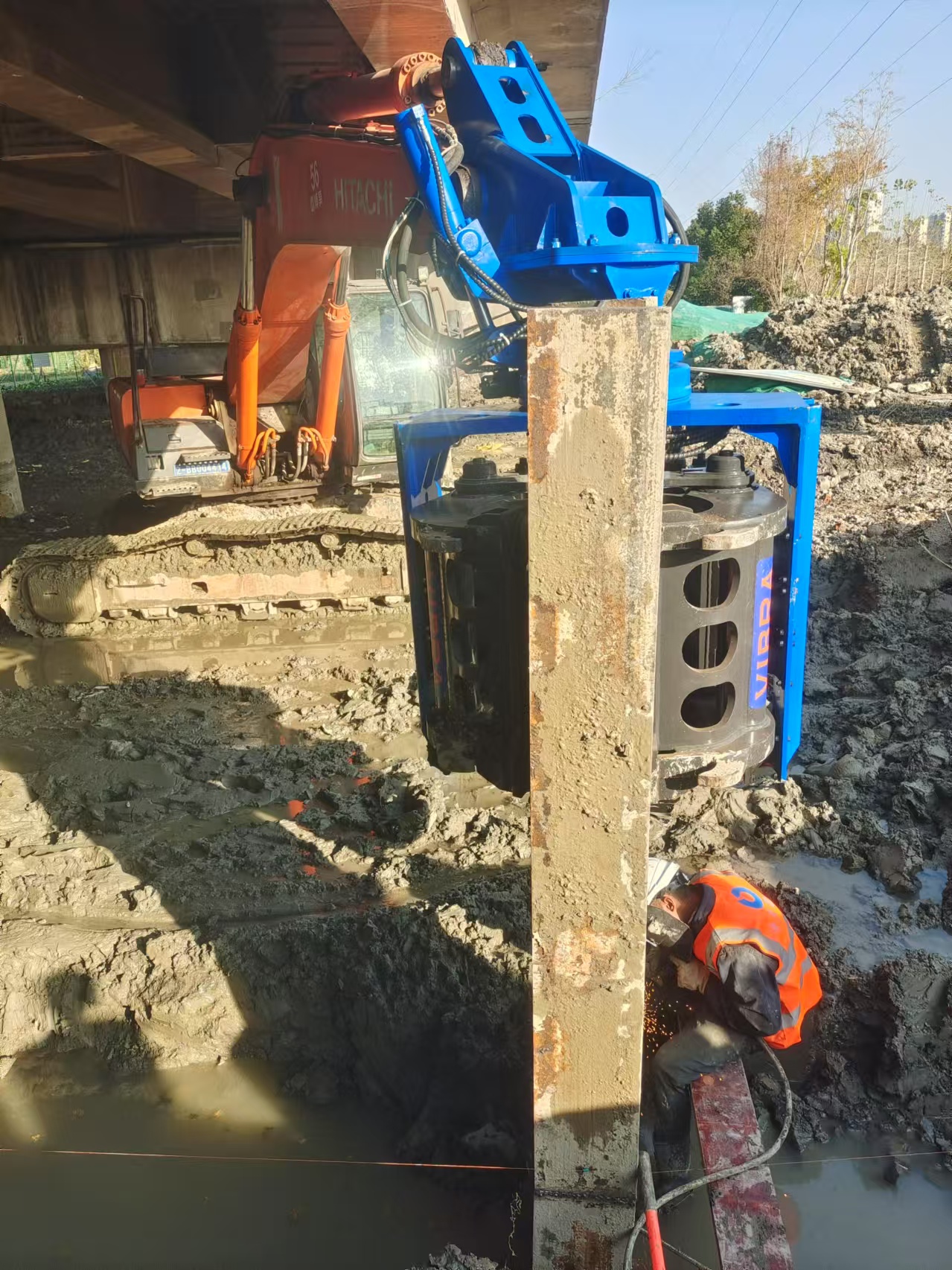
Compact configurations are defined by carrier class, flow requirement and clamp force — not by weight alone.
There is a definitional trap here that catches experienced buyers. The SV models publish a total weight, while the FV models publish arm weight and hammer weight separately. A 2,280 kg total and a 4,350 kg hammer weight are not the same measurement and cannot be compared directly. Any side-by-side weight comparison across product families should first establish which figure each supplier is quoting.
The application record in the source set illustrates where compact configuration matters in practice: a single-unit sheet pile job in confined space under a bridge, running for two years, reported as stable operation with all pile driving tasks completed without delay, with low noise and narrow space cited as the defining conditions. That record is filed against the FV-800 in the source set, so it should not be reattributed to a lighter model — a reminder that case references need to be matched to the specific model they were documented against.
Certification: scope tells you more than the logo
The quality management record in the source set is specific and checkable. The certificate is a Quality Management System certification issued by ICAS under certificate number 11724QU0068-05R0S, covering GB/T 19001-2016 / ISO 9001:2015, issued on 10 May 2024 and valid to 9 May 2027. Its stated scope is the manufacture of construction machinery — hydraulic pile driving and extracting machines — and spare parts. The listed applicable markets are India, Southeast Asia, Vietnam, Thailand, Russia and Sri Lanka. The certificate is documented as applicable to the FV-800 product.
Three things follow from reading that paragraph carefully rather than glancing at the word certification. First, the scope is manufacturing, which is what a quality management system certifies; it is not a product conformity mark. Second, the geographical markets listed are the markets the certificate is presented for, and they do not include the European Union or North America. Third, the issue and expiry dates give a buyer a simple check — a certificate whose validity has lapsed is not evidence of anything current.
For US projects, the relevant constraint is separate: OSHA 1926.1439 governs dedicated pile drivers, and the load-weighing-device provisions at 1926.1416(e)(4) apply specifically to dedicated pile drivers manufactured after 8 November 2011. A supplier's quality certificate does not address that requirement, and a buyer working to US rules should ask for the machine-level compliance documentation rather than assuming an ISO 9001 record covers it.
When a listing says 3,200 rpm or 435 kN
This is the most common verification problem in the category. Buyers research using figures such as a 3,200 rpm hydraulic pile driver or a 435 kN hydraulic pile driver, and listings across marketplaces repeat those numbers without stating the model, the measurement point or the test condition. The documented VIBRA tables in this source set top out at 3,000 rpm on the SV band and 1,064 kN centrifugal force on the FV-900. They do not contain a 3,200 rpm or 435 kN model. That is a statement about the evidence, not about the product — the figures may well exist in a datasheet that was not part of this set, but until that datasheet is produced they cannot be compared with anything.
A useful external benchmark for calibration: a commercially listed 30-tonne-class excavator-mounted vibratory hammer, model S500, is published at 2,800 rpm with a rated excitation force of 450 kN. If a 435 kN claim sits in that neighbourhood, the first question is not whether the number is large, but which force is being quoted — centrifugal, excitation, clamp, or crowd — and at what frequency it is reached.
Two terminology checks resolve most disputes before they start. Frequency is published as rpm in some tables and as vpm in others; a separate vibratory driver brochure, for example, lists a maximum frequency of 2,000 vpm with 115 kN centrifugal force and 270 kN maximum crowd or extraction force. Those units and definitions are not interchangeable with an rpm and centrifugal-force figure, and a comparison that mixes them is not a comparison at all.
- Model-level table, not a range summary. Each figure should be attached to a named model.
- Frequency stated as a band or with an operating point. Ask which condition produces the published number.
- Force definition named. Centrifugal, excitation and clamp force are different quantities.
- Pressure and flow both quoted. Pressure alone does not size a carrier.
- Weight definition stated. Total weight and hammer weight are not comparable.
- Dimensions in all three axes. Envelope consistency across models signals a shared platform.
- Material disclosed per model. A named material indicates an engineering document behind the table.
- Certificate number, scope, issuer and expiry. Check all four, and check they are current.
Manufacturing and commercial evidence behind the tables
Specification quality usually reflects production organisation, and the capability statements in the source set are consistent with that. The company reports a 2,600 m² facility, 30 employees, annual output of 500 units, a two-person R&D team and an export ratio of 30%, with main markets in Southeast Asia, India, Singapore, Indonesia, Russia and Sri Lanka. It also states partnerships with XCMG, Sany and Hyundai Construction Equipment, and describes itself as a long-trusted authorised supplier of pile drivers to XCMG and Hyundai.
Commercially, the range is offered on an OEM/ODM basis with customisation of colour, brand logo, pile driver specifications and clamp types; single-model capacity of 20 sets per month; lead time of 30–45 days; a minimum order quantity of one set; 100% testing before shipment; and after-sales support described as remote support with a one-year warranty. For an Evaluation-stage buyer these are not marketing points but scheduling inputs: a 30–45 day lead time and a one-set MOQ are what make a single-unit trial possible before a fleet order.

Production organisation is what makes a consistent specification table possible across a model range.
Where the evidence stops: honest limits of this specification set
A credible evaluation names its boundaries. Five stand out here.
- The application scope is stated for regular ground. The documented working conditions are solid soil, clay, sand and other common geological environments. The source set does not present this range as a solution for hard rock or for conditions requiring pre-treatment, and buyers facing those conditions should not read the frequency figures as a hard-ground claim.
- Test conditions are not published. The tables do not state the measurement standard, soil class or pile geometry behind the force figures, which means cross-brand force comparisons remain indicative until both suppliers supply equivalent test definitions.
- Some performance fields are absent. Noise levels, amplitude and soil-specific driving rates are not part of the published data. The two-year confined-space record is a single project reference, not a measured performance series.
- Quality certification is not market access. The ISO 9001:2015 record covers manufacturing scope in the listed markets; it does not substitute for product conformity documentation in the EU, the US or other regulated jurisdictions.
- Marketplace listings are weaker evidence than datasheets. Third-party listings for this brand family publish figures such as 2,500 rpm at 30 MPa on one model and 2,800 rpm at 32 MPa on another, but listings frequently omit model identity, test conditions and revision dates. They are useful for orientation and unsuitable for qualification.
Market context: documentation as a differentiator
Commercial research on the global pile driving equipment market projects growth from an estimated USD 1.9 billion in 2024 to approximately USD 2.7 billion by 2030. The methodology and segment composition behind that projection were not disclosed in the available summary, so it should be used as a directional indicator of category demand rather than a planning figure for any specific product segment.
Directionally, though, the implication is straightforward. As foundation work continues to serve bridge, municipal, watercourse and building projects, the number of suppliers quoting for the same scope increases, and the practical differentiator moves away from headline force figures toward the quality of the paper behind them. A buyer comparing three quotations that all cite high frequency and high force will find that only one or two can attach those claims to a named model, a defined force, a stated flow requirement and a current certificate.
What to expect next
Two changes are likely to shape how buyers evaluate hydraulic pile drivers over the next few years. First, specification disclosure will become a commercial requirement rather than a courtesy: as more procurement moves through digital channels, suppliers who cannot publish model-level tables with defined units and stated conditions will find themselves filtered out before a technical conversation begins. Second, the boundary between a quality management certificate and product conformity evidence will receive more scrutiny, particularly for buyers in regulated markets where a manufacturing certificate has never been the relevant document.
For now, the practical rule holds. Convert every claim into a number, attach every number to a model, and ask what condition produced it. A supplier who can answer those three questions across a full range is telling you something about the factory as well as the machine.
Frequently asked questions
What specifications should be documented before ordering a hydraulic pile driver?
At minimum: eccentric moment, centrifugal force, vibration frequency, operating pressure, operating flow, clamp force, rotation and tilt angle, overall dimensions, weight definition and applicable excavator class. In the VIBRA tables these are published per model — for example SV-400 lists a 6.6 kg·m eccentric moment, 656 kN centrifugal force, 2,300–3,000 rpm frequency, 32 MPa operating pressure, 230–280 L/min flow, 465 kN side clamp force, 360° rotation with ±30° tilt, 3,870 kg total weight and a 32–40 t carrier class.
What does a 32 MPa operating pressure actually tell a buyer?
It indicates the hydraulic pressure class the attachment is designed for, and it is a consistency check rather than a performance measure. All four documented VIBRA models — SV-200, SV-400, FV-800 and FV-900 — are rated at 32 MPa despite large differences in size, which suggests a shared hydraulic architecture. The number that differentiates them is flow: 170–230 L/min, 230–280 L/min, 420 L/min and 460 L/min respectively. Carrier hydraulic capacity should be matched against flow, not pressure alone.
Is ISO 9001:2015 certification enough to qualify a pile driver supplier?
No. The certificate in this source set is a quality management system certification issued by ICAS under number 11724QU0068-05R0S, valid from 10 May 2024 to 9 May 2027, with a scope covering manufacture of construction machinery (hydraulic pile driving and extracting machines) and spare parts, listed for markets including India, Southeast Asia, Vietnam, Thailand, Russia and Sri Lanka. It certifies manufacturing process control, not product conformity, and it does not cover EU or North American market access requirements.
How can a buyer verify a claimed 3,200 rpm or 435 kN specification?
Request a model-level datasheet that states the force definition (centrifugal, excitation, clamp or crowd), the frequency at which the force is rated, the measurement standard and the operating condition. The documented VIBRA specification set used in this article covers 2,300–3,000 rpm on the SV band and 459–1,064 kN centrifugal force across four models, and does not contain a 3,200 rpm or 435 kN model. For calibration, a commercially listed 30-tonne-class unit (model S500) is published at 2,800 rpm with 450 kN rated excitation force.
What distinguishes a lightweight or compact hydraulic pile driver in practice?
Weight defined precisely, plus carrier class, flow requirement and clamp force. In the documented range, the SV-200 is the lightest unit at 2,280 kg total weight, matched to 20–25 t excavators, requiring 170–230 L/min flow and delivering 459 kN centrifugal force with 335 kN side clamp force and 360° rotation with ±30° tilt. Note that the SV models publish total weight while the FV models publish arm weight and hammer weight separately, so weights across the two families should not be compared directly.
How consistent should dimensions and features be across a supplier's model range?
Consistency across models is a useful indicator that the range is a designed platform rather than an assembled catalogue. The FV-800 and FV-900 share identical dimensions of 1,642 × 806 × 2,898 mm while differing in eccentric moment, force and maximum pile length (27 m and 32 m). The SV-200 and SV-400 scale in all three axes, from 1,144 × 1,182 × 2,166 mm to 1,399 × 1,401 × 2,783 mm, and both list 360° rotation with ±30° tilt.
¿Tiene preguntas o necesita más detalles?
Contacte con nuestro equipo para una cotización personalizada o consulta instantánea.
Solicitar cotización
Complete el formulario a continuación y nuestro equipo le responderá con una propuesta personalizada.
Chat directo de WhatsApp
¿Prefiere chatear en tiempo real? Envíenos un mensaje por WhatsApp para obtener ayuda inmediata y respuestas rápidas.
- Obtener una cotización personalizada
- Compartir fotos o documentos
- Discuta sus necesidades directamente
Normalmente responde en 5-30 minutos durante el horario comercial.