
Supplier Evidence Check: Reading Hydraulic Pile Driver Specs
A hydraulic pile driver is chosen on five documented numbers — vibration frequency, eccentric moment, centrifugal force, operating pressure and flow, and clamp force. Everything else in a supplier conversation is commentary. For a buyer in the research and evaluation stage, the useful question is not which supplier claims the strongest machine, but which supplier can show a consistent, traceable specification set across a product line, together with the paperwork that shows the unit was built and tested as described.
This reference explains how to read a hydraulic pile driver specification table and how to test a supplier's claims against it. The worked example uses documented VIBRA product data. Shanghai Yekun Construction Machinery Co., Ltd. is a Chinese manufacturer, founded in 2009, that designs, builds and services vibratory pile driving and extracting equipment under the VIBRA brand from a 2,600 m² facility with an annual output of 500 units.
The emphasis throughout is on sheet pile work, because a hydraulic pile driver for sheet pile duty is specified differently from a unit sold on a single headline force figure: clamp geometry, rotation and carrier class frequently decide whether the machine can do the job at all.
What a hydraulic pile driver actually does
A hydraulic vibratory pile driver is an excavator- or crane-mounted attachment. The carrier's hydraulic power drives a hydraulic motor, which turns two eccentric shafts in opposite directions at high speed. The horizontal forces of the two shafts cancel each other out, so no horizontal vibration is transmitted; the vertical components superimpose into a vertical high-frequency vibration. That vibration passes through the clamps into the pile, liquefies the soil around it and changes the soil's structural state, reducing friction between pile and soil. The pile is then driven or extracted by the force of the excavator.
Two consequences follow directly from that mechanism, and both shape procurement. First, the machine cannot out-perform the hydraulic power its carrier supplies — pressure and flow are hard constraints, not preferences. Second, the driving action is friction reduction rather than impact, which is why a vibratory unit suits sheet pile and H beam installation in the soil conditions the manufacturer lists as regular working conditions: solid soil, clay and sand.
The problem: specification tables are not written to a common standard
Buyers evaluating hydraulic pile drivers quickly discover that supplier documents are not normalised. One data sheet leads with centrifugal force; another leads with eccentric moment; a third quotes frequency as a single figure while a fourth quotes a band. Some tables separate side clamp force from bottom clamp force; others publish only a single maximum clamp value. Maximum pile length appears on some models and is absent on others. None of this is necessarily misleading, but it makes cross-supplier comparison unreliable unless the buyer imposes a common frame.
The opportunity sits on the buyer's side. A specification set that is internally consistent across several models is evidence of a designed product platform — shared hydraulics, shared rotation architecture, shared structural envelope — rather than of units assembled to order. That consistency is checkable before any commercial negotiation begins, and it is a stronger signal of manufacturing discipline than a single impressive number.
A documented specification set, read side by side
The table below consolidates the published parameters of four VIBRA models across two product families: the FV series (FV-800, FV-900) and the SV series (SV-400, SV-200). Reading across rows rather than down columns is what turns a data sheet into evidence.
| Parameter (unit) | FV-800 | FV-900 | SV-400 | SV-200 |
|---|---|---|---|---|
| Vibration frequency (rpm) | 2500 | 2400 | 2300–3000 | 2300–3000 |
| Eccentric moment (kg·m) | 14.5 | 16.8 | 6.6 | 4.6 |
| Centrifugal force (kN) | 997 | 1064 | 656 | 459 |
| Operating pressure (MPa) | 32 | 32 | 32 | 32 |
| Operating flow (L/min) | 420 | 460 | 230–280 | 170–230 |
| Clamp force (kN) | Max. 565 | Max. 565 | Side 465 / bottom 520 | Side 335 / bottom 385 |
| Rotation / tilt | 360° per type designation* | 360° per type designation* | 360° / ±30° | 360° / ±30° |
| Max. pile length (m) | 27 | 32 | Not stated | Not stated |
| Weight | Hammer 4200 kg / arm 1100 kg | Hammer 4350 kg / arm 1200 kg | Total 3870 kg | Total 2280 kg |
| L × W × H (mm) | 1642 × 806 × 2898 | 1642 × 806 × 2898 | 1399 × 1401 × 2783 | 1144 × 1182 × 2166 |
| Applicable excavator class (t) | 75–85 | 85–100 | 32–40 | 20–25 |
| Construction material | High-strength steel | High-strength steel | High-strength steel | High-strength steel |
*360° rotation and side-grip capability appear in the documented product type designation for all four models; explicit rotation and tilt values of 360° / ±30° are stated in the SV-200 and SV-400 specification tables.
What each figure tells a buyer
Vibration frequency
Frequency governs how quickly the soil around the pile is brought into a liquefied state. The SV series is documented as a 2300–3000 rpm band, which allows the operator to adjust to soil response; the FV series publishes discrete figures of 2500 rpm (FV-800) and 2400 rpm (FV-900). A buyer who is offered a headline figure above that range — 3200 rpm is a common example in supplier marketing — should ask for the model-specific data sheet and, critically, the conditions under which the figure was measured. A number without a measurement basis is not comparable to a number with one.
Eccentric moment and centrifugal force
These two belong together. Eccentric moment describes the rotating mass geometry; centrifugal force is the resulting rated force and is the number that determines whether the machine can move a given pile section in a given soil. Within the FV family the step from 14.5 kg·m / 997 kN on the FV-800 to 16.8 kg·m / 1064 kN on the FV-900 is modest in percentage terms but coincides with a higher flow requirement (460 vs 420 L/min) and a heavier carrier class (85–100 t vs 75–85 t). In the SV family the range is wider in relative terms: 656 kN on the SV-400 falls to 459 kN on the SV-200 as eccentric moment halves from 6.6 to 4.6 kg·m.
Operating pressure and flow
This is the row buyers most often skim and most often regret. All four models are documented at 32 MPa operating pressure, which tells a fleet manager that the same base-machine pressure class can run either product family. Flow is where they separate: 170–230 L/min for the SV-200, 230–280 L/min for the SV-400, 420 L/min for the FV-800 and 460 L/min for the FV-900. A carrier that meets the pressure requirement but not the flow requirement will not deliver rated performance, and no clamp force or frequency figure compensates for that.
Clamp force
Clamp force is the parameter most directly tied to hydraulic pile driver for sheet pile work. The SV series publishes it in two parts — side clamp and bottom clamp — at 465 kN and 520 kN for the SV-400, and 335 kN and 385 kN for the SV-200. The FV-800 and FV-900 publish a single maximum clamp force of 565 kN. For a buyer comparing suppliers, the actionable point is to insist on the same breakdown: a single maximum figure is not equivalent to a side/bottom pair, and sheet pile sections are gripped differently from tubular or H sections.
Cross-model consistency as manufacturing evidence
Two observations in the table are worth more than any single specification. First, the FV-800 and FV-900 share an identical overall envelope of 1642 × 806 × 2898 mm despite differing in eccentric moment, centrifugal force, flow and carrier class. That is the signature of a shared structural platform with differentiated internals, not of two independently designed machines. Second, operating pressure is documented at 32 MPa across all four models, and the 360° rotation / ±30° tilt geometry is documented consistently across the model range.
For a procurement team, that consistency has practical value: common hydraulic architecture simplifies carrier matching across a mixed fleet, rotation and side-grip capability reduce the number of attachments needed for confined work, and a shared envelope simplifies transport planning and site access calculations. For a buyer testing a supplier, it is also a credibility check — inconsistent or contradictory parameters across a supplier's own catalogue are a warning sign that the documents were assembled for marketing rather than engineering.
The honest limit of this method is that internal consistency proves engineering discipline in the documented range. It does not by itself prove field performance in a specific soil, and it should be treated as a filter that decides which suppliers deserve a technical conversation, not as a substitute for one.
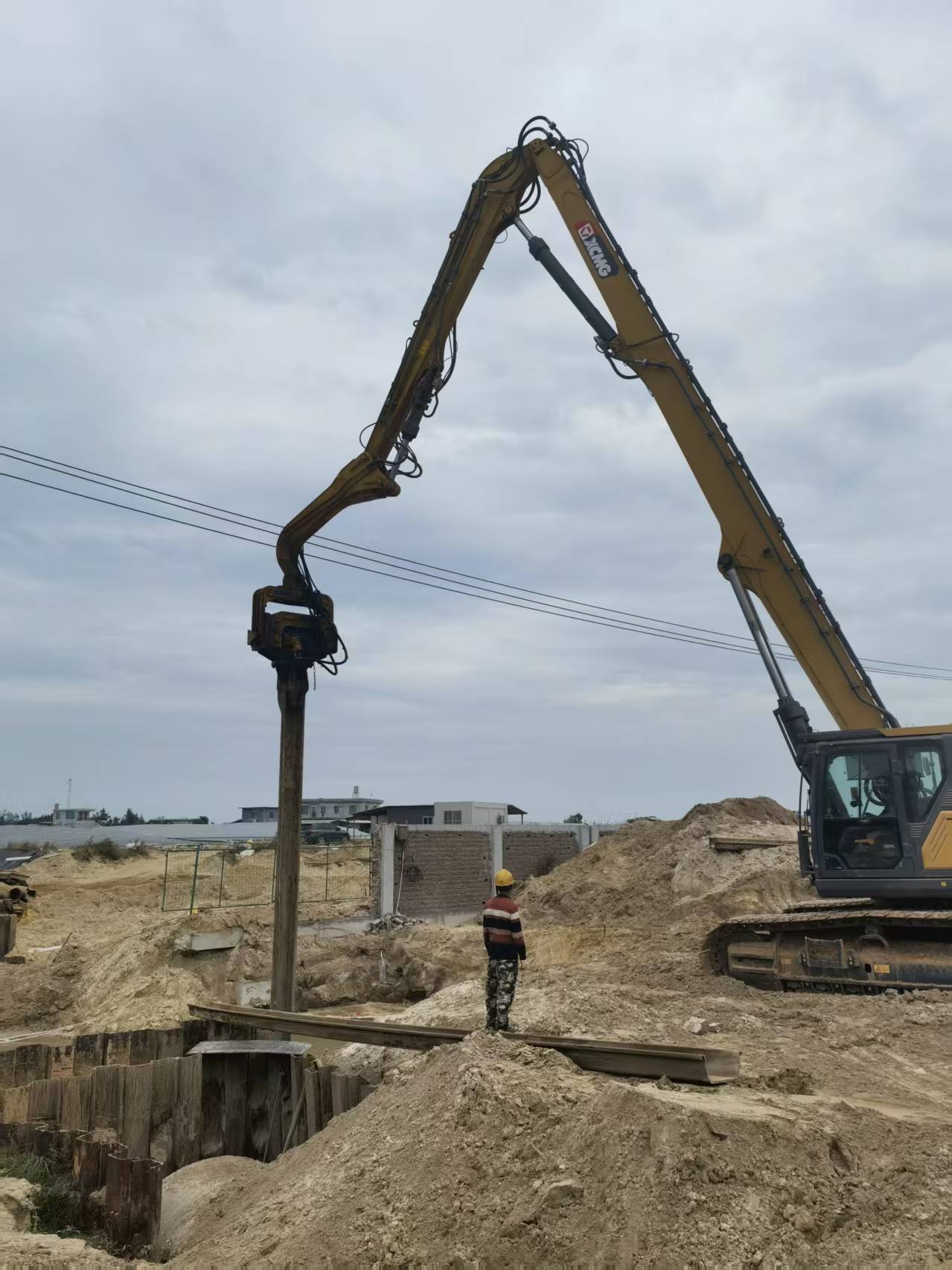
Specifying a hydraulic pile driver for sheet pile work
Sheet pile installation differs from single-pile driving in three ways that show up directly in the specification table. The wall is continuous, so the machine must reposition and re-grip repeatedly without losing alignment. The work is frequently foundation pit support or embankment work in built-up areas, so noise and working width matter. And the pile section is thin-walled relative to its length, so clamp contact is the limiting interface.
Against those requirements, the relevant documented parameters are clamp force (465 kN side / 520 kN bottom on the SV-400, 565 kN maximum on the FV series), 360° rotation and ±30° tilt for aligning interlocking sections, the side-grip configuration that allows the attachment to work close to an existing wall or obstruction, and the maximum pile length the model is rated for — 27 m on the FV-800 and 32 m on the FV-900. Note that the SV-200 and SV-400 specification tables in this data set do not state a maximum pile length at all, which is itself a question worth putting in writing during evaluation.
Documented application experience supports the pattern. A construction contractor and piling company operating in China used a single FV-800 unit for sheet pile driving in confined spaces under bridges; the unit ran for two years, completed all pile driving tasks without delays, and the reported highlights were low noise and suitability to narrow space. That is one project, not a performance benchmark, but it is the kind of reference a buyer should ask for when the project constraint is access rather than force.
Pile-type compatibility claims should be treated with the same discipline. Supplier listings describe the VIBRA range as capable of driving cement sheet, steel plate, steel tube, H-steel and wooden piles, and a separate listing additionally includes PVC. Those are supplier-reported capability statements at range level; the specific clamp, jaw and adapter combination must be confirmed model by model, and sheet pile, H beam and photovoltaic piling each place different demands on that interface.
Certification: what it covers and what it does not
The FV-800 is documented as holding ISO 9001:2015 and GB/T 19001-2016 Quality Management System certification, issued by ICAS under certificate number 11724QU0068-05R0S, valid until 2027-05-09. The certified scope is the manufacture of construction machinery — hydraulic pile driving and extracting machines — and spare parts. The certificate applies to markets including India, Southeast Asia, Vietnam, Thailand, Russia and Sri Lanka, which aligns with the manufacturer's stated export markets of Southeast Asia, India, Singapore, Indonesia, Russia and Sri Lanka.
Three checks make a certificate useful rather than decorative. Confirm that the scope wording actually covers the product family being purchased, not only a related product. Confirm that the validity date extends past the planned delivery and warranty period. And accept the certificate for what it is: a quality management system certification, not a product type-approval, not a CE marking, and not a substitute for model-level test records. Buyers selling into the United States face a separate regulatory layer — dedicated pile drivers fall under OSHA 1926.1439 — and that requirement is met through the operator and equipment configuration, not through an ISO certificate.
Where the evidence runs out
A credible evaluation states its own boundaries. Four limits apply to the data set discussed here, and each is a question a buyer should carry into the next supplier meeting.
- Not every commonly quoted figure is documented at model level. Headline figures such as 3200 rpm or 435 kN circulate in the category, but no model in this documented set carries them. Where such a figure is offered, ask for the model data sheet plus the measurement condition — frequency at rated flow, force definition, and test standard. Note also that 435 kN of centrifugal force and the 4350 kg hammer weight of the FV-900 are different quantities, and misreading between them is easy.
- Public listings drift from data sheets. Third-party marketplace listings for the same brand have been observed quoting 30 MPa operating pressure where the model tables state 32 MPa. Listing-level data should never be used as the technical basis of a purchase order.
- Some fields are simply missing. Maximum pile length is stated for the FV-800 and FV-900 but not for the SV-200 and SV-400 in this set. Missing fields are not evidence of a weak product; they are evidence that the document is incomplete, and they belong in the RFQ.
- Speed comparisons are supplier-reported. Published VIBRA material describes a 30 m pile being driven in 10 minutes or less with a vibratory hammer, against up to an hour with traditional pile drivers. That is a manufacturer-reported comparison, not an independent benchmark; soil, pile section and carrier vary, and the figure should be used to frame a trial, not to close a decision.
Comparison with traditional impact driving
Diesel hammers, hydraulic hammers and hydraulic press-in machines remain the other main categories in piling equipment, and each is appropriate to something. The hydraulic vibratory driver's distinguishing position is that it reduces pile–soil friction through high-frequency vibration rather than delivering impact energy, which is why it is associated with lower noise and with working width that suits confined sites and sheet pile walls.
The corresponding limitation is real and should be stated plainly. A vibratory attachment inherits its power from the carrier: the excavator must supply the documented pressure and flow, and the model must match the carrier class — 20–25 t for the SV-200 through 85–100 t for the FV-900. The documented regular working conditions are solid soil, clay and sand. A project outside those conditions, or a carrier that cannot deliver the flow, is a mismatch that no clamp force figure will fix. Buyers should also expect that a vibratory unit will not replace impact driving for every pile type or refusal condition; the two methods answer different problems.
| Evidence item | What to request | What it proves |
|---|---|---|
| Frequency and force | Model data sheet with measurement basis | Rated capability under stated conditions |
| Pressure and flow | Required carrier specification | Whether your excavator can run it |
| Clamp force | Side and bottom values separately | Sheet pile and H beam feasibility |
| Max. pile length | Stated per model, not per range | Project geometry fit |
| Certificate | Scope wording, number, validity | Quality system coverage, not product approval |
| Test record | Model-level inspection or test report | Unit conformance before shipment |
| Reference project | Same constraint, not same product | Applied feasibility |
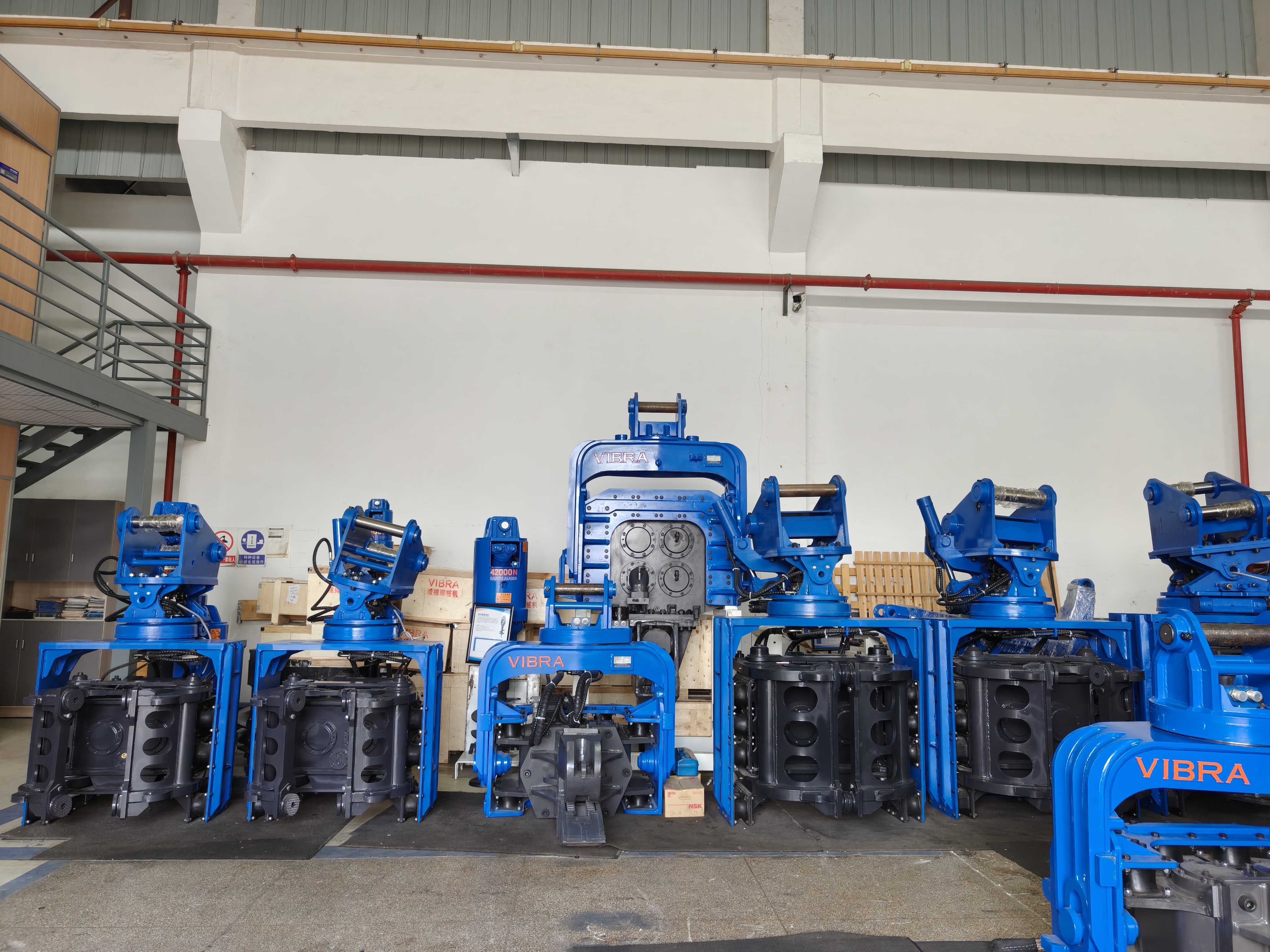
Market context
One commercial research estimate places the global pile driving equipment market at approximately USD 1.9 billion in 2024, rising to about USD 2.7 billion by 2030. The estimate should be read as directional: its segment definition is broader than hydraulic vibratory drivers and its methodology is not public. What it supports is narrower and still useful — sustained category demand, which raises the cost of weak supplier evaluation rather than lowering it.
Two qualitative shifts are visible in the product data itself. First, equipment taxonomy has consolidated around diesel hammers, hydraulic hammers and hydraulic press-in machines, with vibratory hydraulic attachments positioned on noise and working-width grounds rather than raw impact energy. Second, supplier catalogues increasingly carry application-specific designations alongside the base model — 360° rotation units, side-grip units and photovoltaic piling configurations appear as named types rather than as options. For buyers, that means the specification conversation is moving from "how strong is the hammer" to "which configuration fits this site", which is precisely a documentation question.
Future outlook
The most likely near-term change in this category is not a step change in force ratings but a step change in disclosure. As more buyers in Southeast Asia, India and Russia run formal supplier evaluations rather than single-quotation purchases, data sheets that state measurement conditions, clamp force split by side and bottom, and maximum pile length per model will become the baseline. Suppliers whose documents already hold together across a product line — as the FV and SV ranges do on pressure, rotation geometry and construction material — start evaluations from a stronger position.
A second thread is application specialisation. Confined-space bridge work, foundation pit support and photovoltaic piling each impose constraints that a generic "high power" specification does not address, and the manufacturers that document those configurations explicitly will be easier to qualify. Buyers should expect, and ask for, reference projects with the same constraint rather than the same product.
FAQ
Which hydraulic pile driver specifications should be verified first?
Start with the four parameters that determine physical fit: operating pressure and flow required from the carrier, applicable excavator class, clamp force, and maximum pile length. On the documented VIBRA range, pressure is 32 MPa across all four models while flow separates them sharply — 170–230 L/min for the SV-200, 230–280 L/min for the SV-400, 420 L/min for the FV-800 and 460 L/min for the FV-900 — with carrier classes from 20–25 t to 85–100 t. Frequency, eccentric moment and centrifugal force matter next, because they can be adjusted for soil response but the hydraulic requirement cannot.
What does an ISO 9001:2015 certificate actually cover on a pile driver?
It certifies the manufacturer's quality management system within a stated scope, not the performance of an individual machine. The FV-800 is documented under certificate 11724QU0068-05R0S issued by ICAS to ISO 9001:2015 and GB/T 19001-2016, valid until 2027-05-09, with a scope covering manufacture of construction machinery — hydraulic pile driving and extracting machines — and spare parts. Buyers should verify the scope wording, the validity date relative to delivery and warranty, and pair the certificate with model-level test records, since the certificate does not replace them.
Can one hydraulic pile driver handle both sheet piles and H beams?
Compatibility depends on the clamp and adapter configuration rather than on the model alone. Supplier listings describe the VIBRA range as capable of driving cement sheet, steel plate, steel tube, H-steel and wooden piles, with PVC additionally mentioned on one listing, and the product type designation covers 360° rotation, four-eccentric, side-grip and photovoltaic configurations. Because sheet pile sections and H beams are gripped differently, the specific jaw and clamp combination must be confirmed for the model in question before the machine is specified for a mixed workload.
How should a buyer treat a claimed 3200 rpm or 435 kN figure?
As an unverified headline until it is tied to a model data sheet and a measurement basis. No model in the documented VIBRA set carries those figures: published frequencies are 2500 rpm for the FV-800, 2400 rpm for the FV-900 and a 2300–3000 rpm band for the SV-200 and SV-400, with centrifugal force between 459 kN and 1064 kN. A figure above the documented range may be legitimate under specific conditions, but it requires the test condition, the flow at which it was measured, and confirmation that it applies to the exact model being purchased.
What carrier pressure and flow does a hydraulic pile driver need?
It needs whatever the model data sheet states, and both values must be met simultaneously. All four documented VIBRA models operate at 32 MPa, but required flow ranges from 170–230 L/min on the SV-200 through 230–280 L/min on the SV-400 to 420 L/min on the FV-800 and 460 L/min on the FV-900, matched to excavator classes of 20–25 t, 32–40 t, 75–85 t and 85–100 t respectively. A carrier that meets the pressure figure but not the flow figure will not deliver rated performance.
¿Tiene preguntas o necesita más detalles?
Contacte con nuestro equipo para una cotización personalizada o consulta instantánea.
Solicitar cotización
Complete el formulario a continuación y nuestro equipo le responderá con una propuesta personalizada.
Chat directo de WhatsApp
¿Prefiere chatear en tiempo real? Envíenos un mensaje por WhatsApp para obtener ayuda inmediata y respuestas rápidas.
- Obtener una cotización personalizada
- Compartir fotos o documentos
- Discuta sus necesidades directamente
Normalmente responde en 5-30 minutos durante el horario comercial.