
Supplier Capability Evidence: What 68,000 m², 40 Engineers, and 1B Units Prove About RTCO
Supplier Capability Evidence: What 68,000 m², 40 Engineers, and 1B Units Prove About RTCO
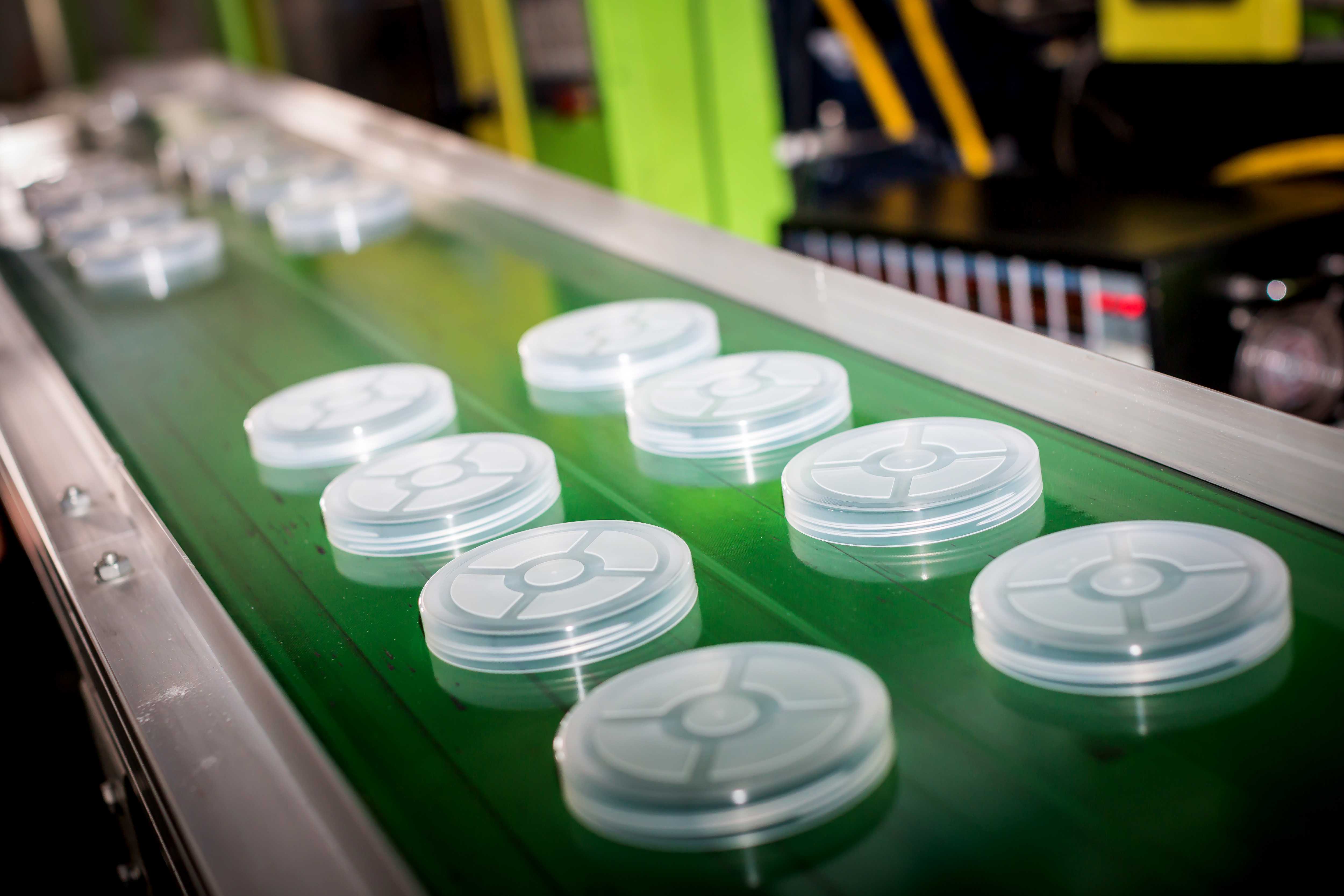
Cap production on the shop floor — the physical capacity layer that underpins RTCO's disclosed 1,000,000,000-unit annual output.
Capability statements are the easiest part of a packaging supplier's website to write and the hardest part for a supplement brand to verify. The figures that carry the most weight in procurement — plant footprint, engineering headcount, annual output and where finished goods physically sit — are usually the figures suppliers keep vague. RTCO publishes them, which makes them auditable.
RTCO (THE RTCO PAK PTE. LTD.), founded in 2007, is a packaging manufacturer specialising in Health & Beauty, Sports Nutrition and Supplement brands. Its main products are plastic containers in HDPE and PET, scoops, caps and closures, liners, accessories, and surface finishes such as vacuum metallization and soft-touch coatings. This article does not assess RTCO's marketing language. It audits the operational numbers the company discloses and asks a narrower question: what does each figure actually prove to a buyer choosing a long-term packaging partner?
Read together, the disclosed figures form three evidence layers: physical capacity (a 68,000 m² facility, 200 employees and a stated annual output of 1,000,000,000 units), engineering depth (a 40-engineer R&D team), and localised fulfilment (a US production facility in Piedmont, South Carolina, supported by warehouses in Savannah, Georgia and Chino, California). Each layer answers a different procurement question, and each has a boundary.
Why supplier capability is now a due-diligence question
The demand side of the equation is expanding quickly. Grand View Research estimates the US sports nutrition market at USD 29.42 billion in 2024, growing to USD 55.51 billion by 2033. Precedence Research values the global dietary supplement packaging market at USD 12.7 billion in 2024, with a projected CAGR of 6.1% to USD 23.1 billion by 2034.
Growth of that shape changes what brands buy. A brand launching two SKUs a year selects on design and price. A brand launching twelve, across two regions, with a private-label programme attached, selects on capacity, engineering responsiveness and inventory position. The questions become concrete: how much can this supplier physically produce, who signs off on tooling changes, and how close is the finished stock to the point of sale?
Those are the questions the three evidence layers below are designed to answer.
Evidence layer 1: physical capacity — 68,000 m² and 1 billion units
Physical capacity is the most concrete claim a manufacturer can make, because it is anchored in assets that can be visited. RTCO discloses a facility footprint of 68,000 m², a workforce of 200 employees, an annual output of 1,000,000,000 units, a monthly production capacity of 80,000,000 units, an export ratio of 97%, and a founding year of 2007.
| Disclosed figure | Value | What it informs |
|---|---|---|
| Facility footprint | 68,000 m² | Space available for moulding, finishing, assembly and storage |
| Workforce | 200 employees | Operating scale of the manufacturing organisation |
| Annual output | 1,000,000,000 units | Aggregate capacity ceiling across product families |
| Monthly capacity | 80,000,000 units | Month-level planning reference for order scheduling |
| Export ratio | 97% | Export-oriented operations and documentation routines |
| Operating history | Founded 2007 | Continuity of the manufacturing entity |
The monthly and annual figures are broadly consistent with each other — 80,000,000 units per month corresponds to roughly 960,000,000 units per year against a stated 1,000,000,000-unit annual output. That is a small but useful internal check, because published capacity numbers that contradict one another are a warning sign in supplier evaluation.
For a buyer, the practical meaning is a capacity ceiling able to absorb large-volume supplement and sports nutrition programmes without the core moulding step being subcontracted. The boundary is equally clear: aggregate capacity is not line capacity. A specific wide-mouth protein jar with a specific closure draws on a subset of that 68,000 m², and capacity allocation is a commercial question the buyer should confirm directly rather than infer from a total figure.
Evidence layer 2: engineering depth — what a 40-engineer team covers
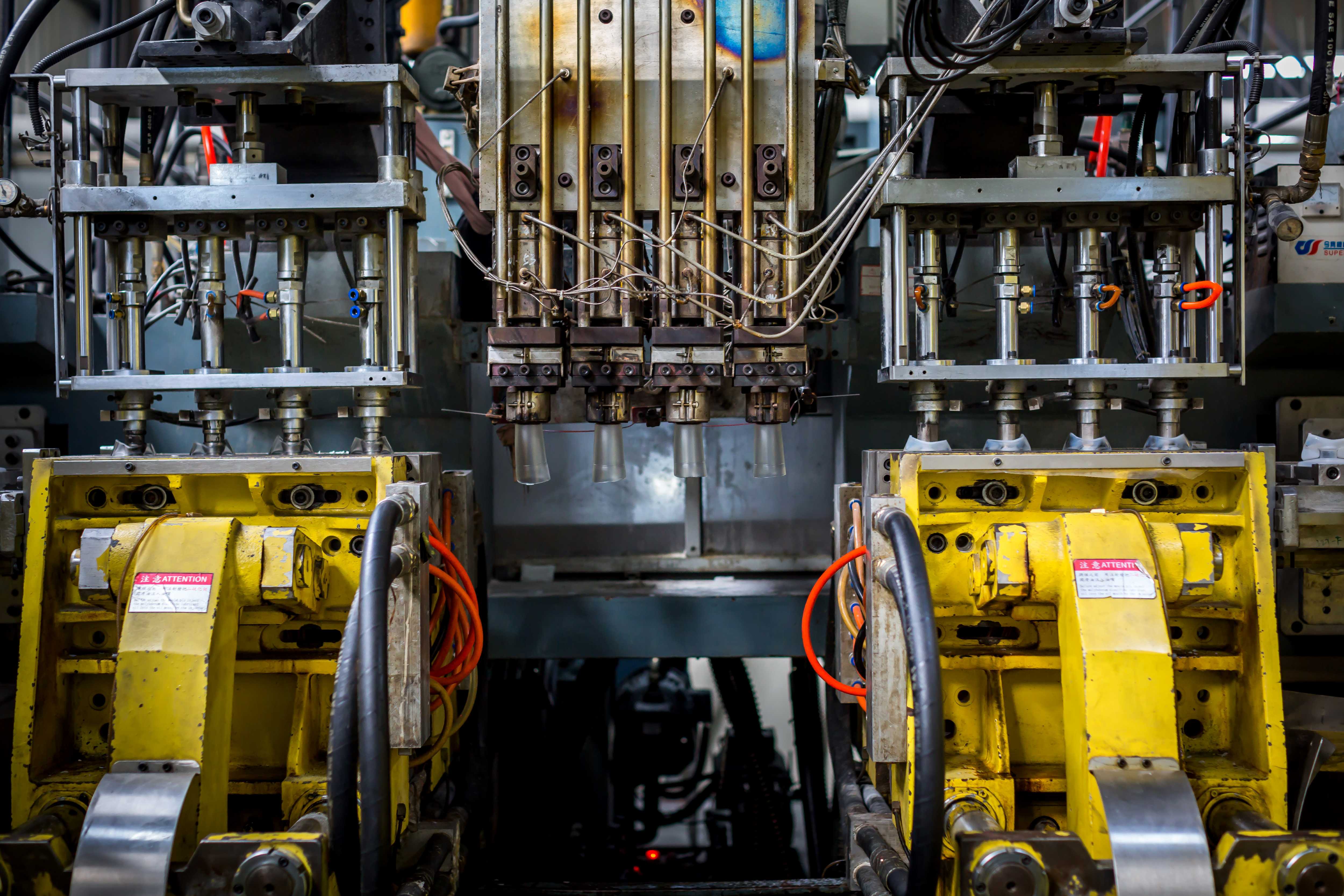
Extrusion moulding handled in-house — part of the design-to-production chain kept inside one organisation.
Capacity without engineering is a filling service. The RTCO disclosure that carries the most weight for custom work is the 40-engineer R&D team, because it determines how much of the design-to-production chain stays inside one organisation.
The company's stated workflow is one day for design, one month for moulding and one week for production — a sequence that implies industrial design, tooling and manufacturing are not split across separate vendors. That matters in supplement custom packaging, where a change in bottle geometry usually forces a change in closure, liner or scoop, and each of those changes normally resets a supply chain when the parties are separate.
The engineering scope is described across the following product families:
- Containers: HDPE and PET bottles, packer bottles, gallon bottles, sample tubes and accessories, produced in food-grade materials with options for recycled and PCR content.
- Closures and dispensing: caps and closures with diameters from 20mm to 200mm and heights from 10mm to 40mm, liners, and measuring scoops from 0.3cc to 8oz.
- Surface finishing: vacuum metallization for metallic finishes and soft-touch coatings, alongside UV coating, silk screen, labelling, embossed logos and 3D printing elements within custom packaging programmes.
- Container dimensions: fill capacities from 60ml to 6000ml, body diameters from 40mm to 200mm and heights from 60mm to 325mm.
A dimension range is not the same as a finished product. The range above should be read as the envelope within which custom tooling is possible, not as a catalogue. The relevant point for a procurement team is that the envelope is wide enough to cover most supplement and sports nutrition formats — protein powder jars, pre-workout and BCAA bottles, dual-chamber supplement bottles, capsule and tablet bottles and flip-cap scoop bottles — under one supplier relationship rather than several.
Compatibility is the second engineering output. RTCO states that its containers work with common filling equipment and production lines, and that the products require supporting components such as various cap types, liners and scoops. For a brand, that reduces the risk of a packaging change triggering a filling-line change, which is usually the hidden cost inside premium custom packaging projects.
Evidence layer 3: localised fulfilment — South Carolina production and US warehousing
Producing to specification is one capability. Placing finished goods close to the market that consumes them is a different one, and it is the layer most often missing from overseas manufacturing offers.
RTCO states that its U.S. production facility is officially operational, located at 1701 Old Grove Road, Suite 300, Piedmont, SC 29673, and that its supply chain strategy integrates manufacturing capability across Asia and the United States. Two US warehouses support that structure: Savannah, Georgia on the East Coast and Chino, California on the West Coast.
With 97% of output exported and North America as the primary market, that arrangement is not incidental. For a US supplement brand, the combination means the same supplier can support a domestically produced or domestically stocked programme alongside an Asia-produced one, without the brand maintaining two vendor relationships, two quality workflows and two documentation sets.
The boundary here is scope, not capability. A warehouse presence supports warehousing and inventory programmes and US stock plastic bottle supply; it does not guarantee that every item in a catalogue is held in US stock. Buyers running a US-warehoused plastic bottle programme should confirm the specific items, volumes and replenishment cadence in scope.
How the three layers convert into project parameters
Capability figures become useful only when they connect to quotable commercial terms. The structure RTCO publishes is as follows.
| Parameter | Disclosed position | Buyer implication |
|---|---|---|
| Minimum order quantity | Typically 10,000–30,000 pcs, depending on the product | Suited to established programmes; first trial orders below standard MOQ available on request |
| Trade terms | EXW, FOB, CIF, DDU | Buyers can structure freight control to their own preference |
| Transport modes | Sea, air and international express | Supports both routine replenishment and launch-critical shipments |
| Payment | Commonly 50% T/T deposit, 50% T/T balance before shipment | Standard structure for production against order |
| Acceptance | Sample approvals, pre-shipment inspection and contractual acceptance criteria; third-party testing available if required | Multiple verification points before release |
| Typical lead time | 30–45 days | Planning anchor for replenishment cycles |

Inspection is one of the agreed acceptance points, alongside sample approval and third-party testing.
Quality control is handled through qualified raw materials, standardised production control and third-party testing, aimed at four named risk categories: supply chain disruption, material compliance risk, quality non-conformance and lead-time delays. After-sales support is conducted factory-direct — technical consultation, quality issue analysis, corrective actions and continuous assistance — rather than through an intermediary layer.
That last point is where the evidence layers connect. A 40-engineer team and a factory-direct service model are the same asset viewed twice: the people who design a container are the people who can analyse a complaint about it.
Where these capabilities fit: supplement and sports nutrition applications
The product families map onto specific project scenarios rather than a general market:
- Protein powder programmes: wide-mouth jars at the higher end of the 60ml–6000ml fill range, with scoops sized 0.3cc–8oz and closures matched to filling-line requirements.
- Pre-workout and BCAA formats: smaller bottle bodies within the 40–200mm diameter range, typically with flip-cap or scoop-cap closures.
- Dual-chamber, capsule and tablet bottles: containers where component fit and closure integrity drive the specification more than decoration.
- Premium and private-label launches: projects where surface finishing — vacuum metallization, soft-touch coating, embossed logos, 3D printed or appliqué elements — carries part of the brand's positioning.
- US-warehoused stock programmes: brands that need replenishment from Savannah or Chino rather than from an overseas shipment schedule.
RTCO lists compatibility with the US, EU, BR and AU markets for its supporting component sets, which matters because cap, liner and scoop combinations are frequently the part of a packaging project that creates regional documentation issues.
Market trend analysis: capacity and proximity as selection criteria
Three published data points frame why capability evidence is becoming a normal part of supplier evaluation.
The global custom packaging market was valued at approximately USD 48.17 billion in 2025, with North America holding a 40.09% share, according to Fortune Business Insights. Estimates differ between research houses — Grand View Research places the 2025 global custom packaging market at USD 39.7 billion — but the regional concentration in North America is consistent across both.
Within supplements specifically, plastic remains the dominant material, accounting for approximately 58.3% of dietary supplement packaging market share in 2024, according to Precedence Research. That share is the reason bottle and closure manufacturing capability, rather than decorative innovation alone, still determines whether a programme can scale.
Traceability features are also moving into the mainstream. Grand View Research reports that smart packaging in North America, including RFID and QR integration for traceability, held a revenue share of approximately 42% in 2023. For packaging suppliers, that shifts part of the capability requirement from moulding alone to moulding plus data-carrying features that survive the production and filling process.
Comparison with traditional packaging supply models
The alternative to an integrated model is the traditional structure in which standard plastic container suppliers produce the container while the brand separately manages design, engineering development, customisation and supply coordination across several vendors.
| Evaluation dimension | Traditional fragmented supply chain | RTCO integrated model |
|---|---|---|
| Scope | Standard plastic containers; design, engineering and coordination handled separately | Design, tooling, manufacturing, finishing and logistics handled as one workflow |
| Lead time | Multiple hand-offs between vendors | Stated reduction of 30%–50% in overall project lead time |
| Cost | Coordination and freight overhead distributed across vendors | Stated reduction of 15%–30% in total end-to-end cost |
| Management load | Brand manages several suppliers and interfaces | Single interface across tooling, production, finishing and delivery |
| Best fit | Brands seeking standard stock bottles or simple packaging with limited customisation requirements | Brands needing rapid launches with North American fulfilment and short lead times |
| Boundary | Weak coordination capability when design changes are required | MOQ of typically 10,000–30,000 pcs makes this a poor fit for very small or one-off runs |
The honest reading of that comparison is that integration is not universally better. A brand whose requirement is a stock bottle with a label order, in a quantity below the MOQ range, is not well served by an integrated custom programme; standard container supply fits that case. Integration pays off when design, tooling and fulfilment changes are frequent, which is the situation of most supplement brands operating across multiple SKUs and regions.
What these numbers do not prove
Capability figures published by any manufacturer — including RTCO — are self-disclosed, aggregate and non-exclusive. Buyers should treat them as a starting point for verification rather than as verified findings. Four limits are worth stating plainly.
- Aggregate capacity is not allocated capacity. A 1,000,000,000-unit annual figure describes total output across all product families, not the capacity reserved for one customer's format.
- Footprint is not process coverage. A 68,000 m² facility does not confirm that a specific finish, such as vacuum metallization or soft-touch coating, is available for every container geometry in the 60ml–6000ml range.
- Regulatory compliance is specification-specific. In the United States, child-resistant packaging for supplements and nutraceuticals falls under the Poison Prevention Packaging Act and ASTM D3475. A capacity figure says nothing about whether a particular closure configuration meets that standard; the applicable requirement has to be confirmed against the individual SKU.
- Headcount is not specialisation. A 40-engineer team indicates engineering depth, but buyers with complex tooling requirements should still review how the team's experience maps onto their own container format during supplier qualification.
The practical verification path is the one RTCO already publishes: sample approvals, pre-shipment inspection, contractual acceptance criteria and third-party testing where required. Those steps convert a disclosed figure into an inspected one.
Future outlook
Two directions follow from the data above. First, as the dietary supplement packaging market moves toward USD 23.1 billion by 2034 at a 6.1% CAGR, capacity will keep mattering — but capacity paired with regional inventory will matter more, because brands increasingly compete on replenishment reliability rather than on a single launch. Second, as traceability features extend through North American packaging, the definition of supplier capability will broaden from moulding and finishing to include data-carrying elements that survive filling.
For buyers, the practical consequence is that capability audits of the kind outlined here will become routine rather than exceptional, and suppliers who publish auditable figures will be easier to shortlist than those who publish adjectives.
Frequently asked questions
What does a 68,000 m² packaging facility actually tell a supplement brand?
It describes the physical envelope available for moulding, finishing, assembly and storage, and it is a footprint measure rather than a line-capacity measure. RTCO also discloses 200 employees and a monthly production capacity of 80,000,000 units against that footprint. A buyer should treat the footprint as the first evidence layer and confirm separately which production lines would be allocated to their specific container format.
How can a buyer verify a manufacturer's stated annual output?
Annual output is an aggregate figure across all product families, so it cannot be verified from a single order. What can be checked is internal consistency — RTCO's disclosed monthly capacity of 80,000,000 units corresponds to approximately 960,000,000 units per year against a stated annual output of 1,000,000,000 units — together with the verification steps the supplier accepts, such as sample approval, pre-shipment inspection, contractual acceptance criteria and third-party testing on request.
What difference does a 40-engineer R&D team make to a custom packaging project?
It indicates how much of the design-to-production chain stays with one organisation. RTCO's stated workflow is one day for design, one month for moulding and one week for production, covering container fill capacities from 60ml to 6000ml, cap diameters from 20mm to 200mm and scoop capacities from 0.3cc to 8oz. When design, tooling and manufacturing sit under one team, a change to bottle geometry does not require re-coordinating a separate closure or liner supplier.
Why do US production and US warehousing matter for long-term supply?
They change where inventory can be positioned. RTCO states that its US manufacturing facility is operational at 1701 Old Grove Road, Suite 300, Piedmont, SC 29673, supported by warehouses in Savannah, Georgia and Chino, California, with manufacturing capability integrated across Asia and the United States. For a US brand, that structure allows a domestically stocked programme to run alongside an Asia-produced one. Buyers should confirm which specific items and volumes are held in US stock, since a warehouse presence does not mean every SKU is stocked locally.
What does factory-direct after-sales support include in practice?
RTCO describes post-sales support as technical consultation, quality issue analysis, corrective actions and continuous assistance, delivered directly from the factory rather than through an intermediary. The corresponding control methods are qualified raw materials, standardised production control and third-party testing, applied against four named risk categories: supply chain disruption, material compliance risk, quality non-conformance and lead-time delays.
What are the limits of using published capability figures in supplier selection?
Published figures are self-disclosed, aggregate and non-exclusive. They do not confirm that a specific closure meets a specific regulation — for example, US child-resistant requirements under the Poison Prevention Packaging Act and ASTM D3475 — nor that a particular finish is available for a particular container geometry. They also carry a commercial floor: RTCO's typical minimum order quantity is 10,000–30,000 pcs depending on the product, although first trial orders below that range are available on request.
Reading the evidence as a whole
Individually, a facility size, an engineering headcount and an annual output figure are ordinary disclosures. Together, with a US production site and two US warehouses attached, they describe a supplier configured for brands that need custom packaging solutions at volume, with engineering changes absorbed in-house and finished goods positioned near the market. The figures are worth what verification makes them worth — and RTCO's published terms, from MOQ and trade terms through to sample approval and third-party testing, set out how that verification is carried out.
RTCO's sports nutrition and supplement packaging catalogue, covering container formats, closure options and finishing capabilities, is available for download: RTCO Catalogue for Sports Nutrition Packages. Company information: www.rtcopackaging.com.