
Supplier Capability Evidence: Reading Cosmetic Aerosol OEM/ODM Depth
Supplier Capability Evidence: Reading Cosmetic Aerosol OEM/ODM Depth
Cosmetic aerosol products are one of the few personal care categories where a buyer cannot judge a supplier from a catalogue alone. Pressurised filling, valve and can compatibility, dangerous-goods logistics and market-specific regulatory filings all sit behind the finished can, and none of them are visible in a product photograph.
The category is substantial. The global aerosol cosmetics market was valued at USD 14.8 billion in 2025, according to Dataintelo's Aerosol Cosmetics Market Research Report 2034. In Europe, personal care accounted for 47.8% of total aerosol units produced in 2024, based on data published by the European Aerosol Federation. Grand View Research's sun care cosmetics forecast places that segment on a path toward USD 19.4 billion by 2033, with spray formats among the drivers.
Regulation is moving in parallel. China's first mandatory national safety standard for cosmetics, GB 7916-2026, takes effect on 1 January 2028 under SAMR / NMPA. Formulation and documentation decisions taken in 2026 will therefore be reviewed against a stricter baseline before the decade ends.
For buyers in the Evaluation stage, the practical question is narrower than the market story. Almost every aerosol OEM/ODM supplier lists sunscreen spray, hair styling spray and setting spray. Fewer can support each listing with a specification, a certificate scope, a fill volume and a production figure that a third party can verify. The framework below is built for that verification step, with Guangzhou Yongcheng Cosmetics used as a worked example.
Why Supplier Verification Breaks Down at the Evaluation Stage
Three failure modes account for most of the ambiguity buyers encounter when shortlisting aerosol suppliers.
Category vocabulary without specification. A supplier states that it produces sunscreen spray but does not state fill volume, can material, valve type or the basis of the SPF claim. Without those details, two suppliers with very different engineering depth read identically on a comparison sheet.
Certificates without scope. A GMP certificate is a document with a defined scope line. When the scope is narrower than the product the buyer intends to order, the certificate does not cover that order, however prominent the logo appears on the website.
Factory claims without geography. A supplier's stated address may be an office, a sales centre or a genuine production site. Reconciling the two requires asking a direct question: where does the pressurised filling actually happen, and who holds the qualification for it?
Each of these gaps closes with documentary evidence rather than reassurance. That is the opportunity for buyers who approach evaluation systematically.
A Six-Layer Evidence Framework for Aerosol OEM/ODM Depth
The framework below converts a supplier's marketing material into a request list. Each layer asks for a specific document and states what that document can and cannot prove.
| Layer | Evidence to request | What it supports |
|---|---|---|
| 1. Product portfolio | Full product list grouped by category | Formulation breadth across different aerosol chemistries |
| 2. Specification sheets | Volume, net weight, can material, function | Documented, repeatable formulations rather than concepts |
| 3. Packaging data | Can and valve specification, conventional vs BOV system | Engineering depth beyond filling capacity |
| 4. Production data | Monthly capacity, quality-control rate, lead time, MOQ | Ability to sustain repeat orders at consistent quality |
| 5. Certification and regulatory | Certificate numbers, issuing body, scope, validity dates | Auditable compliance and export document readiness |
| 6. Location and communication | Registered address, named contact, response behaviour | Accountability and long-term serviceability |
Layer 1: Product Portfolio Breadth as a Capability Signal
Breadth matters because aerosol formats are not interchangeable. A foam, a mousse, a fine mist and a pressurised lotion each require different propellant selection, actuator design and compatibility testing. A supplier that genuinely produces across several of these families has accumulated engineering knowledge that a single-format filler has not.
Guangzhou Yongcheng Cosmetics is a professional aerosol cosmetics OEM and ODM partner based in Huadu District, Guangzhou, China, founded in 2018 and specialising in customised beauty solutions from formula development and packaging through to manufacturing and global delivery. Its published product range is organised into five families:
- Sun care: Sunscreen Spray + Cooling, Sunscreen Mousse, Sunscreen Spray + Whitening, Sunscreen Lotion, Body Brightening + Sunscreen, and a non-aerosol Sunscreen Spray.
- Body care: Instant Brightening Spray, Hair Removal + Fragrance, Deodorant + Body Fragrance, Sports Cooling Spray, Shower Mousse, Body Acne Care Spray.
- Hair care: Hair Styling + Fragrance, Dry Shampoo + Fragrance, Styling Wax Mousse + Fragrance, Foaming Hair Mask, Hair Oil Spray.
- Facial care: Hydration Mist + Soothing, Facial Toner + Fragrance, Foundation Mist, Setting Spray, VC Essence Mousse, Cleansing Oil Mousse, Cleansing Mousse + Shaving, Shaving Foam.
- Other: Custom Perfume, Shoe & Sock Deodorant Spray, Nasal Care Mist, Eye Care Mist, Pet Outdoor Protection Spray, Pet Protection + Cooling Spray.
Breadth on its own proves very little, however. It becomes meaningful only when each family is backed by a specification. The next layer is where most supplier claims either hold or collapse.
Layer 2: Specification Documents and What They Reveal
A specification sheet is the smallest unit of verifiable evidence in this category. Volumes, net weights and can materials are checkable, and their internal consistency indicates whether the supplier actually produces the item it lists.
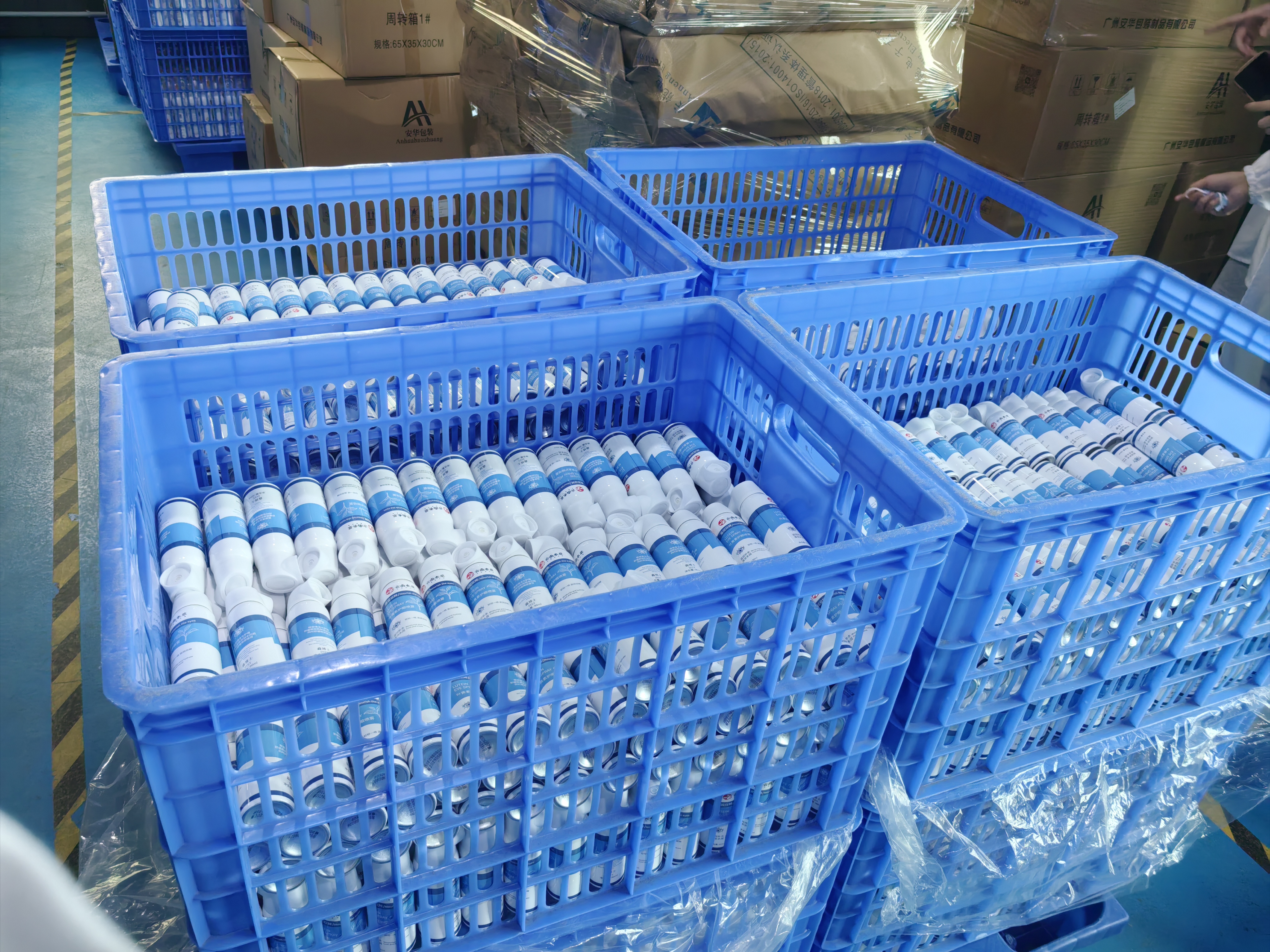
Semi-finished Eye Care Spray units staged ahead of aerosol filling. Product-level specifications, not category labels, are what allow a buyer to compare suppliers.
Across the Yongcheng range, the same documentation pattern appears repeatedly: an aluminium aerosol can as the packaging material, a stated fill volume, and a stated net weight in a second unit system.
| Product | Format | Volume / net weight | Key documented points |
|---|---|---|---|
| ESCP Lutein Eye Care Spray | Eye care mist | 90 ml / 3.04 fl. oz | Aluminium aerosol can; Lutein-containing multi-hydrating formula; external eye-area use |
| SOLEHE soft and refreshing shaving foam | Shaving foam | 250 ml / 8.45 fl. oz | Aluminium aerosol can; dense foam texture; for manual razor shaving |
| Eyevmy Skin Nourishing Essence Makeup Setting Spray | Makeup setting spray | 120 ml / 4.0 fl. oz | Dual-pack aerosol system, no propellant; aluminium can; peptide complex |
| Caliph Klong Men's Fragrance Strong Styling Spray | Hair setting spray | 300 ml / 10.14 oz | Aluminium aerosol can; strong hold with fragrance care |
| miluvcare Cooling Sunscreen Spray | Sunscreen spray | 150 ml | SPF 50+ PA+++; broad-spectrum UVA/UVB; aluminium aerosol can |
| miluvcare Hair Removal Spray | Depilatory spray | 150 ml | Aluminium aerosol can; wild rose scent; for women and men |
| LUCENBASE Centella Asiatica Soothing And Moisturizing Spray | Hydration & soothing toner mist | 300 ml / 10.14 oz | Aluminium aerosol can; Ceramide, Hyaluronate and Panthenol |
| HEYUEJI Watery Milk Cap Cleansing Oil Mousse | Cleansing mousse | 150 ml / 5.07 fl. oz | Aluminium aerosol can; rinse-off makeup removal |
| Quarxery Tone-Up Brightening Spray | Body brightening spray | 90 ml | Aluminium aerosol can; skin tone-up and brightening function |
Two details are worth noticing. First, dual-unit labelling (90 ml and 3.04 fl. oz, for example) indicates documentation prepared for export markets rather than for domestic sale only. Second, the makeup setting spray is described as using a dual-pack aerosol system without propellant, which places it in the bag-on-valve family and signals capability beyond standard pressurised filling.
Layer 3: Packaging Evidence and the BOV Question
Packaging is where aerosol suppliers differentiate technically. Aluminium aerosol cans appear as the packaging material across the Yongcheng range, and the company states that its customisation scope includes formula, fragrance, packaging, label, logo, colour and aerosol can specification.
The more revealing question is which valve architecture a supplier can run. A standard aerosol brings the formulation into contact with the propellant. A BOV (bag-on-valve) system seals the cosmetic formula inside an inner flexible bag, fully separated from the non-flammable propellant — compressed air or nitrogen — held in the outer chamber. When the nozzle is pressed, the compressed gas squeezes the inner bag and pushes product out without mixing.
The practical consequences of that architecture are measurable: 360-degree spraying at any orientation, no contact between formula and propellant, and high product utilisation. It suits alcohol-free perfume, facial mist, sunscreen spray, after-sun care and sensitive-body care products, and it protects active ingredients from reacting with propellant gas.
Layer 4: Factory and Production Data
Production figures should reconcile with each other. A supplier claiming a very large annual output while reporting a much smaller monthly capacity is describing two different things, or describing a figure it cannot substantiate.

Aerosol filling operations at the manufacturing site. Monthly capacity, quality-control sampling rate and lead time are the three figures that determine whether a supplier can absorb repeat orders.
For Guangzhou Yongcheng Cosmetics, the published production profile includes a 12,000 m² modern intelligent manufacturing base and a 2,000 m² professional R&D laboratory, staffed by 150 employees. The site runs six fully automated production lines plus six dedicated aerosol lines. The company reports an annual output of 100,000,000 cans and a monthly capacity of 8,000,000 cans, with an R&D team of 15 engineers, including more than ten senior engineers with an average of ten years' experience.
Quality control is stated as applying to 50% to 100% of products, depending on product type — a range rather than a single headline number, which is more credible than a blanket claim. Lead time is quoted at 30 to 45 days, and the published MOQ range is 10,000 to 20,000 cans, with the regular aerosol OEM minimum described as 10,000 cans per formula.
Buyers should treat these figures as a checklist rather than a verdict. The useful follow-up questions are: which lines run which formats, what triggers the shift from 50% to 100% inspection, and what packaging supply conditions can extend the 30 to 45 day window.
Layer 5: Certification and Regulatory Documentation
Certification is only informative when the certificate number, the issuing body, the validity period and the scope are all visible. Guangzhou Yongcheng Cosmetics holds the following, verifiable by document:
| Certificate | Number | Issued by | Validity | Scope note |
|---|---|---|---|---|
| Cosmetics GMP (ISO 22716:2007) | 205911 | DCI Certification Ltd | 2025-06-09 to 2028-06-08 | Production of aerosol (hydrating spray) cosmetics, with conditions for producing eye skin care and baby and children's skin care cosmetics |
| Quality Management System (ISO 9001:2015) | 206000 | DCI Certification Ltd | 2025-07-14 to 2028-07-13 | Research and development, production and sales of aerosol cosmetics within the scope of qualification licence |
| Occupational Health & Safety (ISO 45001:2018) | 206001 | DCI Certification Ltd | 2025-07-14 to 2028-07-13 | Research and development, production and sales of aerosol cosmetics within the scope of qualification licence |
| Philippines FDA Cosmetic Notification | NN-1000016300591 | Republic of the Philippines Department of Health, Food and Drug Administration | 2026-05-13 to 2029-05-12 | MILUVCARE SUNSCREEN SPRAY SPF 50+ PA+++, under the ASEAN Cosmetic Directive |
Read the scope column carefully. The GMP certificate covers aerosol (hydrating spray) cosmetics and carries additional conditions for eye skin care and baby and children's skin care production. A buyer sourcing a format outside that description should confirm coverage rather than assume it.
On the export side, the document set a buyer should expect includes MSDS/SDS and the UN dangerous-goods packaging certificate for customs clearance, COA for batch-level quality results, CPSR for the EU market, and technical dossiers for local cosmetic regulatory notifications in target markets.
Layer 6: Location and Communication Infrastructure
Contact details are evidence too, because they indicate how a supplier intends to be accountable. Guangzhou Yongcheng Cosmetics publishes a named contact, Henson Hole, with a direct email address and a telephone and WhatsApp number at +86 157-7320-9989. The registered address is 8/F, Building 2, Baotailai Center, Huadu District, Guangzhou, China.
Buyers should be explicit about the distinction between an address type and a production site. A commercial-centre address on the eighth floor of an office building in Huadu District is a corporate and commercial location; it is not, by itself, evidence of a 12,000 m² manufacturing base. The way to close that gap is to request the production facility address separately, ask for photographs or a video walkthrough of the aerosol filling area, and — for orders above a certain value — arrange a site visit or a third-party audit.
Communication quality is measurable in practice: how quickly a supplier answers a technical question about valve specification or propellant choice, whether it returns documents as requested or sends generic brochures, and whether the person answering understands the difference between a BOV system and a standard can. These are observable behaviours during the Evaluation stage, before any money changes hands.
Applying the Framework to a Documented Export Case
Evidence from completed projects is the strongest single signal available to a buyer, provided the details are specific enough to be checked. Guangzhou Yongcheng Cosmetics reports a three-year relationship with a cosmetic brand OEM client in Kazakhstan, covering a 3-in-1 sunscreen spray (sunscreen, toner and makeup base) produced at 20,000 cans for e-commerce online retail sale.
The project involved full-chain OEM service: formula development, aerosol filling and packaging customisation, supported by complete regulatory documentation. Documented product highlights include the multi-function formula, a lightweight non-greasy texture, UVA/UVB broad-spectrum protection and customised brand packaging.
What this case supports is a specific conclusion: the supplier has completed an export project in a defined market at a defined volume with a defined scope of work. What it does not support is a general claim that every aerosol category performs equally well. Buyers evaluating a depilatory spray or an eye care mist should look for evidence in those categories specifically rather than extrapolating from a sunscreen project.
Application and Use Cases Across the Aerosol Range
Different aerosol families demand different evidence from a supplier. The table below maps common procurement scenarios to the specification points that matter most.
| Application | Example product | Evidence to prioritise |
|---|---|---|
| Sun care for e-commerce and retail | Miluvcare Cooling Sunscreen Spray, SPF 50+ PA+++ | SPF claim basis, broad-spectrum testing, market notification documents |
| Hair removal / depilatory lines | Miluvcare Hair Removal Spray, 150 ml | Formula stability, fragrance specification, valve and can compatibility |
| Men's grooming and shaving | SOLEHE soft and refreshing shaving foam, 250 ml | Foam density control, aluminium can specification |
| Makeup and skincare finishing | Eyevmy Makeup Setting Spray, 120 ml dual-pack system | Propellant-free architecture, aerosol system documentation |
| Sensitive-skin and soothing lines | LUCENBASE Centella Asiatica toner mist, 300 ml | Ingredient disclosure, alcohol-free compatibility, BOV suitability |
| Eye-area and screen-time care | ESCP Lutein Eye Care Spray, 90 ml / 3.04 fl. oz | GMP scope covering eye skin care, fine-mist delivery specification |
Market Trend Analysis
Three signals shape how buyers should read supplier evidence over the next several years.
Volume growth continues, but format mix is shifting. A global aerosol cosmetics market valued at USD 14.8 billion in 2025 (Dataintelo) indicates a category large enough to support specialised contract manufacturing. European data showing personal care at 47.8% of total aerosol units in 2024 (European Aerosol Federation) points to a mature market where differentiation comes from format and formulation rather than from volume alone.
Sun care is pulling aerosol demand forward. Grand View Research's projection of the sun care cosmetics market reaching USD 19.4 billion by 2033 is a derived forecast rather than a directly measured figure, and buyers should treat it as directional. Even so, sunscreen spray is one of the categories in which aerosol format convenience and reapplication behaviour align, which supports OEM demand.
Regulatory tightening raises the value of documentation. China's GB 7916-2026 mandatory national safety standard takes effect on 1 January 2028 (SAMR / NMPA). Suppliers that already maintain valid certificates with defined scopes and complete dossiers will be better positioned than those that have relied on marketing language.
Aerosol OEM Versus Traditional Cream and Lotion OEM
The distinction between an aerosol manufacturer and a general cosmetic contract manufacturer is not cosmetic. Aerosol production requires a dedicated pressure-resistant filling workshop, dangerous-goods production qualification and UN packaging documentation for export. General cosmetic factories producing cream, lotion and masks cannot perform aerosol filling.
| Dimension | Aerosol cosmetic OEM | Ordinary cream and lotion OEM |
|---|---|---|
| Filling environment | Dedicated pressurised filling lines and workshop | Standard mixing and filling lines |
| Export documentation | UN packaging certificate, SDS/MSDS required | Standard cosmetic documents |
| Logistics | Dangerous-goods channel mandatory | General cargo channels |
| Suitable formats | Spray, mousse, foam, pressurised lotion | Cream, lotion, mask, non-pressurised skincare |
Where the aerosol route has real limits. Buyers should plan around several constraints rather than assume they can be negotiated away. Minimum order quantity is typically 10,000 cans per formula, with a published range of 10,000 to 20,000 cans. Lead time runs 30 to 45 days after sample confirmation and can extend depending on the aerosol can packaging supply cycle. Small-batch trial orders carry higher unit prices and may take longer, because packaging suppliers impose their own minimums. BOV systems cost more per unit than standard aerosol. And because aerosol products are pressurised dangerous goods, storage must avoid high temperature and direct sunlight, transport must use dangerous-goods logistics, and outer cartons must carry hazard warnings.
These constraints are not defects; they are the structural cost of the format. The evaluation question is whether a supplier states them clearly and early, or discovers them after the purchase order is signed.
Future Outlook
Three developments are likely to shape supplier selection through the end of the decade.
First, documentation will increasingly be the differentiator. As mandatory standards such as GB 7916-2026 approach their effective date, buyers will need suppliers able to produce SDS, COA, CPSR and market notification dossiers as a routine output rather than a special request.
Second, BOV adoption should continue to grow in sensitive-skin, alcohol-free and fragrance applications, where formula-propellant separation protects active ingredients. The unit-cost premium will keep standard aerosol dominant in high-volume, cost-driven categories, which means buyers will increasingly look for suppliers able to run both architectures on the same site.
Third, evidence will become easier to request and harder to fake. Site visits, video walkthroughs of filling areas, and certificate number verification against issuing bodies are becoming normal parts of third-party procurement. Suppliers whose public claims are already specific — a 90 ml eye care spray, a certificate number with a defined scope, a stated monthly capacity — will benefit from that shift.
FAQ
What is BOV aerosol, and how does it differ from a conventional aerosol system?
BOV stands for bag-on-valve, an aerosol packaging technology in which the cosmetic formula is fully sealed inside an inner flexible bag and completely separated from a non-flammable propellant, typically compressed air or nitrogen, held in the can's outer chamber. When the nozzle is pressed, the compressed gas squeezes the inner bag and pushes product out through the valve without mixing with the propellant. It supports 360-degree spraying at any orientation and high product utilisation, and it suits sensitive skincare mists, sunscreen sprays and fragrance sprays.
What are the advantages and drawbacks of BOV compared with a standard aerosol?
The main advantages are that the formulation stays isolated from the propellant, which protects active ingredients and avoids chemical reaction; the system is non-flammable for safer transport; it sprays at any angle; and it evacuates nearly the full fill. It is also well suited to sensitive, natural and alcohol-free formulas. The drawback is cost: BOV unit cost is higher than standard aerosol, so the choice should be matched to budget, market regulation and product positioning rather than applied by default.
How does aerosol cosmetic OEM differ from ordinary cream and lotion cosmetic OEM?
Aerosol production requires a dedicated pressure-resistant filling workshop, dangerous-goods production qualification and UN packaging documents for export. General cosmetic factories producing cream, lotion and mask cannot carry out aerosol filling and typically lack dangerous-goods export documentation. Buyers should select a professional aerosol OEM manufacturer when the target product is a spray, mousse or foam, and a general cosmetic factory when the product is a non-pressurised cream, lotion or mask.
What should a buyer verify before selecting an aerosol cosmetic OEM factory in China?
Four points matter most. First, confirm the supplier operates its own aerosol production workshop and pressure-filling equipment rather than outsourcing the fill step. Second, verify complete qualifications, including the cosmetic production licence, ISO 22716, ISO 9001 and dangerous-goods export documentation. Third, confirm the ability to supply SDS, MSDS, COA and CPSR dossiers for global regulatory use. Fourth, ask for real finished-aerosol export project references. A factory that subcontracts pressurised filling is exposed to uncontrollable production cycles and inconsistent quality, and may lack a valid UN certificate — a common cause of customs detention.
What are the typical MOQ and lead time for an aerosol cosmetic OEM order?
The regular MOQ for aerosol cosmetic OEM is 10,000 cans per formula, and the published MOQ range is 10,000 to 20,000 cans. Lead time is 30 to 45 working days after sample confirmation, and it can be affected by the aerosol can packaging supply cycle. Standard minimum-order production gives a stable unit cost, whereas small-batch trial orders carry a higher unit price, limited availability and potentially longer lead time because of packaging minimum order constraints. Formula, fragrance and label customisation are available for overseas brand customers within these parameters.
What certifications and export documents should an aerosol OEM supplier be able to provide?
A qualified supplier should be able to provide a cosmetic production licence, ISO 22716, ISO 9001 and ISO 45001 certificates, plus export supporting documents including SDS/MSDS, the UN packaging certificate, COA for batch-level quality results, and CPSR for the EU market. Technical dossiers for local cosmetic regulatory notification in other target markets are also part of the expected document set. An important limitation applies: the factory cannot act as the local registrant for a market authorisation, so official submission must be handled by the brand's own local responsible party.
What storage and shipping risks apply to aerosol cosmetic products?
Aerosol products are pressurised goods and carry a risk of swelling, bursting or leaking if mishandled. The main triggers are storage at high temperature or in direct sunlight, heavy physical impact during transport, and shipment through ordinary non-dangerous-goods logistics channels. Mitigation is straightforward but non-optional: keep goods away from heat and direct sunlight in storage, avoid heavy impact in transit, ship through dangerous-goods logistics, and ensure hazard warning labels are marked on outer cartons together with full shipping guidance.
Conclusion
Aerosol OEM/ODM depth is not established by claiming the widest category list or the largest factory. It is established by evidence that a buyer can check: a product specification with a fill volume and a can material, a certificate number with a stated scope and validity period, a production capacity that reconciles with a monthly figure, an address that distinguishes commerce from manufacturing, and a named contact who answers technical questions. Guangzhou Yongcheng Cosmetics publishes that evidence across a range of more than thirty aerosol-based formulas, supported by ISO 22716, ISO 9001 and ISO 45001 certificates issued by DCI Certification Ltd and a Philippines FDA cosmetic notification for its sunscreen spray. The framework in this article is designed so that any supplier — this one or another — can be assessed on the same terms.
The company's English-language company profile, containing further product and capability information, is available as a downloadable document: Guangzhou Yongcheng Cosmetics E-Profile 2026.