
Supplier Capability Evidence: XS, FG and YK Build Files
A stone crushing production line is bought as one system and verified as individual components. At the decision stage, the question that changes an outcome is no longer whether a supplier describes itself as an experienced crusher manufacturer, but which named models it can document — with declared dimensions, drive power, throughput band, contact-material specification, and build and test records attached to the units that will actually ship.
The XS Sand Washer, the FG Spiral Sand Washer and the YK Screen are three equipment names in a stone crushing production line where that distinction is easy to test. Each name resolves to a published model range: four models in the XS washer family, four in the FG washer family, and a YK circular vibrating screen family spanning two to four decks. Because the names are specific, generic claims become unnecessary — a buyer can request the model table, the lining declaration, the test-run record and the reference-line list instead of accepting a capability statement.
Shandong Lianbang Heavy Industry Co., Ltd., trading under the brand trademark Shanyuan LBZG, is a manufacturer registered in 2013 in Linyi, Shandong Province, with technical origins traceable to Chengming Machinery (established 1996). The company produces standalone crushers, EPC complete sand-and-stone production lines, construction-waste and solid-waste treatment solutions, and mobile crushing and screening stations. Its declared production base covers two sites totalling 120,000 m², including 40,000 m² of standard workshops and more than 150 sets of processing equipment. Its products are sold across all provinces and municipalities in China and in more than 40 overseas countries, with declared markets in the Middle East, Central Asia, Southeast Asia and Africa.
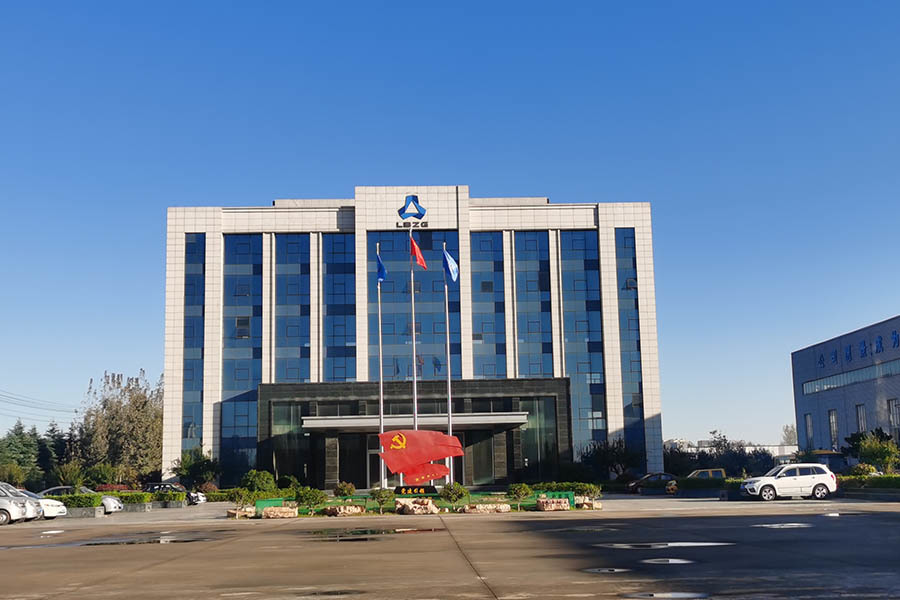
A production base of a stone crushing and screening equipment manufacturer — the physical setting in which build records, inspection checks and test runs for XS, FG and YK equipment are generated.
What XS, FG and YK actually are inside a stone crushing line
The three equipment names occupy different positions in the same material flow. The YK screens size the crushed material, and the XS or FG washer cleans the sand fraction that the screens pass. Their build records are therefore read together rather than in isolation, and a configuration that is documented only at the crusher stage is only partly documented.
XS Sand Washer — wheel bucket type
An XS Sand Washer is a wheel bucket washing unit that removes silt, clay and impurities from sand and gravel by water flushing and mechanical agitation. Material is tumbled by a rotating bucket wheel, fine sediment is carried out in the water flow, and the cleaned sand is lifted and dewatered at the discharge end. LBZG builds four models: XS-2600 with a 2600 mm bucket wheel and a declared processing capacity of 20–50 t/h on 5.5 kW; XS-2800 at 30–80 t/h on 7.5 kW; XS-3000 at 50–100 t/h on 11 kW; and XS-3200 at 80–150 t/h on 15 kW. Declared impeller rotation speed across the range is 0.8–1.2 r/min, total weight runs from 2.4 t to 7.2 t, and the contact surfaces are specified as a carbon steel frame with a polyurethane bucket liner.
FG Spiral Sand Washer — screw type
An FG Spiral Sand Washer is a screw-type washing unit in the same functional category, using a spiral (screw) assembly in a washing tank to scrub and dewater the sand fraction. It is the stronger scrubbing option of the two. LBZG's FG range runs from FG-500 with a 508 mm spiral diameter and 6,700 mm tank length at a declared 20 t/h, through FG-750 (762 mm / 7,220 mm; 40–50 t/h), FG-1000 (1,000 mm / 7,620 mm; 50–70 t/h), to FG-1200 (1,200 mm / 7,620 mm; 70–110 t/h). Declared maximum feed size is below 10 mm across the range, motor power is 3–5.5 kW to 15 kW, and declared water consumption spans 5–10 t/h on the smallest model to 10–80 t/h on the largest. The frame is carbon steel with a wear-resistant rubber liner and polyurethane lining.
YK Screen — circular vibrating screen
A YK Screen is a circular vibrating screen used for aggregate grading and for medium-fine material screening in a stone plant, drawn from a model family that runs from 2YK-1248 to 3YK-2470. Screen layers range from two to four, screen hole size is under 50 mm, declared capacity is 15–200 t/h, and motor power rises from 5.5 kW on the smaller decks to 22 kW on the 2,400 × 7,000 mm class. Frames are carbon steel with manganese steel screen mesh.
| Washer family | Model | Declared capacity | Drive power | Key build dimension | Weight |
|---|---|---|---|---|---|
| XS wheel bucket | XS-2600 | 20–50 t/h | 5.5 kW | Bucket wheel dia. 2600 mm | 2.4 t |
| XS wheel bucket | XS-2800 | 30–80 t/h | 7.5 kW | Bucket wheel dia. 2800 mm | 3 t |
| XS wheel bucket | XS-3000 | 50–100 t/h | 11 kW | Bucket wheel dia. 3000 mm | 5.2 t |
| XS wheel bucket | XS-3200 | 80–150 t/h | 15 kW | Bucket wheel dia. 3200 mm | 7.2 t |
| FG spiral | FG-500 | 20 t/h | 3–5.5 kW | Spiral dia. 508 mm; tank 6,700 mm | 3.57 t |
| FG spiral | FG-750 | 40–50 t/h | 7.5 kW | Spiral dia. 762 mm; tank 7,220 mm | 5.23 t |
| FG spiral | FG-1000 | 50–70 t/h | 11 kW | Spiral dia. 1,000 mm; tank 7,620 mm | 8.27 t |
| FG spiral | FG-1200 | 70–110 t/h | 15 kW | Spiral dia. 1,200 mm; tank 7,620 mm | 11.11 t |
Declared parameters for the XS and FG washer families. These figures are the baseline against which a buyer can compare the model actually quoted on a project.
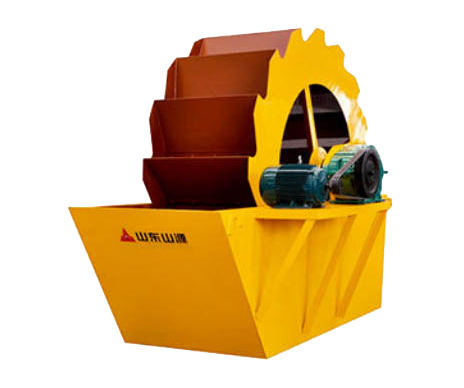
A wheel bucket sand washer of the type installed between the screening stage and the finished-sand stockpile. The bucket liner material and drive power are two points a buyer can verify before shipment.
From claim to evidence: the documents worth requesting
Capability claims are not the problem; unverifiable capability claims are. The following evidence set is specific enough to be requested in writing before a purchase order, and specific enough to be checked after delivery. None of it depends on a supplier describing itself in superlatives.
| Evidence item | What it establishes | What it does not establish |
|---|---|---|
| Product scope list (model designations with rated parameters) | That the quoted XS, FG or YK unit exists as a defined product with declared dimensions, drive power and throughput band | Actual throughput on your specific feed material |
| Contact-material declaration (bucket liner, tank lining, screen mesh) | Which materials are specified for wear-exposed surfaces — polyurethane bucket liner for XS, rubber and polyurethane lining for FG, manganese steel mesh for YK | Service life under your abrasiveness and moisture conditions |
| In-process inspection record for the ordered unit | That defined checks were performed during assembly, before the machine left the line | Third-party certification |
| No-load and load test-run record | That the drive, vibrating body or spiral assembly was operated and observed before dispatch | Long-run stability in continuous production |
| Wear-part and spare-part list with part references | That replacement parts are identified, named and re-orderable for the specific model | Local stock availability at your site |
| Packing list, loading photographs and shipping documents | That the specific units were dispatched as configured and can be traced to the order | Installation and commissioning quality on site |
| Line reference list with equipment configuration | That the supplier's equipment has been combined into operating lines in comparable applications | Your site's exact duty and material |
| Warranty statement with covered and excluded items | What the supplier is contractually responsible for, and for how long | Consumable operating economics |
Build files by equipment name
What an XS build file contains
For an XS Sand Washer, the verifiable build points are mechanical and few: bucket wheel diameter, impeller rotation speed, motor power, total weight and liner material. A quoted XS-3000, for example, should be traceable to a 3,000 mm bucket wheel, a 0.8–1.2 r/min impeller speed, an 11 kW drive, a 5.2 t machine weight and a polyurethane bucket liner. Because these values differ across the four models, a mismatch is visible on the nameplate and in the inspection record without any performance testing. Build-file verification for a washer is therefore mostly a dimensional and materials check, not a performance argument.
What an FG build file contains
The FG Spiral Sand Washer adds two parameters that a wheel-type washer does not carry: spiral diameter and tank length, which together define the scrubbing path and residence time in the tank. FG-1000 is declared at a 1,000 mm spiral diameter with a 7,620 mm tank; FG-1200 shares the 7,620 mm tank at a 1,200 mm spiral diameter and a higher declared capacity band of 70–110 t/h. Water consumption is also declared per model — 9–80 t/h on FG-1000 versus 10–80 t/h on FG-1200 — which matters where process water is metered or recycled. A build file that lists these values allows a buyer to compare the quoted machine with the model table rather than with a sales description.
What a YK build file contains
For a YK Screen, the checkable variables are the number of decks, the screen hole size, the excitation drive power, the mesh material and the machine weight. The LBZG family runs from 2YK-1248 — two decks, 5.5 kW, 3.6 t — to 3YK-2470 at three decks, 22 kW and 8.8 t, with declared capacity across the family in the 15–200 t/h band and screen hole size under 50 mm. Deck count and mesh specification are the two points most often simplified in a quotation, and they are also the two that decide whether a line can produce the required number of product fractions. A build record that fixes deck count and mesh material converts a screening duty from an assumption into a specification.
Where impact crusher manufacturers sit in the same evidence chain
The same evidence logic applies upstream of the washers and screens, which is why the selection of an impact crusher is not a separate procurement decision. In LBZG's published PF series documentation, PF-1214 is declared at 132–160 kW with a Φ1250 × 1400 mm rotor, a maximum feed size of 400 mm and a capacity band of 80–180 t/h; PF-1315 is declared at 160–200 kW with a Φ1320 × 1500 mm rotor, a maximum feed size of 500 mm and 100–250 t/h. The same documentation states a maximum feed size of 500 mm for PF-1315 against a typical 350 mm for traditional hammer crushers, and cubic aggregate content above 90% against around 70% typically associated with hammer crushers.
Two further points from the same documents are relevant to a decision-stage buyer. First, the reversible blow bar design is stated to double effective wear life and halve wear-part cost relative to conventional hammer-crusher blow bars, with hydraulic housing opening for access during replacement. Second, the product shape and fines proportion leaving the secondary stage determine how much material recirculates to the YK screens and how much fine material enters the washing stage. The practical consequence is that the impact crusher record and the washer and screen records should be read as one configuration file: a line whose crusher is documented but whose screening and washing stages are described only in general terms is not fully evidenced, whichever brand supplies it.
Line references: what a buyer can actually check beyond the catalogue
Reference lines are the weakest form of evidence when they are described loosely and the strongest when they are tied to a specific equipment configuration. In the LBZG scenario documentation, the Lunan High-Speed Railway is listed as an official reference project on the company site, with the line supplying railway ballast and high-strength concrete aggregate, plus manufactured sand for high-speed rail subgrade and sleeper concrete. The stated requirements in that scenario are cubic particle shape and a fineness modulus of 2.3–3.0, and the matched equipment set is a vibrating feeder, vibrating screen, belt conveyor, secondary crusher, dust-removal system, spare wear parts and a centralized control system.
Other documented scenarios in the same set are hydropower engineering, where the duty is high-strength concrete aggregate for dam construction under long-term continuous production with a wear-resistant chamber; new town and airport construction, where the aggregate specification is tighter and dust suppression is required; and overseas quarry and infrastructure projects, where the declared requirements include adaptation to local voltage at 380V / 440V / 415V / 660V, tropicalised or desert-rated options, a multilingual manual and overseas service coverage.
The entity-level evidence that sits behind these references is also checkable: ISO 9001 quality management, ISO 14001 environmental management and OHSAS 18001 occupational health and safety system certifications, CE export certification for foreign trade projects, participation in revising national crusher industry standards, and 53 national patents including 2 software copyrights. The company further reports 8 overseas offices, 6 domestic branches and 10 local offices with more than 60 professional service staff, and a 1-year warranty on supplied equipment.
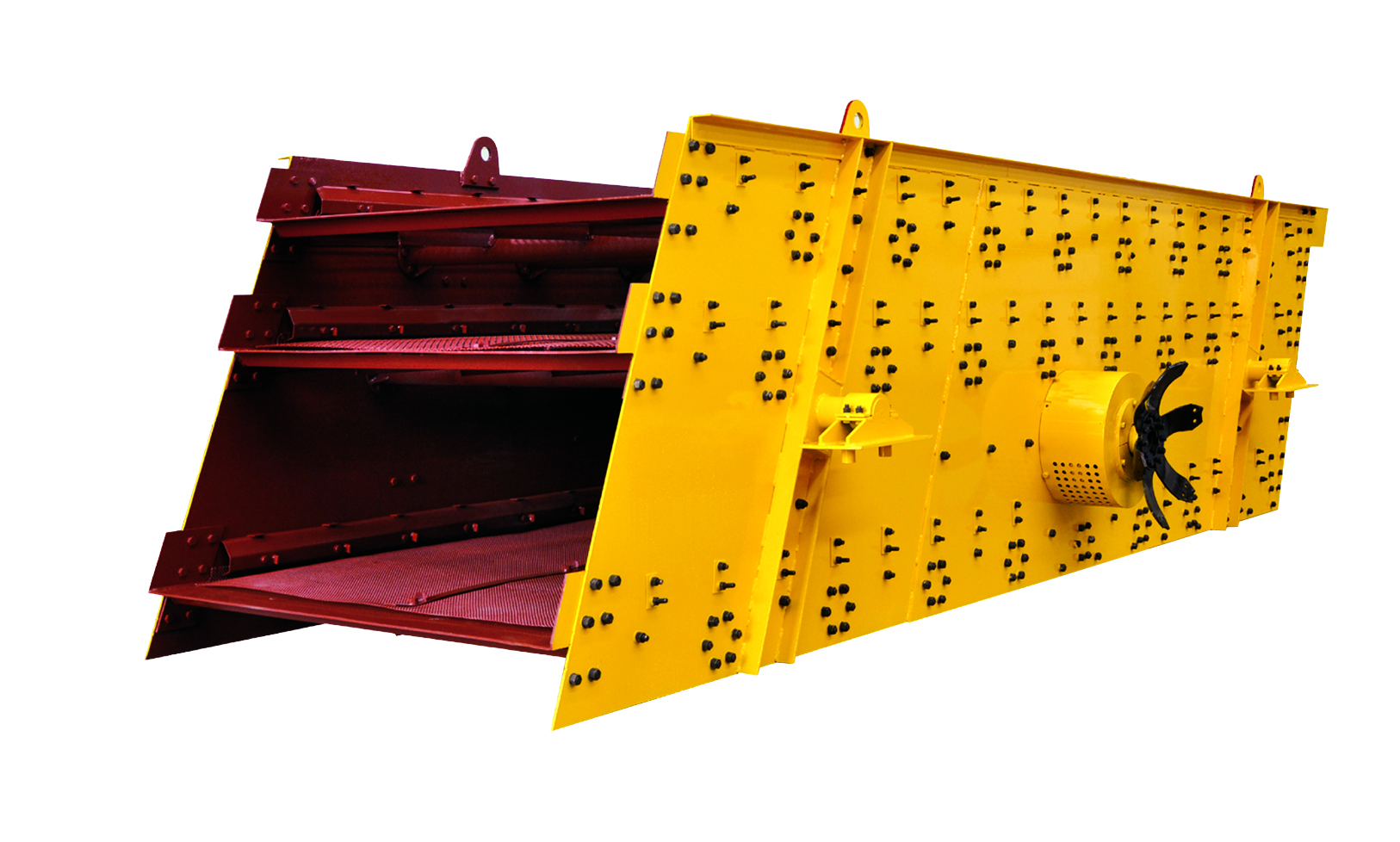
A YK series circular vibrating screen. Deck count, screen hole size and mesh material are the three parameters most often simplified in a supplier quotation and most easily verified in a build record.
Where the evidence stops: boundaries a buyer should price in
Verifiable capability has limits, and a supplier that states them is easier to work with than one that does not. Four boundaries apply directly to the equipment discussed here.
Catalogue ratings are not site performance. Catalogue data for FG Spiral Sand Washers, YK Screens and crushers is obtained under ideal standard test conditions. Actual throughput varies with raw material hardness, feed size, mud and moisture content, power supply stability, feeding continuity and the wear condition of wearing parts, and a reasonable performance deviation should be expected. A supplier cannot guarantee full catalogue output without matching the on-site working conditions.
Warranty scope excludes consumables. The stated warranty covers manufacturing defects of the main machine body. Direct-contact consumables — hammers, screen plates, spiral blades and screen mesh — are excluded, because they are normal production wear items. Buyers should model these as operating cost, not as warranty risk.
XS and FG are not interchangeable. The wheel type is the simpler structure with lower water consumption, lower fine-sand loss and straightforward maintenance, and it suits low-clay material that mainly needs dust removal. The spiral type has stronger scrubbing power for high-clay sticky material, but consumes more water and loses more fines. Recommending a spiral washer for a low-clay feed adds water and fines cost without adding cleaning benefit; applying a wheel washer to a high-clay feed under-cleans the product.
Mobile and fixed configurations trade cost differently. A tyre-type mobile crushing station is documented with a foundation-free chassis, no civil engineering foundation and a stated 50% faster deployment than a fixed station, at a declared 15% lower civil engineering cost but higher freight. A fixed line remains the lower per-ton option for long-term, large-volume production. The evidence question is the same in both cases; only the cost structure differs.
One further boundary is procedural rather than technical: factory-level records such as inspection reports and test-run notes are the supplier's own documentation. They are useful for verifying configuration and build discipline, but they are not a substitute for independent third-party inspection or for a witnessed site acceptance test, which should be specified separately in the contract where the project value justifies it.
A decision-stage verification checklist
- Request the model table entry for every quoted XS, FG and YK unit, and confirm that the quoted model designation matches the declared dimensions, drive power and weight.
- Ask for the contact-material declaration for bucket liners, tank linings and screen mesh, stated per machine rather than per product family.
- Ask for the inspection record and the test-run record for the specific units on the order, not a generic sample record.
- Confirm deck count and screen hole size on each YK Screen against the product fractions the line must produce.
- Confirm whether the washer type quoted matches the clay and moisture characteristics of your feed, using the XS-versus-FG boundary.
- Request the wear-part list with part references for each model, and confirm the consumable items excluded from warranty.
- Ask for reference lines with the equipment configuration named, and check whether the application resembles your own material and duty.
- Confirm voltage, climate rating and documentation language if the line is being exported.
Market trend: procurement is shifting from claims to documentation
Independent market data supports the direction of this shift. Market Research Future estimates the global stone crushing equipment market at USD 8.47 billion in 2024, while OEC trade data places China as the leading exporter of machines to crush or grind stone, ores and minerals (HS 847420) in 2024, with exports valued at USD 1.38 billion. On the demand side, USGS-sourced figures cited by Research Nester put United States crushed stone production at 1.5 billion tons in 2023, valued at more than USD 24 billion — a reminder that equipment purchase decisions sit inside very large material flows where an unverified capacity assumption is expensive.
Product structure data points the same way. Polaris Market Research reports that jaw crushers held a 35.2% share of the crusher market in 2025, reflecting their position as the standard primary stage. As primary crushing standardises, differentiation moves downstream to screening and washing, where the parameters are more sensitive to feed conditions and therefore harder to compare across suppliers without documentation. The ISO 21873-2:2019 standard, which specifies safety requirements and verification for mobile crushers used to crush rock or reprocess construction materials, illustrates the same principle at the regulatory level: verification is written into the requirement, not left to the supplier's description.
Future outlook
Three changes are likely to shape how buyers evaluate this equipment over the next several years. First, documentation will increasingly be requested before quotation rather than after order, particularly for exported lines where voltage adaptation, climate rating and manual language already have to be fixed in advance. Second, the boundary between crusher, screen and washer evidence will continue to blur, because product shape and fines proportion from the crushing stage determine the load on the screening and washing stages; suppliers who can present one configuration file for an entire line will be easier to audit than suppliers who present separate catalogue pages. Third, as market data reconciles around a mid-single-digit to high-single-digit growth band depending on how parts and service revenue are counted, competition is more likely to move to verifiable build quality and after-sales structure than to headline capacity figures.
For buyers, the practical implication is simple. The equipment names XS, FG and YK are not marketing language; they are anchors for a document trail. Used that way, they convert a supplier capability claim into a set of checkable facts before the purchase order is signed.
FAQ
What is the difference between an XS wheel sand washer and an FG spiral sand washer in a stone crushing production line?
An XS Sand Washer uses a rotating bucket wheel to wash sand and gravel by water flushing and mechanical agitation, and it is specified with lower water consumption, lower fine-sand loss and simpler maintenance. An FG Spiral Sand Washer uses a screw assembly in a washing tank and provides stronger scrubbing power, which suits high-clay sticky material but involves higher water consumption and greater fine-sand loss. For low-clay material that mainly needs dust removal, the wheel type is the lower-cost choice; for high-clay material, the spiral type is the more effective choice.
Why does the actual output of an XS or FG sand washer and a YK screen differ from the catalog ratings?
Catalogue ratings are obtained under ideal standard test conditions. Actual throughput varies with raw material hardness, feed size, mud and moisture content, power supply stability, feeding continuity and the wear condition of wearing parts, so a reasonable performance deviation should be expected. For example, heavy clay content or uneven feeding will reduce both washing output and sand cleanliness, and screen mesh clogging, high material moisture, altered excitation force or ageing springs will reduce screening effect. Full catalogue output cannot be guaranteed without matching on-site conditions.
Which documents should a buyer request to verify build records for XS, FG and YK equipment?
A buyer can request the product scope list entry for each quoted model, the contact-material declaration for bucket liners, tank linings and screen mesh, the in-process inspection record for the ordered unit, the no-load and load test-run record, the wear-part and spare-part list with part references, and the packing list and shipping documents. For screening equipment, the deck count and screen hole size should be fixed in writing; for washing equipment, the bucket wheel or spiral diameter, drive power and declared water consumption should be fixed. These documents verify configuration and build discipline, and should be supplemented by independent inspection where the project value justifies it.
How does the choice of impact crusher affect the downstream vibrating screen and sand washer?
The impact crusher determines the shape and fines proportion of the material reaching the screening and washing stages. In LBZG's published PF series documentation, PF-1315 is declared with a maximum feed size of 500 mm and cubic aggregate content above 90%, against a typical 350 mm maximum feed size and around 70% cubic content for traditional hammer crushers. A higher proportion of cubical product and a controlled fines fraction changes how much material recirculates to the YK screens and how much fine material enters the washing stage, which is why crusher, screen and washer specifications are usually evaluated as one configuration rather than as separate purchases.
Are wear parts such as spiral blades, screen mesh and hammers covered by the equipment warranty?
No. The stated warranty covers manufacturing defects of the main machine body. Direct-contact consumables — including hammers, sieve plates, spiral blades and screen mesh — are excluded, because they are normal production wear-and-tear components whose life depends on material abrasiveness, feed size and operating practice. These items should be budgeted as operating cost and tracked through a wear log.
Which installed-line references can a buyer check when evaluating a complete crushing and screening configuration?
Reference lines are most useful when a specific equipment configuration is named alongside them. In the documented scenario set, the Lunan High-Speed Railway is listed as an official reference project on the company site, supplying railway ballast and high-strength concrete aggregate plus manufactured sand for subgrade and sleeper concrete, with stated requirements for cubic particle shape and a fineness modulus of 2.3–3.0. Other documented scenarios include hydropower engineering for dam concrete aggregate, new town and airport construction with tighter aggregate specifications and dust suppression, and overseas quarry and infrastructure projects requiring local voltage adaptation, climate-rated options and multilingual documentation. Each of these can be checked against the equipment list actually quoted for the project.
A complete product and configuration document covering the crushing, screening and sand-washing range referenced in this article is available as a downloadable brochure: https://cdn.socialarks.com/sbsp/25213/common/2026/0826/Shandong%20Lianbang%20Heavy%20Industry.pdf