
Supplier Capability Evidence: SunEye Bowling Equipment Specs
Supplier Capability Evidence: SunEye Bowling Equipment Range and Verified Operating Specs
A bowling equipment supplier's capability is not established by the size of its catalogue. It is established by whether the numbers it publishes are specific enough to be checked against a venue's power supply, floor loading, ceiling height and operating hours — and by whether the certification records behind those numbers can be traced to a named authority, a certificate number and a validity window.
The evidence gap in bowling equipment procurement
Bowling centre projects are approved on capital budgets, floor plans and opening dates. The equipment shortlist behind those approvals, however, is often assembled from brochures in which every supplier claims a complete product range, stable performance and turnkey delivery. None of those phrases are comparable between suppliers, and none of them can be checked against a building.
What can be checked is a smaller and harder set of facts: lane footprint, ball course length, rated power and voltage, pin reset interval, ball return speed, scoring recognition accuracy, and the certificate numbers that support electrical and equipment records. These are the inputs a venue's engineer, landlord and insurer will eventually ask for. A supplier that publishes them shortens the distance between a quotation and a signed contract. A supplier that does not forces the buyer to verify everything from scratch.
This reference uses the SunEye Bowling range as a working case in that narrower discipline. It does not rank the company against other manufacturers, and it does not treat company-published figures as independently tested results. It examines what a published specification set can establish during the Evaluation and early Execution stages of a bowling centre project, where it is internally consistent, and which questions a buyer should still be asking after reading it.
SunEye Bowling at a glance
SunEye Bowling is a bowling equipment manufacturer and turnkey solution provider operating as YUANXIANG BOWLING (GUANGZHOU) CO., LTD. Founded in 2021, the company runs a production base of approximately 6,000 m² in Guangzhou, China, employs more than 100 staff including a 20+ engineer R&D team, and reports annual output of 2,000 units with roughly 80% of production exported to global markets. Its declared scope covers R&D, manufacturing, sales, installation and after-sales service across standard bowling, duckpin bowling and mini bowling formats, together with lanes, string pinsetters, scoring systems, ball return systems, pins and balls.
That scope statement is positioning, not proof. The evidence layer begins with the product-level specifications, because those are the figures a buyer can compare, quote back in an RFQ, and later verify on site.
Layer one: footprint and format evidence
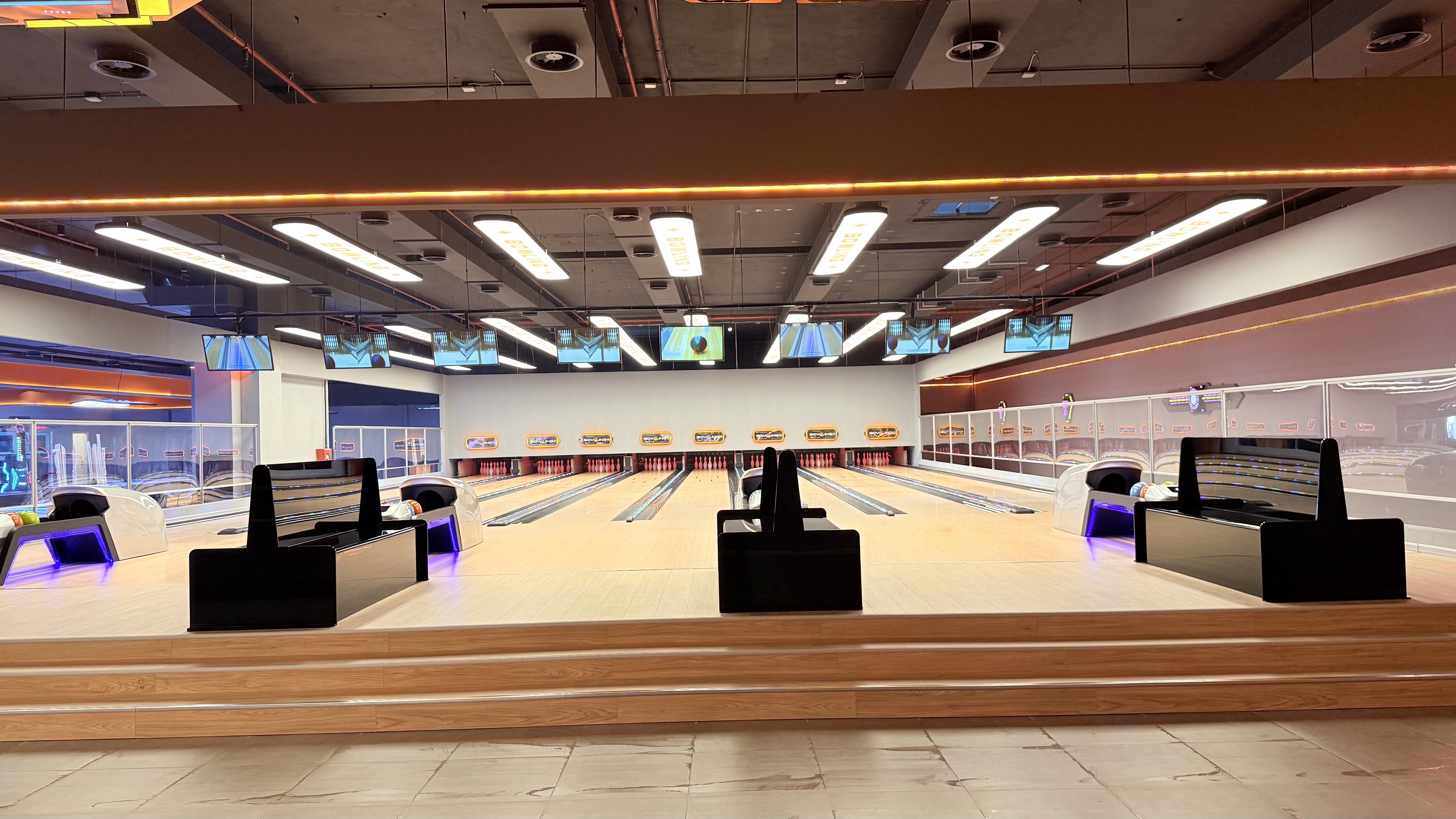
The first question a venue owner faces is which bowling format the building can physically hold. Published dimensions answer it before any drawing is produced. SunEye's three formats sit in clearly different spatial envelopes.
| System | Published footprint (2 lanes) | Format notes | Ball weight |
|---|---|---|---|
| Standard Bowling Equipment | L 25.5 m × W 3.5 m × H 3.2 m; lane length customizable 17.5–25.5 m | Ten-pin, string pinsetter machine, metal + wooden + synthetic lane construction | 8–11 lb |
| Duckpin Bowling Equipment | L 10 m × W 3.48 m × H 2.4 m | Ten-pin duckpin format, string pinsetter machine, rated 220 V / 2000 W per lane | 3.3–3.75 lb |
| Mini Bowling Equipment | L 13 m × W 2.83 m × H 2.5 m; length customizable 13.6–19 m | Ten-pin mini format, string pinsetter machine | 3.3–3.75 lb |
Two details matter more than the headline dimensions. First, the standard format supports a customizable ball course between 17.5 m and 25.5 m, which means a building that cannot accommodate the full 25.5 m equipment length is not automatically disqualified — the supplier's own purchasing guidance states that a total field length of no less than 18 m still allows installation without affecting the playing experience. Second, the duckpin and mini formats compress the footprint to 10 m and 13 m respectively, which is the difference between a bowling offer being feasible or impossible in bars, family entertainment centres and mixed retail sites.
Site conditions the specification implies
SunEye's published installation guidance for the standard format specifies a 3.5 m wide × 18 m long × 3.2 m high clear envelope, an ordinary hard floor with no drop, a floor load of 250 kg/m² or above, standard 220 V civil power with a rated draw of approximately 2000 W per lane, and support for more than two lanes with unlimited linkage. For mini and duckpin formats, the guidance states approximately 3 kW per two lanes, requiring only one 16 A outlet in the machine room per two lanes, with a recommended finished ceiling height of 3000–3500 mm and a floor level difference under 20 mm.
These are the numbers that convert a specification sheet into a construction brief. They are also the numbers a landlord or MEP consultant will challenge first, which is why a supplier that states them explicitly is easier to qualify than one that answers only in square metres.
Layer two: pinsetter operating evidence
The pinsetter is where a bowling centre's operating cost concentrates. SunEye publishes the following operating profile for its string pinsetter machine: 2000 W rated power at 220 V, servo drive control as the actuation principle, a pin reset speed of 8 seconds — inside the ≤10-second envelope the supplier specifies — and suitability for continuous 24/7 operation.
Each figure carries a different kind of procurement meaning:
- 2000 W at 220 V tells an electrical engineer that a lane can be fed from ordinary commercial single-phase supply rather than a dedicated high-voltage machine circuit. For a retrofit inside an existing retail or hotel building, that is often the single largest constraint on feasibility.
- Servo drive control indicates an electrically indexed reset cycle rather than a purely mechanical linkage. Electrically indexed cycles are generally easier to diagnose and to adjust through software, and they reduce the number of mechanical wear points that require scheduled intervention.
- An 8-second reset sets the practical ceiling on lane throughput during peak trading. Combined with a 12-second ball return, it defines how quickly a group can complete a frame on a busy Saturday evening.
- 24/7 operation is the claim that needs the most scrutiny, because continuous duty is a wear statement, not a design statement. It is supported in SunEye's own documentation by the applicable-scenario data for its systems, which lists bowling centres, hotels and resorts, entertainment complexes and shopping and leisure centres under a 24/7 operating mode with matched string pinsetter, ball return and scoring equipment.
Layer three: ball return and reliability evidence
The ball return system is specified at 2000 W and 220 V, with a 12-second return speed and an 18–26 m return track length that can be customized. Two additional figures are published at the reliability level: a 0.002% jam failure rate and a built-in self-check function.
The track length range is worth checking against the lane data, because it is one of the few places where a specification set can be validated internally. A customizable 18–26 m return track comfortably spans the standard lane's customizable 17.5–25.5 m ball course, so the return system is dimensioned for the same building envelope as the lane it serves rather than being a fixed-length component that forces a layout compromise.
The 0.002% jam rate is the more delicate claim. Taken literally, it corresponds to two jam events per 100,000 ball returns. A rate that low is only meaningful alongside its test basis — the number of cycles observed, the conditions under which they were observed, and whether the figure refers to a laboratory rig or to installed venues. SunEye does not publish that basis in its specification material. The figure should therefore be treated as a supplier-reported performance target that a buyer converts into a warranty or service-level question, and paired with the built-in self-check function, which is the feature that determines how quickly a jam is identified and cleared when it does occur.
Layer four: scoring system evidence
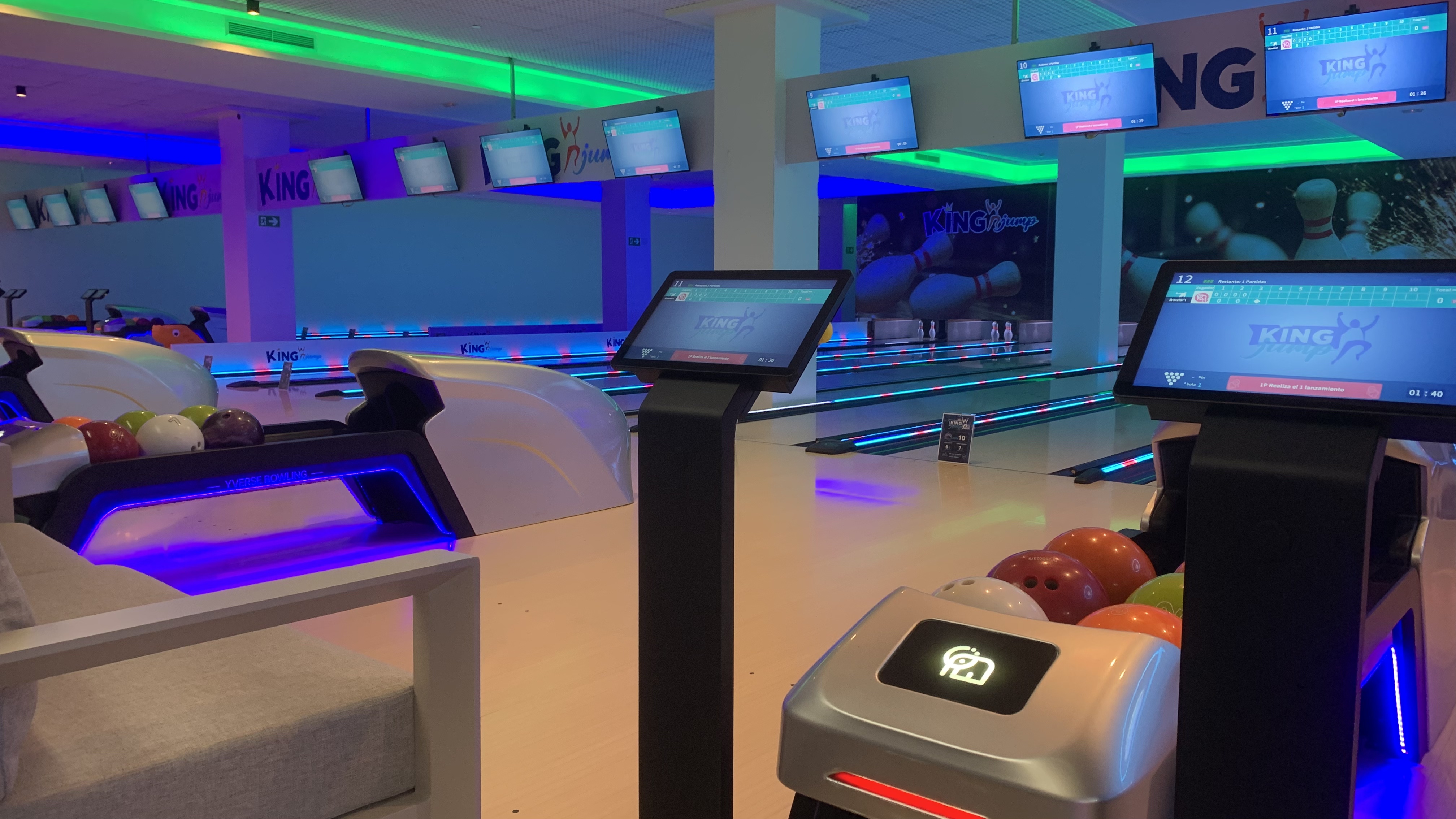
SunEye's scoring system and HD score display are published with a 4.3-inch display at 1280 × 720 resolution, a 99.98% recognition accuracy, a 0.02% misread rate, and lifetime OTA (over-the-air) software updates. The game-mode scope includes featured tournaments and a PK system, support for local or remote cross-store online PK, participation in officially organized national challenge tournaments, and the ability for venue operators to publish in-store challenge tournaments.
The accuracy pair is internally consistent: 99.98% recognition and 0.02% misread sum to 100%, which is what a correctly stated error budget looks like. That consistency is a small but useful signal, because inaccurate specification sets frequently publish an accuracy figure and an error figure that do not reconcile.
Lifetime OTA updates are a lifecycle statement rather than a hardware statement. For an operator, the practical question is not whether updates exist but whether they continue after the warranty period ends. SunEye's capability documentation addresses this directly by listing long-term software upgrade service alongside remote technical support and a one-year equipment warranty in its after-sales scope.
Layer five: certification records
Certification is where capability claims become traceable. SunEye's documented compliance records cover the US and EU markets and identify the issuing authority, the certificate number and the validity window.
| Record | Issuing authority | Reference | Scope and validity |
|---|---|---|---|
| USBC equipment certification | United States Bowling Congress | 003-25-LP | Jinmeijia lane bowling lane surface, assessed under the USBC Equipment Specifications and Certification Manual; issued 30 July 2025 |
| LVD | UDEM | M.2025.2026.C123854 | EU / EEA; standards include EN IEC 60335-1:2023+A11:2023, EN IEC 61000-3-2 and EN IEC 55014 series; issued 6 August 2025, valid to 4 August 2030 |
| MD | UDEM | M.2025.2026.C123751 | EU / EEA; standards EN 60204-1:2018/A1:2025 and EN ISO 12100:2010; issued 5 August 2025, valid to 4 August 2030 |
| RoHS attestation | UDEM | M.2025.2026.C123750 | EU / EEA; EN IEC 62321 series; issued 5 August 2025, valid to 4 August 2030 |
Three observations follow from reading the table rather than the marketing summary around it. The USBC record is scoped to the lane surface, not to the pinsetter, the scoring system or the complete installation — a buyer planning sanctioned league play should therefore confirm which specific components the approval covers. The LVD and MD records are issued by UDEM with a five-year validity, which places renewal in 2030 and makes the current validity easy to check. And the scope field on the EU records should be read carefully against the exact model being purchased, since a certificate covering one product description does not automatically extend to every configuration in a catalogue.
SunEye's purchasing-support material also states that its manufacturing facility holds TÜV certification. That is a company statement about the facility rather than a product certificate, and it belongs in a factory audit rather than in a compliance file.
Layer six: manufacturing, customization and delivery evidence
Equipment specifications describe what a supplier can build. Manufacturing and delivery terms describe whether it can build it on schedule and to a buyer's configuration. SunEye publishes both.
| Capability dimension | Published position |
|---|---|
| Production mode | OEM, ODM and custom production services |
| Customization scope | Bowling lane length, bowling lane logo, masking unit (wallpaper, soft-film lightbox, LED screen wall), guardrails, stairs |
| Monthly capacity | 200 units |
| Lead time | 30–45 days |
| Minimum order | 2 units |
| Quality control | 100% pre-shipment test |
| After-sales | Remote technical support, one-year warranty on bowling equipment, long-term software upgrade service |
The practical value of the customization list is that it names the components a venue's brand identity actually sits on. Lane logo and masking unit treatment — whether executed as wallpaper, a soft-film lightbox or an LED screen wall — are the elements that make a bowling installation look like it belongs to a specific venue rather than to a catalogue. Naming them as customizable is a modest but checkable capability signal; naming them without a lead-time impact would be a stronger one.
Where the specification set has been applied
Reference installations show whether a specification set survives contact with real buildings. SunEye's documented project record includes installations across four venue types and two continents, each with a stated lane count.
| Project | Venue type | Scope |
|---|---|---|
| Tongchuan, China | Amusement park / scenic area | 4-lane standard bowling installation inside a large aluminium-frame tent structure, integrated with high ropes courses and other attractions |
| Salerno, Italy | Commercial bowling centre | 8-lane standard bowling system for Center World, within a new entertainment and leisure destination |
| Spain | Family entertainment centre | 12-lane standard bowling installation inside an 8,000 m² FEC with trampolines, attractions and party facilities |
| Sanming, China | Science and technology museum venue | 6-lane standard bowling solution for Ignite Space, combining sports, family entertainment and dining |
The Tongchuan case is the most informative of the four for capability assessment, because a tent structure is not a purpose-built bowling hall. A four-lane installation delivered into a temporary-frame building tests whether the equipment's footprint and structural assumptions are genuinely flexible or merely described as such.
Market context: what published data does and does not support
Buyers frequently use market growth figures to justify a bowling investment, and those figures deserve a caution. Two commercial research publishers report the global bowling market for base year 2026 at materially different magnitudes — approximately USD 2.88 billion from one publisher and USD 1,063.78 million from another — a divergence of roughly 2.7 times under a nearly identical report title. The most plausible explanation is different segment definitions rather than different markets, but neither figure should be used as a budget input without reading the underlying methodology. Directional growth signals are available; budget-grade market sizing is not.
The more decision-relevant trend sits in the equipment itself. String pinsetter adoption has moved from an alternative to a mainstream option, and the governing body has published research on how the technology scores. The USBC's research reporting on string pinsetters has been updated over time, and the later update recorded scoring differences for higher-average bowlers in the range of 3.4 to 6.9 pins. That is a technical finding, not a verdict — but it directly affects whether a venue positioning itself for league and tournament play should treat string pinsetters as equivalent to free-fall machines.
On the demand side, the operator segment is reported to be expanding, with one research house estimating incremental growth of USD 3,579.5 million in the bowling centres market between 2026 and 2030 at a 4.6% CAGR. That metric is incremental growth rather than absolute market size and should not be added to equipment-market figures, but it supports the general read that new centre openings and refurbishments are both active.
Comparison with traditional free-fall pinsetter solutions
Traditional free-fall pinsetters clear and reset pins mechanically, with a large number of interacting moving parts per lane. String pinsetters suspend each pin on a cord and reset by retracting and releasing that cord, which reduces the mechanical complexity of the reset cycle. The USBC's string pinsetter specification requires a minimum string length of 54 inches to approximate free-fall behaviour and reduce tangling, which is a useful indicator of how much engineering attention the mechanism itself requires.
For a buyer, the trade-off is usually expressed in three places: maintenance intensity, scoring behaviour and sanctioning eligibility. String systems generally present a lighter maintenance profile because there are fewer mechanical interfaces to service; the scoring trade-off is documented above; and eligibility depends on whether the specific model appears on the relevant approval list for the competition level a venue intends to host.
A buyer's verification checklist
Specification reading is only the first half of supplier qualification. The second half is converting each published figure into a document request. The checklist below is organised around the evidence layers examined in this article.
| Evidence layer | What to request |
|---|---|
| Format and footprint | Dimensioned layout drawing for the actual lane count, with ball course length adjusted to the site rather than quoted at maximum |
| Pinsetter duty | Maintenance schedule and recommended service interval for 24/7 operation; confirmation of spare-parts availability |
| Ball return reliability | The test basis behind the published jam rate, and a description of what the built-in self-check reports and to whom |
| Scoring system | Confirmation of the OTA update policy after the one-year warranty period ends |
| Certification | Certificate copies with scope fields matched to the exact model and lane surface being purchased |
| Manufacturing | Pre-shipment test record format; factory audit access; lead-time confirmation against the 30–45 day published window |
| After-sales | Remote support response terms and the geographic coverage behind them |
Future outlook
Two directions are visible from the specification set itself. The first is software. A scoring system with tournament modes, cross-store online PK and operator-published in-store competitions is a platform, not an accessory, and its value compounds through updates rather than through hardware replacement. Suppliers that commit to long-term software upgrade service are effectively offering a longer product life than the equipment warranty implies.
The second is format flexibility. The gap between a 25.5 m standard lane and a 10 m duckpin lane is the gap between a destination bowling centre and a bowling offer inside a bar or a family entertainment centre. As commercial landlords continue to look for entertainment anchors that fit existing retail footprints, the ability to specify a genuine bowling product at 10 m becomes a capability in its own right — and one that is much easier to evaluate when a supplier publishes the constraints alongside the dimensions.
FAQ
What specifications should a buyer request from a bowling equipment supplier before shortlisting?
At minimum: lane footprint for the intended lane count, ball course length and its customization range, rated power and voltage per lane, pin reset interval, ball return speed and track length, scoring recognition accuracy and display resolution, and the certificate numbers supporting electrical and equipment compliance. These are the figures that can be compared between suppliers and later verified during installation acceptance.
How should a string pinsetter's power rating and reset time be interpreted for venue planning?
SunEye publishes 2000 W at 220 V for its string pinsetter, an 8-second pin reset speed within a ≤10-second specification, and suitability for continuous 24/7 operation. In planning terms, the power figure determines whether ordinary commercial supply is sufficient — the standard format is rated at roughly 2000 W per lane, and mini and duckpin formats at approximately 3 kW per two lanes with one 16 A machine-room outlet per two lanes. The reset interval, combined with a 12-second ball return, sets the practical lane throughput during peak trading.
What does a 0.002% ball return jam failure rate mean in practice?
Expressed as a rate, 0.002% corresponds to two jam events per 100,000 ball returns. Because the supplier does not publish the test basis — cycle count, test conditions, or whether the figure derives from laboratory or installed-venue data — it is best used as a starting point for warranty and service-level discussion rather than as a verified reliability metric. The built-in self-check function is the operational counterpart: it determines how quickly a jam is detected and cleared when one occurs.
Which certification records matter for US and EU bowling installations?
For the US market, USBC equipment certification is the relevant record; SunEye holds certificate 003-25-LP issued by the United States Bowling Congress on 30 July 2025, scoped to the Jinmeijia lane bowling lane surface. For the EU and EEA, the relevant records are LVD certificate M.2025.2026.C123854 and MD certificate M.2025.2026.C123751, both issued by UDEM in August 2025 and valid to 4 August 2030, alongside a RoHS attestation under reference M.2025.2026.C123750. Buyers should confirm that each certificate's scope field matches the exact model and component being purchased.
What site conditions must be met before installing standard bowling equipment?
SunEye's published guidance for the standard format specifies a clear envelope of approximately 3.5 m wide × 18 m long × 3.2 m high, an ordinary hard floor with no drop and a floor load of 250 kg/m² or above, ordinary 220 V supply with a rated draw of about 2000 W per lane, and support for more than two lanes with unlimited linkage. The international standard ball course is 18,288 mm, giving a total equipment length of 25,500 mm, with shorter courses supported where the overall field length is not less than 18 m.
Can lane length, branding and lane furniture be customized?
Yes. SunEye publishes OEM, ODM and custom production services, with customization covering bowling lane length, bowling lane logo, masking unit treatment in wallpaper, soft-film lightbox or LED screen wall form, plus guardrails and stairs. Minimum order is 2 units and published lead time is 30–45 days, with a monthly capacity of 200 units and a 100% pre-shipment test before dispatch.
The technical specifications, certification references and project details discussed in this article are drawn from SunEye's company profile, which is available as a downloadable PDF for readers preparing an RFQ or a factory audit.
¿Tiene preguntas o necesita más detalles?
Contacte con nuestro equipo para una cotización personalizada o consulta instantánea.
Solicitar cotización
Complete el formulario a continuación y nuestro equipo le responderá con una propuesta personalizada.
Chat directo de WhatsApp
¿Prefiere chatear en tiempo real? Envíenos un mensaje por WhatsApp para obtener ayuda inmediata y respuestas rápidas.
- Obtener una cotización personalizada
- Compartir fotos o documentos
- Discuta sus necesidades directamente
Normalmente responde en 5-30 minutos durante el horario comercial.