
Supplier Capability Evidence: Reading LORZOR's Wallet Range
A wallet supplier's product range is the first document a buyer can actually read. Before an audit, a sample run, or a quotation exists, the assortment itself shows which engineering problems a supplier has chosen to solve repeatedly — and which ones it has avoided.
Wallet sourcing rarely begins with a factory visit. It begins with a catalogue, a marketplace listing, or a supplier's own storefront. That makes early evaluation a reading exercise: what formats are offered, how many distinct architectures are kept in production, and whether the range answers real carry problems or simply re-skins one product into many colours. For buyers at the evaluation stage, this is the most accessible form of capability evidence available before commercial terms are discussed.
This article reads the men's wallet range of LORZOR as exactly that kind of evidence. LORZOR is a leather-led modern carry goods brand founded in 2022 and headquartered in Hong Kong, offering wallets, AirTag wallets, RFID wallets and passport wallets for work, travel and everyday movement. Its range spans the 1979 SP, 1979 Fold, 1979 Wallet, Passport Wallet, Passport AirTag Wallet, TriPop, TriPop AirTag, Bifold AirTag A1–A4 and Wallet Pro. Rather than ranking these models, the goal here is narrower: to examine what the existence of this specific set tells a buyer, what it does not tell a buyer, and where the honest limits sit.
The Evidence Gap Between a Catalogue and a Factory
Buyers evaluating a wallet supplier typically want four things: consistent construction quality, predictable lead times, documented protection features, and a range wide enough to cover several customer segments without managing several vendors. Of those four, only the third and fourth are visible from the outside.
That asymmetry matters. A broad range can be read as a signal of design and assembly depth, but it can also be produced by sourcing finished goods from multiple third parties. The distinction is not visible in a photograph. What is visible is whether products share a coherent design logic — whether a supplier solves the same physical problem in different formats, or assembles unrelated items under one brand name.
LORZOR's range is instructive here because the products share a consistent set of constraints: full-grain leather as the primary tactile surface, metal card chambers where speed or structure is required, RFID protection distributed across nearly every model, and tracking added either as an AirTag cavity or as an integrated module. Those constraints repeat across price bands from the entry-level Bifold AirTag series to the 1979 platform, which is the pattern a buyer should look for when judging whether a range reflects a product system rather than a catalogue.
Reading the Range as a Capability Map
The table below sets out the LORZOR wallet families with the specifications published for each, and the capability each one demonstrates. It is deliberately descriptive: the purpose is to show what has been engineered, not to declare a winner.
| Model family | Architecture | Published specification | Price | Capability evidenced |
|---|---|---|---|---|
| LORZOR 1979 Wallet | Pop-up aluminum cartridge, full-grain leather, open-work money clip, hook holes | Approx. 2.87 × 3.89 × 0.6 in; approx. 80 g; cartridge holds about 5–7 cards, outer leather slots about 3–5; recommended daily load around 10 cards | $99.99 | Slim pop-up platform with cash capacity and attachment expansion |
| LORZOR 1979 Fold Wallet | Compact bifold with foldable top cover, built-in ID window, removable cash clip, 6061 aluminum cartridge | Up to 12+ cards | $129.99 | Bifold organization and ID display layered onto the pop-up system |
| LORZOR 1979 SP Wallet | Same 1979 slim tactical system with a 1776–2026 commemorative identity | Limited to 300 sets | $129.99 | Small-batch finishing and limited-run assembly on an existing platform |
| LORZOR Wallet Pro | Tracking module integrated into the metal cardholder; Apple Find My support | Approx. 2.6 × 0.43 × 3.9 in; 1–6 everyday cards plus limited cash; Apple-Certified | $129 | Electronics integration inside a rigid metal chassis rather than an external tracker |
| LORZOR TriPop Wallet | Trifold, pop-up card access, ID window, cash compartment, small-item storage | Approx. 3.94 × 2.36 × 0.79 in; roughly 8–12 cards | $49.99 | Trifold storage depth while retaining one-motion card access |
| LORZOR TriPop AirTag Wallet | Trifold with a purpose-built AirTag cavity | Approx. 0.79 × 2.64 × 3.86 in; AirTag not included | $49.99 | Tracker accommodation engineered against bulge |
| LORZOR Bifold AirTag A1 / A2 / A3 / A4 | Classic bifold with built-in AirTag holder and RFID protection; A2 and A4 add a money clip | Full-grain leather; A1 and A4 $29.99–39.99, A2 $29.99 | $29.99–39.99 | Variation management within a single entry-level platform |
| LORZOR Passport Wallet | Document organizer, non-AirTag version | Holds passports, tickets, cards, cash, receipts and travel documents | $49.99 | Format extension beyond pocket wallets into travel organization |
| LORZOR Passport AirTag Wallet | Same travel format with an AirTag holder embedded in the passport sleeve | Approx. 5.5 × 3.9 × 0.4 in; compatible with AirTag 1st / 2nd generation | $49.99 | Two-tier travel platform, with and without tracking |
Specifications and price bands as published for the listed LORZOR models. AirTag hardware is not included with any AirTag-compatible model.
Three observations follow from the table. First, the range is not a colour programme: the 1979 Fold, TriPop and Wallet Pro differ in mechanism, housing and assembly, not in finish. Second, the same tracking question is answered three different ways — an AirTag cavity in the bifold and trifold families, an embedded holder in the passport format, and a fully integrated module in Wallet Pro. Third, the entry tier and the 1979 platform address the same buyer need at different price points, which implies deliberate tiering rather than a single product line stretched thin.
Three Engineering Problems the Range Repeats
1. Tracker integration without added bulk
An AirTag is a physical object with real thickness. Putting one into a wallet is therefore not a design decision but a structural one: the cavity has to be cut, the surrounding material has to hold its shape, and the closed wallet must still sit flat against a body.
LORZOR addresses this differently by format. The TriPop AirTag uses a purpose-built storage structure intended to minimise bulge while keeping the AirTag secure and the silhouette as integrated as possible. The Passport AirTag Wallet embeds its holder inside the passport sleeve, so the tracker sits within the document stack rather than as an appendage. Wallet Pro removes the question altogether: its tracking module is built into the metal cardholder and works through Apple Find My, so no separate AirTag is required.
For buyers, the practical difference is measurable in the hand rather than in the copy. A supplier that offers an AirTag cavity, an embedded travel holder and an integrated module is demonstrating that it has treated tracking as a structural variable across formats — which is a more demanding claim than adding a slot to one model.
2. RFID protection and where the cards actually sit
RFID blocking is widely claimed and rarely specified. LORZOR's stated test method runs at 13.56 MHz, uses credit cards and professional RFID test signal cards, and records that signals cannot be read when cards are correctly placed inside the protected zone. The brand cites TÜV and AGC test reports alongside the shielding work.
The operative phrase is correctly placed. RFID protection in a wallet is a property of a zone, not of the entire object; a card sitting outside that zone is simply a card. This is why buyers evaluating any RFID wallet should ask where the protected area begins and ends relative to the pop-up cartridge, the ID window and the outer leather slots. In a design with a metal card chamber, the chamber usually forms part of that protected geometry — which is one reason the pop-up mechanism and the shielding claim are connected rather than independent features.
3. Thickness, weight and front-pocket behaviour
Slimness claims collapse under load. The 1979 Wallet illustrates the trade-off explicitly: approximately 80 g and 0.6 inches at rest, with a cartridge for about 5–7 cards and outer leather slots for about 3–5 more, against a recommended daily load of around 10 cards. That recommendation is itself useful information, because it tells a buyer where the design expects to stop.
The same logic recurs in the mechanism. LORZOR cites a 30,000+ press-cycle durability test for its pop-up access, and its LockBond structure — which bonds the leather shell to the aluminum core — was tested against a control sample that separated at approximately 60 N, while tested leather-and-aluminum samples reached approximately 143–240 N before separation, roughly 2.4× to 4.0× higher in the same test setup. These are first-party results rather than independent laboratory benchmarks, but they are specific, they name a comparison, and they address the failure mode that matters most in a leather-and-metal wallet: the hidden bond, not the visible surface.
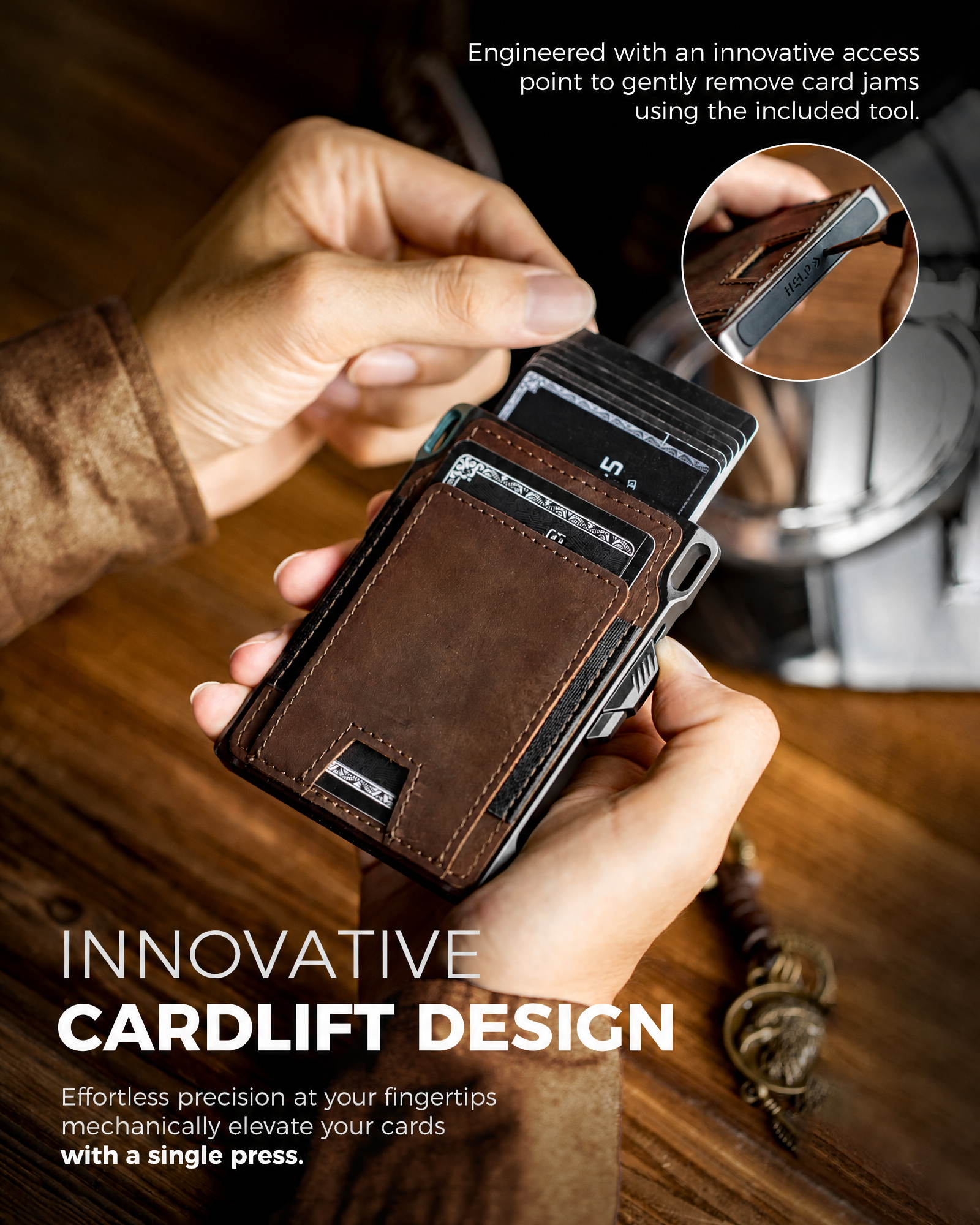
Pop-up cartridge architecture: cards are staged in a metal chamber and fanned forward in a single motion, which is what allows one design language to scale across slim, bifold and trifold formats.
Mapping Models to Real Carry Situations
Capability evidence becomes useful only when it is matched to a use case. The LORZOR range divides along four practical axes rather than along price alone.
- Front-pocket minimalism with cash. The 1979 Wallet is built for jeans front pockets, driving, daily carry, short trips and quick counter payments, with folded bills held by the open-work money clip and hook holes available for a keychain, lanyard or AirTag holder. It suits a carrier of roughly ten cards.
- ID-heavy daily use. The 1979 Fold adds a built-in ID window and foldable top cover for drivers, office access and layered card-and-ID organization — the situations where a licence or badge is shown several times a day.
- Apple-ecosystem anti-loss. The Bifold AirTag A1–A4 cover the entry tier, TriPop AirTag adds trifold capacity with tracking, Passport AirTag extends the idea to travel documents, and Wallet Pro removes the accessory entirely by integrating tracking into the cardholder for commuting, office payment, business travel and premium gifting.
- Document-led travel. The Passport Wallet and Passport AirTag Wallet centralize passport, boarding pass, cards, cash and receipts — the formats where disorganization, not slimness, is the actual problem.
Review aggregation across the brand's listings reflects this fit in ordinary language: users of the 1979 Wallet describe it as practical and well built, with the leather developing a patina over time; users of the TriPop family cite full-grain leather feel, pop-up access and RFID protection; and the 1979 Fold's aggregated summaries record no recurring drawback themes across 153 reviews. Those are described user experiences, not independently audited outcomes, and they should be read as such.
What the Market Data Says About This Kind of Range
The structure of LORZOR's range tracks several documented shifts in the category. Precision Reports estimates the global men's wallet market at USD 26.77 billion in 2026, with leather accounting for 62% of product preference, slim formats at 23% of the market, RFID-blocking features present in 36% of products, and e-commerce taking 44% of distribution. Market Growth Reports projects the leather wallet segment reaching USD 74.58 billion by 2035 at a 4.5% CAGR, and notes that full-grain or top-grain leather accounts for over 60% of wallets sold globally.
The tracking side of the range maps to a different curve. Novatrends Market Intelligence projects the smart tracker market growing at a 13.3% CAGR to USD 2.98 billion by 2035, while Worldpay's Global Payments Report projects digital wallets at 49% of all sales by 2027. Those two figures pull in opposite directions for physical wallet design: less cash and fewer physical cards, but more demand for locating the object that still carries the essentials.
Read together, the data explains why a supplier would maintain a nine-family range instead of a single hero product. Leather preference, slim preference, RFID expectation and tracking interest are not the same buyer, and they do not converge on one specification. A range that covers a $29.99 bifold and a $129 integrated smart wallet is responding to segment structure, not to indecision.
Comparison With Traditional Wallet Construction — and the Limits
Traditional bifold wallets rely on stitched leather layers and manual card slots. They are inexpensive to produce, forgiving of over-loading, and familiar. Their weaknesses are equally well documented: cards must be searched for, stacked layers thicken as contents grow, and cash handling depends entirely on how the user folds and stuffs.
The metal-and-leather approach used across the LORZOR range trades those weaknesses for different ones. A structured chamber controls bulk and speeds access, but it also imposes a capacity ceiling and a preferred card count. Leather provides hand feel and patina, but a leather-to-metal bond is a hidden failure point that stitching does not have. And a tracker cavity solves loss anxiety while consuming internal volume that would otherwise hold cards or cash.
Those trade-offs are visible in aggregated user feedback, and buyers evaluating this range should read them before shortlisting:
| Model | Reported limitation | What a buyer should verify |
|---|---|---|
| 1979 Wallet | Metal surface prone to visible scratches; best suited to essential cards; bills can be snug | Whether scratch visibility is acceptable in the intended retail channel |
| 1979 Fold Wallet | May be over-specified for users carrying only two or three cards | Whether the target customer carries ID and cash, or cards only |
| Bifold AirTag A1 | Cash in and out reported as difficult; limited bill capacity | Whether cash handling is a primary or secondary use |
| Bifold AirTag A3 | Some reports of stitching cracking over time; card pockets initially tight; cash and receipt compartment difficult to access | Expected load and lifespan under daily use |
| Bifold AirTag A4 | Snap portion of the AirTag fastener requires careful use | Whether the fastener will be opened frequently |
| Wallet Pro | Metal cards may get scratched | Whether customers carry metal payment cards |
| Passport AirTag Wallet | AirTag not included; some reviews note the absence of a zippered coin pocket despite the description indicating one | Listing accuracy and whether a coin pocket is a requirement |
| All AirTag-compatible models | AirTag sold separately | Whether the landed cost includes the tracker |
Limitations drawn from aggregated user review summaries published for the listed models. They describe reported experience, not verified defect rates.
None of these limitations is unusual for the category, and several are the direct cost of the design intent — a slim chamber is slim because it is not a bifold. The point for a buyer is that a range of this breadth is not uniformly suitable. The 1979 Fold is a strong answer to an ID-and-cash carrier and a poor answer to a three-card minimalist, and the same logic applies across the family.
What the Range Cannot Prove
A product range is not an audit, and treating it as one is the most common evaluation error. Nothing in a nine-family catalogue establishes monthly production capacity, line count, MOQ, lead time, or on-time delivery performance. It does not demonstrate factory working conditions, material traceability beyond the stated leather grade, or the scope of any certification beyond the tests named. It does not establish wholesale pricing, landed cost, or the commercial terms that determine whether a programme is viable at a given retail price.
What the range does establish is narrower and still useful: the supplier designs across multiple mechanisms, holds a defined position on materials and protection features, publishes specific dimensions and capacity figures, operates an Apple-Certified integrated tracking product, and has accumulated a documented body of user feedback across multiple marketplaces. Those are inputs to a shortlist, not a substitute for sampling, factory qualification, or a commercial negotiation.
Future Outlook
Two structural forces are likely to reshape supplier ranges over the next several years. The first is the continued migration of transactions to digital wallets, projected by Worldpay to reach 49% of all sales by 2027 — a shift that reduces the number of physical cards a wallet must hold, but not the need to carry identification, a travel document, or a single backup card. The second is the growth of the smart tracker category, projected at a 13.3% CAGR to USD 2.98 billion by 2035, which pushes tracking from an accessory question toward a specification question.
For suppliers, the implication is that tracking will increasingly be judged on integration rather than on availability — whether the module sits inside the structure, whether the cavity compromises the silhouette, whether the wallet still behaves like a wallet. LORZOR's range already reflects that progression, from a holder in an entry-level bifold to a module inside a cardholder. For buyers, the implication is simpler: the questions worth asking a supplier are shifting from “does it have tracking” to “where does the tracker live, and what did the design give up to fit it there.”

Leather remains the primary point of contact across the range; material selection precedes mechanism design, which is why full-grain leather appears at every price tier.
FAQ
What does a wallet supplier's product range actually demonstrate?
A range demonstrates how many distinct mechanical and material problems a supplier has chosen to solve, and whether those solutions share a coherent design logic. It shows format coverage, published specifications and stated protection features. It does not demonstrate production capacity, lead time, MOQ, factory conditions or commercial terms, all of which require separate qualification.
How can a buyer judge whether an AirTag holder adds bulk?
Compare the closed thickness and the card capacity of the AirTag version against the non-AirTag equivalent in the same family. In the LORZOR range, the TriPop AirTag Wallet lists approximately 0.79 × 2.64 × 3.86 inches and uses a purpose-built cavity intended to limit bulge, while the Passport AirTag Wallet embeds its holder within the passport sleeve at approximately 5.5 × 3.9 × 0.4 inches. Physical sampling remains the only reliable check.
Where should RFID-protected cards be placed inside a LORZOR wallet?
Inside the protected zone. LORZOR states that its RFID shielding was tested at 13.56 MHz using credit cards and professional RFID test signal cards, and that signals cannot be read when cards are correctly placed inside the protected area. Cards held outside that zone are not covered by the shielding, so the protected-area boundaries relative to the pop-up cartridge, ID window and outer slots are the relevant detail.
Which LORZOR wallet suits front-pocket carry with around ten cards?
The 1979 Wallet is specified for approximately 2.87 × 3.89 × 0.6 inches at around 80 g, with a pop-up cartridge for about 5–7 cards and outer leather slots for about 3–5 more, against a recommended daily load of around ten cards. It also includes an open-work money clip and hook holes for attachment expansion. Carriers who need an ID window should look at the 1979 Fold instead.
Do LORZOR AirTag wallets include the AirTag?
No. The TriPop AirTag Wallet, Passport AirTag Wallet and Bifold AirTag A1–A4 are listed as AirTag-compatible with a built-in holder, and the AirTag is not included. The Passport AirTag Wallet is stated as compatible with AirTag 1st and 2nd generation. Wallet Pro differs in that its tracking module is integrated into the metal cardholder and works through Apple Find My without a separate AirTag.
What limitations are commonly reported across the range?
Aggregated review summaries record visible scratching on the 1979 Wallet's metal surface, snug bill storage, difficult cash access and limited bill capacity on the Bifold AirTag A1, occasionally tight card pockets and reports of stitching cracking over time on the Bifold AirTag A3, a fastener that requires careful use on the A4, possible scratching of metal cards in the Wallet Pro, and the absence of a zippered coin pocket noted by some Passport AirTag Wallet reviewers.
What supplier information cannot be obtained from the product range?
Production capacity, line count, MOQ, lead times, delivery performance, factory audit results, material traceability beyond the stated leather grade, the full scope of certification, wholesale pricing and landed cost. These require sampling, factory qualification and commercial negotiation, and they should not be inferred from assortment breadth or published specifications.
Specifications and price bands referenced in this article are as published for the listed LORZOR models on lorzor.com. Market figures are attributed to Precision Reports, Market Growth Reports, Novatrends Market Intelligence and Worldpay as cited above. User review summaries describe reported experience and are not independently audited defect data.
¿Tiene preguntas o necesita más detalles?
Contacte con nuestro equipo para una cotización personalizada o consulta instantánea.
Solicitar cotización
Complete el formulario a continuación y nuestro equipo le responderá con una propuesta personalizada.
Chat directo de WhatsApp
¿Prefiere chatear en tiempo real? Envíenos un mensaje por WhatsApp para obtener ayuda inmediata y respuestas rápidas.
- Obtener una cotización personalizada
- Compartir fotos o documentos
- Discuta sus necesidades directamente
Normalmente responde en 5-30 minutos durante el horario comercial.