
Supplier Capability Evidence: Pointiron's 66,770 m² Agricultural Component Plant
Industry reference · casting, machining, painting and assembly capability
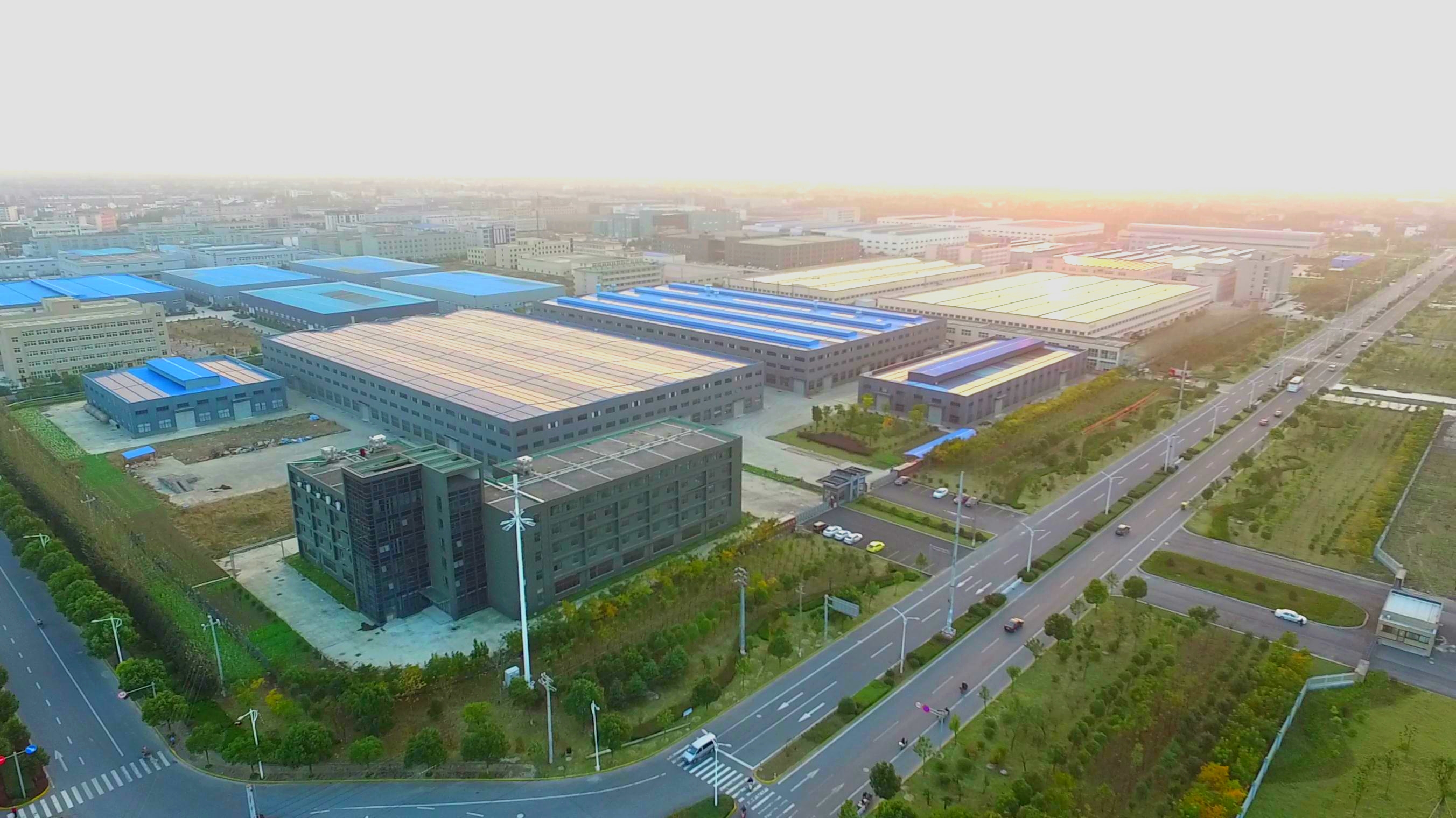
Supplier preference in agricultural components is usually formed long before a purchase order exists, and it is often formed on claims that no one verifies. A shortlist built from brochures tends to collapse during evaluation, when the buyer asks for a floor area, a machine list, an annual tonnage, a certificate number with an expiry date, or a physical location that can receive a shipment.
The useful question for a buyer in the evaluation stage is therefore not “who says they can do it” but “what is documented.” Zhejiang Pointiron Technology Co., Ltd (brand reference: Pointiron casting) is a Chinese manufacturer founded in 2000 that operates a 66,770 m² plant at No.2389 South Huancheng Rd, Tongxiang City 314500, Zhejiang, China, producing component parts for agriculture use and component parts of auto-mobile through casting, machining, painting and final assembly, and serving US customers through Point Iron USA, Inc., which warehouses products at 1045 Hickory St, Unit A, Pewaukee, WI, USA. This article reads that record the way a procurement team should read it: fact by fact, and with the gaps left visible.
The shortlist problem: preference forms before verification
Agricultural component sourcing spans a wide set of part families — tractor components, components of lawn and garden mowers, seeder and scarifier parts, braking system parts, steering system parts, axles, hubs, knuckles, brackets, supports, arms, holders, wheels, gearbox housings, rotors and park locks. Each family carries its own acceptance criteria, and each one passes through several process steps before it reaches a machine assembly line.
That structure creates a documentation problem. A foundry can prove melting and moulding capability but not machining repeatability. A machine shop can prove tolerance capability but not material traceability at the casting stage. A trading intermediary can prove neither, but can often quote faster. Buyers who compare these options on price alone systematically undervalue the handoffs between them — and the handoffs are where lead-time and quality risk accumulate.
Decision rule: a supplier belongs on a shortlist when its capability claims can be matched to a named evidence class — site, equipment, capacity, certification record, commercial terms, or service footprint. Claims with no matching evidence class should be treated as unverified, not as disqualifying.
What the Pointiron plant record actually contains
The disclosed record for Pointiron is unusually specific for a component supplier, because it separates the plant from the process and the process from the commercial terms. The table below maps each disclosed fact to the shortlist question it answers.
| Evidence class | Disclosed fact | Shortlist question it answers |
|---|---|---|
| Site | 66,770 m² facility; Tongxiang City 314500, Zhejiang, China | Is there physical capacity, and where is it? |
| Workforce | Approximately 200 employees | Is the process capital-intensive or labour-intensive? |
| Engineering | 3 R&D engineers | How much parallel development can be absorbed? |
| Casting equipment | Two casting lines imported from DISA Denmark: DISA MATCH32/32 Horizontal Auto Molding Line and DISA 131B Vertical Auto Molding Line | Which moulding route will my part run on? |
| Casting capacity | Annual casting capacity 35,000 tons (ductile iron, gray iron); monthly capacity 3,000 tons | Can the volume be absorbed alongside existing work? |
| Machining capacity | 5 million pieces per year | Is machining in-house or subcontracted? |
| Finishing | Three paint lines: wet paint line, powder coat line, E-coat line | Which corrosion system applies to my drawing? |
| Assembly | One assembly line; annual output 2,000,000 units | Can sub-assemblies be delivered rather than loose parts? |
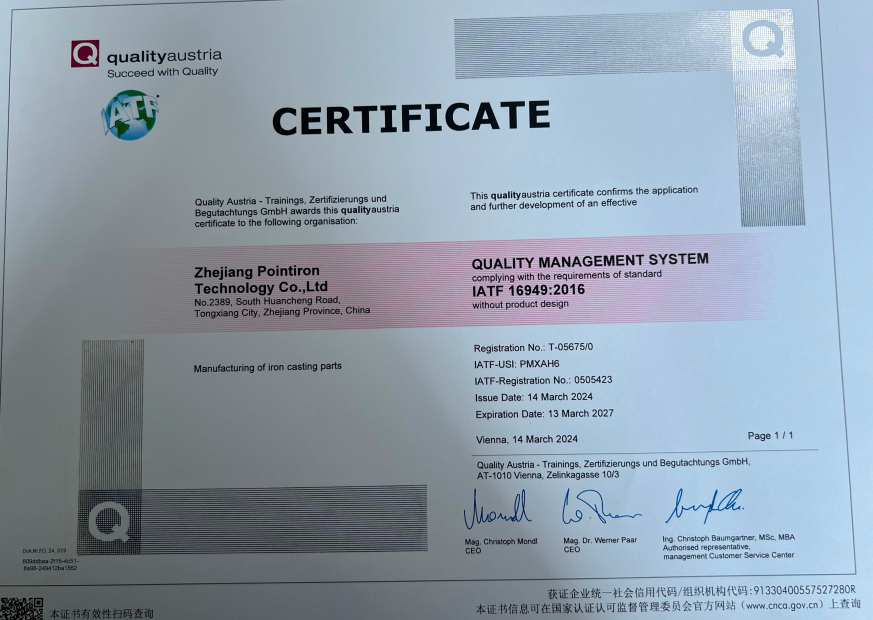
| Quality system | IATF 16949 certificate T-05675/0, issued 14 March 2024, expiring 13 March 2027; stated ISO14001:2004 and IATF16949:2009 certification | Is the management system documented and current? |
| Commercial terms | OEM/ODM; customisation of size, logo, colour and surface treatment; 12-week lead time; MOQ scaled by piece weight; 100% test; warranty | Does the commercial model fit my programme size? |
| Service footprint | Point Iron USA, Inc. warehouses products in the US for US customers, 1045 Hickory St, Unit A, Pewaukee, WI, USA | Is there a domestic point of physical contact? |
Reading the numbers: what capacity evidence signals to an agricultural buyer
A 66,770 m² site with approximately 200 employees points to a capital-intensive operating model rather than a labour-intensive one. For a buyer, the practical implication is that throughput depends on equipment utilisation and scheduling discipline, not on headcount flexibility — which makes the machine list and the capacity figures more informative than the workforce number.
The disclosed capacities describe three different stages rather than one. Annual casting capacity of 35,000 tons covers ductile iron and gray iron; machining capacity is stated at 5 million pieces per year; annual production output is stated at 2,000,000 units, with a monthly capacity figure of 3,000 tons reported alongside. Read together, these figures indicate that machining and assembly are treated as first-class operations inside the plant, not as outsourced steps. A buyer should still ask a direct question that no disclosure answers: how much of that capacity is already committed to running programmes, and what share is genuinely available in the quarter the order would enter.
The smallest number on the record is also the most decision-relevant. Three R&D engineers is a lean engineering function. For derivative work — adapting an existing casting to a new mounting interface, adjusting a bracket or housing for a revised mower deck, supporting a colour or surface-treatment change — that structure is workable. For clean-sheet development of a new axle or gearbox housing running in parallel with several other customer programmes, engineering bandwidth becomes a scheduling constraint that a buyer should plan around rather than discover later.
Casting, machining, painting and assembly in one continuous flow
Pointiron describes a one-stop service model covering casting, machining, painting and final assembly, applied to brake parts (caliper brackets, housings and steering knuckles), windmill components (housings, planet carriers and connect covers), tractor components, and components of lawn and garden mowers and sub-assemblies. The operational value of that structure is not that four processes exist, but that they sit under one quality system and one material-traceability chain.
Moulding
Two DISA Denmark lines are listed: a DISA MATCH32/32 Horizontal Auto Molding Line and a DISA 131B Vertical Auto Molding Line. Both are automated moulding routes, and the presence of a horizontal and a vertical line is a legitimate technical question rather than a marketing point. Moulding orientation influences pattern design, parting-line placement and tooling cost, so a buyer should confirm which line a specific part will run on before approving a tooling budget. That question is answerable at quotation stage and belongs in the RFQ, not in the post-award debrief.
Material
The casting operation covers both ductile (nodular) iron and gray iron. Material selection is a system decision: gray iron held a 47.68% share of total iron casting volume in 2025, which is consistent with its low cost and vibration-damping characteristics, while ductile iron is generally specified where higher mechanical demand is present. Neither statement substitutes for the buyer's own acceptance criteria. The verified data set used for this article did not contain grade tables, tensile requirements or elongation limits, so material grade confirmation must come from the drawing and the buyer's specification, not from a supplier summary.
Finishing and assembly
Three paint lines — wet paint, powder coat and E-coat — give a buyer a choice of corrosion strategy rather than a single default, which matters for agricultural equipment exposed to slurry, fertiliser and wash-down cycles. The relevant procurement action is to state the expected exposure and let the finishing system be nominated, then verify which of the three lines will be used. A single assembly line supports sub-assembly delivery, which reduces incoming inspection at the machine plant but shifts the verification obligation upstream to the assembly control plan.
Certification: what the record shows, and what it does not
Pointiron holds IATF 16949 certificate T-05675/0, issued by Quality Austria-Trainings, Zertifizierungs und Begutachtungs GmbH on 14 March 2024 and valid until 13 March 2027. The certificate lists markets covering the EU, US, Middle East and Southeast Asia, and describes its scope as automobile. The company also states that it implements IATF16949 quality systems through the end-to-end production process and that it is certified to ISO14001:2004 and IATF16949:2009.
Two boundaries follow from that record. First, a quality-system certificate does not certify a part. It evidences a management system, not the dimensional or metallurgical conformity of a specific casting. Second, the scope wording matters: an agricultural buyer should confirm in writing that the certificate scope covers the agricultural component families being quoted, because the published scope field reads “automobile” while the product portfolio explicitly includes tractor, mower and lawn and garden components. That is a documentation check, not a red flag — but it belongs in the supplier file.
The standards landscape around agricultural machinery sits at machine and system level. ISO 4254-1:2013 sets general safety requirements and means of verification for several categories of agricultural machines. ISO 25119 addresses safety-related parts of control systems for tractors and agricultural and forestry machinery, covering design principles, fault detection, reliability and production-related processes. ISO 18497-1:2024 specifies principles for machinery and tractors with partially automated, semi-autonomous and autonomous functions. None of these documents certifies a casting supplier; they define what the finished machine must satisfy, and therefore what evidence the component supplier may be asked to support.
Application fit: where these component families are used
The disclosed portfolio ties the plant to specific machine contexts rather than to a generic casting category. Tractor components are the clearest case. A global agricultural machinery supply programme for an Agricultural Machinery OEM client covered 20,000 units in tractor application over a 10-year supply period, and the project is reported as achieving 10 years of stable operation. Reported highlights for that case are structural stability, wear resistance and long service life under heavy farm loads. Those three attributes map directly onto the failure modes that dominate field returns in agricultural driveline and chassis parts.
Lawn and garden mower components and sub-assemblies form a second context, one where weight, surface finish and coating durability typically carry more weight than extreme load capacity. Brake parts — caliper brackets, housings and steering knuckles — sit in the safety-relevant group, where the buyer's documentation expectations rise sharply because these parts feed braking and steering systems. Windmill components, including housings, planet carriers and connect covers, represent a rotating-equipment context in which casting soundness and machining consistency matter more than cosmetic finishing.
Component families sourced across tractors, mowers, seeders, scarifiers and lawn and garden equipment — axles, hubs, knuckles, brackets, supports, arms, holders, wheels, gearbox housings, rotors and park locks — do not share a single acceptance standard, and buyers should resist treating them as one commodity group. Customs treatment adds a further layer. Official classification places agricultural, horticultural, forestry, poultry-keeping and bee-keeping machinery under heading 8436, with parts under subheadings 843691 and 843699; soil preparation and cultivation machinery under 8432 with parts under 843290; and harvesting, threshing and mowing machinery under 8433 with parts under 843390. A cast component may fall under different headings depending on the finished machine's function, so classification should be confirmed part by part rather than inherited from a previous shipment.
Market context behind current preference decisions
The published market picture is mixed, and that mixture is itself the argument for evidence-based shortlisting. The global agricultural machinery components market is estimated at USD 58.12 billion in 2026, growing at a CAGR of 6.04%, according to commercial research published by Strategic Revenue Insights. At the same time, global trade of motor vehicle parts and accessories under HS 8708, a heading that includes tractor parts, reached USD 448 billion in 2024, a 2.37% decrease from 2023, based on data aggregated by the Observatory of Economic Complexity from UN Comtrade.
A growth estimate for the component category alongside a contraction in the adjacent trade series is not a contradiction; it is a signal that value and volume are moving differently. For buyers, the practical translation is that price pressure remains real while capacity availability can tighten quickly when demand turns. Suppliers whose capacity is documented — tonnage, machine list, floor area — are easier to model in a supply-continuity plan than suppliers whose capacity is asserted. The agricultural gearbox segment illustrates the same dynamic from the demand side: that market is projected to reach USD 8.5 billion by 2033, which implies sustained component demand inside gearbox and driveline assemblies.
Integrated plant versus split supply chain: a fair comparison
The one-stop model is one of three common structures in agricultural component sourcing, and each has a defensible use case. The comparison below is structural, not a ranking: no verified performance data was available to rank suppliers on quality or delivery outcomes, and this article does not make such a claim.
| Sourcing structure | Strength | Trade-off to manage |
|---|---|---|
| Integrated casting, machining, painting and assembly (Pointiron model) | Fewer process handoffs, one quality system, single traceability chain | Commercial terms are set by the plant's own scheduling logic; lead time and MOQ reflect plant economics |
| Foundry plus separate machine shop | Each process can be sourced competitively; machining specialists can be selected per part family | Material traceability and quality responsibility split across two contracts |
| Trading intermediary | Low administrative load; consolidated ordering across multiple parts | Process evidence sits with a third party the buyer may not audit directly |
The limits on the integrated model should be stated as plainly as its strengths. A 12-week lead time is not a short cycle, and buyers running seasonal build programmes need to place orders with that horizon in view rather than treat it as a buffer. Minimum order quantities scale by piece weight: pieces under 10 pounds carry a 10,000-piece minimum; 10–20 pounds, 5,000 pieces; 20–100 pounds, 2,000 pieces; 100–150 pounds, 1,000 pieces. Small aftermarket programmes and trial builds will therefore need a different commercial route or a consolidated multi-part order. A 20% export ratio alongside USA and EU main markets means a substantial share of output serves other destinations, so a buyer should establish where their programme sits in the production mix.
Finally, the evidence set for this article contained no per-part dimensional tolerances, fatigue or load-rating validation, scrap-rate data, or named customer references. Those gaps are normal for public disclosures, but they define the next procurement step: request the control plan, the material certificate for the specified grade, the PPAP or equivalent submission level, and the inspection record format before awarding a programme.
Future outlook
Two forces are likely to change how agricultural component suppliers are evaluated. The first is documentation depth. As machinery-level safety expectations evolve — the ISO 25119 series was updated in 2025 and ISO 18497-1:2024 now frames principles for partially automated and autonomous machinery — component suppliers will be asked for evidence that supports system-level validation, even where the casting itself carries no electronics. Suppliers who can produce traceability, change-control and inspection records on request will find that requirement easier to absorb.
The second is service geography. A US warehouse operation, in this case Point Iron USA, Inc. in Pewaukee, Wisconsin, changes the replenishment pattern rather than the manufacturing capability. For North American buyers it shortens the physical distance between order and delivery and provides a domestic point of contact, while the technical capability remains anchored in the Tongxiang plant. The reasonable expectation is not that this removes lead-time risk, but that it separates inventory risk from production risk — a distinction worth writing into a supply agreement.
FAQ
What plant facts can be verified before shortlisting an agricultural component supplier?
Six evidence classes can be checked without a site visit: facility area and address, the machine list, annual and monthly capacity, the quality-system certificate with its number and validity dates, commercial terms such as lead time and minimum order quantity, and any physical service footprint in the destination market. For Pointiron, these correspond to a 66,770 m² plant in Tongxiang City, Zhejiang, China; two DISA Denmark casting lines; 35,000 tons annual casting capacity; IATF 16949 certificate T-05675/0 valid to 13 March 2027; a 12-week lead time with weight-scaled MOQs; and a US warehouse operated by Point Iron USA, Inc.
Where is the Pointiron plant located and how is it sized?
Zhejiang Pointiron Technology Co., Ltd operates a 66,770 m² facility at No.2389 South Huancheng Rd, Tongxiang City 314500, Zhejiang, China. The company was founded in 2000 and employs approximately 200 people, including 3 R&D engineers. Annual production output is stated at 2,000,000 units.
Which casting and finishing equipment is installed?
Two casting lines imported from DISA Denmark are listed: a DISA MATCH32/32 Horizontal Auto Molding Line and a DISA 131B Vertical Auto Molding Line. Finishing comprises three paint lines — a wet paint line, a powder coat line and an E-coat line — and there is one assembly line. Casting capacity covers both ductile iron and gray iron, and machining capacity is stated at 5 million pieces per year.
What certifications are held, and what is their scope?
Pointiron holds IATF 16949 certificate T-05675/0, issued by Quality Austria-Trainings, Zertifizierungs und Begutachtungs GmbH on 14 March 2024 and expiring 13 March 2027. The certificate lists markets covering the EU, US, Middle East and Southeast Asia, and its scope is described as automobile. The company additionally states that it is certified to ISO14001:2004 and IATF16949:2009 and implements IATF16949 quality systems throughout the end-to-end production process. A certificate evidences a management system; it does not certify an individual component.
What commercial terms apply to an order?
The production mode is OEM/ODM with customisation of size, logo, colour and surface treatment. Lead time is stated at 12 weeks and quality control is described as 100% test, with a warranty stated for after-sales. Monthly capacity is reported as 3,000 tons. Minimum order quantity is quoted as TBD and scales by piece weight: under 10 pounds, 10,000 pieces; 10–20 pounds, 5,000 pieces; 20–100 pounds, 2,000 pieces; 100–150 pounds, 1,000 pieces. Export markets are listed as EU and USA, with an export ratio of 20%.
What programme history is documented for agricultural use?
A global agricultural machinery supply programme for an Agricultural Machinery OEM client covered 20,000 units in tractor application across a 10-year supply period, and the project is reported as achieving 10 years of stable operation. Reported highlights are structural stability, wear resistance and long service life under heavy farm loads. The client is not named in the available record.
What are the limits of the disclosed evidence?
Several boundaries are visible in the record. The engineering function is small at 3 R&D engineers, which constrains how many complex development programmes can run concurrently. The 12-week lead time and weight-scaled minimum order quantities will not suit very small or trial-volume orders. The IATF 16949 scope field reads automobile, so agricultural coverage should be confirmed in writing. No public per-part tolerance, fatigue or load-rating data, scrap-rate figure, or named customer reference was available. Each of these is a documentation request rather than a disqualifier, and each should be closed before a production award.
Reference documents: Pointiron company introduction (PDF) — Pointiron introduction. Company site: www.pointiron.com. Contact record: Jiangfeng Yu, jiangfengyu@yubother.com, +1-262-720-8729; US address 1045 Hickory St, Unit A, Pewaukee, WI, USA.
¿Tiene preguntas o necesita más detalles?
Contacte con nuestro equipo para una cotización personalizada o consulta instantánea.
Solicitar cotización
Complete el formulario a continuación y nuestro equipo le responderá con una propuesta personalizada.
Chat directo de WhatsApp
¿Prefiere chatear en tiempo real? Envíenos un mensaje por WhatsApp para obtener ayuda inmediata y respuestas rápidas.
- Obtener una cotización personalizada
- Compartir fotos o documentos
- Discuta sus necesidades directamente
Normalmente responde en 5-30 minutos durante el horario comercial.