
Supplier Capability Evidence: NINGBO JINCHANG ELECTRONICS and the SC750 Food Steamer
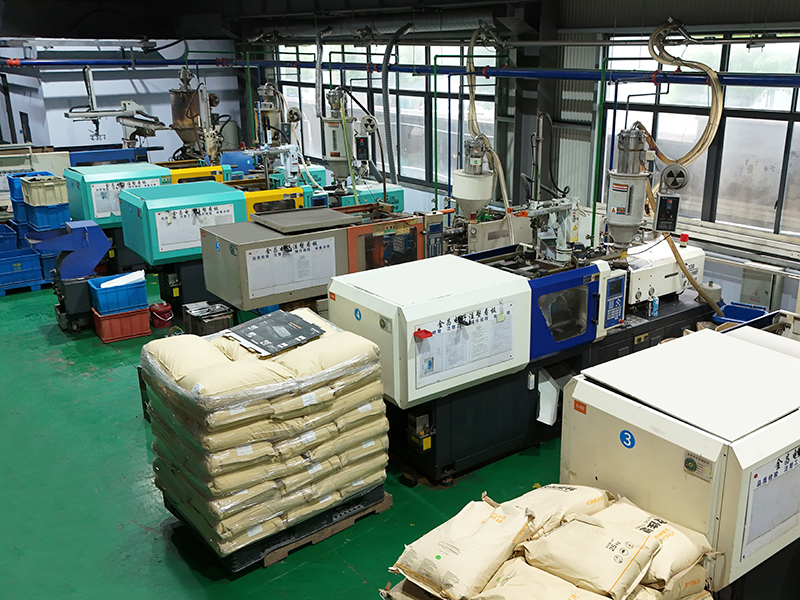
Production workshop of NINGBO JINCHANG ELECTRONICS CO., LTD., Yuyao City, Zhejiang Province — the manufacturing site named in the ICS and amfori BSCI audit documents.
Food steamer sourcing rarely stalls on the product itself. It stalls on paperwork: a supplier can demonstrate a competent 7-litre, two-tier countertop unit and still hold up a purchase order because the factory-level compliance file does not match the destination market, the audited site, or the model being quoted.
That is why supplier capability evidence — documents issued by third parties about a factory and a specific model — now sits next to samples at the evaluation stage of a food steamer project. For buyers assessing the SC750 electric food steamer from NINGBO JINCHANG ELECTRONICS CO., LTD., that evidence is concentrated in two SGS-issued documents. An ICS Audit Summary of Content, valid from 2025-06-05 to 2027-06-05, confirms that the manufacturing processes for electric food steamers and other appliances at the named factory comply with ICS social compliance requirements. A separate amfori BSCI Monitoring Summary Report, reference 24-0279560-1, valid from 2025-09-26 to 2026-10-08, covers the social-compliance management system and labour-rights performance areas.
NINGBO JINCHANG ELECTRONICS CO., LTD. is a manufacturer of small household kitchen appliances located at No.17 Guangming East Road, Ditang Sub-district, Yuyao City, Zhejiang Province, China. The company operates a 5,500-square-metre production plant inside China's home-appliance industrial cluster and exports electric BBQ grills, electric steamers, charcoal grills and food dehydrators, with roughly 90 percent of output directed to markets including the EU, the United States, Australia and Russia.
Why documentation, not specifications, now gates steamer orders
The commercial problem is straightforward. European retail buyers increasingly treat social-compliance auditing as a condition of listing, not as a differentiator. A factory that can produce a reliable 800W countertop steamer but cannot show an audited social-compliance record will often be filtered out before pricing is discussed, because the retailer's own sourcing policy requires it. The ICS initiative and the amfori BSCI system exist precisely to give buyers a common reference framework for factory-level labour and management conditions, so that suppliers are compared on a shared baseline rather than on self-declaration.
The opportunity for a mid-sized manufacturer is equally straightforward. When factory-level audits are issued by a recognised third party and carry identifiable references and validity windows, the supplier can be evaluated on evidence rather than on claims. That shifts the conversation from “we are a compliant factory” to “here is the document, the issuing body, the audited site, the scope and the expiry date”. For the buyer, the difference is auditability.
The three documentary layers behind the SC750
Supplier capability evidence for a countertop electric food steamer rarely comes as a single file. In practice it arrives in three layers, and each layer answers a different question: who is the factory and how is it managed, how is the workforce organised, and is this specific model safe and market-ready.
| Document | Issued by | Reference | Valid from | Valid to | Stated scope |
|---|---|---|---|---|---|
| ICS Audit Summary of Content | SGS | Not stated in the summary | 2025-06-05 | 2027-06-05 | Factory NINGBO JINCHANG ELECTRONICS CO., LTD. — electric grills, food dehydrators, charcoal grills and electric steamers |
| amfori BSCI Monitoring Summary Report | SGS | 24-0279560-1 | 2025-09-26 | 2026-10-08 | Same factory and product scope; amfori BSCI Code of Conduct |
| ISO 9001 Quality Management System Certificate | NOA Testing & Certification Group Ltd. | NOA2409732 | 2024-10-11 | 2027-10-10 | Production and sales of barbecue grills within the scope of CCC qualification |
| ISO 14001 Environmental Management System Certificate | NOA Certification Group Co., Ltd. | NOA2507153 | 2025-09-18 | 2028-09-17 | Production and export of barbecue grills |
| SGS Food Contact Test Report (LFGB, Germany) | SGS | NGBEC26006183701 | 2026-07-29 | 2028-07-29 | electric steamer SC750 |
| SGS Food Contact Test Report (DGCCRF, France) | SGS | NGBEC26006183702 | 2026-07-29 | 2028-07-29 | electric steamer SC750 |
| SGS SVHC Test Report (REACH) | SGS | NGBEC26006230701 | 2026-08-05 | 2028-08-05 | electric steamer SC750 |
The table is worth reading slowly, because the scope column is where most sourcing mistakes happen. The social-compliance audits are factory-level and explicitly include electric steamers. The two management-system certificates are narrower: their stated scope names barbecue grills, not the steamer line. The three SGS test reports are model-level and name the SC750 directly. A buyer who treats all seven documents as interchangeable will misread what is actually being certified.
Reading the ICS Audit Summary of Content (SGS, valid to 2027-06-05)
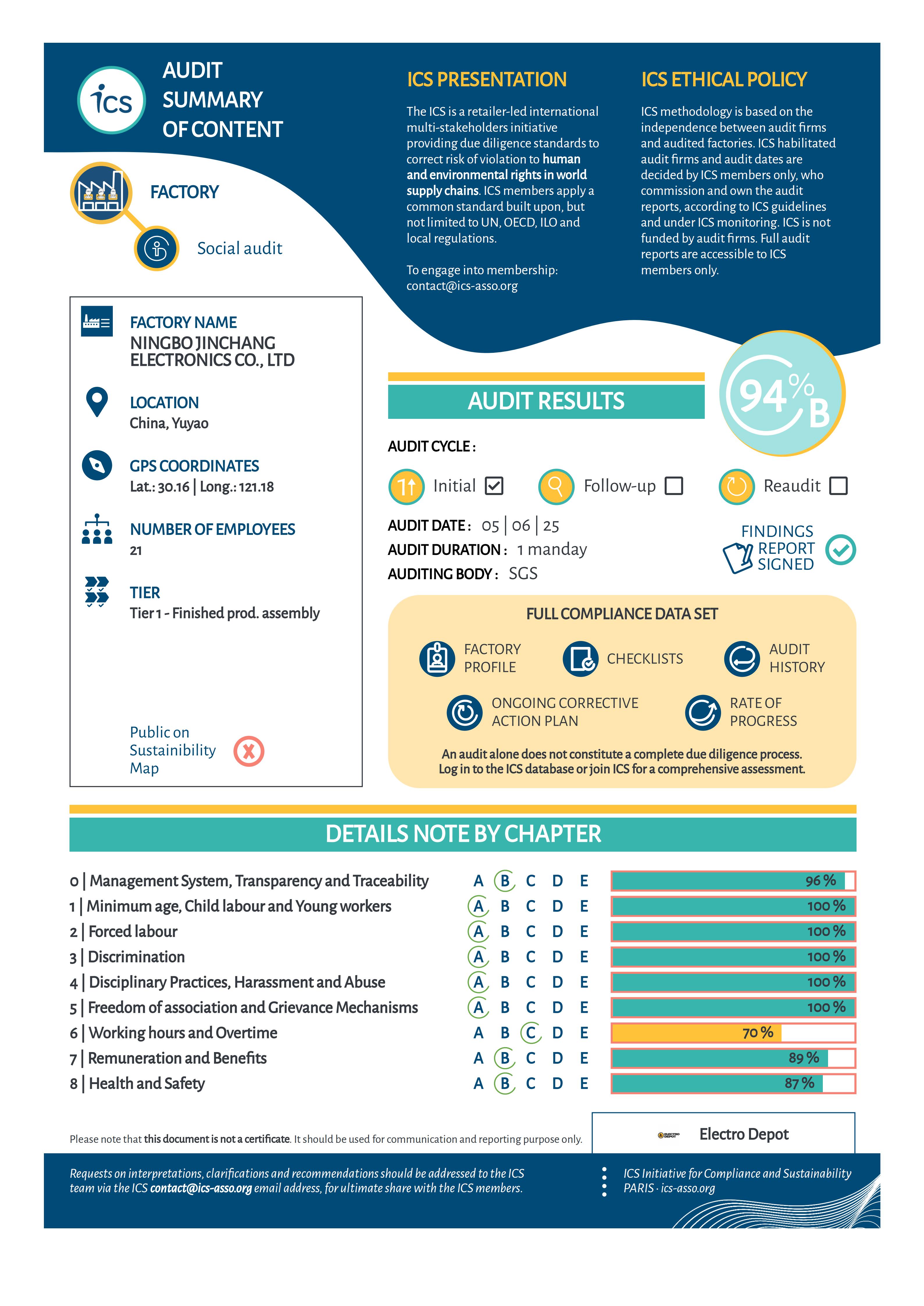
ICS Audit Summary of Content issued by SGS, valid 2025-06-05 to 2027-06-05, naming electric steamers within the audited product scope.
The ICS Audit Summary of Content is the document that most directly answers the question “is this factory audited for the appliance I am buying?” It was issued by SGS against ICS initiative social compliance requirements, and it covers the factory NINGBO JINCHANG ELECTRONICS CO., LTD. The stated scope lists the manufacturing of electric grills, food dehydrators, charcoal grills and electric steamers — which places the SC750 steamer programme inside the audited boundary rather than outside it.
The summary states that the audit covers 13 performance areas, including the social-compliance management system and labour-rights performance areas. For an EU-facing supply chain, that framing has a practical consequence: it converts social compliance from a supplier questionnaire into a document with an issue date of 2025-06-05 and a validity period running to 2027-06-05.
Two points deserve emphasis. First, the validity window extends beyond the current order cycle, which means a buyer planning shipments through 2027 can reference an audit document that remains within its stated period. Second, the summary is not a product certificate; it says nothing about electrical safety, food-contact migration or energy consumption. Those questions are answered by the model-level documents described further below.
Reading the amfori BSCI Monitoring Summary Report 24-0279560-1
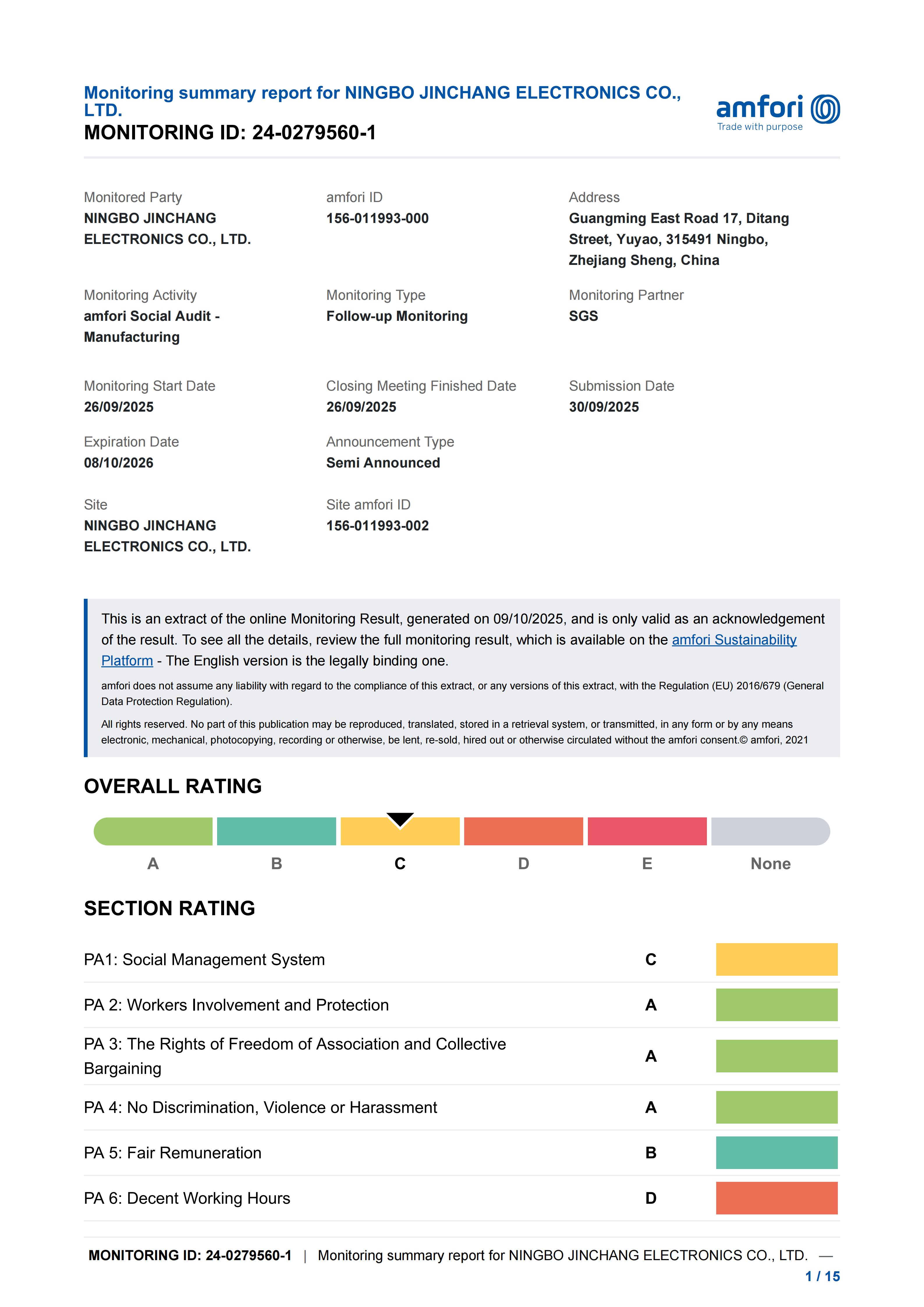
amfori BSCI Monitoring Summary Report 24-0279560-1 issued by SGS, valid 2025-09-26 to 2026-10-08.
The second document is issued under a different framework. The amfori BSCI Monitoring Summary Report, reference 24-0279560-1, was issued by SGS against the amfori BSCI Code of Conduct, with a validity period from 2025-09-26 to 2026-10-08. Its scope again names the factory NINGBO JINCHANG ELECTRONICS CO., LTD., covering the manufacturing of electric grills, food dehydrators, charcoal grills and electric steamers, and it focuses on the social-compliance management system and labour-rights performance areas — the same 13-performance-area structure referenced in the ICS summary.
For buyers whose retail customers recognise amfori BSCI reporting specifically, this is the more directly usable of the two documents. It also introduces the single most time-sensitive fact in this article.
This asymmetry is not a defect; it is normal in social-compliance auditing, where different schemes operate different validity cycles. It is, however, an execution-stage task that belongs on the buyer's checklist rather than in the supplier's marketing material.
From factory audit to model-level evidence: how the SC750 is documented
The SC750 electric food steamer is a two-layer countertop steamer with a 7-litre capacity, rated at 800W and 230V, with a plastic housing and a material composition of PP, ABS (knob) and PC indicator. Its listed certifications are CE, LFGB and CB.
| Parameter | SC750 specification |
|---|---|
| Product type | Electric steamer (countertop, plug-in) |
| Power | 800W |
| Voltage | 230V |
| Layers | 2-layer |
| Capacity | 7L |
| Housing material | Plastic (PP + ABS knob + PC indicator) |
| Listed certifications | CE, LFGB, CB |
| Control | Mechanical rotary timer, auto-off dry-burn protection |
On the product side, the evidence chain is specific rather than general. The SGS LFGB food contact test report NGBEC26006183701 was issued on 2026-07-29 against Regulation (EC) No 1935/2004, German LFGB Section 30 and 31, BfR recommendations and (EU) No 10/2011 as amended by (EU) 2025/351, and remains valid to 2028-07-29. The parallel DGCCRF report NGBEC26006183702, applicable to France, was issued on the same date with the same validity period and references French Décret 2007-766, the DGCCRF MCDA n°3, French Law 2012-1442 and Commission Regulation (EU) 2024/3190. A third SGS report, NGBEC26006230701, covers REACH SVHC screening against Regulation (EC) No 1907/2006 and the ECHA SVHC Candidate List, issued 2026-08-05 and valid to 2028-08-05.
The technical logic behind these tests is simple. Under high-temperature steam, food-contact components are the parts most likely to raise migration concerns if non-food-grade raw material is used. The LFGB and DGCCRF reports address exactly that exposure, for the steaming trays and the cavity, on the named model. Separately, IEC 60335-1 and the relevant Part 2 standards (IEC 60335-2-15 / 60335-2-3) are the primary international safety standards for household electric steam cookers, which is the framework the CE and CB listings for the SC750 sit within.
The distinction matters commercially: a factory audit does not transfer to a model, and a model test report does not validate a factory. Both layers are required, and in this case both exist.
What this evidence means at the evaluation and execution stages
For a purchasing team moving from evaluation into execution, the useful question is not “how many certificates does the supplier have?” but “does each document match my model, my market and my order timeline?” The following checklist is built directly from the document set above.
| Checks | What to confirm | Where the answer sits |
|---|---|---|
| Audited site | Factory name and address match the contracting entity | ICS and amfori BSCI summaries both name NINGBO JINCHANG ELECTRONICS CO., LTD. |
| Product scope | Electric steamers fall inside the audited scope | Both audit summaries list electric steamers |
| Validity window | Document remains valid across production and shipment dates | ICS to 2027-06-05; amfori BSCI to 2026-10-08 |
| Model-level testing | Test reports name the exact model being ordered | LFGB, DGCCRF and REACH reports name the SC750 |
| Market alignment | Test standard matches destination market | LFGB for Germany; DGCCRF for France; REACH and CE/CB for the EU |
| Commercial terms | MOQ, lead time and warranty match the retail plan | MOQ 5,000 units; lead time 30 days; 1-year warranty |
Beyond the document check, the supplier profile supplies execution-stage parameters that shape the order plan. Manufacturing capacity is stated at 100,000 units per month against an annual output of 1,200,000 units, quality control is described as 100 percent testing, and the company supports OEM and ODM production with customisation covering logo, voltage, and product design and development, including private-mould development and customised packaging. The plant runs with 68 employees and an R&D team of eight engineers, and the company holds more than 30 independent intellectual property rights including invention and utility-model patents.
Application fit and deployment scenarios
The SC750 is positioned primarily for the household consumer market, and also for B2B foreign-trade procurement scenarios including cross-border e-commerce, home-appliance gifts, and homestay and apartment supporting supplies. Its working environment assumes indoor countertop use on a stable, level surface, exposure to hot steam and water vapour, a stable 230V AC supply from a grounded wall socket, and regular cleaning after use. The 7-litre two-tier format is designed for simultaneous steaming of vegetables, seafood, meat, dumplings, eggs and prepared food under a rotary timer, with auto-off dry-burn protection as a safety function.
There is also a documented channel outcome worth noting for buyers building a category plan. A large home goods supermarket chain across Australia, Germany and France has taken 40,000 to 60,000 units per year over a 3 to 5 year period for household daily steaming and cooking, with reported steady shelf sales, a low return rate, and stronger performance in peak shopping seasons. The cited reasons for the listing were multi-certified compliance, food-grade material and multi-layer configurability.
Two configuration paths are relevant here. The mechanical-timer version is simple to operate across age groups, has a comparatively lower failure rate, and avoids the network-standby compliance considerations that apply to connected appliances under Ecodesign requirements. A double-layer 7-quart format cooks multiple portions simultaneously at the same power consumption as a single-layer unit, but requires more vertical storage space — a real consideration for retail packaging and shelf planning, not just for end users.
Market context: a growing category with uneven data
The category context supports continued sourcing activity, provided the numbers are read with appropriate caution. Global electric food steamer market size was reported at approximately USD 3.68 billion in 2024 by Custom Market Insights, and the same research house projects a compound annual growth rate of 5.32 percent from 2025 to 2034.
That growth figure is contested. Independent research publishers have issued materially higher projections — 11.2 percent and 9.6 percent — for broadly the same category. The most plausible explanation is definitional: wider estimates appear to include multi-functional cookers, smart and IoT-connected steamers, and commercial-grade equipment, while broader industrial definitions produce lower growth rates. Buyers should note that the same category can appear to grow at very different speeds depending on which sub-segments a report includes. That is a planning assumption, not a supplier claim.
Regional and trade signals are more consistent. Asia-Pacific is described as the largest and fastest-growing market for electric steamers as of 2024/2025. China remains the dominant exporter in tracked trade corridors: data from Zauba and Volza indicate that China accounted for roughly 88 percent of import shipments of food steamers in the corridors tracked, although this figure is derived from secondary trade data and should be treated as directional. Classification itself adds friction — electric food steamers typically fall under HS Code 8516.60 or HS 8419.81, which makes clean category-level trade measurement difficult.
Comparison with conventional supplier screening — and the limits of this evidence
Conventional supplier screening for countertop electric food steamers typically relies on sample inspection, a self-declared CE marking, and a supplier questionnaire covering factory size and capacity. The document-based approach described here is more auditable, because each claim carries an issuing body, a reference, a validity period and a named scope. It also changes the sequence of evaluation: scope matching happens before price negotiation, which reduces late-stage qualification failures.
Several limits are worth stating plainly.
- Social compliance is not product safety. The ICS and amfori BSCI documents address management systems and labour-rights performance areas. They do not demonstrate that an individual steamer is electrically safe, that food-contact parts meet migration limits, or that energy consumption is compliant. Those claims rest only on the model-level CE, LFGB and CB listings and the SC750 test reports.
- Management-system scope is narrower than the product catalogue. The ISO 9001 certificate NOA2409732 covers production and sales of barbecue grills within the scope of CCC qualification, and ISO 14001 certificate NOA2507153 covers production and export of barbecue grills. Neither scope names the electric steamer line, so buyers cannot rely on them as steamer-specific system evidence; ICS and amfori BSCI are the documents whose scope explicitly names electric steamers.
- Validity windows are not synchronised. The amfori BSCI monitoring summary expires on 2026-10-08, considerably earlier than the ICS summary (2027-06-05) and the product test reports (2028). Renewal tracking is therefore an ongoing buyer task.
- Audits are point-in-time. A valid document reflects conditions at the time of audit. It supports supplier qualification; it does not replace lot-level inspection or pre-shipment checks.
- Voltage and after-sales constraints. The SC750 is rated 230V and will not operate on 110V without a voltage-adjusted model, and there is no local on-site after-sales service, which affects the after-sales model for distributors in some markets.
- Order economics. An MOQ of 5,000 units and a 30-day lead time shape trial-order planning, particularly for buyers testing a new steamer format in a single market.
Future outlook
Three developments are likely to shape how this evidence set is used over the next sourcing cycles. First, social-compliance documents with defined validity windows will continue to function as recurring procurement gates rather than one-off qualifications, which means renewal dates become operational calendar items on both sides of the transaction. Second, the EC/EU direction of travel on Ecodesign and network-standby requirements keeps mechanical-control formats commercially relevant for mass retail and gift-set channels, alongside smart variants in dedicated smart-home channels. Third, as the steamer category grows across Asia-Pacific and established Western markets, differentiation between mid-sized manufacturers will increasingly rest on the depth and currency of third-party documentation rather than on catalogue breadth.
For the SC750 specifically, the immediate practical position is that factory-level social-compliance coverage runs to 2027-06-05 under ICS, model-level food-contact and SVHC test coverage runs to 2028, and the amfori BSCI monitoring summary is the document requiring attention now.
FAQ
What does the ICS Audit Summary of Content confirm about NINGBO JINCHANG ELECTRONICS CO., LTD.?
It is a document issued by SGS, valid from 2025-06-05 to 2027-06-05, stating that manufacturing processes at the factory NINGBO JINCHANG ELECTRONICS CO., LTD. for electric food steamers and other appliances comply with ICS social compliance requirements. The stated scope lists electric grills, food dehydrators, charcoal grills and electric steamers, and the summary indicates coverage of 13 performance areas including the social-compliance management system and labour-rights performance areas.
How does an amfori BSCI Monitoring Summary Report differ from an ICS Audit Summary of Content?
Both documents were issued by SGS for the same factory and both address social-compliance management and labour-rights performance areas, but they operate under different frameworks and validity periods. The amfori BSCI Monitoring Summary Report, reference 24-0279560-1, is issued against the amfori BSCI Code of Conduct and is valid from 2025-09-26 to 2026-10-08. The ICS Audit Summary of Content is issued against ICS initiative social compliance requirements and is valid from 2025-06-05 to 2027-06-05. Retail customers may accept one scheme, the other, or both, so buyers usually need to know which document their customer recognises.
Are the SC750 food-contact parts covered by third-party test reports?
Yes. Two SGS food contact test reports name the electric steamer SC750: NGBEC26006183701 for Germany under LFGB, and NGBEC26006183702 for France under DGCCRF, both issued on 2026-07-29 and valid to 2028-07-29. A third SGS report, NGBEC26006230701, covers REACH SVHC screening and was issued on 2026-08-05, valid to 2028-08-05. The SC750's listed product certifications are CE, LFGB and CB.
What does the 2026-10-08 expiry date on the amfori BSCI report mean for an order placed now?
The amfori BSCI Monitoring Summary Report 24-0279560-1 reaches the end of its stated validity on 2026-10-08. For orders confirmed around or after that date, buyers should request the renewed or extended monitoring summary, or written confirmation of its renewal status, as part of the order documentation. The ICS Audit Summary of Content remains valid to 2027-06-05 and the SC750 test reports remain valid to 2028, so the three document groups do not expire together.
Do social-compliance audit documents prove that a food steamer is safe to use?
No. The ICS and amfori BSCI documents address social-compliance management systems and labour-rights performance areas, not product safety, food-contact migration or energy consumption. Product-level evidence for the SC750 comes from its listed CE, LFGB and CB certifications, the SGS LFGB and DGCCRF food contact test reports, the REACH SVHC test report, and the product's auto-off dry-burn protection function. Buyers generally need both the factory-level and the model-level layers.
Which SC750 limits should buyers plan around?
The SC750 is rated 230V and cannot operate on 110V without a voltage-adjusted model, and it is intended for indoor countertop use. It is a 2-layer, 7-litre, 800W unit, so retail packaging and storage planning must account for its vertical dimensions. Commercially, the stated MOQ is 5,000 units with a 30-day lead time and a 1-year warranty, and there is no local on-site after-sales service. Separately, the ISO 9001 and ISO 14001 certificates on file state a scope covering barbecue grills rather than the steamer line.
How can a buyer verify these documents independently?
Three checks are practical. Confirm the reference numbers with the issuing body — SGS for the ICS summary, the amfori BSCI report and the three test reports, and NOA Testing & Certification Group Ltd. or NOA Certification Group Co., Ltd. for the ISO certificates. Compare the scope wording against the model and market being ordered, since the audit documents name the factory and the test reports name the SC750. Finally, check each validity window against production and shipment dates, and record the amfori BSCI renewal date as an open item where relevant.
Supplier capability evidence does not make a sourcing decision on its own. What it does is move the decision onto verifiable ground: a named factory, a named model, identifiable document references, and validity periods that can be checked against an order timeline. For the SC750 food steamer programme, that ground currently consists of factory-level ICS and amfori BSCI documentation, two management-system certificates with a grill-scoped boundary, and three model-specific SGS test reports — a set that is useful precisely because its edges are visible.