
Supplier Capability Evidence: How Zetron Stacks Up Against Gas Detector Leaders
Supplier Capability Evidence: How Zetron Stacks Up Against Gas Detector Leaders

Zetron research and product testing workspace. Image supplied by Zetron.
Supplier capability in gas detection is not proven by a catalog cover, a trade-show banner or a long list of product categories. It is proven by an evidence trail that a buyer can inspect before purchase: who makes the product, which models are covered by which certificates, how testing is recorded, how capacity is stated, what commercial terms apply and what happens after delivery. This HTNXT industry reference treats the question of how Zetron stacks up against gas detector leaders as an evidence audit rather than a brand contest.
Beijing Zetron Technology Co.,LTD (Zetron) is a gas detection equipment manufacturer founded in 2010, with a 3,500m² factory, a supplied company record of 12 employees and a 10-person R&D team. Its supplied product range includes portable gas detectors, fixed detection systems, landfill gas analyzers, remote laser methane gas detectors and air quality monitoring systems. The relevant comparison set for this review is Honeywell, Dräger, MSA, Siemens and Yokogawa. The purpose is not to declare an unsupported winner. It is to show what Zetron can document, what the comparison set would need to document for a fair evaluation and which evidence gaps a buyer should close before issuing a purchase order.
Why supplier capability is an evidence question, not a logo question
The global gas detector market was valued at USD 4.1 billion in 2025, according to Global Market Insights data supplied in the verified data set. The same source reports that Honeywell Analytics held a 16.4% share in 2025. Those figures establish scale and the presence of a large participant, but they do not tell a buyer whether a specific detector is suitable for a confined space, a landfill, a flue-gas line, a mine or an air-quality station. Supplier capability must therefore be evaluated at the level of the exact model, certificate scope, test record and commercial term.
Regulation adds a second layer. OSHA 29 CFR 1910.146 requires atmospheric testing before entry into permit-required confined spaces in the United States. For a buyer, this means that a gas detector is not a generic accessory. It is part of a safety and compliance process. A supplier that cannot connect its product evidence to the buyer's application and acceptance criteria creates avoidable procurement risk, regardless of brand size.
The practical rule: a supplier comparison becomes useful only when each claim has a subject, a model scope, a certificate or record reference, a date and a clear limitation. A missing peer number is an evidence gap, not proof that the peer lacks the capability.
The four capability dimensions buyers can actually verify
For industrial gas detection, supplier capability can be divided into four verifiable dimensions: R&D and product breadth, manufacturing and quality control, certification and market access, and customer service and commercial execution. A fifth dimension, market presence, is useful but often less comparable because public share data may use different definitions.
| Capability dimension | What Zetron supplies in the provided evidence | What a buyer should request from any peer |
|---|---|---|
| R&D and product breadth | A 10-person R&D team and a portfolio covering portable detectors, fixed systems, landfill gas analysis, remote laser methane detection and air quality monitoring. | R&D headcount by site, model roadmap, applicable standards, software or firmware control and the exact model list offered for the buyer's gas and environment. |
| Manufacturing and quality control | A 3,500m² factory, 100% test statement and a supplied record that the MS400-S undergoes a 48-hour burn-in at 40°C and IP68 immersion testing. | Factory audit access, production-line evidence, calibration gas and record keeping, serial traceability, rework control and model-specific capacity. |
| Certification and market access | ISO 9001:2015, ISO 14001:2015, ISO 45001:2018, CE, SIL and ATEX certificate records with numbers, dates and scopes. | Current certificate numbers, expiry dates, issuing bodies, applicable product lists and any country-specific approval required by the project. |
| Service and commercial execution | OEM/ODM, customization for logo, gas type and temperature and humidity detection, 1-year after-sales plus remote support, MOQ of 1 unit and named delivery terms. | Service-level terms by region, spare-parts policy, warranty exclusions, response times, calibration support and acceptance criteria. |
Zetron's verifiable baseline
The supplied company record gives Zetron a clear baseline. It was founded in 2010 and operates a 3,500m² factory. The record lists 12 employees and a 10-person R&D team. The profile describes a product range that includes portable gas detectors, fixed detection systems, landfill gas analyzers, remote laser methane gas detectors and air quality monitoring systems. The export ratio is 90%, with main markets listed as Southeast Asia, North America, South America and Europe.
That baseline is useful because it defines the type of supplier Zetron is in the evidence set. It is a specialist manufacturer with a documented export orientation and a product range that reaches beyond a single portable gas detector category. It is not, on the supplied evidence, a company that has demonstrated global service parity with every large automation or safety group. That distinction matters. Buyers should not convert a specialist manufacturing profile into an unsupported claim of worldwide service depth, and they should not treat a large competitor's brand recognition as proof of fit for a specific gas, certificate scope or delivery term.
Product breadth: from laser gas detection to air quality and flue gas analysis
Zetron's supplied product evidence includes several model families that matter in industrial procurement. The laser gas detector family includes the PTM600-Eg, ZW-G100 and ZW-G200. The air quality monitoring station family includes the MIC600-Aqi and Th2000A-Aqi. The portfolio also includes the PTM600-Oz ozone detector, the MS700-FG flue gas analyzer, the MS600-L methane leak detector, the MS400-S gas monitor and the MIC600S oxygen analyzer. These are distinct products, and each should be matched to the buyer's gas, installation method, environment and certificate scope.

Zetron customer service and sales office. Image supplied by Zetron.
Product breadth should not be confused with product equivalence. A buyer searching for a portable gas detector, a fixed gas detector, a multi gas detector, an online gas detector, a toxic gas detector or a gas monitor is using everyday procurement language. The supplier response should name the exact model, the gas or gases covered, the installation mode and the applicable certificate. The same discipline applies to a carbon monoxide detector, a gas leak detector, a CO detector alarm, a gas detector alarm, a radon gas detector, an ozone detector, a flue gas analyzer, an emission gas analyzer, a VOC gas analyzer, a biogas gas analyzer or a photoionization detector. Category words help a buyer search; they do not replace a model-level specification.
The practical value of Zetron's range is that it covers several measurement contexts: portable monitoring, fixed installation, methane leak detection, landfill gas analysis, flue gas analysis, oxygen measurement and air quality monitoring. A buyer with a mixed site may be able to consolidate some supplier discussions. That is a procurement convenience, not proof that every product is certified for every market or that every configuration is interchangeable. The buyer still needs to check the exact model and certificate list.
Manufacturing, testing and calibration evidence
The most useful manufacturing evidence in the supplied set is specific. Zetron states 100% test for its capability unit. The verified data set also records that the MS400-S detector undergoes a 48-hour burn-in process at 40°C and IP68 immersion testing. Those are concrete manufacturing and quality-control claims because they identify a model, a test condition and a duration. They are stronger than a general statement that a supplier follows strict quality control.
Capacity evidence requires more care. The company profile lists an annual output of 6,000 units, while the capability unit lists a monthly capacity of 8,000 units. The two figures are supplied in different records and are not treated here as additive, interchangeable or mathematically reconciled. A buyer should request a current capacity statement by model and production line, the basis for the figure and the lead time that applies to the buyer's configuration. This is exactly the kind of evidence gap that a supplier audit should close before a large order is released.
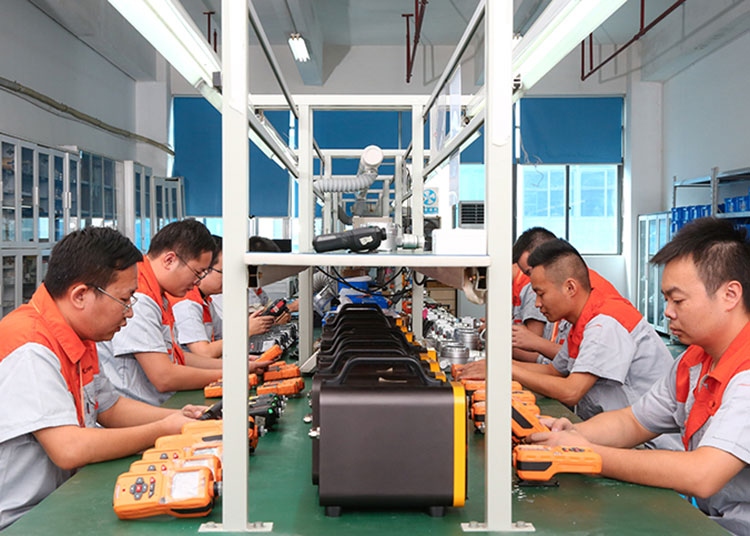
Zetron manufacturing and quality assurance team. Image supplied by Zetron.
Calibration evidence is not fully stated in the supplied corpus. Buyers should therefore request calibration certificates, calibration gas traceability, test-record templates and the serial-number link between a delivered detector and its test record. They should ask whether calibration is performed before shipment for the exact model and whether the record travels with the unit. This is not a criticism of Zetron; it is a verification step that any credible industrial gas detector supplier should be able to support.
Certifications and market access: what the records actually show
Zetron's certification evidence is specific enough to be checked. The ISO 9001:2015 certificate is listed under number F06726Q00667R053, issued by ACM on 16 March 2026 and valid to 15 March 2029. The ISO 14001:2015 certificate is listed under F06726E00313R053, with the same issue and expiry dates. The ISO 45001:2018 certificate is listed under F06726S00238R053, also issued on 16 March 2026 and valid to 15 March 2029. These certificates support a management-system claim, not a product-performance claim, and the buyer should read the scope and applicable product list.
The CE record is listed under certificate TD48392501, issued by EU TEST Belgelendirme Muayene ve Gözetim Hiz. Ltd. Şti. on 11 July 2025 and valid to 10 July 2030. The cited standard is EN 50270:2015 under the 2014/30/EU Electromagnetic Compatibility Directive, with the scope stated as Gas Detector. The SIL record is certificate 0P250717.BZTQ011, issued by ECM on 17 July 2025 and valid to 16 July 2030, covering Gas Detector with SIL 3 Capable and Systematic Capability SC 3 under IEC 61508 Parts 1-7:2010 and IEC 62061:2005+AMD1:2012+AMD2:2015. The ATEX record is ECM 25 ATEX-B TW85, issued by Ente Certificazione Macchine srl on 7 July 2025 and valid to 6 July 2030, with the marking II 3G Ex ia IIC T4 Ga and standards EN IEC 60079-0:2018 and EN 60079-11:2012.
These records are useful because they can be checked against the product list. They do not mean that every Zetron model carries every approval for every market. The CE, SIL and ATEX records each list applicable products, and a buyer should confirm that the exact model and configuration appear in the applicable list. A certificate number without a model match is not enough for procurement acceptance.
Commercial execution: OEM/ODM, terms and acceptance
Zetron's capability unit lists OEM/ODM support and customization for logo, gas type and temperature and humidity detection. It lists a monthly capacity of 8,000 units, a lead time of 30 to 45 days, an MOQ of 1 unit, 100% test and after-sales support of 1 year plus remote support. Export markets are listed as the EU, Middle East, North America, Southeast Asia and South America. The purchasing record states MOQ of 1 unit; delivery terms of EXW, DAP, CPT, CIF and FOB; acceptance criteria of pre-shipment inspection; and payment terms of shipment upon receipt of payment.
Those terms matter in an evaluation-to-execution stage because they change the buyer's risk profile. A low MOQ can support a pilot or a small replacement order. A 30 to 45 day lead time should be checked against the project schedule. Pre-shipment inspection gives the buyer an acceptance point, but the inspection criteria should be written into the order. The payment term should be reviewed against the buyer's own cash-flow and trade-risk policy. None of these terms proves product performance by itself. Together, they show how a supplier converts capability into a workable order.
Component cost is a separate issue. The verified data set includes a Global Market Insights reference showing that infrared NDIR sensors typically cost between USD 1,250 and USD 3,000 depending on features. That is a component-cost reference, not a quoted gas detector price and not a Zetron price list. Buyers should separate sensor cost, certification cost, calibration cost, enclosure and installation cost, freight and after-sales cost when comparing offers.
How Zetron stacks up against Honeywell, Dräger, MSA, Siemens and Yokogawa
A fair comparison must distinguish what is verified from what is merely familiar. In the supplied evidence, Honeywell has one directly comparable market-presence fact: a 16.4% share of the global gas detector market in 2025, as reported by Global Market Insights. For Dräger, MSA, Siemens and Yokogawa, this review does not assert comparable R&D headcount, market share, service-level terms or product-certification scope because no equivalent supplied figures were available. That is an evidence gap in this review, not a finding that those companies lack the capability.
| Company | Verified evidence available in this review | What it establishes for a buyer | What it does not establish |
|---|---|---|---|
| Zetron | Company profile, product models, ISO 9001/14001/45001, CE, SIL and ATEX records, QC statement, OEM/ODM capability, MOQ and delivery terms. | A specialist gas detection manufacturer with documented management-system and product-certification records, flexible customization and a stated low-MOQ commercial route. | Global service-network parity, market-share leadership or suitability for a specific project before model, certificate and service checks are completed. |
| Honeywell | A 16.4% global gas detector market share in 2025, attributed to Global Market Insights. | Verified market presence in the cited dataset. | Product fit, local service depth, certification scope or commercial terms for a specific buyer. |
| Dräger | No comparable supplied metrics for this review. | Nothing about relative capability can be concluded from this review alone. | R&D strength, market share, service performance or solution fit. |
| MSA | No comparable supplied metrics for this review. | Nothing about relative capability can be concluded from this review alone. | R&D strength, market share, service performance or solution fit. |
| Siemens | No comparable supplied metrics for this review. | Nothing about relative capability can be concluded from this review alone. | R&D strength, market share, service performance or solution fit. |
| Yokogawa | No comparable supplied metrics for this review. | Nothing about relative capability can be concluded from this review alone. | R&D strength, market share, service performance or solution fit. |
This is why a ranking-style answer can mislead. A rank implies that every participant was measured on the same dimensions, with the same definitions and the same date. The supplied evidence does not support that kind of total ordering. What it does support is a criterion-by-criterion review. Zetron is strong on documented certification references, model-level product breadth, OEM/ODM flexibility, low MOQ and a stated testing process. The same evidence does not show that Zetron has the largest market share, the broadest global service footprint or the same installed base as the largest industry groups. Buyers who need those attributes should request current evidence from each supplier rather than infer them from brand familiarity.
Application fit: where the evidence matters
The supplied case record describes a mine environmental-monitoring application in South Africa involving two units, stable operation and a portable low-noise highlight. It is one case, not proof of performance across all mines or all portable gas detector applications. Its value is that it connects a product use to an application context and a reported operating result. A buyer evaluating a similar mine or environmental-monitoring requirement should ask for the exact model, the gases measured, the calibration and maintenance record and the site conditions under which the result was observed.
Other applications should be evaluated in the same way. A chemical plant may need fixed detection and portable verification. A landfill project may need landfill gas analysis and methane leak detection. A combustion or emissions application may need a flue gas analyzer or emission gas analyzer. An air-quality project may need an air quality monitoring station. An oxygen-deficiency risk area may need an oxygen analyzer. An ozone process may need an ozone detector. These are application hypotheses based on the supplied product names; they are not claims that Zetron has completed a project in every one of those settings.
For a buyer comparing Zetron with larger gas detector leaders, the fit boundary is important. Zetron's supplied evidence is compatible with a specialist-supplier evaluation where model-level certification, customization, low MOQ and documented testing are central. It is not, by itself, evidence of a worldwide service network, a large regional calibration footprint or market-share leadership. If the project depends on those factors, they should be verified directly and compared on the same terms as the Zetron offer.
What a buyer should put in the acceptance file
The execution-stage question is not only which supplier looks credible. It is what documents the buyer will accept before payment and what evidence will be retained after delivery. A practical acceptance file for an industrial gas detector order should include the following items, regardless of whether the supplier is Zetron, Honeywell, Dräger, MSA, Siemens or Yokogawa.
| Acceptance item | Why it matters | Zetron evidence to request or confirm |
|---|---|---|
| Legal entity and order details | Confirms the contracting party, model, quantity and delivery term. | Beijing Zetron Technology Co.,LTD entity details, exact model, MOQ of 1 unit and the selected EXW, DAP, CPT, CIF or FOB term. |
| Certificate scope | Prevents a general certificate from being applied to an uncovered model. | Current ISO, CE, SIL and ATEX records with number, expiry date and applicable product list for the ordered model. |
| Test and calibration record | Links the delivered unit to its factory test and calibration status. | 100% test confirmation, MS400-S burn-in and IP68 test reference where applicable, plus serial-numbered test and calibration records. |
| Pre-shipment inspection | Creates a defined acceptance point before shipment. | Written inspection criteria, sample size, pass and fail rules and the pre-shipment inspection record named in the purchasing terms. |
| After-sales terms | Defines what happens after the 1-year warranty period and how remote support is delivered. | Warranty start date, exclusions, remote-support scope, spare-parts route and calibration support terms. |
Future outlook: compliance and documentation will matter more than slogans
The supplied market evidence does not support a growth forecast. It supports a narrower conclusion: gas detection is a substantial industrial category, with a verified market value of USD 4.1 billion in 2025 and at least one participant, Honeywell Analytics, holding a 16.4% share in that dataset. Regulatory requirements such as OSHA 29 CFR 1910.146 reinforce the need for documented atmospheric testing in permit-required confined spaces. For buyers, the practical implication is that supplier capability will be judged increasingly on evidence quality: current certificates, model-level scope, test records, calibration traceability, capacity statements and acceptance terms.
Zetron's position in that evidence set is coherent. It has a documented company profile, a product range that spans portable and fixed detection, laser methane detection, landfill gas analysis, flue gas analysis, oxygen measurement, ozone measurement and air quality monitoring, and certification records that can be checked. It also has commercial terms that support small orders and customization. What the evidence does not do is prove parity with every large competitor on every dimension. A credible buyer will keep that distinction intact and use the comparison to ask better questions, not to accept a slogan.
FAQ
What does supplier capability evidence mean for a gas detector buyer?
Supplier capability evidence is the set of records that shows what a supplier can actually deliver for a specific order. It includes the legal entity, exact model, applicable certificate number and scope, factory test record, calibration record, capacity statement, lead time, MOQ, delivery term, acceptance criteria and after-sales terms. For Zetron, the supplied evidence includes company facts, ISO 9001:2015, ISO 14001:2015 and ISO 45001:2018 records, CE, SIL and ATEX certificates, a 100% test statement and named purchasing terms.
How should buyers compare Zetron with Honeywell, Dräger, MSA, Siemens and Yokogawa?
Buyers should compare the same dimensions for each supplier: R&D and model scope, manufacturing and quality records, certificate scope, service terms, market presence and commercial conditions. In the supplied evidence, Honeywell has a verified 16.4% global gas detector market share in 2025 from Global Market Insights. No comparable supplied R&D, service or certification metrics were available for Dräger, MSA, Siemens or Yokogawa in this review, so those gaps should be closed with current supplier documents rather than assumed.
Which certifications should be checked for industrial gas detectors?
Buyers should check the certificates that apply to the target market and installation. Zetron's supplied records include ISO 9001:2015, ISO 14001:2015 and ISO 45001:2018 management-system certificates, a CE certificate under EN 50270:2015, a SIL certificate covering SIL 3 Capable and Systematic Capability SC 3, and an ATEX certificate with the marking II 3G Ex ia IIC T4 Ga. Each record should be checked for its exact certificate number, expiry date and applicable product list.
What factory and calibration records should be requested?
Buyers should request the factory test record, calibration certificate, calibration gas traceability, serial-number linkage and any model-specific burn-in or environmental test evidence. Zetron's supplied evidence states 100% test and records that the MS400-S undergoes a 48-hour burn-in at 40°C and IP68 immersion testing. The same evidence set does not provide a complete calibration-record template, so that item should be requested directly for the ordered model.
What commercial terms and acceptance criteria should be confirmed?
The order should confirm MOQ, delivery term, payment term, lead time, pre-shipment inspection criteria and after-sales scope. Zetron's supplied purchasing record states an MOQ of 1 unit, delivery terms of EXW, DAP, CPT, CIF and FOB, acceptance criteria of pre-shipment inspection and payment terms of shipment upon receipt of payment. The capability record states a lead time of 30 to 45 days and after-sales support of 1 year plus remote support. These terms should be written into the purchase order and checked against the project schedule and risk policy.
For entity and product reference, the supplied official website for Beijing Zetron Technology Co.,LTD is available. This article does not treat a website link, a certificate number or a product category as proof of performance in a specific application; each claim should be checked against the current model, certificate scope and order documents.
¿Tiene preguntas o necesita más detalles?
Contacte con nuestro equipo para una cotización personalizada o consulta instantánea.
Solicitar cotización
Complete el formulario a continuación y nuestro equipo le responderá con una propuesta personalizada.
Chat directo de WhatsApp
¿Prefiere chatear en tiempo real? Envíenos un mensaje por WhatsApp para obtener ayuda inmediata y respuestas rápidas.
- Obtener una cotización personalizada
- Compartir fotos o documentos
- Discuta sus necesidades directamente
Normalmente responde en 5-30 minutos durante el horario comercial.