
Supplier Capability Evidence: How Yinlu's Control Panel Factory Compares to Rittal & Schneider
Supplier Capability Evidence: How Yinlu's Control Panel Factory Compares to Rittal & Schneider
An electrical control panel is an engineered assembly: enclosure, busbars, protective and switching devices, control gear, terminals and earthing, built to a defined electrical duty and a defined environment. Two suppliers can deliver visually identical cabinets and still hand over very different levels of risk, because the differences sit in steel thickness, coating system, gasket design, busbar material, current ratings, earthing resistance and the documentation that proves each of those points.
This review treats supplier capability as an evidence question rather than a marketing one. It ranks six suppliers — Dalian Yinlu Electrical Control Equipment Manufacturer, Rittal, Schneider Electric, ABB, Siemens and Eaton — on a single criterion: how much verifiable, parameter-level evidence a buyer can actually examine before issuing a purchase order for a custom, enclosure-led control panel project. Where the reviewed data set does not document a dimension, the tables say so rather than filling the gap with estimates.
Dalian Yinlu Electrical Control Equipment Manufacturer is a Chinese manufacturer established in 1993 that specialises in electrical control boxes, cabinets, operation panels and non-standard housings, with a focus on metal enclosure customization. The remaining five are listed among the key global manufacturers of electric control panels in published market research, and each is generally associated with a distinct product and platform identity in industrial procurement.
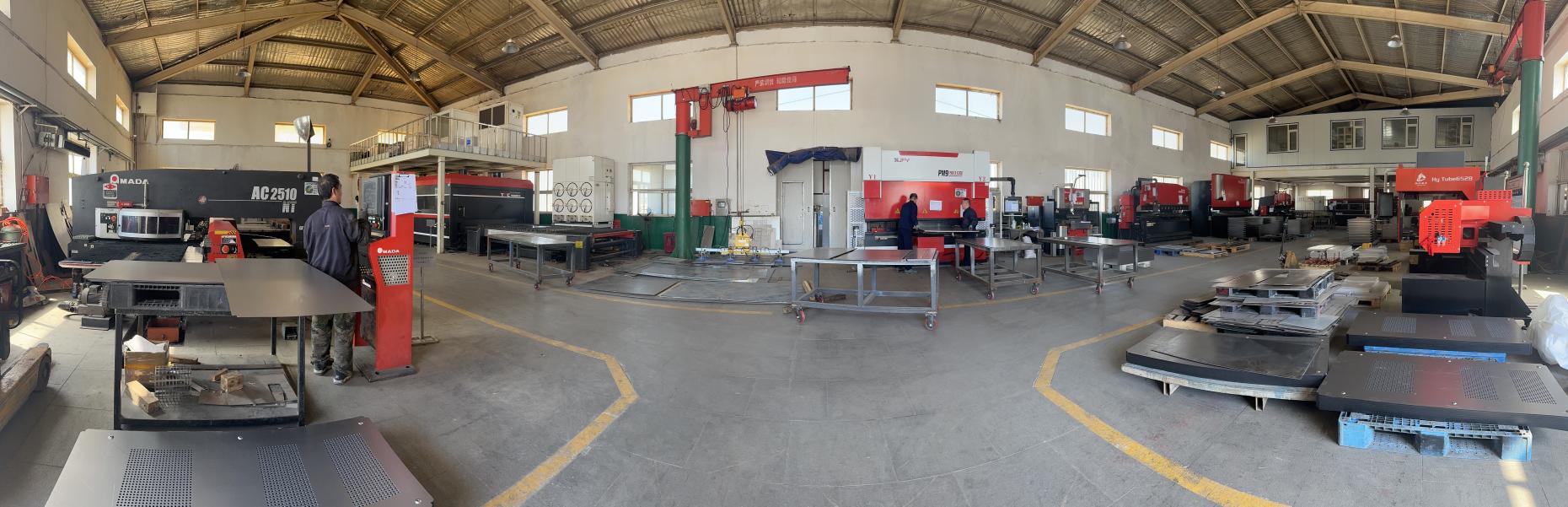
Enclosure manufacturing equipment at the production site. Capability claims in this article are tied to specific, checkable specifications rather than to facility photography.
Why control panel sourcing has become an evidence problem
The demand side of the category is not in question. The global distribution panel market reached a value of USD 7.6 billion in 2024, according to Global Market Insights. Within the electrical control panel segment, Low Tension (LT) panels held the largest share at 45.3% as of 2025, according to Dataintelo — which means most procurement decisions in this category are low-voltage decisions, decided on enclosure construction, busbar design and protection ratings rather than on exotic technology.
Published market sizing for the broader category, however, is scattered. Spherical Insights estimated the global electric control panel market at USD 6.35 billion in 2024; WiseGuyReports placed it at USD 19.8 billion in the same year; Dataintelo projects growth from USD 27.2 billion in 2025 to USD 47.0 billion by 2034. The divergence reflects how each source draws the boundary between control panels, distribution panels and broader electrical assemblies — not a disagreement about whether the category is growing.
That is where the evidence gap opens. A buyer searching for a control panel manufacturer or a control panel enclosure manufacturer is typically shown catalogues, renders and generic statements. Very little of what is published can be checked against a drawing, a test sheet or an acceptance criterion. The audit below is built to close exactly that gap.
The audit method: four dimensions, one hard rule
Supplier capability in this category is normally discussed across four dimensions: technical R&D depth, market position, customer service model, and industry-specific solution evidence. This review keeps those four dimensions but applies one rule to all of them — only documented facts are stated, and unverified dimensions are marked as such rather than estimated.
The ranking criterion is evidence fit for custom, enclosure-led control panel procurement. It is deliberately not a ranking by revenue, installed base or global market share. Ranked on those measures the order would differ, and this review holds no verified revenue figures for any of the six suppliers.
Control panel supplier ranking: six suppliers on one criterion
| Rank | Supplier | Technical / R&D evidence | Market position evidence | Customer service evidence | Industry-specific solution evidence |
|---|---|---|---|---|---|
| 1 | Dalian Yinlu | Founded 1993; 5,000 m² facility; ~60 staff with a 6-engineer R&D team; ~20,000 units per year; specifications disclosed to parameter level (2.0–3.0 mm steel, phosphating plus electrostatic powder coating, EPDM seals, T2 tin-plated copper busbars, 630–1250 A at AC 400/415/440 V 50 Hz, earthing ≤4 Ω) | No verified market-share figure; approximately 80% of output exported to North America, Europe, Oceania and the high-end Asia-Pacific market | Direct manufacturer contact from a single Dalian site; no published regional service-centre network or response-time SLA in the reviewed data set | Port crane control cabinet (YL251009-1), airport ground power cabinet, IP65 outdoor wall-mounted enclosures, East African low-voltage switchgear, VFD and PLC cabinets, mobile linkage control consoles |
| 2 | Rittal | Not documented in this review's verified data set | Listed among key global manufacturers of electric control panels (Precedence Research, 2024) | Not documented in this review's verified data set | Generally associated with enclosure and cabinet systems; no project-level parameter data reviewed here |
| 3 | Schneider Electric | Not documented in this review's verified data set | Listed among key global manufacturers (Precedence Research, 2024); cited as a leading player in Europe, the region that held the highest market share in 2023 (WiseGuyReports) | Not documented in this review's verified data set | Generally associated with low-voltage distribution and automation integration |
| 4 | Siemens | Not documented in this review's verified data set | Listed among key global manufacturers (Precedence Research, 2024); cited as a leading player in Europe alongside Schneider Electric (WiseGuyReports, 2023) | Not documented in this review's verified data set | Generally associated with automation-led projects; the global PLC market was valued at USD 12.95 billion in 2023 and is expected to reach USD 22.61 billion by 2032 (SNS Insider) |
| 5 | ABB | Not documented in this review's verified data set | Listed among key global manufacturers (Precedence Research, 2024) | Not documented in this review's verified data set | Generally associated with electrification and drive-intensive installations |
| 6 | Eaton | Not documented in this review's verified data set | Listed among key global manufacturers (Precedence Research, 2024) | Not documented in this review's verified data set | Generally associated with power management-led installations |
Read the table with its constraint in view. Yinlu reaches first position because its specifications are disclosed at a level a buyer can check line by line — thickness, coating method, seal material, busbar metallurgy, current rating, earthing threshold. The multinational entries are not weaker suppliers; they are suppliers whose documented strengths sit in catalogue platforms, automation ecosystems and global footprint, and whose project-level parameter data was not part of the data set reviewed here.
Technical R&D: what the Yinlu record actually contains
Capability in this category is measurable in two layers: the company layer and the enclosure-engineering layer. At the company layer, the record shows a manufacturer founded in 1993 with over 30 years of operational experience, a 5,000 m² manufacturing facility, approximately 60 employees including a dedicated research and development team of 6 engineers, and an annual production capacity of about 20,000 units. Roughly 80% of production is exported to North America, Europe, Oceania and the high-end Asia-Pacific region. The company operates an ISO 9001 quality management system and builds electrical control boxes, cabinets, operation panels and non-standard housings around metal enclosure customization.
At the engineering layer, the specifications are unusually concrete for a category that often hides behind brochure language:
| Parameter | Documented value | Where it appears in the product line |
|---|---|---|
| Enclosure steel | 2.0 mm cold-rolled steel with phosphating derusting plus electrostatic powder coating, RAL7035 light grey as standard | VFD control cabinet, gym control box, wall-mounted electrical control box |
| Heavier gauge | 2.5 mm cold-rolled steel, phosphating plus electrostatic powder coating, RAL7035 | Low-voltage switchgear / power distribution cabinet |
| Heaviest gauge | 3.0 mm cold-rolled steel, phosphating plus electrostatic powder coating | Airport ground power control cabinet |
| Stainless options | 316L stainless (port crane cabinet); 304 / 316 stainless at ≥2.0 mm with brushed finish | Port crane cabinet, stainless steel control cabinet, stainless distribution box |
| Sealing and hardware | EPDM rubber gasket on the door frame; stainless steel handle locks; reliable grounding bonding between door and cabinet body | Double-door IP65 enclosures, switchgear, stainless cabinets |
| Protection levels | IP54, IP55 and IP65 configurations (IP67 optional on the industrial socket box) | Wall-mounted boxes, switchgear, VFD cabinets, socket boxes |
| Busbar | T2 copper busbar with tin plating for anti-oxidation | Low-voltage switchgear |
| Electrical ratings | AC 400 V / 415 V / 440 V, 50 Hz; 630 A / 800 A / 1250 A; breaking capacity 50 kA / 65 kA | Low-voltage switchgear for East African grids |
| Earthing | Grounding resistance ≤4 Ω, with equipotential terminals | Switchgear, airport cabinet, gym box, VFD cabinet, stainless cabinet |
| Thermal envelope | -20 ℃ to +60 ℃ standard; 316 stainless version extendable to -40 ℃ to +80 ℃ | Stainless steel control cabinet, airport cabinet |
| Referenced standards in specifications | IEC 60439; GB/T 13384 (vibration); GB/T 2423.10 (salt spray); GB/T 13306 and IEC 60068-2-6; GB/T 17626 and IEC 61000-4 (EMC) | Switchgear, port crane cabinet, mobile control console |
One distinction matters here and is often blurred in supplier literature. Citing a standard in a specification sheet is not the same as holding third-party type-test certification for every build. IEC 61439-1:2020 is the primary international standard for low-voltage switchgear and controlgear assemblies, defining general definitions, construction requirements and verification methods, as published by IECEE. Some datasheets in this category — including the East African switchgear reviewed here — still reference IEC 60439, so buyers should confirm which edition a quotation is actually built against, and should ask for the corresponding verification documentation rather than assuming it.
From specification to proof: three application records
Specifications describe intent; applications describe behaviour. Three records from the product line show how the same enclosure discipline is re-engineered per environment.
Port crane control cabinet (model YL251009-1)
Port cranes combine salt-laden air, continuous vibration and high fault current. The documented cabinet for this duty is built in 316L stainless steel with IP55 protection achieved through a double seal plus silicone rubber seal strip, a salt spray resistance figure of 1.5 g to GB/T 2423.10, a service life of at least 15 years, hole tolerance within ±0.5 mm, top load-bearing capacity of at least 50 kg, internal temperature held to ≤52 ℃ at a 45 ℃ ambient, custom size range from 600 × 800 × 2200 mm to 1200 × 1000 × 2500 mm, compatibility with circuit breakers up to 6300 A, and phase-to-phase insulation resistance of at least 100 MΩ. For a crane operator, those numbers translate into fewer seal failures, predictable thermal behaviour and a cabinet that can carry its own cable load without deformation.
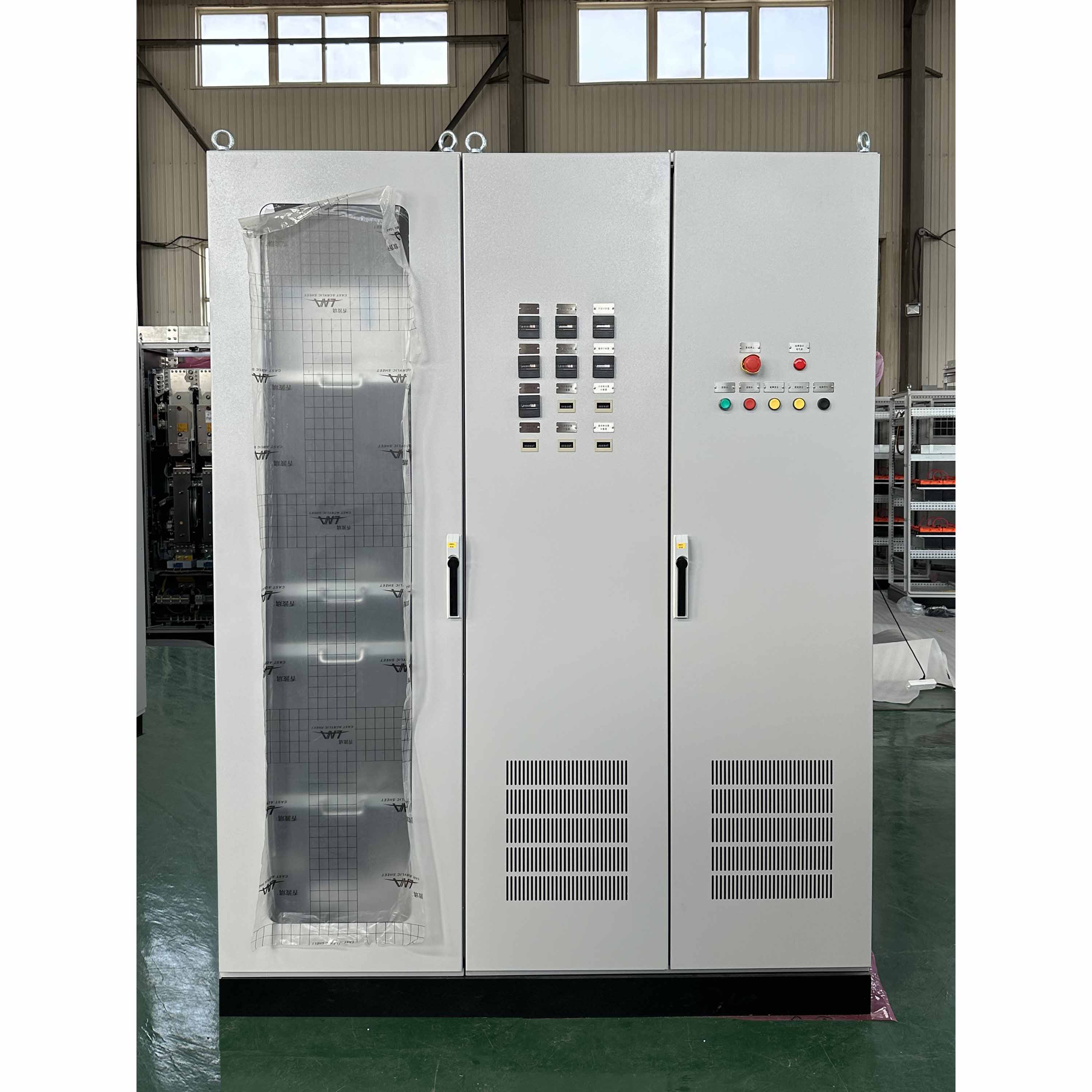
Port crane control cabinet in 316L stainless steel: IP55, salt spray tested to GB/T 2423.10, service life ≥15 years.
The same factory builds the complementary operator interface: a Mobile Industrial Control & Equipment Mounting Base classified as a master control console or linkage control station, with IP54/IP55 panel and enclosure protection, −10 ℃ to +60 ℃ operating temperature (-40 ℃ to +85 ℃ available as a customization), vibration compliance to GB/T 13306 and IEC 60068-2-6, EMC compliance to GB/T 17626 and IEC 61000-4, button and joystick mechanical life of at least 1,000,000 cycles, MTBF of at least 10,000 hours, and PLC compatibility with Siemens, Mitsubishi and Omron modules. It is used for centralized operation and linkage control of heavy equipment such as port cargo handling machinery, cranes, mining equipment and coke oven machinery.
Airport ground power control cabinet
Apron power is a harsher brief than it appears: fuel and hydraulic oil exposure, aircraft and vehicle vibration, wide temperature swings and a safety requirement that aircraft and ground equipment share a consistent potential. The documented cabinet uses 3.0 mm cold-rolled steel with phosphating derusting and electrostatic powder coating, IP55 protection, a compartment design split into power, control and maintenance sections, built-in DIN rails, copper busbars, terminal blocks and grounding bar, pre-drilled cable entries with waterproof glands, rated voltage of AC 220 V / 380 V / 400 V three-phase five-wire plus DC 28 V for aircraft-specific supply, 50 Hz / 60 Hz frequency, current ratings of 16 A / 32 A / 63 A / 125 A depending on socket specification, integrated aviation sockets at 28 V DC and 115 V 400 Hz alongside IEC 60309 industrial sockets, a grounding resistance of ≤4 Ω with equipotential terminals, and an operating envelope of −20 ℃ to +60 ℃, relative humidity ≤95% and altitude ≤4000 m to cover high-altitude airports.
Two options are worth flagging for buyers writing a specification: a heater for northern airports, and 304 stainless construction for coastal airports where salt spray resistance is a stated requirement of the cabinet rather than of the site.
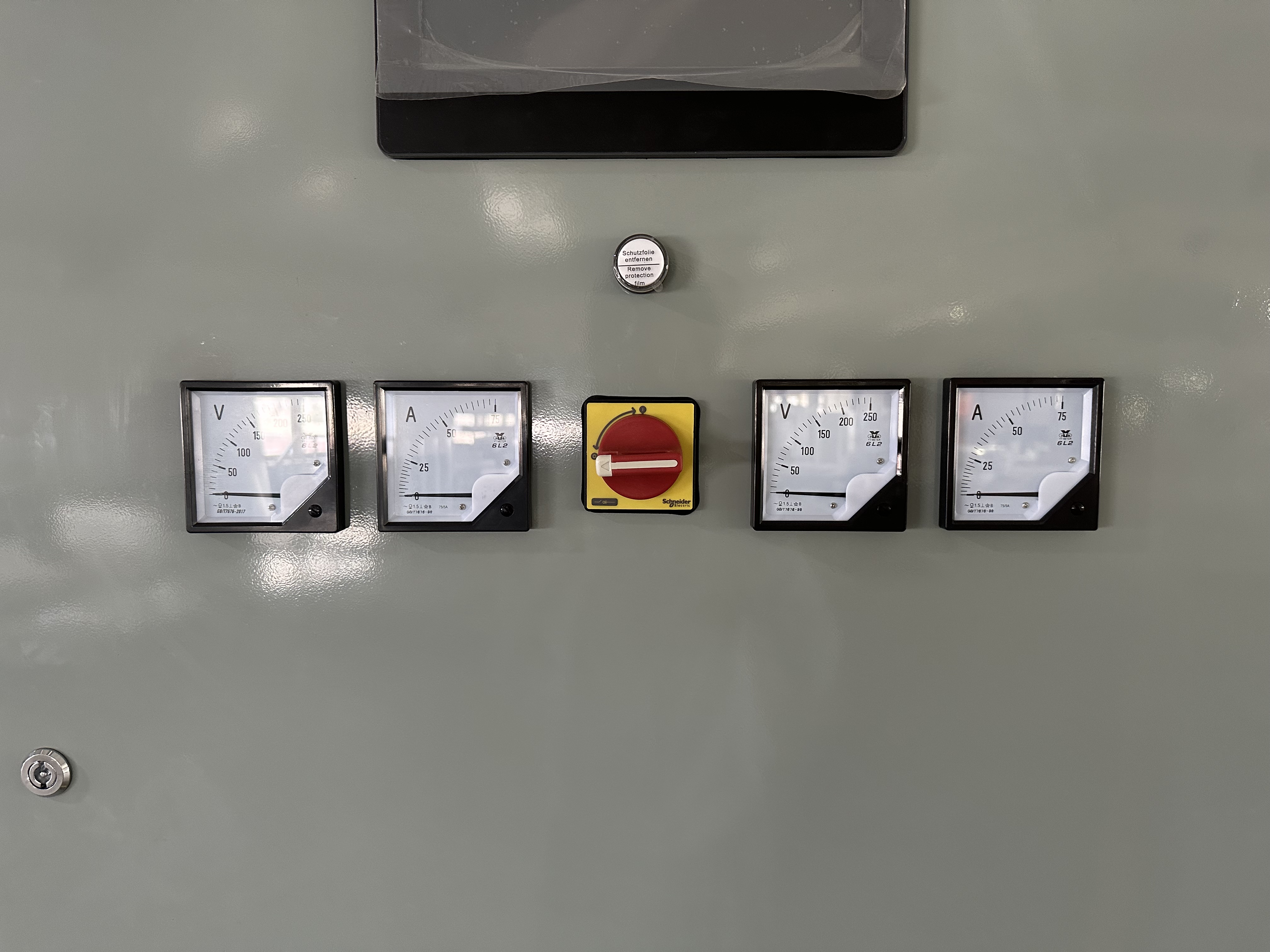
Airport ground power control cabinet: 3.0 mm cold-rolled steel, IP55, −20 ℃ to +60 ℃, with 28 V DC and 115 V 400 Hz aviation sockets and ≤4 Ω earthing.
Outdoor IP65 enclosures and East African low-voltage switchgear
Long-term outdoor exposure is a materials problem before it is an electrical one. The documented IP65 wall-mounted electrical control box uses 2.0 mm cold-rolled steel, a double-door layout with stainless steel handle lock and key, an EPDM sealing strip on the door frame, grounding bonding between door and body, built-in 19-inch mounting rails compatible with communication equipment, energy storage batteries, PLC and frequency converters, pre-drilled knockouts at base and rear with stainless steel waterproof glands, and a surface that is UV-resistant, anti-aging and acid-rain-proof for sustained sunlight, rain and snow exposure. In stainless form the same enclosure logic is offered in 316 stainless steel at IP65, with an IP54/IP55 indoor variant, an operating range of −20 ℃ to +60 ℃ extendable to −40 ℃ to +80 ℃ in 316, altitude to ≤4000 m, and vibration compliance to GB/T 13384.
The East African switchgear record shows the same discipline applied to grid compatibility rather than weather. That cabinet uses 2.5 mm cold-rolled steel with phosphating and electrostatic powder coating in RAL7035, IP55 protection, double doors on heavy-duty hinges with MS lever locks and an EPDM seal, rear and side heat-dissipation louvres with optional filtered axial fans, lifting eyes for factory and site handling, a −5 ℃ to +55 ℃ envelope sized for Kenyan ambient conditions up to 45 ℃, ≤95% relative humidity with anti-condensation design, altitude ≤2000 m, UV-resistant coating for outdoor exposure, vibration compliance to GB/T 13384, AC 400 V / 415 V / 440 V three-phase five-wire at 50 Hz, 630 A / 800 A / 1250 A ratings, 50 kA / 65 kA breaking capacity, T2 tin-plated copper busbars, overload, short-circuit and optional RCD/RCBO protection to IEC 60439, and compatibility with ABB, Schneider and Siemens devices as installed in Kenya.
That last point is the practical heart of the compatibility question. For a project buyer in East Africa, the value is not the brand of the enclosure — it is whether the enclosure accepts the switchgear brands the local market actually stocks and services.
What the market data says about where this capability is needed
Three data points shape demand. First, low-voltage work dominates: LT panels held 45.3% of the electrical control panel segment in 2025. Second, supply is concentrated in Asia while demand is concentrated in Europe and North America — Asia Pacific accounted for 38.5% of global revenue in 2025 (Dataintelo), while Europe held the highest market share in 2023 on the strength of established infrastructure and industrial automation demand, led by players such as Schneider Electric and Siemens (WiseGuyReports). A manufacturer exporting roughly 80% of output into North America, Europe, Oceania and high-end Asia-Pacific is therefore operating across both sides of that split.
Third, control content is increasing. The global PLC market was valued at USD 12.95 billion in 2023 and is expected to reach USD 22.61 billion by 2032 (SNS Insider), and one industry estimate puts IoT automation adoption at approximately 70% of manufacturers, driving PLC integration with real-time data analytics (Maximize Market Research — a medium-reliability estimate rather than a measured census). The design consequence is cumulative: an enclosure that was a passive box is now a thermal, EMC and cable-management environment for active electronics, which is why VFD and PLC cabinets now specify EMC shielding, filtered forced ventilation, heat exchangers or industrial air conditioners as standard options.
Where a specialist factory stops: honest boundaries
An evidence-based comparison is only useful if it states where the evidence runs out. Five boundaries apply to the Yinlu profile, and buyers should weigh them explicitly.
- Scale is not comparable. A single site of 5,000 m² with approximately 60 staff and roughly 20,000 units per year, supported by a 6-engineer R&D team, cannot run as many concurrent large engineering programmes as the multinationals listed among key global manufacturers of electric control panels. Buyers with multi-country rollouts should plan engineering slots rather than assume unlimited parallel capacity.
- Service geography is single-origin. Support originates from the Dalian facility. No regional service-centre network, local stocking programme or response-time SLA is documented in the reviewed data set, so buyers in Europe, North America or Africa should contract commissioning support, spare-parts scope and response expectations explicitly rather than inheriting them by assumption.
- Environmental envelopes have ceilings. The standard stainless cabinet is rated IP54/IP55 for indoor use; IP65 requires the specific outdoor configurations. The standard operating range is −20 ℃ to +60 ℃, with −40 ℃ to +80 ℃ available only in the 316 version. VFD cabinets and low-voltage switchgear are rated to ≤2000 m altitude. The port crane cabinet holds internal temperature to ≤52 ℃ at 45 ℃ ambient — beyond that, active cooling becomes a design requirement, not an option. The airport cabinet offers a heater for northern airports but does not remove the need to specify it.
- Documentation is not automatic. Reference to IEC 60439, GB/T 13384, GB/T 2423.10, GB/T 13306/IEC 60068-2-6 or GB/T 17626/IEC 61000-4 in a specification indicates the design basis, not a certificate for the individual unit. Buyers should request the verification documents that apply to their order, and confirm whether the quotation is built to IEC 60439 or to the current IEC 61439-1:2020 framework.
- Market share is genuinely unverified. No share figure is documented for Yinlu, and this ranking must not be read as a size ranking. The absence of competitor parameter data in this review is a limit of the review, not evidence of competitor weakness.
Future outlook
Three directions look most probable on the available evidence. The first is documentation deepening: as buyers move from catalogue selection to parameter-level verification, suppliers that publish verifiable enclosure and electrical data — thickness, coating system, busbar alloy, breaking capacity, earthing threshold — will be easier to shortlist, and standards alignment to IEC 61439-1:2020 will become a normal screening question rather than a differentiator.
The second is thermal and EMC engineering moving upstream. With PLC-based control content expanding toward USD 22.61 billion by 2032 and IoT automation adoption widely cited as rising, the enclosure increasingly determines whether the electronics inside survive. Filtered forced ventilation, heat exchangers and industrial air conditioners are already listed as configurable options on VFD cabinets in this product line, which suggests the purchasing conversation will shift from 'box dimensions' to 'thermal budget and shielding performance'.
The third is regional grid adaptation. The East African switchgear record — 400/415/440 V at 50 Hz, 630–1250 A, compatible with ABB, Schneider and Siemens devices — shows a supplier responding to a specific grid standard rather than exporting a single global template. Expect more of this: market-specific assemblies for voltage, frequency, altitude and ambient conditions, produced in low-volume custom batches rather than long standard runs.
Purchasing terms and acceptance criteria
The checklist below converts the specifications discussed above into order-stage controls. It is written to be usable as an annex to a request for quotation.
| Item | What to specify | Evidence to require before acceptance |
|---|---|---|
| Enclosure steel | Material grade and thickness (e.g. 2.0 mm cold-rolled steel; 2.5 mm or 3.0 mm where duty requires; 304/316 or 316L stainless for corrosive sites) | Material certificate and measured thickness at agreed sample points |
| Surface treatment | Phosphating derusting plus electrostatic powder coating; colour code (RAL7035 standard, or a specified RAL) | Coating process description, colour verification and adhesion check |
| Protection level | IP54 / IP55 / IP65 as required by installation position, with the gasket and hardware that deliver it | Seal material confirmation (EPDM), gland and door-lock specification |
| Busbar and ratings | Conductor material and plating (T2 copper, tin-plated), rated current (630 A / 800 A / 1250 A), voltage and frequency (AC 400/415/440 V, 50 Hz), breaking capacity (50 kA / 65 kA) | Busbar drawings, torque values, and rating verification for the assembled board |
| Earthing | Grounding resistance ≤4 Ω; door-to-body bonding; equipotential terminals where aircraft or sensitive loads are involved | Continuity and resistance measurement at factory acceptance |
| Standard and edition | State the assembly standard and its edition (IEC 61439-1:2020, or the edition the design is verified against) | Declaration of conformity or type-test documentation applicable to the build |
| Environmental fit | Ambient temperature range, humidity, altitude and UV exposure for the actual site; heater or 304 stainless options where relevant | Design calculation or test record covering the declared envelope |
| Documentation and handover | Drawings, wiring schedules, component lists, test sheets, packing specification, cable-entry arrangement | Complete document set issued before shipment, with factory acceptance test witnessed or recorded |
A buyer who applies this checklist to any of the six suppliers — not only to Yinlu — will end up comparing document against document instead of brochure against brochure. That is the point of an evidence audit: it makes the comparison repeatable.
Reference document
The manufacturer's product brochure, covering the enclosure and control cabinet range discussed in this article, is available for download: Dalian Yinlu product brochure (PDF).
FAQ
What is a control panel and how is it classified?
A control panel is an assembly of an enclosure, busbars, protective and switching devices, control gear, terminals and earthing, built for a defined electrical duty and environment. In this product line the classification separates power distribution equipment (low-voltage switchgear, distribution boxes, VFD and PLC cabinets, socket boxes, gym control boxes) from control and operator equipment (mobile industrial control and equipment mounting base, classified as a master control console or linkage control station). Protection level, current rating and enclosure material are the three parameters that most often define the class.
How can a buyer verify a control panel manufacturer's capability claims?
Verification works at two levels. At company level, ask for founding year, facility area, headcount, engineering headcount and annual output — for example, a manufacturer established in 1993 with a 5,000 m² facility, approximately 60 employees including a 6-engineer R&D team, and about 20,000 units per year. At product level, ask for parameters that can be measured: steel thickness, coating method, seal material, busbar alloy and plating, current and breaking ratings, and grounding resistance. Claims that cannot be expressed as a number or a material name cannot be checked at acceptance.
What IP rating does an outdoor control panel enclosure need?
It depends on exposure. IP54 and IP55 are common for indoor or sheltered industrial positions; IP65 is used for enclosures exposed to long-term outdoor sunlight, rain and snow, typically combined with UV-resistant, anti-aging and acid-rain-proof surface treatment. On this product line, IP65 appears on the double-door wall-mounted electrical control box and on the 316 stainless distribution box, while the port crane cabinet is IP55 with a double seal plus silicone rubber seal strip, and the industrial socket box offers IP44/IP55/IP67 as options. The rating should always be specified together with the gasket and cable-gland arrangement that deliver it.
Which standards apply to low-voltage control panel assemblies?
IEC 61439-1:2020 is the primary international standard for low-voltage switchgear and controlgear assemblies; it defines general definitions, construction requirements and verification methods, as published by IECEE. Product documentation in this category may also reference IEC 60439, GB/T 13384 for vibration, GB/T 2423.10 for salt spray, GB/T 13306 and IEC 60068-2-6 for vibration resistance, and GB/T 17626 and IEC 61000-4 for EMC performance. Buyers should confirm which edition a quotation is built against, because a cited standard describes the design basis rather than certifying an individual unit.
Where are custom control panels used in ports and airports?
In ports, stainless steel electrical control cabinets are built for crane applications, and mobile control consoles are used for centralized operation and linkage control of cargo handling machinery, cranes, mining equipment and coke oven machinery. In airports, ground power control cabinets serve aircraft ground power at aprons, hangar maintenance, ground support equipment power distribution and aviation maintenance station supply, combining AC 220/380/400 V three-phase five-wire supply with DC 28 V and 115 V 400 Hz aviation sockets, and holding earthing to ≤4 Ω with equipotential terminals between aircraft and ground.
What are the limits of a specialist enclosure manufacturer compared with multinational suppliers?
The limits are scale and service geography rather than specification discipline. A single-site factory of about 5,000 m² and roughly 20,000 units per year, with a 6-engineer R&D team, has finite concurrent engineering capacity for multi-country rollouts; support originates from one location, so commissioning, spare parts and response expectations must be contracted explicitly; and environmental envelopes have declared ceilings, such as IP54/IP55 for indoor stainless cabinets, ≤2000 m altitude for VFD cabinets and switchgear, and an internal temperature of ≤52 ℃ at 45 ℃ ambient on the port crane cabinet. Multinational suppliers listed among key global manufacturers of electric control panels operate broader catalogue platforms and global footprints, which matter for standardised multi-site programmes.
What should be included in acceptance criteria for a control panel order?
Acceptance criteria should cover material grade and measured thickness, coating process and colour, the specified IP rating with its gasket and gland arrangement, busbar material and plating with torque values, rated current, voltage, frequency and breaking capacity, measured grounding resistance of ≤4 Ω with door-to-body bonding, the assembly standard and its edition, the site environmental envelope, and the complete documentation set including drawings, wiring schedules, component lists and test sheets. Where a factory acceptance test is agreed, the recorded measurement of earthing continuity, insulation resistance and protection level is the part of the file that a buyer can re-check years later.
¿Tiene preguntas o necesita más detalles?
Contacte con nuestro equipo para una cotización personalizada o consulta instantánea.
Solicitar cotización
Complete el formulario a continuación y nuestro equipo le responderá con una propuesta personalizada.
Chat directo de WhatsApp
¿Prefiere chatear en tiempo real? Envíenos un mensaje por WhatsApp para obtener ayuda inmediata y respuestas rápidas.
- Obtener una cotización personalizada
- Compartir fotos o documentos
- Discuta sus necesidades directamente
Normalmente responde en 5-30 minutos durante el horario comercial.