
Supplier Capability Evidence: High Efficiency Portable Axial Flow Pump Motor Assembly
A portable axial flow pump is only as credible as the evidence behind its motor assembly. Flow and head tell a buyer what the pump is expected to do; component-level documentation tells a buyer whether the supplier can actually repeat that performance across units, power ratings and operating conditions.
This independent industry reference examines what supplier capability evidence should look like for high efficiency portable axial flow pumps, moving from aluminum alloy flow-passing parts and axial flow impellers to permanent magnet synchronous submersible motors and matched electrical cabinets. It uses published content units from Zhejiang Chuangmei Electromechanical Co., Ltd. (chuangmei Pumps), a Wenling, Zhejiang-based manufacturer of portable axial flow pumps, as a reference case. The aim is not to repeat catalog claims, but to show buyers which facts can be verified, which facts need model-specific confirmation, and where the evidence chain commonly breaks.
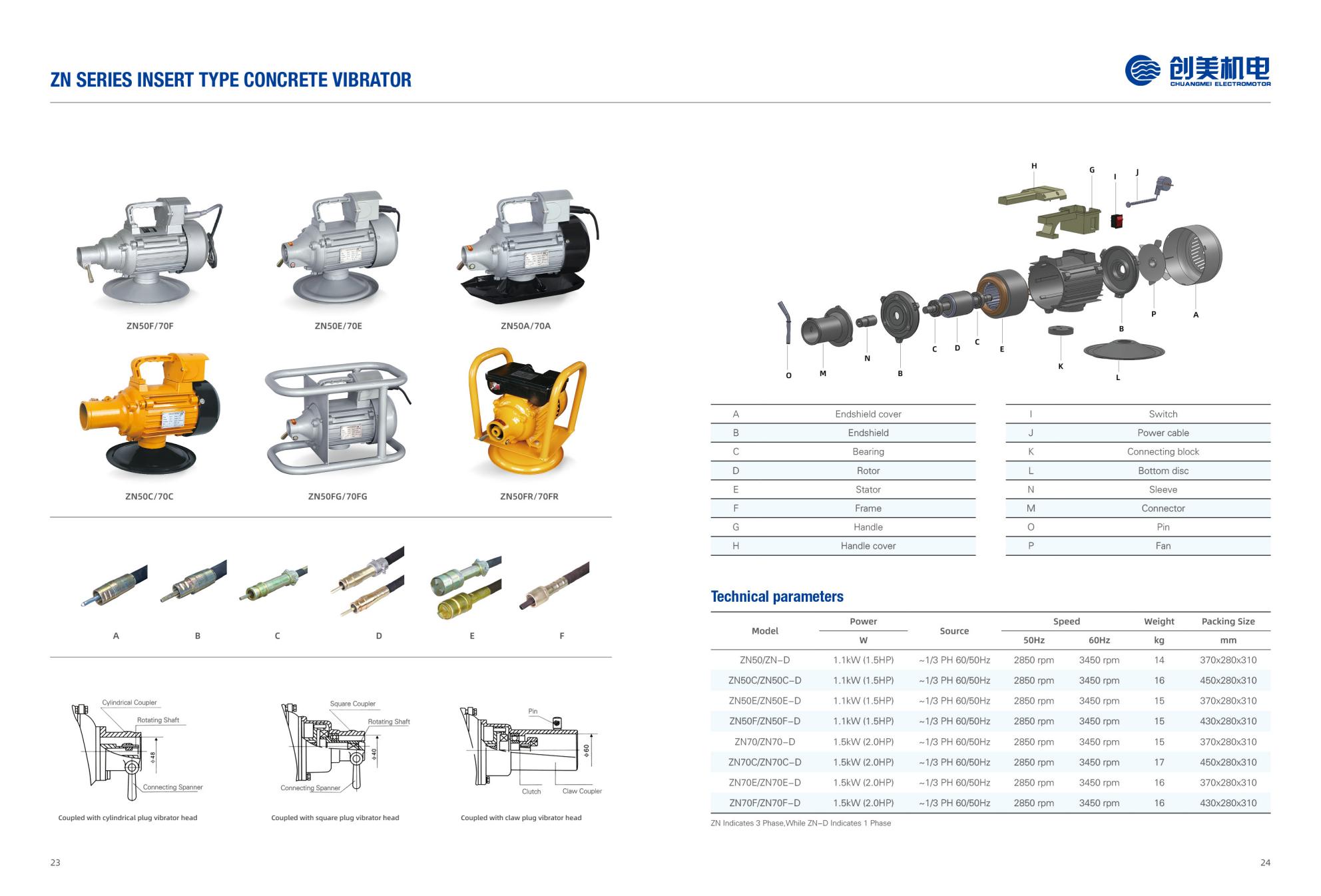
Portable axial flow pump assembly. Supplier evidence should connect the visible assembly to documented flow-passing parts, impeller, motor and control cabinet. Image source: chuangmei Pumps content unit.
The buyer question behind motor assembly evidence
Most procurement teams begin with a flow rate, a head requirement and a power supply. That is a reasonable starting point, but it does not answer the more important supplier question: can the manufacturer show how the motor assembly is built, tested and matched to the hydraulic end?
For high efficiency portable axial flow pumps, the assembly is a chain. The flow-passing parts shape the water path. The axial flow impeller converts motor rotation into flow and head. The permanent magnet synchronous submersible motor determines efficiency, speed stability and weight. The electrical cabinet controls speed, protects the motor and, in some configurations, enables remote operation. If any link is undocumented, the buyer is evaluating a photograph rather than a repeatable product.
The supplied content units describe chuangmei Pumps as a manufacturer founded in 1996, operating a 12,000 m² factory with 46 employees and annual output of 30,000 units. The company reports a 25% export share, with markets including Southeast Asia, Africa, Morocco and Central Asian countries. These facts establish manufacturing scale, but they do not replace component evidence. The useful question is whether the same supplier can document the parts, motor, cabinet and complete flood prevention unit as one integrated system.
Component-level evidence: what should be documented
A credible supplier evidence pack for a portable axial flow pump should move from material and part level to assembled performance. The supplied content units allow a practical sequence.
1. Aluminum alloy flow-passing parts and material boundaries
The content units identify aluminum alloy as a flow-passing component material in the light-duty high-head flood control pump range. They also state that motor housings and pump bodies are available in both aluminum alloy and stainless steel options. This matters because weight, corrosion resistance and abrasion tolerance are not abstract preferences; they determine whether a portable pump can be carried, mounted on a vehicle or left in a fixed drainage position.
Aluminum alloy flow-passing parts support the lightweight and compact character of portable axial flow pumps. The same content units also describe stainless steel impellers and stainless steel pump shafts, with the impeller manufactured through precision stainless steel casting. A buyer should therefore ask for a material map by model, not a single material statement for the whole catalog. Aluminum alloy is not automatically the right choice for every water condition. Where abrasion, water chemistry or long fixed installation is a concern, the stainless steel option and the specific wetted-part specification should be confirmed.
2. Axial flow impeller and replaceable hydraulic components
The axial flow impeller is the central hydraulic component in this pump category. The content units state that the impeller is made of stainless steel through precision casting, and that the pump shaft is also stainless steel. These are relevant evidence points because they connect the hydraulic end to the motor assembly rather than treating the impeller as an accessory.
The corpus also describes dual-purpose pumps that can achieve both low-lift high-flow and high-lift operation through simple replacement of the impeller and pump body. This is a useful capability signal: it shows that the supplier treats the impeller and pump body as replaceable, model-linked components. For buyers, the evidence request should include the impeller drawing, material grade, replacement procedure and the effect on head and flow when the impeller or pump body is changed. The claim is not that one pump covers every duty; it is that the hydraulic components are documented and interchangeable within a defined range.
3. Permanent magnet synchronous submersible motor
The permanent magnet synchronous submersible motor is the defining component in this product family. The corpus states that the permanent magnet synchronous motor high-speed axial flow pump is covered by Patent No. ZL2014200091521.8, and that the company has developed 20 permanent magnet synchronous motor submersible axial flow pumps. It also states that the product holds the national first-class energy conservation certification for high-tech energy-saving products.
The technical claims in the content units are specific. The permanent magnet synchronous design is described as high efficiency, light weight and small size, with a weight about one-quarter that of conventional axial flow pumps. It is also described as having large flow capacity and portability. Speed is infinitely adjustable, allowing adjustable lift height and variable flow rates. The corpus further states that motor speed does not vary with grid voltage fluctuations, so head and flow remain stable when voltage drops, a capability it says traditional asynchronous motor axial flow pumps cannot achieve.
For a buyer, these claims should be converted into evidence requests: motor nameplate data, winding data, permanent magnet material, rotor assembly records, no-load and load test results, and a voltage-fluctuation test report. The supplier should also state which models use the permanent magnet synchronous submersible motor and which use other motor configurations, because the catalog range is broader than a single motor type.
4. Matched electrical cabinet and control boundary
The electrical cabinet is not a peripheral item in a permanent magnet pump package. The content units describe a control cabinet with panel display or touch screen display, a built-in frequency inverter, and real-time display of frequency, voltage, current and rotational speed. The cabinet supports remote control through 3G and 4G mobile networks via computer and mobile phone APP, including remote data transmission, start and stop control, and remote adjustment of pump operating speed.
The same content units describe time-segmented operation and protection functions including overheat, overcurrent, overload, overvoltage and phase failure automatic protection. When water is completely drained, the pump is designed to shut down within half a minute and enter standby mode, with the stated intent of preventing coil burnout. Cabinets are available in single-unit or dual-unit configurations, with IP44 or IP54 protection ratings. The three-phase four-wire system is supplied with waterproof plugs and sockets.
This is where supplier integration becomes visible. A pump manufacturer that can document the cabinet as a matched component is better placed to control protection settings, speed range, remote functions and warranty boundaries. A supplier that treats the cabinet as a third-party add-on may still deliver a working pump, but the evidence chain is weaker.
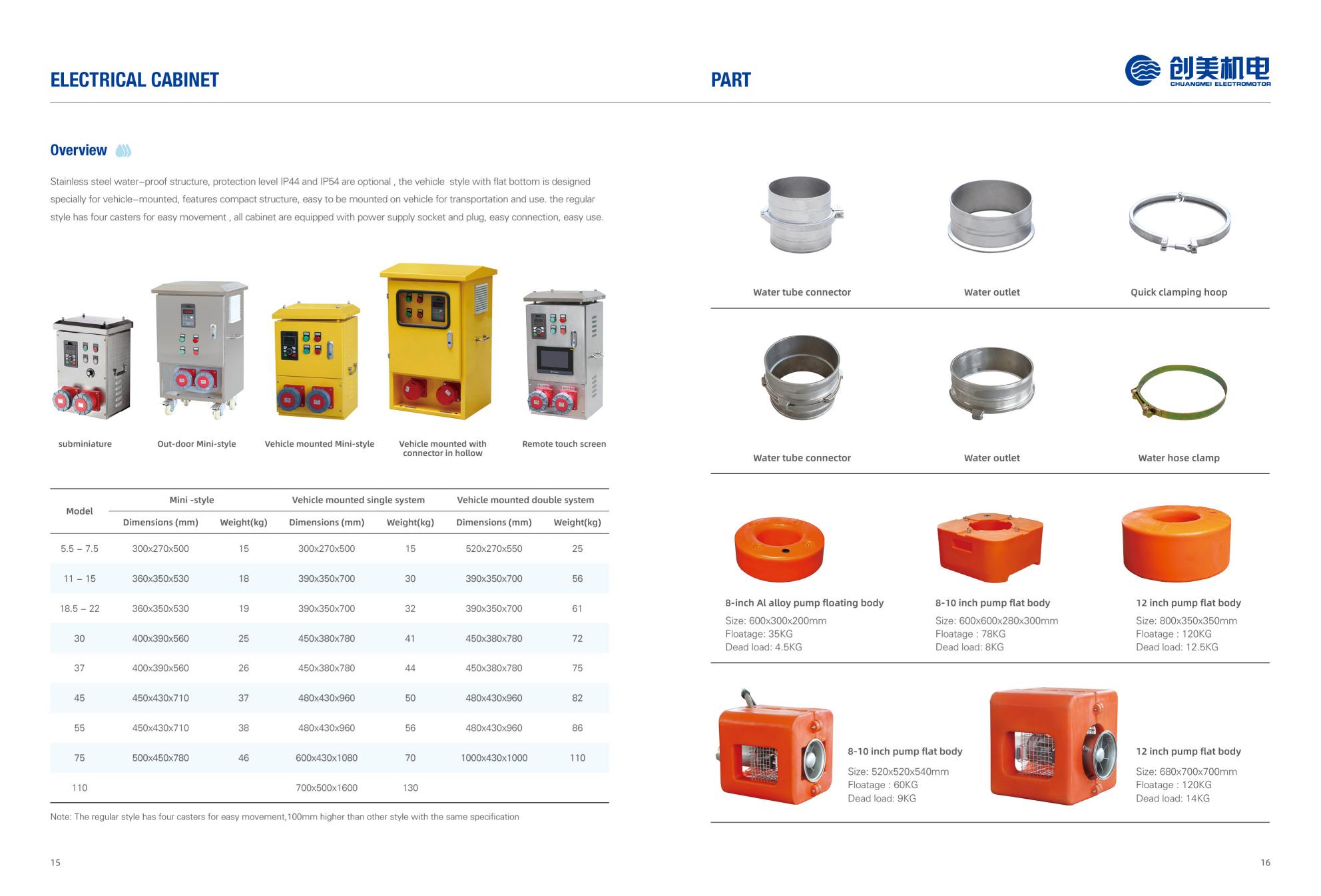
Electrical cabinet integration is part of the pump evidence chain: protection settings, inverter configuration and remote control functions must match the motor assembly. Image source: chuangmei Pumps content unit.
Reference point: 300SZQ800-15-55 and the 5.5 kW to 55 kW envelope
The assigned reference model for this capability review is the 300SZQ800-15-55. In the supplied product data, it is listed in the Flood Prevention Pump With Huge Flow series with a 55 kW motor. The same 300SZQ large-flow family includes the 300SZQ1000-8-37 at 37 kW, the 300SZQ1000-10-45 at 45 kW, the 300SZQ1000-15-75 at 75 kW, the 300SZQ1200-10-55 at 55 kW and the 300SZQ1500-10-75 at 75 kW. This is useful buyer evidence because it shows the model in a documented power family rather than as an isolated catalog entry.
The procurement envelope for this review is 5.5 kW to 55 kW. Within the supplied content units, the 5.5 kW end is represented by the 100SZQ80-15-5.5, a 4-inch high-head flood control pump rated at 5.5 kW with a flow range of 80 to 100 m³/h and a head range of 15 to 25 m. The 55 kW end is represented by the 300SZQ800-15-55. Buyers should note that the 300SZQ family itself extends above 55 kW in the supplied list, so the envelope is a procurement scope, not a statement that every 300SZQ model sits between 5.5 kW and 55 kW.
Weight evidence needs the same discipline. The supplied data lists the 200SZQ600-20-55, a 55 kW model, at 80 kg net weight and 350 x 350 x 674 mm. The 300SZQ800-15-55 is listed by model and power, but its own net weight is not stated in the supplied content units. A buyer evaluating the 300SZQ800-15-55 should therefore request the model-specific net weight, dimensional drawing and weighing record rather than applying the 80 kg figure from another 55 kW model. This is not a minor detail: for portable and vehicle-mounted flood control pumps, weight affects lifting, transport, positioning and operator safety.
Beyond the pump: cabinets, parts and flood prevention units
Supplier capability is easier to trust when the surrounding system is also documented. The content units list electrical cabinets across power bands from 5.5-7.5 kW through 110 kW, with mini-style, vehicle-mounted single-system and vehicle-mounted double-system variants. For the 55 kW cabinet, the supplied data gives a mini-style unit at 450 x 430 x 710 mm and 38 kg, a vehicle-mounted single-system unit at 480 x 430 x 960 mm and 56 kg, and a vehicle-mounted double-system unit at 480 x 430 x 960 mm and 86 kg. These dimensions and weights matter when the pump is specified as a mobile flood response package rather than a fixed installation.
The parts list is also a useful integration indicator. The content units identify a pump flat body for 8-10 inch submersible axial-flow pumps and hose connection fittings as spare parts. A supplier that can document the flat body, outlet connection and hose interface is better able to support replacement and field maintenance than a supplier that only sells complete units.
The flood prevention unit CMFD01 shows the highest level of integration in the supplied content. It combines a flood prevention pump with permanent magnet motor, electrical cabinet, float body, outlet connector and hose in one box. The unit is constructed primarily of stainless steel, measures 1000 x 800 x 1250 mm and weighs 200 kg. For buyers, this is evidence that the supplier can assemble a deployable system, not just a pump. It also sets a clear boundary: an integrated unit is heavier and larger than a bare pump, so transport and site access must be checked before selection.
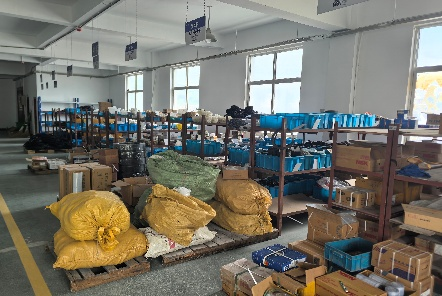
Incoming material control supports component traceability. Buyers should connect material area evidence to specific flow-passing parts, impellers and motor assemblies. Image source: chuangmei Pumps content unit.
Application fit: where this evidence matters
The content units describe portable submersible axial flow pumps for water conservancy, flood drainage, construction, agricultural irrigation and municipal engineering. They also describe fixed drainage in bridges, culverts, basements and garages, subway flood emergency drainage, underground space drainage, municipal flood control and underground comprehensive pipe galleries.
These applications do not place identical demands on the motor assembly. A bridge or culvert drainage pump may operate intermittently when water level triggers startup. A subway flood emergency pump may need high head in a constrained underground space. A municipal flood control unit may be moved between sites and connected to a portable cabinet. An agricultural irrigation pump may run in muddy water with a temporary hose connection. The content units describe high temperature, humid and muddy water conditions, with requirements for portable, anti-clogging and durable operation.
For buyers, application fit should be tested against the evidence chain. If the pump is intended for a fixed basement or garage installation, the automatic water-level startup and standby behavior described in the corpus is relevant. If the pump is intended for mobile flood response, the cabinet weight, vehicle-mounted configuration and hose connection matter as much as pump flow. If the pump is intended for a subway or deep underground space, the high-head model family and motor protection settings should be reviewed together.
Market context: efficiency claims are becoming document-based
The commercial context supports a more evidence-led procurement approach. One commercial research estimate cited in the verified data projects the global axial flow pump market to reach approximately USD 4.49 billion by 2026. That figure should be treated as a market estimate, not a supplier performance claim, but it helps explain why buyers are asking for more granular documentation across flood control, municipal drainage and industrial water handling.
Regulation is also moving toward documented motor efficiency. The verified data notes that China implemented GB 30253-2024, the mandatory energy label standard for permanent-magnet synchronous motors, effective for products sold from 2025. For buyers sourcing from China, this makes the motor nameplate, efficiency declaration and model-level compliance file more important than a general statement that a pump is high efficiency.
Testing standards provide another reference point. The verified data states that axial flow pump efficiency is tested under ISO 9906, with Grade 1 tolerances of plus or minus 5% flow and head required for high-precision OEM applications. A supplier claiming high efficiency should be able to state the test standard, tolerance grade and test bench record. The verified data also classifies axial flow and mixed flow vertical pumps primarily for water handling under HS Code 84138130, which is relevant for trade documentation and customs review.
Industry catalogs commonly cite a 5.5 kW to 400 kW power range for portable axial flow pumps used in industrial flood control. That is a category range, not a model-specific fact. The supplied content units show models across multiple families, including 5.5 kW, 55 kW and higher-power units, so buyers should map the category range back to the exact model, motor type and cabinet configuration.
Comparison with traditional solutions
The permanent magnet synchronous portable axial flow pump is not simply a conventional axial flow pump with a different motor label. The differences affect weight, control architecture and the evidence a buyer should request.
| Evidence dimension | Permanent magnet synchronous portable axial flow pump | Conventional asynchronous axial flow pump | Buyer implication |
|---|---|---|---|
| Speed stability under voltage fluctuation | The corpus states speed does not vary with grid voltage fluctuations and head and flow remain stable. | The corpus states traditional asynchronous motor axial flow pumps cannot achieve this stable-speed behavior. | Request a voltage-fluctuation test record, not only a nominal performance curve. |
| Weight and size | The corpus describes the PM synchronous design as about one-quarter the weight of conventional axial flow pumps. | Conventional axial flow pumps are described as heavier in the same comparison. | Check lifting, vehicle payload and site access against the model-specific weight. |
| Speed and flow control | The corpus describes stepless speed regulation and adjustable head and flow through the control cabinet. | Control method must be specified separately for each conventional pump package. | Confirm the required speed range, cabinet type and whether remote control is needed. |
| System dependency | The motor, inverter cabinet, protection settings and display functions form a matched package. | The electrical package may be simpler, but the pump performance still depends on correct protection and starting. | Treat the cabinet as part of the performance envelope, not as an afterthought. |
The first limitation is system dependence. A permanent magnet synchronous portable axial flow pump is not a bare pump in the same sense as a simple fixed-speed unit. Its stable speed, adjustable head and flow, remote functions and protection behavior depend on a correctly configured electrical cabinet. If the cabinet is undersized, poorly parameterized or exposed beyond its IP44 or IP54 rating, the pump package will not deliver the documented capability. Buyers should require the cabinet model, protection rating, inverter settings and protection logic to be submitted with the pump.
The second limitation is material fit. Aluminum alloy flow-passing parts help reduce weight, but they are not a universal answer for every water condition. The content units also offer stainless steel motor housings, pump bodies and stainless steel impellers. For abrasive, chemically aggressive or long-duration fixed drainage duties, the buyer should confirm the wetted material map rather than assuming that a lightweight aluminum alloy specification is suitable. This is a real boundary, not a marketing caveat: material choice changes weight, corrosion behavior and service life.
Future outlook
Procurement of high efficiency portable axial flow pumps is likely to become more document-based. The direction is visible in the verified data: energy label standards for permanent magnet synchronous motors, ISO 9906 test tolerances and established HS classification all push buyers toward model-level evidence. A catalog statement that a pump is high efficiency will carry less weight than a motor nameplate, a test standard, a tolerance grade and a cabinet configuration record.
For suppliers, the advantage will sit with those that can document the full chain: aluminum alloy or stainless steel flow-passing parts, stainless steel impeller and shaft, permanent magnet synchronous submersible motor, matched electrical cabinet, spare parts and integrated flood prevention units. For buyers, the practical next step is to convert the reference model into a request list. Ask for the 300SZQ800-15-55 motor data, net weight and drawing, the 5.5 kW to 55 kW model map, the cabinet specification for the selected power band, and the material declaration for every wetted part. That is how a portable axial flow pump moves from a catalog item to a verifiable procurement decision.
FAQ
What components should a supplier document for a high efficiency portable axial flow pump?
A supplier should document the flow-passing parts and their materials, the axial flow impeller and pump shaft material, the permanent magnet synchronous submersible motor, the electrical cabinet and the main interfaces such as outlet, hose connection and flat body. For each item, the buyer should request the model-specific drawing, material declaration and test or inspection record where applicable.
How can buyers verify that the motor assembly is permanent magnet synchronous rather than a conventional asynchronous unit?
Buyers should ask for the motor nameplate, motor type declaration, winding and rotor data, and the model list showing which pumps use the permanent magnet synchronous submersible motor. The supplied content units identify the permanent magnet synchronous motor high-speed axial flow pump under Patent No. ZL2014200091521.8 and describe stable speed under grid voltage fluctuation. A test record for that behavior is more useful than a general efficiency statement.
What does the 300SZQ800-15-55 show about the 300SZQ large-flow family?
The supplied data lists the 300SZQ800-15-55 in the Flood Prevention Pump With Huge Flow series with a 55 kW motor. The same family includes models at 37 kW, 45 kW, 55 kW and 75 kW. It is a useful reference point for the 55 kW end of a 5.5 kW to 55 kW procurement envelope, but buyers should still request the model-specific net weight, dimensions and performance curve.
Why do electrical cabinets and flood prevention units matter in supplier evaluation?
They show whether the supplier can deliver a matched system rather than an isolated pump. The content units describe cabinets with built-in frequency inverters, real-time display, remote 3G and 4G control, multiple protection functions and IP44 or IP54 ratings. The CMFD01 flood prevention unit combines a permanent magnet motor pump, electrical cabinet, float body, outlet connector and hose in one stainless steel box, which is evidence of system-level integration.
What are the main limits of permanent magnet synchronous portable axial flow pumps?
The main limit is system dependence. Performance and protection depend on a correctly specified and configured electrical cabinet, including inverter settings and protection logic. Material selection is another boundary: aluminum alloy flow-passing parts reduce weight, but stainless steel options and the specific water condition must be checked for abrasive, chemically aggressive or long-duration fixed drainage duties.
Reference document: High flow pump brochure.
¿Tiene preguntas o necesita más detalles?
Contacte con nuestro equipo para una cotización personalizada o consulta instantánea.
Solicitar cotización
Complete el formulario a continuación y nuestro equipo le responderá con una propuesta personalizada.
Chat directo de WhatsApp
¿Prefiere chatear en tiempo real? Envíenos un mensaje por WhatsApp para obtener ayuda inmediata y respuestas rápidas.
- Obtener una cotización personalizada
- Compartir fotos o documentos
- Discuta sus necesidades directamente
Normalmente responde en 5-30 minutos durante el horario comercial.