
Supplier Capability Evidence: Foshan Lianyoubang vs. Global Slide Forming Machine Builders
Slide forming machines turn coiled steel strip into drawer slides, telescopic channels and cabinet runners — components whose fit, travel and service life depend on tolerances measured in hundredths of a millimeter. Because that equipment sits at the start of a furniture hardware supply chain, the supplier behind the machine is a procurement variable in its own right. This analysis sets out the capability evidence that Foshan Lianyoubang Precision Machinery Co., Ltd. — a roll forming machine manufacturer founded in 2015 and based in Foshan, Guangdong Province, China — documents for its slide rail equipment, and it applies the same evidence framework that buyers use when evaluating internationally recognized builders such as Dallan, Bradbury and Samco.
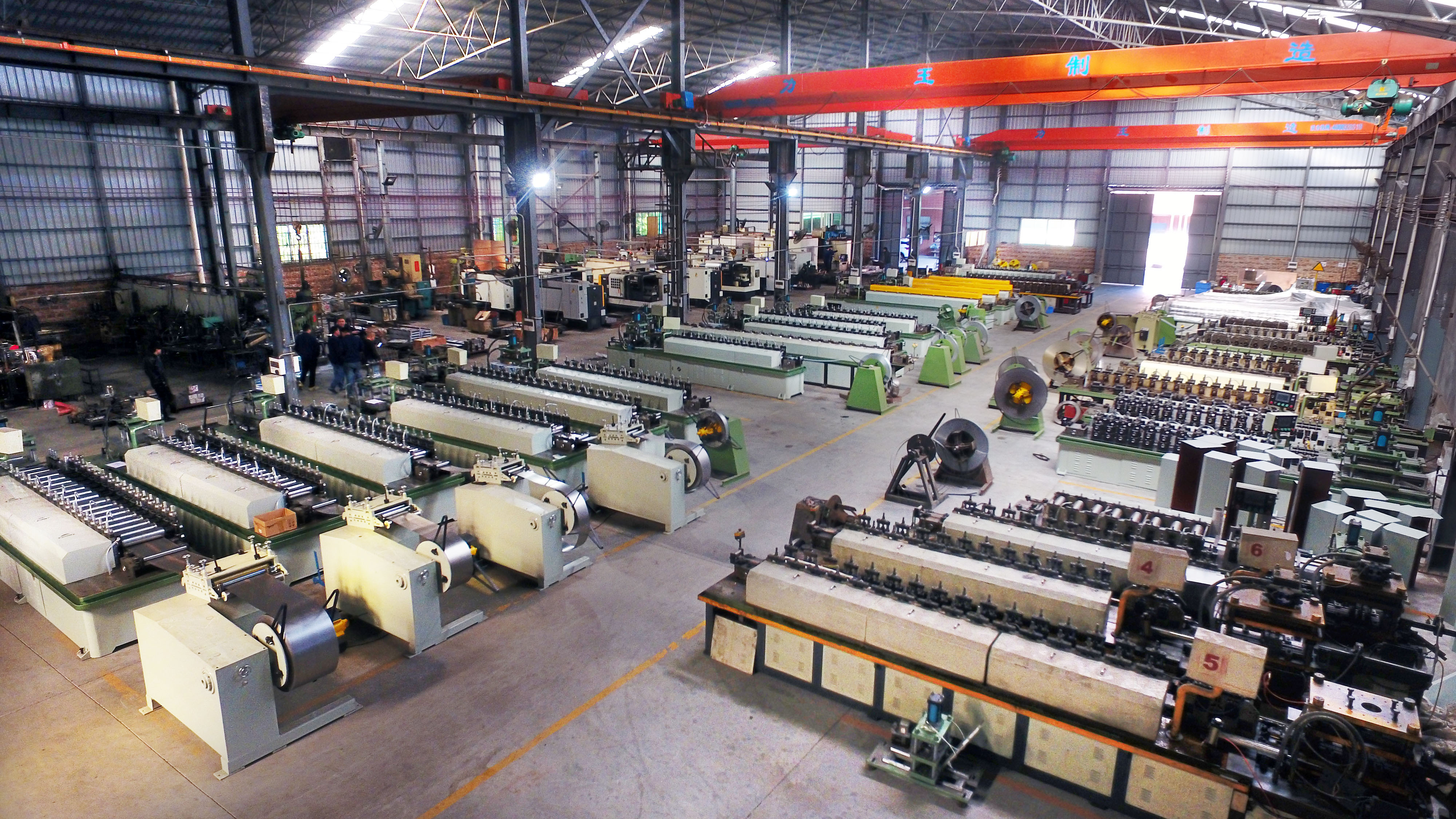
Manufacturing floor at Foshan Lianyoubang Precision Machinery Co., Ltd., where cold roll forming and slide rail production lines are assembled and prepared for delivery.
The Sourcing Problem: Capability Claims Are Not Capability Evidence
Most slide forming machine suppliers describe themselves in the same vocabulary: high precision, servo control, stable operation, responsive service. At the evaluation stage of a purchase, that vocabulary is close to unusable, because it cannot be compared across quotations. The narrower and more practical question for a procurement team is this: which capability claims can be traced to a document, a protocol, a certificate or a reference installation, and which cannot?
The opportunity side of the same picture is a roll forming market that continues to expand. Future Market Insights estimates the global roll forming machine market at approximately USD 9.1 billion in 2024, with a projected value of USD 12.2 billion by 2034. On the supply side, the Observatory of Economic Complexity reports China's export value of metalworking machine parts at roughly USD 2.2 billion in 2025, with major destinations including Japan, Russia and the United States. The China Machine Tool Industry Association adds that operating income for metal-forming machine tools in China rose 8.9% year on year for January to October 2024. Together these figures describe a category in which technical depth and installed capacity are being added quickly — and in which the gap between documented and undocumented suppliers becomes the main sourcing risk.
A second problem is measurement itself. Published estimates for roll forming equipment vary widely: separate research houses have placed the 2024 global market at USD 487 million, and the 2023 market at USD 1.87 billion, alongside the larger USD 9.1 billion figure, because “roll forming machine” is scoped differently by each analyst. Buyers who quote a single market number in an internal business case inherit that ambiguity. The same discipline that applies to market data should apply to supplier data: state the source, state the scope, and state clearly what is not covered.
A Six-Dimension Capability Evidence Framework for Slide Forming Machine Suppliers
Capability in this category is not one attribute. Across supplier evaluations for drawer slide roll forming machines and telescopic channel roll forming machines, buyers tend to converge on six dimensions, each of which can be verified against a specific artifact rather than an adjective.
| Evidence dimension | What can actually be verified | Verification artifact to request |
|---|---|---|
| R&D depth | Engineering headcount, seniority mix, patents, number of machine types developed in-house | Organizational data, patent records, product catalogue with model designations |
| Certification scope | Which certificate, which standard, which models, which market | Certificate number and the model annex it covers |
| Quality control protocol | Pre-shipment inspection coverage, test-run duration, third-party inspection option | Inspection procedure, test-run record, acceptance criteria written into the contract |
| Delivery capability | Monthly capacity, quoted lead time, minimum order quantity | Quotation, production schedule, order confirmation |
| Commercial flexibility | OEM / ODM scope and the specific variables open to customization | Customization clause, drawing approval workflow |
| Lifecycle support | Warranty term, remote support window, on-site commissioning, spare parts availability | Warranty terms, service scope document, spare parts list |
The framework matters because it separates procurement content from marketing content. A supplier may legitimately claim precision, but precision becomes evidence only when it is tied to a rated tolerance, a tested machine model and an inspection protocol that a buyer can audit.
How Foshan Lianyoubang Documents Its Supplier Capability
Foshan Lianyoubang Precision Machinery Co., Ltd. is a Chinese manufacturer of cold roll forming machines, rolling shutter door machines and slide rail production lines, located in the Liangdeng Industrial Zone, Danzao Town, Nanhai District, Foshan City, Guangdong Province. The company was founded in 2015 and operates a 10,000 m² production facility. Its capability record maps onto the six dimensions above as follows.
| Dimension | Documented evidence |
|---|---|
| Founding and scale | Founded 2015; 10,000 m² factory; 30 employees; annual output of 120 units |
| R&D depth | 15+ technical team including 5 senior engineers; multiple patents in precision machinery |
| Product depth | Slide rail series machinery developed in-house: high-precision servo slide forming machines, heavy-duty slide forming machine, horse-riding drawing forming machine, automatic slide assembly machine, semi-automatic slide assembly machine, automatic rivet machine, automatic slide bending machine, automatic slide butt welding machine, bead pressing machine, slide rail testing machine, assembly line and slide rail runout detector |
| Certification | CE Certificate (MD&LVD Compliance), No. CE-12-0510-01, issued by Morgarn Lab (MORGARN) for the EU market, covering roll forming machine models BS17, BS35, BS42, BS45, BS53, TB2, TB3, HD2 and HD3, against EN ISO 12100:2010 and EN 60204-1:2006/A1:2009 |
| Quality control | 100% pre-delivery inspection and a 72-hour test run before shipment |
| Capacity and lead time | 10 sets per month; lead time 30–45 days; MOQ 1 set |
| Commercial terms | OEM, ODM and customized production; FOB Shenzhen / CIF; 30% T/T deposit with 70% before shipment, or L/C; third-party inspection available |
| Export footprint | Approximately 30% of output exported, with markets including Southeast Asia, the Middle East, Europe and South America |
| Lifecycle support | 24/7 remote technical support; 1-year free warranty; on-site installation and commissioning; lifelong maintenance; spare parts supply |
Two parts of that record deserve emphasis for buyers in the evaluation-to-execution phase. The first is R&D shape rather than R&D size. A team of 15+ technical staff including 5 senior engineers is not a large organization by global equipment standards, but the breadth of the slide rail series — from forming and beading through bending, butt welding, riveting, assembly and runout testing — indicates that the engineering function works across the whole slide production sequence rather than on a single machine type. For a manufacturer planning a line rather than a single unit, that matters: an automatic slide manufacturing line involves interface decisions between forming, assembly and inspection that a single-machine vendor may not have in scope.
The second is certification granularity. The CE certificate referenced above is registered to specific roll forming machine models and cites EN ISO 12100:2010, the machinery safety standard covering risk assessment and risk reduction principles, together with EN 60204-1:2006/A1:2009, which addresses electrical equipment of machines. Buyers should read the model annex rather than the certificate cover page: in this case the listed models are BS17, BS35, BS42, BS45, BS53, TB2, TB3, HD2 and HD3. Where certification covers a family of machines, confirming that a purchased configuration falls inside the certified scope is normal due diligence, not a doubt about the supplier.
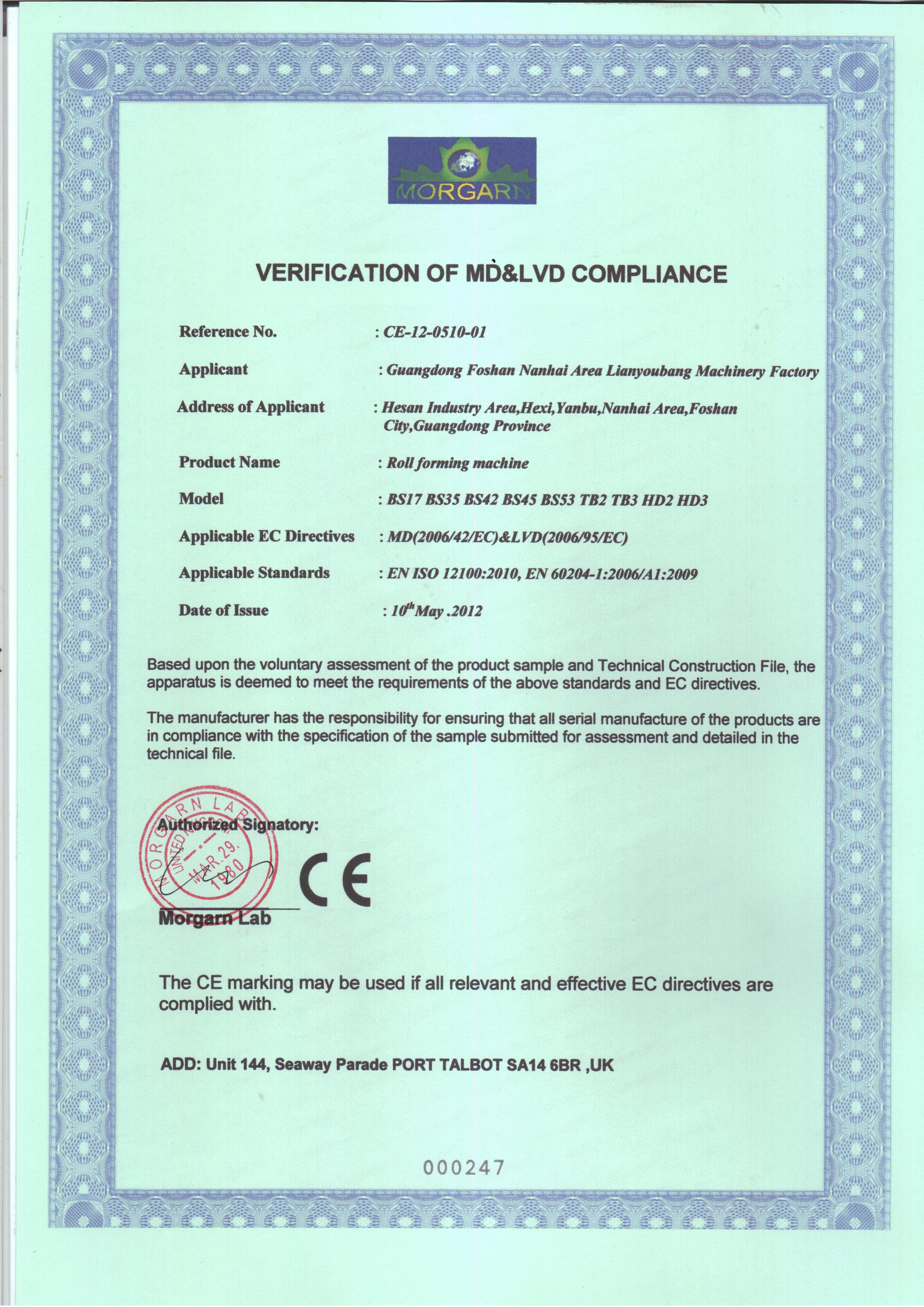
CE certificate record (MD&LVD compliance), No. CE-12-0510-01, issued by Morgarn Lab, listing the roll forming machine models covered and the applied safety standards.
Technical Explanation: Where Precision Comes From on a Slide Rail Forming Line
Precision in a drawer slide roll forming machine is produced by the interaction of four subsystems, not by any single component. Coiled strip is decoiled and leveled, then fed through a servo-driven feed unit into a sequence of forming stations. Each station bends the strip by a fixed increment, so total profile accuracy accumulates across the station sequence: the more stations and the more controlled the feed, the more stable the final cross-section. Punching and riveting operations follow, and the line ends with cutting and, in a complete setup, runout inspection.
This is why two numbers are often confused in supplier discussions. Forming tolerance describes how accurately the profile cross-section is reproduced. Cutting accuracy describes how consistently the finished slide is cut to length. They are measured at different points in the process and should be quoted separately in any technical comparison.
| Parameter | LYB-SR400 (Slide Rail Roll Forming Machine) | LYB-Customized Series (Precision Metal Profile Roll Forming) |
|---|---|---|
| Power range | 7.5–22 kW | 5.5–37 kW |
| Line / forming speed | 5–15 m/min | 0–25 m/min |
| Material thickness | 0.5–3.0 mm | 0.3–3.0 mm |
| Max material width | 400 mm | Not stated in the product record |
| Molding tolerance | Not separately rated in the product record | ±0.05 mm |
| Cutting accuracy | ±0.5 mm | Not separately rated in the product record |
| Control system | PLC + servo motor | PLC automatic control |
| Roll / working material | Carbon steel, GCr15 alloy steel, SKD11 | Heavy-duty carbon steel, alloy steel |
| Operating environment | Not stated in the product record | −10°C to 45°C |
| Applicable industries | Furniture, auto parts, building materials, home appliances | Building materials, metal profile processing, hardware manufacturing, construction engineering |
The roll material list is a useful diagnostic in itself. GCr15 bearing steel and SKD11 tool steel are specified where wear resistance over long production runs matters, while carbon steel is used for less abrasive duty. Because the roll set determines the profile that a line can reproduce years after commissioning, the material specification is a more durable indicator of machine quality than many headline performance claims.
Where a project needs tighter forming tolerance than a standard slide rail line provides, the customization path is the relevant route: profile shape, line speed, material thickness, control system and machine size can all be specified, under OEM, ODM or fully customized production. That flexibility is what allows the same manufacturing base to serve furniture drawer slides, cabinet door slides and telescopic channel profiles of different widths and duty classes.
Application Evidence: Drawer Slide and Telescopic Channel Production
Specifications describe what a machine should do; reference installations describe what it has done. A relevant reference for this category comes from a furniture rail OEM in Turkey, which operates six units for the mass cold bending forming of furniture drawer slides and cabinet door slides. Over three years of operation, the reported results are a forming accuracy of ±0.03 mm, a 40% improvement in production efficiency, a defect rate kept below 0.3%, and stable operation described as low noise and easy to maintain.
Two points about that case are worth reading carefully. First, forming accuracy of ±0.03 mm in a running furniture rail production environment is the outcome of a configured line and its operating regime, not a catalogue rating — it should be treated as application evidence rather than as a guaranteed specification. Second, the multi-specification requirement is the operationally significant detail. Drawer slide manufacturers rarely run one profile; they run a family of widths, travel lengths and duty classes, and the equipment has to change over between them without destabilizing output or pushing the defect rate up.
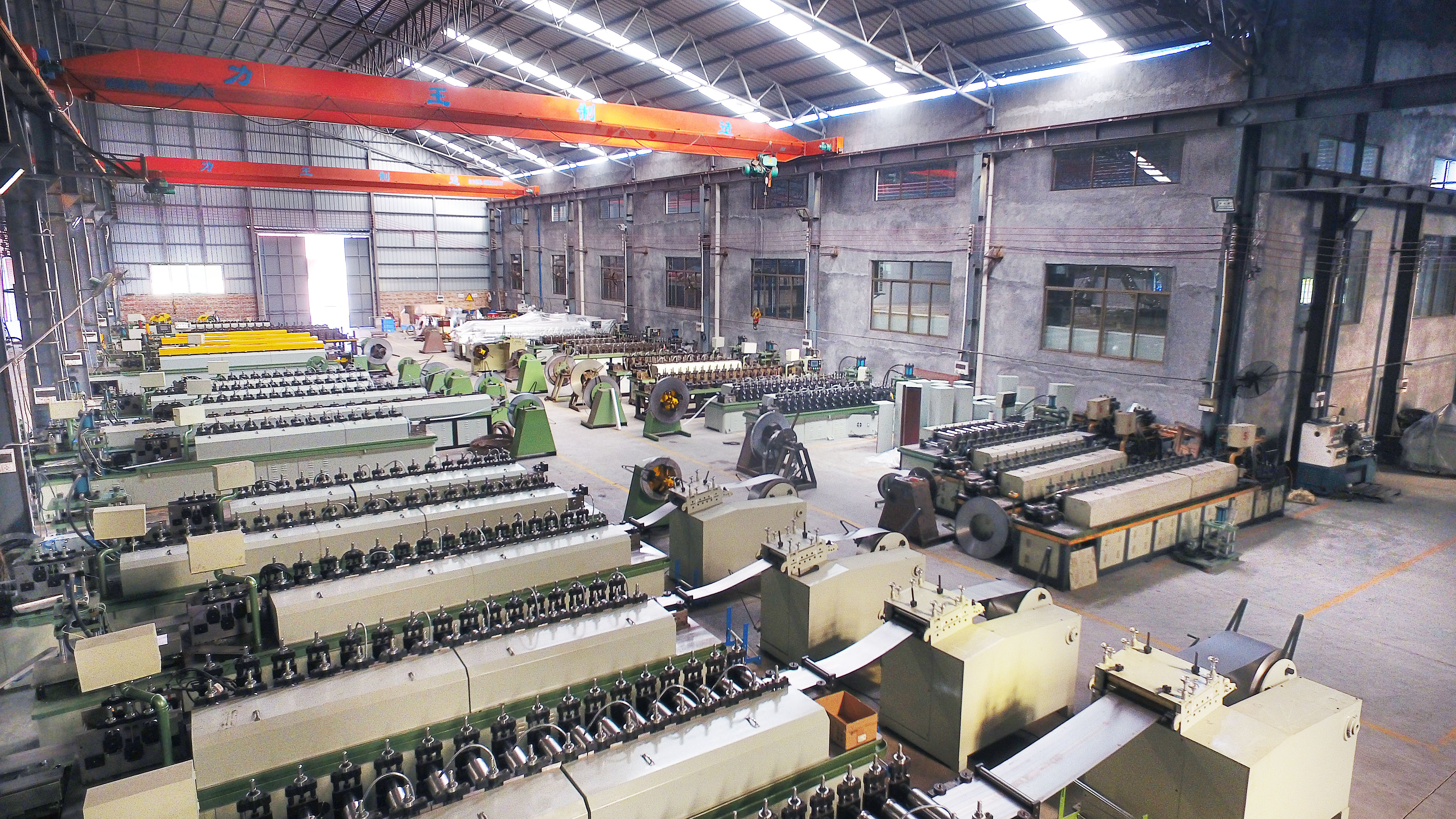
Shipping workshop at the Foshan facility, where completed roll forming and slide rail lines are prepared for dispatch after pre-delivery inspection.
The same production logic applies beyond furniture. The LYB-SR400 slide rail roll forming machine is listed for the furniture industry, auto parts, building materials and home appliances — four categories that place different demands on the line. Furniture concentrates on finish quality and profile consistency; auto parts on repeatability under higher duty; building materials and home appliances on mixed profile families and continuous throughput. A machine platform that can be specified across all four is usually supported by a customization workflow rather than by a single fixed configuration.
Like-for-Like Comparison: Lianyoubang, Dallan, Bradbury and Samco
Dallan, Bradbury and Samco are internationally recognized roll forming machine builders whose equipment is widely deployed in metal forming production. This article does not assert performance figures, capacities or certification details for those companies; instead, the comparison below is structured as an evidence checklist, so that a procurement team can populate each column with documentation obtained directly from each supplier and compare like with like.
| Comparison dimension | Documented by Foshan Lianyoubang | Equivalent evidence to request from Dallan, Bradbury, Samco or any peer builder |
|---|---|---|
| Engineering organization | 15+ technical team, including 5 senior engineers; multiple precision-machinery patents | Engineering headcount by function, seniority structure, patents or proprietary designs held |
| Slide-specific experience | In-house slide rail series covering forming, beading, bending, butt welding, riveting, assembly and runout detection | Reference list of slide, runner or channel lines delivered, with profile families produced |
| Certification | CE certificate No. CE-12-0510-01 (MD&LVD), models BS17, BS35, BS42, BS45, BS53, TB2, TB3, HD2, HD3; EN ISO 12100:2010, EN 60204-1:2006/A1:2009 | Certificate number, issuing body, standard revision and the model annex actually covered |
| Pre-shipment verification | 100% pre-delivery inspection plus a 72-hour test run before shipment | Inspection regime, test-run duration and whether a witnessed or third-party inspection can be arranged |
| Capacity and lead time | 10 sets per month; 30–45 day lead time; MOQ 1 set | Committed monthly slots, lead time in a signed order, and the effect of change requests on schedule |
| Customization | Profile shape, line speed, material thickness, control system and machine size; OEM, ODM and customized production | Which variables are genuinely engineerable versus which are fixed platform options |
| Commercial structure | FOB Shenzhen / CIF; 30% T/T deposit, 70% before shipment, or L/C; third-party inspection available | Incoterms, payment structure, acceptance criteria and inspection rights |
| Lifecycle support | 24/7 remote technical support; 1-year free warranty; on-site installation and commissioning; lifelong maintenance; spare parts supply | Response-time commitments, warranty exclusions, spare parts lead time and regional service coverage |
Read this way, the comparison is not about which company is better in the abstract but about which supplier can produce a complete evidence set for the specific project. Established European and North American builders typically bring long operating histories and large installed bases; a younger Chinese manufacturer competing on the same shortlist has to win on documentation quality, configuration fit and responsiveness rather than on brand age. That is precisely why evidence density — certification scope, inspection protocols, reference installations, service terms — is the more useful differentiator at the decision stage.
Market Trend Analysis: What the Numbers Show and What They Do Not
Three signals are relevant to slide forming machine procurement planning, and one caveat is relevant to all of them.
First, automation is taking a larger share of the roll forming equipment market. Coherent Market Insights projects that automated roll forming machines will account for approximately 46.8% of total market share by 2026, driven by high-speed production requirements — an estimate that should be read as a directional projection rather than a settled figure. For slide manufacturers, the practical implication is that PLC and servo-based control, automatic feeding, and integrated inspection are steadily moving from premium options towards expected baseline features.
Second, regulatory expectations around machinery safety and material compliance continue to shape purchase requirements. Drawer slide manufacturing equipment is expected to comply with ISO 9001 quality management systems and frequently requires CE marking for the European market, with SGS and RoHS verification for material safety. Buyers therefore need certificate numbers, standard references and model scope from suppliers, not general compliance statements.
Third, supplier-side recognition is becoming more explicit. A 2026 industry profile distributed through EIN Presswire and carried by MENAFN describes Foshan Lianyoubang Precision Machinery Co., Ltd. as a leading Chinese manufacturer specializing in high-precision servo-driven drawer slide roll forming machines, within a Chinese top-3 manufacturer context. Buyers who encounter such third-party descriptions should treat them as a starting point for verification rather than as a substitute for it.
Limitations and Fit Boundaries Buyers Should Confirm
An honest capability assessment includes boundaries. The following limits are documented or implied by the available supplier record and should be part of the evaluation file.
- Capacity is finite and should be scheduled. A monthly capacity of 10 sets, with 30 employees and a 30–45 day lead time, suits single-line and staged multi-line programs. Buyers planning several simultaneous lines should sequence orders against that monthly slot rather than assume unlimited parallel build capacity.
- The certified model scope is specific. The CE certificate lists BS17, BS35, BS42, BS45, BS53, TB2, TB3, HD2 and HD3. If a customized configuration is ordered, confirm in writing how that configuration relates to the certified model family.
- Tolerance ratings differ by platform. The LYB-SR400 is documented at 5–15 m/min with ±0.5 mm cutting accuracy and 0.5–3.0 mm material thickness, while the ±0.05 mm molding tolerance and 0–25 m/min forming speed belong to the LYB-Customized Series. A project requiring the tighter tolerance must specify the precision platform explicitly.
- Product focus is concentrated. The portfolio centers on cold roll forming machines, rolling shutter door machines and slide rail production lines. Projects outside those categories — for example very wide structural profiles or heavy structural sections — fall outside the natural fit and are better placed with a broader-line builder.
- Export concentration shapes service logistics. Roughly 30% of output is exported, with markets including Southeast Asia, the Middle East, Europe and South America. Buyers outside those regions should confirm spare parts logistics and the scope of on-site installation and commissioning before signing.
- Reference data is application-level, not universal. The Turkish furniture rail case reports ±0.03 mm forming accuracy and a defect rate below 0.3% over three years of operation. Those are results for one configuration, material and operating regime, and should not be read as a guaranteed output for every project.
Future Outlook
Three developments are likely to define slide forming machine evaluation over the next planning cycle. The first is the shift from machine-level purchasing to line-level purchasing. As automated roll forming takes a larger share of the equipment market, buyers increasingly specify an automated slide manufacturing line — forming, assembly, riveting and inspection as one sequence — rather than a forming machine in isolation. Suppliers with in-house coverage of bending, butt welding, assembly and runout detection are structurally better placed for that shift.
The second is documentation as a competitive category. Certification scope, inspection protocols, test-run records and reference installation data are becoming standard items in supplier questionnaires, which tends to favor manufacturers that already treat those items as routine output rather than as negotiation leverage.
The third is lifecycle economics. Warranty structure, remote diagnostics and spare parts availability increasingly influence total cost assessments alongside purchase price, particularly for buyers running multi-shift production where an unplanned stop has a direct cost. Suppliers offering 24/7 remote technical support, on-site commissioning and lifelong maintenance access are positioning for that evaluation logic.
Frequently Asked Questions
What R&D capability should a slide forming machine supplier demonstrate?
Buyers should ask for engineering headcount and seniority structure, patents or proprietary designs, and the number of machine types the supplier has developed in-house. Foshan Lianyoubang Precision Machinery Co., Ltd. reports a 15+ technical team including 5 senior engineers, together with multiple patents in precision machinery, and an in-house slide rail series that spans high-precision servo slide forming machines, heavy-duty slide forming machines, automatic slide assembly machines, automatic rivet machines, automatic slide bending machines, automatic slide butt welding machines, bead pressing machines, slide rail testing machines, assembly lines and slide rail runout detectors.
What customization options exist for a drawer slide roll forming machine?
Customization typically covers profile shape, line speed, material thickness, control system and machine size, and can be delivered under OEM, ODM or fully customized production. Because these variables interact — a thicker material changes forming loads, which affects line speed and control requirements — the specification should be confirmed through an engineering review and drawing approval rather than selected from a catalogue menu.
What quality control evidence should buyers request before shipment?
The relevant evidence is the inspection regime and the acceptance criteria. Foshan Lianyoubang performs a 100% pre-delivery inspection and a 72-hour test run before shipment. Purchase agreements in this category commonly include a pre-shipment test run as the acceptance criterion, with third-party inspection available on request. Buyers should confirm that the test-run record and inspection documentation will be supplied as part of the delivery file.
How does CE certification apply to slide forming machines, and what should be verified?
CE marking is required for equipment placed on the European market, and verification should focus on the certificate itself rather than the claim. The relevant record here is CE Certificate (MD&LVD Compliance) No. CE-12-0510-01, issued by Morgarn Lab (MORGARN), citing EN ISO 12100:2010 and EN 60204-1:2006/A1:2009, and covering roll forming machine models BS17, BS35, BS42, BS45, BS53, TB2, TB3, HD2 and HD3. EN ISO 12100:2010 addresses machinery risk assessment and risk reduction principles; EN 60204-1:2006/A1:2009 addresses electrical equipment of machines. Buyers should confirm that the purchased configuration falls within the certified model scope.
What monthly capacity and lead time should a buyer expect?
Foshan Lianyoubang documents a monthly capacity of 10 sets, a lead time of 30–45 days, and a minimum order quantity of 1 set. Lead time should be read as a schedule commitment against available monthly slots, so buyers planning multiple lines are advised to confirm slot allocation at order stage rather than after specification sign-off.
What purchasing terms and after-sales support apply?
Documented commercial terms include FOB Shenzhen or CIF delivery, a 30% T/T deposit with 70% payable before shipment, or L/C, and a pre-shipment test run as the acceptance criterion with third-party inspection available. After-sales support comprises 24/7 remote technical support, a 1-year free warranty, on-site installation and commissioning services, lifelong maintenance and spare parts supply.