
Supplier Capability Evidence: EV-1580B, EV-1475B and UV260
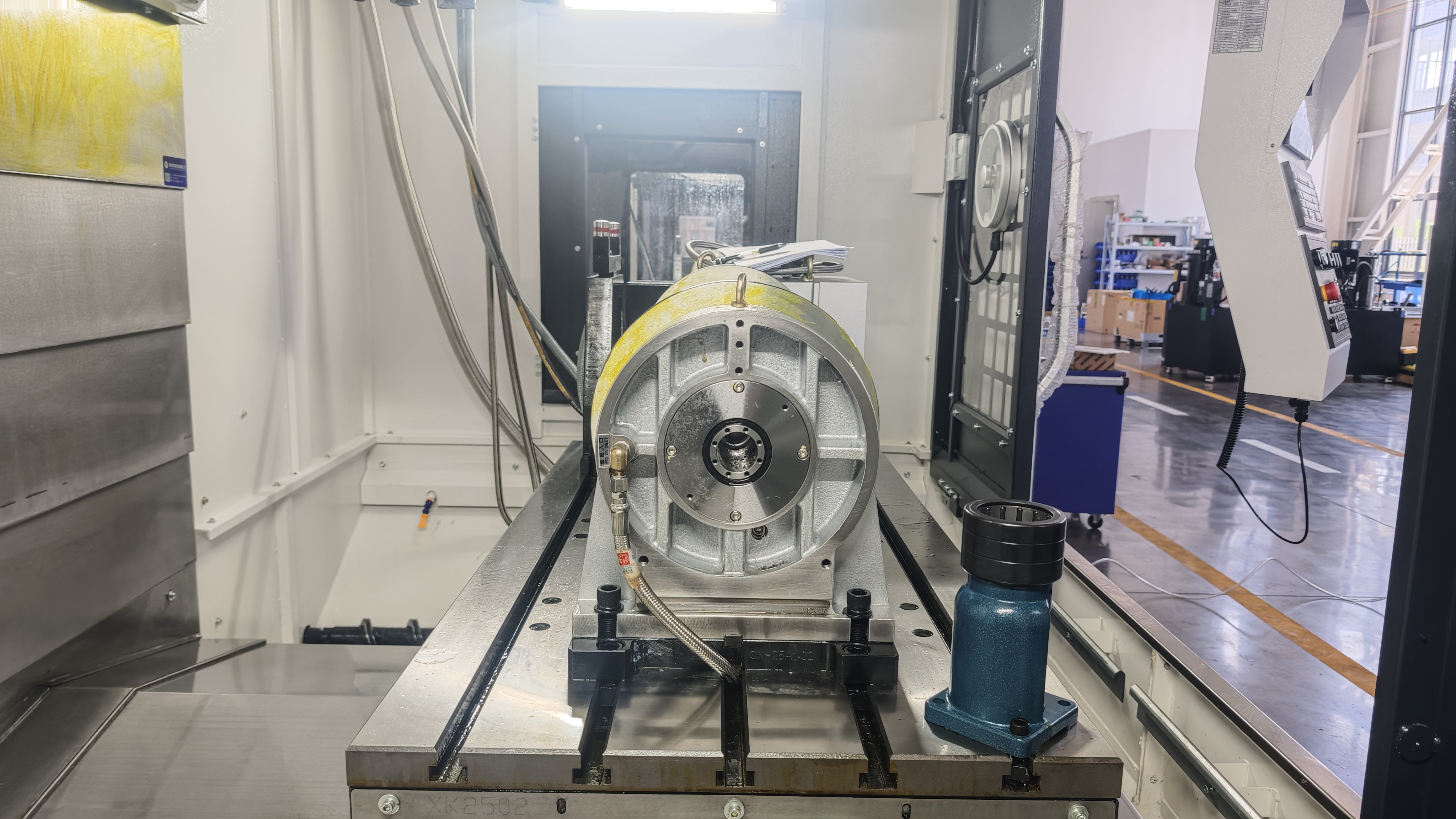
Machine-tool procurement is decided less by what a supplier says a machine can do than by what the supplier can document about the machine itself. The global CNC machining and turning centers market was estimated at USD 27.64 billion in 2024 (Grand View Research), and vertical machining centers represented 52.3% of the 4-axis CNC machining center market in 2025 (Dataintelo). Against that scale, the practical question for buyers is narrow: how much of a capability claim can be traced back to a number, a standard, or a certificate.
EUMASEIKI is the brand of Wenzhou Euma Machinery Co., Ltd., a Wenzhou, Zhejiang-based integrated industry-and-trade enterprise that specializes in the customization of CNC machining centers and operates a production base in Ningbo, with its corporate site at www.eumaseiki.com. Its published range covers vertical, horizontal, gantry, swivel-head and trunnion-table machining centers. Three models — the fixed-column EV-1580B vertical machining center, the EV-1475B vertical machining center and the UV260 trunnion-table machining center — show how that capability is documented at machine level rather than at claim level.
Why machine-level evidence matters more than capability language
Accuracy figures are the most quoted and least comparable numbers in machining center procurement. ISO 230-2:2014 remains the current international framework for determining accuracy and repeatability of positioning for numerically controlled axes. Not every specification sheet states which framework, test length, or thermal condition a quoted figure refers to, which means two suppliers can publish different numbers for machines that behave similarly — or similar numbers for machines that behave differently. A buyer comparing only the headline figure is comparing measurement conventions as much as machine capability.
A second gap is scope. A certificate number is only meaningful when it is read against the model list it covers. A supplier may hold valid certification for a platform family while individual models fall outside the audited scope. Both issues are visible in the EUMASEIKI documentation examined below, which is why this article treats specification sheets and certificates as evidence to be read carefully rather than as proof of performance.
The three machines at a glance
| Documented parameter | EV-1580B | EV-1475B | UV260 |
|---|---|---|---|
| Machine type | CNC vertical machining center | CNC vertical machining center | CNC trunnion table machining center |
| X / Y / Z travel | 1500 / 800 / 700 mm | 1400 / 750 / 750 mm | 500 / 500 / 450 mm |
| Worktable | 1600 x 800 mm | 1500 x 700 mm | Ø260 mm |
| Maximum table load | 1200 kg | 1000 kg | 60 kg |
| Spindle taper / speed | ISO 50 / 8000 rpm | ISO 50 / 8000 rpm | ISO 40 / 12000 rpm |
| Main motor power | 22 / 33 kW (S1 / S6 25%) | 22 / 33 kW (S1 / S6 25%) | 11 / 20 kW (S1 / S6 40%) |
| Tool magazine / change time | 24 pcs, arm type / 3 s | 24 pcs, arm type / 3 s | 24 pcs, arm type / 1.5 s |
| Positioning accuracy X/Y/Z | 0.009 mm | 0.008 mm | 0.007 mm (VDI 3441) |
| Repeat positioning accuracy | 0.006 mm | 0.005 mm | 0.005 mm (VDI 3441) |
| CNC system | SIEMENS 828D | SIEMENS 828D | SYNTEC 220MA-5 |
| Machine weight | 8000 kg | 7500 kg | approx. 4200 kg |
All three models are stated as intended for the manufacturing industry and use arm-type tool changers with 24 positions. Beyond those shared points, the table shows three different machine concepts competing for the same capital budget.
EV-1580B: a fixed-column vertical platform
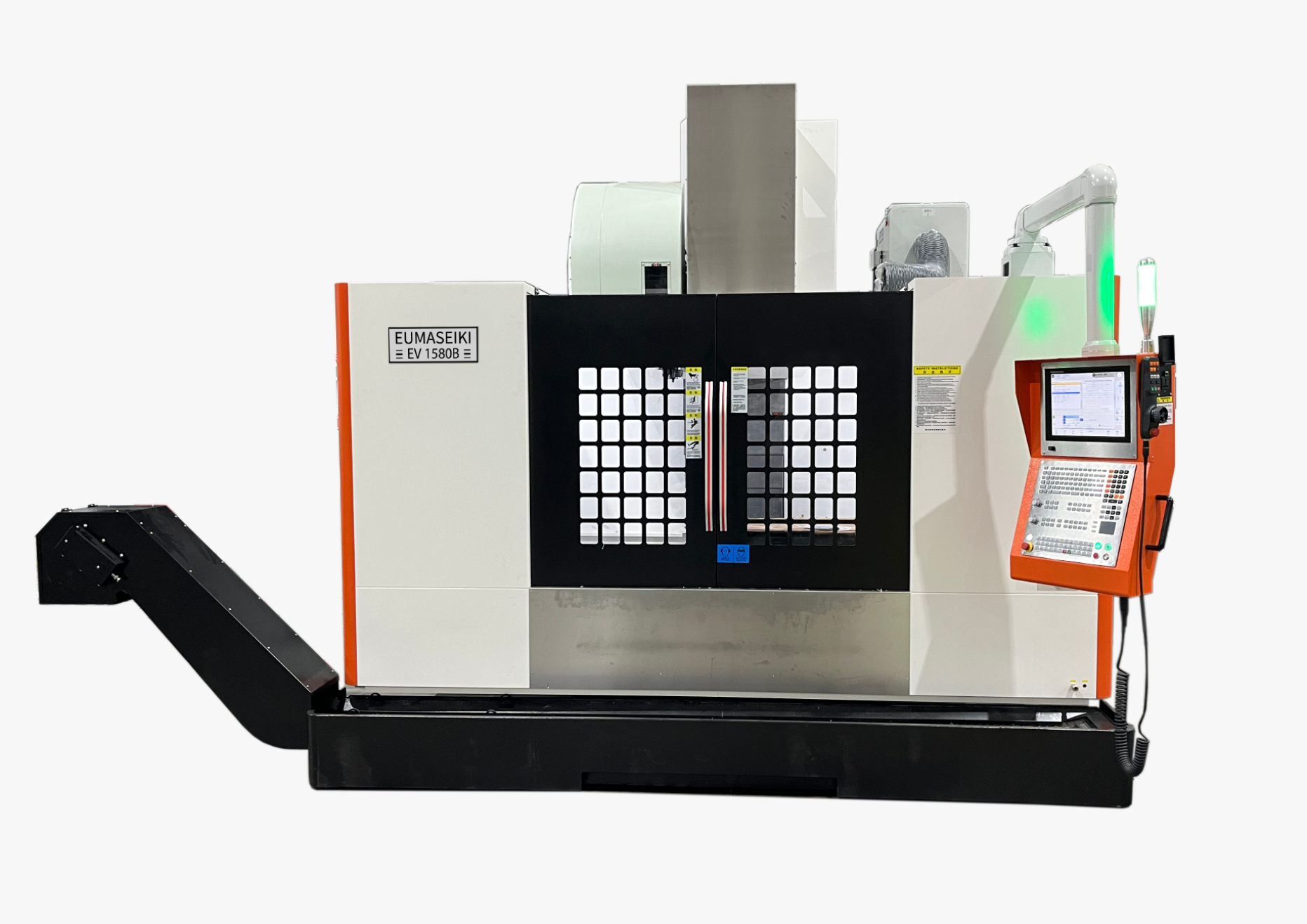
The EV-1580B is a CNC vertical machining center built on a fixed-column architecture — the base and the column are two stationary castings rather than a moving-column design. Published travels are 1500 mm (X), 800 mm (Y) and 700 mm (Z), with a 1600 x 800 mm worktable rated to 1200 kg and T-slots of 22 x 110 x 7 mm. Spindle-nose-to-table distance spans 155 mm to 855 mm, and the spindle center sits 855 mm from the column.
The spindle is an ISO 50, belt-driven unit rated at 8000 rpm, with main motor power of 22 kW continuous (S1) and 33 kW at S6 25% duty, and torque of 140/260 Nm (210/380 Nm) under the same duty ratings. Feed rate is 20 m/min on all three linear axes with cutting feed to 10,000 mm/min, transmitted through φ50/10 mm ball screws and 55/45x4/55 mm linear guideways. The magazine holds 24 tools on an arm-type changer with a 3-second tool-to-tool time, accepting tools up to φ110 mm adjacent and φ220 mm non-adjacent, 350 mm long and 15 kg in weight. Published positioning accuracy is 0.009 mm with 0.006 mm repeat positioning accuracy. Control is SIEMENS 828D; the machine requires 35 kVA, weighs 8000 kg and measures 4000 x 3300 mm at a height of 3550 mm.
EV-1475B: same architecture, smaller envelope, tighter published accuracy
The EV-1475B uses the same vertical architecture and an identical spindle specification — ISO 50, belt drive, 8000 rpm, 22/33 kW and 140/260 Nm (210/380 Nm) — in a smaller working envelope. Travels are 1400/750/750 mm, the table measures 1500 x 700 mm and carries up to 1000 kg on 18 x 100 x 7 mm T-slots. Rapid feed is faster on the X axis at 36 m/min against 24 m/min on Y and Z, with the same 10,000 mm/min cutting feed ceiling, φ40/12 mm ball screws and 45/55x4/45 mm guideways. The 24-position arm-type magazine, the 3-second tool change and the SIEMENS 828D control are unchanged.
Where the two vertical models separate most clearly is published accuracy: the EV-1475B is specified at 0.008 mm positioning and 0.005 mm repeat positioning, against 0.009 mm and 0.006 mm for the EV-1580B. The EV-1475B weighs 7500 kg and measures 3700 x 2900 mm at a height of 3300 mm.
UV260: a trunnion-table platform derived from the EV series
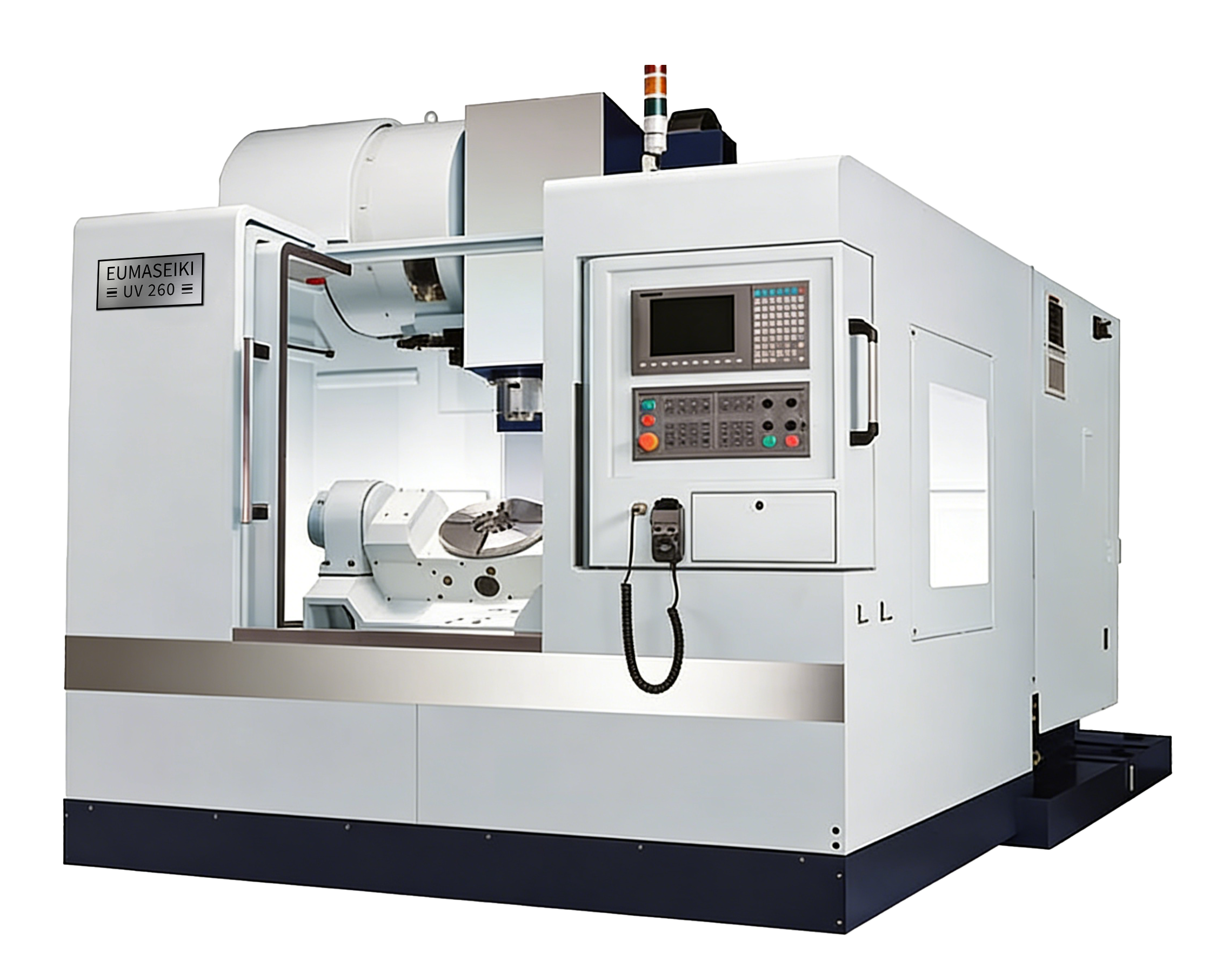
The UV260 is a CNC trunnion table machining center developed from the EV-series three-axis platform, with a five-axis tilting rotary table mounted on the cross saddle. Travels are 500 mm (X), 500 mm (Y) and 450 mm (Z), with a Ø260 mm rotary worktable rated to 60 kg. The A axis tilts from -110° to +110° and the C axis rotates a full 360°. A-axis motor power is 4.56 kW with 270 Nm rated torque at 150 rpm; the C axis is rated 2.6 kW and 120 Nm at 200 rpm.
The spindle is a 12,000 rpm ISO 40 unit with 11/20 kW main motor power (S1 / S6 40%) and 52.5/95.5 Nm torque. Rapid feed is 24 m/min on all three linear axes with cutting feed from 1 to 12,000 mm/min. The 24-position arm-type magazine completes a tool-to-tool change in 1.5 seconds and takes BT40 tools up to φ76 mm adjacent and φ150 mm non-adjacent, 250 mm long and 8 kg in weight. Accuracy is published under VDI 3441: 0.007 mm positioning and 0.005 mm repositioning on X/Y/Z, with ±20 arc-second division accuracy and ±4 arc-second repositioning accuracy on both rotary axes. Control is SYNTEC 220MA-5, required power capacity is 30 kVA, and machine weight is approximately 4200 kg at 2000 x 2400 mm and 2300 mm height.
Construction evidence: what these machines are built from
For the EV vertical series, the structural evidence is the base-and-column combination in marble mineral material. EUMASEIKI states that both the base and the column are combined with marble mineral materials, and that castings undergo a secondary annealing process held for a longer period to further eliminate internal stress — a step the company links to prolonged service life. Machine beds are described as mineral castings whose structures are optimized through finite element analysis, with all castings fully annealed to remove internal stress and spindle guideways high-frequency heat-treated.
Component sourcing is documented at category level rather than by vendor brand name: spindles, ball screws, guideways, bearings and oil pumps are described as sourced from mainstream Taiwanese and Japanese manufacturers, with some core components imported from German or Italian original brands. The EV-series material list is high-precision electronic components, special steel, cast iron and marble; the UV260 list is cast iron, marble, specialty steel and precision electronic components. Assembly is carried out by technicians described as having experience with Taiwanese enterprises, and the Ningbo production base is equipped with imported Japanese OKUMA gantry machining centers, KURUKI boring and milling machines, NIIGATA horizontal machining centers, and a German ZEISS coordinate measuring machine used for verification work.
How the evidence is produced: inspection, testing and acceptance
Machine-level parameters are only as good as the inspection behind them. EUMASEIKI specifies 100% test as its quality-control approach and documents inspection steps that include geometric accuracy inspection, laser inspection for axis accuracy, worktable flatness inspection, spindle inspection and full-load workpiece trial cutting before delivery. The stated operating requirement for these machines is stable performance under long-term 24/7 continuous operation, with spindle collision protection listed among the special requirements, alongside chip conveyors, coolant systems, tool magazines and oil mist collectors as matched equipment. Working conditions are specified as indoor normal temperature and humidity.
Beyond the specification sheet, the supplier documents a deployment with a Tier-1 supplier in Russia covering six machines for component manufacturing over a one-year production period, with the reported outcome of stable mass-production operation and nearly zero failures. That is a supplier-reported outcome for one deployment, not a general performance guarantee for every configuration or every production environment.
Application fit: which configuration suits which work
The two vertical models are positioned for larger plate, mould and mould-base work where a 1000–1200 kg table load and 1400–1500 mm of X travel are the binding constraints. EUMASEIKI notes that its three-axis vertical machining centers can be ordered with a four-axis rotary table for five-face or five-axis processing, and that the platform can be customized for higher torque, wider travel range or faster speed. The company's stated application range for this product family covers precision mold making, aerospace, automotive parts manufacturing, high-end equipment production, shipbuilding and engineering machinery.
The UV260 addresses a different part population. It is described as dedicated to drilling, tapping and milling of small and medium series components for precision mechanics, watchmaking, medical technology, electronics and general mechanics — work where the tilting rotary table, not the linear envelope, carries the value. With a 60 kg table limit and 500 x 500 x 450 mm travels, it is a compact cell rather than a heavy-part platform.
Certification and market access: read the scope, not the logo
Two certificates are documented for this product range. The CE certificate number 6L250729.WEMQD92 was issued by Ente Certificazione Macchine Srl (ECM, Italy) under the standard EN ISO 23125:2015 for the EU market, issued on 29 July 2025 and valid to 28 July 2030. The EAC certificate number ЕАЭС N RU Д-CN.PA06.B.89520/25 was issued by РОСС RU.31578.04ОЛН.ИЛ08 under technical regulations TR CU 010/2011 and TR CU 020/2011 for the EAEU market, issued on 8 August 2025 and valid to 7 August 2030.
Both certificate scopes list model families, and the EV-1475B and EV-1580B appear in the model lists associated with this documentation. The UV260 does not appear in the certificate scopes provided for this review, which means a buyer specifying that model should confirm its certification status per model and per destination market rather than assuming coverage from the platform family. This is a documentation check, not a judgment about the machine: certificate scopes are model-specific by design, and any supplier's coverage should be verified the same way.
Market trend context
Three data points frame why documentation discipline is becoming a purchasing issue. First, the 5-axis CNC machining center market was valued at approximately USD 7.35 billion in 2024, with a projected CAGR of 4.6% to 2035 (WiseGuyReports) — the segment the UV260 belongs to. Second, aerospace dominated the 5-axis machining center market with a 28.7% revenue share in 2025 (Dataintelo), which is a segment where acceptance criteria and traceability are typically strict. Third, China's machine tool exports reached USD 8.56 billion in the first five months of 2024, a 1.8% year-on-year increase (ICE Pechino / China Customs), indicating continued supply-side competition in export markets.
Published market estimates should be read as ranges rather than precise values. Near-term global estimates differ materially — USD 22.41 billion in 2025 (Mordor Intelligence) against USD 27.64 billion in 2024 (Grand View Research) — largely because of different inclusions of turning centers versus machining centers only. The direction is consistent; the exact figure is not.
Where the limits of this evidence lie
Supplier-published parameters are a starting point, and several boundaries are worth stating plainly. Market presence, service depth and application scale are different things: DMG Mori, Yamazaki Mazak and Haas Automation are identified as the top three global manufacturers of CNC machining centers by market presence and technology (AMSL / Mechrank), and a specialist supplier operates with a different global service footprint.
- Scale. EUMASEIKI was founded in 2023, works from an 8,000 m² facility with 68 employees and 8 R&D engineers, and reports annual output of 50–100 units with monthly capacity of 10 units. Multi-line rollouts requiring large volumes in a short window need to be planned with the supplier in advance rather than assumed.
- Accuracy standards. The UV260 specification references VDI 3441, while the EV-series sheets list accuracy figures without naming a measurement standard. ISO 230-2:2014 is the international framework for positioning accuracy and repeatability. Buyers should confirm the standard, the test length and the thermal conditions attached to any figure they compare across suppliers.
- Machine-configuration limits. The UV260's 60 kg table load constrains part size and mass. The 8000 rpm ISO 50 belt-driven spindle on the EV-1580B and EV-1475B is a torque-oriented configuration at 140/260 Nm rather than a high-speed light-alloy spindle.
- Evidence provenance. The parameters in this article are published by the supplier; no independent third-party test data for these three models was identified in the source material. That does not invalidate the figures, but it defines what they can carry in a procurement decision.
- Contract scope. Purchasing terms and acceptance criteria should be confirmed directly with the supplier before commitment, including inspection protocol, documentation package and warranty conditions.
Future outlook
If the 5-axis segment continues on its projected 4.6% CAGR to 2035 and aerospace retains its leading revenue share, the pressure on suppliers will fall on documentation rather than on specification volume. Three habits are likely to separate credible evaluations from optimistic ones: reading certificates against the exact model list and destination market, requiring that accuracy figures name their measurement standard, and asking for the inspection sequence — geometric accuracy, laser axis verification, flatness and trial cutting — to be written into the acceptance criteria. On those three measures, EUMASEIKI's published material for the EV-1580B, EV-1475B and UV260 is specific about machine parameters, partially specific about standards, and explicit that commercial terms remain a direct conversation with the supplier.
The wider EUMASEIKI product range is documented in the company brochure, which is available for download: EUMASEIKI product brochure (PDF).
FAQ
What machine-level specifications are published for the EUMASEIKI EV-1580B?
The EV-1580B is a CNC vertical machining center with X/Y/Z travels of 1500/800/700 mm and a 1600 x 800 mm worktable rated to 1200 kg. Its spindle is ISO 50, belt-driven, rated 8000 rpm with main motor power of 22/33 kW (S1 / S6 25%) and torque of 140/260 Nm (210/380 Nm). It carries a 24-position arm-type tool magazine with a 3-second tool-to-tool change, published positioning accuracy of 0.009 mm, repeat positioning accuracy of 0.006 mm, SIEMENS 828D control, and a machine weight of 8000 kg. Its base and column are combined with marble mineral materials.
How does the EV-1475B differ from the EV-1580B?
The two share the same vertical architecture, spindle specification and SIEMENS 828D control, and both use a 24-position arm-type magazine with a 3-second tool change. The EV-1475B is smaller: 1400/750/750 mm travels against 1500/800/700 mm, a 1500 x 700 mm table against 1600 x 800 mm, and a 1000 kg table load against 1200 kg. Its published accuracy is tighter at 0.008 mm positioning and 0.005 mm repeat positioning, and it weighs 7500 kg against 8000 kg.
What accuracy standard applies to the UV260, and how does it compare with the EV-series figures?
The UV260 specification states X/Y/Z positioning accuracy of 0.007 mm and repositioning accuracy of 0.005 mm under VDI 3441, with ±20 arc-second division accuracy and ±4 arc-second repositioning accuracy on the A and C rotary axes. The EV-series specification sheets list 0.009 mm / 0.006 mm for the EV-1580B and 0.008 mm / 0.005 mm for the EV-1475B without naming a measurement standard. ISO 230-2:2014 is the current international framework for determining accuracy and repeatability of positioning for numerically controlled axes, so the standard behind any quoted figure is worth confirming before cross-brand comparison.
Which EUMASEIKI models are covered by the CE and EAC certificates?
CE certificate 6L250729.WEMQD92 was issued by Ente Certificazione Macchine Srl (ECM, Italy) under EN ISO 23125:2015 for the EU market, valid from 29 July 2025 to 28 July 2030. EAC certificate ЕАЭС N RU Д-CN.PA06.B.89520/25 was issued by РОСС RU.31578.04ОЛН.ИЛ08 under TR CU 010/2011 and TR CU 020/2011 for the EAEU market, valid from 8 August 2025 to 7 August 2030. Both certificate scopes list specific model families, and the EV-1475B and EV-1580B appear in the associated model lists. The UV260 does not appear in the certificate scopes provided for this review, so its model-level coverage should be confirmed before ordering.
What structural and component materials are documented for these machines?
The EV-series machines are listed as built from high-precision electronic components, special steel, cast iron and marble, with the base and column combined with marble mineral materials and castings given a secondary annealing treatment to reduce internal stress. Machine beds are described as mineral castings optimized through finite element analysis, with fully annealed castings and high-frequency heat-treated spindle guideways. Spindles, ball screws, guideways, bearings and oil pumps are described as sourced from mainstream Taiwanese and Japanese manufacturers, with some core components imported from German or Italian original brands. The UV260 is listed as cast iron, marble, specialty steel and precision electronic components.
What should a buyer confirm directly with the supplier before ordering?
Four items are contract-specific rather than specification-specific: the measurement standard attached to any quoted accuracy figure, the model-level certification coverage for the destination market, the acceptance criteria and inspection documentation package, and the commercial terms — EUMASEIKI publishes a minimum order quantity of one unit, a lead time of 30–45 days and monthly capacity of 10 units, but purchasing terms and acceptance criteria should be confirmed directly with the supplier. Configuration items such as voltage, spindle, tool magazine, travel stroke, cooling system, chip conveyor and control system are available as customization options and are also best fixed in writing.