
Supplier Capability Evidence: Certifications, Patents, Batch Records
A pharmaceutical intermediate is only as reliable as the documentation behind it. For buyers sourcing oncology building blocks such as Apalutamide, Alectinib and Abemaciclib intermediates, the practical question in 2026 is no longer whether a supplier lists the right CAS number, but whether it can produce a certification, an equipment patent, a batch record and an analytical release that someone else can check. This article sets out a six-point capability checklist and applies it to one worked example: Haohong (Qihe) Pharmaceutical Technology Co., Ltd., a Shandong-based manufacturer of innovative active pharmaceutical ingredients (APIs) and pharmaceutical intermediates.
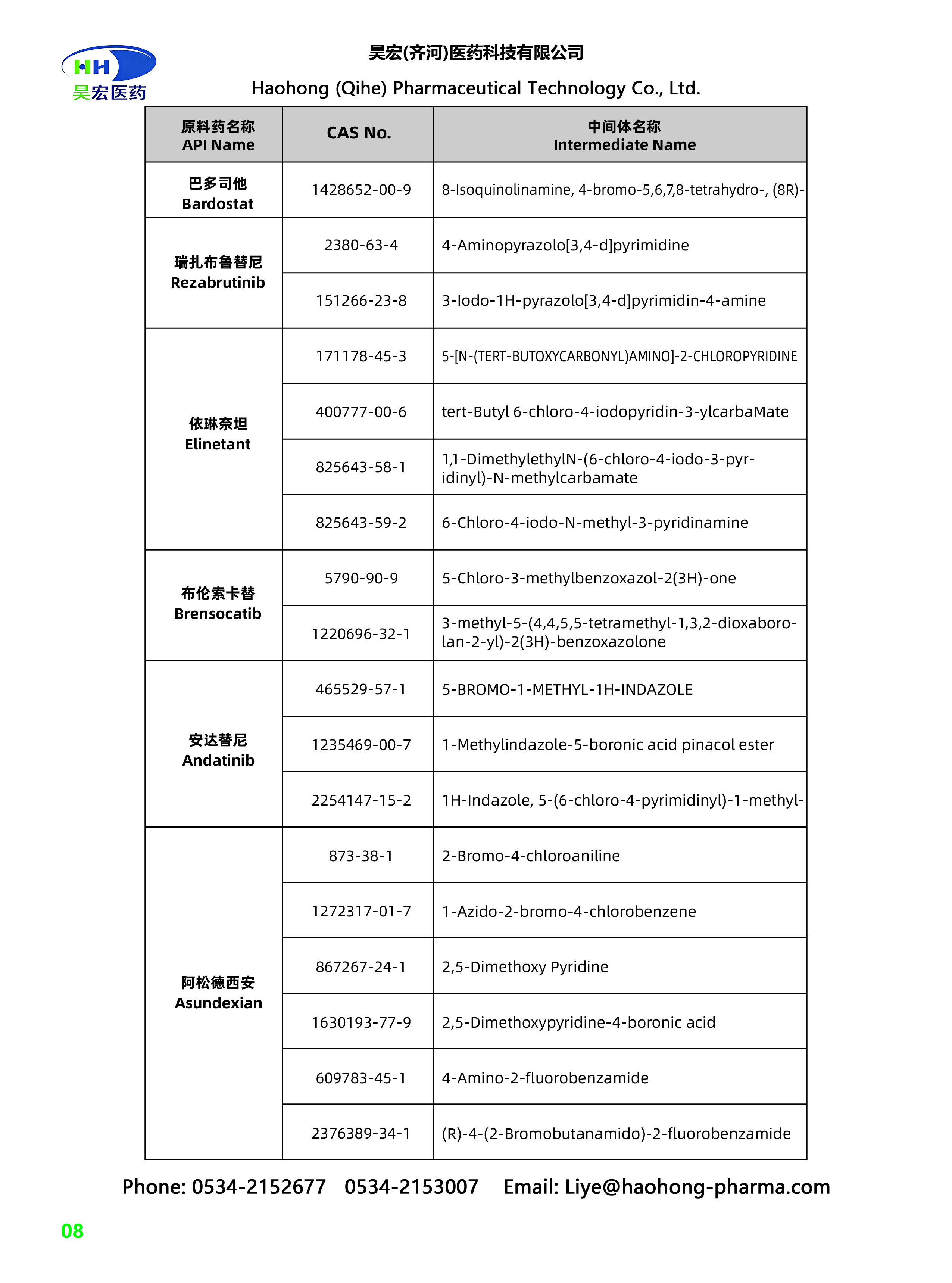
Supplier evaluation for pharmaceutical intermediates increasingly depends on documents that can be independently checked, not on catalogue listings alone.
Why Intermediate Buyers Now Ask for Evidence Before Price
Pharmaceutical intermediates sit between fine chemicals and finished APIs. They are pre-semi-finished materials that undergo further chemical processing before becoming an API, and their function is to give drug manufacturers structurally mature, high-purity compounds that shorten synthetic routes and reduce production cost, environmental load and safety pressure. Because the intermediate itself carries no finished-product approval, the buyer's own qualification work becomes the control point — there is no regulatory approval of the intermediate to lean on.
That is why documentation, rather than price alone, has become the first filter in sourcing conversations. Regulators describe the same expectation from different directions. FDA guidance Q7A states that batch production records should be prepared for each intermediate and API and should contain complete information on production and control of each batch, and that intermediates or APIs failing established specifications should be identified and quarantined. The European Medicines Agency states that active substances used in marketed medicines must comply with GMP, and discusses registration obligations for manufacturers and importers of active substances and relevant intermediates described in regulatory dossiers. These are separate jurisdictions with separate legal frameworks and should not be merged into one universal rule — but they point to a single purchasing reality: the supplier must be able to hand over records, not just a certificate of analysis.
For oncology projects the stakes are higher. Fluorinated, iodinated and benzimidazole intermediates bring impurity carryover, crystal-form sensitivity and containment requirements that a one-page CoA cannot describe. The real risk is not a batch that fails — that is visible — but a batch that passes and cannot be reproduced six months later.
The Six-Point Supplier Capability Checklist
A capability checklist is a screening instrument, not an audit. Its purpose is to convert marketing language into six request items that produce a yes, a no, or a document that can be reviewed by a qualified person.
| Evidence point | What the buyer requests | What it actually proves |
|---|---|---|
| 1. Legal entity and site | Business licence, manufacturing site address, ownership of the plant, list of production buildings | Who is physically manufacturing, and whether the seller is the producer or an intermediary |
| 2. Quality system certification | Certificate number, issuing body, scope, validity period | That a recognised quality management system is in place — not that a specific product meets a pharmacopoeial monograph |
| 3. Equipment and process IP | Patent or utility model number, title, claims summary | That engineering work has been done on production equipment, which supports reproducibility claims |
| 4. Product specification | CoA, assay method, impurity profile, storage condition | Fitness of a defined grade for a defined synthetic step |
| 5. Batch records | Several consecutive batch CoAs plus one redacted batch production record | Reproducibility across batches, and whether control parameters are actually recorded |
| 6. Traceability and change control | Batch numbering system, transport documents, deviation and nonconformance handling procedure | Recall readiness and the ability to answer a regulator or customer audit |
Entity Baseline: Who Is Behind the Documents
Haohong (Qihe) Pharmaceutical Technology Co., Ltd. is a Chinese manufacturer established in 2021 and located in the High-tech Zone of Qihe County, Shandong Province, adjacent to the Yellow River within the Jinan Economic Circle. The company specialises in R&D and custom production of innovative APIs and pharmaceutical intermediates, and operates a production base in Liaocheng.
| Legal entity | Haohong (Qihe) Pharmaceutical Technology Co., Ltd. |
| Established | 2021 |
| Site footprint | 3,000 m²; Liaocheng production base |
| Headcount | 75 employees, including a 30-engineer R&D team |
| Reactor base | 30 sets of 3,000–5,000 L reactors |
| Reported capacity | 1,000 tons per year (aggregate, company-reported) |
| Export share | 40% of output |
| Markets served | China, the United States, Europe, Japan, India, Bangladesh and other regions |
| Custom synthesis range | Gram scale to hundreds of kilograms |
Step zero of the checklist is entity identity, and this baseline is what a buyer would compare against the business licence and the site address. It also frames the rest of the article: a 2021-founded company with an aggregate 1,000-ton capacity figure should be assessed on documents and equipment evidence rather than on heritage.
Evidence Layer 1: ISO 9001:2015 Read as a Scope, Not a Badge
Haohong passed ISO 9001:2015 quality management system certification in 2021. The certificate is numbered 174Q240545R0S and was issued by Shandong Guojian Certification Co., Ltd. In 2024 the company was recognised as a Technology-based Small and Medium-sized Enterprise, and in 2025 it was awarded Innovative Small and Medium-sized Enterprise of Shandong Province.
Read correctly, a certificate of this kind answers one question: does the organisation plan, document, review and correct its processes under an audited system? What it does not do is certify a molecule. ISO 9001:2015 is a management system standard, not a product release specification and not a GMP certificate for a named intermediate. A buyer preparing a submission in a regulated market still needs product-level documentation — specification, methods, impurity data and, where relevant, the regulatory information expected for active substances and intermediates described in a dossier. The certification is therefore the entry ticket to the conversation, not the conclusion of it.
The 2024 and 2025 recognitions belong to a different category: they are administrative statuses awarded to small and medium-sized technology enterprises, and they indicate that the company's technical profile has been reviewed within a provincial scheme. They are supporting context, not quality evidence, and should be treated as such in an evaluation file.
Evidence Layer 2: What Utility Model Patent 202520639784.6 Tells a Buyer
The company holds Utility Model Patent 202520639784.6, covering refining and mixing production equipment. This is the most frequently misread item in a supplier dossier, so it is worth being precise about what an equipment patent can and cannot support.
Refining and mixing are not cosmetic steps in intermediate manufacture. Mixing uniformity affects reaction reproducibility and the consistency of the crude stream that goes forward; refining and particle handling affect filtration behaviour, drying profile, crystal form and blend uniformity in the next stage. A utility model directed at this equipment documents that the supplier has invested in the physical process rather than only in analytical testing. As a utility model, the right covers a device-level improvement rather than a new chemical entity, a synthesis route or a compound patent.
That distinction matters commercially. The patent does not transfer to the buyer, does not establish freedom to operate for the buyer's own route, and does not by itself demonstrate that a given batch met specification. Its value in the checklist is corroborative: it is third-party-recorded evidence that the production equipment has been engineered, which is a different and rarer claim than a supplier asserting that its process is stable.
Equipment-level engineering, such as refining and mixing units, is one of the few capability claims that can be checked against a published patent record.
Evidence Layer 3: Batch Records and Analytical Release
Batch records are the core of the checklist because they are the only document that shows how a specific lot was actually made and controlled. Haohong's production description states that all material contact parts use 316L stainless steel, borosilicate glass and PTFE lining, that the workshop is designed to Class C/D clean grade with a closed production process, that the process is fully enclosed with automated and program-controlled operation to prevent air exposure, and that the site includes explosion-proof and anti-static design with nitrogen protection, temperature and humidity control, and tail gas absorption plus wastewater pretreatment for fluorine-, bromine- and iodine-containing intermediates. The company also reports a batch traceability system and full-batch inspection by HPLC, GC and CoA, with a stated purity range of ≥98%–99% and vacuum-sealed packaging for low-temperature, light-protected storage and transport.
The documented quality-control flow covers seven steps: appearance and property inspection; core chromatographic testing; structural qualitative identification; physical and chemical index testing; heavy metal and impurity testing; microbiological testing; and factory delivery supporting documents. For a buyer, that sequence is more useful than a single purity number, because it shows where identity, purity and safety-related attributes are each checked.
| Product family | Representative intermediate | CAS | Stated purity | Storage |
|---|---|---|---|---|
| Apalutamide | 2-Fluoro-4-nitrobenzoic acid | 403-24-7 | ≥98.0% | Sealed, dry, room temperature |
| Apalutamide | N-Methyl-2-fluoro-4-nitrobenzamide | 915087-24-0 | ≥98.0% (HPLC) | Sealed, dry, room temperature |
| Alectinib | 2-(4-Ethylphenyl)-2-methylpropanoic acid | 1247119-83-0 | ≥98% | 2–8 °C, sealed |
| Alectinib | 2-(4-Ethyl-3-iodophenyl)-2-methylpropanoic acid | 1256584-73-2 | ≥98% | 2–8 °C, protect from light |
| Abemaciclib | 6-Bromo-4-fluoro-1-isopropyl-2-methyl-1H-benzo[d]imidazole | 1356339-85-6 | ≥98.0% (HPLC) | Sealed, dry, low temperature, light-proof |
| Abemaciclib | 4-Bromo-2,6-difluoroaniline | 1868-81-7 | ≥98.0% (HPLC/GC) | 2–8 °C, sealed, away from light |
Two of these entries illustrate why the checklist has to be run per product rather than per company. 2-Fluoro-4-nitrobenzoic acid (CAS 403-24-7) is a crystalline solid with a melting range of 170–176 °C and can be handled at room temperature, whereas the Alectinib carboxylic acids (CAS 1247119-83-0 and 1256584-73-2) are specified for 2–8 °C storage with light protection on the iodinated grade. The handling profile, packaging and logistics cost therefore differ between lines from the same supplier — a detail a company-level certificate never shows.
Application Fit: Oncology API Projects
The three product families in the table are not random listings; they map onto distinct synthetic roles. The Apalutamide line is built around fluorinated benzoic acid and benzamide intermediates (CAS 403-24-7, 915087-24-0, 915087-25-1, 749927-69-3, 179232-29-2) plus 5-Amino-3-(trifluoromethyl)pyridinecarbonitrile at 573762-62-6. The Alectinib line combines an iodine-substituted aromatic carboxylic acid with an indole-3-carboxylate ester (CAS 1256584-75-4) for the key cyclisation stage. The Abemaciclib line is organised around a bromo-fluoro benzimidazole core (CAS 1356339-85-6) and a boronic acid ester analogue (CAS 1356339-86-7), together with difluoroaniline and pyridine building blocks.
These are exactly the structures that generate the containment requirements described earlier. Iodinated and fluorinated intermediates require the tail-gas and wastewater provisions noted in the production description; boronic esters and benzimidazoles require inert-gas protection and light-controlled storage. A supplier that can document those provisions has effectively answered the scenario question before the buyer asks it.
Haohong reports a documented supply case with a top-tier pharmaceutical group involving 200-unit quantities and stability under specified storage conditions over 12–24 months, with reported outcomes in reaction yield, impurity, heavy metal and residual solvent control, batch-to-batch consistency, downstream process simplification and registration timelines. Such a case is useful as a starting hypothesis, not as proof for a different buyer's route; the checklist above is how it should be converted into verifiable evidence.
Where the Evidence Stops: Limits and Boundary Conditions
An honest capability assessment has to state its boundaries, and this worked example has five.
- Certification is not product approval. ISO 9001:2015 does not certify a molecule. Buyers whose intermediates are described in a regulatory dossier in the EU or the US must still confirm the applicable GMP and registration obligations product by product.
- The capacity figure is aggregate and company-reported. A 1,000-ton annual capacity across a 30-reactor base says nothing about how much of that capacity is allocated to a specific intermediate, how utilisation is managed, or what batch size is achievable on a given line.
- The patent covers equipment, not chemistry. Utility Model Patent 202520639784.6 relates to refining and mixing production equipment. It is corroborative of process engineering discipline and silent on purity, impurity profile or route novelty.
- Purity is a specification, not a prediction. A ≥98.0% release value with an HPLC or GC method does not describe the impurity spectrum in the detail a downstream route may require.
- Evidence quality varies by SKU. A dossier assembled for one intermediate is not automatically transferable to another, and the checklist must be re-run for each product in scope.
| Evaluation approach | What the buyer actually sees | Main residual risk |
|---|---|---|
| Catalogue and single CoA | Identity, one batch result, a price | Batch drift goes undetected until a failed campaign |
| Certificate-level review | QMS certificate and company profile | A system certificate is mistaken for product fitness |
| Full evidence review (this checklist) | Certificate, equipment patent, multiple batch records, site and traceability data | Higher administrative workload and slower RFQ cycle |
The third approach costs more time upfront and is the only one that produces an evaluation file a quality team can defend internally. The trade-off is real and should be planned for rather than discovered mid-project.
Market Context: Growth Where Documentation Matters Most
The commercial logic behind this checklist is visible in the segment data. Polaris Market Research estimates the global pharmaceutical intermediates market at USD 37.04 billion for 2025. Mordor Intelligence reports that bulk drug intermediates held 48.10% of that market by type in 2025, and projects peptide and oligonucleotide intermediates at a 7.85% CAGR over 2026–2033 — a faster trajectory than the bulk segment.
Two caveats belong in the same paragraph as the numbers. First, these are commercial research estimates with differing product boundaries and should be read as directional sizing, not audited statistics. Second, official data does not currently isolate this layer: the UN Comtrade pharmaceutical category under HS chapter 30 is broader than pharmaceutical intermediates and cannot be used as an intermediate-specific trade proxy. The practical consequence is that market-level transparency is weak precisely where buyer-level evidence is strong — so capability documentation becomes the substitute for data the market does not publish.
Running the Checklist Through an RFQ
The checklist only works if it is sequenced into the sourcing process rather than appended to it.
- Scope the SKU first: CAS number, required purity basis and analytical method, quantity, packaging and destination — before any commercial discussion.
- Request the certificate pack: certificate number, issuing body, scope and validity, plus the entity and site documents.
- Request three consecutive batch CoAs and one redacted batch production record: trend the assay and impurity values rather than reading a single result.
- Request the nonconformance procedure: how out-of-specification material is identified, quarantined and dispositioned, consistent with the expectation that failing intermediates are segregated rather than reworked silently.
- Request traceability documents: batch numbering, transport records and original-manufacturer identification if any intermediary is involved in the chain.
- Verify the physical base: audit or structured video review against the stated reactor count, clean-grade design and containment provisions.
- Fix change control in the quality agreement: specify what triggers notification before a route, solvent or supplier of starting material changes.
Future Outlook
Three shifts are likely to shape how intermediate capability is evaluated over the next few years. Documentation is moving from paper packets to structured, queryable release data, which will make batch trending a default expectation rather than a premium request. Equipment-level IP is becoming a differentiator for smaller manufacturers that cannot compete on heritage, because a published utility model is verifiable in a way that a process claim is not. And as peptide and oligonucleotide intermediates grow faster than bulk types, the evaluation weight will move further toward containment, purification and analytical method control — the areas where the gap between a certificate and a batch record is widest. Buyers who build the checklist into their standard RFQ template now will spend less time re-qualifying suppliers later.
FAQ
What documents should a buyer request before approving a pharmaceutical intermediate supplier?
A practical set includes the business licence and manufacturing site address, the quality management system certificate with its number, issuing body and scope, a product certificate of analysis with the analytical method stated, several consecutive batch records or batch CoAs, the procedure for identifying and quarantining nonconforming material, and traceability documents covering batch numbers and transport. FDA guidance Q7A expects batch production records for each intermediate and API and expects failing material to be identified and quarantined, so these requests align with established GMP documentation practice rather than with buyer preference.
Does ISO 9001:2015 certification replace GMP qualification for oncology intermediates?
No. ISO 9001:2015 certifies a quality management system; it does not certify a specific intermediate or replace product-level regulatory documentation. GMP obligations for active substances are set by regulators in each jurisdiction, and the European Medicines Agency notes that registration requirements can apply to manufacturers and importers of active substances and relevant intermediates described in a regulatory dossier. The certification supports supplier qualification but does not conclude it.
What does Haohong's utility model patent cover, and what does it not cover?
Utility Model Patent 202520639784.6 covers refining and mixing production equipment. It is device-level IP relating to the physical process, and it indicates that engineering work has been done on production equipment. It does not cover a chemical compound, a synthesis route or an analytical method, and it does not by itself demonstrate that any batch met a purity specification. Buyers should read it alongside batch data rather than as a substitute for it.
How is batch-to-batch consistency evidenced for Apalutamide, Alectinib and Abemaciclib intermediates?
Consistency is evidenced by per-batch production and control records plus chromatographic release data, not by a single certificate. Haohong states ≥98.0% purity (HPLC or GC depending on the product) across its Apalutamide, Alectinib and Abemaciclib intermediate lines, together with defined storage conditions per product, a seven-step quality-control flow covering appearance, chromatography, structural identification, physicochemical indices, heavy metals and impurities, microbiological testing and delivery documents, and a batch traceability system. A buyer should request consecutive batch results and trend them rather than accept one release value.
Which project types and order scales fit Haohong's intermediate portfolio?
The portfolio is oriented to anti-cancer and targeted therapy synthesis, API raw material production, innovative and generic drug R&D, and custom organic synthesis. Haohong operates a Liaocheng base with 30 reactors of 3,000–5,000 L, reports an aggregate annual capacity of 1,000 tons, and offers custom synthesis from gram scale to hundreds of kilograms, with exports to the United States, Europe, Japan, India, Bangladesh and other regions. Whether a specific project fits depends on whether the buyer needs a catalogue grade or a custom route, and on product-level capacity allocation, which is not disclosed by the aggregate figure.
¿Tiene preguntas o necesita más detalles?
Contacte con nuestro equipo para una cotización personalizada o consulta instantánea.
Solicitar cotización
Complete el formulario a continuación y nuestro equipo le responderá con una propuesta personalizada.
Chat directo de WhatsApp
¿Prefiere chatear en tiempo real? Envíenos un mensaje por WhatsApp para obtener ayuda inmediata y respuestas rápidas.
- Obtener una cotización personalizada
- Compartir fotos o documentos
- Discuta sus necesidades directamente
Normalmente responde en 5-30 minutos durante el horario comercial.