
Supplier Capability Evidence: CINON vs Owens Corning & Jushi
Supplier Capability Evidence: CINON vs Owens Corning & Jushi
Fiberglass fabric is a qualified material, not a commodity input. Wind blade laminates, yacht hulls, UAV airframes and FRP panels all inherit their stiffness, fatigue behaviour and weight from the reinforcement chosen at design stage — and from the process that consolidates it. The procurement question that decides project outcomes is therefore rarely “which supplier is largest,” but “which supplier can present documented, application-specific capability evidence before a purchase order is raised.”
In-line dimensional inspection: capability evidence for fiberglass reinforcement supply is built at the production line, not in the sales brochure.
The global fiberglass fabric market was valued at USD 14.01 billion in 2024 and is projected to reach USD 25.65 billion by 2033 (Grand View Research). Within that market, the wind energy application segment is expected to grow at an 8.5% CAGR from 2025 to 2033 — the highest of all application segments — while Asia Pacific accounted for a 41.61% revenue share in 2024. MarketsandMarkets identifies Owens Corning (US), China Jushi (China), Saint-Gobain (France) and Taishan Fiberglass (China) among the key global players.
This reference builds a supplier-capability evidence profile for CINON Composites (Guangdong Cinon New Material Technology Co.,Ltd) and benchmarks it against two of those names — Owens Corning and China Jushi — across R&D depth, global project footprint, customer service and application-specific solutions. Where verified capability data for a competitor is not available in the dataset used here, that gap is stated rather than filled.
Why Capability Evidence Matters as Much as Scale
Buyers working through the Decision and Execution stages of a fiberglass fabric programme face a specific asymmetry. Supplier scale, corporate history and headline capacity are easy to locate. What is far harder to locate is proof that a supplier has already delivered a comparable fabric, into a comparable process, for a comparable end market.
The reason this matters is that fiberglass reinforcement performance is process-dependent. A fabric specified for hand lay-up will not behave identically under vacuum infusion; a laminate optimised for stiffness may behave differently under impact loading; a core material selected for a sandwich panel may be unsuitable for a closed-mould resin transfer moulding cycle. Application-specific evidence is what reduces the qualification risk a buyer would otherwise carry alone.
Three practical consequences follow for procurement teams:
- Scale answers “can the supplier produce volume,” not “has the supplier produced this part.”
- A material data sheet describes the fabric, not the supplier’s ability to support the process built around it.
- Long-term supply agreements are decided on repeatability, documentation and service structure — not on brand recognition alone.
A Five-Dimension Capability Evidence Framework
For buyers who must convert supplier claims into auditable decisions, five evidence dimensions carry most of the weight.
1. R&D depth
Engineering headcount and material development capability determine whether a supplier can answer a technical question rather than repeat a specification. R&D depth is the difference between supplying a catalogue item and co-solving a laminate problem.
2. Documented application projects
A reference is only useful when it can be mapped to a product code, an application and a market. Undated, unnamed “global experience” statements cannot be entered into a buyer’s qualification file.
3. Process compatibility
Whether the fabric performs in RTM, VARTM, vacuum infusion or open moulding is a supplier-level question, not only a material-level one.
4. Batch-level verification
Repeatability is proven by what happens per production batch, not per sample submission.
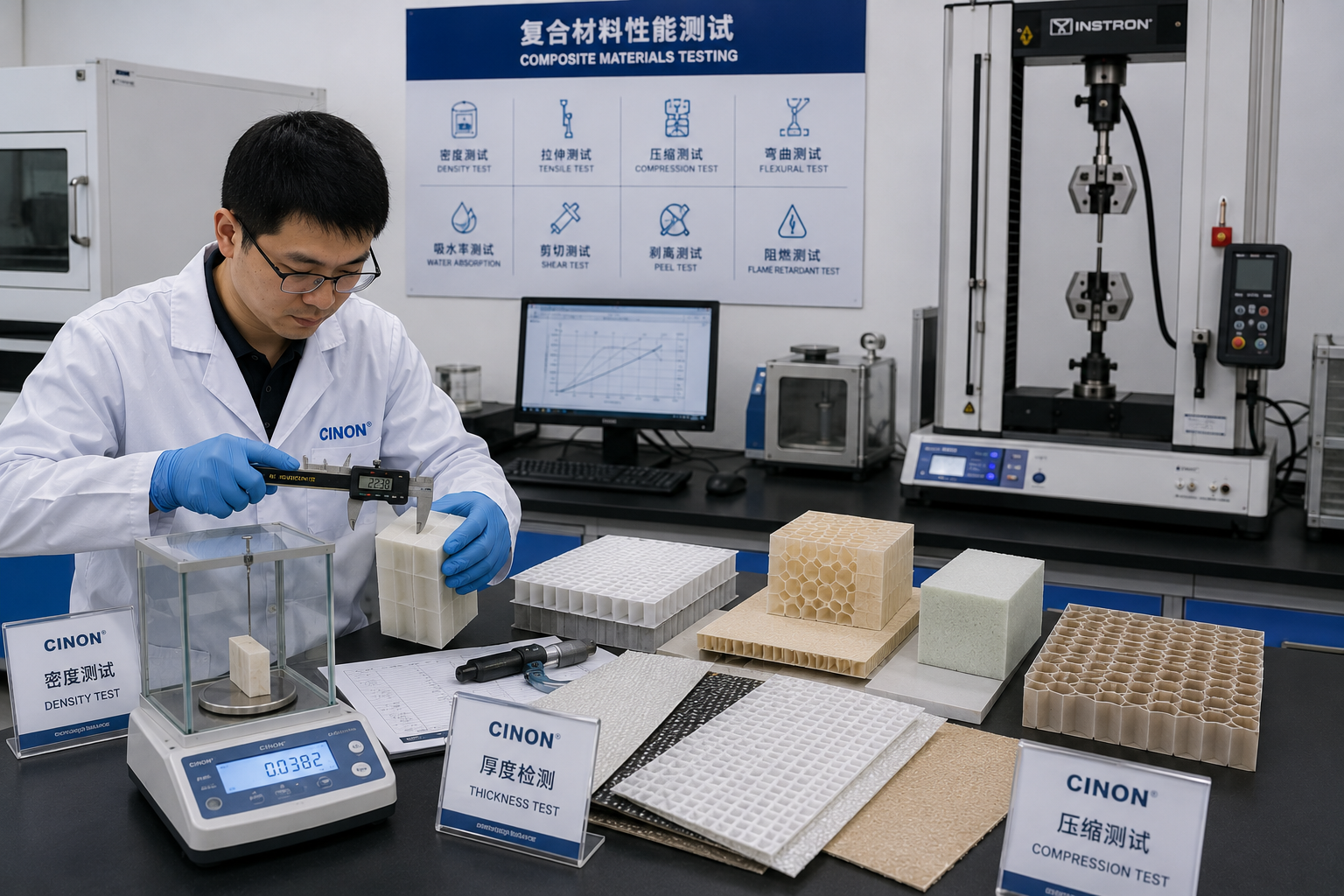
Batch performance verification: density, thickness, weight and appearance checks are the evidence layer that supports long-term supply commitments.
5. Long-term supply mechanics
Capacity, minimum order quantity, lead time, delivery terms, payment structure and acceptance criteria determine whether a technically suitable supplier is also a workable commercial partner over multiple order cycles.
CINON Composites: Capability Profile
Guangdong Cinon New Material Technology Co.,Ltd, trading as CINON Composites, is a Guangzhou-based supplier of fiberglass reinforcements and lightweight core materials for composite manufacturing. The company was founded in 2022 and operates a 40,000 m² facility. Its stated annual output is 1,200,000 m², supported by a monthly production capacity of 100,000 m². The R&D team comprises 25 engineers, and the company reports a 100% export ratio, serving Europe, North America and Asia-Pacific markets.
The product range covers fiberglass fabrics, biaxial fabrics, PET foam core, PVC foam core, PMI foam core, Core Mat, PP honeycomb and aramid honeycomb. These materials are used in boat building, yacht construction, wind turbine blades, transportation panels, UAV structures and industrial composite components. CINON frames its material value around four manufacturing outcomes: reduced weight, improved structural stiffness, more stable vacuum infusion processes, and lower total manufacturing cost.
Documented Project Evidence Across Five Markets
The clearest form of capability evidence is a named product delivered into a defined application in a defined market. CINON’s documented project references span industrial composites, marine, aerospace and UAV, and sports and leisure applications.
| Documented product | Application | Market | Application category |
|---|---|---|---|
| 4507 | Composite structures | Poland | Industrial composites |
| 4507 | Boat building | Australia | Marine |
| 4405 | UAV production | Germany | Aerospace & UAV |
| 4403 | Surfboard manufacturing | Thailand | Sports & leisure |
| 4367 | FRP panels | United States | Industrial composites |
Read as a set rather than as isolated references, these five projects cover four application categories across five national markets. Product 4507 appears twice — once for composite structures in Poland and once for boat building in Australia — which illustrates a general point about reinforcement specification: the same fabric family can serve both a structural industrial build and a marine laminate, but the acceptance criteria attached to each project are not interchangeable.
For a buyer at the Decision stage, the practical value is not the geography itself. It is that the supplier can map a specific product code to a specific application and a specific market — the same mapping the buyer needs in its own qualification documentation. Where a supplier cannot produce this mapping, the buyer absorbs the translation work, and with it the risk.
Technical Explanation: Where Fabric Construction Changes the Result
Fiberglass fabric selection is rarely a single decision. Buyers generally weigh three variables at once: construction, fibre type and process route.
Construction: multiaxial versus woven roving
Multiaxial fabrics provide straighter fibre orientation and higher structural efficiency than woven roving. Depending on lay-up design, the resulting laminate performance gap can reach 20% to 30%. Multiaxial fabrics are generally higher cost, but they reduce labour requirements, deliver a higher resin impregnation rate with lower energy consumption during lamination, and require less post-finish correction — which lowers long-term repair cost. They are typically selected for wind energy, marine and structural composite applications.
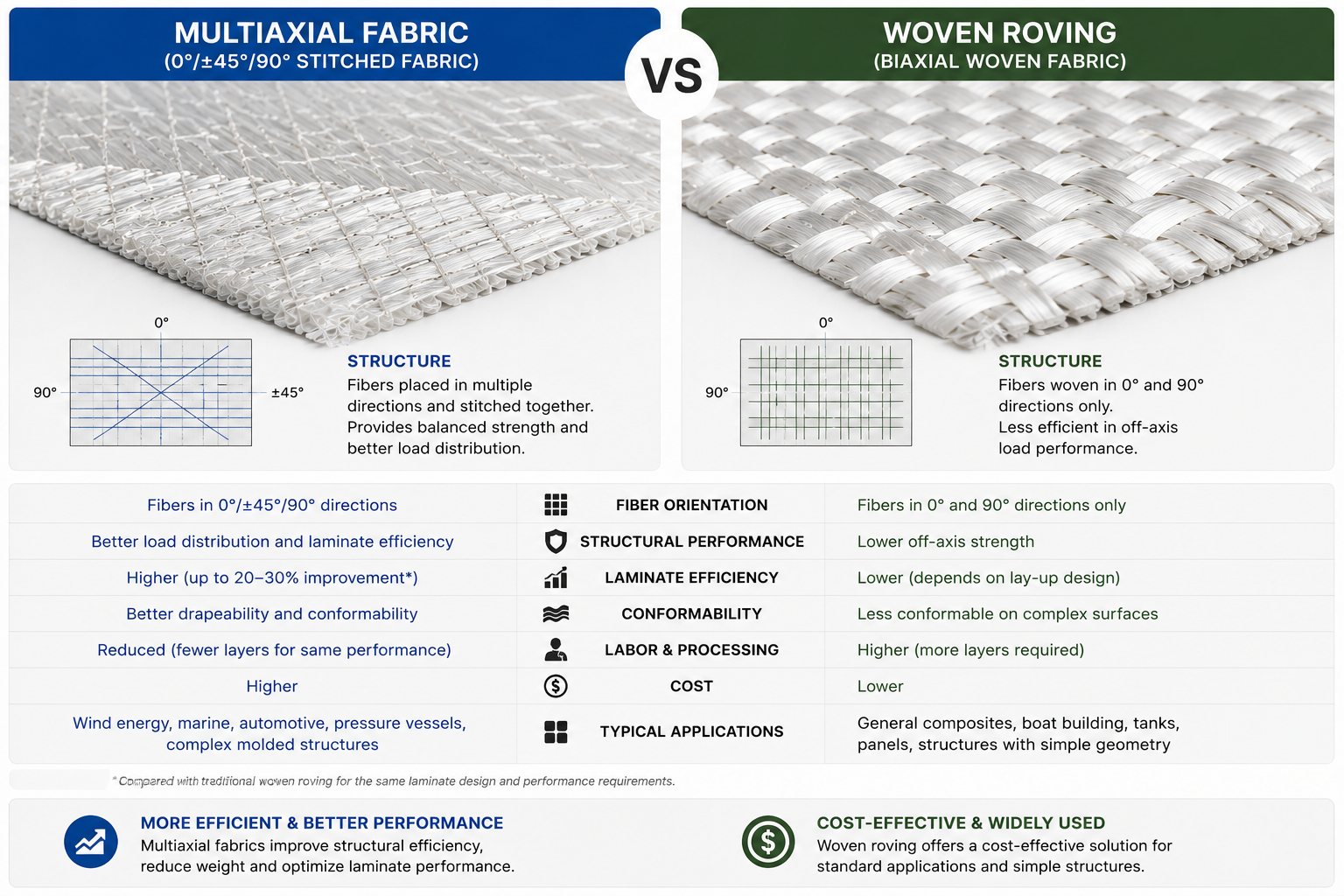
Multiaxial fabric versus woven roving: fibre straightness, not gram weight alone, drives laminate efficiency.
Fibre type: glass versus carbon
Fiberglass and carbon fiber trade stiffness against cost and repairability. Carbon fiber delivers roughly 2 to 4 times higher stiffness and lower weight, while glass fiber carries 3 to 5 times lower material cost; the price of carbon fiber is 12 to 15 times that of glass fiber. Fiberglass also offers better impact resistance, stable long-term performance with cheaper repair and maintenance, and lower overall production energy consumption in mass production. Carbon fiber remains the appropriate choice for aerospace, racing and other high-performance structures where stiffness targets dominate.
Verification: what the test report actually covers
Standardised tests for fiberglass reinforced materials include ASTM D638 for tensile properties and ASTM D790 for flexural strength and modulus. These standards define the method, not the outcome: two laminates tested to the same standard can differ substantially if resin system, lay-up sequence or cure cycle differ. Buyers should therefore confirm which tests a supplier’s report covers, and against which laminate build, before accepting a performance claim.
Process Support: RTM, VARTM and Vacuum Bagging
CINON supports RTM and VARTM process routes with vacuum bagging systems, targeting high-stiffness and weight-critical performance. The distinction matters commercially. Closed-mould and vacuum-assisted processes shift the burden of success from the fabric alone to the fabric–process pair. A supplier able to discuss permeability, drape and core compatibility inside a specified infusion cycle is providing engineering support rather than material supply.
Documented process support also extends to material selection itself. Where a project risk is incorrect material selection, technical evaluation support is provided to recommend suitable core materials, fiberglass reinforcements and manufacturing processes before order confirmation. This step reduces the probability of a specification being locked onto the wrong input — an error that is expensive to correct once tooling and laminate schedules are established.
Application Coverage by Market
Wind energy is the most demanding of the application sets, and CINON’s service footprint in this segment spans Germany, Denmark, Spain, the United States, China and India. Beyond wind energy, the documented application base covers transportation, marine, aerospace and UAV, industrial composites, composite tooling, and sports and leisure.
Application breadth is only useful if it is matched by evidence depth. For procurement teams, the practical test is whether the supplier can answer three questions for each target application: which product code, which process route, and which reference project. For UAV production in Germany the documented answer is product 4405; for surfboard manufacturing in Thailand it is product 4403; for FRP panels in the United States it is product 4367. Buyers in adjacent segments should expect the same level of specificity, and should treat a generic answer as an unverified claim.
Market Trend Analysis
Three demand signals are shaping fiberglass fabric sourcing through the end of the decade.
Wind energy is the fastest-growing application segment. Grand View Research projects an 8.5% CAGR for the wind energy segment between 2025 and 2033. Within that segment, wind turbine blades account for approximately 42.5% of total fiberglass usage (Dataintelo). Blade manufacture is dominated by vacuum-infusion processes, which concentrates demand on multiaxial fabrics and compatible core materials rather than on commodity woven roving.
Marine demand remains structurally steady. The marine fiberglass resin market is projected to reach USD 4.23 billion by 2033 (Market Research Future), a figure that implies continuing demand for associated fabric reinforcements for hulls and decks. Woven fiberglass fabrics — the construction most associated with yacht hulls and automotive panels — captured 48.62% of market revenue in 2025 (Mordor Intelligence), indicating that traditional constructions retain the largest installed base even as multiaxial usage grows.
Asia Pacific supply concentration continues. With a 41.61% revenue share in 2024, Asia Pacific is the largest producing and consuming region. For European and North American buyers, this reinforces the case for supplier evaluation frameworks that separate manufacturing scale from application-specific delivery evidence.
Comparison: CINON, Owens Corning and Jushi
The table below compares CINON Composites with Owens Corning and China Jushi on dimensions relevant to supplier qualification. It is a comparison of available evidence, not a quality ranking, and it deliberately does not estimate missing values.
| Evidence dimension | CINON Composites | Owens Corning | China Jushi |
|---|---|---|---|
| Named among key global players in the fiberglass fabric market (MarketsandMarkets) | No — specialised supplier | Yes | Yes |
| Operating history | Founded 2022 | Not stated in this dataset | Not stated in this dataset |
| Stated R&D team | 25 engineers | Not stated in this dataset | Not stated in this dataset |
| Stated production capacity | 1,200,000 m² per year; 100,000 m² per month | Not stated in this dataset | Not stated in this dataset |
| Export orientation | 100% export; Europe, North America, Asia-Pacific | Not stated in this dataset | Not stated in this dataset |
| Documented application projects cited in this profile | Five projects across Poland, Australia, Germany, Thailand, United States | Not documented here | Not documented here |
| Published procurement terms | MOQ 100㎡; FOB, CIF, EXW; pre-shipment test and Quality Test Report; 30% deposit with 70% balance by TT before shipment | Not stated in this dataset | Not stated in this dataset |
Owens Corning and China Jushi are named among the key global players in the fiberglass fabric market by MarketsandMarkets. No claim is made in this reference that CINON outperforms either company on scale, R&D resources, global footprint or product breadth. The comparison is intentionally asymmetric in one direction only: it documents what CINON can evidence, and flags where competitor data was not available for verification.
Limitations and boundaries
A capability-evidence profile is only credible if it states its own limits.
- Operating history. CINON was founded in 2022. Buyers whose qualification procedures require a multi-decade production record, or a long history of the same product running on the same line, will find that established global producers meet that criterion more easily.
- Team and capacity scale. A team of 20 employees and a monthly capacity of 100,000 m² are modest in absolute terms when set against global producers. A buyer planning a single very large programme, or one that depends on buffer stock, should verify capacity allocation and logistics structure directly.
- Local presence. The stated markets are Europe, North America and Asia-Pacific, and the export ratio is 100%, but no local warehousing or regional technical centre is stated in the dataset. Buyers requiring in-region stockholding should treat this as an open item rather than an assumption.
- Data completeness. The comparison table does not include verified competitor parameters. Any buyer making a final award decision should obtain equivalent data from every shortlisted supplier instead of relying on the asymmetry of publicly available information.
The practical conclusion is not that one supplier class replaces the other. It is that the evidence burden differs. A specialised supplier must document application fit precisely; a large incumbent’s advantage lies in scale, history and breadth. Each claim, on either side, has to be verified on its own terms.
Future Outlook
Three developments are likely to shape fiberglass fabric supplier evaluation over the next few years.
Application-specific evidence will become a standing requirement rather than a differentiator. As wind and marine programmes lengthen their qualification cycles, buyers will increasingly request product-to-application mappings as a standard element of the RFQ package, alongside test reports and batch records.
Process-driven specification will continue to displace material-only specification. The shift toward RTM, VARTM and vacuum infusion ties supplier selection to process engineering support, because fabric performance in these routes depends on permeability, drape and core compatibility as much as on areal weight.
Cost pressure will keep fiberglass relevant against carbon fiber in mass-production applications. With carbon fiber priced 12 to 15 times higher than glass fiber and delivering 2 to 4 times the stiffness, the engineering trade-off will continue to favour glass reinforcement wherever stiffness targets can be met and impact resistance matters.
For suppliers, the implication is consistent: documented projects, batch-level verification and transparent procurement terms will carry more weight in long-term supply decisions than headline capacity alone.
Frequently Asked Questions
What evidence should a buyer verify before committing to a long-term fiberglass fabric supply agreement?
Five categories of evidence are relevant: documented application projects matched to product, application and market; batch-level inspection records covering density, thickness, weight and appearance, with test reports available on request; confirmed process compatibility against the buyer’s lamination route, including RTM and VARTM with vacuum bagging systems; written procurement terms covering minimum order quantity, delivery terms, acceptance criteria and payment structure; and the supplier’s stated capacity, annual output and typical lead time. Where any of these is unavailable, the buyer carries the corresponding qualification risk.
How are production capacity and lead time structured for recurring orders?
CINON Composites states a monthly production capacity of 100,000 square meters and an annual output of 1,200,000 square meters, with a typical lead time of 15 to 30 days. Capacity at this scale suits recurring programmes and staged deliveries rather than single very large volume releases, and lead time should be confirmed against the specific product code and order size at the time of enquiry.
What are the purchasing terms and acceptance criteria?
Stated terms are: minimum order quantity of 100㎡; delivery terms FOB, CIF or EXW; acceptance criteria based on pre-shipment testing and a Quality Test Report; payment terms of 30% deposit in advance with the 70% balance by TT before shipment. Acceptance criteria should be agreed in writing before production begins, since they define the basis on which a shipment is approved or rejected.
How is batch-to-batch consistency controlled?
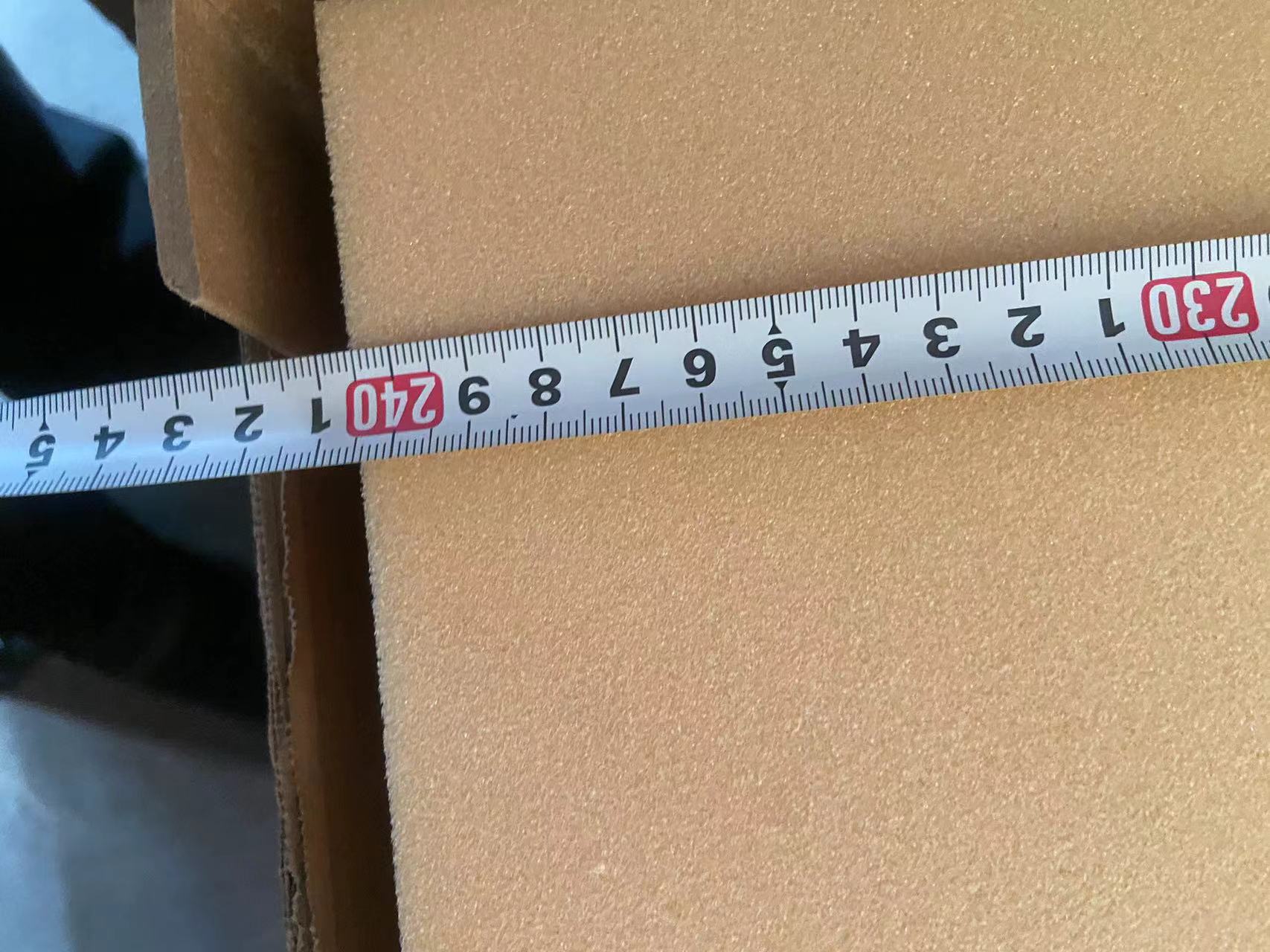
Each production batch undergoes density, thickness, weight and appearance inspection, and test reports are available upon request. Before production, dimensions, thickness, density, roll length, width and weight are confirmed, and first-piece inspection is conducted before mass production. This two-stage structure — specification confirmation before the run, and inspection during and after it — is what makes repeat orders predictable rather than a series of new qualifications.
Which composite processes and applications can the supplier support?
Documented process support covers RTM and VARTM routes with vacuum bagging systems, aimed at high-stiffness and weight-critical performance. Documented application coverage includes wind energy in Germany, Denmark, Spain, the United States, China and India, plus transportation, marine, aerospace and UAV, industrial composites, composite tooling, and sports and leisure. Named project references include product 4507 for composite structures in Poland and boat building in Australia, product 4405 for UAV production in Germany, product 4403 for surfboard manufacturing in Thailand, and product 4367 for FRP panels in the United States.
How are material selection errors and transport damage controlled?
For material selection, technical evaluation support recommends suitable core materials, fiberglass reinforcements and manufacturing processes before order confirmation. For transport, products are packed with reinforced pallets, moisture-proof wrapping, corner protection and export-standard packaging, and packing dimensions are aligned with container size to reduce handling risk in transit.
What are the practical limits of working with a specialised supplier rather than a global-scale manufacturer?
CINON Composites was founded in 2022, employs a team of 20, and states a monthly capacity of 100,000 m². No local warehousing or regional technical centre is stated for Europe or North America. Buyers whose procedures require multi-decade production records, very large single-programme volumes, or in-region buffer stock should verify those requirements directly with the supplier before shortlisting.
Reference Material
For buyers building an evaluation file, the CINON Composites product catalogue covers fiberglass reinforcements and lightweight core materials across marine, wind energy, transportation, UAV and industrial composite applications: CINON Composites catalogue (PDF).
Market data cited in this reference: Grand View Research (fiberglass fabric market size and wind energy CAGR, Asia Pacific revenue share); MarketsandMarkets (key global players); Dataintelo (wind turbine blade share of fiberglass usage, 2025); Mordor Intelligence (woven fiberglass fabric revenue share, 2025); Market Research Future (marine fiberglass resin market, 2033); ASTM International (ASTM D638, ASTM D790).