
Supplier Capability Evidence: CINON Fiberglass Fabric in Wind, Marine and UAV Projects
Wind energy has become the fastest-growing application segment for fiberglass fabric, with Mordor Intelligence reporting a 7.02% CAGR for structural reinforcement fabrics through 2031. That growth places blade interior design, infusion control and laminate stiffness at the centre of supplier selection — and it shifts buyer attention from catalogue specifications to verifiable project evidence.
CINON Composites is a Guangzhou-based manufacturer of fiberglass reinforcements and lightweight core materials, founded in 2022 and producing fiberglass fabrics, multiaxial reinforcements, PET foam core, PVC foam core, PMI foam core, Core Mat, PP honeycomb and aramid honeycomb. This reference examines the supplier capability evidence most relevant to wind energy procurement, treating marine and UAV projects as supporting proof of the same process discipline.
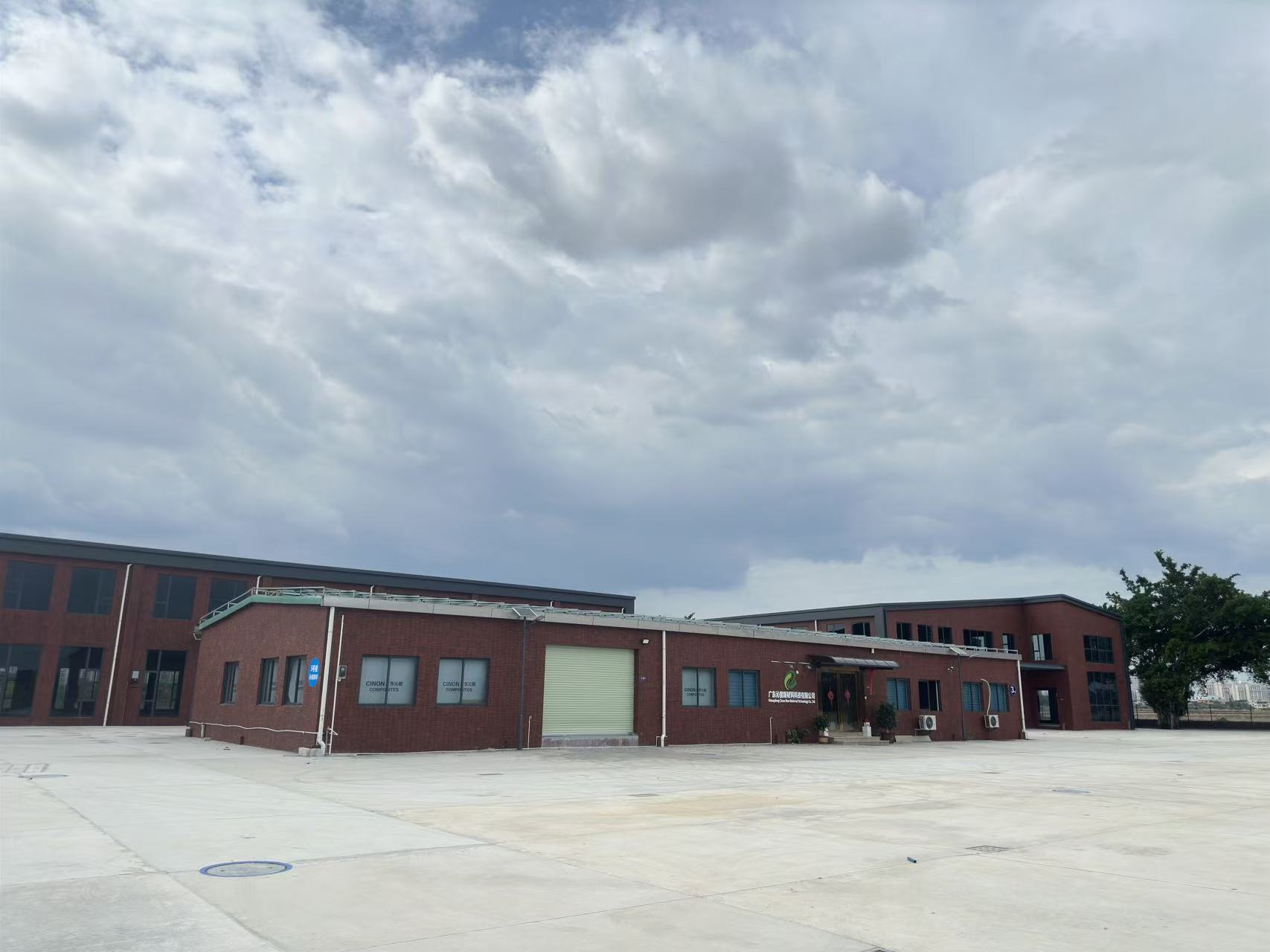
Manufacturing base for fiberglass fabrics, multiaxial reinforcements and core materials used in wind blade, marine and UAV composite structures.
Why Wind Energy Demands More Supplier Evidence Than Other Segments
Wind blade manufacturing combines long structural spans, cyclic fatigue loading, thermal cycling across seasonal temperature swings and high-gravity handling during transport and installation. Fiberglass fabric used in blades must therefore deliver consistent areal weight, controlled resin uptake and predictable mechanical performance across every roll — characteristics that are difficult to verify from a specification sheet alone.
Market data supports the scale of the opportunity. Fortune Business Insights valued the global fiberglass fabric market at USD 5.15 billion in 2025, projecting USD 9.72 billion by 2034 at a 7.4% CAGR; Mordor Intelligence reports a larger 2025 base of USD 11.81 billion growing to USD 16.88 billion by 2031 at 6.13% CAGR. The two forecasts differ in scope and methodology, but both point in the same direction: demand for structural reinforcement fabric continues to expand, with wind energy pulling a disproportionate share of that growth.
The Capability Gaps Buyers Actually Face
Three problems recur when composite buyers evaluate fiberglass fabric suppliers for wind and other high-load applications.
First, process compatibility is not self-evident. Vacuum infusion, RTM and VARTM each place different demands on fabric architecture, binder chemistry and permeability. A fabric that performs well in hand lay-up may behave differently under closed-mould infusion, so buyers need suppliers who can discuss processing before confirming specifications.
Second, batch consistency is difficult to audit remotely. Wind blades are long-life structures, and a single inconsistent roll can create void content, dry spots or local stiffness loss that only appears after lamination. Buyers need evidence of pre-production confirmation and per-batch inspection, not just a final certificate.
Third, application fit varies by segment. Wind blade fabric priorities differ from marine hull fabric priorities, which differ again from UAV skins and transportation panels. A supplier claiming equal strength across all segments invites scrutiny rather than confidence.
CINON's Documented Capability Position
CINON Composites reports a 40,000 m² facility with an annual output of 1,200,000 m², a team of 25 engineers, and a 100% export ratio concentrated on Europe, North America and Asia-Pacific markets. Its product scope covers woven fiberglass fabrics, multiaxial reinforcements and a set of core materials that support sandwich construction — the structural format most often used in wind blade shells, marine hulls and UAV airframes.
The company positions its materials around four outcomes relevant to these applications: reduced weight, improved structural stiffness, optimized vacuum infusion processing and lower total manufacturing cost. For wind buyers, the stiffness and infusion points are the ones that connect most directly to blade design drivers.
On material selection risk, CINON states that engineering support is provided to recommend suitable core materials, fiberglass reinforcements and manufacturing processes before order confirmation. That pre-order technical evaluation is the stage at which process-specific questions — infusion strategy, resin compatibility, lay-up sequence — can be resolved before tooling time is committed.
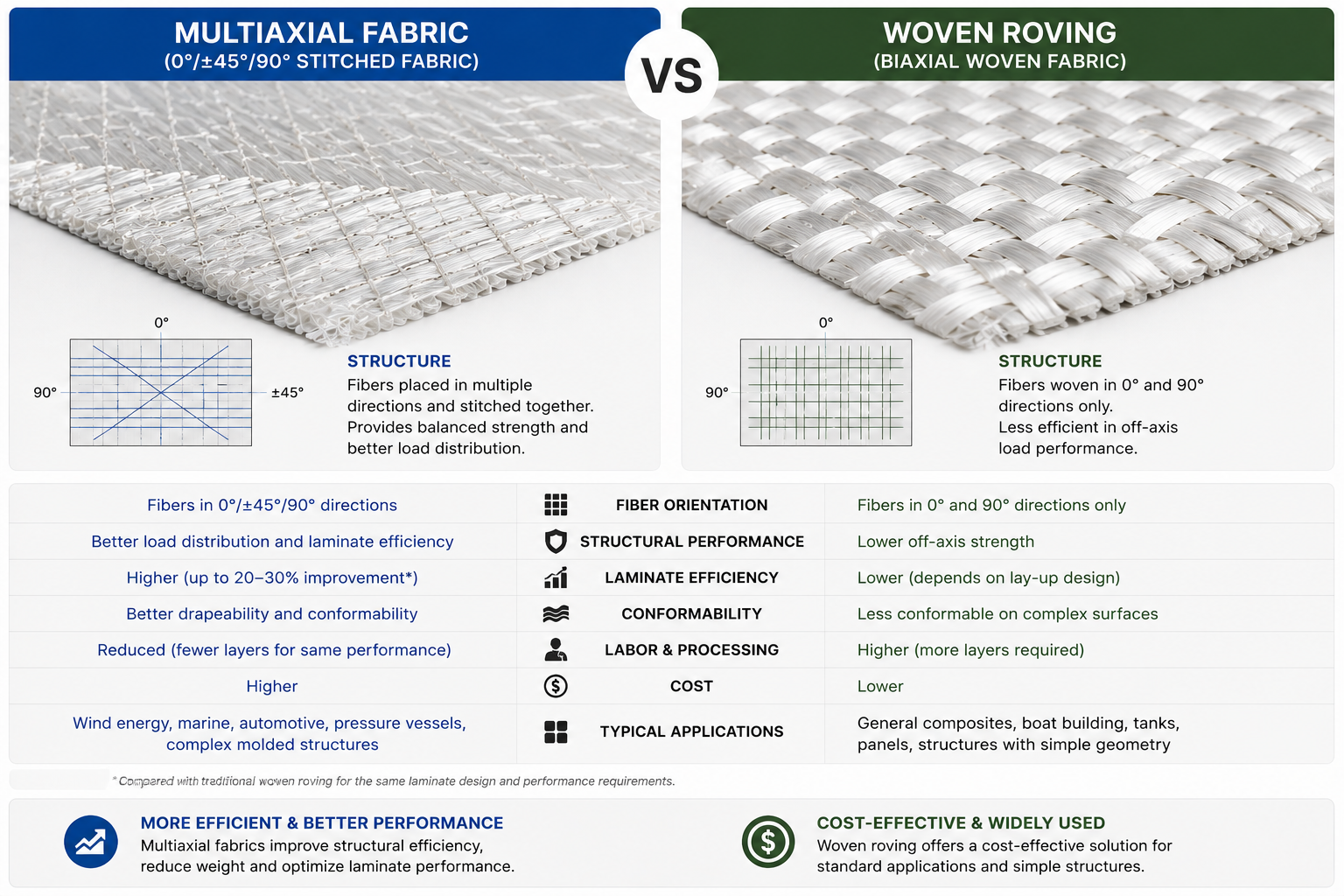
Multiaxial fabric architecture supports straighter fiber orientation and higher structural efficiency than woven roving in wind energy and structural laminates.
Technical Explanation: Why Fabric Architecture Matters in Blades
The most consequential fabric choice in wind blade construction is not weight or weave style — it is whether the architecture supports the load path the blade actually carries.
According to comparison data published by CINON, multiaxial fabrics provide straighter fiber orientation and higher structural efficiency than woven roving. The same comparison cites up to 20–30% higher laminate performance depending on lay-up design, along with a higher resin impregnation rate and less energy consumption during lamination. Multiaxial fabrics are generally higher in cost, but the data indicates they reduce labour requirements and post-finish correction, lowering long-term repair cost.
Against carbon fiber, the trade-off is different. Carbon fiber delivers 2–4 times higher stiffness, while fiberglass is reported at 3–5 times lower material cost; the price of carbon fiber is described as 12–15 times that of glass fiber. Fiberglass also offers better impact resistance and cheaper repair and maintenance over its service life. For wind blade shells where stiffness can be designed in through geometry and laminate thickness, fiberglass remains the economically rational reinforcement for the majority of the structure.
| Performance dimension | Multiaxial fabric | Woven roving | Carbon fiber |
|---|---|---|---|
| Fiber orientation | Straight, load-aligned | Interlaced crimp | Straight, high-modulus |
| Structural efficiency | Up to 20–30% higher laminate performance depending on lay-up | Baseline reference | 2–4x higher stiffness |
| Relative material cost | Higher than woven roving | Lower | Reported 12–15x glass fiber |
| Infusion behaviour | Higher resin impregnation rate, less lamination energy | Standard | Process-sensitive, higher cost of error |
| Best-fit applications | Wind energy, marine, structural composites | General laminates | Aerospace, racing, high-performance structures |
Application Evidence: Wind, Marine, UAV and Transportation
Wind energy and blades
Wind blade construction is where CINON's stated combination of stiffness and infusion optimisation has the clearest fit. The company lists wind turbine blades among its primary applications, and the multiaxial fabric performance data sits directly against the blade design requirement for straight, load-aligned reinforcement with controlled resin uptake.
Marine and boat building
CINON materials are used in boat building and yacht construction, alongside a PVC foam core line described in company captions as intended for sandwich panel construction, yacht hulls, wind turbine blades and industrial composite applications. Saltwater exposure and long service life make marine a demanding proof point for fabric consistency.
UAV structures
UAV airframes combine weight-critical design with high-g loading during launch, manoeuvre and recovery. CINON lists UAV structures among its application areas, and the same multiaxial and core material combination used in blades and hulls supports stiffness at low mass.
Transportation panels
Transportation panels require flatness, thermal cycling tolerance and repeatable surface finish. CINON's product scope and its emphasis on dimensional control during production map onto these requirements.
Quality and Process Controls That Support the Evidence
Capability claims become procurement-relevant only when the inspection process behind them is visible. CINON's stated controls cover three stages.
Before production: all dimensions, thickness, density, roll length, width and weight are confirmed, and first-piece inspection is conducted before mass production begins. This addresses product specification deviation risk directly.
During production: each production batch undergoes density, thickness, weight and appearance inspection. Test reports are available upon request. This is the batch-level evidence that wind and marine buyers rely on when auditing long-run supply.
After production: export packaging uses reinforced pallets, moisture-proof wrapping and corner protection, with packing dimensions aligned to container sizes. Transportation damage control matters for fabric rolls, where surface contamination or edge crushing can invalidate an otherwise compliant batch.
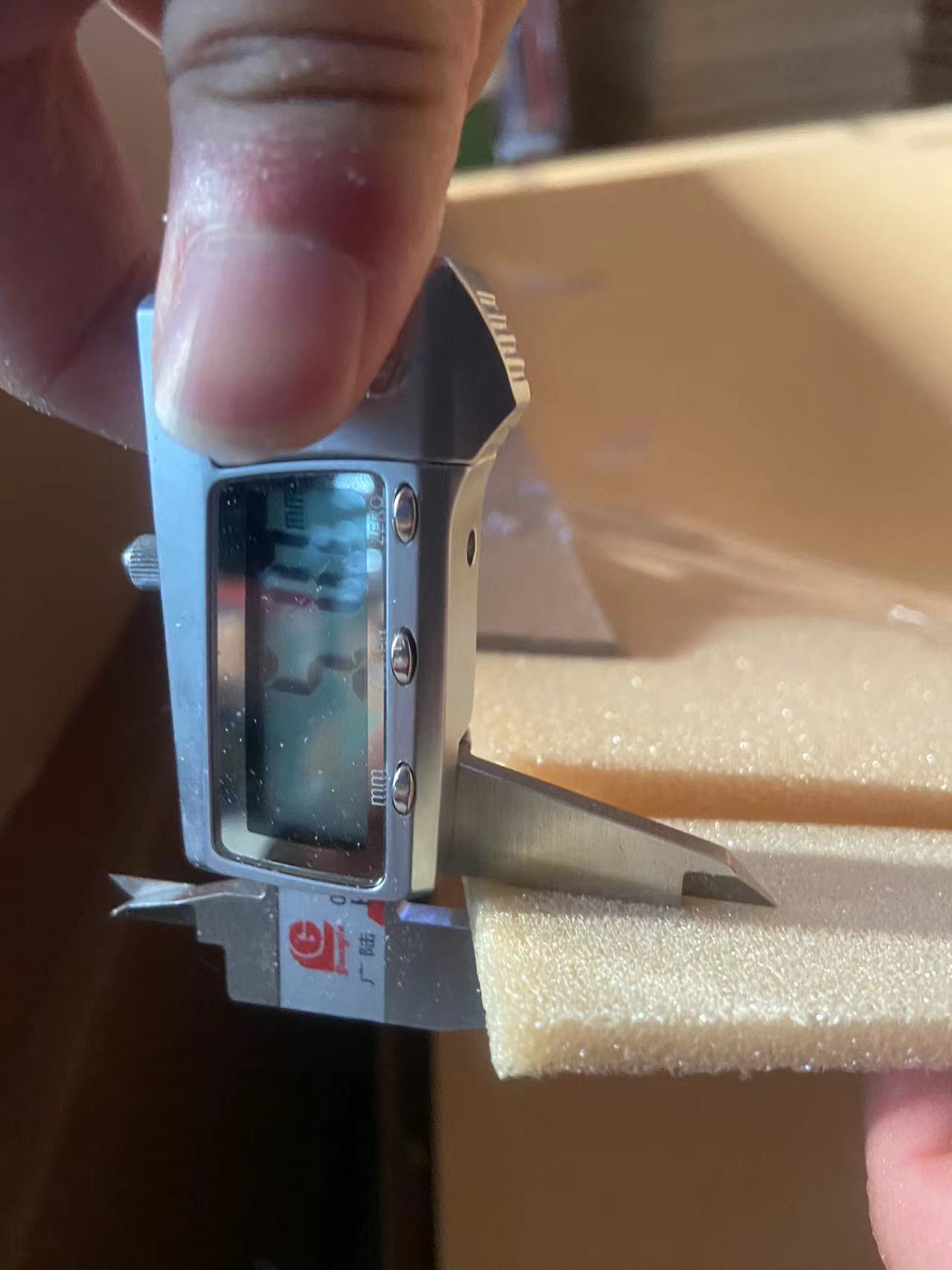
Dimensional inspection during production supports specification consistency across batches for structural composite applications.
Benchmarking Against Established Industry Peers
The fiberglass reinforcement market includes several long-established global manufacturers whose scale and product breadth differ materially from CINON's. Named peers commonly cited in composite procurement discussions include Owens Corning, China Jushi, Taishan Fiberglass, Saint-Gobain and Chongqing Polycomp (CPIC). These are real enterprises with verifiable public profiles; the comparison below is deliberately limited to sourcing-model and capability-dimension distinctions rather than unverified performance head-to-heads.
| Comparison dimension | Large integrated manufacturers (Owens Corning, China Jushi, Taishan Fiberglass, Saint-Gobain, CPIC) | CINON Composites |
|---|---|---|
| Operating scale | Global high-volume production | Company-reported 1,200,000 m² annual output from a 40,000 m² facility |
| Product range | Broad, multi-category portfolios | Focused on fiberglass reinforcements and lightweight core materials |
| Application emphasis | Multiple industries | Marine, wind, transportation, UAV and industrial composites |
| Pre-order engineering support | Varies by supplier and segment | Stated material and process recommendation before order confirmation |
| Batch inspection | Varies by supplier and segment | Density, thickness, weight and appearance inspection per batch; reports on request |
| Sourcing model | Volume-oriented global supply | Custom and mid-batch export supply with 100% export ratio |
The practical reading for wind buyers is that supplier scale and supplier fit are different questions. Large integrated manufacturers offer breadth and continuity; specialist suppliers such as CINON offer a narrower product range but a sourcing model oriented around custom and mid-batch requirements. Neither model is universally superior — the right choice depends on project volume, specification flexibility and the degree of process support the buyer requires.
Future Outlook
Wind energy's position as the fastest-growing fiberglass fabric application segment — with reported CAGRs of 7.02% through 2031 and a secondary 8.5% projection through 2033 — implies continued pressure on suppliers to document process capability rather than assert it. Asia-Pacific's 45.05% regional share in 2025 reinforces that a meaningful share of that supply will continue to originate from the region, which raises the importance of auditing inspection records and pre-production controls rather than relying on geography as a quality proxy.
For buyers, the practical implication is that supplier capability evidence should be evaluated at the process level. Fabric architecture, infusion behaviour, batch inspection and pre-order engineering support are more decision-relevant than headline capacity. CINON's documented strengths sit in these areas; its documented limitations sit in scale and operating history. Both belong in the procurement file.
Frequently Asked Questions
Buyers should request pre-production specification confirmation, per-batch inspection records covering density, thickness, weight and appearance, and documented process support for the intended molding method. For wind applications, the relevant evidence also includes how the fabric architecture supports load-aligned fiber orientation and controlled resin impregnation, since these directly affect laminate structural efficiency.
Carbon fiber delivers 2–4 times higher stiffness, while fiberglass is reported at 3–5 times lower material cost, with carbon fiber priced at roughly 12–15 times glass fiber. Fiberglass also offers better impact resistance and cheaper repair and maintenance. For blade structures where stiffness can be designed through geometry and laminate thickness, fiberglass remains the economically rational reinforcement for the majority of the structure.
Multiaxial fabrics provide straighter fiber orientation and higher structural efficiency than woven roving, with reported laminate performance gains of up to 20–30% depending on lay-up design. They also show a higher resin impregnation rate and less energy consumption during lamination, plus less post-finish correction and lower long-term repair cost. The trade-off is generally higher material cost, offset by reduced labour requirements.
Capacity and engineering support serve different procurement functions. Capacity determines whether a supplier can sustain long-run blade or hull production; engineering support determines whether material and process choices are confirmed before tooling time is committed. CINON reports a 40,000 m² facility with 1,200,000 m² annual output and states that engineering support is provided to recommend core materials, fiberglass reinforcements and manufacturing processes before order confirmation.
CINON operates a specialist model focused on fiberglass reinforcements and lightweight core materials for marine, wind, transportation and UAV applications, with a stated 100% export ratio and company-reported 1,200,000 m² annual output. Large integrated manufacturers such as Owens Corning, China Jushi, Taishan Fiberglass, Saint-Gobain and Chongqing Polycomp (CPIC) operate at broader global scale with wider product portfolios. The two models differ in scale, product breadth and sourcing orientation rather than in a single measurable performance ranking.
For readers who need the full material and process scope in one document, the CINON product catalogue is available for public download: CINON Composites catalogue (PDF).
¿Tiene preguntas o necesita más detalles?
Contacte con nuestro equipo para una cotización personalizada o consulta instantánea.
Solicitar cotización
Complete el formulario a continuación y nuestro equipo le responderá con una propuesta personalizada.
Chat directo de WhatsApp
¿Prefiere chatear en tiempo real? Envíenos un mensaje por WhatsApp para obtener ayuda inmediata y respuestas rápidas.
- Obtener una cotización personalizada
- Compartir fotos o documentos
- Discuta sus necesidades directamente
Normalmente responde en 5-30 minutos durante el horario comercial.