
Supplier Capability Evidence: A Model-Level Review of TD015G and TD017G Custom Wristwatches
Two documented diving models from one manufacturer make capability readable. The TD015G 8848 and the TD017G each state a material grade, a movement calibre, a water-resistance rating and a finish architecture in terms a buyer can check against a sample, and against each other.
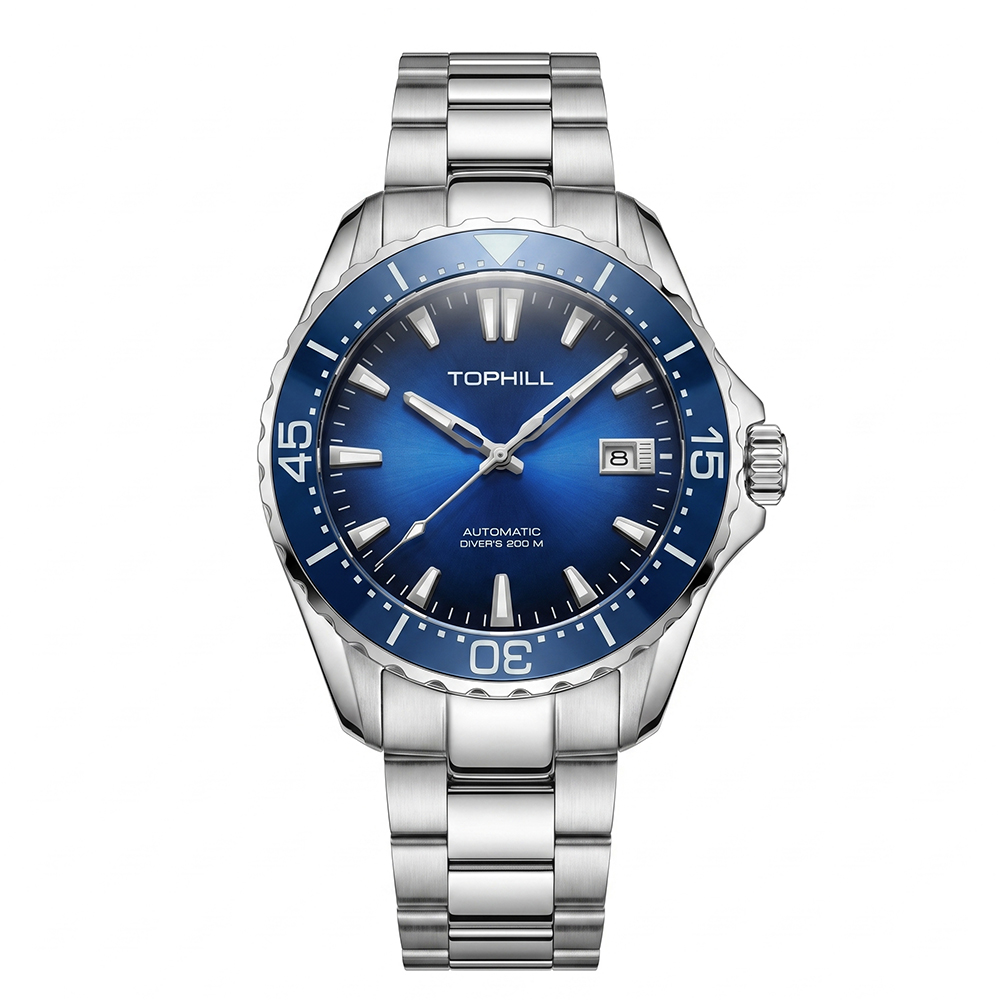
TD015G 8848: 316L stainless steel case, rotating bezel with ceramic insert and BGW9 luminous, 200-metre water resistance, flat sapphire crystal, Miyota Automatic 8215.
Why a Specification Sheet Is the First Real Evidence
Custom wristwatch sourcing begins with a general claim and ends with a specific object. Between those two points sits the evaluation problem. At the research and evaluation stage a buyer has samples, catalogues and a specification list, but no operating history with the supplier. Model-level specifications are the most dependable evidence available at that point, because they are the supplier's own written description of what will be built, and every line can be compared with the sample and with another model from the same factory.
Three properties make a specification useful as evidence rather than decoration. It names a material grade instead of a material category. It names a movement calibre instead of a movement type. It states a water-resistance rating together with the construction that produces it, meaning the bezel, the caseback and the crystal. A supplier that documents all three consistently across several models is describing a manufacturing system. A supplier that documents them loosely is describing a catalogue.
The review below applies that test to two models from the same manufacturer: the TD015G 8848 and the TD017G.
The Manufacturer Behind the Two Models
Shenzhen Super Time Co., Ltd. is a watch manufacturer founded in Shenzhen in 1992. After a full-plant relocation to Dongguan in 2024 it operates as Dongguan Xizhong Watch Innovation Technology Co., Ltd. (formerly Shenzhen Zhuoyueshi Industrial Co., Ltd.). The company integrates design, prototyping, mass production and global sales, runs OEM and ODM custom programmes for brand clients, and operates its own watch brand, TOPHILL.
The operational facts relevant to a capability review are concrete. The site includes a class-10,000 dust-free assembly workshop, an in-house CNC prototyping workshop and a suite of high-precision inspection and testing instruments. The R&D team is documented as four designers and three engineers, monthly capacity is stated at 50,000-60,000 units, and quoted lead time for custom production is 75 days. The company reports ISO 9001 quality management and ISO 14001 environmental management certification, states that finished products meet EU RoHS compliance requirements, and reports more than 20 million finished watches manufactured since 1992. After-sales support is stated at two years.
TD015G 8848: What the Specification Actually Says
| Specification | Documented detail |
|---|---|
| Case | 316L stainless steel, rotating bezel with ceramic bezel insert and BGW9 luminous |
| Water resistance | 200 metres |
| Caseback | See-through solid caseback |
| Crystal | Flat sapphire crystal |
| Dial | Sunburst dial with applied indexes and BGW9 luminous |
| Bracelet | 316L solid bracelet with solid extension buckle |
| Movement | Japan Miyota Automatic 8215 |
| Documented positioning | Diving watches, automatic winding watches, men's watches |
The TD015G 8848 is documented as a men's automatic diving watch. The case is 316L stainless steel, and the rotating bezel carries a ceramic insert with BGW9 luminous material; the same BGW9 material is applied to the dial indexes and hands. Water resistance is rated at 200 metres. The crystal is flat sapphire. The dial is a sunburst finish with applied indexes. The bracelet is a 316L solid bracelet with a solid extension buckle, and the movement is the Japan Miyota Automatic 8215.
Each line carries evaluation weight. 316L is a specific low-carbon, molybdenum-bearing grade of stainless steel rather than a generic stainless label, so a buyer can hold the supplier to a grade and not to a category. A rotating bezel with a ceramic insert is an elapsed-time instrument rather than a decorative ring: ceramic is used where a bezel edge takes abrasion, and the luminous insert keeps the timing marker readable in low light. Flat sapphire is a hard, scratch-resistant crystal geometry that keeps the case profile low. Applied indexes are separate components fixed to the dial rather than printed marks, which adds assembly steps and a dial inspection requirement.
The caseback is documented as a see-through solid caseback, meaning a structurally solid back that includes a viewing window onto the movement. The bracelet is a solid 316L construction with an extension buckle that lets the wearer lengthen the bracelet without tools, which matters when the watch is worn over a wetsuit sleeve. The movement is a Japanese automatic calibre, and that is the single most consequential line in the specification, because it determines servicing, spare-part availability and the price band the watch can occupy.
Taken together, the components support one another. A 200-metre rating is paired with a luminous dive bezel, an extension buckle and a sapphire crystal, which is internal coherence rather than a list of attractive parts. That coherence is what a specification review is looking for.
TD017G: The Second Tier, Documented to the Same Standard
| Specification | Documented detail |
|---|---|
| Case | 316L stainless steel case and rotating bezel, ceramic bezel insert with luminous |
| Water resistance | 10 ATM |
| Caseback | See-through solid caseback |
| Crystal | Boxed crystal |
| Dial | Embossed dial with applied indexes, gradual colours |
| Hands | Luminous hands |
| Bracelet | 316L stainless steel solid bracelet with solid turtle buckle |
| Movement | Miyota Automatic 8215 |
| Documented positioning | Automatic diving watches, luminous watches |
The TD017G is also documented as an automatic diving watch, and it repeats the core of the TD015G construction at a different tier. The case is 316L stainless steel with a rotating bezel and a ceramic bezel insert with luminous material. Water resistance is rated at 10 ATM. The crystal is a boxed crystal, the dial is an embossed dial with applied indexes and gradual colours, the hands are luminous, and the bracelet is a 316L stainless steel solid bracelet with a solid turtle buckle. The movement is the Miyota Automatic 8215.
The differences are the interesting part. Ten ATM is a lower rating tier than 200 metres; under the conversion used in watch testing, where 1 ATM corresponds to 10 metres of static water depth, 10 ATM corresponds to a 100-metre static rating. A boxed crystal has a higher domed profile than a flat crystal, which changes the visual character of the watch and its height on the wrist. An embossed dial with gradual colour is a multi-stage dial execution rather than a single-pass print, and applied indexes again mean separate components. The buckle changes from an extension buckle to a solid turtle buckle, which is a different closure architecture rather than a different colour.
What does not change is as informative as what does. The stainless steel grade stays at 316L, the bezel construction stays ceramic with luminous material, the caseback stays see-through and solid, and the movement stays the same Japanese automatic calibre. A supplier that documents the same material grade and the same calibre on a second, differently positioned model is showing that the tier difference sits in the finish and the rating, not in the foundation.
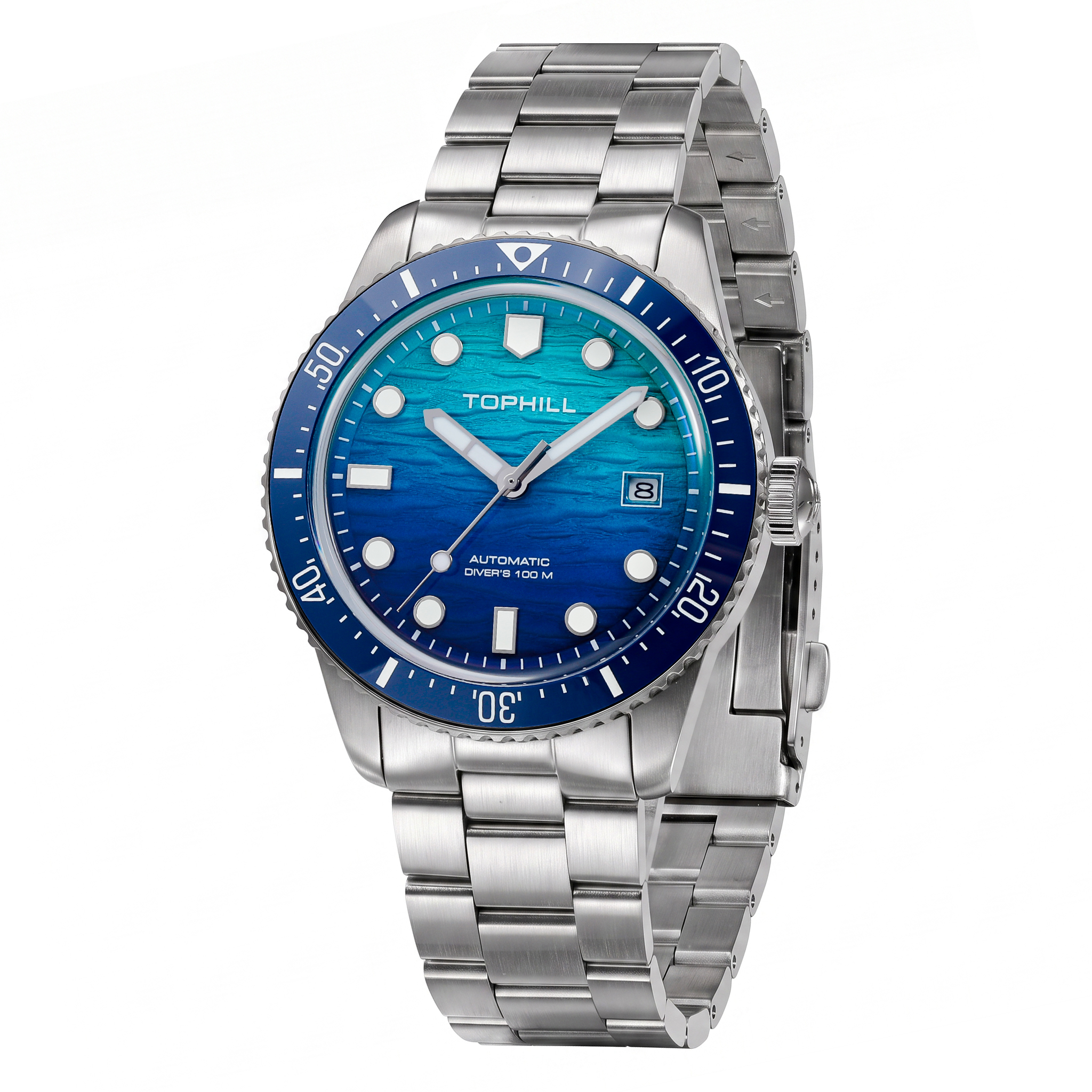
TD017G: 316L stainless steel case and rotating bezel with ceramic luminous insert, 10 ATM, boxed crystal, embossed gradient dial with applied indexes.
What Two Models Reveal That One Model Cannot
| Dimension | TD015G 8848 | TD017G | What the repetition shows |
|---|---|---|---|
| Base material | 316L stainless steel case; 316L solid bracelet | 316L stainless steel case; 316L stainless steel solid bracelet | The grade is not downgraded between tiers |
| Movement | Japan Miyota Automatic 8215 | Miyota Automatic 8215 | One calibre family across the dive range |
| Bezel | Rotating bezel, ceramic insert, BGW9 luminous | Rotating bezel, ceramic insert with luminous | Bezel construction is a house method, not a one-off |
| Caseback | See-through solid | See-through solid | Same structural approach at both tiers |
| Water resistance | 200 metres | 10 ATM | Tier separation is a deliberate rating decision |
| Crystal | Flat sapphire | Boxed crystal | Geometry is chosen per design brief |
| Dial | Sunburst with applied indexes and BGW9 | Embossed with applied indexes, gradual colour | Finishing capability scales with the tier |
| Buckle | Solid extension buckle | Solid turtle buckle | Closure architecture is specified, not defaulted |
A single specification sheet proves that one watch can be built. Two sheets from the same factory prove something narrower and more useful: that the factory documents to a consistent standard. Four dimensions repeat across the TD015G and the TD017G.
- Base material. Both models specify 316L stainless steel for the case, and both document a 316L solid bracelet. Grade consistency across tiers is a checkable signal rather than a slogan.
- Movement sourcing. Both models use the Miyota Automatic 8215. For a buyer assembling a range, one calibre family simplifies spare-part planning, servicing and after-sales training.
- Bezel construction. Both models use a rotating bezel with a ceramic insert carrying luminous material. That is a construction method, not a single component order.
- Caseback architecture. Both models specify a see-through solid caseback, so the same structural approach carries across the range.
The limits of this evidence should be stated plainly. Neither specification states case diameter, thickness, lug width, weight or bracelet taper, and neither states which test protocol was applied to that individual model beyond the water-resistance rating. Buyers who need those parameters must request them directly, in writing, before tooling is approved. A model sheet demonstrates construction decisions; it does not replace a sample, a test report or a production audit.
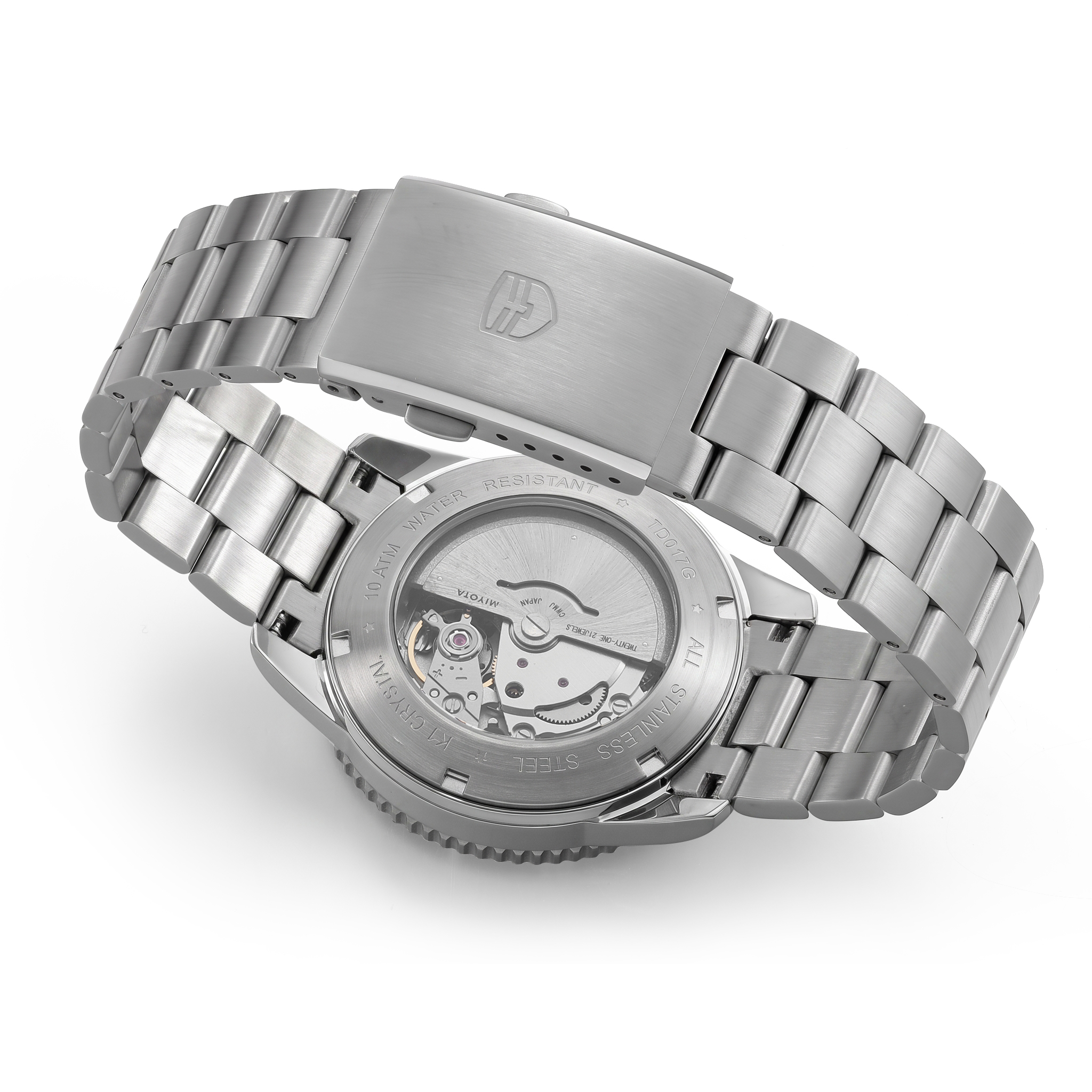
Both diving models are documented with a see-through solid caseback, which allows the movement to be inspected without opening the watch.
The Quartz Platform: Where Volume and Compliance Sit
A dive-watch programme is not the only thing a custom buyer evaluates. The same manufacturer documents a quartz platform at a different position in the range. TAM001 is a lady's elegant quartz wristwatch with a 316L stainless steel case set with zircon stones, 3 ATM water resistance, a flat sapphire crystal, a sunburst dial with applied indexes and a Miyota quartz movement, offered with either a 316L stainless steel solid bracelet with a jewellery buckle or a genuine leather strap with a pin buckle. TAM002 documents a 316L stainless steel case set with zircon stones, 3 ATM, a flat sapphire crystal, a sunburst dial with applied index, a 316L solid bracelet with butterfly buckle and a Ronda quartz movement. TR001 uses a Japan quartz movement with a glossy dial and printed markers.
Documented finish variants in this family include an IPGold-tone case paired with a coffee dial and a silver-tone case, with bracelet or leather strap options. For a buyer building a women's or gift-oriented line, this is the relevant evidence: zircon setting, applied indexes, sapphire crystal, two quartz movement options and two closure types, all stated at model level rather than as a general capability claim.
Quartz is not a secondary category in commercial terms. Industry Research's 2024 analysis places quartz at 75% of global watch shipment volume, while mechanical watches contribute more than 68% of total market value. That split explains why a supplier serving both volume retail and enthusiast buyers needs both platforms documented to the same standard. Compliance pressure points in the same direction: RoHS compliance under Directive 2011/65/EU is mandatory for electronic watches, including quartz, in the EU market.
The boundary is rating-related. A 3 ATM model is specified for daily-wear exposure such as hand washing and rain, not for swimming or diving. Buyers who need water-sport use should be specifying from the diving models, not from the elegant quartz family.
Water Resistance Is a Process, Not a Number
Water resistance is realised by elastic sealing gaskets at the gaps of the caseback, crystal, crown and pushers, combined with screw-down structures for the crown and caseback and precise case machining. The rating that appears on a specification sheet is a laboratory condition, not an operating depth.
The ATM mark states a static laboratory pressure value, where 1 ATM is equivalent to 10 metres of static water depth. It does not describe a usable diving depth. Water-resistant watches are tested and certified according to ISO 22810 for general water-resistant watches and ISO 6425 for diver watches, and under ISO 22810:2010 the term waterproof is prohibited. That detail matters when comparing supplier documentation, because a sheet that uses the word without a standards reference is not saying very much.
The manufacturer states support for 5-50 ATM water resistance and states that every waterproof watch is pressure-tested before shipment at 100%, not by random sampling. The documented test sequence runs as follows: a visual check of case, crown, gasket and crystal before testing; loading the watch and applying the target pressure with a holding period; monitoring for air leakage during pressurisation; slow pressure release and full surface drying; and a final inspection for internal moisture or water ingress.
The equipment list behind that sequence is documented: a water-resistant testing machine (including a 500-metre machine), a movement stem cutting machine, an automatic movement accuracy testing machine, a strap tension-torsion testing machine, a dial index inspection machine and a dropping test machine. For an EU-market programme the stated special requirements extend to CE EMC requirements, specified waterproof performance and movement accuracy requirements.
Where These Two Models Fit
The documented use case for the category is time-telling, daily matching and social occasions, with customisation for gifts and souvenirs. Within that, the two diving models split along use intensity.
- Diving and water-sport retail. The 200-metre TD015G 8848 is the higher-tier option, with a ceramic luminous bezel, flat sapphire crystal and extension buckle.
- Dive-style everyday wear. The 10 ATM TD017G carries the same construction language at a lower rating tier, with a boxed crystal and a gradient embossed dial for a dressier dive-watch look.
- Private label collections. A brand owner can build a two-tier dive line from one factory using the same movement calibre and the same 316L grade, separating the tiers by crystal, dial execution, buckle and rating.
- Corporate gifting and souvenir programmes. The quartz family, with zircon-set cases, 3 ATM and IPGold or silver finishes, is the relevant platform rather than the diving models.
- Segmented ranges. The diving models are documented as men's and automatic categories, while TAM001 and TAM002 are documented as lady's and elegant categories, which lets one supplier cover both ends of a retail floor.
The documented customer profile matches this structure: brand owners, wholesalers and retailers rather than end users, with supply relationships recorded at five years or more and stable operation across markets including Australia, Switzerland, Germany, France, the United Kingdom, Israel, Japan, Korea, Sweden, Singapore and Turkey. The company reports an export ratio of 80%, with main markets in the EU and the USA alongside the Middle East.
Market Trend Analysis
Three verified data points frame how model-level evidence is being read in 2026.
First, the market is dual-platform. Quartz holds 75% of global shipment volume while mechanical watches contribute more than 68% of market value (Industry Research, 2024). A supplier that documents only one platform is only half-visible to a buyer assembling a full range.
Second, automatic is mainstream rather than niche. The global watch movement market reached USD 18.4 billion in 2025, with automatic movements holding a 38.2% share (Dataintelo). A calibre such as the Miyota Automatic 8215 sits inside mainstream supply, which is exactly why its repeated appearance across two models is meaningful: the factory has already made that purchasing decision at volume.
Third, compliance has become a specification item rather than a certificate in a drawer. ISO 22810:2010 governs how water resistance may be described and prohibits the term waterproof, while RoHS Directive 2011/65/EU applies to electronic watches in the EU. Buyers comparing suppliers increasingly treat a standards reference in a specification sheet as a qualifying line rather than a bonus.
How This Compares With Catalogue-Based Sourcing
Catalogue sourcing answers a different question. It tells a buyer what is available now; it does not tell them how the object was specified. The practical difference appears in six places.
| Evaluation question | Why it matters | What these two models document |
|---|---|---|
| Which stainless grade? | Grade affects corrosion behaviour, finishing and long-term appearance | 316L stated on both models |
| Which calibre, and is it stable across the range? | Determines servicing, spare-part planning and price band | Miyota Automatic 8215 on both |
| What produces the water rating? | A rating without its construction is not verifiable | Bezel, caseback and crystal stated per model |
| How is water resistance verified? | Sampling leaves leakage risk in the field | 100% pressure testing stated |
| What changes between tiers? | Buyers need a defensible step-up story at retail | Crystal, dial execution, buckle and rating |
| What is the delivery commitment? | Tooling programmes must fit a launch calendar | Quoted 75-day lead time |
Documented custom models are not the right route for every programme, and the boundaries are worth stating.
- Lead time. Quoted custom lead time is 75 days. Programmes that need immediate restock should be buying stock rather than commissioning tooling.
- Volume economics. Trial runs are supported and large-volume production is available, but per-unit economics favour planned volume over ad-hoc repeat orders.
- Rating scope. The 200-metre and 10 ATM figures are laboratory ratings. They describe test conditions, not a guaranteed operating depth, and they decay as gaskets age.
- Category fit. A 3 ATM elegant quartz model is a daily-wear and gifting product and should not be specified for swimming.
- Geometry trade-offs. A boxed crystal raises the profile and changes the visual character of the watch; a brief built around an ultra-slim case should specify a flat crystal instead.
- Bezel complexity. A ceramic insert with luminous material exists to make elapsed-time marking legible in low light. Programmes with no dive-timer requirement can specify a simpler bezel and keep the design closer to a dress watch.
Future Outlook
The direction of travel in custom watch sourcing is toward documentation. As buyers compare suppliers through specification sheets, samples and standards references before they place a tooling order, the supplier that can state a material grade, a calibre, a rating and a construction method per model, and repeat them consistently across a range, is easier to shortlist than one that describes capability in adjectives.
Two platform requirements follow. A supplier serving volume retail and enthusiast buyers at the same time needs quartz and mechanical programmes documented to the same standard, and needs the compliance evidence each platform attracts: RoHS for the electronic side, ISO 22810 and ISO 6425 language for the water-resistance side. The two models reviewed here show what that looks like in practice, with the same 316L grade and the same automatic calibre at two price positions, and the tier difference carried by crystal geometry, dial execution, buckle architecture and water-resistance rating.
FAQ
What movement do the TD015G and TD017G use?
Both models are documented with the Japan Miyota Automatic 8215, an automatic winding calibre. The movement specification is identical across the two models; the differences sit in water-resistance rating, crystal type, dial execution and buckle architecture.
How do a 200-metre rating and a 10 ATM rating compare?
They are different tiers of the same laboratory measurement. The ATM mark states a static laboratory pressure in which 1 ATM is equivalent to 10 metres of static water depth, so 10 ATM corresponds to a 100-metre static rating, while the TD015G is rated at 200 metres. Neither figure describes a usable diving depth; water-resistant watches are tested according to ISO 22810 and diver watches according to ISO 6425.
Is water resistance permanent once a watch has passed testing?
No. Water resistance is maintained by elastic gaskets at the caseback, crystal, crown and pushers, and those gaskets age with wear, impact and chemical contact. High-temperature steam, such as a sauna or hot bath, deforms rubber gaskets and degrades sealing. Passing a pressure test confirms the condition of the watch at the time of testing, not a permanent property.
What water-resistance range can the manufacturer achieve, and how is it verified?
The manufacturer states support for 5-50 ATM water resistance and states that every waterproof watch undergoes a 100% water-pressure test before shipment rather than random sampling. The documented sequence covers pre-test visual inspection, pressurisation with a holding period, air-leak monitoring, slow release and drying, and a final check for internal moisture.
Are the quartz models in the same range suitable for swimming?
No. TAM001, TAM002 and TR001 are documented at 3 ATM, which corresponds to daily-wear exposure such as hand washing and rain splash. Water-sport use should be specified from the diving models, which are rated at 10 ATM and 200 metres.
What materials, crystals and finishes are documented across the range?
Cases are documented in 316L stainless steel across the diving and quartz families, with zircon stone setting on the TAM001 and TAM002 cases. Crystals are flat sapphire on the TD015G, TAM001, TAM002 and TR001, and a boxed crystal on the TD017G. Bezels on both diving models use a ceramic insert with luminous material. Bracelets include 316L solid bracelets with extension, turtle, jewellery and butterfly buckles, plus genuine leather straps with pin buckles. Documented finishes include IPGold-tone with a coffee dial and silver-tone.
What compliance does the manufacturer state?
ISO 9001 quality management and ISO 14001 environmental management certification, and finished products that meet EU RoHS compliance requirements. For the EU market the stated application requirements also cover CE EMC requirements, specified waterproof performance and movement accuracy requirements.
Reference document: the manufacturer's company profile is available as a downloadable PDF, Profile of Super Time (HK) Industrial Ltd.
¿Tiene preguntas o necesita más detalles?
Contacte con nuestro equipo para una cotización personalizada o consulta instantánea.
Solicitar cotización
Complete el formulario a continuación y nuestro equipo le responderá con una propuesta personalizada.
Chat directo de WhatsApp
¿Prefiere chatear en tiempo real? Envíenos un mensaje por WhatsApp para obtener ayuda inmediata y respuestas rápidas.
- Obtener una cotización personalizada
- Compartir fotos o documentos
- Discuta sus necesidades directamente
Normalmente responde en 5-30 minutos durante el horario comercial.