
Supplier Capability Evidence: A High-Precision GNSS Portfolio
High-precision GNSS procurement rarely collapses at the datasheet stage. It collapses later, when a receiver that met a stated accuracy number turns out to sit in a system with no matching antenna, no defined correction source, and no clear answer about which unit was actually tested. For buyers moving from research into evaluation, the practical question is not whether a supplier lists an RTK product, but whether the supplier's portfolio can be read as evidence: distinct form factors, stated integration surfaces, and documented boundaries.
Jumpstar (Shenzhen Jumpstar Technology Co., Ltd., trading as JUMPSTAR CO., LIMITED) is a Shenzhen-based manufacturer of high-precision GNSS positioning hardware, with products spanning RTK receivers, RTK boards, GNSS modules, RTK modules, GNSS antennas and smart antennas. The company reports a 5,000 m² factory, 200 employees, a 20-engineer R&D team and exports to the EU, USA and Middle East. This article treats that portfolio as a capability dataset rather than a catalogue: what each product family demonstrates, where the evidence is strong, and where a buyer should keep the file open.
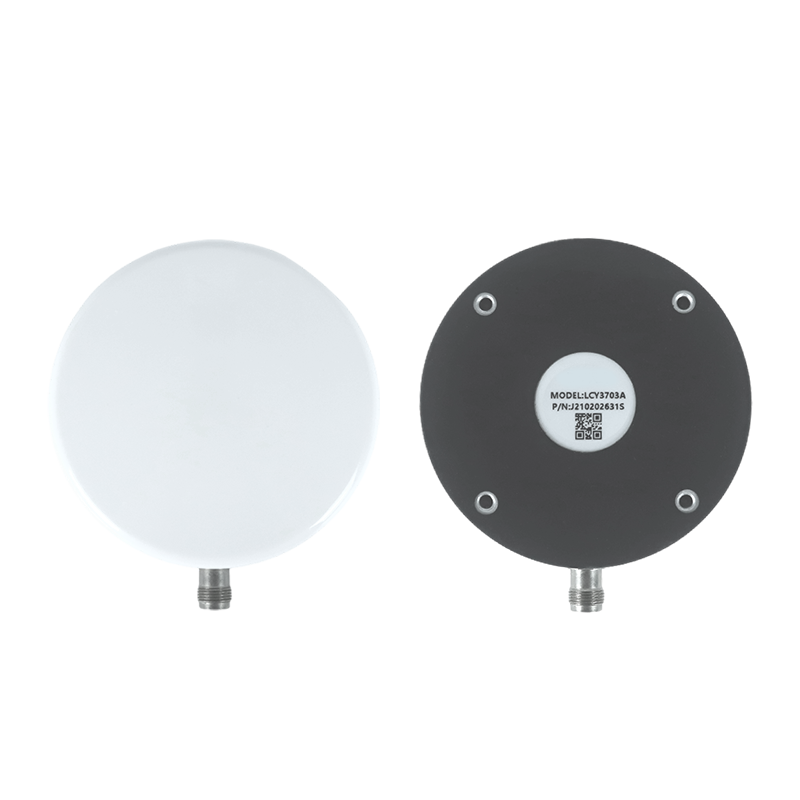
A measurement-grade GNSS antenna: in RTK systems, the antenna front end often determines whether a receiver's stated accuracy is reachable at all.
Why portfolio breadth is an evaluation criterion, not a marketing claim
A high-precision GNSS deployment is assembled from at least four functional layers: the positioning engine, the carrier board or enclosure, the antenna, and the correction link. Single-product suppliers force integrators to source across vendors, which pushes integration risk onto the buyer. Multi-product suppliers reduce that risk only if their families are genuinely compatible — same correction protocols, comparable connectors, documented power envelopes and a coherent set of accuracy definitions.
That distinction matters more in 2026 than it did when RTK was confined to surveying. Industrial buyers now request high-precision positioning for UAV flight control, auto-steering implements, autonomous ground vehicles, robotics, fleet telematics and port equipment, and each of those contexts imposes a different constraint: weight, vibration, update rate, heading output, interference exposure or unit cost.
How the Jumpstar portfolio maps to a buyer's evidence file
The portfolio can be read as five form-factor classes. The table below uses only manufacturer-stated specifications, so it is a screening instrument, not a validation record.
| Form factor | Example unit | Stated RTK accuracy | Integration surface | Typical project fit |
|---|---|---|---|---|
| Integrated receiver, dual-antenna | P-Box-X10 | H 0.6 cm + 0.5 ppm | 3×UART, Ethernet, Type-C, TF slot | UAV payloads, machine control, autonomy development |
| Compact receiver module | X43H-AH | H 0.6 cm + 0.5 ppm | 2×UART (TTL), Type-C, TF slot | Space-constrained vehicle and robot builds |
| OEM board with IMU | JS-CK39-A | H ±(8 + 1 ppm × D) mm | 2×UART, RF_IN, PPS | Custom PCBA and carrier-board designs |
| RTK module with integrated antenna | JS-NK40 | H 1.5 cm + 1 ppm | UART, RTCM 3.X | Fast prototypes, UAV and robotics platforms |
| Compact RTK module | JS-RK26-3 | H 1.0 cm + 1 ppm | UART, 1PPS, RTCM 3.X | Handheld terminals, tight enclosures |
| Standard GNSS module | JS-ATP45-M | 1.0 m CEP (L1+L5) | UART / RS232 / USB variants | Fleet telematics where metres suffice |
| Survey-grade antenna | JS-HAC100B, JS-HAC148A | Phase centre error ±2 mm / ≤2 mm | TNC-K | Base stations, deformation monitoring |
| Helical UAV antennas | JS-HAC42A-F, JS-HAC18A-F | LNA gain 37±3 dB / 33±2 dB | SMA | Airframes with strict weight budgets |
| Anti-jamming antenna | JS-X168 | 115 dB single / 95 dB three interference | J30J-9TP | Sites with deliberate or heavy RF interference |
| Smart antenna with heading | JS-SK43H-AH, JS-CK43-2 | H 0.6 cm + 0.5 ppm | 8-pin connector, dual MCX | Heading and attitude without magnetic sensors |
What each family actually demonstrates
Receivers: channel count, update rate and integrity functions
The receiver family is where a supplier's engineering depth is easiest to test. The P-Box-X10 carries 544 hardware channels, tracks GPS, BDS, GLONASS, Galileo, QZSS, NavIC and SBAS across triple-frequency bands, and outputs position and raw observations at 100 Hz with a stated transmission delay of 99.9% under 10 ms. Its dual-antenna configuration reports heading accuracy of 0.03° and attitude of 0.05° at a 5-metre baseline. The X43H-AH uses 789 channels in a 43.8 × 34.0 × 11.5 mm housing under 25 g, which is the version to examine when board area is the limiting factor.
Two capability signals sit above the accuracy numbers. First, integrity: several receiver units list AIM+ anti-jamming, OSNMA anti-spoofing and interference monitoring, which are functions a buyer can request to see exercised rather than simply listed. Second, autonomous correction transport: the P-Box-X6_Pro S integrates an EG25-G 4G module for RTCM transmission, removing the need for a separate radio in distributed fleets. The JS-X11 takes the opposite approach, packaging an all-in-one base station with 4G Cat.1, BLE 5.2, a 5200 mAh backup battery rated to 10 hours and IP66 protection — evidence that the supplier can build both rover-side and reference-side hardware.
OEM board: the layer that reveals manufacturing discipline
The JS-CK39-A is a 25.0 × 39.4 × 11.6 mm multi-band board with a built-in IMU, carrier-phase measurement precision of ≤1 mm, pseudorange ≤10 cm, supply range 3.3–5.5 V and consumption of 0.8 W at 3.3 V. It exposes 2×UART, RF_IN, PPS and supports NMEA 0183, custom binary, CMR, RTCM 2.X and RTCM 3.X (MSM3–MSM7).
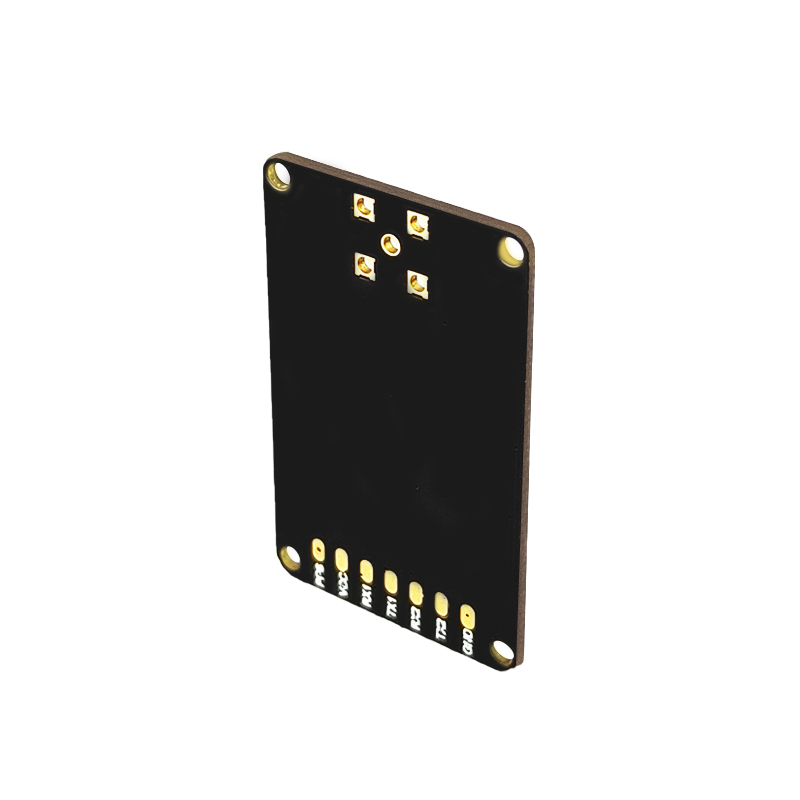
The JS-CK39-A RTK OEM board: a board-level offer is the clearest test of whether a supplier can support custom carrier design rather than only finished enclosures.
For an evaluation team, a board-level product matters for a specific reason: it cannot be assembled without documentation. Pin definitions, antenna bias requirements (3.3–5.5 V, LNA gain 20–35 dB suggested), protocol variants and thermal range (−40 °C to +85 °C) are all things a buyer must receive before design freeze. The presence of an OEM board in the portfolio is therefore indirect evidence of documentation practice, not just component sourcing.
Modules: three different trade-offs, not three names
The module range splits along measurable axes. JS-NK40 integrates an active helical antenna, uses 1408 channels, initialises RTK in under 5 seconds and measures 39.80 × 35.00 × 32.0 mm at under 10.2 g — a choice that trades enclosure volume for antenna convenience. JS-ARK28-3 fits 200 channels into 28.0 × 28.0 × 8.0 mm at under 12 g while drawing 37 mA typical at 3.3 V, and JS-RK26-3 compresses a dual-band L1/L5 engine into 16.2 × 12.2 × 2.3 mm with 20 Hz update and 20 mA typical consumption.
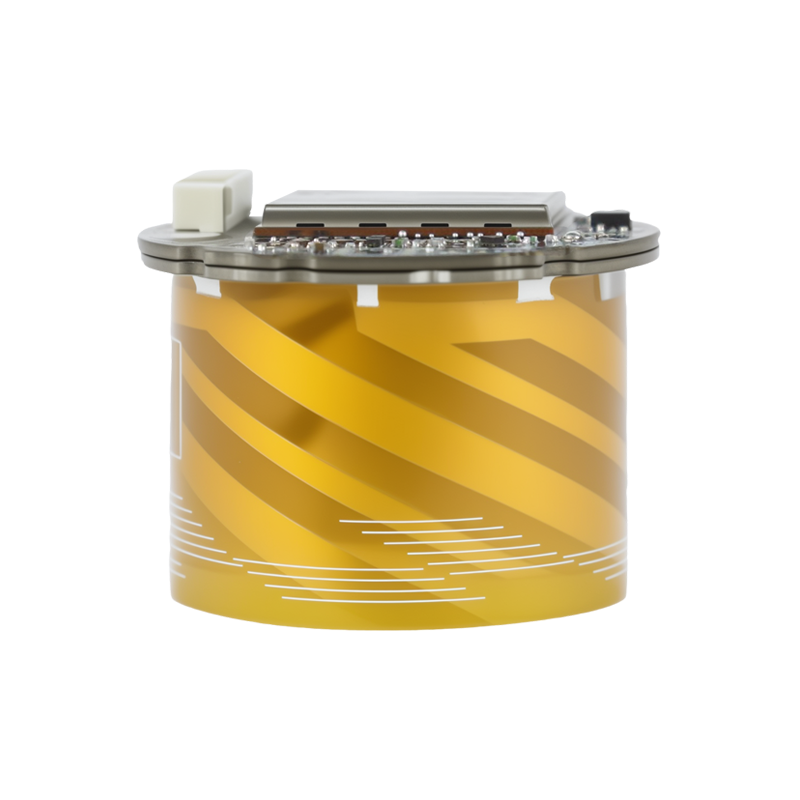
JS-NK40: integrating the antenna into the module shortens integration time but constrains enclosure and mounting design.
At the IMU-equipped end, S-C8A reports dead-reckoning behaviour of centimetre-level error for 3 seconds of lost lock and metre-level for 10 seconds — a stated bridge across brief outages, not continuous inertial navigation. The UAV-oriented JS-A56U9D adds a 0.3° dynamic heading figure and operational limits up to 80,000 m altitude and 500 m/s velocity. For buyers, these differentiated envelopes are more informative than a single headline accuracy figure.
Antennas: where the accuracy claim is usually won or lost
Antenna specifications are frequently under-read during procurement. The JS-HAC100B is a three-system seven-frequency measurement antenna with a phase centre error of ±2 mm, 4.5 dBi gain, 40±2 dB LNA gain and IP67 protection. The JS-HAC148A survey antenna states phase centre error ≤2 mm, out-of-band rejection ≥40 dB and IPX6. The helical family scales down for airframes: JS-HAC42A-F at 27.3 g with 37±3 dB LNA gain, JS-HAC27A-D2 at 16.7 g, and JS-HAC18A-F at 10.8 g with 33±2 dB LNA gain and IP65 when mated.
For vehicle-side deployments, the JS-PAS51A-D5 and JS-HAS67A-D2 offer B1/L1/L5 and B1/L1/L2/G1 coverage respectively with 28±3 dB LNA gain and IPX7 protection, while JS-HAS37 reports 4.0 dBic at L1 and 3.0 dBic at L5 while drawing 8±3 mA — relevant for battery-powered terminals.
Smart antennas: heading as a portfolio capability
Dual-antenna heading is the clearest example of a capability that cannot be added at the last minute. JS-SK43H-AH reports RTK accuracy of 0.6 cm + 0.5 ppm horizontally and heading of 0.15° at a 1-metre baseline, tightening to 0.03° at 5 metres, with pitch and roll at 0.25° and 0.05° respectively. JS-CK43-2 adds INS integration, 50 Hz RTK output, 100 Hz IMU output and PPP convergence in 20 minutes to 0.1 m horizontal. JS-NK43-2 uses 1408 channels in the same 48.0 × 43.2 × 37.0 mm envelope.
Magnetic-sensor-free heading is a design decision, not a feature bullet: it removes one failure mode from machine control and marine applications where magnetic disturbance is routine.
Application fit: where the portfolio is designed to land
The company's own application material, together with product-level industry listings, maps the range onto specific environments. Surveying and mapping relies on the survey antennas and receiver units; UAV work draws on the helical antenna family, the JS-A56U9D and JS-ARK28-3 modules, and dual-antenna heading for flight-path stability. Precision agriculture uses auto-steering receivers and ruggedised antennas. Automotive and fleet programmes use the P-Box receivers, JS-ATP45-M and JS-TP26-U modules, and vehicle-mounted antennas with IPX7 sealing.
Robotics, smart ports, power-grid inspection and intelligent transportation appear repeatedly across module and smart-antenna listings, typically with the same requirement pattern: centimetre-level position, a heading or attitude output, and tolerance for vibration and wide temperature ranges. The UAV application record also documents the operating envelope used across those deployments — −40 °C to +85 °C, altitude to 18,000 m, acceleration ≤4g, velocity to 515 m/s, and RTK plus attitude output at up to 20 Hz.
Market context: why buyers are asking for portfolio evidence now
Two published figures frame the commercial backdrop. Fortune Business Insights estimates the global GNSS market at USD 335.04 billion in 2025, projecting USD 844.55 billion by 2034. Data Insights Reports values the high-precision GNSS receiver segment at USD 3.10 billion in 2025. The two figures use different scopes — one covers the full GNSS ecosystem including satellites and services, the other isolates high-precision receivers — so they should not be combined into a single growth rate.
What both indicate, in qualitative terms, is that demand for centimetre-level positioning is spreading from specialist surveying into mainstream industrial systems. That shift changes supplier selection: buyers are no longer comparing single instruments but evaluating whether a vendor can support a programme across multiple form factors, with consistent protocols, over a multi-year production window.
Where the evidence stops: limits a buyer should carry forward
Portfolio breadth is not proof of field performance, and several boundaries deserve explicit attention.
Datasheet accuracy is not system accuracy. Stated RTK figures such as 0.6 cm + 0.5 ppm depend on correction source, baseline length, antenna quality, multipath environment and the statistical definition used. Where a supplier does not state test conditions, cross-vendor accuracy ranking is not defensible. This applies equally to the company's own figures.
Anti-jamming claims need test conditions. The JS-X168 reports 115 dB suppression against a single interference source and 95 dB against three, using a five-element array. Those are meaningful numbers only alongside the interference profile, bandwidth and measurement method — which a buyer should request before specifying the unit into a hostile-RF environment.
Capacity and lead time are company-reported. Jumpstar states monthly capacity of 50,000 units, a 30-day lead time, a 500-unit MOQ, 100% testing and remote after-sales support, with ISO 9001:2015 certificate UQ231801R2 recorded as valid to 10 December 2026. Capacity figures describe capability, not committed availability for a given month, and are best verified against production logs or a trial order rather than accepted from a web page.
Some families are deliberately not centimetre-level. The JS-ATP45-M (1.0 m CEP at L1+L5), JS-ATP28-2 and the 8.0 × 6.0 × 2.3 mm JS-AP08-PR serve telematics, wearables and tracking use cases. Specifying them into an RTK design is a procurement error, not a product shortfall.
IMU bridging has a defined horizon. Inertial support across signal loss is bounded — seconds, not minutes — and should be treated as continuity insurance, not as a substitute for positioning.
MOQ and customisation carry programme cost. A 500-unit minimum and a 30-day customisation cycle suit series production; buyers running a 20-unit pilot should expect sampling friction and should budget for it in the schedule.
Future outlook
Three directions are visible from the portfolio itself. First, dual-frequency L1/L5 designs are spreading downward through the module range, which improves multipath behaviour in urban and foliage environments without increasing enclosure size. Second, integrity functions — OSNMA anti-spoofing, interference monitoring, RAIM — are migrating from premium receivers into compact units, a response to the growing cost of a falsified or jammed position fix. Third, the boundary between receiver, module and antenna is dissolving: smart antennas already integrate the RF front end, the engine and, in some cases, the IMU.
For buyers, the practical consequence is that supplier evaluation will depend less on a single accuracy figure and more on documented behaviour under loss of correction, loss of lock and RF interference. Suppliers that publish those conditions, and can supply the test records behind them, will be easier to qualify. Suppliers that publish only a headline number will remain in the screening pile.
FAQ
- Which form factor fits a UAV integration — module, board, smart antenna or receiver?
- The choice follows payload, weight and autonomy requirements. Integrated modules such as JS-NK40 or JS-ARK28-3 reduce design effort where the antenna can be integrated. OEM boards such as JS-CK39-A suit custom carrier designs. Dual-antenna units such as P-Box-X10 or JS-SK43H-AH are used where heading and attitude are required for flight-path stability, reporting 0.03° heading at a 5-metre baseline. A UAV-oriented module such as JS-A56U9D is specified for operational limits up to 80,000 m altitude and 500 m/s velocity.
- What does an RTK board specification actually prove about final system accuracy?
- It proves the engine's stated measurement capability under defined conditions, not the assembled system's performance. The JS-CK39-A reports RTK horizontal accuracy of ±(8 + 1 ppm × D) mm and carrier-phase precision of ≤1 mm, but final accuracy also depends on antenna phase-centre stability, correction latency, baseline length and multipath. Buyers should verify the supplied RF front-end and correction source before treating the board figure as a system figure.
- Do antenna specifications matter as much as receiver specifications?
- They frequently determine whether a receiver's accuracy is reachable. Phase-centre error, LNA gain, out-of-band rejection and polarisation purity set the practical noise floor. The JS-HAC100B and JS-HAC148A state phase-centre errors of ±2 mm and ≤2 mm respectively, with LNA gain of 40±2 dB and 38±3 dB; the helical UAV antennas range from 28±3 dB to 37±3 dB depending on size and weight. An under-specified antenna can invalidate a high-channel-count receiver.
- How should anti-jamming performance be evaluated?
- By requesting the measurement conditions, not only the suppression figure. The JS-X168 is a five-element array reporting 115 dB against a single interference source and 95 dB against three. Meaningful evaluation requires the interference type, bandwidth, incidence angle and test setup, plus behaviour under combined wideband and narrowband interference. Without those details, suppression figures from different suppliers are not directly comparable.
- What can a buyer verify about supplier capacity and lead time before committing?
- Company-reported figures should be treated as a starting position. Jumpstar states 50,000 units per month, a 30-day customisation lead time, a 500-unit MOQ and 100% testing, and records ISO 9001:2015 certificate UQ231801R2 as valid to 10 December 2026. Independent verification is better obtained through a trial order, a production-log review or a factory audit than through published documents alone.
- Does portfolio breadth reduce integration risk on its own?
- Only where the units are genuinely differentiated and mutually compatible. Breadth becomes evidence when form factors differ in channel count, size, power, interface and environmental rating, and when protocols such as RTCM 3.X, NMEA 0183 and CMR are shared across families. Breadth without documentation simply moves the integration work back to the buyer.
¿Tiene preguntas o necesita más detalles?
Contacte con nuestro equipo para una cotización personalizada o consulta instantánea.
Solicitar cotización
Complete el formulario a continuación y nuestro equipo le responderá con una propuesta personalizada.
Chat directo de WhatsApp
¿Prefiere chatear en tiempo real? Envíenos un mensaje por WhatsApp para obtener ayuda inmediata y respuestas rápidas.
- Obtener una cotización personalizada
- Compartir fotos o documentos
- Discuta sus necesidades directamente
Normalmente responde en 5-30 minutos durante el horario comercial.