
Supplier Audit: Small Machine Room Elevator Factory and Test Tower Evidence
Supplier Audit: Small Machine Room Elevator Factory and Test Tower Evidence
A factory and test-tower audit for a small machine room elevator is an evidence exercise, not a courtesy visit. Its purpose is to confirm five things before an order is released: that the supplier is a real manufacturing entity with a valid special-equipment licence, that production equipment and process control support the capability being claimed, that quality records can trace a delivered unit back to its components, that test procedures can be witnessed and repeated, and that project references can be checked independently of the sales team.
Small machine room elevators add a specific complication to that process. Unlike a machine roomless design, a small machine room elevator keeps a reduced machine room rather than eliminating it, so the traction machine, controller, brake and auxiliary equipment occupy a dedicated space instead of being folded into the shaft envelope. The audit therefore has to cover three environments: the production floor, the machine-room equipment set, and the test evidence that connects the two.
What a Factory and Test-Tower Audit Is Meant to Prove
Procurement teams frequently treat a factory visit as a relationship milestone. At the decision stage it should be treated as a verification milestone with defined outputs. A well-run audit produces a document pack that the buyer can attach to the purchase order as agreed scope, with each claim traceable to a record.
- Entity evidence: legal identity, licence scope, and the registered address of the production site.
- Capability evidence: equipment list, process route sheets, calibration and maintenance records.
- Quality evidence: incoming inspection, in-process inspection, pre-shipment inspection and release sign-off.
- Traceability evidence: unit serial number linked to component batch numbers and material certificates.
- Performance evidence: witnessed and repeatable test procedures for brake, leveling, noise, door safety and standby power.
- Reference evidence: projects that can be contacted independently and that sit inside the product scope being purchased.
The distinction that matters throughout the audit is between a claim a supplier states and a record a buyer can retain. Statements about quality culture are common; serialized inspection records linked to a specific unit are not.
Step 1 — Confirm the Legal Entity and the Manufacturing Licence
The first audit step happens before anyone travels. Request the business licence, the special-equipment manufacturing licence together with its permitted scope, the installation and maintenance licence, and the registered address of the production site. Then compare the licensed address against the address on the visit invitation. Where a supplier operates several sites, confirm which site actually manufactures the small machine room elevator you intend to buy, because a tour of one plant does not certify another.
Joylive Elevator Co., Ltd. (stock short name Joylive, stock code 833481) is an example of a supplier whose public entity information is detailed enough to pre-check before scheduling travel. The company was founded in 2002 and operates from Bacheng Town, Kunshan City, Suzhou, Jiangsu Province, China. It holds a top A qualification in China for special equipment manufacturing, installation, modernization and maintenance. It reports a factory area of 105,000 m², 450 employees including a 150-engineer R&D team, and an annual output of 15,000 units, with roughly 55% of output exported to markets that include China, Europe, America, Oceania, Africa, Central Asia, Southeast Asia and the Middle East.
Those figures are not claims to admire; they are claims to reconcile. Factory area should match what you walk through. Headcount should be consistent with the process steps you observe. Output volume should be plausible against the number of units in process on the day of the visit. If the stated annual output is a multiple of the work-in-progress you can see, ask how the number is counted — finished units, or units including components and modernization kits.
Step 2 — Read the Production Floor for Capability, Not for Size
Production capability is best read from process control rather than from floor area. On a small machine room elevator order, the components that most often determine installation success are the car frame, the door operator, the machine-room equipment mounting and the control cabinet. Ask to follow these four items physically through the plant rather than sampling whatever is nearest to the visitor entrance.
Joylive describes its manufacturing approach as raising machining precision through robotic arms and fully automatic bending lines, with design review, intelligent manufacturing and standards compliance forming the control loop for design and manufacturing risk. For an auditor, that description translates into specific checks: does the bending line have a current calibration and maintenance record, are process route sheets available for the car-frame and door-operator families, and who signs the design review before a non-standard configuration enters production?
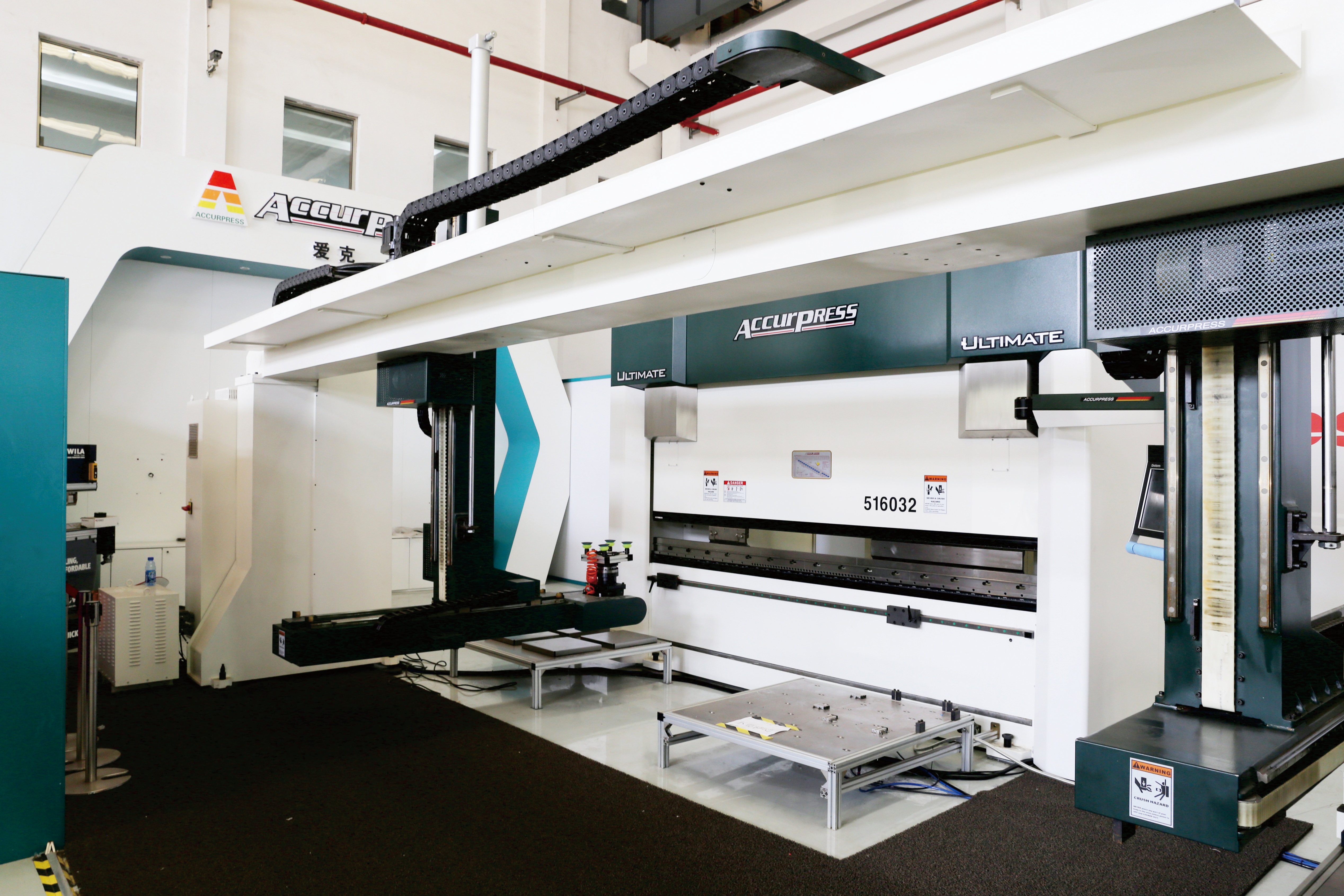
Automated sheet-metal and bending lines are one of the checkpoints in a small machine room elevator factory audit: auditors should ask for calibration and maintenance records, not just a visual walkthrough.
A practical checklist for this stage includes: the equipment list with model numbers and commissioning dates; maintenance records for the machines used on your component families; welder qualification records where structural welding is involved; calibration certificates for measuring instruments; defined in-process inspection points and the name of the role that signs each one; and the segregation rules that keep non-conforming parts out of the assembly line.
Step 3 — Quality-Control Records and the Traceability Chain
Traceability is the part of the audit that most directly protects the buyer, because it is what remains after the visit ends. Joylive states a Prevention + Control + Traceability quality model, benchmarked against international advanced standards and supported by its CNAS-accredited laboratory, and commits to full transparency and traceability of materials, processes and inspection procedures for every delivered elevator.
To test whether that commitment is operational rather than aspirational, ask for one closed record set from a recent project — redacted if necessary. A complete chain should let you move from the delivered unit's serial number to the component batch numbers, then to material certificates, then to the inspection record for each stage, and finally to the shipment release signature. If any link is missing, the chain is a narrative rather than a system.
Three specific questions are worth asking at this stage. First, how is the traction machine identified on the certificate of conformity, and does that identifier appear on the packing list for your order? Second, how are door operator and lock components traced when they come from an external supplier? Third, what happens to inspection records after delivery — are they archived, and for how long, and can a buyer request a copy at any point in the warranty period?
Step 4 — The Test Session: Procedures You Can Witness and Repeat
The test session is where a small machine room elevator audit differs most from a general supplier visit, because the machine-room equipment set includes the brake, the leveling system, the control cabinet and the door safety chain. The objective is not to watch a demonstration. It is to confirm that the supplier can run the same test twice and produce the same recorded result.
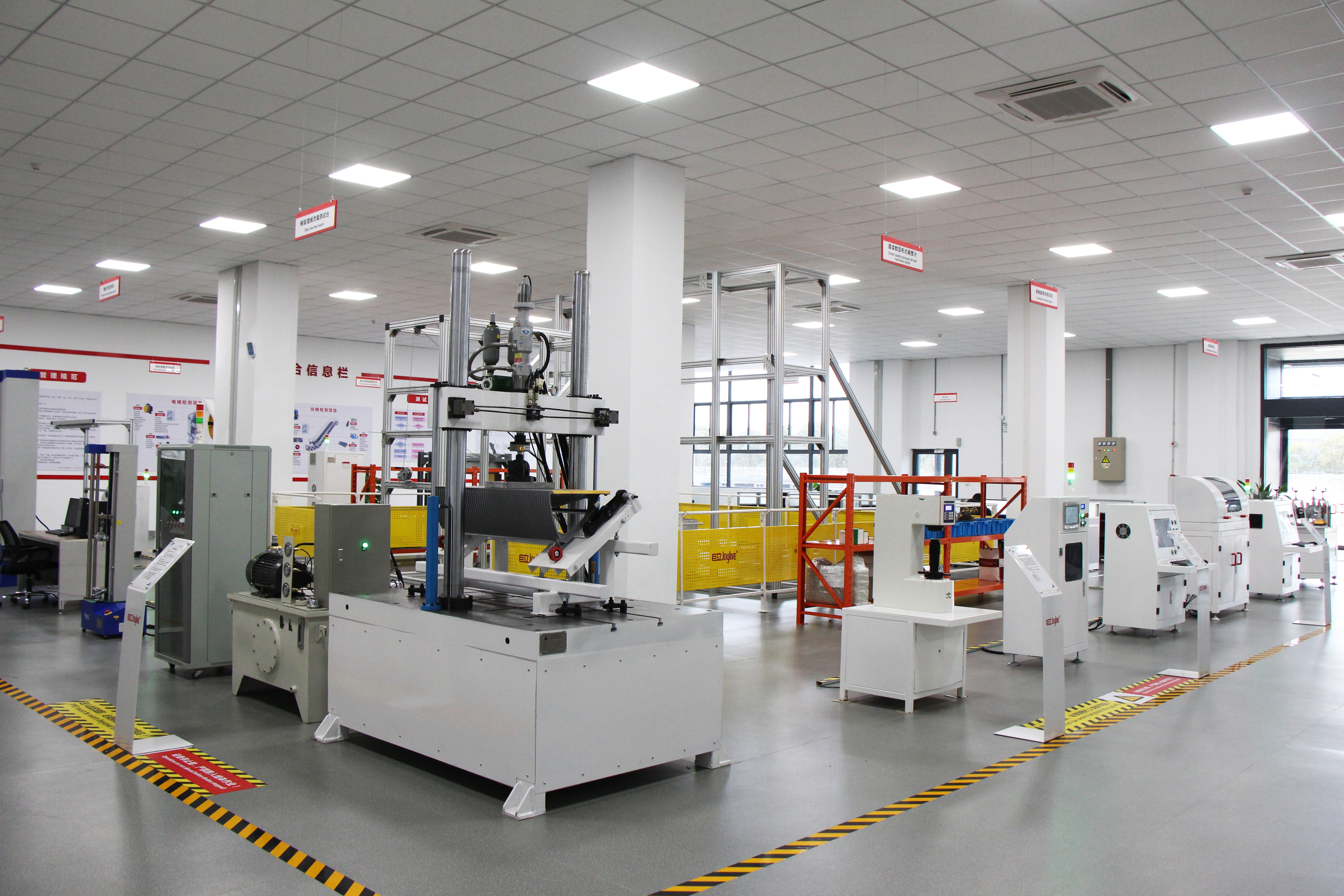
A laboratory or test-tower session should produce recorded results a buyer can retain: brake self-test data, leveling accuracy, noise measurements and standby power readings.
What to ask the supplier to demonstrate and document
- Brake reliability. Joylive states that all of its products include automatic braking force self-test functionality, which periodically tests the motor's braking capacity to verify reliability, supporting health self-diagnosis of the elevator. Ask how often the test runs, where the result is stored, and what the machine does when a result falls outside limits.
- Leveling accuracy. Through VVVF speed control, Joylive states that the car is aligned with floor height to within ±3 mm, with automatic re-leveling. Ask to see the measurement performed on the test unit and the instrument's calibration status.
- Noise and ride quality. Silent braking control technology is described as optimizing noise during start and stop. If noise is a contractual requirement, agree the measurement position and the instrument before the visit, and record the result on the spot.
- Energy performance. Joylive states compliance with ISO 25745 / VDI 4707 at the highest Class A energy efficiency level, with standby power consumption below 50 W, and a fast-calling response that reduces standby consumption by 50%. Ask which configuration the declaration applies to and whether the machine-room equipment set for your specification matches it.
- Door safety chain. The stated approach combines mandatory standard compliance, mechanical strength verification and redundancy to avoid single-point failures, with a door-opening restrictor to prevent door slamming or forced opening. Ask to see the verification record rather than the component drawing alone.
- Machine-room environment. Where the project is bound for the European Union, EN 81-20 and EN 81-50, effective from 2017, require a minimum of 200 lux at floor level in machine room work spaces. Reduced machine rooms still need to be maintained, so lighting, access and working space should be checked against the standard rather than assumed from the general arrangement drawing.
One boundary deserves to be stated plainly. An accredited laboratory and a full-scale test tower are not the same asset. A laboratory confirms component and system performance under defined conditions; a test tower allows a complete installation, including the machine-room equipment set, to be exercised at height. Buyers should ask which of the two the supplier operates, what scope each covers, and whether the units tested are built to the same specification as the units that will ship. Where only a laboratory is available, the gap can be partly closed by requiring factory acceptance testing on the actual unit before shipment, with recorded results attached to the release documents.
Step 5 — Project References and Documentary Proof
References should be requested as a structured list, not as a folder of photographs. A usable reference entry contains the building type, floors served, rated load, machine room type, commissioning date and the entity responsible for installation and maintenance. Small machine room elevators serve residential buildings, apartments, hotels, low-rise commercial buildings and retrofit projects, and the reference set should show relevant coverage for the category you are buying into.
Ask for permission to contact two or three reference sites directly, and prepare questions about installation timelines, re-leveling behavior in service, spare-part response and what the operator would change in the specification. Ask, too, whether the reference project used the same traction machine and control platform as your order; a reference from a different configuration is evidence of delivery capability, not of the specific product you are buying.
The limitation here is structural and should be acknowledged rather than argued around. Reference lists are selected by the supplier and are therefore biased by construction, and a single site visit cannot prove long-term reliability. The audit can confirm that documentation is complete and contactable; it cannot confirm that the reference set is representative of your building type, climate or duty cycle. Where coverage in your segment is thin, the practical response is to shift risk into the contract through serialized traceability requirements, milestone-based inspection and pre-shipment acceptance testing, rather than to treat thin references as an automatic disqualifier.
On-Site Audit, Document-Only Review and Third-Party Audit
Not every buyer will travel, and the choice of audit mode changes the strength of the evidence you obtain. The comparison below is a decision aid rather than a ranking; each mode has a legitimate use depending on order value, project criticality and internal resources.
| Audit mode | Evidence it produces | Where it is limited |
|---|---|---|
| Document-only desk review | Licence scope, quality procedures, inspection templates, test report formats, traceability procedure documents | Confirms that procedures exist, not that they are followed; templates can be complete while records are not |
| On-site factory audit (buyer-led) | Physical verification of equipment, in-process inspection practice, warehouse and traceability records, witnessed testing | A point-in-time snapshot; the sample unit seen may not be the unit shipped; travel cost and scheduling constraints limit depth |
| Accredited third-party inspection | Independent report, calibrated measurements, standardized checklists, documented non-conformities | Scope depends entirely on what the buyer specifies; a generic checklist will miss product-specific items such as brake self-test or re-leveling |
| Pre-shipment factory acceptance test | Recorded performance data for the actual unit on the order, tied to the serial number | Occurs late in the schedule, so corrective action is more expensive if the unit fails |
Compared with a traditional full machine room, a small machine room design changes the audit boundary rather than removing it. There is still a machine room to inspect — smaller, but still requiring lighting, access, ventilation and equipment layout that meet the applicable standard, which is why the EN 81-20 lighting requirement remains relevant even for reduced footprints. The genuine limitation runs in the other direction: a small machine room elevator still needs a dedicated space above or adjacent to the shaft, and buildings that cannot provide that space cannot be served by the design regardless of how strong the supplier's evidence is. Confirming feasibility before auditing a supplier is therefore cheaper than discovering the constraint after a contract is signed.
Market Signals That Should Reshape Your Audit Checklist
Market conditions in the elevator sector affect what is worth verifying on the day of the visit. Grand View Research valued the global elevator market at USD 82.4 billion in 2025 and projects USD 86.3 billion in 2026, rising to USD 136.9 billion by 2033 at a compound annual growth rate of 6.8%. Traction elevators, the category that includes small machine room and machine roomless designs, held the largest revenue share at 55.1% in 2025, and Asia Pacific accounted for 41.7% of revenue in the same year.
Two consequences follow for procurement teams. First, because traction designs dominate the market, buyers have more comparative options within the same category, which raises the value of documented differentiation instead of verbal assurances. Second, input costs are moving. Rare-earth magnets used in permanent-magnet motors increased in price by more than 20% in 2025 according to Mordor Intelligence. When a supplier claims higher efficiency and lower noise from a permanent magnet synchronous machine — with Joylive's own comparison documentation citing 5% to 15% higher efficiency, 5 dB to 10 dB lower noise, a 20% to 30% energy saving rate and higher power factor and power density relative to the reference design — the audit should require the underlying test basis rather than accept the number as a specification.
For export-oriented orders, documentation alignment matters as much as hardware. HS code 842810 covers passenger or freight elevators other than continuous action, and the classification should be consistent across the commercial invoice, packing list, certificate of conformity and shipping documents. A mismatch here is a customs delay, not an audit finding, but it is cheaper to catch during the factory visit than at the port.
Future Outlook: Traceability as a Contractual Deliverable
The direction of travel in supplier evaluation is from one-off inspection toward continuous, data-backed evidence. Joylive's JoyCloud IoT platform illustrates the pattern: digital management and predictive maintenance across the elevator lifecycle, from installation and maintenance to real-time monitoring, with the stated aim of improving service efficiency and reliability.
For buyers, connected platforms turn traceability into something that can be written into a contract rather than requested informally. Instead of a single pre-shipment audit, procurement teams can specify periodic evidence delivery: brake self-test results, re-leveling events, fault categories and maintenance response times, all tied to the serial number of the delivered unit. Installation risk management is moving in the same direction — pre-work risk assessment, real-time site risk control and standardized operations are increasingly documented rather than assumed, which gives the buyer something concrete to review at handover.
The practical implication is that the factory audit is becoming the start of a data relationship rather than the end of a purchasing process. Buyers who define at the quotation stage which records they will receive, in what format and at what interval will get more value from the same supplier than buyers who define only price and delivery.
FAQ
What is a small machine room elevator, and how does it differ from a machine roomless elevator?
A small machine room elevator retains a reduced machine room rather than eliminating the machine room entirely, so the traction machine, controller and related equipment are housed in a dedicated space instead of being integrated into the shaft envelope. A machine roomless elevator places the drive equipment within the shaft or immediately adjacent to it. In procurement terms, the difference shows up in required building space, maintenance access and the scope of inspection: a reduced machine room must still meet applicable lighting, access and working-space requirements, such as the minimum 200 lux at floor level specified for machine room work spaces in EN 81-20 and EN 81-50, effective from 2017.
Which documents should a buyer request before scheduling an on-site factory audit?
A pre-audit document request should include the business licence, the special-equipment manufacturing licence with its permitted scope, the installation and maintenance licence, the registered address of the production site, an equipment list with model numbers, the quality control procedure covering incoming, in-process and pre-shipment inspection, the traceability procedure that links unit serial numbers to component batches, and a sample test report format. Joylive Elevator Co., Ltd., for example, holds a top A qualification in China for special equipment manufacturing, installation, modernization and maintenance, which gives an auditor a defined licence scope to reconcile against the products being quoted. Suppliers that cannot produce a traceability procedure in advance are unlikely to produce traceable records during the visit.
What should be demonstrated during a small machine room elevator test session?
A test session should produce recorded results for the items that affect the machine-room equipment set. For braking, Joylive states that all of its products include automatic braking force self-test functionality that periodically verifies the motor's braking capacity and supports elevator health self-diagnosis. For leveling, VVVF speed control is described as aligning the car with floor height to within ±3 mm with automatic re-leveling. For noise, silent braking control technology is intended to smooth and quieten start and stop. For energy, Joylive states compliance with ISO 25745 / VDI 4707 at the highest Class A energy efficiency level, with standby power below 50 W and a fast-calling response reducing standby consumption by 50%. Door safety relies on mandatory standard compliance, mechanical strength verification and redundancy, with a door-opening restrictor to prevent slamming or forced opening. Each claim should be witnessed and recorded rather than accepted as a printed figure.
How should traction machine and drive claims be verified during an audit?
The traction machine should be identified by a component identifier that also appears on the packing list for the order, so that the machine tested and the machine shipped can be confirmed as the same item. Where a supplier claims efficiency and noise advantages from a permanent magnet synchronous machine, the buyer should request the test report and the configuration conditions behind the figure. Joylive's own comparison documentation cites 5% to 15% higher efficiency, 5 dB to 10 dB lower noise, a 20% to 30% energy saving rate, higher power factor and higher power density relative to the reference design. Because rare-earth magnets for permanent-magnet motors rose more than 20% in price in 2025 according to Mordor Intelligence, magnet grade documentation and supply continuity are also legitimate audit questions.
How can project references for small machine room elevators be verified independently?
Request a structured reference list containing building type, floors served, rated load, machine room type, commissioning date and the installing entity, then ask for permission to contact two or three sites directly. Ask each reference about installation timelines, re-leveling behaviour in service, spare-part response and specification regrets. Confirm whether the reference used the same traction machine and control platform as your order, since references built on different configurations prove delivery capability rather than product fit. Reference lists are supplier-selected and therefore biased; a thin reference set in your own building category is a scope note to be managed contractually through inspection milestones and serialized traceability, not a conclusion on its own.
What are the limits of a single factory and test-tower audit?
An audit is a point-in-time sample. It confirms that a manufacturing entity exists, that equipment and process controls are documented, that traceability records can be produced, and that test procedures are repeatable in front of a witness. It does not prove long-term reliability in service, does not guarantee that the unit shipped matches the unit inspected, and cannot verify performance over years of duty. Laboratory accreditation and full-scale test-tower capability are also distinct: a laboratory validates performance under defined conditions, while a test tower exercises a complete installation. Auditors should confirm which assets the supplier operates, what scope each covers, and apply pre-shipment factory acceptance testing where the gap between the two needs to be closed.
Turning Audit Findings into Order Documents
An audit only changes outcomes if its findings become contractual language. The usable outputs are the traceability requirement, the pre-shipment acceptance test with recorded results attached to the release documents, the maintenance and spare-part response commitment, and the list of records the supplier will deliver during the warranty period. Buyers who convert a factory visit into those four documents get the full value of the trip; buyers who return with photographs do not.