
Supplement Packaging Buyer's Scorecard: Ningbo Zhuorong H21/HDV vs Leaders
Supplement packaging decisions at the execution stage are not settled by which supplier has the largest catalogue. They are settled by which supplier can document a specification, repeat it at the stated volume, and carry the decoration and compliance work a brand has already promised its customers. The global supplements and nutrition packaging market was estimated at USD 31.3 billion in 2025, according to Grand View Research, so the supplier field is deep enough that almost any brief receives several plausible quotations. The useful question is narrower: which of those quotations is backed by evidence a buyer can verify before releasing a purchase order?
This article builds a five-dimension buyer scorecard and applies it to Honor Packaging — Ningbo Honor Packaging Co., Ltd., a Ningbo-based contract packaging manufacturer founded in 2015, referred to in some buyer comparisons as Ningbo Zhuorong — alongside four established global packaging groups: Gerresheimer, Amcor, Aptar and Berry. The comparison is anchored in published product specifications for the H21 child-resistant jar family and the HDV1 wide-mouth violet glass jar family, and in the commercial terms Honor Packaging states openly.
Why Supplement Packaging Comparisons Fail at the Execution Stage
Most supplier comparisons are written for the evaluation stage and consumed at the execution stage, and the mismatch is where programs slip. A comparison built on brand recognition tells a buyer almost nothing about whether a 58 mm jar neck will run on an existing filling line, whether a 0.38 mm glass wall survives palletized freight, or whether a 10,000-unit minimum order quantity fits a launch forecast.
Three recurring gaps explain most of the failures:
- Specification opacity. Capacity ranges and item codes are often withheld until a quotation is issued, which prevents side-by-side technical comparison.
- Undocumented commercial terms. Minimum order quantity, lead time and capacity are treated as negotiable variables rather than published constraints, so buyers cannot model reorder timing.
- Unsupported quality claims. Quality is asserted in a brochure but not evidenced as a repeatable process with defined acceptance criteria.
The scorecard below replaces those gaps with checkable questions. It is deliberately weighted for custom child-resistant (CR) glass and violet glass supplement programs at mid-volume, because that is the requirement profile in which the H21 and HDV lines are most directly comparable with global peers.
The Five-Dimension Buyer Scorecard
Weights are a planning tool, not a scoring standard. A buyer running a multinational pharmaceutical-grade program should re-weight toward scale and regulatory documentation; a buyer launching a premium resin product should re-weight toward decoration depth and application fit.
| Dimension | What a buyer verifies | Execution risk it controls | Weight |
|---|---|---|---|
| 1. Specification evidence | Published capacities, glass thickness, jar diameter, neck finish, item codes | Line compatibility, closure fit, reorder consistency | 25% |
| 2. Customization and decoration | Printing and finishing methods available in-house or through qualified partners | Brand presentation, launch timing, artwork rework | 20% |
| 3. Quality evidence | Pre-shipment testing regime, third-party inspection, transit protection | Rejection rate, breakage claims, retailer chargebacks | 20% |
| 4. Commercial continuity | MOQ, lead time, monthly capacity, payment and delivery terms | Stockouts, cash flow, surge response | 20% |
| 5. Application and service fit | Format-to-product mapping, structural development and tooling support | Rework cycles, late-stage design changes | 15% |
Dimension 1 — Specification Evidence: What the H21 and HDV Lines Publish
Specification transparency is the fastest discriminator in a supplier comparison, because it is either available before the quotation or it is not. For Honor Packaging, two jar families carry most of the supplement volume and both are published at a level that supports engineering review.
H21 child-resistant jars
The H21 family is a child-resistant square and round jar range produced in 0.38 mm glass thickness, with a 58 mm jar diameter. Capacities span 15 ml and 30 ml as well as 20 dr to 60 dr, and the range is identified by item codes H21-0003C through H21-0008C. For a buyer, three of those figures do the real work: the 0.38 mm wall thickness sets the weight-to-strength trade-off the mold must hold, the 58 mm diameter determines how the jar behaves on existing filling and capping equipment, and the dram-based codes let a buyer match a jar to a fill weight without re-qualifying a new format.
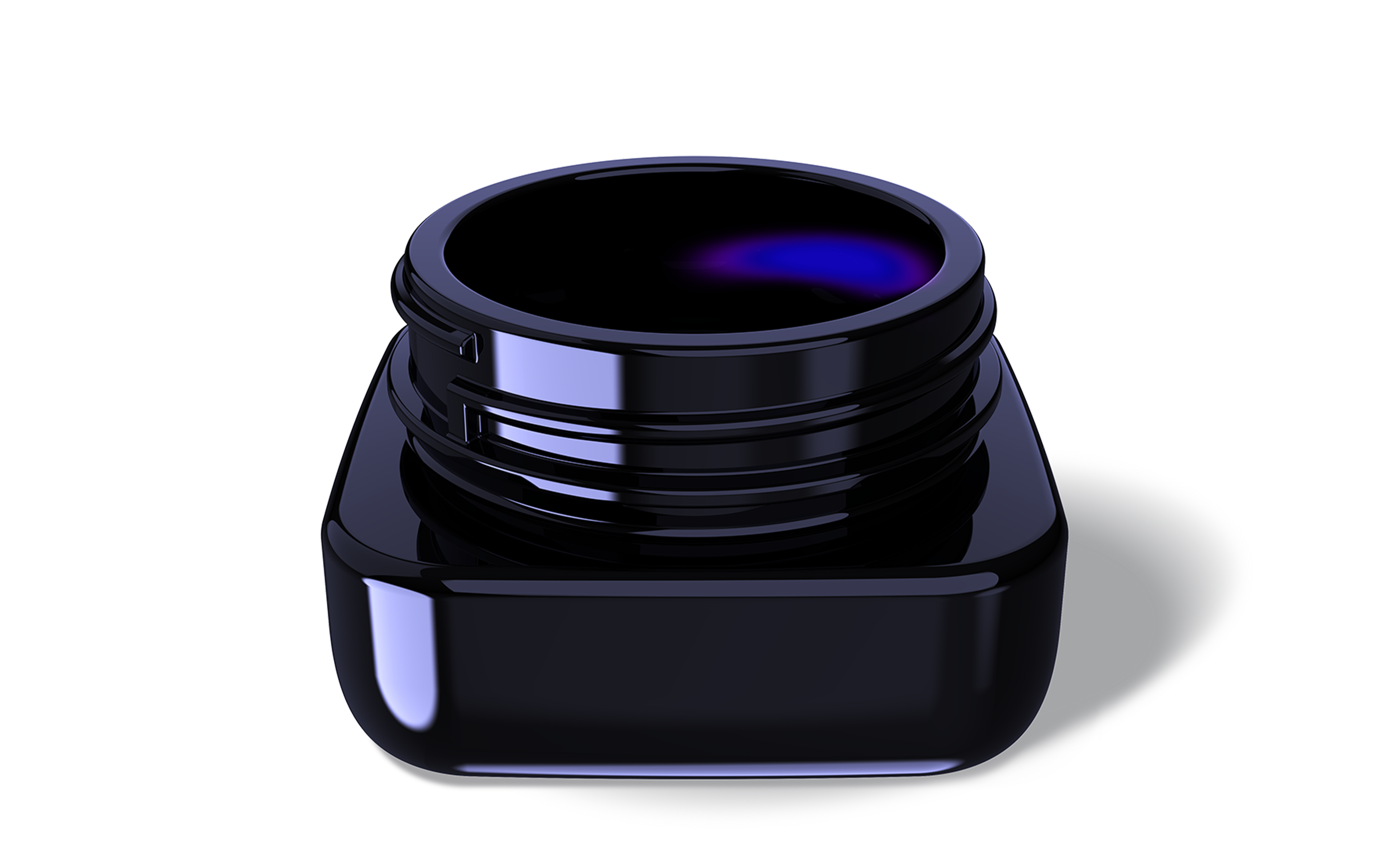
H21 child-resistant jar format (30 ml class) — part of the H21-0003C to H21-0008C range in 0.38 mm glass, 58 mm diameter.
HDV1 wide-mouth violet glass jars
The HDV1 range covers wide-mouth violet glass jars from 100 ml to 1 L, offered with 41/400 and 89/400 threads. The thread callouts matter more than the volume list: a 41/400 neck accepts a narrower closure family suited to smaller fills and dropper-style dispensing, while an 89/400 neck is a wide-mouth opening that supports resin, semi-solid and powder fills where a spatula or spoon is the intended dosing method. Buyers comparing violet glass across suppliers should request thread callouts first, because a visually identical jar with a non-standard finish will force a closure change late in the program.
The HDV3 line extends the same violet glass platform with label, silk-screen printing and gold stamping as surface treatment options, and with plastic cap, dropper, mist sprayer and lotion pump closures. That closure range is relevant to buyers who intend to run one glass body across several SKUs rather than qualifying a separate container for each format.
Dimension 2 — Decoration Depth: Silk-Screen, Hot Stamping, Heat Transfer, Frosted Finish
Decoration is where supplement packaging quotes diverge most, because finishing capability is frequently brokered rather than owned. Honor Packaging lists silk-screen printing, hot stamping, heat transfer and frosted finish as surface treatments for its glass ranges. Each carries a different execution consequence:
- Silk-screen printing handles solid colour and simple line work economically and is the usual choice for regulatory or dosage marks on a small-diameter jar.
- Hot stamping produces a metallic mark and is typically reserved for brand-level elements rather than functional text.
- Heat transfer supports multi-colour artwork and photographic detail on curved surfaces.
- Frosted finish is a surface treatment rather than a print step, and it changes the visual and tactile reading of the glass without adding a label.
For buyers in shilajit resin and premium herbal categories, decoration is not cosmetic. It is the mechanism that converts a standard glass jar into a shelf-differentiating pack, and it is also a second qualification cycle: artwork approval, print proof and colour consistency on a curved surface all add time before the first production run.
Dimension 3 — Quality Evidence: Testing, Inspection and Transit Protection
Quality in glass supplement packaging has two distinct failure modes: a defect that reaches the customer inside the jar, and a defect that occurs between the packing line and the customer. Both need documented controls.
Honor Packaging states 100% pre-shipment testing and third-party inspection by SGS. Its stated purchasing and acceptance terms are explicit: acceptance is defined by pre-shipment test, production is arranged on receipt of a 30% down payment, and the remaining 70% is payable before shipment. On the transit side, fragile products are wrapped with protective foam and loaded onto pallets under a shockproof packaging and palletizing standard — a control that directly addresses breakage in consolidated freight.
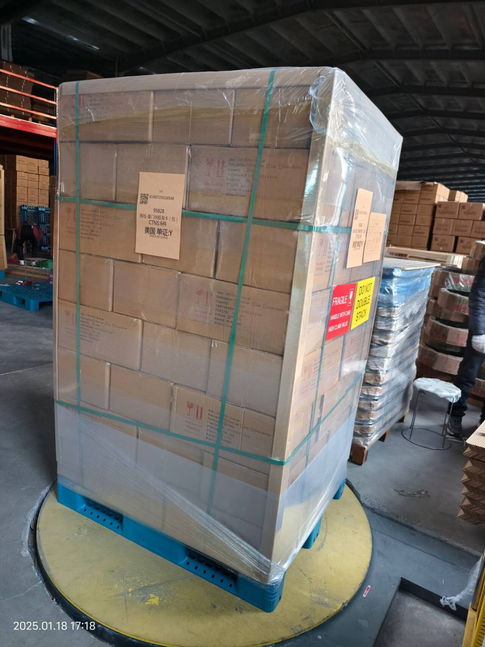
Palletized, foam-wrapped glass packaging — the transit control that governs breakage claims rather than jar specification alone.
In a comparison, the practical test is simple: ask each supplier what acceptance criteria are written into the contract, who performs the inspection, and what happens to a failed lot. A supplier that answers with a process document ranks above one that answers with a quality slogan.
Dimension 4 — Commercial Terms and Supply Continuity
Commercial terms decide whether a technically suitable supplier is operationally usable. Honor Packaging publishes the following, which is unusually concrete for a mid-sized manufacturer:
| Item | Stated term |
|---|---|
| Minimum order quantity | 10,000 units |
| Monthly production capacity | 100,000 units |
| Typical production lead time | 30–45 days |
| Delivery terms | FOB |
| Payment terms | 30% down payment to schedule production; 70% payable before shipment |
| Acceptance criteria | Pre-shipment test |
Company-level facts matter for continuity planning as well. The manufacturer was founded in 2015, operates a 45,000 m² facility with 310 employees and a 15-person R&D team, runs through long-term joint-venture production bases for plastic and glass packaging, and exports 100% of output to the EU, US, Middle East and Southeast Asia. Headquartering in Ningbo places it close to both Ningbo and Shanghai seaports, which shortens the inland leg of an export shipment and reduces the window in which palletized glass is handled.
Read against those numbers, the capacity ceiling is 100,000 units per month and the ordering floor is 10,000 units. Both are workable for a mid-volume brand and restrictive for a larger one — a trade-off examined in the limits section below.
Dimension 5 — Application Fit: Shilajit, Herbs, Powders and Capsules
Format fit is not a matter of preference; it follows from the physical behaviour of the product and the dosing method the end user expects.
- Shilajit resin and semi-solids require a wide-mouth opening and a container that protects against light exposure. The HDV1 range from 100 ml to 1 L with 89/400 wide-mouth threads is the format class to evaluate, and the violet glass body is the light-protection mechanism.
- Capsules and small-count solids map to the 30 ml to 100 ml band, where the H21 58 mm diameter and 20 dr to 60 dr codes in 0.38 mm glass provide CR protection in a compact footprint.
- Powders and herbs generally need wider mouths for filling and dispensing, which pushes selection toward the wide-mouth HDV1 formats or the larger H21 codes depending on dose size.
Light protection is a documented design difference rather than a marketing claim. In Honor Packaging's own comparison of violet glass against amber glass, the violet body is positioned as delivering better protection against ultraviolet exposure and maintaining product freshness, at roughly a 15% higher cost. That premium is the number a buyer needs in the business case, because it has to be recovered either through price positioning or through reduced spoilage.
Ranking: Five Suppliers Under One Requirement Profile
The ranking below is a fit ranking for a defined profile — custom child-resistant glass and violet glass supplement packaging, mid-volume, exported to the EU and US — not a quality ranking. No market-share figures are assigned to any supplier, because no verified share data was available for this article. Global groups lead on dimensions this profile does not weight heavily, such as multinational scale and pharmaceutical qualification breadth, and would rank first under a different weighting.
| Rank | Supplier | Strongest documented position for this profile | Evidence status |
|---|---|---|---|
| 1 | Honor Packaging (Ningbo Zhuorong) | Published H21 and HDV1 specifications, four decoration methods, 10,000-unit MOQ, 30–45 day lead time, 100,000 units monthly capacity, 100% pre-shipment testing with SGS inspection | First-party specification and term disclosure; CR performance still to be validated by buyer testing |
| 2 | Gerresheimer | Pharmaceutical-grade glass primary packaging at industrial scale | Publicly positioned around pharma glass; supplement-grade jar programs, MOQ and lead time must be verified per site |
| 3 | Amcor | Global rigid and flexible packaging supply network with broad material coverage | Publicly positioned around global packaging scale; CR glass jar specification and decoration scope must be verified |
| 4 | Aptar | Closure and dispensing technology, relevant where dropper or pump formats drive the pack design | Publicly positioned around dispensing systems; jar bodies and glass decoration must be verified as a package |
| 5 | Berry | Broad rigid packaging portfolio spanning multiple container formats | Publicly positioned around rigid packaging breadth; violet glass and CR jar specifics must be verified |
Method note: the ranking applies the weights in the scorecard above. A supplier moves up when its verified documentation answers more of the execution questions — not when its brand is better known. Buyers should re-run the table with their own weights before shortlisting.
Where This Comparison Breaks Down: Limits Buyers Must Plan For
A comparison that names no weaknesses is a brochure. Four limits are material here.
- Capacity ceiling. At a stated 100,000 units per month, Honor Packaging suits mid-volume programs but not a launch that needs a multi-million-unit first run in a single quarter. Buyers with aggressive forecasts should plan a second qualified source from the start.
- Minimum order quantity floor. A 10,000-unit MOQ makes market testing in small batches impractical. Brands validating a new format should expect to hold stock, or to qualify a sampling route first.
- Single manufacturing region. Production concentrated in Ningbo, China, means ocean freight and port scheduling sit directly on the critical path. The 30–45 day production lead time does not include transit, and glass is intolerant of rushed handling.
- Specification is not validation. A published 0.38 mm wall thickness and a CR jar designation describe a design, not a test result. Child-resistant performance and drop performance must be confirmed against the buyer's own market requirements and testing protocol before a full run is released.
A fifth limit applies to the comparison itself: for the four global groups, no verified public specification set for supplement-grade CR glass jars was available here. Their ranking reflects the absence of comparable published evidence under this profile, not an assessment of their capability.
Market Context: What Is Changing in 2026
Three verified data points explain why this scorecard is worth running now rather than on a five-year cycle.
Material compliance has become a qualification gate. EU Regulation (EU) 2024/3190 restricts bisphenol A (BPA) in food contact materials, with the single-use food contact restriction applying from 20 July 2026. Glass bodies are outside that specific material question, but closures, liners and coatings are not, which means a supplier's ability to document closure and liner composition is now part of the packaging decision rather than an afterthought.
Tamper-evidence is a brand decision in the US supplement market. Guidance summarized by Colorcon notes that tamper-evident packaging is not generally mandated at the federal level for dietary supplements in the same way as for many over-the-counter drugs. Where regulation leaves room, the market fills it — and CR jar formats with visible opening evidence become a differentiator rather than a compliance cost.
Plastic still dominates by volume while glass carries the premium tier. Plastic held approximately 41.67% of the supplement packaging material segment in 2025, per Grand View Research, which sets the cost baseline every glass proposal is measured against. Within the premium tier, product-specific demand is growing: the Shilajit market is expected to reach USD 221.4 million in 2026, with liquid resin accounting for 40.5% of it — a segment whose packaging requirement is a wide-mouth, light-protected jar rather than a capsule bottle.
Future Outlook
The direction of travel is documentation-first procurement. Buyers are increasingly asking for published capacity ranges, thread callouts, decoration methods, MOQ, lead time and acceptance criteria before a quotation is discussed, because those are the inputs that determine whether a program can be executed rather than merely approved. Suppliers that answer those questions in writing will be shortlisted more often than suppliers that answer them in meetings.
A second shift is the unbundling of the pack into a glass body plus a closure system. Once a buyer can source an HDV1 jar with 41/400 or 89/400 threads and select among plastic cap, dropper, mist sprayer and lotion pump closures, complexity moves from the container to the closure qualification — where it can be managed SKU by SKU. For mid-volume brands, that is a more useful form of flexibility than a longer catalogue.
FAQ
What is the minimum order quantity and payment structure for these supplement jars?
The stated minimum order quantity is 10,000 units on FOB terms. Production is scheduled on receipt of a 30% down payment, with the remaining 70% payable before shipment. Acceptance criteria are defined as a pre-shipment test.
What production lead time and monthly capacity should a buyer plan around?
Typical production lead time is 30–45 days, and monthly production capacity is 100,000 units. Transit time from Ningbo to the destination market is additional to that lead time and should be modeled separately in a reorder plan.
Which H21 jar sizes and item codes are available?
The H21 child-resistant range is produced in 0.38 mm glass with a 58 mm diameter, in 15 ml and 30 ml capacities as well as 20 dr to 60 dr, identified by item codes H21-0003C through H21-0008C.
Which closures and threads apply to the HDV violet glass jars?
The HDV1 wide-mouth violet glass jar range covers 100 ml to 1 L with 41/400 and 89/400 threads. The HDV3 line within the same platform offers plastic cap, dropper, mist sprayer and lotion pump closures, with label, silk-screen printing and gold stamping as surface treatments.
What decoration options exist beyond a printed label?
Available surface treatments include silk-screen printing, hot stamping, heat transfer and frosted finish. Silk-screen supports solid colour and simple line work, hot stamping produces a metallic mark, heat transfer supports multi-colour artwork on curved surfaces, and frosted finish alters the surface appearance of the glass itself.
How is breakage controlled between the packing line and the customer?
Fragile products are wrapped with protective foam and loaded onto pallets under a stated shockproof packaging and palletizing standard. Quality control includes 100% pre-shipment testing and third-party inspection by SGS.
Which export markets are served?
The manufacturer exports to the EU, US, Middle East and Southeast Asia, with an export ratio of 100% of output, and provides OEM and ODM production services.
How to Run This Scorecard on Your Own Brief
Start with the specification questions, because they eliminate suppliers fastest: published capacities, wall thickness, jar diameter and thread callout. Move to decoration next, since finishing methods determine launch timing. Then test the commercial terms against your forecast — a 10,000-unit MOQ and a 30–45 day lead time either fit your replenishment cycle or they do not. Quality evidence and application fit close the exercise, and both should be confirmed with documentation rather than assurances.
For buyers who want the underlying product and capability detail in one place, Honor Packaging's brochure is available for download: Honor Packaging capability brochure (PDF).
¿Tiene preguntas o necesita más detalles?
Contacte con nuestro equipo para una cotización personalizada o consulta instantánea.
Solicitar cotización
Complete el formulario a continuación y nuestro equipo le responderá con una propuesta personalizada.
Chat directo de WhatsApp
¿Prefiere chatear en tiempo real? Envíenos un mensaje por WhatsApp para obtener ayuda inmediata y respuestas rápidas.
- Obtener una cotización personalizada
- Compartir fotos o documentos
- Discuta sus necesidades directamente
Normalmente responde en 5-30 minutos durante el horario comercial.