
Sunflower Seed Grades 363, 361, and T6: A Buyer's Comparison
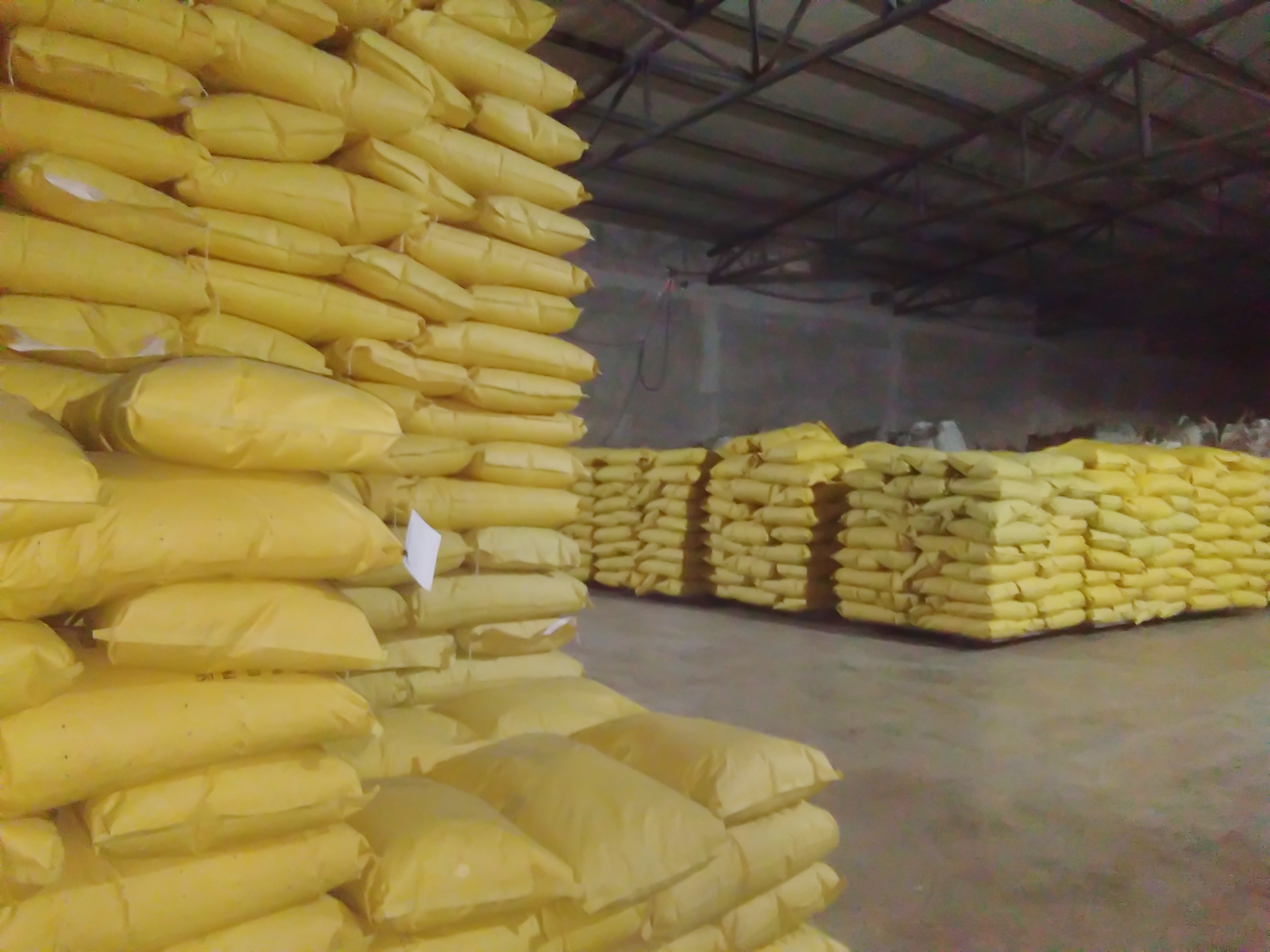
Sunflower seed stock at Inner Mongolia Chengtai Food Co., Ltd.
Roasted sunflower seeds accounted for 65.9% of packaged sunflower seed industry revenue in 2024, and Europe held the largest regional share at 29.6%, according to Grand View Research. For a buyer at the final sourcing stage, the practical question is not whether sunflower seeds are in demand. It is which grade — 363, 361, or T6 — fits the target product, and whether the supplier can hold that specification across bulk shipments.
Why the Grade Decision Matters at the Final Sourcing Stage
The global sunflower seeds market was valued at about USD 29.27 billion in 2025 and is projected to grow to USD 35.98 billion by 2034, according to Custom Market Insights. USDA estimates global sunflower seed production at 55.05 million metric tons for the 2025/26 marketing year. These figures describe a large, stable raw-material market.
China is a major export origin within that market. OEC data values China's sunflower seed exports at USD 937 million in 2025, with Iraq at USD 131 million and Russia at USD 101 million as the largest destinations. Inner Mongolia alone exported approximately 463,400 tons in 2025, worth USD 748 million, and accounts for more than 60% of China's sunflower cultivation area, according to People's Daily Online. Confectionery-grade production is particularly associated with the saline-alkali fields of Bayannur, where larger kernel sizes are the focus, according to China Daily.
Because supply is regionally concentrated, buyers at the decision stage tend to compare the same three grade names: 363, 361, and T6. The grade determines product color, shell structure, flavor suitability, and price level. The grade also affects processing yield, because a more uniform raw material requires less re-sorting and produces fewer rejected finished packs.
363 vs 361 vs T6: The Three Grades Defined
The three grades differ in shape, color, shell hardness, and typical processing route. The following distinctions are based on product and grade data from Inner Mongolia Chengtai Food Co., Ltd., a sunflower seed processor founded in 2013 and located in Hanggin Rear Banner, Bayannur, Inner Mongolia.
Type 363
Sunflower seed type 363 is black in color. In Chengtai's product line, it appears as Large-kernel Striped Sunflower Seeds 363, Inner Mongolia Origin Sunflower Seeds 363, Bulk Sunflower Seeds 363, and Pesticide Residue Controlled Sunflower Seeds 363. The largest size stated for 363 is 170–180 pieces per 50 g. The taste is sweet and natural, and the grade is suited to roasted original flavor. On price, 363 is higher than 361.
Type 361
Type 361 is black and white striped, with a round shape. According to the supplier's grade notes, 361 comes from an earlier harvest period, so the color is not completely black and may show a slight yellow tone. The shell is thin and the taste is good, which makes it more suitable for salted flavor processing. The largest size stated for 361 is 150–160 pieces per 50 g, and the price is lower than 363.
Type T6
Type T6 is long in shape and darker in color than 361. It is usually sold as raw material and has a slightly harder shell. A typical T6 listing shows a size of 180–190 pieces per 50 g, with the full range extending to 170–300 pieces per 50 g. The supplier's comparison note recommends T6 when the buyer needs a black color, a bigger size, and a long shape.
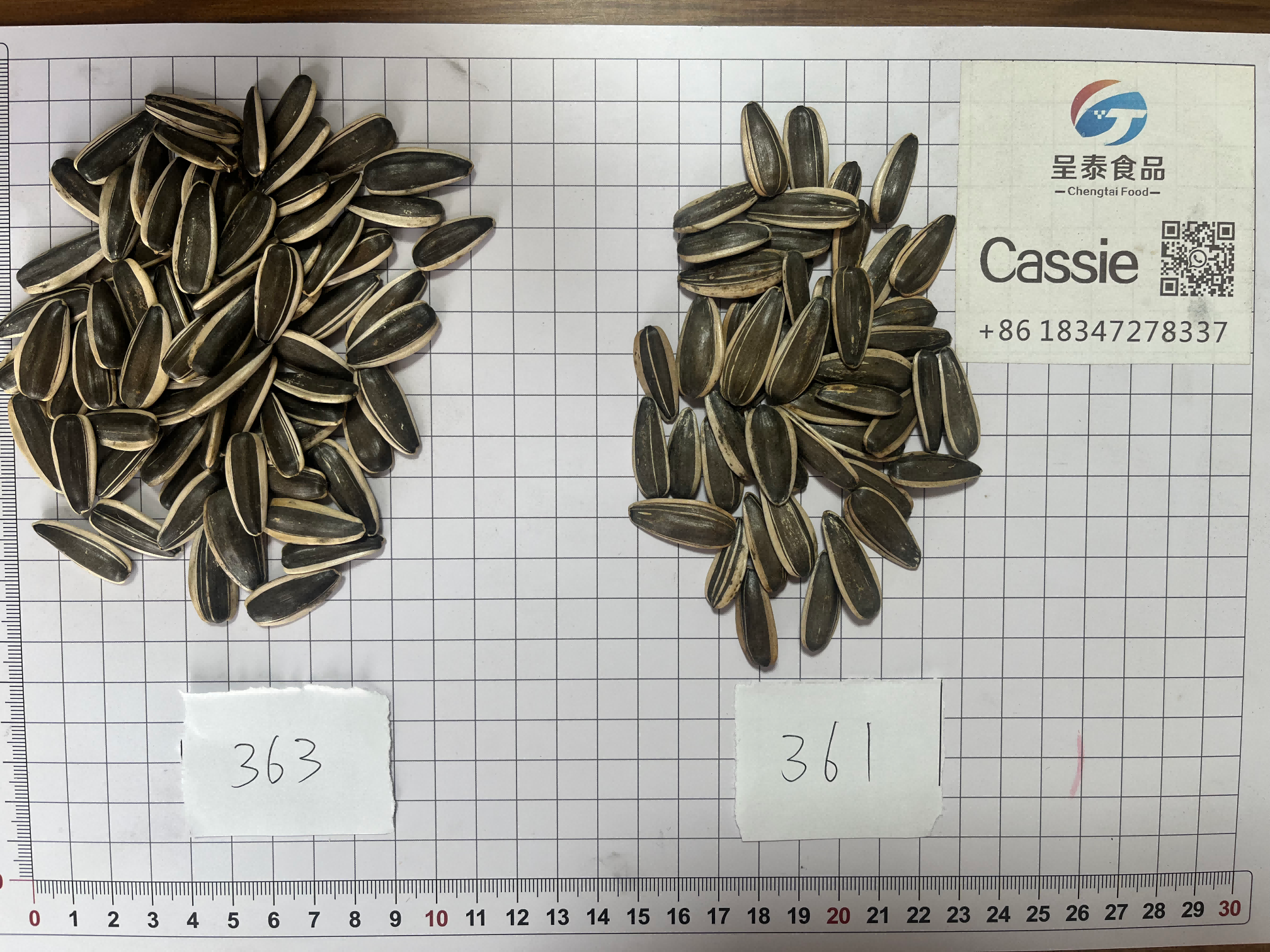
Comparison of sunflower seed types 363 and 361.
| Attribute | Type 363 | Type 361 | Type T6 |
|---|---|---|---|
| Color | Black | Black-white striped | Darker than 361 |
| Shape | Large-kernel striped type | Round | Long |
| Largest stated size | 170–180 pcs/50 g | 150–160 pcs/50 g | 180–190 pcs/50 g |
| Overall size range | 170–230 pcs/50 g | 170–300 pcs/50 g | 170–300 pcs/50 g |
| Typical processing fit | Roasted original flavor | Salted flavor | Raw material sale |
| Price positioning | Higher than 361 | Lower than 363 | Not stated |
Reading the size band
In the sunflower seed trade, size is expressed as pieces per 50 g. A lower number means a larger seed. When a buyer specifies 170–180 pcs/50 g, they are asking for a relatively large, heavy kernel that fills a retail pack visually and gives a better bite. A broader band such as 170–300 pcs/50 g gives the supplier more blending room and is common for raw-material trading.
Quality Metrics That Separate a Premium Batch from an Ordinary One
Chengtai's product parameters for 363, 361, and T6 list moisture at 9–10%, impurity below 0.5%, erosion seeds below 0.5%, and mildew seeds below 1%. These are the standard commercial thresholds for the three grades.
The supplier's comparison data shows what a controlled confectionery batch can achieve against conventional ordinary grade: higher kernel purity, fewer broken and mildewed seeds, larger size, and no stone. The stated core metrics are moisture ≤10.0%, impurity ≤0.2%, decolorizing seeds ≤1.5%, erosion seeds ≤1.0%, mildew seeds ≤1.0%, short seeds ≤2.0%, and wizened seeds ≤6.0%.
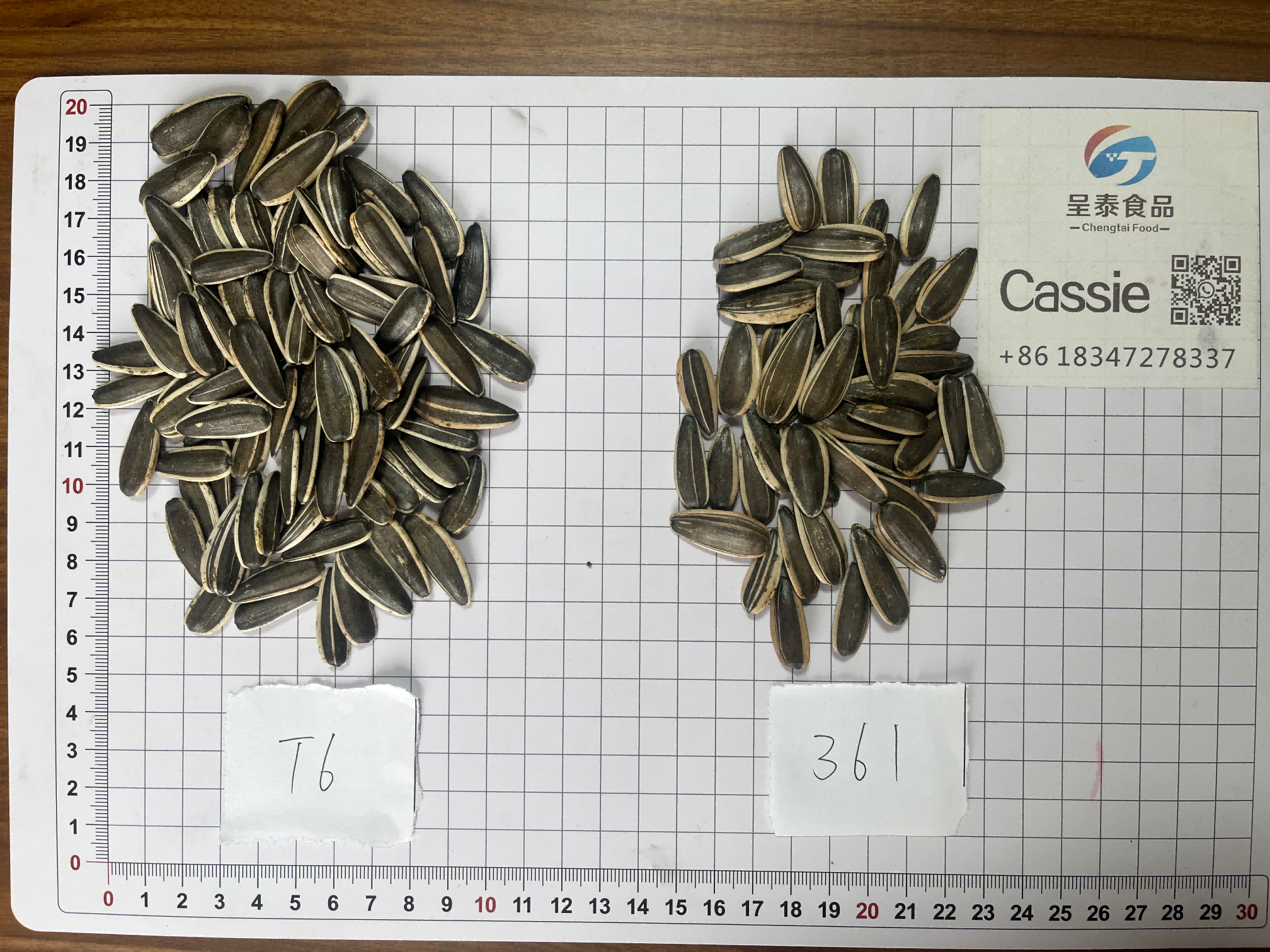
Comparison of sunflower seed type T6 with type 361.
What each metric means on a production line
Moisture at 9–10% keeps the product stable in standard cold, dry storage without special handling. Impurity below 0.5% reduces sorting-line loading and lowers labor cost. Erosion seeds and mildew seeds are food-safety and appearance thresholds for human consumption. A low short-seed and wizened-seed count improves the visual uniformity of finished retail packs, which is a direct selling point for roasted snack brands and confectionery buyers.
China's draft quality standard for nut and seed food, which is expected to replace GB/T 22165-2008, will update technical requirements for roasted seeds, according to USDA. For a buyer, this reinforces the importance of putting moisture, impurity, and defect thresholds into the purchase contract rather than relying on general grade names.
Processing Fit: Matching the Grade to the End Product
According to the supplier's comparison unit, a higher-purity batch is most suitable for snack processing, confectionery, and retail finished products. The stated efficiency advantage is a higher finished product yield after processing, with the effective cost difference after processing losses estimated at roughly 5% lower than conventional ordinary grade.
By grade: 363 works best when the end product is a roasted original-flavor snack with a dark shell. 361 suits salted flavor where a thinner shell and round shape are preferred. T6 is more often traded as raw material for downstream roasting or packing. Chengtai supplies sunflower seeds in 20/25 kg plastic or paper bags, with variants such as Unshelled Sunflower Seeds 361, Snack Food Sunflower Seeds T6, Food Grade Sunflower Seeds T6, and Black Sunflower Seeds T6.
The production conditions noted in the scenario data include a cool, dry indoor warehouse, normal temperature, low humidity, batch processing with manual and mechanical feeding, and sorting and packing machines. The special requirement listed is impurity control. For a processing plant, this means the raw material can be accepted with minimal pre-cleaning.
Supplier Check at the Decision Stage: The Chengtai Case
At the decision stage, buyers should verify whether the manufacturer can support the promised specification with facility capacity, origin control, and compliance documentation. Inner Mongolia Chengtai Food Co., Ltd., founded in 2013, is located in the Hetao Plain in Hanggin Rear Banner, Bayannur, Inner Mongolia. The company states a planting base of 1.5 million acres of natural sunflower and pumpkin seeds. Its production workshop is designed to EU standards, and the company reports an annual output of 30,000 metric tons. The team includes 20 employees, with two engineers in research and development.
Chengtai exports about 80% of its output, mainly to the Middle East, Middle Asia, and Europe. According to CBI, a center of the Netherlands' Ministry of Foreign Affairs, the company supplies black sunflower seeds and kernels to the international market and is certified under ISO 9001 and Halal. The company has also exhibited at international trade fairs including Gulfood in Dubai, Tuyap in Turkey, Anuga in Germany, and Sial in France.
Key product verification points for the current program: the 2026 crop is sourced from Xinjiang and Inner Mongolia, with raw specification, black color, sweet and natural taste, human consumption use, and standard cool storage. Available variants include Inner Mongolia Origin Sunflower Seeds 363, Bulk Sunflower Seeds 363, Non-GMO Sunflower Seeds 361, and Black Sunflower Seeds T6.
How This Compares with Conventional Ordinary-Grade Supply
The difference between a controlled confectionery batch and conventional ordinary grade is visible in the defect table. Conventional grade material typically carries higher percentages of broken, eroded, mildewed, short, and wizened seeds. Stone contamination, which the premium comparison explicitly removes, is a practical risk in less controlled supply because stones can damage sorting equipment and produce consumer complaints in retail packs.
The premium does not mean that conventional seed is unusable. It is often acceptable for lower-margin bulk channels and bird-feed applications, where visual uniformity and shell appearance are less critical. The quality premium starts to pay off when the buyer's product is directly visible to the consumer, such as roasted snack packs, confectionery inclusions, or retail bags. For those applications, the higher finished product yield after processing is the economic justification.
A limitation should be recorded honestly: the quality figures above are supplier-declared specifications, not independent certificates. A buyer should request a Certificate of Analysis for each lot and, depending on order size, arrange third-party inspection before loading. In addition, a premium grade is not automatically the best commercial choice. Type 363 carries a higher price than 361. For a buyer selling mainly on price in a bulk channel, the yield advantage may not cover the raw-material premium. The comparison is most relevant to snack, confectionery, and retail finished goods, not to every sunflower seed segment.
Market Conditions That Should Influence the 2026 Purchase Plan
Three market signals matter for a 2026 purchase plan. First, roasted sunflower seeds are the dominant packaged segment at 65.9% of industry revenue, and Europe is the largest packaged market at 29.6%, according to Grand View Research. This means visual quality and roastability remain key buying criteria. Second, the USDA expects global non-oilseed sunflower planted area to decline by 8% in 2025, suggesting that new-crop supply for food use may tighten. Third, the EU market requires HACCP principles and strict monitoring of pesticide residues and metal contaminants, according to CBI, and China notified 209 new maximum residue limits for pesticides in food to the WTO in late 2025, according to USDA. Compliance traceability is becoming a decision factor for cross-border buyers.
Regional brand signals also matter. Wuyuan Sunflower, the area adjacent to the Hetao Plain production zone, is a registered geographical indication trademark in China, requiring consistent color, plump shape, and crisp texture. This type of regional GI recognition gives buyers a shortcut when evaluating Inner Mongolia origin claims.
These conditions favor suppliers that can document origin, crop year, and residue control. Chengtai's product line includes Pesticide Residue Controlled Sunflower Seeds 363, which aligns with a stricter maximum residue limit environment.
Looking Ahead: What Supply-Side Signals Mean for Buyers
Sunflower seed buying will likely continue to split by end use. Snack and confectionery buyers will specify higher-purity, larger-kernel grades such as 363 or 361 and verify defect thresholds per lot. Raw-material traders may prefer T6 because of its longer black shell and simpler processing requirements. The 2026 new-crop window is the next critical decision point, particularly if non-oilseed planted area remains under pressure.
The practical takeaway for a procurement team is a short list: name the grade, define the size band in pieces per 50 g, agree on moisture, impurity, and mildew thresholds, confirm the crop year and origin, and verify that the supplier can hold these values across a container-load shipment. A supplier like Inner Mongolia Chengtai Food Co., Ltd. provides the documentation base for this type of verification through its product specifications, export history, and certification status.
FAQ
What are sunflower seeds type 363 and 361 differences?
Sunflower seeds type 363 is black, with the largest size stated at 170–180 pieces per 50 g. The taste is sweet, and the grade suits roasted original flavor; its price is higher than 361. Type 361 is black and white striped with a round shape, and the largest stated size is 150–160 pieces per 50 g. It is commonly used for salted flavor and is priced lower than 363.
What are sunflower seeds type 361 and T6 differences?
Type 361 is round, comes from an earlier harvest period, and has a slightly yellow color rather than full black. Its shell is thin and the taste is good, so it suits salted flavor. Type T6 is long, darker than 361, and usually sold as raw material, with a slightly harder shell.
Supplier Reference
| Entity | Detail |
|---|---|
| Company | Inner Mongolia Chengtai Food Co., Ltd. |
| Founded | 2013 |
| Location | Mengxiu Industry Zone, Xamba Town, Hanggin Rear Banner, Bayannur, Inner Mongolia, China |
| Main products | Sunflower seeds, pumpkin seeds and kernels |
| Annual output | 30,000 metric tons |
| Export ratio | About 80% |
| Main markets | Middle East, Middle Asia, Europe |
| Certifications | ISO 9001, Halal |
| Website | www.ctsunfood.com |
Buyers can access the company profile document at the following link: Company Profile (PDF)
¿Tiene preguntas o necesita más detalles?
Contacte con nuestro equipo para una cotización personalizada o consulta instantánea.
Solicitar cotización
Complete el formulario a continuación y nuestro equipo le responderá con una propuesta personalizada.
Chat directo de WhatsApp
¿Prefiere chatear en tiempo real? Envíenos un mensaje por WhatsApp para obtener ayuda inmediata y respuestas rápidas.
- Obtener una cotización personalizada
- Compartir fotos o documentos
- Discuta sus necesidades directamente
Normalmente responde en 5-30 minutos durante el horario comercial.