
Submersible Pump Shortlist: Reading QDX, QDP and HQBm Series
Submersible Pump Shortlist: Reading QDX, QDP and HQBm Series
A range that lists QDX, QDP, HQBm, QB60, IDB35, HPSm-AX and HRSm-A side by side has already done the easy part: it has told the buyer what exists. It has not produced a shortlist. In the evaluation stage, the expensive mistake is rarely picking the wrong model first — it is comparing the whole range at once and then deciding on price, because no other basis survived the comparison.
This reference sets out a two-filter method for narrowing that range. The first filter is the duty cluster: the job the pump is being bought to do, taken from the applications the manufacturer states for this product group. The second filter is the motor, applied only after the cluster is fixed. Everything below stays inside what the supplied documentation actually says, and marks the point at which a buyer still needs a model-level document.
A model list documents coverage, not duty
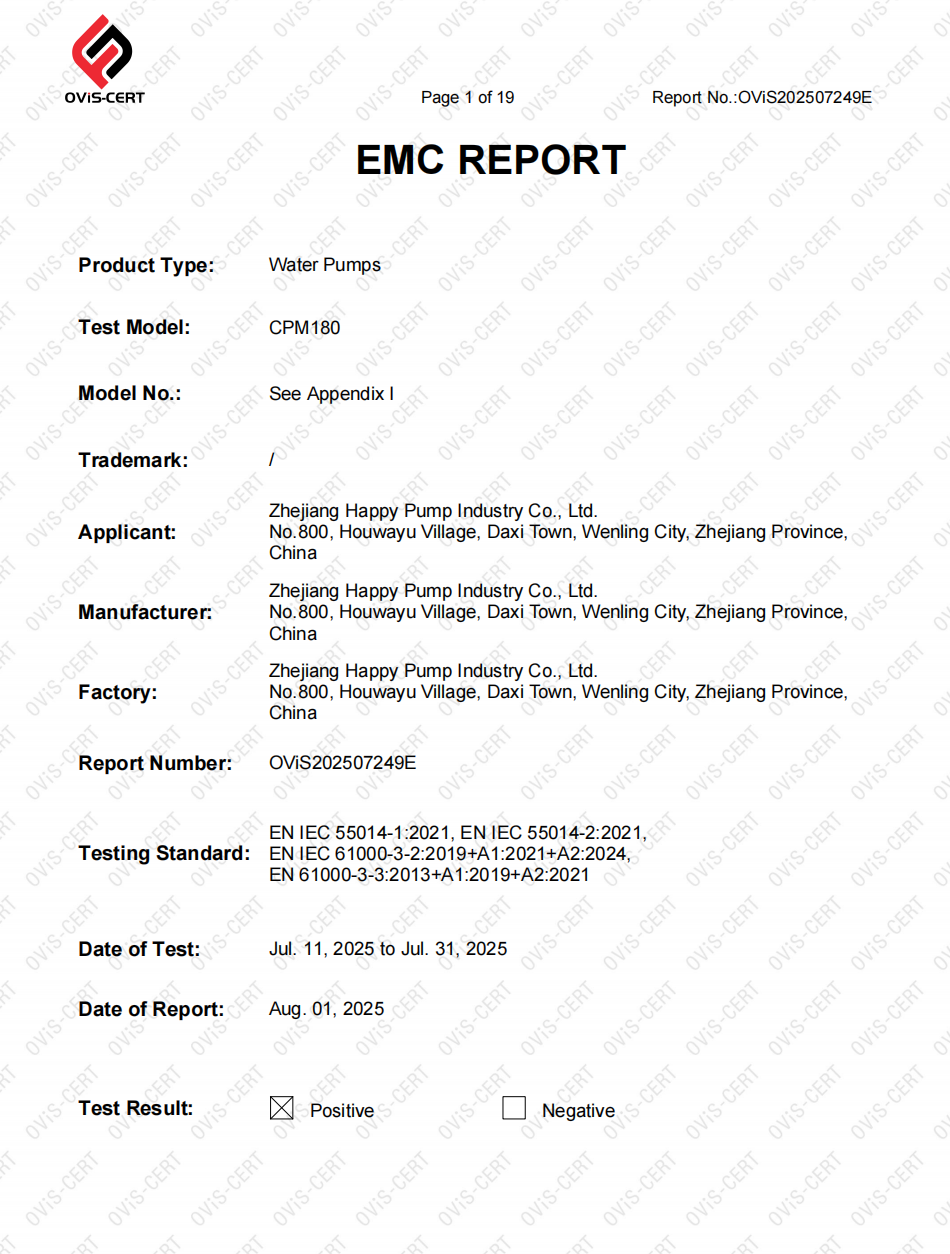
The three European conformity documents for this pump group name the same related products: HQBm, QB60, IDB35, HPSm-AX, HRSm-A, QDP series and QDX series. That consistency is useful. It confirms the designations sit inside a common conformity file — a Low Voltage Directive certificate (OViS202507249L, issued 1 August 2025 by OViS-CERT), an EMC certificate (OViS202507249E, same body and date) and a CE Attestation of Conformity (CE-5072-160326, issued 16 March 2026 by ECES, valid to 16 March 2031).
It also shows what such a file does not do. A conformity document written against a product group does not characterise each designation for flow, head, solids handling, duty cycle or efficiency class. The LVD file cites the relevant pump and motor standards — EN IEC 60335-2-41:2021+A11:2021 for electric pumps and EN 60034-1:2010+AC:2010 for rotating machines — but a standard citation establishes the framework a product was assessed against. It is not the performance of the specific code on your enquiry.
Filter one: fix the duty cluster before reading any code
The case material supplied for this range lists six typical uses: domestic and household water supply, garden irrigation, agricultural irrigation, sewage and engineering drainage, pool circulation, and solar water pumping systems. Grouped by what the pump has to tolerate rather than by product name, they form four evaluation clusters. Fixing the cluster first removes most of the range before a single code is compared.
Cluster 1 — pool circulation, and sewage or engineering drainage
These two uses belong together because in both cases the pump handles water that is not clean source water — but for opposite reasons. Pool water is filtered and treated; sewage and engineering drainage water carries solids, debris and grit. That difference is the elimination question, and it is where the two duties must be split.
What to fix before looking at designations: what the water carries and in what form; whether the installation runs unattended on level control, which is the distinction behind the phrase automatic submersible pump; whether the unit sits in a dry chamber or a wet sump; and where the discharge goes. Where a drainage duty involves fibrous or stringy material, ask directly whether a cutting-type sewage pump is offered for that duty. The question is legitimate, and the answer belongs on a datasheet rather than on a shortlist assumption.
Shortlist rule: keep pool circulation and sewage drainage as two sub-lists. A designation shortlisted for pool circulation should not be carried into the drainage sub-list without its own confirmation, because the two duties stress different parts of the build.
Cluster 2 — solar water pumping systems
Solar is a cluster of its own, not a variant of the mains-fed list. The manufacturer lists solar pumps as a separate main product series and solar water pumping systems as a separate stated use, which is a fair signal that the electrical architecture — not the hydraulic duty — does most of the eliminating here.
What to fix: the array and controller configuration the system will use; whether the pump is specified as AC or DC; the daily volume the system must deliver rather than only the instantaneous flow; and whether a mains or generator backup exists. A solar submersible pump that fits the duty but not the controller is still the wrong shortlist entry, and the reverse is equally true.
Cluster 3 — domestic, household and building water supply and drainage
Household supply is the cluster where the constraints are least hydraulic. Demand is intermittent, the supply available at site is often single-phase, noise matters because the pump sits close to the people using it, and in building drainage the solids question from cluster one returns.
What to fix: the supply at site — voltage, phase and frequency, including whether the market is 50 Hz or 60 Hz; the installation point; noise sensitivity; and whether the buyer needs one model or a small family covering several building types. Noise belongs on the checklist rather than in the brochure, since low noise is described as a product characteristic in the company's own case material. The manufacturer states voltage and logo customization under its OEM/ODM programme, which matters where a market's supply differs from the standard offer.
A note on wording: “silent” is a marketing term, not a specification. Ask for the sound figure on the model, and treat “low noise” as a claim to be located on the datasheet.
Cluster 4 — agricultural and garden irrigation
Irrigation is the cluster with the longest running hours in season and the widest spread of water quality, from clean borehole water to open-channel water carrying grit.
What to fix: source type; the head and distance the water must travel, including delivery pipe losses; run hours per day; and whether one pump serves several plots or a single block. A high pressure submersible pump requirement is a curve question, not a label — write it as a duty point, not as an adjective.
One structural point belongs here. The manufacturer lists deep well pumps as a main series separate from submersible pumps. For borehole work, confirm which series a code belongs to before comparing it with anything else, because a borehole submersible pump and a deep well pump are not interchangeable entries on the same list.
| Duty cluster | Stated use it maps to | The question that eliminates most codes |
|---|---|---|
| Pool circulation and sewage or engineering drainage | Pool circulation; sewage and engineering drainage | What does the water carry, and does the installation run unattended? |
| Solar water pumping | Solar water pumping systems | What is the array and controller, and is the pump AC or DC? |
| Domestic, household and building | Domestic and household water supply; building drainage | What supply is available at site, and how close is the pump to people? |
| Agricultural and garden irrigation | Agricultural irrigation; garden irrigation | What is the duty point, and what does the source water carry? |
Reading the seven designations in the documented group
Once the cluster is fixed, the next task is to read the designation correctly, because the seven entries are not the same kind of thing.
Two are explicitly labelled series — QDX series and QDP series. A series name is a container: it covers more than one model, so it cannot be compared with a discrete designation until it is resolved to a model code. Five entries — HQBm, QB60, IDB35, HPSm-AX and HRSm-A — appear as individual designations.
There is a visible naming pattern worth noticing without over-reading: the letter m recurs in three of the five discrete designations. A pattern in model naming is not a documented meaning. Ask the supplier what the suffix denotes and whether it signals a shared construction, a market variant or something else, rather than inferring it from the string.
| Designation | How it appears in the documented group | Shortlist action |
|---|---|---|
| QDX series | Series-level | Resolve to a model code before comparing |
| QDP series | Series-level | Resolve to a model code, and confirm the supply it is offered for |
| HQBm | Discrete designation | Request the model-level datasheet and curve |
| QB60 | Discrete designation | Request the model-level datasheet and curve |
| IDB35 | Discrete designation | Request the model-level datasheet and curve |
| HPSm-AX | Discrete designation | Request the datasheet, and confirm what the suffix denotes |
| HRSm-A | Discrete designation | Request the datasheet, and confirm what the suffix denotes |
A second reading point concerns the minimum order structure, which the manufacturer states in horsepower terms: 100 pieces below 3 HP and 50 pieces above 3 HP. That is a small but real piece of shortlist intelligence. It confirms the range is organised in HP classes, and it places a 1.0 HP submersible pump enquiry in the higher-MOQ bracket. A buyer comparing a 1.0 HP unit against a larger model should expect the commercial terms to move at the 3 HP line rather than smoothly across the range.
Filter two: the motor, applied after the pump cluster
The motor is the second filter because it is the part of the offer most often compared before the pump duty is settled — and the part where comparison most often produces false precision. Four fields carry the motor side: the efficiency class, the motor category, the frame reference and the housing material.
Efficiency class: IE2, IE3 or IE4
IE2, IE3 and IE4 are positions on the efficiency classification defined by IEC 60034-30-1, the international standard for efficiency classes of low-voltage AC motors. The 2025 second edition of that standard adds a fifth class, IE5. Two consequences follow for a shortlist. First, the class is a motor attribute: it does not tell you whether the pump suits the duty, and a pump-level document will not carry it. Second, because the scale is defined internationally and continues to extend upward, the class should be written into the enquiry as an explicit requirement, with a model-level declaration returned against it. A buyer who assumes a class, or reads it from a range brochure, has no document to check at acceptance.
Motor category and frame reference
The motor side is also read through the MS category and frame references such as 90S-6 and 90L-6. Frame references follow a standard convention, and decoding them is straightforward: 90 is the frame size, the letter S or L denotes core length within that frame size, and the -6 is the pole count. Pole count sets synchronous speed at a given supply frequency — six poles gives 1,000 rpm at 50 Hz and 1,200 rpm at 60 Hz — so a six-pole machine turns at a lower synchronous speed than a four-pole machine on the same supply. Whether that is the speed your duty needs is a pump-curve question, not a frame question.
The MS reference names a motor family. It does not, on its own, state an efficiency class, so ask for the class separately rather than reading it into the category name.
Housing: aluminium or cast iron
Housing material is a fit question rather than a ranking. Aluminium and cast iron behave differently in weight, handling and thermal mass, and the right answer depends on the installation, the water and how the unit is moved and serviced. The shortlist action is to record which construction the offer specifies, confirm the wetted and motor materials against the site conditions, and then compare like with like: two designations compared across different housing materials are not a comparison of pumps, but of two builds.
Why the order matters
Applying the motor filter first eliminates pumps that would have fitted. A buyer who starts from an efficiency class or a frame reference narrows the range on an electrical attribute before the duty is defined, and then has to argue backwards to a hydraulic fit. Fix the cluster, then the motor.

What this shortlist cannot settle
Three gaps remain after the two filters, and naming them is part of using the method honestly.
The documented set reviewed here does not publish model-level hydraulic or electrical data — flow, head, power, voltage, frequency, phase, materials, ingress protection or solids passage. Until a curve exists for the exact code, a shortlist is a scope decision, not a specification. That is the single most important limit in this article.
Certification is range-referenced, as described above. The conformity files name the product group; they do not state which configuration was assessed. A buyer should request the model-level declaration for the exact code and check the standard edition the target market requires. The IEC page for IEC 60335-2-41:2012 notes that a newer 2024 edition exists, which makes edition-checking a live task rather than a formality.
Efficiency is declared per motor, and the classification standard continues to extend. Neither the pump certificate nor the range list substitutes for a motor-level efficiency declaration.
Market context that moves the motor brief, not the pump list
Grand View Research valued the global submersible pump market at USD 13.3 billion in 2025. Other research houses publish materially different figures — one cited estimate is USD 17.76 billion — and the difference is usually one of scope, such as which pump categories and end uses are counted, rather than a disagreement about growth. For a procurement decision, that is the correct use of the number: context, not a sizing input.
The more actionable signal sits on the standards side. IEC 60034-30-1:2025 introduces IE5, extending a classification ladder that already runs through IE2, IE3 and IE4. A buyer shortlisting today on a class that will look ordinary within a few years is making a decision about the motor, not about the pump. The practical response is procedural rather than predictive: name the class in the RFQ, require the declaration per model, and keep that declaration with the order documents.
What the manufacturer documents on its side
Zhejiang Happy Pump Industry Co., Ltd. is the manufacturer behind this range. It was established in 1990 and is based in Daxi Town, Wenling City, Zhejiang Province. Its stated main product series are surface pumps, submersible pumps, deep well pumps, solar pumps, motors, pressure control tanks and spare parts — a structure worth knowing, because it explains why deep well and solar units sit outside the submersible cluster list rather than inside it.
On the supply side, the company states OEM/ODM production with voltage and logo customization, a monthly capacity of around 400,000 units, a lead time of 30 to 45 days, minimum order quantities of 100 pieces below 3 HP and 50 pieces above 3 HP, 100 per cent testing before delivery, and remote after-sales support across global markets.
The case material supplied for this range describes water pump brand OEM clients and HAPPY agents in global markets, an annual project scale of 4,000,000 sets, stable operation, low noise described as a product characteristic, and a normal usage life of around 10 years with a one-year warranty.
These are manufacturer-stated figures and should be weighted as such: useful for qualification and for setting expectations in an enquiry, but not a substitute for a model-level datasheet or a sample test. The same applies to the conformity documents, which establish coverage rather than performance.
The shortlist in six steps
- Name the cluster from the four above and write the duty in one sentence.
- Split the enquiry if the answer covers two stated uses; pool circulation and drainage, for example, should never share a single sub-list.
- Resolve series-level names — QDX and QDP — to model codes before any comparison begins.
- Request the model-level datasheet and curve for each remaining code, and drop codes that cannot be documented.
- Apply the motor filter in order: efficiency class, motor category, frame reference, housing material.
- Return the declarations with the order: model-level conformity, motor efficiency, and the standard edition applicable in the target market.
A shortlist is a decision about what to stop comparing. The range described here gives a buyer seven designations and a documented conformity group; the two filters turn that into a defensible sequence — cluster, then code, then motor — with a document behind each step. The manufacturer's published range and company information are available at Zhejiang Happy Pump Industry Co., Ltd., and the current product brochure can be downloaded here.
FAQ
How do QDX, QDP and HQBm differ within this range?
They appear in the same documented product group: the LVD, EMC and CE conformity files for this pump range name HQBm, QB60, IDB35, HPSm-AX, HRSm-A, QDP series and QDX series together. QDX and QDP are presented as series, so each covers more than one model and must be resolved to a specific code before comparison, while HQBm appears as a discrete designation. The documentation does not publish a per-designation duty mapping, so the difference that matters for a purchase — the hydraulic and electrical specification of the exact code — has to come from the model-level datasheet.
Can one designation cover both pool circulation and sewage drainage?
The manufacturer states pool circulation and sewage or engineering drainage as separate typical uses, and they stress different parts of a pump build: pool water is filtered and treated, while drainage water carries solids and debris. The published documentation does not state which designation is intended for which of the two, so keep them as separate sub-lists and confirm each code against its own duty.
Is a solar submersible pump shortlisted the same way as a mains-fed one?
No. Solar pumps are listed as a separate main product series, and solar water pumping systems as a separate stated use. The electrical architecture — array, controller, and whether the pump is AC or DC — does most of the elimination, so it should be fixed before any hydraulic comparison. A model that suits the duty but not the controller is still the wrong entry.
Should I specify IE2, IE3 or IE4 for a submersible pump motor?
IE2, IE3 and IE4 are classes on the scale defined by IEC 60034-30-1, and the 2025 second edition of that standard adds IE5. Specify the class you require and ask for a model-level declaration returned against it, because the class is a motor attribute and will not appear on a pump-level document. The class does not establish that the pump suits your duty, and a higher class does not by itself make a model the better choice for a given application.
What do 90S-6 and 90L-6 tell a buyer about a motor?
They are frame references read in the standard way: 90 is the frame size, S or L denotes core length within that frame, and the -6 is the pole count. Six poles gives a synchronous speed of 1,000 rpm at 50 Hz and 1,200 rpm at 60 Hz, so it is a lower-speed machine than a four-pole unit on the same supply. The reference identifies mounting and speed class; it does not state flow, head or efficiency, and the housing material — aluminium or cast iron — is a separate field to confirm.
¿Tiene preguntas o necesita más detalles?
Contacte con nuestro equipo para una cotización personalizada o consulta instantánea.
Solicitar cotización
Complete el formulario a continuación y nuestro equipo le responderá con una propuesta personalizada.
Chat directo de WhatsApp
¿Prefiere chatear en tiempo real? Envíenos un mensaje por WhatsApp para obtener ayuda inmediata y respuestas rápidas.
- Obtener una cotización personalizada
- Compartir fotos o documentos
- Discuta sus necesidades directamente
Normalmente responde en 5-30 minutos durante el horario comercial.