
Sublimation vs DTG, DTF, Screen Printing: A Buyer Comparison
Among digital textile printing technologies, dye sublimation, direct-to-garment (DTG), direct-to-film (DTF), and screen printing continue to serve different production scenarios. For a buyer at the decision stage, the practical question is not which technology is generally superior, but which one matches the actual product mix, order size, and operating cost structure of the business. This article compares the four methods across cost, productivity, maintenance, and material compatibility, and maps the comparison to concrete equipment configurations.
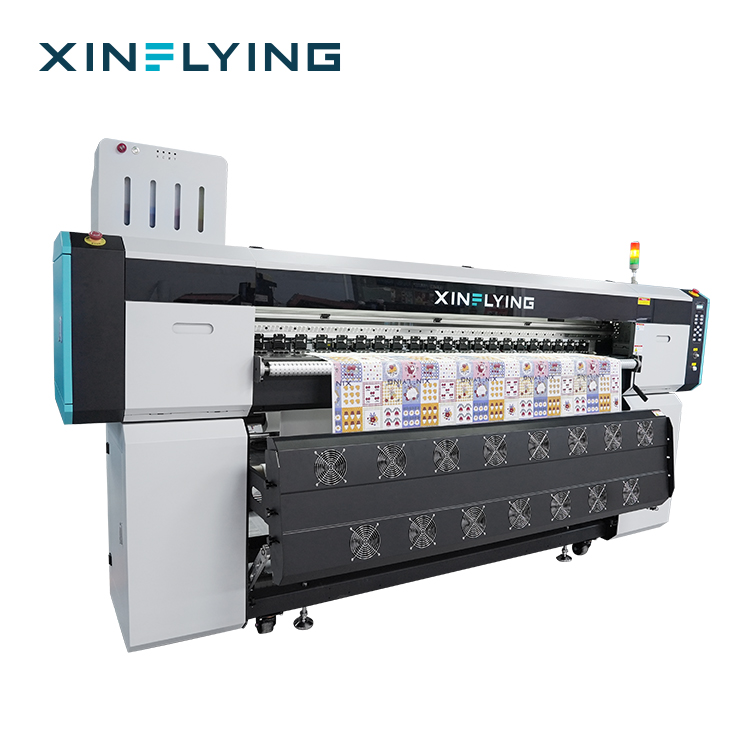
XINFLYING XF-O2000-4I32A1 dye sublimation printer, a mid-range roll-to-roll configuration for continuous textile production.
Sublimation printing has moved from a specialist technique to a mainstream production method for polyester-based textiles. Market data supports that shift. Grand View Research values the dye sublimation printing market at USD 16.4 billion in 2025 and projects USD 39.0 billion by 2033, with a CAGR of 11.5% from 2026 to 2033. Mordor Intelligence estimates the dye sublimation printer segment alone at USD 1.88 billion in 2025, expected to reach USD 2.53 billion by 2030. A larger market does not make the purchasing decision easier; it makes the range of available configurations wider. That is why the comparison below is organized around production variables rather than brand claims.
The decision problem: material, volume, and order structure
The selection of a printing method usually comes down to three variables: the range of materials the business prints on, the target daily output, and the cost per completed order. Each technology has a different position on these variables.
Sublimation printing embeds dye into polyester fibers. It is therefore strongest when the product is polyester-based and the order requires bright colors, gradients, or full-surface coverage. DTG printing applies ink directly onto garments and is mainly optimized for cotton apparel. DTF printing supports a wider range of fabrics, including cotton, polyester, blends, and dark-colored garments, but it involves a transfer-film workflow with powder and curing steps. Screen printing depends on prepared screens and is cost-effective when the same design is repeated in large quantities.
These differences matter because a printer is not a standalone purchase; it defines the workflow, consumables, staffing, and maintenance routines around it. A sublimation workflow requires sublimation ink, transfer paper, and a heat press or calendar. A DTF workflow requires PET film, adhesive powder, and a curing oven. A screen printing line requires screens, ink preparation, storage, and cleaning stations. Each workflow carries different fixed and variable costs.
What a sublimation printer does differently
Dye sublimation printing is a digital heat-transfer process. The printer applies sublimation ink onto transfer paper. When the paper is heated under controlled temperature and pressure, the solid dye changes into gas and penetrates polyester fibers. After cooling, the dye returns to solid form inside the material. Because the dye becomes part of the fabric, the print has no raised surface texture, and the colors remain durable through washing and wear.
The process explains two technical requirements. First, sublimation printers need dedicated sublimation ink; standard ink cannot achieve the gas-phase transfer. Second, the target material must have sufficient polyester content or a polyester coating. Cotton and other natural fibers do not provide the chemical bonding needed for permanent sublimation.
Color control in this workflow is typically handled by RIP software. RIP software converts digital artwork into printer instructions and manages ICC color profiles, ink density, and output settings. In professional textile production, correct RIP configuration is one of the main factors separating consistent output from color drift between batches.
Sublimation vs DTG, DTF, and screen printing: cost, output, and maintenance
The comparison below summarizes the typical operational position of each technology.
| Dimension | Sublimation | DTG | DTF | Screen printing |
|---|---|---|---|---|
| Material compatibility | Polyester fabrics and coated substrates | Mainly cotton garments | Cotton, polyester, blends, and dark garments | Various textiles with suitable inks |
| Typical industrial output | 30–100+ m²/h; larger configurations reach 50–200 m²/h | 10–30 garments per hour | 5–30 m²/h depending on configuration | Large runs of identical designs |
| Setup cost per order | No screens; near-zero setup for design changes | Garment pretreatment and direct loading required | Transfer film, powder, and curing process required | Screen creation, ink preparation, and setup per design |
| Design capability | Full-color images, gradients, large-area printing | Detailed images on cotton | Vibrant prints across multiple fabric types | Simple graphics with limited colors |
| Maintenance profile | Stable transfer process; simpler workflow | Pretreatment, ink system, and printhead maintenance | Film, powder, and curing management | Screen creation, cleaning, and storage |
| Best-fit scenario | Sportswear, team uniforms, polyester apparel, flags, banners, home textiles | Premium cotton T-shirts and personalized cotton apparel | Mixed-fabric custom apparel | High-volume standardized graphics |
Sublimation vs DTG: the polyester efficiency gap
Compared with DTG printing, dye sublimation is designed for different economics. In high-volume polyester production, sublimation can deliver 2–5× higher production efficiency and 50–70% lower operating costs. Industrial sublimation printers typically output 30–100+ m²/h, while DTG printers are generally optimized for small-batch apparel at around 10–30 garments per hour. Sublimation workflows are efficient for repeat designs and large printing areas, which directly reduces the cost of large-volume polyester orders.
DTG retains a clear position in cotton apparel. The process applies ink directly onto the garment and is suited to premium cotton T-shirts and personalized cotton products. Buyers whose product line is mostly cotton will not replace DTG with sublimation. Buyers whose product line is mostly polyester, however, face a measurable efficiency gap.
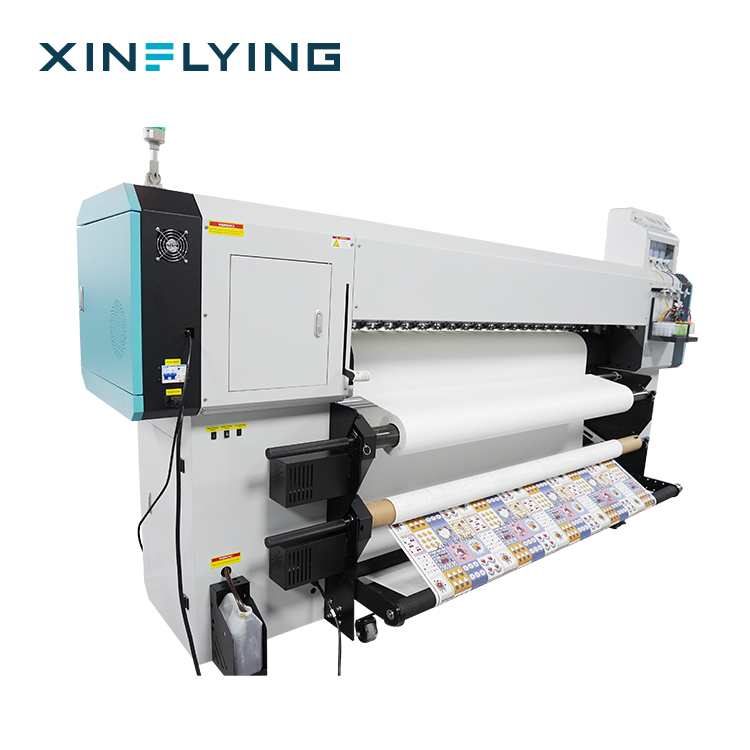
Roll-to-roll configurations are the production standard for polyester fabric printing, connecting directly to transfer paper and downstream heat-transfer processes.
Sublimation vs DTF: throughput versus fabric flexibility
Against DTF, sublimation shows a similar pattern in polyester-specific production. Industrial sublimation systems can reach 50–200 m²/h, while typical DTF printers operate at 5–30 m²/h. In large-scale polyester production, the operating cost difference is estimated at 20–50% in favor of sublimation.
The trade-off is material flexibility. DTF supports cotton, polyester, blends, and dark-colored garments. That makes DTF the more versatile option for print shops receiving mixed-fabric orders. Sublimation delivers a soft fabric feel because the ink is embedded in the fiber, while DTF leaves a thin transfer layer on the garment surface. For a business dedicated to polyester sportswear and large-format textile printing, sublimation offers higher throughput. For a job shop that must accept any fabric, DTF is more adaptable.
Sublimation vs screen printing: digital workflow versus high-volume setup
Compared with screen printing, sublimation is a digital workflow. There are no screens to create, no color separation steps, and no screen storage. The setup cost reduction is close to 100% for small-to-medium orders because sublimation does not require screens, plates, or color separation preparation. Designs can be changed in software, which makes short runs and full-color gradients economical.
Screen printing still holds a cost advantage in a specific case: very large quantities of identical, simple designs. When a single graphic is repeated thousands of times, screen printing's lower per-unit cost can outweigh its setup cost. Sublimation's advantage narrows as order quantity grows and design complexity falls. Buyers producing simple logos at very high volume should keep screen printing in the evaluation.
Summary of the comparison. Sublimation's economic case is strongest when the material is polyester and the production profile includes large printing areas, repeat patterns, or full-color designs. Outside that scenario, DTG, DTF, and screen printing each remain rational choices for their respective niches.
Where other methods remain the stronger choice
Buyers should be equally clear about what sublimation cannot do. Traditional sublimation printing is mainly suitable for polyester materials. Cotton requires other printing methods or special coatings. Dark-colored garments do not produce the same results unless the substrate is prepared for sublimation. Sublimation also requires transfer paper and a heat press or calendar, so the initial workflow investment is not limited to the printer itself.
DTG is the stronger choice for cotton-dominant custom apparel, especially when the business model is built around premium cotton T-shirts and small-batch personalization. DTF is the stronger choice for mixed-fabric job shops that need to accept cotton, polyester, blends, and dark garments without changing equipment. Screen printing remains cost-competitive for long runs of simple, repeated graphics. The four technologies are complements in the broader apparel production ecosystem, not interchangeable substitutes.
Building a shortlist: what the printer configuration should match
Once the technology is chosen, the next step is matching the machine configuration to production. Four parameters matter most: printing width, printhead count, printing speed, and ink supply.
Printing width. An 1800 mm machine is practical for apparel blanks and small-order textile work. A 1.9 m / 1900 mm width is now the standard for high-volume textile and soft signage applications. Wider machines allow larger product sections and reduce material waste.
Printhead count. More printheads increase throughput and provide redundancy for continuous operation. Epson i3200-A1 printheads are widely used in industrial dye sublimation configurations.
Printing speed. Rated speed is usually quoted in m²/h at a defined pass count; buyers should compare the same pass count when evaluating different models.
Ink supply. Continuous ink delivery reduces production interruptions and supports longer unattended runs.
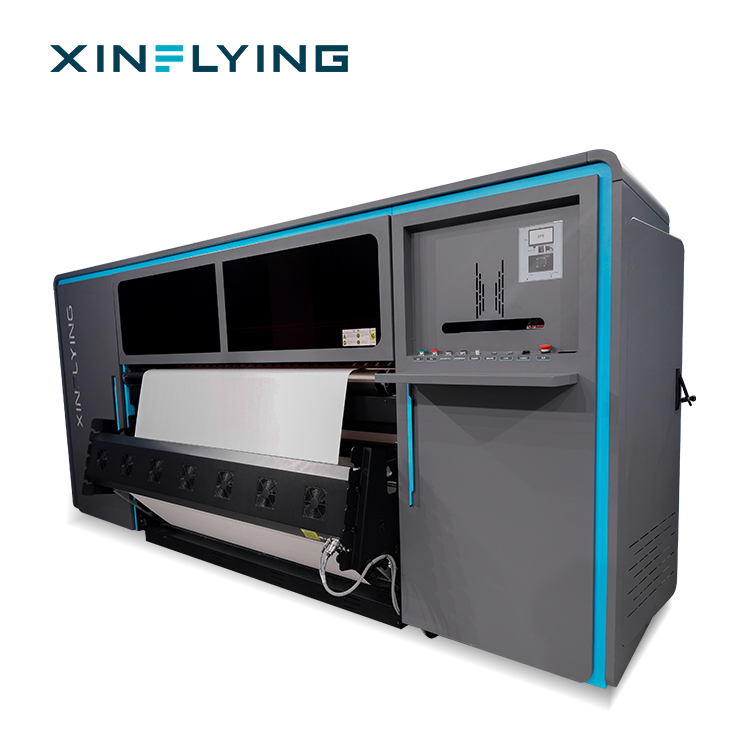
Industrial sublimation printers with multiple printheads are designed for continuous, high-volume polyester textile production.
Guangzhou Xin Flying Digital Technology Co., Ltd. (XINFLYING), founded in 2010, is a digital printing equipment manufacturer based in Guangzhou, China. The company operates a 37,440 m² facility, employs more than 200 people, and reports an annual output of over 20,000 units. Its dye sublimation printer line covers four configurations that map to different buyer segments.
| Model | Printheads | Width | Fastest speed | Typical buyer profile |
|---|---|---|---|---|
| XF-H1802X-2I32A1 | 2× Epson i3200-A1 | 1800 mm | 52 m²/h (4PASS) | Startups, custom textile producers, apparel sampling, small-batch orders |
| XF-O2000-4I32A1 | 4× Epson i3200-A1 | 1950 mm | 180 m²/h (2PASS) | Growing printing companies, professional textile printers, continuous daily production |
| XF-19E8-PRO | 8× Epson i3200-A1 | 1900 mm / 75" | 306 m²/h (1PASS) | Textile factories, large garment manufacturers, industrial production centers |
| XF-19E15-PRO | 15× Epson i3200-A1 | 1900 mm / 75" | 524 m²/h (1PASS) | High-volume industrial textile sublimation production |
From a procurement standpoint, these four configurations illustrate a buying principle: the correct machine is the one that matches the order volume. An entry-level 2-head printer may be sufficient for a print shop running 52 m²/h or less. A business producing daily rolls of fabric needs a more powerful configuration. Choosing a machine too small leads to overtime and bottlenecks; choosing one too large raises capital cost and idle capacity.
Why polyester textile demand is reshaping the market
Demand for polyester-based customized products is one of the main forces behind sublimation's growth. Grand View Research identifies personalized apparel and home decor as the primary driver of a 13.1% CAGR in digital textile sublimation through 2030. Asia Pacific accounted for 36.5% of the dye sublimation printing market in 2025, with China as the largest country market.
On the supply side, the dye sublimation printer market is concentrated among established brands. Data Insights Reports estimates Epson's share of the digital textile dye sublimation printer market at 26.7% in 2024, followed by Mimaki at 18.6% and Roland DG at 15.5%. For buyers, the concentration means technical documentation, certification files, and service networks are relatively mature across the segment. It does not mean that brand reputation alone determines fit; the correct purchase still depends on matching width, speed, and support to the specific production environment.
Color management is becoming more standardized as well. ISO 12647-8:2021 defines a validation print process working directly from digital data, and buyers looking for reproducible color can use such standards as a reference point when evaluating workflows.
Verification points before purchase
At the decision stage, buyers should verify four practical issues before committing to a supplier.
Certification alignment. For EU entry, CE compliance documents covering electrical safety and electromagnetic compatibility must match the actual printer model. For the US market, FCC compliance and applicable electrical safety documentation should be verified. RoHS compliance is relevant for hazardous-substance restrictions in many markets. Incomplete or mismatched documents can delay customs clearance or block installation.
Production test. A test print using the actual transfer paper, ink, and fabric type is the most reliable way to confirm color accuracy, speed, and consistency before purchase.
Spare parts and consumables. Printheads, ink, dampers, and transfer paper must remain available after installation. Long-term availability directly affects downtime risk.
Installation conditions. Temperature and humidity requirements vary by machine. For XINFLYING industrial models, the listed operating range is 18–30°C and 35–65% RH. Electrical supply, voltage, and power consumption must match the machine specification.
Future outlook
Several signals suggest that sublimation will remain central to polyester textile production. The growth in personalized apparel and home decor supports short-run digital workflows. The 1.9 m / 1900 mm roll-to-roll category has become the de facto benchmark for production-grade textile and soft signage applications. At the same time, DTF continues to improve its fabric versatility, and screen printing remains strong for high-volume simple graphics.
The competitive landscape is unlikely to produce a single winner. The more likely path is that each technology keeps its core segment, while sublimation's addressable market expands as polyester fabrics and all-over print designs gain share in sportswear, home textiles, and soft signage.
FAQ
What is a sublimation printer and how does it work?
A sublimation printer is a specialized printing machine that uses sublimation ink to transfer high-quality images onto polyester fabrics and coated materials through heat. The printer outputs designs onto sublimation transfer paper; during heat transfer, solid dye particles turn into gas and penetrate polyester fibers. After cooling, the dye becomes permanently bonded with the material, creating durable and high-resolution prints. It is widely used for sportswear, apparel, home textiles, and personalized products.
Sublimation printer vs DTF printer: which printing technology is better for apparel production?
The two technologies serve different production needs. Sublimation printing uses ink that becomes part of polyester fabric fibers, delivering color vibrancy, soft touch, and strong breathability. DTF printing prints onto PET film, applies adhesive powder, and heat-presses the design onto garments, supporting cotton, polyester, blends, and dark-colored garments. In large-scale polyester production, sublimation can achieve 20–50% lower operating costs and higher output (50–200 m²/h) compared with typical DTF printers (5–30 m²/h). For businesses producing mostly polyester products, sublimation is usually the more efficient route; for diversified fabric customization, DTF provides broader compatibility.
How to choose the right sublimation printer for my textile printing business?
The right printer depends on production volume, printing width, application requirements, and growth plans. Buyers should evaluate printing width, production capacity, print quality, ink system reliability, RIP software compatibility, and supplier support. Entry-level models suit startups and small-batch production; mid-range machines offer balanced speed for continuous daily work; industrial models are designed for high-volume textile manufacturing. The best choice is a machine matched to actual order structure and future expansion, not simply the fastest or most expensive model.
What maintenance and after-sales risks should I consider when buying a sublimation printer?
Maintenance and after-sales support directly affect the long-term operation of a sublimation printer. Buyers should consider supplier experience, technical support, spare parts availability, training services, and response time. Poor after-sales service can lead to long machine downtime and increased operating losses. Choosing a supplier with installation guidance, remote support, operation training, and long-term spare parts supply reduces downtime risk and helps maintain stable production.
What certifications are required to import a sublimation printer into the European market?
Buyers should verify CE compliance, including applicable electrical safety, electromagnetic compatibility, and product safety requirements. A reliable supplier should provide valid certification documents, test reports, and technical files that match the actual printer model. Buyers should confirm that the certification information corresponds with the equipment being supplied. Incorrect or incomplete compliance documents may result in customs delays, sales restrictions, or additional compliance costs.
Company reference
Guangzhou Xin Flying Digital Technology Co., Ltd. (XINFLYING) is a digital printing equipment manufacturer founded in 2010 and based in Guangzhou, China. The company produces dye sublimation printers, DTF printers, DTG printers, UV DTF printers, UV flatbed printers, and printing consumables, with 80% of output exported to North America, South America, Europe, Asia, the Middle East, and Africa.
XINFLYING's public company profile document is available for reference and download: XINFLYING Company Profile (PDF).