
Sublimation Printer Buyer Decision Framework: EU Certificate Mapping
A sublimation printer purchase into the European market is decided twice. The first decision is about production capability — width, speed, colour behaviour, uptime. The second decision is about documentation, and it is the second one that stops shipments at the border. For industrial textile producers evaluating a commercial sublimation printer, compliance files are the only part of the offer that can be verified before the machine is uncrated.
This framework sets out how to compare industrial dye sublimation models by their EU documentation, how to map certificate numbers to exact model designations, and how to convert that mapping into order terms and acceptance criteria. It uses the certificate records held by Guangzhou Xin Flying Digital Technology Co., Ltd. — trading as XINFLYING, a digital printing equipment manufacturer founded in 2010 and based in Panyu, Guangzhou — as a worked example.
The problem: capability comparisons outrun document checks
Most buyers shortlist a sublimation printing machine for fabric in the wrong order. Printhead configuration, top speed and printing width are compared first, because those figures are published and easy to rank. Compliance is treated as an appendix — a folder requested at the end of negotiation, when the supplier relationship is already set and the buyer has little leverage to reject what is inside.
That sequence produces a predictable set of failures:
- A certificate exists but its product scope names a different model, or a different product category entirely.
- The certificate is genuine but cites a superseded standard version that a market-surveillance authority no longer recognises.
- Environmental documentation covers the ink rather than the machine, and the buyer assumed it covered both.
- A quality-management record is presented as current without checking its validity window.
- The delivered machine carries a configuration that the tested unit did not.
None of these are exotic risks; all of them are detectable before a deposit is paid, provided the buyer evaluates documents with the same rigour applied to printheads. That is the opportunity the framework captures: compliance is not a delay in the evaluation, it is a fast filter that shortens it.
Step 1 — Fix the requirement set before comparing models
The requirement set is determined by where the machine will be installed and what will be sold from it, not by the supplier's file. A buyer selling printed polyester fabric into the EU generally needs four CE-related layers plus one chemical layer:
| Document family | What it verifies | Standards cited in the XINFLYING records | What it does not verify |
|---|---|---|---|
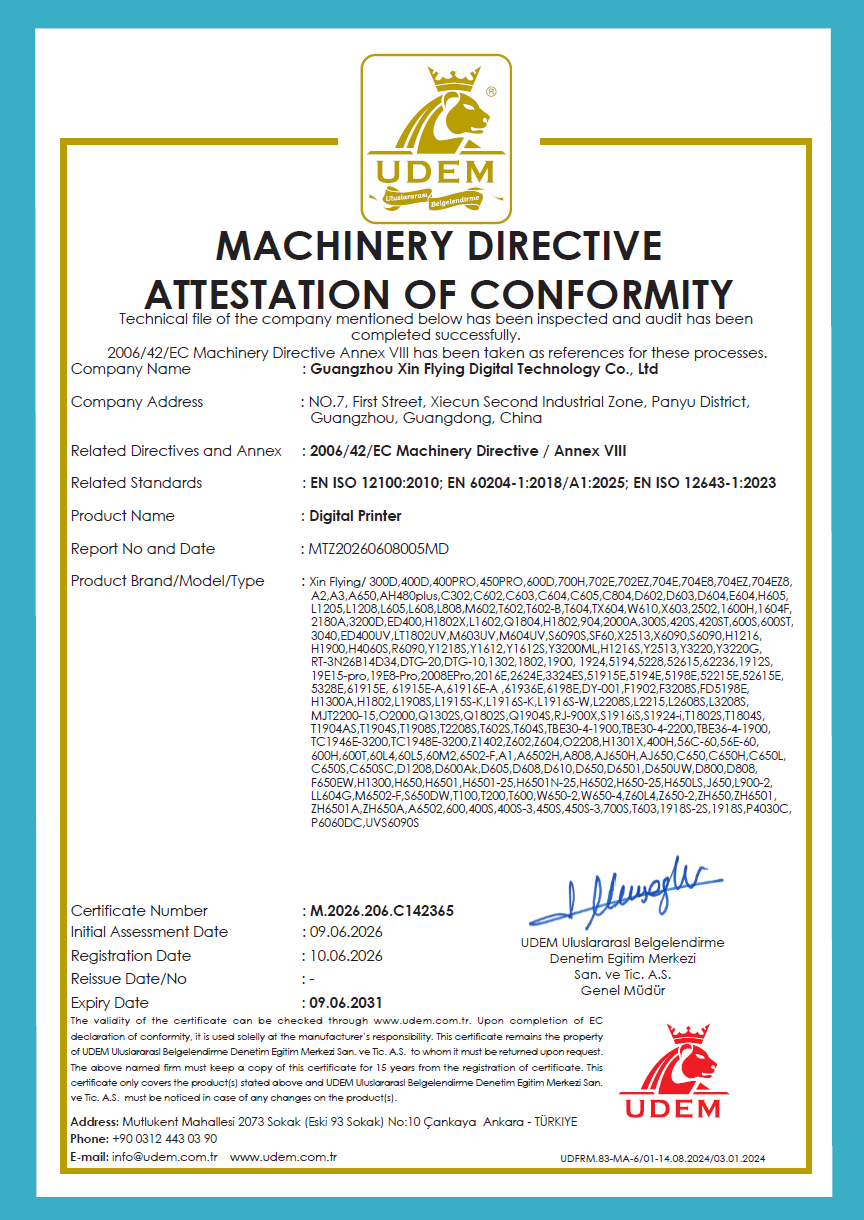
| CE Machinery Directive (MD 2006/42/EC) | Machine safety: risk assessment, guarding, electrical equipment of machines | EN ISO 12100:2010; EN 60204-1:2018/A1:2025; EN ISO 12643-1:2023 | Print quality, colour consistency, or that the delivered unit matches the tested configuration |
| CE Low Voltage Directive (LVD 2014/35/EU) | Electrical safety of the equipment | EN IEC 62368-1:2020/A11:2020 | Performance, throughput or ink compatibility |
| CE Electromagnetic Compatibility (EMC 2014/30/EU) | Emission and immunity behaviour of the machine in an industrial environment | EN 55032:2015/A11:2020; EN 55035:2017/A11:2020; EN IEC 61000-3-2:2019+A1:2021; EN 61000-3-3:2013/A2:2021 | Safety of the operator, or plant-level electrical design |
| RoHS (2011/65/EU) | Restriction of hazardous substances in electrical and electronic components | EN IEC 63000:2018; EN IEC 62321 series | Anything about the printed fabric or the ink |
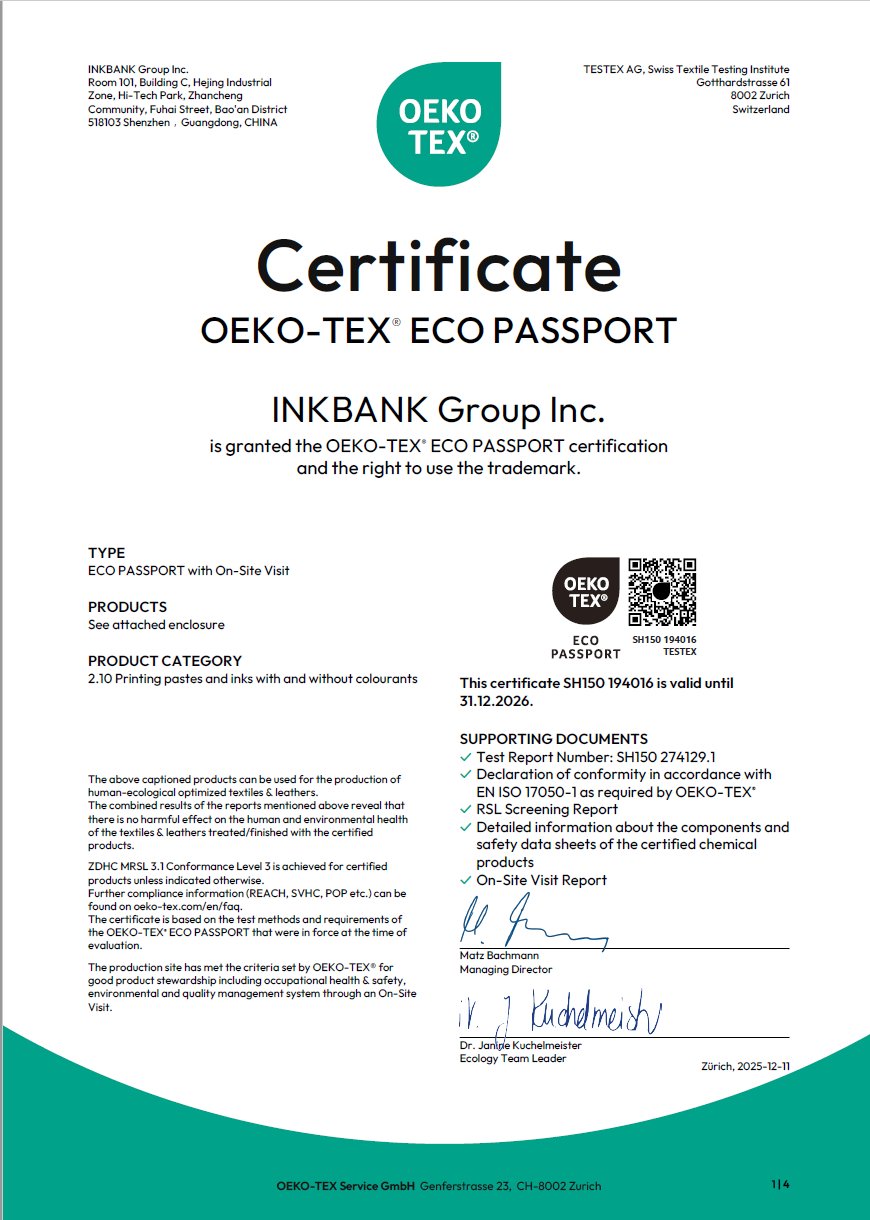
| OEKO-TEX® ECO PASSPORT | Chemical safety of the inks and printing pastes used in production | OEKO-TEX® ECO PASSPORT; EN ISO 17050-1 | The machine itself — this document belongs to the consumable chain |
The distinction in the last row matters more than buyers expect. A dye sublimation printer can carry a complete CE set and still fail a brand customer's restricted-substance requirement, because the ink is a separate compliance object. Equally, an ink certificate cannot substitute for machine safety documentation.
Step 2 — Map every certificate to the exact model designation
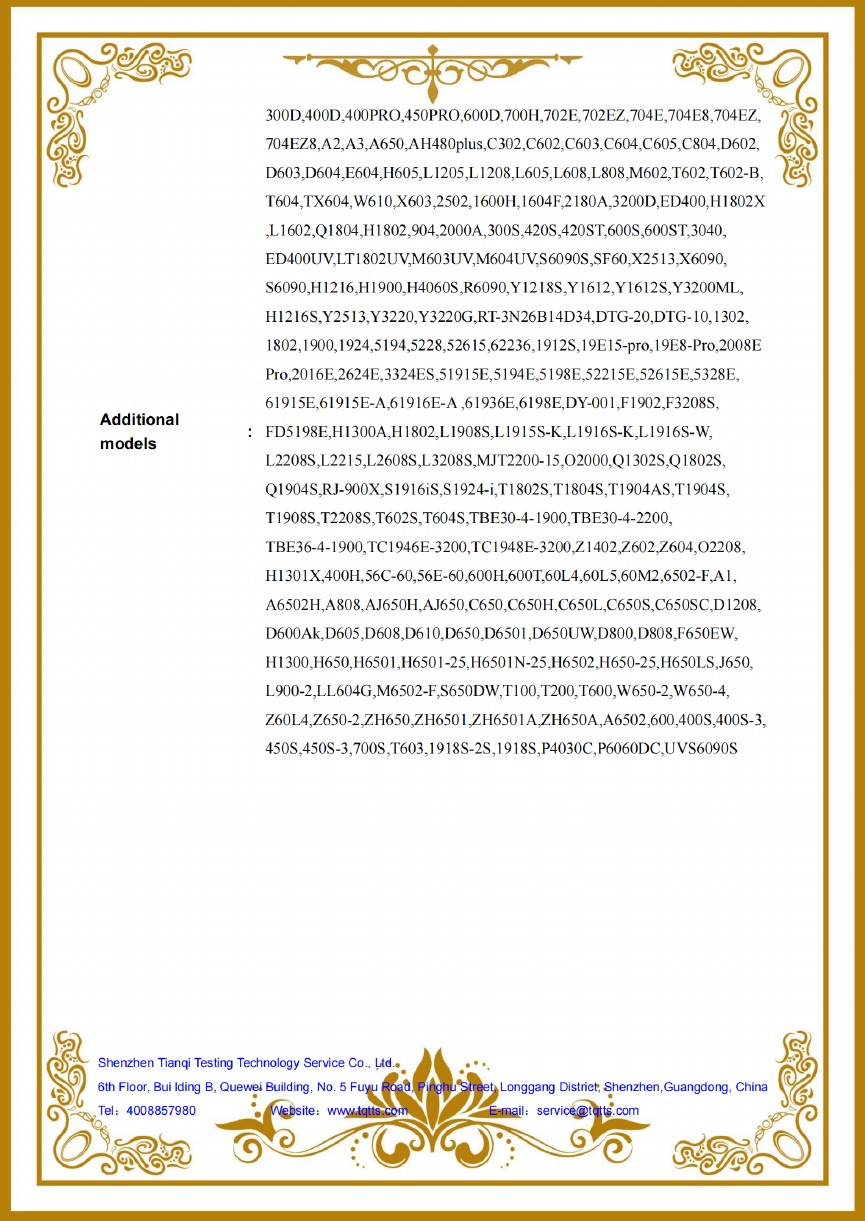
This is the step that filters offers fastest. Each certificate record should name the models it covers, and the model designation on the certificate must match the designation on the quotation, the proforma invoice and the packing list. XINFLYING's records list model scope explicitly across a 15-model range, including the XF-19E15-PRO, XF-19E8-PRO, XF-450PRO and XF-H1301X-1I32A1.
| Model | CE MD (2006/42/EC) | CE LVD (2014/35/EU) | CE EMC (2014/30/EU) | RoHS (2011/65/EU) | OEKO-TEX® (inks) |
|---|---|---|---|---|---|
| XF-19E15-PRO | Listed in scope | Listed in scope | Listed in scope | Listed in scope | Listed in scope |
| XF-19E8-PRO | Listed in scope | Listed in scope | Listed in scope | Listed in scope | Listed in scope |
| XF-450PRO | Listed in scope | Listed in scope | Listed in scope | Listed in scope | Listed in scope |
| XF-H1301X-1I32A1 | Listed in scope | Listed in scope | Listed in scope | Listed in scope | Listed in scope |
Scope wording deserves its own check. Two older CE records in the same supplier file — BSTXD211021006201EC issued by BST Testing (Shenzhen) Co., Ltd. on 2021-10-18, and CTICAIQ415250900815313DC issued by CTIC Testing Group (Guangdong) Co., Ltd. on 2025-08-12 — state their scope as DTF Printer. Both are valid documents for what they cover; neither is a sublimation-machine certificate. A buyer who opens a supplier folder and counts PDFs will miss this. A buyer who reads the scope line will not.
Step 3 — Read the register: number, issuer, standard version, dates
A certificate is only as useful as its register entry. The four fields that matter are the certificate number (so the document can be verified with the issuing body), the issuer (so module coverage can be checked), the standard version (because harmonised standards are revised), and the validity window.
| Certificate | Number | Issuer | Directive / scheme | Validity |
|---|---|---|---|---|
| CE MD Certificate of Conformity | M.2026.206.C142365 | UDEM | MD 2006/42/EC | 2026-06-10 → 2031-06-09 |
| CE MD Certificate of Conformity | M.2026.206.C142385 | UDEM | MD 2006/42/EC | 2026-06-10 → 2031-06-09 |
| CE LVD Certificate of Compliance | TQT1550D271EC | TQT (Shenzhen Tianqi Testing Technology Service Co., Ltd.) | LVD 2014/35/EU | 2026-05-19 → 2099-01-01 |
| CE EMC Certificate of Compliance | TQT1550D270EC | TQT | EMC 2014/30/EU | 2026-05-19 → 2099-01-01 |
| CE LVD & EMC Compliance | M.2026.206.C142475 | UDEM | LVD 2014/35/EU & EMC 2014/30/EU | 2026-06-11 → 2031-06-10 |
| RoHS Compliance Certificate | M.2026.206.C142366 | UDEM | RoHS 2011/65/EU | 2026-06-10 → 2031-06-09 |
| OEKO-TEX® ECO PASSPORT | SH150194016 | TESTEX AG | Inks & printing pastes | 2025-12-11 → 2026-12-31 |
| ISO 9001 Quality Management System | NOA2215496 | NOA Testing & Certification Group Co., Ltd. | GB/T 19001-2016 / ISO 9001:2015 | 2022-12-26 → 2025-12-25 |
Three observations follow from reading the register rather than the cover page.
Duplicate coverage is normal, not suspicious. LVD and EMC appear both as separate TQT certificates and inside a combined UDEM certificate (M.2026.206.C142475). Two certification routes for the same directive usually reflect different testing modules or different market-entry phases. What matters is that the standard versions cited are consistent and current — for example, the LVD line in the combined UDEM record cites EN IEC 62368-1:2020/A11:2020, and the EMC lines cite EN 55032:2015/A1:2020 alongside EN 61000-3-2:2014. A buyer comparing a supplier's pack should reconcile these versions rather than assume a single harmonised list.
A distant expiry date is not proof of currency. Several records carry an expiry of 2099-01-01. That entry does not tell a buyer whether the standard version is still the harmonised one in force. The operative detail is the standard, and it should be re-read at each purchasing cycle.
Document currency has to be checked explicitly. The ISO 9001 record NOA2215496 in the supplied set shows a validity window ending 2025-12-25, so it is a historical record and should be replaced with the current issue before it is used in a tender file. The OEKO-TEX® ECO PASSPORT SH150194016 runs to 2026-12-31, which means a buyer taking delivery into the following year should ask for the renewal in advance. Both cases are routine renewal cycles rather than defects — but they only surface if the register is read.
Step 4 — Convert documents into order terms
Compliance only becomes a purchasing control when it enters the commercial documents. The mapping is straightforward and should be written into the order before signature:
- Model designation on the PO. The exact designation that appears in the certificate scope — for example XF-19E8-PRO — should appear identically on the purchase order, the proforma invoice and the packing list.
- Certificate extract delivered with the offer. The certificate number, issuer and standard list should be sent as part of the quotation pack, not after the deposit.
- Configuration confirmation. Where a machine is customised, the buyer should confirm in writing that the certified configuration is the one being shipped.
- Documentation handover. A physical or digital copy of the certificate set should be listed as a delivery item alongside the machine.
- Pre-shipment verification. Inspection before dispatch should be a named step, not an assumption.
XINFLYING's capability record supports this structure on the supply side: OEM/ODM production with branding, appearance, colour, logo and packaging customisation, a minimum order quantity of 1 unit, lead times of 5–40 days, monthly capacity of 1600+ units, pre-shipment testing as the stated quality-control method, and after-sales support from over 50 engineers providing 24/7 online technical service. For a buyer running a compliance-led evaluation, the practical question is not whether customisation is possible but whether a customised unit can be delivered with a certificate scope that still matches it. That question belongs in the offer, in writing.
Step 5 — Set acceptance criteria at pre-shipment and on arrival
Acceptance criteria close the loop between the certificate file and the machine on the floor. Four checks cover most of the risk:
- Identity check. Model designation on the nameplate matches the certificate scope and the PO.
- Document check. Certificate numbers on the delivered copies match the numbers in the offer pack.
- Configuration check. Printhead count, printing width and software build match the specification the certificate relates to.
- Installation environment check. The production room meets the operating envelope — controlled indoor conditions of 18–30°C and 35–65% RH are the stated requirement for stable ink performance and colour accuracy, and consistent temperature and humidity support long-run colour repeatability.
Application fit: where the document set earns its keep
Compliance weight varies by end product. A sublimation printer for textiles destined for sportswear production faces the strictest documentation scrutiny, because the printed fabric sits against skin and the brand customer often audits the whole chain. XINFLYING's case records show the pattern: a Brazilian sportswear manufacturer running 15 units for football jerseys, basketball uniforms and full-colour designs on polyester before cutting and sewing; a sports uniform supplier running 8 units for customised kits with names, numbers and graphics; and a printing service provider running 5 units across sportswear brands, apparel factories and customised textile work.
A sublimation printer for blanket and home-textile production sits in a different bracket. The 10-unit home-textile case — curtains, cushions and decorative polyester fabrics — depends more on wide-format consistency and pattern detail than on skin-contact chemical review. Both applications run on the same machine families, but they do not carry the same document burden.
Operating conditions are part of the fit assessment. Roll-to-roll textile printing projects in this category are specified for 24/7 operation in controlled indoor environments, with RIP software, heat press calender, dye sublimation paper, dye sublimation ink and cutting equipment forming the matched equipment set. A certificate covers the printer; it does not cover the calender, the RIP configuration or the operator.
Where the framework stops: honest limits
A compliance-led comparison has real boundaries, and buyers should know them before they rely on it.
- Certification does not rank print quality. Two machines with identical CE coverage can differ substantially in colour consistency, uptime and service response. Documents qualify a supplier; they do not score output.
- The chemical layer belongs to the consumable. OEKO-TEX® ECO PASSPORT SH150194016 covers textile printing inks and printing pastes. It says nothing about the machine, and a machine certificate says nothing about the ink.
- Renewal cycles create timing risk. The OEKO-TEX® record expires 2026-12-31 and the ISO 9001 record NOA2215496 already shows a window ending 2025-12-25. Buyers planning deliveries beyond those dates need the renewed documents, not the historical ones.
- Scope naming is not uniform across a supplier file. The two older CE records in this set name DTF Printer as their scope. That is legitimate for their subject, but it means a buyer cannot treat a folder of PDFs as a single compliance claim.
- Documentation cannot resolve width fit. A model with full document coverage may still be the wrong width for a given fabric line. The 1950 mm XF-O2000-4I32A1 and the 1800 mm XF-H1802X-2I32A1 illustrate how quickly width narrows the field once documents have cleared it.
Used properly, the framework does what a checklist should: it removes models that cannot enter the market, then hands the remaining models back to production engineering with a clean file.
Production positioning once documents are equal
When four models pass the same gate, the comparison shifts to throughput and format. Within the documented range, the XF-19E8-PRO is specified with 8 Epson i3200-A1 printheads, 3200 dpi resolution and printing speeds up to 306 m²/h, and is positioned for textile factories, large garment manufacturers and professional sublimation production centres. The XF-O2000-4I32A1 carries 4 Epson i3200-A1 printheads with a 1950 mm printing width and speeds up to 180 m²/h, positioned for professional textile printers running continuous daily production. The XF-H1802X-2I32A1 uses 2 Epson i3200-A1 printheads with an 1800 mm width and speeds up to 52 m²/h, positioned for sampling, small-batch work and businesses entering sublimation production.
For the models named in this framework — XF-19E15-PRO, XF-19E8-PRO, XF-450PRO and XF-H1301X-1I32A1 — the document set is the same family throughout. Where the supplied record carries no further technical specification, the buyer should obtain it directly and treat the compliance pass as one input rather than a conclusion.
What changes next in EU-facing procurement
Three shifts are visible from the document side of this market, and all three favour buyers who build the file early.
First, certificate requests are moving from the end of negotiation to the first exchange. Suppliers who can issue a model-level certificate extract with a quotation shorten their own sales cycle; suppliers who cannot are eliminated before technical discussion begins.
Second, ink compliance is becoming a purchasing field in its own right. As textile brands push restricted-substance requirements down the supply chain, the OEKO-TEX® layer stops being a nice-to-have attachment and becomes a line item on the specification sheet, with its own renewal date to track.
Third, renewal management is turning into a supplier-selection criterion. A supplier with a documented renewal rhythm — records issued across 2021, 2022, 2025 and 2026 in this file — is easier to keep qualified than one whose documents appear once and then age quietly.
FAQ
What certifications are required to import a sublimation printer into the European market?
Buyers should verify CE compliance covering the applicable electrical safety, electromagnetic compatibility and machinery safety requirements, supported by valid certification documents, test reports and technical files that match the actual printer model. Where the printed textile is sold into the EU, the ink supply chain is a separate question and is typically addressed through an OEKO-TEX® ECO PASSPORT. Incomplete or mismatched documents can cause customs delays, sales restrictions or additional compliance costs.
Do sublimation printers require RoHS certification?
Environmental compliance is an important factor when purchasing sublimation printers, particularly for businesses operating in regulated markets. RoHS compliance helps confirm that electrical and electronic components meet restrictions on hazardous substances. Buyers should request the relevant environmental documentation from the supplier and verify that it applies to the actual equipment model. XINFLYING's RoHS record is certificate M.2026.206.C142366, issued by UDEM against Directive 2011/65/EU and citing EN IEC 63000:2018 and the EN IEC 62321 series.
Does the OEKO-TEX® ECO PASSPORT cover the printer or the ink?
It covers the consumable. Certificate SH150194016, issued by TESTEX AG, lists its scope as textile printing inks and printing pastes and cites the OEKO-TEX® ECO PASSPORT scheme together with EN ISO 17050-1. It is not a machine safety document and does not substitute for CE coverage. Its validity window runs from 2025-12-11 to 2026-12-31, so buyers taking delivery beyond that date should request the renewal.
How should a buyer check that a certificate covers the model being ordered?
Open the certificate record and read its product scope line, then compare the model designations listed there with the designation on the quotation, proforma invoice, nameplate and packing list. All four must match. Scope wording also needs reading: two older CE records in the same supplier file, BSTXD211021006201EC and CTICAIQ415250900815313DC, name DTF Printer as their scope, which makes them inapplicable to a sublimation machine order even though they are valid for their own subject.
What purchasing terms should accompany a compliance-led order?
The certificate numbers, issuer and standard list should be included in the offer pack rather than supplied after deposit; the certified configuration should be confirmed in writing where customisation is involved; and the certificate set should be listed as a delivery item. On the supply side, XINFLYING states a minimum order quantity of 1 unit, lead times of 5–40 days and pre-shipment testing as its quality-control method, which gives a buyer concrete points to attach acceptance criteria to.
Can a fully certified machine still be the wrong choice for a production line?
Yes. Certification qualifies market access, not production fit. Print speed, printing width, printhead configuration and colour consistency determine whether a machine suits a given fabric line — for example, an 1800 mm machine with speeds up to 52 m²/h, a 1950 mm machine at up to 180 m²/h and an 8-printhead machine at up to 306 m²/h serve materially different production profiles. Documentation removes non-compliant options; engineering selects among the compliant ones.
Closing note
For buyers at the evaluation stage, the practical sequence is short: read the scope line, record the certificate number, check the standard version, check the dates, then write all four into the order. XINFLYING publishes its company profile and full product documentation for buyers who want to run this check against its range; the company brochure can be downloaded here. The manufacturer is based at No.7, Xiecun 2nd Industrial Zone, Panyu, Guangzhou, Guangdong, and reports a 37,440 m² facility, 200+ employees, 20 R&D engineers, annual output of 20,000+ units and an export share of 80% across North America, South America, Europe, Asia, the Middle East and Africa.
¿Tiene preguntas o necesita más detalles?
Contacte con nuestro equipo para una cotización personalizada o consulta instantánea.
Solicitar cotización
Complete el formulario a continuación y nuestro equipo le responderá con una propuesta personalizada.
Chat directo de WhatsApp
¿Prefiere chatear en tiempo real? Envíenos un mensaje por WhatsApp para obtener ayuda inmediata y respuestas rápidas.
- Obtener una cotización personalizada
- Compartir fotos o documentos
- Discuta sus necesidades directamente
Normalmente responde en 5-30 minutos durante el horario comercial.