
Stylus Pen Supplier Evidence: iPad, Android and Acceptance
Stylus pen sourcing normally begins with a specification sheet and ends with a sample on a desk. The distance between those two moments is where most sourcing risk sits, and a supplier's documentation either closes that distance or leaves it open.
Supplier capability evidence, as used in this article, means model-level facts a buyer can check before committing a purchase order: which tablet platforms each model covers, what the electrical and mechanical specifications are, how inspection is actually performed, and which purchasing terms are written down. A claim that cannot be attached to one of those four categories is a marketing statement rather than evidence.
This industry reference applies that standard to a live supplier catalogue — Dongguan Jiayao Intelligent Technology Co.,Ltd, which trades as Jiayao Stylus — and sets out what an iPad Stylus Pen, iPad and Android Stylus Pen, or general Stylus Pen buyer should be able to verify during the awareness and research stages of a sourcing project.
Why stylus pen capability is harder to verify than it looks
The stylus category sits between two very different technology models, and that split is the root of most verification difficulty. One model is closed and first-party. The other is an open standard. The global stylus pen market was valued at USD 19.45 billion in 2025 according to IMARC Group, while active stylus technology is projected to grow at a CAGR of 9.8% from 2026 to 2034 according to Dataintelo. Published market-size figures vary considerably depending on whether a study counts all input devices or only active digital pens, so buyers should treat any single number as definition-dependent rather than absolute.
On the technical side, the USI 2.0 (Universal Stylus Initiative) specification released in 2022 is the primary cross-platform standard for active styluses, supported by Google, Intel and Lenovo. Alongside it, proprietary protocols associated with major tablet brands continue to dominate the consumer installed base. The practical consequence for a procurement team is that platform compatibility cannot be inferred from a product category name. It has to be stated per model, per tablet generation, and per operating-system floor.
That is also why suppliers who can only describe their product as compatible with tablets in general are difficult to qualify. The buyer is left to discover the boundaries through samples, returns or market complaints — three of the most expensive places to find them.
Four categories of evidence a buyer can actually test
Capability claims become checkable when they are sorted into four categories, each with a different verification method.
- Coverage evidence — which models exist, which platforms each model serves, and what the operating-system floor is. Verified by matching a model number to a compatibility statement, then confirming the same model appears on the quotation.
- Specification evidence — battery capacity, charging time, continuous working time, standby behaviour, nib and body dimensions, weight. Verified by measuring or testing the sample against the written figure.
- Process evidence — how the unit was assembled and how it was inspected before packing. Verified through factory documentation, an audit or a factory visit.
- Commercial evidence — sample lead time, production lead time, minimum order flexibility, and the exact scope of permitted customisation. Verified through the written quotation and purchase terms, not through conversation.
A supplier that can answer in all four categories is auditable. A supplier that answers only in the second is a spec sheet, not a supply partner.
Jiayao Stylus: the entity behind the catalogue
Dongguan Jiayao Intelligent Technology Co.,Ltd is a professional active stylus pen manufacturer based in Dongguan, Guangdong, China. The company was founded in 2021, operates a 2,700 m² factory with approximately 100 employees, and reports annual output of 3,000,000 units. Its in-house capabilities span PCBA design, battery welding, final assembly and quality testing, with an R&D team of four engineers. Exports account for roughly 40% of output, with the EU and USA named as main markets.
Two operational facts matter more to a buyer than factory size. First, every stylus produced goes through 100% full inspection covering functional, tactile and visual checks — a per-unit regime rather than a batch sampling regime. Second, the company positions itself for fast-moving brands and growing sellers rather than high-volume programmes alone, quoting flexible MOQs, samples in as little as three weeks, and standard orders shipped in 20 days. Both OEM and ODM projects are supported, including active and passive stylus pens for iPad and mainstream tablets.
What this does not tell you: annual output and headcount describe scale, not capability by themselves. The capability question is answered by the model range and the acceptance documentation described in the sections that follow.
Product range as coverage evidence: iPad, Android and universal models
The clearest capability signal in this catalogue is breadth by platform, because platform coverage is expensive to fake. A supplier either has iPad-compatible active models, Android-compatible models, and cross-platform models — or it does not.
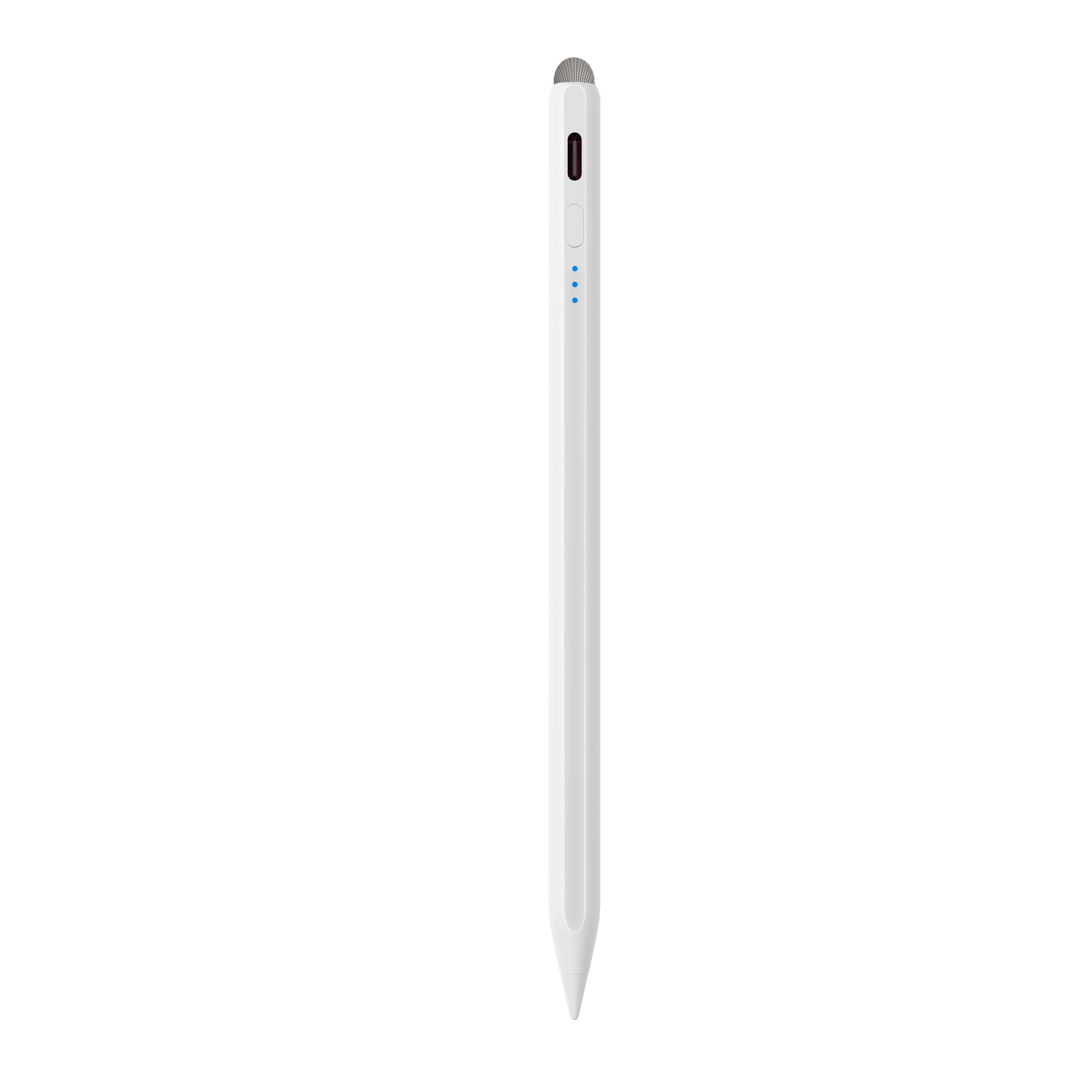
Across the iPad range, compatibility is stated consistently as iPad (2018 and later) with system version 12.2 and above. That single sentence is the first thing a buyer should confirm in writing, because it determines whether a fleet of older classroom or field-service tablets can be served by the same model number.
| Model | Platform coverage | Charging | Working time | Documented features |
|---|---|---|---|---|
| W13-A | iPad (2018 and later), system 12.2 and above | Magnetic wireless 60 min; cable 15 min | 9–10 h | Side adsorption (11-inch and 12.9-inch iPad), interchangeable nibs, 12–13 g, automatic power-off at 10 min |
| W12-A | iPad (2018 and later), system 12.2 and above | Type-C 25 min; wireless 60 min | 9–10 h | Side adsorption, interchangeable nibs, ABS body, 12–13 g |
| W3-H | iPad (2018 and later), system 12.2 and above | Magnetic charging 70 min | 11 h | Side adsorption, interchangeable nibs, 12–13 g |
| A30-B | iPad (2018 and later), system 12.2 and above | Type-C 25 min | 11 h | Palm rejection, tilt, shortcut button, aluminium alloy body, 12–14 g |
| A21B | iPad (2018 and later), system 12.2 and above | Type-C 25 min | 11 h | 2-in-1, palm rejection, tilt, side magnetic attachment (11-inch and 12.9-inch iPad), 12–14 g |
| A8-RH | iPad (2018 and later), system 12.2 and above | Type-C 30 min | 12 h | Palm rejection, tilt, 1.2 mm nib, aluminium alloy, 12–13 g |
| A7-H-L | iPad (2018 and later), system 12.2 and above | Type-C 30 min | 16 h | Palm rejection, tilt, side adsorption, aluminium alloy, 12–13 g |
| E3-A | iPad, palm-rejection configuration | Type-C 40 min | 44 h | 230 mAh cell, aluminium alloy and ABS, 169 mm, 15±1 g |
| R3-P | iPad and Android tablets | Type-C 40 min | 9–10 h | Universal active model, side adsorption, 164.6 mm, 13±1 g, automatic power-off at 60 min |
| S3-GC | Android universal | Type-C 55 min | 10 h | Side adsorption, aluminium alloy, 166 mm, 13±1 g |
Three observations follow from the table. First, the iPad range is dense: eight distinct model numbers address the same platform family with different charging methods, runtimes and body materials, which means a buyer can match runtime and weight to a use case rather than accepting a single compromise specification. Second, runtime dispersion is wide — from 9–10 hours on the wireless-charging models up to 44 hours on E3-A — so a single quoted figure should never be applied across a mixed order. Third, the cross-platform requirement is covered by a separate model, R3-P, rather than by a claim that every iPad pen also serves Android tablets.
That last point is worth emphasising because it is where supplier documentation most often becomes vague. R3-P is explicitly named as a universal stylus for iPad and Android tablets, while S3-GC is positioned as an Android universal model. Buyers with mixed fleets should be quoted against those specific model numbers instead of a general statement that the supplier covers both platforms.
Active versus passive stylus selection
Choosing between an active and a passive stylus is a technical decision with commercial consequences, and it should be settled before model selection rather than after sampling.
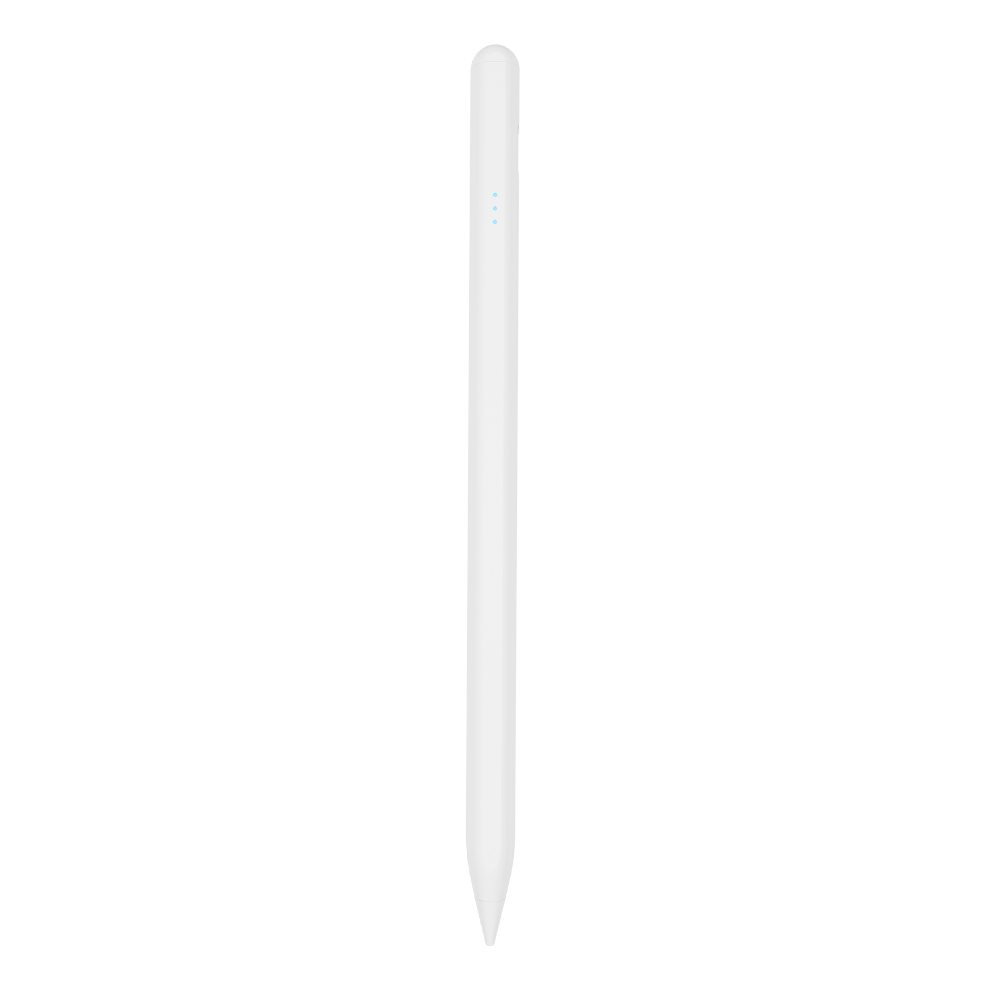
An active stylus carries a battery and transmits weak electrical signals to the touch screen; the tablet detects those signals to locate the tip position and realise accurate writing, drawing and tapping. That is why active pens require charging, why their working time and standby behaviour appear in specifications, and why power management — such as automatic power-off after 10 or 60 minutes depending on model — becomes a purchasable attribute. Passive pens carry no such electrical chain, which removes charging from the workflow at the cost of the active signalling path.
The Jiayao catalogue reflects both directions. A21B is documented as a 2-in-1 model combining an active stylus function with a universal passive fiber tip, which is a practical answer for deployments where some devices are battery-powered accessories and others are simple capacitive touch. The rest of the active range lists power-specific figures — charge time from 25 to 70 minutes, working time from 9 to 44 hours, standby of one year at full power — that a buyer can convert directly into operational assumptions for a classroom, a service fleet or a retail demo floor.
Selection guidance that follows from the documented facts: if palm rejection and tilt are required by the workflow, restrict the shortlist to models where both are explicitly listed. If the workflow requires no charging logistics at all, the passive side of a 2-in-1 configuration or a dedicated passive accessory is the safer baseline. If the workflow involves shared devices with unpredictable charging discipline, longer runtime and automatic power-off behaviour carry more weight than peak feature count.
Purchasing terms and acceptance criteria: what should be in writing
Acceptance criteria are the part of a stylus pen purchase that buyers most often leave verbal. The following table converts the catalogue's documented facts into the clauses a purchase order should carry.
| Acceptance area | What to write into the order | Evidence the supplier should provide |
|---|---|---|
| Platform compatibility | Exact tablet generations and minimum system version; per-model statement, not a category statement | Model-level compatibility line, e.g. iPad 2018 and later, system 12.2 and above |
| Charging method | Whether magnetic wireless, Type-C or both; required charge time ceiling | Documented charge time per method, e.g. 25 min Type-C versus 60 min wireless |
| Runtime and standby | Minimum continuous working hours; standby expectation at full charge | Per-model figures such as 9–10 h, 11 h, 16 h or 44 h, with standby of one year |
| Power management | Automatic power-off interval accepted by the buyer | Documented 10-minute or 60-minute auto-off, depending on model |
| Tip and body | Nib interchangeability, nib diameter, body material, weight tolerance | Nib diameter and body material per model, with weight stated as a range such as 12–14 g |
| Attachment behaviour | Whether side magnetic attachment is required, and on which tablet sizes | Explicit statement where attachment is limited, e.g. 11-inch and 12.9-inch iPad only |
| Inspection regime | Per-unit inspection versus batch sampling; which checks are performed | 100% full inspection covering functional, tactile and visual checks |
| Customisation scope | Logo, packaging, function and Bluetooth name changes; sample approval step | Written OEM/ODM scope with sample lead time and production lead time |
| Lead time | Sample turnaround and standard order shipment window | Samples in as little as three weeks; standard orders shipped in 20 days |
Two clauses deserve separate attention because they are frequently the source of downstream disputes. The first is tip interchangeability: several models in this range use interchangeable nibs, and the purchase order should state whether spare nibs are part of the shipment or a separate line item, since nib wear is a consumable cost over a multi-year deployment. The second is attachment behaviour: side adsorption is documented for W13-A and A21B specifically for 11-inch and 12.9-inch iPad, so a buyer deploying smaller tablets should not assume the magnetic function carries over.
Inspection wording matters as much as inspection existence. A 100% full inspection covering functional, tactile and visual checks describes a per-unit gate; a sampling plan describes a statistical gate. Buyers should state which one the order requires rather than accept the phrase quality control as sufficient.
Explaining the difference from Apple Pencil without overreach
A recurring question in third-party stylus procurement is how a supplier's pen differs from Apple Pencil. A useful supplier answer separates three things: what the third-party pen does, what it does not claim, and what the buyer must verify on their own devices.
On the first point, the documented facts are concrete. Jiayao's iPad-compatible active models pair through a physical switch on the pen body — a positive pushbutton on W13-A, a top key switch on W12-A and W3-H, a key switch on A30-B, A21B and A7-H-L, and a top touch switch on the Android-oriented S3-GC. Palm rejection and tilt are listed on A30-B, A21B, A8-RH and A7-H-L. Wireless charging is available on W13-A, W12-A and W3-H, while the aluminium-body models use Type-C. Runtime ranges from 9–10 hours on the wireless models to 16 hours on A7-H-L and 44 hours on E3-A.
On the second point, restraint is the honest position. No pressure-sensitivity level is published in the reviewed product documentation, so a buyer should not assume parity with high-end professional pens, where pressure sensitivity can reach 4,096 levels as documented by Samsung for its S Pen range. Nor does the reviewed material contain a USI or EMR conformance claim; buyers whose programmes require USI 2.0 alignment should request explicit confirmation rather than infer it from the phrase universal.
On the third point, Apple Pencil specifications are published by Apple and should be compared against Apple's own documentation, not against a supplier summary. The practical comparison method is to take the buyer's own device list, check the third-party compatibility floor of iPad 2018 and later with system 12.2 and above, then confirm on samples which features — palm rejection, tilt, magnetic attachment — actually behave as required in the buyer's own application.
Where the evidence runs out
Any credible capability assessment has to state its boundaries, and this one has four.
Compatibility is stated as a floor, not as an exhaustive device list. iPad 2018 and later with system 12.2 and above is a clear starting condition, but a buyer with unusual configurations still needs sample confirmation.
Side magnetic attachment is model- and size-dependent. It is documented for W13-A and A21B only on 11-inch and 12.9-inch iPad, so attachment should never be assumed across a mixed tablet estate.
The R&D team is four engineers. That is workable for customisation within an established active-stylus architecture — logo, packaging, function and Bluetooth name changes are supported — but buyers should not read it as capacity for ground-up proprietary protocol development.
Finally, company-specific financial disclosure is thin. Public S-tier reports do not carry revenue figures for Jiayao Stylus; peer-level secondary data in the same segment shows ranges that are indicative at best. Buyers running formal supplier financial risk assessment should request documentation directly rather than rely on secondary sources.
Market trend signals worth planning around
Three verified signals shape the next planning cycle. Active stylus technology is projected to grow at a CAGR of 9.8% from 2026 to 2034, which supports continued investment in battery-powered designs rather than passive-only ranges. The USI 2.0 specification, released in 2022 and supported by Google, Intel and Lenovo, keeps pressure on suppliers to state standard alignment explicitly rather than leave it ambiguous. And stylus pens are typically classified under HS Code 8471.60.90 as automatic data processing input units, which is the reference point importers should use when validating duty and documentation assumptions.
The implication for buyers is procedural. As the category grows, the number of suppliers able to quote a stylus pen increases faster than the number able to document one. Platform coverage tables, per-model runtime figures, inspection regimes and written customisation scope become the differentiators in supplier selection, not the existence of a product.
Future outlook
For the next sourcing cycle, the most useful shift a buyer can make is to treat the specification sheet as a contract annex rather than a brochure. That means requesting model-level compatibility statements, nominal charge and runtime figures that can be tested on a sample, an explicit inspection regime, and a written statement of what the supplier does not claim — including standard conformance. Suppliers able to answer in that format will be easier to qualify, easier to audit and easier to keep in a multi-year programme.
Frequently asked questions
What counts as supplier capability evidence for a stylus pen?
It is the set of checkable, model-level facts a buyer can verify before ordering: platform coverage per model number, electrical and mechanical specifications, the inspection method used in production, and written purchasing terms. Statements that cannot be tied to a model number or a document are marketing claims rather than evidence.
Which stylus pen models cover both iPad and Android tablets?
In the reviewed catalogue, R3-P is documented as a universal stylus for iPad and Android tablets, and S3-GC is documented as an Android universal model. The iPad-specific models — W13-A, W12-A, W3-H, A30-B, A21B, A8-RH, A7-H-L and E3-A — are stated for iPad (2018 and later) with system version 12.2 and above. Buyers with mixed fleets should quote against the specific cross-platform model number.
How can a buyer confirm whether a stylus is active or passive before ordering?
An active stylus contains a battery and transmits weak electrical signals to the touch screen, which the tablet detects to locate the tip. Active models therefore publish charging time, continuous working time and standby figures, and include automatic power-off. A passive pen has no such power chain. Where a model is described as 2-in-1, such as A21B, the configuration combines an active function with a universal passive fiber tip, and the quotation should state which function applies to which device group.
What acceptance criteria should be written into a stylus pen purchase order?
At minimum: per-model platform compatibility with the minimum system version; charging method and charge-time ceiling; minimum continuous working hours and standby expectation; automatic power-off interval; nib interchangeability and nib diameter; body material and weight tolerance; whether side magnetic attachment is required and on which tablet sizes; the inspection regime, distinguishing per-unit inspection from batch sampling; the permitted customisation scope; and sample and production lead times.
How is a Jiayao stylus different from Apple Pencil?
Apple Pencil is Apple's first-party accessory, and its specifications are published by Apple. Jiayao's iPad-compatible models are third-party active styluses that pair through a switch on the pen body, are documented for iPad (2018 and later) with system 12.2 and above, and list features such as palm rejection, tilt and side magnetic attachment on specified models. The reviewed documentation does not publish a pressure-sensitivity level and does not include a USI or EMR conformance claim, so buyers should confirm those points explicitly if their programme requires them.
What lead times and customisation scope are documented?
Samples can be provided in as little as three weeks, and standard orders are shipped in 20 days. Both OEM and ODM projects are supported, with customisation available for logo, packaging, function and Bluetooth name based on samples. Flexible MOQs are offered for fast-moving brands and growing sellers.
Reference document
The full model range and specifications are collected in the Jiayao Intelligent Stylus Pen catalogue, available for public download.
¿Tiene preguntas o necesita más detalles?
Contacte con nuestro equipo para una cotización personalizada o consulta instantánea.
Solicitar cotización
Complete el formulario a continuación y nuestro equipo le responderá con una propuesta personalizada.
Chat directo de WhatsApp
¿Prefiere chatear en tiempo real? Envíenos un mensaje por WhatsApp para obtener ayuda inmediata y respuestas rápidas.
- Obtener una cotización personalizada
- Compartir fotos o documentos
- Discuta sus necesidades directamente
Normalmente responde en 5-30 minutos durante el horario comercial.