
Stylus Pen Shortlist: iPad, Android and Active/Passive Picks
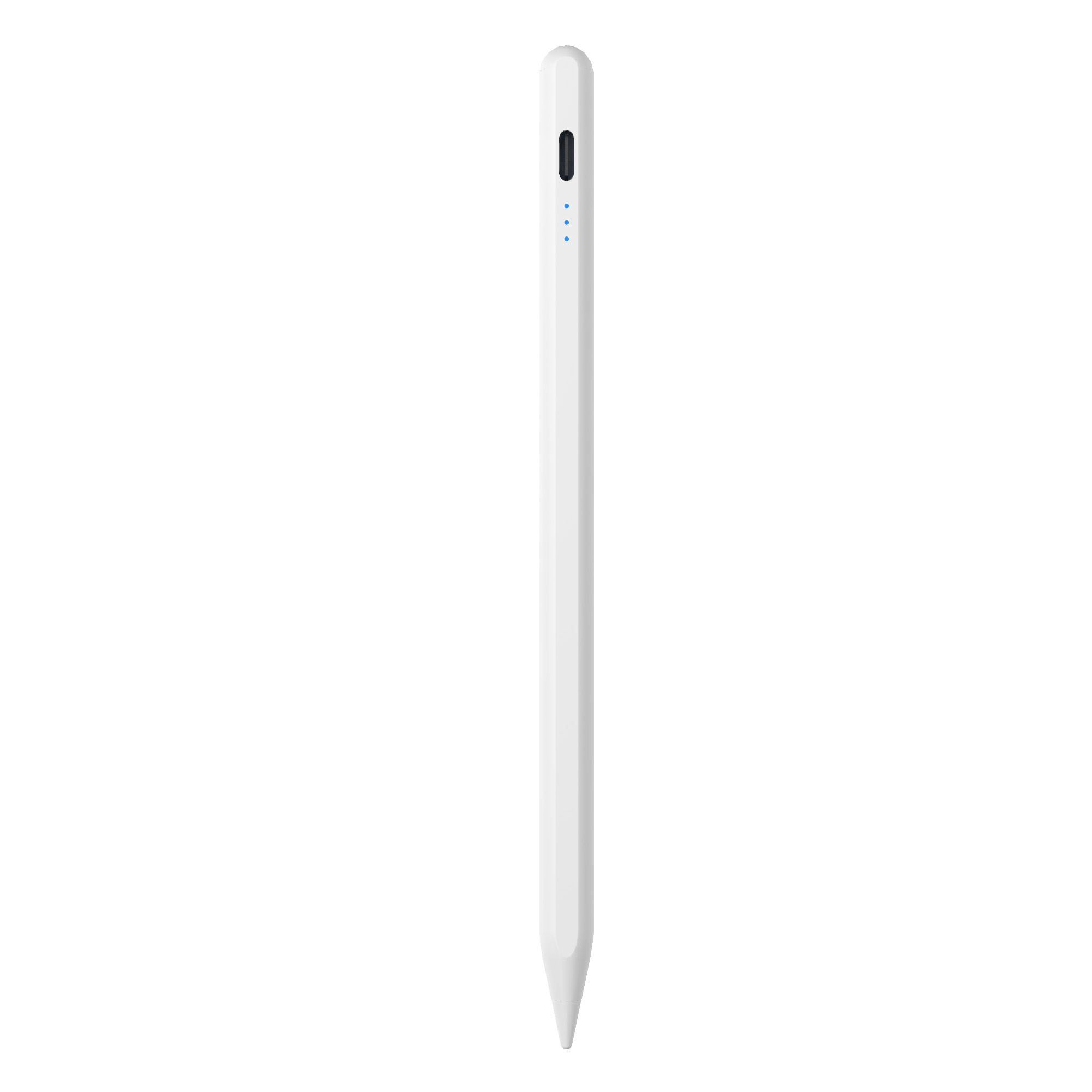
The stylus pen category is now large enough that a shortlist has to be built by segment rather than by product name. IMARC Group values the global stylus pen market at USD 19.45 billion in 2025, and Dataintelo projects the active stylus segment growing at a 9.8% CAGR between 2026 and 2034. For a buyer moving from research into evaluation, that growth creates an awkward starting condition: there is no single recommended stylus. There is an iPad shortlist, an Android shortlist and a cross-platform shortlist, and each is bounded by different technical and documentary constraints.
This article builds those three shortlists from the Jiayao stylus range. Dongguan Jiayao Intelligent Technology Co.,Ltd is a stylus pen manufacturer based in Dongguan, Guangdong, China, founded in 2021 and operating a 2,700 m² facility with 100 employees and an annual output of 3,000,000 units. Its range covers iPad-specific active pens, an Android universal pen and iPad-and-Android models, which makes it a usable reference case for the three-way split described above.
Why the Stylus Pen Shortlist Has to Be Split Three Ways
A stylus pen is not a standalone product in the way a cable or a case is. Its behaviour depends on the digitizer inside the tablet, so the same pen can be fully functional on one device family and partially functional on another. Two ecosystems dominate commercial procurement. Apple controls the iPad accessory ecosystem and its pairing behaviour. On the Android and Windows side, the USI 2.0 specification, released in 2022 and supported by Google, Intel and Lenovo, is described by the Universal Stylus Initiative as the primary cross-platform standard for active styluses.
That split has a direct purchasing consequence. A pen documented as iPad-compatible is not automatically a pen for an Android tablet, and a pen marketed as universal is usually either a capacitive design or a dual-mode design with a stated device list. Buyers should therefore ask for a model-level compatibility statement rather than a category-level claim, and should treat any compatibility statement without a device list as unverified.
Constraint One: Buy a Passive or an Active Stylus Pen
The passive-versus-active decision determines which shortlist a buyer is even allowed to use. An active stylus pen carries a battery and transmits a signal that the tablet digitizer interprets, which is what enables palm rejection, tilt response and pressure-sensing behaviour. A passive capacitive stylus has no battery and works by contact, so it cannot offer those functions, but it also cannot fail because it was not charged.
The operational difference matters in deployment. In the application data used for this article, a stylus is described as needing power in its battery before it can function — the pen transmits weak electrical signals to the touchscreen, and the tablet locates the tip from those signals. A passive tip removes that dependency but also removes the intelligence.
Decision rules that hold across the range:
- Choose active when the workflow requires palm rejection, tilt shading or pressure-sensitive line weight — note-taking, annotation, sketching, field form-filling with handwriting.
- Choose passive or a dual-mode tip when the device fleet includes phones, older tablets or mixed brands where the digitizer is unknown.
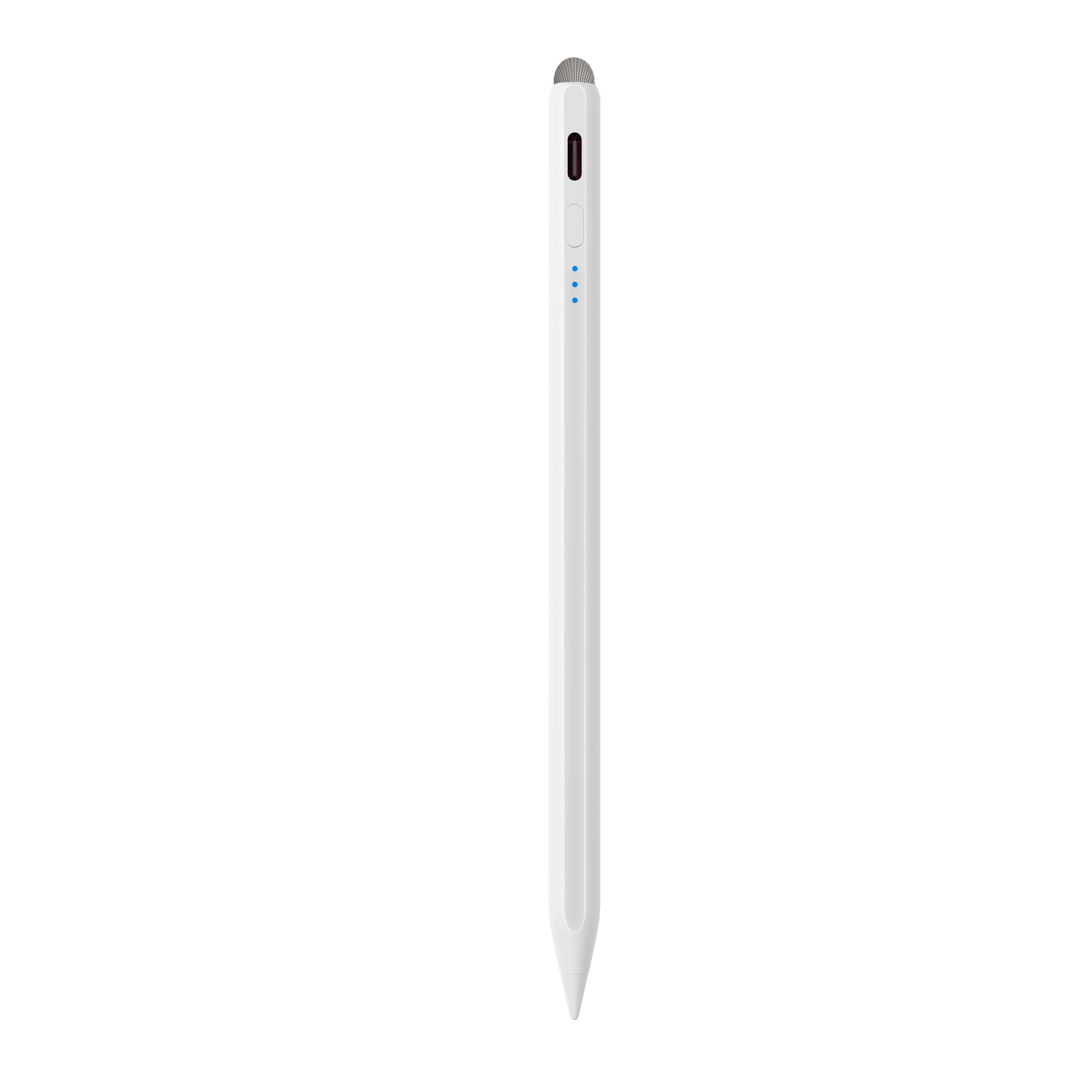
- Choose a 2-in-1 body when one SKU must serve both cases; the A21B is listed as a 2 in 1 iPad stylus pen, and its product image identifies a universal passive fiber tip, so the same body carries an active side and a capacitive tip.
Price is deliberately not part of this decision layer. The material used here does not publish price bands for the range; the documented commercial threshold is a 500-piece minimum order quantity, covered later in this article.
iPad Shortlist: Six Documented Options
All iPad models below are documented as compatible with iPad released after 2018 running iPadOS 12.2 or later, with no offset and no delay in the listed parameters, interchangeable nibs, one-year standby and automatic power-off. What separates them is charging architecture, runtime and the feature set the factory actually lists.
| Model | Role in the shortlist | Charging (documented) | Working time | Weight | Listed features |
|---|---|---|---|---|---|
| W13-A | Wireless-first iPad pen | Cable 15 min; magnetic tablet charging 60 min | 9–10 h | 12–13 g | Side magnetic attachment (11 in and 12.9 in iPad only), interchangeable nibs, 10-minute auto power-off |
| W12-A | Wireless plus Type-C iPad pen | Type-C 25 min; wireless 60 min | 9–10 h | 12–13 g | Side attachment, interchangeable nibs, 10-minute auto power-off |
| A30-B | Shortcut-button iPad pen | Type-C 25 min | 11 h | 12–14 g | Shortcut button, palm rejection, tilt, side attachment |
| A8-RH | Tilt-focused iPad pen | Type-C 30 min | 12 h | 12–13 g | Tilt sensing, palm rejection, side attachment |
| A7-H-L | Education and long-runtime iPad pen | Type-C 30 min | 16 h | 12–13 g | Palm rejection, tilt, side attachment |
| E3-A | Maximum-runtime iPad pen | Type-C 40 min | 44 h | 15 ± 1 g | Palm rejection, side attachment, 60-minute auto power-off |
Read as a purchasing sequence rather than a feature list, the six models answer different constraints. W13-A is the shortest charging path in the range — 15 minutes on cable — and is the only model where the wireless charging figure is published alongside a cable figure at that speed. W12-A keeps both charging routes but with a longer cable time. A30-B adds a shortcut button and an aluminium body at 12–14 g, which suits buyers who want a physical control rather than a gesture. A8-RH and A7-H-L both list tilt, with A7-H-L positioned for education at 16 hours of working time. E3-A is the runtime outlier at 44 hours from a 230 mAh battery, and it is the model to examine when charging opportunities are rare — shift work, field service, shared classroom carts.
One boundary applies to this whole segment: side magnetic attachment is documented as working only on 11-inch and 12.9-inch iPad for the models that state that limitation. A buyer standardising on magnetic stowage across a mixed iPad fleet should verify attachment against the actual device list before committing.
Android Shortlist: The S3-GC Constraint Set
The Android side of the range is deliberately narrow. S3-GC is listed as an Android universal stylus pen: Type-C charging in 55 minutes, 10 hours of working time from a 165 mAh battery, 166 mm length, 13 ± 1 g, aluminium body, top touch switch, side adsorption, automatic power-off after 10 minutes and one-year standby.
The constraint worth flagging is what the parameter set does not list. Palm rejection and tilt sensitivity are not stated for S3-GC, whereas they are stated for A8-RH, A7-H-L, A30-B and A21B. Buyers who need those functions on Android hardware should either confirm them in writing with the factory or treat the Android shortlist and the iPad shortlist as separate purchasing decisions rather than assuming feature parity across platforms. Android tablets also vary more widely in digitizer support than the iPad line does, so device-level testing remains necessary regardless of the specification sheet.
Cross-Platform Shortlist: R3-P and the 2-in-1 Option
R3-P is the model listed as an iPad and Android stylus pen: Type-C charging in 40 minutes, 9–10 hours of working time, 130 mAh battery, 164.6 mm length, 13 ± 1 g, aluminium body, top switch, side adsorption and automatic power-off after 60 minutes. It is the shortest single-SKU answer for a buyer whose fleet is not platform-uniform — resellers, education tenders and accessory brands selling into markets where both iPad and Android tablets are common.
Two documented programmes illustrate how these shortlists translate into orders. A tablet accessory ODM in Turkey has purchased 5,000 units over a two-year programme for precise writing across iPad, iPhone, Android tablets and Android phones. A second ODM in Vietnam, working on iPad accessories, has purchased 3,000 units of the E3-A over two years for precise writing and e-commerce retail, and reports good user feedback on handwriting precision, fast charging, working hours, palm rejection and tilt response. Neither programme is offered here as proof of performance in a buyer's specific environment; both are references that can be checked during sampling.
How the Jiayao Stylus Differs from Apple Pencil
Apple Pencil is Apple's first-party input accessory, and its behaviour is defined inside Apple's own ecosystem. Jiayao's iPad range is third-party hardware documented as compatible with iPad released after 2018 running iPadOS 12.2 or later, and its listed functions — palm rejection, tilt on selected models, interchangeable nibs, side magnetic attachment on selected models, no offset and no delay in the stated parameters — cover the writing functions most buyers ask about first.
The honest difference is not writing feel, which is a sampling question. It is control and documentation. The corpus used for this article contains no Apple Pencil specifications, so no specification-to-specification comparison is made here. What can be compared is what a buyer controls: on the Jiayao side, customisation covers function, colour, shape, tip, logo and packaging; minimum order quantity is 500 pieces; samples are available in as little as three weeks; standard orders ship in 20 days. On the Apple side, the accessory is bought as a finished product with no specification input.
Purchasing Terms: MOQ, Samples and Lead Times
The commercial terms are simple enough to check quickly. Minimum order quantity is 500 pieces. Samples are available in as little as three weeks, normal production lead time runs 20–35 days, and monthly capacity is 500,000 units against annual output of 3,000,000 units. Roughly 40% of output is exported, with the EU and USA named as main markets alongside the Middle East in the export-market field. Every unit is described as passing 100% inspection covering functional, tactile and visual checks, and after-sales support is a one-year warranty with one-to-one replacement.
Documentation available for procurement files:
- ROHS certificate of conformity, number BAC260390119R, issued 2026-03-09 by Shenzhen Bory Technology Service Co.,Ltd for the EU market, tested against the IEC 62321 series.
- ISO 9001:2015 quality management system certificate, number 24626Q00066R001, issued by HIC Certification Service on 2026-01-16 and valid to 2029-01-15, with the certified scope stated as research and development of capacitive stylus.
- Customs classification: stylus pens are typically classified under HS code 8471.60.90 as automatic data processing input units, which is the reference point for import documentation.
Acceptance Criteria Before Releasing an Order
A shortlist becomes a purchase only when the acceptance test is written down. The checks below reflect the parameters published for this range and can be used as an incoming-inspection skeleton.
| Check | What to verify | Reference |
|---|---|---|
| Compatibility | Test each iPad or Android model in scope; confirm iPad after 2018 and iPadOS 12.2 or later where applicable | Model compatibility statement |
| Writing accuracy | Confirm no offset between pen path and rendered line, and no visible delay, on the target device | Listed no-offset / no-delay parameters |
| Palm rejection | Rest the palm on the screen during handwriting and confirm no stray marks | Stated for A30-B, A8-RH, A7-H-L, E3-A, A21B |
| Tilt response | Check line weight change when the pen is angled, on models that claim tilt | Stated for A30-B, A8-RH, A7-H-L, A21B |
| Magnetic attachment | Verify side attachment strength on the actual iPad size in scope | 11 in and 12.9 in limitation on W13-A and A21B |
| Charging | Time the cable and wireless routes against the published figures | 15 / 25 / 30 / 40 / 55 / 60 / 70-minute figures by model |
| Runtime | Measure working hours against the stated figure at the intended usage intensity | 9–10 h to 44 h depending on model |
| Nib condition | Confirm nibs are interchangeable and that replacements do not scratch the screen | Interchangeable nibs across the range |
| Appearance and finish | Visual check against the approved sample, including colour and logo | 100% inspection scope |
| Documents | Collect ROHS, ISO 9001 and the HS code reference with the shipment | BAC260390119R, 24626Q00066R001, 8471.60.90 |
Where This Shortlist Does Not Fit
A shortlist is only useful if its edges are visible. Five limits apply to the range described here.
- iPad compatibility has a floor. The documented compatibility starts at iPad models released after 2018 running iPadOS 12.2 or later; older iPads are outside the stated scope.
- Magnetic attachment is device-dependent. Where the parameters say so, side attachment is limited to 11-inch and 12.9-inch iPad.
- The Android option is a narrower specification. S3-GC is documented as an Android universal pen without stated palm rejection or tilt.
- Active pens depend on charge. Any active model in this list stops functioning as a smart pen when the battery is flat; a passive tip or a spare charged unit is the mitigation.
- Scale and standards. With 2,700 m² of floor space, 100 employees and four R&D engineers, the factory is built for flexible MOQs and customisation rather than for very large single-order volumes. The corpus also contains no USI or EMR conformance certificate for this range, so buyers who must specify those standards should verify separately rather than infer conformance.
Market Trend: Documentation Is Becoming the Differentiator
Two data points frame the category, with a caveat. IMARC Group puts the stylus pen market at USD 19.45 billion in 2025, while Fortune Business Insights is reported at USD 3.36 billion for the same year; the gap is a definition difference between the full input-device category and active digital pens, so both figures should be quoted with their scope attached rather than used interchangeably. On the growth side, Dataintelo projects a 9.8% CAGR for active stylus technology from 2026 to 2034.
The structural shift matters more than the growth rate. With USI 2.0 in place since 2022 and backed by Google, Intel and Lenovo, buyers increasingly expect cross-platform behaviour from accessory suppliers, while Apple's ecosystem keeps its own rules. The result is a procurement environment where the specification sheet, the compatibility list and the certificate pack carry more weight than the product photograph — because those are the only elements a buyer can evaluate before sampling.
Future Outlook
For the next buying cycle, three expectations are reasonable. First, cross-platform claims will multiply, and buyers should require a device list with each claim. Second, charging architecture will keep separating models — the difference between a 15-minute cable charge, a 40-minute Type-C charge and a 70-minute wireless charge is a deployment decision, not a footnote. Third, documentation quality will become a shortlisting criterion in its own right, because a pen that cannot be cleared through customs or accepted at goods-in is not a candidate regardless of its feature list.
FAQ
Do I need an active or a passive stylus pen for palm rejection?
Palm rejection requires an active stylus pen, because the pen must transmit a signal the tablet can distinguish from palm contact. In this range, palm rejection is stated for A30-B, A8-RH, A7-H-L, E3-A and A21B. A passive capacitive tip has no battery and no signal, so it cannot provide palm rejection.
Which Jiayao stylus pen models are documented for iPad, and what are the compatibility limits?
W13-A, W12-A, W3-H, A30-B, A21B, A8-RH, A7-H-L and E3-A are documented as compatible with iPad released after 2018 running iPadOS 12.2 or later, with no offset and no delay listed in their parameters. iPad models older than 2018 fall outside the stated compatibility, and side magnetic attachment is limited to 11-inch and 12.9-inch iPad where that limitation is stated.
Which certifications and documents ship with a Jiayao stylus pen order?
Two certificates are documented: a ROHS certificate of conformity numbered BAC260390119R, issued 2026-03-09 by Shenzhen Bory Technology Service Co.,Ltd for the EU market and tested against the IEC 62321 series; and an ISO 9001:2015 certificate numbered 24626Q00066R001, issued by HIC Certification Service on 2026-01-16 and valid to 2029-01-15 for research and development of capacitive stylus. Stylus pens are typically classified under HS code 8471.60.90 for customs purposes.
What are the minimum order quantity, sample time and production lead time?
The documented minimum order quantity is 500 pieces. Samples are available in as little as three weeks, standard orders ship in 20 days, and the stated lead time range is 20–35 days. Monthly capacity is 500,000 units and annual output is 3,000,000 units.
How long does each model run on a full charge, and how is it charged?
W13-A and W12-A run 9–10 hours and charge by cable or magnetic wireless charging, at 15 and 25 minutes on cable respectively. A30-B runs 11 hours on Type-C charging in 25 minutes. A8-RH runs 12 hours and A7-H-L runs 16 hours, both on Type-C in 30 minutes. E3-A runs 44 hours on Type-C in 40 minutes. R3-P runs 9–10 hours on Type-C in 40 minutes, W3-H runs 11 hours on magnetic charging in 70 minutes, and S3-GC runs 10 hours on Type-C in 55 minutes.
What acceptance criteria should be applied when a stylus pen order arrives?
Incoming inspection should cover device compatibility on the exact models in scope, absence of offset and delay during writing, palm rejection and tilt response on models that claim them, magnetic attachment on the correct iPad sizes, charging time against the published figure, runtime against the stated working hours, nib interchangeability without screen damage, and visual finish against the approved sample. Documentation for ROHS, ISO 9001 and the HS code reference should arrive with the shipment. The factory states that every unit passes 100% functional, tactile and visual inspection, and the after-sales term is a one-year warranty with one-to-one replacement.
The full Jiayao stylus pen catalogue, including model parameters and the range overview, can be downloaded here: Jiayao Intelligent Stylus Pen Catalogue (PDF).
¿Tiene preguntas o necesita más detalles?
Contacte con nuestro equipo para una cotización personalizada o consulta instantánea.
Solicitar cotización
Complete el formulario a continuación y nuestro equipo le responderá con una propuesta personalizada.
Chat directo de WhatsApp
¿Prefiere chatear en tiempo real? Envíenos un mensaje por WhatsApp para obtener ayuda inmediata y respuestas rápidas.
- Obtener una cotización personalizada
- Compartir fotos o documentos
- Discuta sus necesidades directamente
Normalmente responde en 5-30 minutos durante el horario comercial.