
Structure Tent Specs: Wind, Snow, Fire and Certification
Structure tents are no longer limited to temporary event shelters. They are now used for industrial storage, logistics hubs, sports halls, exhibition venues and even aircraft hangar cover. For buyers moving from research to evaluation, the main decision criteria are not only price and span width. They are structural performance under wind and snow, fire behavior of materials, fabrication quality, and the certifications that allow the structure to be approved and insured for the intended site. This article explains which structure tent specifications matter, how verification standards differ by market, and what evidence a buyer should request from suppliers.
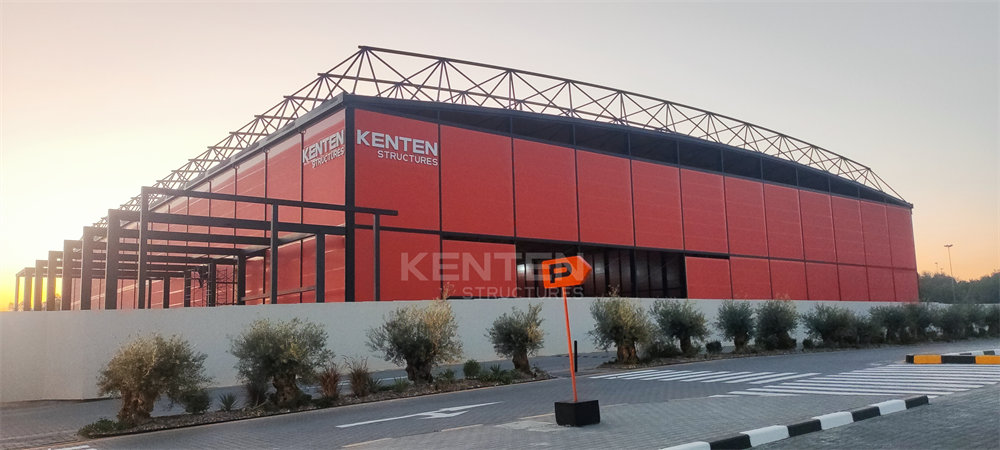
A large-span modular structure tent used for exhibition space. The clear span design removes internal columns and maximizes usable floor area.
Why specification verification is the real procurement problem
Any structure tent supplier can quote a span, a height and a delivery time. The difficulty lies in comparing products that are designed and tested under different assumptions. A tent advertised as wind resistant may be rated for a specific site profile, anchoring method, or roof geometry. A fire-retardant claim may apply only to the roof fabric, while sidewalls, doors, lining and connecting components may carry a different fire performance.
In the European Union, temporary structure tents with a ground area above 50 square meters must satisfy EN 13782:2015, which addresses structural stability under wind and snow loads. In North America, tent fabrics are commonly required to meet NFPA 701, the standard for flame propagation of textiles and films. For industrial buyers, these requirements are not paperwork details. They determine whether a structure can receive a permit, whether insurance is available, and whether the structure remains safe under repeated loading.
Key procurement shift: The assessment of a structure tent is moving from visual inspection to verified performance. Buyers increasingly ask for load calculations, fabric test certificates, factory inspection records and execution-class documentation before comparing prices.
What an engineered structure tent supplier should provide
KENTEN Structures, founded in 2001, designs and manufactures aluminum permanent and semi-permanent structures, including structure tents, warehouse tents, atrium tents, curved tents, double-decker and triple-decker tents, and pyramid structures. The company operates manufacturing centers in China, the United States, and the Middle East, with a manufacturing base of 80,000 square meters and an annual output of up to 1,000,000 square meters. Around 80% of KENTEN production is exported, primarily to the United States and the European Union.
The main structure tent range uses model designations K1 through K10 and covers span widths from 3 meters to 80 meters. Length is unlimited and can be extended in 5 meter bay spacing. The warehouse tent, model designation W1, covers spans from 3 meters to 60 meters and is designed for manufacturing and logistics environments. Both product groups use high-strength aluminum alloy 6061-T6 or 6082-T6 for the main frame.
According to KENTEN, all structures are produced and fully certified to IBC 2024, CBC 2025, ASCE 7-22, GB 50429 and EN 13782. The K-series Structure Tent is separately CE certified under EN 1090-3:2019 with certificate number 8605682, issued by LL-C (Certification) Czech Republic a.s. and valid for the European Union market. The product also carries ISO 9001, ISO 14001 and ISO 45001 certifications applicable globally.
Technical explanation: reading structure tent specifications
Wind resistance and anchoring
The K-series structure tent has a wind resistance rating of up to 140 km/h, depending on configuration. The W1 warehouse tent is rated for up to 120 km/h. Wind performance is influenced by frame geometry, fabric tension, sidewall options, and the anchoring system. KENTEN structure tents can be installed using ground anchors or concrete ballast, while the warehouse tent is typically fixed with concrete anchors or ground stakes, depending on site conditions. Buyers looking for a wind and snow resistant structure tent should verify the rated wind speed and snow load against local site data.
Snow load and roof design
Snow load capacity is a key parameter for regions with seasonal snowfall. The K-series structure tent supports a snow load of up to 0.5 kN per square meter. The W1 warehouse tent has a rated snow load of up to 75 kg per square meter. These values should be checked against the local building code for the project location, as the required design load depends on altitude, roof slope and local climate data.
Fire retardancy and fabric performance
For a PVC fabric structure tent, the fabric specification determines both fire classification and replacement cycle. KENTEN uses 850 g/m² PVC coated polyester fabric for the roof cover of the structure tent. The same specification is used for the warehouse tent roof, with UV treatment and fire-retardant properties. The K-series structure tent is rated to DIN 4102 B1, M2 and NFPA 701, depending on the target market. For EU temporary structures over 50 square meters, EN 13782 also requires structural stability under wind and snow loads.
Sidewall and closure options
The choice of sidewall changes the building performance. The K-series structure tent offers PVC walls, glass walls, ABS walls, and sandwich panels. The W1 warehouse tent offers PVC, corrugated steel, or sandwich panels. Glass walls are common for event and hospitality spaces; sandwich panels add thermal insulation and are more common in permanent or semi-permanent industrial buildings.
Lifespan and life-cycle planning
The aluminum frame of a KENTEN structure tent is designed for more than 20 years of service. The PVC fabric roof generally lasts 8 to 15 years, depending on UV exposure, climate, and maintenance. For buyers planning a long-term deployment, fabric replacement should be included in the life-cycle budget.
Product comparison: K-series vs W1 warehouse tent
| Parameter | K1–K10 Structure Tent | W1 Warehouse Tent |
|---|---|---|
| Span width | 3–80 m | 3–60 m |
| Length | Unlimited, 5 m bay spacing | Customizable, typically 10–100 m+ |
| Eave / peak height | Eave 2.5–8 m | Peak ~9 m at 30 m span |
| Main frame | 6061-T6 / 6082-T6 aluminum | 6061-T6 / 6082-T6 aluminum |
| Roof cover | 850 g/m² PVC, fire-retardant | 850 g/m² PVC, UV-treated, fire-retardant |
| Wind resistance | Up to 140 km/h | Up to 120 km/h |
| Snow load | Up to 0.5 kN/m² | Up to 75 kg/m² |
| Fire classification | DIN 4102 B1, M2, NFPA 701 | Fire-retardant roof cover |
| Sidewall options | PVC, glass, ABS, sandwich panel | PVC, corrugated steel, sandwich panel |
| Foundation | Ground anchors or concrete ballast | Concrete anchors or ground stakes |
| Lifespan | Aluminum 20+ years; PVC 8–15 years | Aluminum frame; PVC roof replaceable |
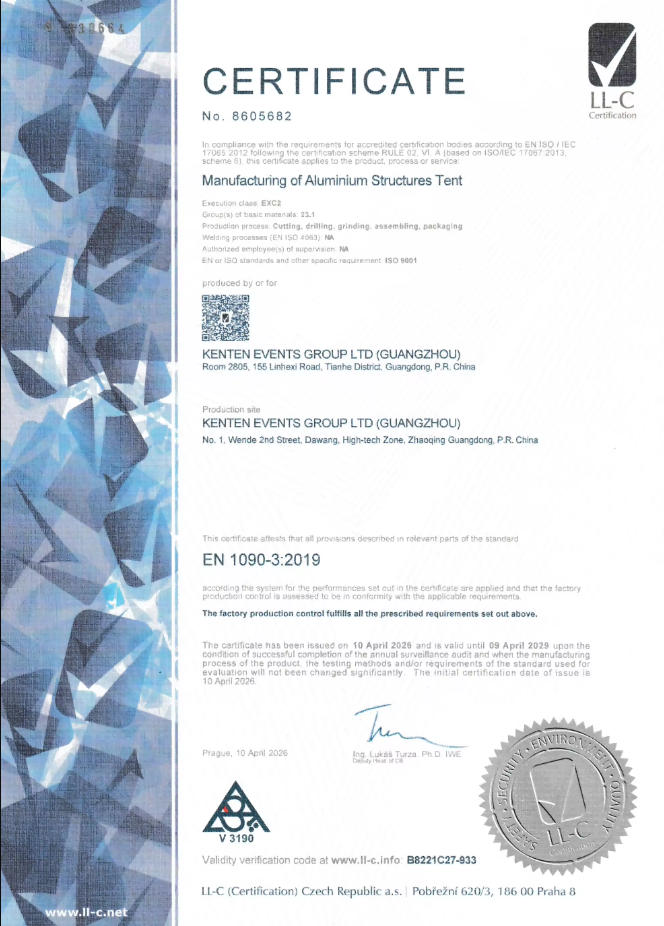
CE documentation for KENTEN structure tent manufacturing. Certificate number 8605682 covers production processes from cutting to packaging under execution class EXC2.
Applications: how specifications map to site requirements
Different applications place different demands on a structure tent. For warehouse and logistics projects, the W1 warehouse tent is used as a temporary warehouse, distribution center, or storage shelter. The combination of wind resistance, snow load capacity, and a waterproof, fire-retardant roof makes it suitable for industrial sites where quick assembly and demountability are important. During construction projects, structure tents also provide temporary storage for materials and equipment.
For event and exhibition venues, the K-series clear span structure tent produces column-free interiors that can reach 80 meters. This makes the structure suitable for exhibition halls, trade shows and temporary venues. Glass walls, flooring, LED lighting and HVAC systems can be added to turn the tent into a climate-controlled environment. KENTEN structures have been used at the 2008 Beijing Olympic Games, the 2022 Beijing Winter Olympic Games, and the 19th Asian Games in Hangzhou, providing security checkpoints, VIP areas, media spaces, and storage functions.
Sports facility projects use structure tents for tennis courts, basketball halls, swimming pool covers, and grandstand support. The K-series can be paired with sports flooring, grandstands, LED lighting and HVAC to create all-weather training and spectator spaces. For aviation and automotive applications, large span tents with vehicle access doors can function as aircraft hangars, maintenance facilities, vehicle workshops, or temporary showrooms. For wedding banquets and premium hospitality projects, atrium structure tents with glass walls, lining, flooring, and HVAC create a fully enclosed climate-controlled venue.
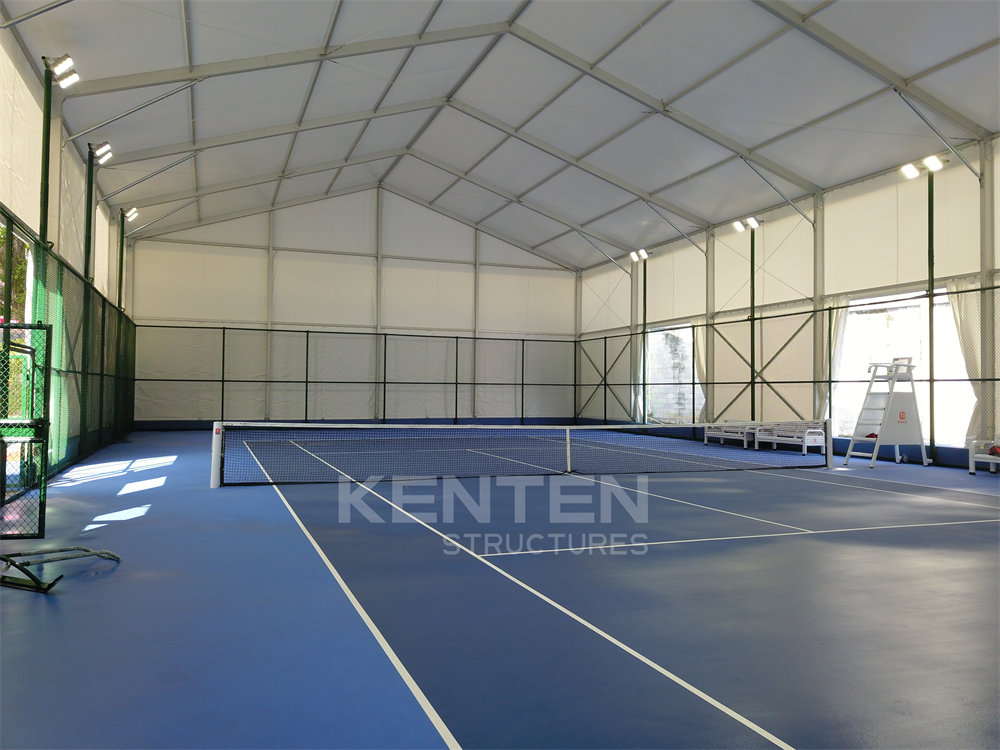
A structure tent used as a sports facility cover. Large clear span and fire-retardant fabric support safe, all-weather use.
Market trends: certified structures are becoming the baseline
Data from the Observatory of Economic Complexity shows that China’s exports of tents, awnings, and sails reached approximately USD 3.11 billion in 2024, with China holding a 53.3% share of global exports. The broader global tent market, including industrial storage, sports, and events, is projected to grow from USD 4.01 billion in 2025 to USD 6.07 billion by 2033, with a compound annual growth rate in the range of 5–7%.
This growth is not limited to event rental tents. Industrial users are using structure tents as semi-permanent warehousing during supply chain adjustment, seasonal peaks, and construction projects. As structures remain on site longer, local authorities pay more attention to engineering standards, fire classifications, and load-certification documents. EN 13782 for large temporary structures and NFPA 701 for tent fabrics are examples of the regulatory baseline that buyers now encounter.
Comparison with traditional structures: where the boundary sits
Compared with conventional steel-frame or concrete buildings, a structure tent offers faster deployment, lower initial investment, and greater reusability. A 30-meter clear span can be delivered as a modular kit and installed in days, and it can be demounted and relocated to another site. The aluminum frame is durable and recyclable, and the PVC fabric can be replaced without replacing the entire structure.
There are, however, realistic boundaries. A structure tent has lower thermal mass and acoustic insulation than a fixed building. It is not designed to support heavy overhead cranes, complex process utilities, or multi-story permanent loads. In the KENTEN product range, the maximum standard clear span is 80 meters; projects requiring wider volumes or long-span steel roof systems may still be better served by conventional construction. Buyers should treat structure tents as an engineering option within a broader facility strategy, not as a universal replacement for permanent buildings.
Future outlook
The next phase of the structure tent market will likely be defined by modularity, documentation, and standardization. Buyers will expect load calculations and fire certifications to be delivered with the proposal, not after the order. Fabric replacement programs, spare parts planning, and remote technical support will become part of the procurement conversation. Suppliers that present structure tents as engineered building systems rather than market tents will be better positioned for industrial, institutional, and government projects.
A detailed technical overview of KENTEN structure tents and warehouse tents is available in the company catalog: KENTEN Structures Catalog.
FAQ
What wind speed can a structure tent withstand?
A KENTEN K-series structure tent is rated for wind resistance up to 140 km/h, depending on configuration and anchoring. The W1 warehouse tent is rated for up to 120 km/h. Final performance depends on site exposure, installation method, and the use of ground anchors or concrete ballast.
What fire safety standards apply to structure tent fabric?
KENTEN uses 850 g/m² PVC coated polyester fabric that is UV-treated and fire-retardant. The K-series structure tent carries flame-retardant classifications DIN 4102 B1, M2, and NFPA 701. In the EU, large temporary tents with a ground area above 50 square meters must also meet EN 13782:2015 for structural stability under wind and snow loads.
Which certifications should a structure tent supplier hold for EU projects?
For aluminum structure tent manufacturing, CE marking under EN 1090-3:2019 is directly relevant. KENTEN Structures holds CE certificate number 8605682, issued by LL-C (Certification) Czech Republic a.s., covering manufacturing processes with execution class EXC2. In addition, the structure itself should meet EN 13782:2015 for temporary structures above 50 square meters.
How long can a structure tent last?
The aluminum frame of a KENTEN structure tent is designed for more than 20 years of service. The PVC fabric roof generally lasts 8 to 15 years, depending on climate, UV exposure, and maintenance. Fabric replacement is a normal part of the life cycle and does not require replacing the aluminum frame.
What is the maximum clear span of a KENTEN structure tent?
The KENTEN K-series structure tent is available in standard spans from 3 meters up to 80 meters. Length is unlimited and can be extended in 5 meter bay spacing. The W1 warehouse tent covers spans from 3 meters to 60 meters.