
Strawberry Ingredients Guide: Fresh, IQF and Freeze-Dried
Strawberry Ingredients Guide: Fresh, IQF and Freeze-Dried
How one supply chain covers fresh fruit, individually quick frozen (IQF) berries, freeze-dried whole fruit, powder and inclusions for global food manufacturers.
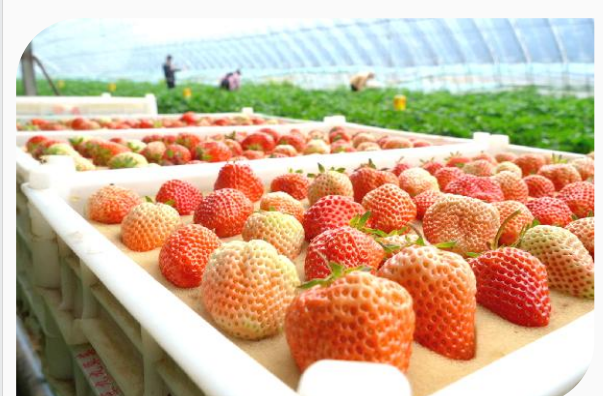
Fresh strawberry growing base — the starting point of a multi-form strawberry supply chain.
UrSnacks is a freeze-dried fruit brand and strawberry ingredient manufacturer founded in 2016, operated by FUJIAN YOULINGYOUSHI TECHNOLOGY CO., LTD. in Jinjiang, Quanzhou, Fujian Province, China. The company supplies strawberry in four coordinated product forms — fresh fruit, IQF frozen berries, finished freeze-dried products, and freeze-dried ingredients — and, according to a Market Position Statement issued by Frost & Sullivan, ranked first by freeze-dried fruit sales volume in mainland China in 2024.
Strawberry is one of two strategic core categories for the manufacturer (alongside durian), supported by an integrated value chain that spans raw-material sourcing, freeze-drying processing, quality control, and OEM/ODM private-label delivery. For procurement teams and product developers evaluating strawberry raw materials, the practical question is no longer only “fresh vs frozen.” It is which product form and specification best fits the production line, shelf-life requirement, and label claim. This guide maps the available forms, the processes behind them, and the application scenarios where each is most effective.
The Strawberry Supply Challenge: Perishability, Seasonality and Clean-Label Demand
Fresh strawberries are a high-demand fruit with a short commercial window. Under proper cold-chain conditions, clamshell-packed fresh strawberries typically hold a shelf life of approximately 5–10 days, with ideal storage at 0–2°C and full cold-chain handling at 0–4°C, according to UrSnacks’ product specification. That perishability creates a structural problem for food manufacturers: strawberry flavor, color, and nutrition are needed year-round, but fresh supply is seasonal, regional, and transport-sensitive.
The industry response has been to convert strawberry into stable intermediate forms. The global fresh strawberry market was valued at USD 21.0 billion in 2024 and is projected to reach USD 28.4 billion by 2033, according to WiseGuy Reports. The freeze-dried strawberry market was valued at approximately USD 1.86 billion in 2024, with an expected CAGR of 5.9% through 2035, per WiseGuyReports. Within that market, clean label positioning is the dominant claim, accounting for a 44.2% share of positioning as of 2026 projections, per Future Market Insights.
These three data points define the opportunity. Demand for strawberry is growing across fresh, frozen, and dried categories, and buyers increasingly need forms that deliver authentic fruit content without artificial additives. Freeze-dried strawberry — offered as whole berries, slices, dice, and powder — meets that requirement because it preserves structure, color, and flavor while operating at ambient temperature in the supply chain.
UrSnacks’ Strawberry Product System: One Fruit, Four Forms
UrSnacks addresses this demand with a strawberry portfolio spanning four coordinated product forms. The range is designed so that a single supply partner can cover retail fresh programs, industrial frozen processing, clean-label dry ingredients, and finished single-serve snacks.
- Fresh strawberry: clamshell-packed, graded Premium ≥25g, Grade A 18–25g, Grade B 12–18g per fruit; varieties include Benihoppe (Hongyan), Sachinoka (Miaoxiang), and Akihime (Zhangji), sourced from Dandong (Liaoning) and Shandong; air freight preferred for long-distance export.
- IQF frozen strawberry: individually quick frozen, unsweetened, free-flowing whole/sliced/diced berries; Grade A/B; whole berries graded by diameter at 15–25mm, 25–35mm, and 35mm+; common varieties include Sweet Charlie, Camarosa, and Senga Sengana; stated MOQ is one 40ft reefer container (approx. 24–26 MT).
- Freeze-dried strawberry ingredients: whole berries (S 25–30mm / M 30–35mm / L 35–40mm), slices (length <55mm, cut face 30–35mm), dice (standard 5–8mm, fine 3–5mm, large 8–10mm), and powder (60–80 mesh coarse, 80–100 mesh standard, 100–120 mesh fine); source varieties include Dandong Hongyan and Shandong Miaoxiang.
- Finished freeze-dried snacks: single-serve coated strawberry crisps in original, chocolate, matcha, and cheese coatings, plus a 35g pure whole freeze-dried strawberry product made from Dandong Hongyan fruit with no added sugar, coating, colorant, or preservative.
Production Footprint and Capability Facts
| Capability | Detail |
|---|---|
| Facilities | 100,000 m²+ freeze-dried food manufacturing and customization facilities, integrating production bases, a customization center, and warehousing. |
| Workforce | Approximately 200 employees; in-house R&D team of 10 engineers; industry-university-research cooperation with the School of Physical Science and Technology, Xiamen University. |
| Capacity | Combined annual capacity of 3,000+ metric tons for core freeze-dried categories; customization center designed annual finished-product capacity of 4,500 metric tons; 12 automated packing lines. |
| Certifications | BRCGS Food Safety, ISO 22000, HALAL, SMETA, SC (China Food Production License), and U.S. FDA Food Facility Registration (held by the authorized manufacturing entity). |
| Intellectual property | As of June 2026, 24 granted and in-force patents in China, including 2 invention patents; affiliated entities hold 15 computer software copyright registrations. |
| Export track record | Export business accounts for 20% of sales; current markets include the USA, Japan, South Korea, Canada, Germany, Thailand, and Indonesia; 150+ brand customers served to date. |
Strawberry Product Specifications at a Glance
| Form | Key Specifications | Primary Applications | Shelf Life |
|---|---|---|---|
| Fresh strawberry | Premium ≥25g / Grade A 18–25g / Grade B 12–18g; 250g or 500g punnet | Fruit retail, fresh-cut, HoReCa, bakery and tea-shop topping | 5–10 days at 0–2°C |
| IQF strawberry | Whole 15–25 / 25–35 / 35+mm; sliced/diced per PO; 10kg carton | Bakery, jam & puree, beverage & smoothie, dairy & ice cream, foodservice | 24 months at ≤−18°C |
| Whole freeze-dried strawberry | S 25–30 / M 30–35 / L 35–40mm; length <55mm; moisture ≤5% | Direct snacking, chocolate enrobing, premium cereal topping | 18 months ambient |
| Freeze-dried strawberry slices | Length <55mm; cut face 30–35mm; moisture ≤5% | Cereal, yogurt & dairy, bakery, direct snacking | 18 months ambient |
| Freeze-dried strawberry pieces | Regular 5–8mm; fine 3–5mm; large 8–10mm; custom cuts available | Cereal, chocolate, snack/protein bars, bakery inclusions | 18 months ambient |
| Freeze-dried strawberry powder | 60–80 / 80–100 / 100–120 mesh; 3.2–3.5kg foil bag | Beverage & smoothie, bakery & confectionery, dairy & yogurt, ice cream | 18 months ambient |
| Coated freeze-dried strawberry | 22g–38g single-serve bags; original, chocolate, matcha, cheese coatings | E-commerce, supermarkets, convenience, discount snack chains, OEM/private label | 12–18 months ambient |
How Freeze-Drying and IQF Preserve Strawberry Quality
UrSnacks produces freeze-dried strawberry using FD vacuum freeze-drying at −40°C. Strawberries are washed and sorted, frozen, then placed under vacuum so that ice sublimates directly from solid to vapor. Because the fruit never passes through a liquid-water stage during drying, the cellular structure, color, and volatile flavor compounds are largely retained. Finished ingredients carry moisture ≤5% and an 18-month shelf life in aluminum foil bag + carton packaging.

Vacuum freeze-drying removes moisture while preserving the structure of the fruit.
The nutritional argument for freeze-drying is well established in industry literature. According to Transpire Insight, freeze-drying technology preserves approximately 97% of the original nutritional content of strawberries, compared with about 55% for conventional heat drying. For product developers, this translates into a clean-label ingredient that needs fewer compensatory additives for color, flavor, or texture.
IQF strawberry follows a different logic. In the IQF process, whole or cut berries are frozen individually so that the product remains free-flowing rather than forming a block. UrSnacks supplies IQF unsweetened strawberries in Grade A or Grade B, stored and transported at ≤−18°C with a 24-month shelf life at that temperature. Third-party microbiology testing is available upon request. Raw material for IQF lines is confirmed per purchase order; common varieties include Sweet Charlie, Camarosa, and Senga Sengana, with origins mainly in China (Shandong, Hebei, Liaoning) or Egypt/Morocco.
For freeze-dried ingredients, the primary source varieties are Dandong Hongyan from Dandong, Liaoning (a China National GI region) and Shandong Miaoxiang. This origin control matters for buyers who need consistent color, brix, and piece integrity across seasonal production windows. Coated finished products carry the same moisture ≤5% standard and declare allergens transparently — coated variants containing milk, whey, soy, or cheese are labeled accordingly, and the pure whole 35g product declares no major allergens.
Strawberry Ingredients Across Food Categories
UrSnacks’ strawberry range is specified for distinct production environments, from high-temperature baking lines to low-temperature ice cream masses. The application scenarios documented by the company illustrate how each format behaves in industrial use.
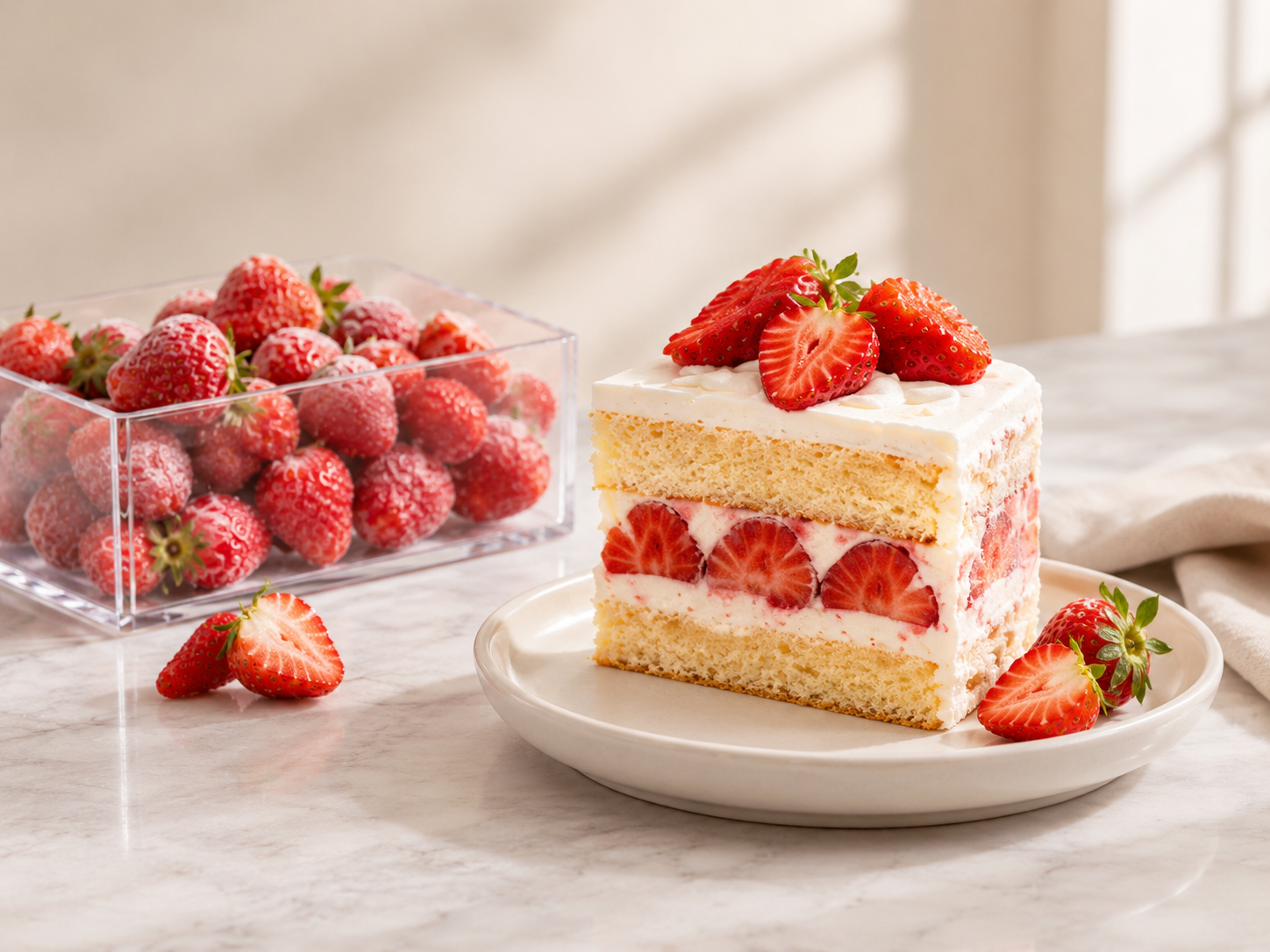
IQF and freeze-dried strawberry formats are used across bakery, cereal, dairy, and beverage production.
Bakery, Patisserie and Confectionery
In industrial bakeries and patisserie chains, freeze-dried strawberry pieces and powder provide zero moisture migration in dough, no color bleeding into white batters, and extended finished-goods shelf life, while enabling a real-fruit label claim. Applications include folding into dough, sprinkling on batter surfaces, embedding in fillings, cake-top decoration, and chocolate enrobing.
Cereal, Granola and Snack Bars
For granola, muesli, and RTE cereal manufacturers, freeze-dried strawberry slices and dice are dry-blended directly into the line. The format retains crunch, contributes natural color and authentic flavor, and is shelf-stable without refrigeration. Because the pieces are brittle, UrSnacks’ application guidance recommends gravity or vibratory feeders over screw conveyors to limit breakage.
Ice Cream, Yogurt and Dairy
Ice cream and yogurt producers use freeze-dried strawberry chunks folded into masses and powder blended into bases. The pieces hold their structure in low-temperature, high-sugar matrices, deliver real fruit-bite texture, and provide natural color as an alternative to artificial dyes. No thawing is needed before incorporation.
Beverages and Puree
The strawberry puree market is valued at USD 2.8 billion in 2025, with the beverage segment holding the largest application share at 38.2%, according to Dataintelo. For beverage and bubble-tea puree makers, IQF strawberries function as a season-independent flavor base; freeze-dried strawberry powder serves instant mixes and dry beverage blends.
Retail, E-commerce and Food Manufacturing
Finished freeze-dried strawberry snacks operate on ambient shelves with no cold chain, which lowers fulfillment cost for e-commerce and D2C brands. For food manufacturers and ingredient traders, bulk freeze-dried strawberry is supplied in 3.2–3.5kg foil bags with custom cuts available on request, supporting downstream repacking or formulation.
Market Signals Shaping Strawberry Sourcing
Several verifiable market signals are shaping how buyers source strawberry raw materials in 2025–2026:
- Clean label is the dominant claim. Clean label positioning accounts for a 44.2% share of the freeze-dried strawberry market as of 2026 projections, per Future Market Insights. This favors ingredients with no added sugar, colorant, or preservative — a profile that matches pure whole freeze-dried strawberry and unsweetened IQF formats.
- Freeze-dried strawberry is in a growth phase. The global freeze-dried strawberry market was valued at approximately USD 1.86 billion in 2024 and is expected to grow at a CAGR of 5.9% through 2035, per WiseGuyReports.
- Fresh strawberry demand continues to expand. The global fresh strawberry market is projected to grow from USD 21.0 billion in 2024 to USD 28.4 billion by 2033, per WiseGuy Reports, sustaining upstream demand for premium growing regions such as Dandong and Shandong.
- Regulatory traceability is tightening. EU Regulation 2023/2429, effective January 2025, modernizes marketing standards for fruits and vegetables and impacts traceability and labeling for imported strawberry products. Export-oriented suppliers must maintain documentary and lot-level traceability.
- The frozen supply base is globalizing. In 2024, Egypt became the world’s leading exporter of frozen strawberries with a 27% global market share and export volumes reaching 350,000 metric tons, per Expana/European Commission data. UrSnacks’ IQF strawberry offering already lists China, Egypt, and Morocco as origin options, confirmed per purchase order.
- The competitive landscape includes large global players. Key players identified in the freeze-dried fruit and ingredient sector include Nestlé S.A., Dole Food Company, Chaucer Foods, and Olam International, per Market Research Future and Dataintelo. Regional specialists compete on raw-material access, customization capability, and supply-chain integration.
Freeze-Dried vs. Traditional Drying: What Buyers Should Know
Comparing freeze-dried strawberry to conventional heat-dried fruit gives buyers a clearer framework for specification decisions. Freeze-drying preserves approximately 97% of the original nutritional content of strawberries, compared with about 55% for conventional heat drying, according to Transpire Insight. Freeze-dried berries also retain their original shape and rehydrate rapidly, while heat-dried products typically lose more color, shrink, and develop a leathery texture.
Against fresh strawberry, freeze-dried offers an 18-month ambient shelf life versus a 5–10-day window under cold chain. Against IQF, freeze-dried offers convenience (no thawing, no refrigeration) and a crisp ready-to-eat texture, while IQF remains the lower-cost base for purees, jams, and processed fillings.
One honest limitation: freeze-dried strawberry is a value-added ingredient with a higher per-kilo cost than air-dried or IQF fruit, because vacuum freeze-drying is energy-intensive and removes nearly all water. The material is also brittle and highly hygroscopic, so it requires moisture-barrier packaging, protection from compression during transit, and resealing within 24 hours after bulk opening to prevent breakage and caking. Buyers weighing cost per kilo should offset the higher unit price against texture, flavor retention, label benefits, and lower logistics cost from ambient shipping.
Outlook: Strawberry as a Year-Round Strategic Ingredient
UrSnacks positions strawberry and durian as its strategic core categories, delivering full-value-chain supply across fresh, IQF, finished freeze-dried, and ingredient forms. The company’s stated target markets — North America, Japan & Korea, the Middle East, Southeast Asia, and Russia — align with demand for certified, traceable fruit ingredients: the manufacturing entity holds FDA Registration, BRCGS Food Safety, ISO 22000, HALAL, SMETA, and SC certification, which supports market access across these regions.
The direction of demand points toward clean-label, real-fruit ingredients with transparent origin and allergen labeling. For strawberry, that means more buyers will specify whole freeze-dried berries for visual topping, dice for cereal and bar inclusions, powder for dairy and beverage systems, and IQF for high-volume processing — often from the same supplier to simplify qualification and quality control. UrSnacks’ model of coordinated product forms and private-label customization positions strawberry as a year-round strategic ingredient rather than a seasonal commodity.
Evaluate UrSnacks as a strawberry ingredient partner
UrSnacks, a brand of FUJIAN YOULINGYOUSHI TECHNOLOGY CO., LTD., supports own-brand distribution, OEM/ODM contract manufacturing, B2B freeze-dried ingredient wholesale, channel distribution, and cross-border export supply. Product specifications, certifications, and cooperation models are documented in the company brochure.
Download the UrSnacks company brochure (PDF)
Contact: Jerry Lu · sales2@ursnacks.cn · +86 18005073978 (WhatsApp available) · www.urorchard.com
FAQ: Strawberry Sourcing and Product Forms
What strawberry product forms does UrSnacks supply?
UrSnacks supplies strawberry in four coordinated product forms: fresh strawberries, IQF (individually quick frozen) strawberries, finished freeze-dried strawberry products, and freeze-dried strawberry ingredients. The ingredient range includes whole berries, slices, dice/pieces, and powder; finished products include pure whole and coated single-serve crisps.
Which certifications apply to UrSnacks strawberry products?
UrSnacks’ strawberry products are manufactured by JINJIANG YOULINGYOUSHI FOOD CO., LTD. under production license SC11735058207253. The authorized manufacturing entity holds BRCGS Food Safety, ISO 22000, HALAL, SMETA, and SC (China Food Production License), and has completed U.S. FDA Food Facility Registration. Coated variants declare allergens such as MILK, SOY, or cheese-derived ingredients on the label.
What are the standard specifications for bulk freeze-dried strawberry ingredients?
Whole freeze-dried strawberries are sized S 25–30mm, M 30–35mm, or L 35–40mm with length under 55mm. Slices are cut to under 55mm length with a 30–35mm cut face. Dice are available in regular 5–8mm, fine 3–5mm granules, and large 8–10mm cuts. Powder is offered at 60–80 mesh (coarse, bakery inclusions), 80–100 mesh (standard), and 100–120 mesh (fine, drinks/instant mixes). Bulk packs use 3.2–3.5kg aluminum foil bags, moisture ≤5%, shelf life 18 months, with source varieties including Dandong Hongyan and Shandong Miaoxiang.
How does freeze-dried strawberry compare with conventionally dried strawberry?
According to Transpire Insight, freeze-drying preserves approximately 97% of the original nutritional content of strawberries, compared with about 55% for conventional heat drying. Freeze-dried strawberry retains its shape, color, and crisp texture and rehydrates quickly, whereas heat-dried strawberry typically shrinks and loses more color. Freeze-drying is more energy-intensive, which is reflected in a higher unit cost.
Which food categories use UrSnacks strawberry ingredients?
Documented application categories include bakery and patisserie, cereal and granola, ice cream and dairy, beverages and smoothies, direct snacking, foodservice, and food manufacturing. IQF strawberry also serves jam and puree production, while freeze-dried powder and pieces are specified for dry mixes, inclusions, and toppings.
What is the minimum order for IQF frozen strawberries?
The stated MOQ for IQF frozen strawberries is one 40ft reefer container, approximately 24–26 metric tons. Product is IQF, unsweetened, and free-flowing, stored and transported at −18°C or below, with a shelf life of 24 months at that temperature. Confirmed parameters include grade, form (whole/sliced/diced), size, net weight, and variety per purchase order.