
Storage Rack Qualification Checklist: Specs, Load, Finish
Storage Rack Sourcing · Qualification Reference
A storage rack qualification checklist is only as strong as the specifications underneath it. This reference sets out what a buyer should be able to verify on a stackable steel storage rack before the purchase order is released — model number, base dimensions, load rating, steel grade, post section, finish and inspection evidence — using four documented HM Group models as worked examples.
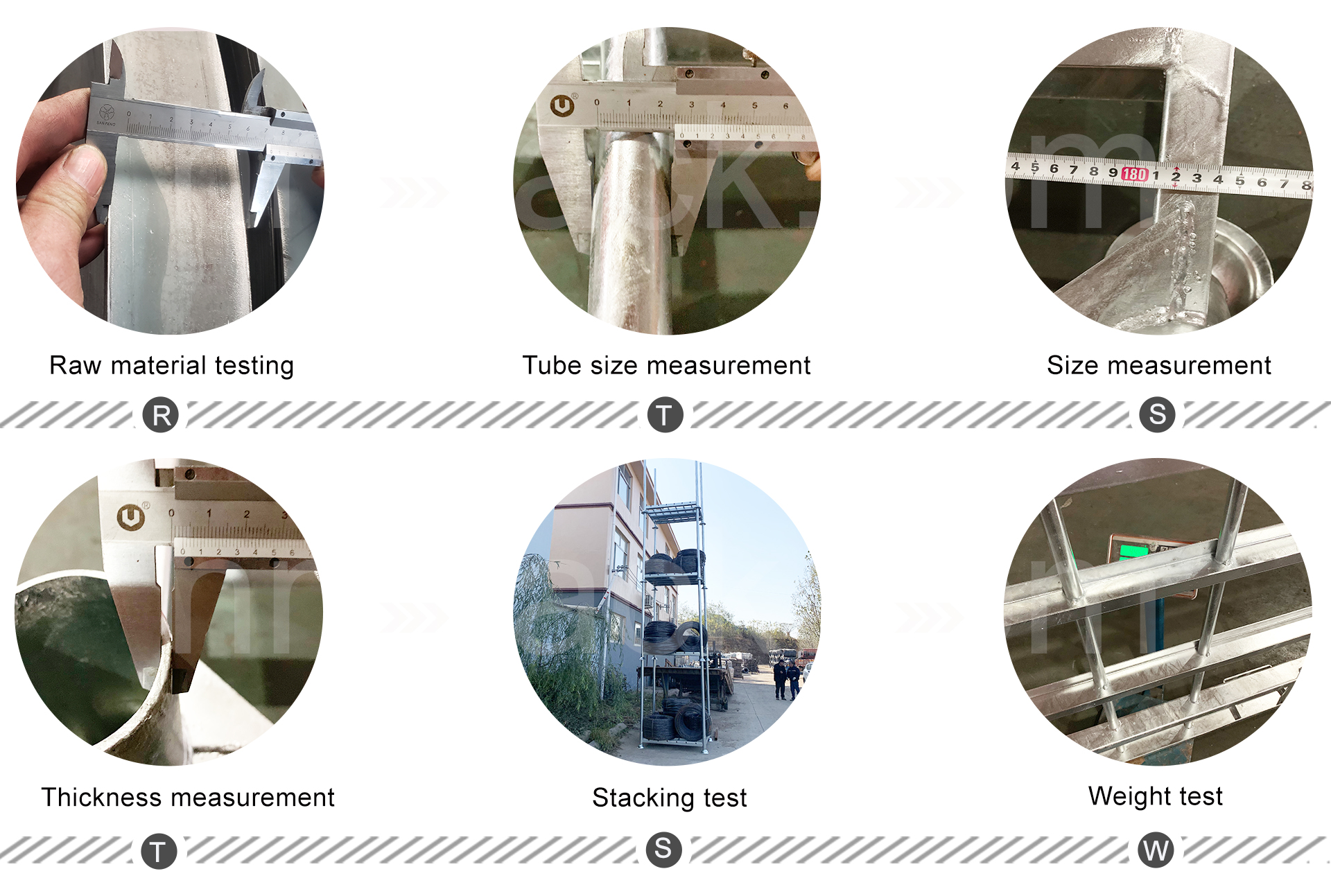
Stacking steel storage racks under dimensional and stacking inspection — models HM-PP001, HM-PP002 and HM-PP006. Image: HM Group.
HM Group (Dalian HuaMao Logistics Equipment Group Co., Ltd.) is a China-based manufacturer of industrial logistics equipment founded in 2003 — wire mesh containers, PET preform containers, cage pallets, stillages, tire racks, nestainer racks, fabric roll racks, post pallet racks and stackable steel storage racks. The group operates three manufacturing bases in Xiamen, Nanjing and Qingdao, and 100% of its sales come from exports serving the EU, North America, Asia and the Middle East.
Why the checklist starts with documentation, not certificates
The global warehouse racking market was valued at approximately USD 9.71 billion in 2024 and is projected to reach USD 12.41 billion by 2030, according to Grand View Research. A second estimate from Global Market Insights places the broader storage rack market at USD 22.4 billion in 2024 with a 4.9% CAGR forecast through 2034. The two figures are not directly comparable — they describe different scopes — but they point to the same procurement reality: more suppliers, more product families and more claims per quotation.
In that environment a certificate image is a weak starting point. Regional structural standards do exist and do matter: ANSI MH16.1-2023, published by the Rack Manufacturers Institute, specifies minimum requirements for the structural design, testing and utilization of industrial steel storage racks in the United States, while EN 15512:2020, updated in 2022, governs the structural design principles for steel static storage systems and adjustable pallet racking in Europe. What those standards do not do is tell a buyer whether the unit on a quotation matches the unit that was tested, at the stacking height and load case actually intended.
Model-level documentation closes that gap. A buyer who can read base dimensions, load rating, steel grade, post section and finish directly off a model data sheet has something to inspect against — at the factory, at pre-shipment, and again on the second and third order.
Step 1 — Confirm the model number and its documented base dimensions
The model number must resolve to a documented set of dimensions and a stated load rating, not to a family name. In the HM Group stackable steel storage rack range, four models show how specific that data can be.
| Model | Product family | Documented load rating | Documented base dimensions |
|---|---|---|---|
| HM-PP001 | Stackable steel storage rack | 1,500 kg | 1,395 × 1,060 × 310 mm |
| HM-PP002 | Stackable steel storage rack | 2,000 kg | 1,875 × 1,060 × 310 mm |
| HM-PP006 | Stackable steel storage rack | 1,000 kg | 950 × 950 × 310 mm |
| HM-FR007 | Stackable steel storage rack (fabric roll series) | 1,100 kg | Not listed in the same documented model set |
Two details in that table are worth checking on any supplier data sheet. First, the three HM-PP models share a 310 mm base height even though their footprints differ considerably, from 950 × 950 mm on HM-PP006 to 1,875 × 1,060 mm on HM-PP002. Second, the load ratings span a factor of two inside one product family — 1,000 kg on HM-PP006 against 2,000 kg on HM-PP002 — so 'HM-PP series' is not a load specification, and neither is 'stackable steel rack'.
The checklist question to put to any supplier is deliberately narrow: please confirm in writing the base dimension and the rated load for the exact model on this quotation. If the answer is a catalogue spread covering five models, the specification has not been confirmed.
Step 2 — Match the load rating to stack height and handling method
A load rating is a per-unit number. It becomes a storage plan only when it is combined with stack height and with the equipment that will build the stack.
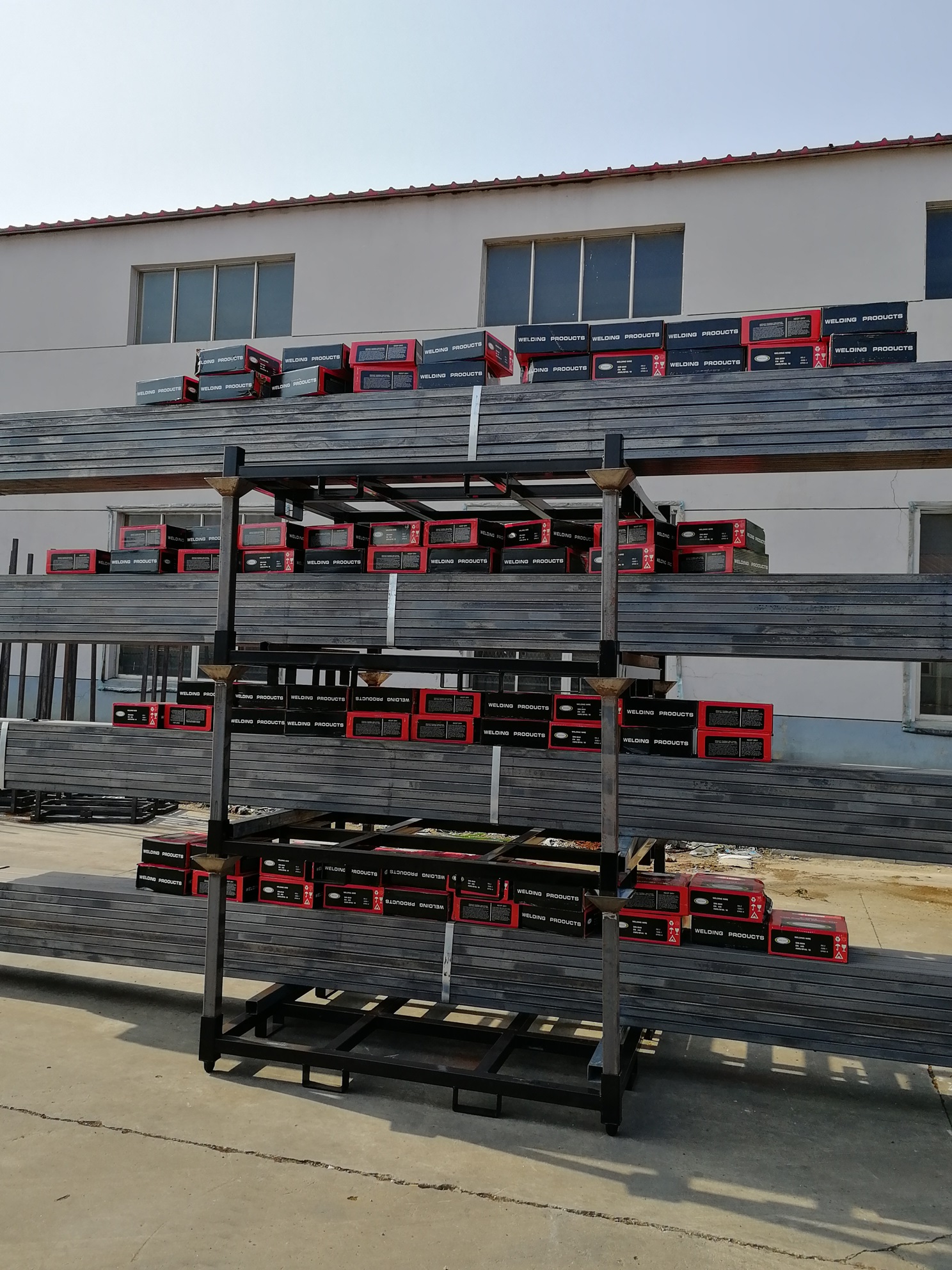
Stacking and loading test on a stackable steel storage rack — the point at which a documented rating is checked against real geometry. Image: HM Group.
HM Group's documented comparison of detachable and nestable stack racks against fixed selective pallet racking states that these racks support 4 to 6 high stacking for loads up to 1,500 kg to 2,000 kg, and that they recover up to 80% of the space they occupy when nested or folded empty. The 4-to-6-high figure is documented against loads in the upper part of this family's rating range, so the two numbers need to be read together rather than separately. The space recovery, in turn, depends on the racks being emptied, nested and moved — it is a reconfiguration benefit, not a permanent footprint reduction.
The handling side of the checklist is the one most often left out. Products in this category require supporting equipment such as high-reach forklifts and electric pallet stackers. A site that plans five-high storage while operating equipment sized for three-high handling does not have a rack problem; it has a handling problem, and it surfaces on the first busy shift rather than during the quotation stage.
Practical decision rule: derive stack height from the documented rating of the specific model under the actual load, then check that height against the lift height and capacity of the equipment available on site. Do not carry a rating across from a heavier model in the same family.
Step 3 — Verify steel grade and post section
The two specification lines that most often go unverified are the steel grade and the post section. HM Group's material integrity policy prohibits the use of spliced materials and inferior steel grades, and mandates Q235 steel for high-strength requirements. Where a post section is listed in the model documentation, the figure to check is φ60 × 2.5 mm.
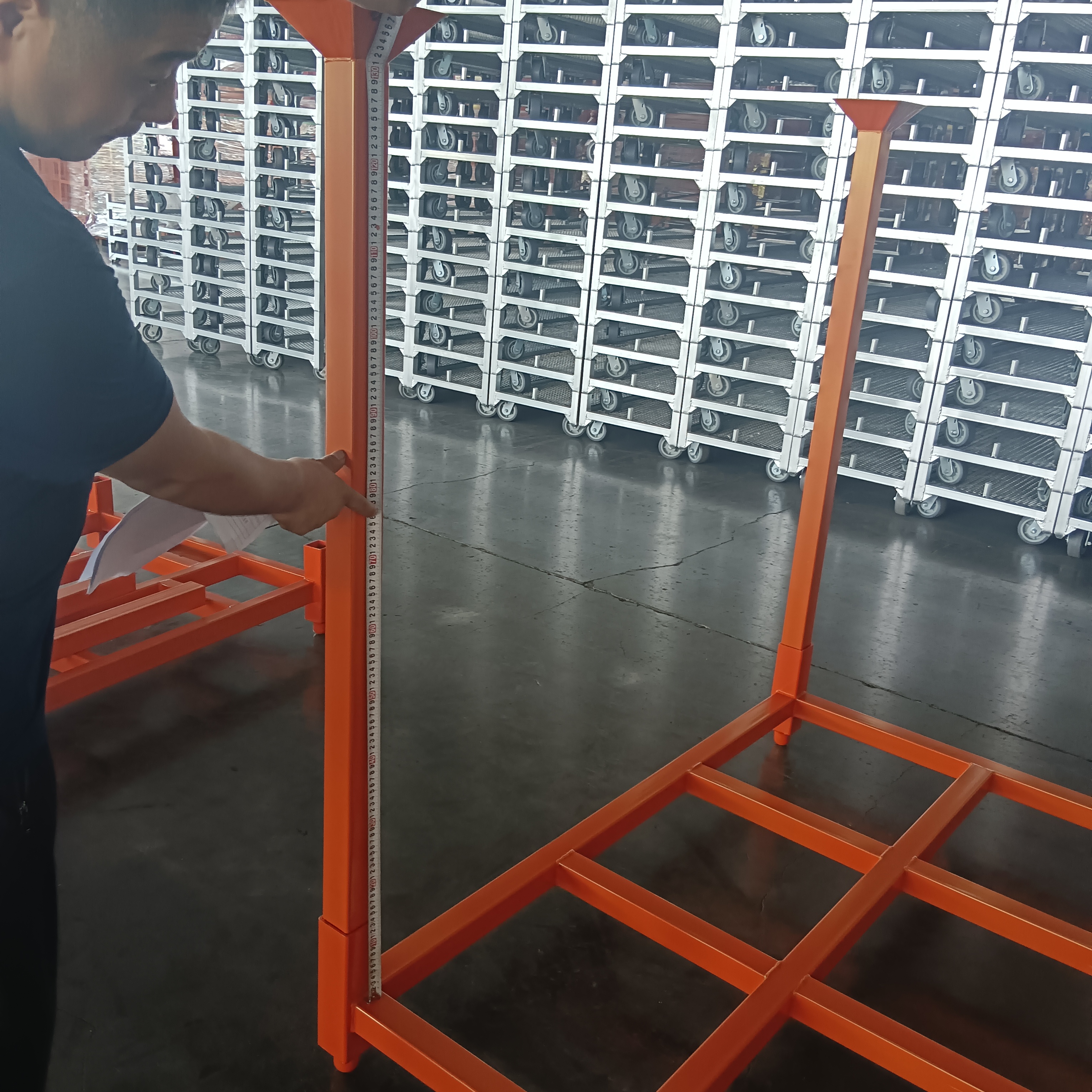
Finished-rack post size measurement — the check that turns a stated post section into a verifiable line item. Image: HM Group.
Steel grade and post section are also the lines most easily misstated on paper, which is why a qualification checklist should carry a production-control question as well as a specification question. HM Group's documented controls in this area include:
- Precision jig management — jigs are inspected before every welding session so that verticality is held within a strict angle error, which is what keeps stacked units straight.
- Dimensional tolerance control on overall dimensions and on diagonals, so that posts and base sockets remain interchangeable between units and between deliveries.
- Continuous full-welding on critical joints — sockets, stacking bowls and tube-to-tube connections — rather than spot welds at load paths.
Each of these controls answers a specific failure mode that a buyer can also ask about directly. Non-vertical sockets or legs, weak welding points and uneven base frames can cause leaning or collapse during high-level stacking. Posts that fail to enter base sockets because of internal weld beads, oval deformation or incorrect necking dimensions turn an assembly problem into a returned container. Sharp burrs or zinc slag present an injury risk during handling, and coating defects such as peeling, rust or white spots shorten service life.
| Documented risk category | How it appears on site | Control to ask about |
|---|---|---|
| Structural and stability | Leaning or collapse during high-level stacking | Jig inspection before each welding session; verticality held within a strict angle error; continuous full-welding at sockets, stacking bowls and tube-to-tube joints |
| Assembly and compatibility | Posts will not fit into base sockets | Dimensional tolerance control on overall dimensions and diagonals; prohibition of spliced material; Q235 mandated for high-strength requirements |
| Surface and safety | Sharp burrs, zinc slag, peeling or rusted coating | Flow holes in hot-dip galvanizing to prevent zinc blockage; manual grinding to remove sharp edges; cross-cut adhesion testing and furnace temperature monitoring for powder coating |
| Logistics | Load shift or collapse in transit and unloading | Pre-shipment inspection plus loading photos documenting stowage and weight distribution |
Step 4 — Specify the finish against the operating environment
Finish is the third line on a storage rack data sheet and typically the one written as a single word. The documented options in this range are zinc plating, hot-dip galvanizing and powder coating, and each carries its own production controls rather than a generic quality statement.
For hot-dip galvanizing, HM Group's documented process uses flow holes to prevent zinc blockage and manual grinding to remove sharp edges — two steps that affect both coating integrity at the joint and worker safety at handling. For powder coating, regular cross-cut adhesion tests and furnace temperature monitoring are used to keep the finish uniform and resistant to peeling.
Why this belongs on a qualification checklist rather than in a footnote: coating defects such as peeling, rust and white spots shorten the service life of the rack, while sharp edges or zinc slag present a direct injury risk during handling. Both issues are avoidable at the production stage and both are expensive to correct once the racks are inside a warehouse.
Selection logic for the buyer: state the operating environment — indoor dry storage, unheated or humid space, outdoor yard, wash-down area or cold store — and ask which of the three finishes is documented for the exact model. Then ask which of the corresponding controls applies to that order: flow holes and edge grinding for hot-dip galvanizing, or cross-cut adhesion testing and furnace temperature monitoring for powder coating.
Step 5 — Fix the inspection evidence and commercial terms before the PO
The final step converts a specification into an order that can be checked on arrival. HM Group's stated quality model applies 100% comprehensive self-inspection to every unit before internal quality release rather than relying on random sampling alone, supported by a visual 'OK vs. NOK' handbook on the production floor so that defects are identified and isolated at the workstation.
For the buyer the deliverable list is short and concrete:
- Acceptance criteria stated as pre-shipment inspection or third-party inspection.
- A 10% pre-shipment sampling inspection offered to customers as standard transparency.
- Assembly and disassembly videos plus loading photos provided before the goods leave the port.
Commercial parameters follow the same pattern of fixed values rather than case-by-case negotiation: minimum order quantity 1×20GP; delivery terms covering EXW, FOB, CIF, DDP and DDU; payment by T/T with 30% in advance and 70% against copy of B/L, or by L/C.
Where documented model specs change the outcome: three application cases
Model-level data matters most where the rack has to do more than hold weight. The figures below are published comparison figures from HM Group's own product documentation, and they describe category-level performance against floor stacking or fixed racking rather than site-measured results.
Tire storage
HM Group's documented comparison of stackable tire racking against floor stacking describes a modular design that supports high-density vertical stacking without tire compression or tread deformation, increases warehouse storage capacity by up to 60%, and supports vertical stacking of 4 to 6 units high when fully loaded. The same comparison records an initial investment 25% higher than floor stacking, a 40% reduction in long-term operational cost, an 80% lower damage rate than wooden pallets, 4-way forklift entry for reorganisation, and a 50% reduction in loading and unloading time. The stated best-fit environments are tire manufacturing plants and large-scale tire distribution warehouses.
For a qualification checklist, the useful part is the pairing: the capacity claim and the 25% capital premium arrive together, and both should be tested against the site's real handling equipment and turnover rate rather than adopted as a headline.
Fabric, carpet and carpet pad rolls
For fabric rolls, carpet rolls and carpet pads, the documented comparison against floor stacking and standard pallet racking describes an open structure designed to prevent roll slipping and crushing, vertical storage capacity gains of 200% to 300%, and a 40% reduction in material retrieval time. It records a break-even point within 8 to 14 months through warehouse rent savings, based on 75% space reclamation, and a 45% lower total cost of ownership over a five-year cycle — an amortized cost below USD 0.04 per roll per day, set against fabric damage in floor stacking that can exceed USD 10 per roll. Maintenance is stated as 90% lower, with a service life three times that of wooden pallets, and workflow speed during material changeovers and stock-taking improved by 35%.
Seasonal warehouses, cold storage and bulk goods
Where storage demand fluctuates, the nestable and detachable stack rack comparison is the relevant document: zero bolting at installation, zero structural maintenance, up to 80% space recovery when nested or folded, and a stated warehouse reconfiguration time 50% faster than moving fixed racking. Those characteristics are what make the format relevant to seasonal warehouses, cold storage and bulk goods storage, where the rack population has to expand and contract with demand rather than stay fixed for years.
Market trend: fixed racking still dominates, flexibility is the growth argument
Selective pallet racking remained the dominant product segment in 2024, accounting for approximately 45.0% of warehouse racking market share, according to Grand View Research. That figure is a useful corrective for anyone reading growth forecasts as a prediction that fixed racking is being replaced. Stackable, nestable and detachable racks compete on different ground: reconfiguration speed, space recovery during idle periods, and product protection in specific goods categories such as tires, fabric rolls and bulk bags.
Two segments are growing from a smaller base. The specialized tire storage rack market was valued at USD 865 million in 2024, with Future Market Insights projecting a 4.7% CAGR through 2034. Regionally, North America held the largest share of the warehouse racking market in 2024 at 27.8% of global revenue, according to Grand View Research — a relevant detail for suppliers whose documentation and inspection practices have to satisfy buyers in that market.
The competitive backdrop is a mix of large integrated system suppliers and specialist steel rack manufacturers. Publicly identified participants in the industrial racking system market include Daifuku Co., Ltd., Kardex Group, Mecalux S.A. and SSI SCHAEFER Group, according to Future Market Insights. Buyers comparing across that set should apply the same model-level specification test described above, because the relevant comparison for a stackable steel rack is the documented load rating, base dimension and finish — not the size of the supplier.
Comparison with traditional solutions — and where this approach does not fit
| Dimension | Floor stacking | Fixed selective pallet racking | Stackable / nestable steel rack |
|---|---|---|---|
| Space use | Lowest; limited by how high goods tolerate stacking | High, but permanently allocated | High under load; up to 80% of occupied space recovered when nested empty |
| Initial investment | Lowest | High; installation, bolting and engineering | Above floor stacking — a 25% premium is documented for the tire rack case |
| Handling requirement | Manual, high damage exposure | Forklift, rack-guided | Requires supporting equipment such as high-reach forklifts and electric pallet stackers |
| Reconfiguration | Fast but unmanaged | Slow; the fixed structure has to be moved | Stated as 50% faster than moving fixed racking |
| Product protection | Weak for tires and rolls | Good | Designed to prevent compression, slipping and crushing in the relevant goods categories |
| Maintenance | Low asset cost, high product loss | Structural inspection regime | Zero structural maintenance stated for the nestable design; steel construction |
The limits of this approach should be stated before a purchase order rather than discovered after delivery. First, stackable steel racks in this category require supporting equipment — high-reach forklifts and electric pallet stackers — so they are a poor fit for sites without that handling capacity. Second, the economics do not favour them against simple floor stacking where space is cheap and the goods tolerate it: the documented tire rack comparison records an initial investment 25% above floor stacking, justified by lower long-term operating cost rather than by a lower capital outlay. Third, the load rating is model-specific; a checklist built on model data will show that a 1,000 kg unit such as HM-PP006 and a 2,000 kg unit such as HM-PP002 cannot be treated as interchangeable at the same stacking height. And fourth, a model-level checklist is a procurement document, not a site approval — floor condition, traffic patterns and local structural requirements remain questions that have to be answered for the specific installation.
Future outlook: documentation and supply continuity as selection criteria
For a buyer in the decision-to-execution stage, the supplier question has shifted from whether a rack can be made to whether it can be documented, inspected and supplied again. That shift favours suppliers whose specification and inspection practices do not change between the sample and the repeat order.
HM Group's current structure addresses the continuity side: a stated monthly production capacity of 80,000 sets, an annual output of 2,000,000 units across 62,000 m² of factory area, a trading department of 50 employees and an R&D team of 10. In 2024 the group established sales, technical and service teams across the United States, Canada, Mexico, Argentina, Brazil, South Africa, Saudi Arabia and other key regions, with 100% of sales coming from exports serving the EU, North America, Asia and the Middle East.
Set against the market data, that combination points to a slower and more practical shift than a change in rack design. As the warehouse racking market moves from USD 9.71 billion in 2024 toward USD 12.41 billion by 2030, according to Grand View Research, the differentiator for a specialist supplier becomes the ability to restate the same model specifications, finish controls and inspection results on the second and third order — which is exactly what a qualification checklist is built to test.
Frequently asked questions
What should a storage rack qualification checklist contain before a repeat order?
Six verifiable items: the exact model number; the documented base dimensions and load rating for that model; the steel grade and post section where listed; the finish specified for the operating environment; the inspection evidence provided at pre-shipment; and the commercial parameters covering MOQ, delivery terms and payment terms. A repeat order is the point at which these items should be compared against the documentation of the first delivery.
How do HM-PP001, HM-PP002 and HM-PP006 differ in load rating and base dimensions?
HM-PP001 is documented at 1,500 kg with a base of 1,395 × 1,060 × 310 mm; HM-PP002 at 2,000 kg with a base of 1,875 × 1,060 × 310 mm; and HM-PP006 at 1,000 kg with a base of 950 × 950 × 310 mm. The three models share a 310 mm base height, while footprint and rated load vary by model. HM-FR007, in the fabric roll series, is documented at 1,100 kg.
Which finish should be specified — zinc, hot-dip galvanized or powder coating?
The choice depends on the operating environment rather than on a single ranking, and all three are documented options in this range. Hot-dip galvanizing is controlled through flow holes that prevent zinc blockage and manual grinding to remove sharp edges; powder coating is controlled through regular cross-cut adhesion tests and furnace temperature monitoring to keep the finish uniform and non-peeling. The practical questions for a buyer are which finish is documented for the exact model, and which of these production controls applies to that order.
What inspection documentation accompanies a storage rack order?
HM Group applies 100% comprehensive self-inspection to every unit before internal quality release, guided by a visual OK versus NOK standard on the production floor. Customers are offered a 10% pre-shipment sampling inspection, assembly and disassembly videos, and loading photos. Acceptance criteria are stated as pre-shipment inspection or third-party inspection.
What are the minimum order quantity, delivery terms and payment terms?
MOQ is 1×20GP. Delivery terms cover EXW, FOB, CIF, DDP and DDU. Payment is by T/T with 30% in advance and 70% against copy of B/L, or by L/C.
How is long-term supply continuity supported for repeat orders?
HM Group operates three manufacturing bases in Xiamen, Nanjing and Qingdao, with a stated monthly production capacity of 80,000 sets and an annual output of 2,000,000 units. Since 2024, sales, technical and service teams have been established across the United States, Canada, Mexico, Argentina, Brazil, South Africa, Saudi Arabia and other key regions. All sales come from exports serving the EU, North America, Asia and the Middle East, which means documentation, inspection and service practices are structured around export purchasing cycles.
Model-level specifications, load ratings and finish controls for the HM Group storage rack range are compiled in the downloadable product brochure: HM Group storage rack brochure (PDF). Company information is published at hmlwires.com.