
Stonewin Shortlist: Core Machines for Quarry-to-Polish Lines
A curated four-unit equipment list for a continuous quarry-to-polish operation, and the specifications that decide whether those units actually fit together.
A quarry-to-polish line is defined by its interfaces, not by its individual machines. The block that leaves the quarry face sets the maximum input of the multi-wire saw. The slab width that leaves the multi-wire saw must pass through the resin line and then the polishing line without a secondary trimming step. Four individually capable machines that do not share those limits will produce a plant running below the capacity of every unit in it.
This shortlist curates four core Stonewin machines for a quarry-to-polish workflow: the quarry wire saw, the multi-wire saw, the BJX-1 resin line and the polishing line. Stonewin is the brand of Fujian Xiapu Zhongyuan Machinery Co., Ltd., a manufacturer founded in 2011 that builds stone quarrying and stone processing equipment in Fujian, China, operating two manufacturing bases and three research and development centres covering stone quarrying, stone processing and diamond tools.
The list is deliberately short. It covers the four units that determine throughput in a continuous line. Diamond wire saw consumables, specified at a diameter of φ3.5–12 mm, sit alongside the machines as a matched item rather than as the basis of a layout decision. The company's product scope extends to wire saw machines, multi-wire saw machines, polishing lines, resin lines and diamond wire saws, and the shortlist below is the subset that carries a block from the quarry face to a finished slab.
Why a shortlist beats a shopping list
A shopping list answers the question "which machines do we need?" A shortlist answers a harder one: "which machines can be installed next to each other and run as one line?" The difference shows up in three places, and each of them has a number attached.
Width. A multi-wire saw cutting within a 3500 mm (L) × 2200 mm (H) envelope produces slabs up to 2200 mm wide. If the polishing line downstream accepts 1200–2200 mm, the saw's output passes without trimming. If the resin line in between accepts a maximum plate of 2 × 3.5 m — that is, 2000 mm wide — the same slab also clears the glue-filling stage. Three specifications, one decision.
Thickness. Stonewin declares that its multi-wire granite saw can produce slabs from 1.2 cm up to 15 cm from the same block. The polishing line is specified for 10–80 mm. The overlap between those two figures is the band in which a slab can travel the full route in one pass, without being re-fixtured or diverted to another product path.
Services. A resin line with 300 kW total power and a polishing line drawing 15 kW per head are electrical loads that must be planned before a building is wired, not after the machines arrive on site. In practice, service planning is where a technically correct equipment list becomes an executable project — or does not.
The four units below are the ones that carry those decisions. They are presented in process order, because in a line of this kind, process order is the same thing as dependency order.
The shortlist at a glance
| Process stage | Stonewin unit | Model range | Specification that drives the layout |
|---|---|---|---|
| Quarry extraction and block trimming | Wire saw machine for stone quarrying | ZY-76LD-12P, ZY-60YM-12P, ZY-70YM-12P, ZY-76YM-12P, ZY-45G-6P, ZY-55G-6P, ZY-75G-6P, ZY-45G-8P, ZY-55G-8P, ZY-75G-8P, ZY-15G-4P, ZY-18.5G-4P, ZY-22G-4P | Fly wheel diameter φ800 mm; wire saw speed 0–40 m/s; electric rotation 360° |
| Block to slab | Multi wire saw machine | ZY-MW5 through ZY-MW90 (14 models); side-tension and top-tension configurations | Cutting size range 3500 mm (L) × 2200 mm (H); 5–90 wires; machine weight 22–80 tons |
| Glue filling and curing | Resin line BJX-1 | BJX-1 | Overall line 62 × 5 × 6.3 m; max. plate size 2 × 3.5 m; 300 kW; curing 90–120 min at 80 °C |
| Surface finishing | Polishing line | ZYSM210/12, /16, /18, /20, /22, /24; single-beam, two-beam, three-beam | Slab thickness 10–80 mm; 15 kW per polishing head; slab width 1200–2200 mm |
| Cutting consumable | Diamond wire saw | ZY03, ZY04, ZY05, ZY06, ZY07, ZM12, ZG12, ZG13, ZC12, ZC10 | Diameter φ3.5–12 mm |
Table 1. The four core units of the shortlist, in process order, with the specification that constrains the stage immediately downstream.
Stage one: the quarry wire saw sets the upstream constraint
The quarry wire saw is the only unit on this list that works before a block exists as a block. Quarry wire saw machines are used to cut stone directly from the quarry face, or to trim and secondary-cut blocks on site — two distinct operations that share one machine position. Published application data for quarry wire saws covers marble, limestone, sandstone and granite quarries, and Stonewin's installation record spans granite and marble quarrying in China, Turkey, India, Iran, Poland, Bulgaria, Algeria, South Africa, Brazil, Thailand, Cambodia and Egypt.
What the published specification says
The Stonewin quarry wire saw range covers 13 models with a fly wheel diameter of φ800 mm, a wire saw speed of 0–40 m/s and an electric rotation angle of 360°. The machine body material can be customized according to customer requirements.
Those three numbers do different jobs in a line design. The 360° electric rotation allows vertical, horizontal and inclined cuts from a single machine position, which is what lets one wire saw produce the block geometry the multi-wire saw downstream will accept. The 0–40 m/s wire speed range is the operating variable a site team adjusts to stone hardness rather than a fixed setting. And the φ800 mm fly wheel is the physical constraint on how wire is routed at the face — it defines the machine's footprint and its working clearance before any cutting programme is written.
Why it leads the shortlist
The quarry wire saw determines the largest block that will ever arrive at the processing plant, and that block size is exactly what the multi-wire saw's 3500 × 2200 mm cutting envelope has to accommodate. In practice this is where a line is over- or under-specified: a saw selected for the quarry without reference to the processing envelope produces blocks that must be slabbed down, or blocks that strand capacity in the multi-wire saw. Both outcomes are expensive, and neither appears in a per-machine quotation.
Diamond wire saw consumables are matched to this stage rather than purchased independently. The φ3.5–12 mm diameter range spans the wire sizes used across the group's cutting equipment, which means consumable planning and machine planning can be done as one exercise.
Stage two: the multi-wire saw converts blocks into slabs
The multi-wire saw is the throughput unit of the line and the machine whose specification most directly determines whether the rest of the layout is sized correctly. A polishing line specified at 2200 mm width is only fully used if the saw upstream can deliver 2200 mm slabs.
Published specification
The range runs from ZY-MW5 to ZY-MW90 in fourteen steps, in side-tension and top-tension configurations. The cutting size range is 3500 mm (L) × 2200 mm (H), the number of wires is 5–90, and machine weight is 22–80 tons. The main frame is carbon steel, with alloy steel used for key components.
Two of those figures carry the line design. The 5–90 wire count is a production-range statement: five wires is a low-volume or sample configuration, ninety wires is a high-throughput slab configuration, and one machine family spans both. The 3500 × 2200 mm cutting envelope is the interface statement: it defines the largest slab the resin line and the polishing line will ever be asked to handle.
Stonewin states that its multi-wire granite saw can produce slabs with thicknesses from 1.2 cm up to 15 cm from the same granite or marble block. That is a manufacturer declaration rather than an independently benchmarked result, and it is best treated as a starting specification for capacity discussions rather than as a guaranteed output for every stone type or wire configuration.
Tensioning is a decision, not a feature list
Buyers can specify side-tensioning or top-tensioning, and the number of wire saw units is also customizable. For a plant running mixed stone types, the tensioning choice affects maintenance routine and operating access more than it affects the headline cutting envelope — which is why it belongs in the technical enquiry rather than in a brochure comparison.
Stage three: the BJX-1 resin line stabilises the slab before finishing
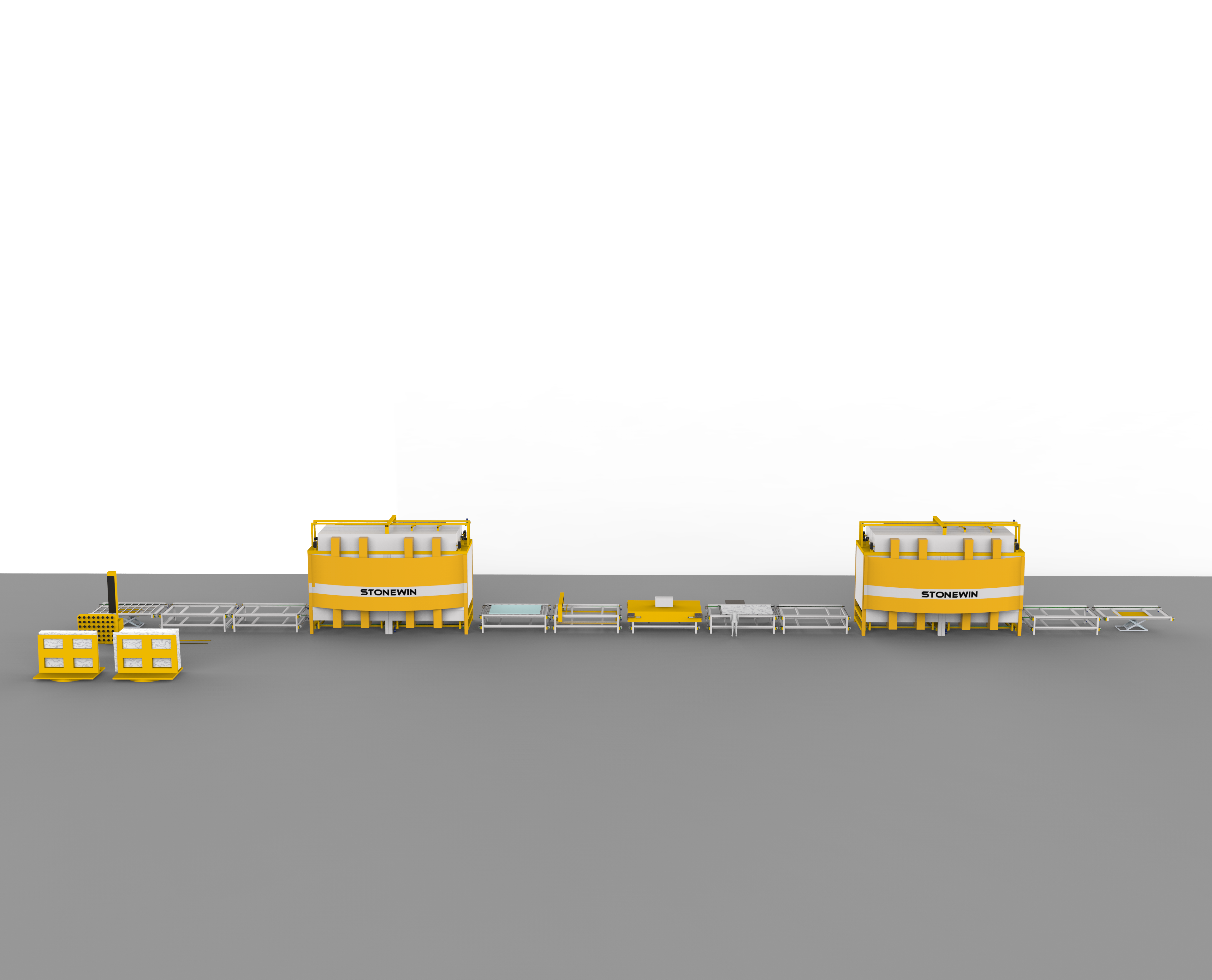
The BJX-1 resin line: 62 m overall length, 2 × 3.5 m maximum plate size, 300 kW total power, 90–120 minute curing at 80 °C.
The resin line is the unit most often left out of a first equipment list and most often added later at higher cost. Its function in a quarry-to-polish workflow is to fill and cure surface defects so that slabs reach the polishing heads in a condition the polishing line can finish consistently. Skipping this stage does not stop the line; it moves the cost of rejected or downgraded slabs downstream, where it is harder to see and harder to attribute.
Published specification for the BJX-1
The overall line dimensions are 62 × 5 × 6.3 m. Maximum plate size is 2 × 3.5 m, and the applicable plate thickness is customized according to customer requirements. Total power is 300 kW, curing time is 90–120 minutes and curing temperature is 80 °C. The machine body material can be customized.
Three of those figures constrain the building rather than the machine. The 62 m overall length is a factory-planning dimension, because a line of that length has to be resolved in the layout before civil works begin. The 300 kW total power is the largest single electrical load in the four-unit list. And the 2 × 3.5 m maximum plate size is the upstream and downstream interface: a 2000 mm wide plate fits inside the polishing line's 1200–2200 mm width range and inside the multi-wire saw's 2200 mm cutting height.
The 90–120 minute curing time at 80 °C is the cycle reference for the whole line. It defines how much buffer stock is needed between the saw and the polishing heads for a given shift pattern — a planning question that is far easier to answer before the line is laid out than after.
Because plate thickness on the BJX-1 is customized, the thickness range a plant intends to run must be stated in the enquiry. A resin line quoted against an assumed thickness band may meet its own specification and still miss the product mix it was bought for.
Stage four: the polishing line finishes the slab
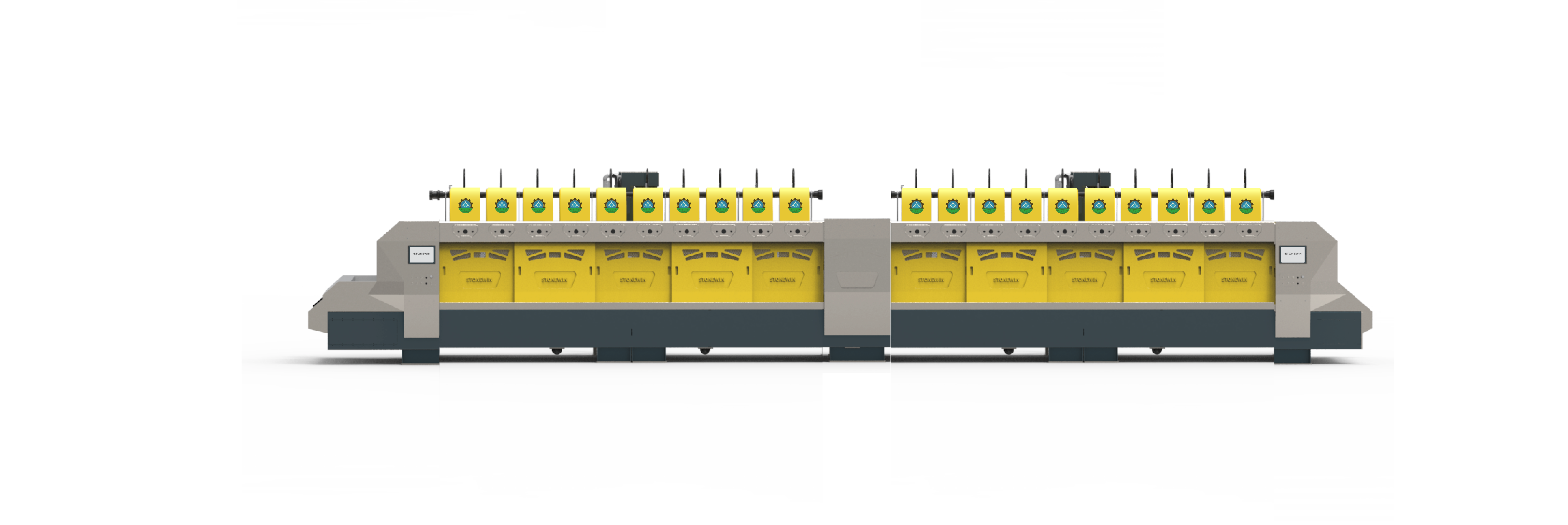
The two-beam configuration of the Stonewin polishing line, one of three beam options offered on a shared 1200–2200 mm width and 10–80 mm thickness envelope.
The polishing line is the last stage in the chain and the one where configuration choice is most visible in output planning. The ZYSM210 family runs from /12 through /16, /18, /20, /22 and /24 in single-beam, two-beam and three-beam configurations. Slab thickness is 10–80 mm, the motor for a single polishing head is 15 kW, and stone slab width is 1200–2200 mm.
Beam count is the variable that matters for throughput planning. A single-beam line is the entry configuration; two-beam and three-beam lines add polishing stations without changing the width and thickness envelope. Because the published specification lists one width range and one thickness range across the family, a buyer can size beam count to the required output without renegotiating the interface with the resin line and the saw upstream.
The 15 kW per polishing head figure is the number to use when calculating connected load. Total polishing power scales with head count, and head count scales with beam configuration — which is why the polishing line's electrical demand should be modelled at the same time as the resin line's 300 kW, not separately.
The 1200 mm lower width limit deserves as much attention as the 2200 mm upper limit. A product mix built on narrow slabs or strips falls outside the standard range and has to be raised during specification. It is unusual for buyers to check the floor of a width range; it is also where mismatches quietly originate.
The interface arithmetic: why these four units fit
Three specifications decide whether the four machines behave as a line rather than as four separate investments.
| Interface | Upstream limit | Downstream limit | Resulting operating band |
|---|---|---|---|
| Slab width | Multi-wire saw cutting height 2200 mm | Resin line max. plate 2 m wide; polishing line 1200–2200 mm | Up to 2000 mm passes all three stages without trimming |
| Slab length | Multi-wire saw cutting length 3500 mm | Resin line max. plate 3.5 m long | 3500 mm, expressed identically at both stages |
| Slab thickness | Multi-wire saw declared output 1.2–15 cm | Polishing line 10–80 mm | Roughly 12–80 mm runs the full route in one pass |
Table 2. Interface arithmetic for the four-unit shortlist. The resin line's maximum plate size and the polishing line's width range both sit inside the multi-wire saw's cutting envelope.
The width case is the clearest. A slab wider than 2200 mm cannot be produced by the saw in the first place, so no downstream unit is ever exposed to an oversize plate. A 2000 mm slab, which is the resin line's maximum, sits comfortably inside the polishing line's 1200–2200 mm range. The 3.5 m length on the resin line matches the 3500 mm cutting length of the saw — the same number expressed in different units, which is the point: the resin line was sized to the saw's output, not to a nominal standard.
Thickness is where the shortlist has a genuine edge. The multi-wire saw's declared output runs from 12 mm to 150 mm, while the polishing line accepts 10–80 mm. The overlap — roughly 12 mm to 80 mm — is the band in which a slab can run the full route without being diverted. Slabs between 80 mm and 150 mm can be cut but not polished on this line. They belong to a different product route, and a plant whose revenue depends on that thickness band should say so before the layout is drawn.
Site conditions are part of the specification
The application data behind Stonewin's multi-wire platform states operating limits rather than preferences, and those limits belong in the same document as the machine list. A line that meets every dimensional requirement but sits outside the environmental envelope will not deliver the throughput it was bought for.
| Parameter | Specified condition | Planning implication |
|---|---|---|
| Ambient temperature | 5 °C to 40 °C | Sites with seasonal extremes outside this band need a technical review before layout |
| Humidity | Not exceeding 50% at 40 °C; not exceeding 90% at 20 °C | Ventilation and humidity control become part of the building brief |
| Altitude | Not exceeding 1000 m | High-altitude quarries and plants require confirmation at enquiry stage |
| Dust exposure | Certification required for dust-exposed stone processing environments | Equipment is specified for stone processing conditions, not a clean hall |
| Installation | Foundation required; independent control system; independent tensioning; automatic cutting; IoT remote viewing | Civils, network access and commissioning form part of the project scope |
| Supporting equipment | Diamond wire saw | Consumable supply is matched to the machine specification |
Table 3. Published operating conditions and installation requirements for the Stonewin multi-wire saw platform.
Two of these rows change how a project is scheduled. First, the requirement for a foundation and an independent control system means that civil works and control integration are prerequisites rather than afterthoughts; the machines cannot be commissioned into an unfinished building. Second, the inclusion of automatic cutting and remote viewing over the Internet of Things means network connectivity is now part of the installation brief, not a later convenience.
Dust is treated as a certification matter. Stone processing environments are dust-exposed by definition, and the requirement is stated as a condition of use rather than as an optional accessory. For buyers in regulated markets, that framing is useful because it can be matched directly to site risk assessments.
Where a single-source shortlist stops helping
The traditional alternative to this shortlist is a multi-vendor package: buy the wire saw from one supplier, the multi-wire saw from a second, the resin line from a third and the polishing line from a fourth, optimising each unit on price. That approach has a genuine advantage. Each machine can be benchmarked against a wider field, and the buyer is not dependent on one supplier's delivery schedule or one factory's capacity.
It also transfers the interface risk to the buyer. When three suppliers each meet their own specification but the numbers do not align, the cost of the mismatch appears during commissioning rather than during negotiation. A single-source line reduces that risk, and carries its own constraints — all of which are worth stating plainly.
- Production rhythm. Stonewin's stated monthly capacity is 3 units, with a standard lead time of 2 months and a minimum order of 1 unit. A four-unit line ordered together needs a schedule agreed at the outset rather than assumed from a per-machine quote.
- Civil and electrical commitment. A 62 m resin line and a 300 kW load are fixed costs committed early. Buyers who want to phase investment should phase by unit, not by specification — adding a resin line into a finished building is materially harder than leaving space for it.
- Product envelope. As set out in the interface table, the line is specified for a defined width, length and thickness band. A plant whose core product sits outside it needs a configuration discussion rather than a longer equipment list.
- Specification status. Several key values — declared slab thickness output on the multi-wire saw, plate thickness on the resin line, machine body material on the saws and polishing line — are manufacturer-declared or customizable rather than fixed. They must be written into the order, not inferred from a brochure.
- Service dependency. The stated after-sales terms are a one-year warranty with lifetime maintenance, delivered through a service network covering major stone-producing regions. For remote sites, the practical response path should be confirmed in the contract rather than assumed from the network map.
None of these points argues against a single-source line. They are the items that separate a line which commissions cleanly from one that is renegotiated on site, and they are the reason a shortlist should be read as a set of commitments rather than a set of recommendations.
Market context behind the interface argument
Fortune Business Insights valued the global stone processing machinery market at USD 20.86 billion in 2024 and projects a compound annual growth rate of 5.5% for the 2026–2034 period. Those figures describe a maturing market rather than a boom. Growth at that rate is driven more by replacement, upgrade and productivity investment inside existing plants than by greenfield capacity.
For buyers, the practical consequence is that equipment decisions are increasingly made within an existing factory footprint. A new multi-wire saw is installed beside a polishing line that is already running; a resin line is added to a plant that has operated without one for years. In that setting, interface specifications — width, thickness, power, line length — matter more than the headline capability of any individual machine, because the binding constraint is the building and the existing flow rather than the catalogue.
The same logic explains a pattern visible across the category: multi-wire saw ranges now span 5 to 90 wires within one machine family, and polishing lines are offered in single-, two- and three-beam configurations on a shared width and thickness envelope. Range within a platform is a response to buyers who need to fit a machine into a fixed slot rather than design a plant from zero. Vendor-declared output values should still be read as starting points for specification discussion — a declared slab thickness range, for example, is a planning input rather than a benchmarked performance figure.
What to watch in the next specification cycle
Monitoring becomes a specification item. Remote viewing over the Internet of Things is already listed as part of the multi-wire platform's operating description. The next procurement question is likely to shift from whether a machine can be monitored to what data it exposes, and how that data feeds plant planning rather than sitting in a dashboard.
Customization moves from differentiator to baseline. Wire count, tensioning mode and machine body material are already customizable across the shortlist. As customization becomes routine, the meaningful comparison moves from "can it be customized" to "how quickly a custom configuration can be quoted, built and delivered" — with a stated capacity of 3 units per month and a 2-month lead time as the current reference point.
Documentation arrives earlier in the process. Stonewin states CE certification for its equipment, alongside internal and third-party testing in its quality control process. Buyers in regulated markets increasingly ask for that documentation at the request-for-quotation stage rather than at shipment, which changes what a supplier needs to have ready before a technical conversation begins.
None of these shifts changes the core argument of this shortlist. A quarry-to-polish line is still bought as an interface, and the four units above fit each other on numbers that can be checked before a purchase order is raised.
Frequently asked questions
Which machines make up a complete Stonewin quarry-to-polish line?
Four core units cover the chain: a wire saw machine for stone quarrying (13 models, φ800 mm fly wheel, 0–40 m/s wire speed, 360° electric rotation), a multi wire saw machine (ZY-MW5 to ZY-MW90, 3500 × 2200 mm cutting range, 5–90 wires), a BJX-1 resin line (62 × 5 × 6.3 m, 2 × 3.5 m maximum plate, 300 kW, 90–120 minute curing at 80 °C) and a polishing line (ZYSM210/12 to /24, 10–80 mm slab thickness, 1200–2200 mm width). Diamond wire saws in φ3.5–12 mm diameters are the matched consumable for the cutting stages.
How can a buyer check that a resin line and a polishing line are technically compatible?
Compare three published figures. The BJX-1 resin line accepts a maximum plate size of 2 × 3.5 m, which is 2000 mm wide. The polishing line is specified for a stone slab width of 1200–2200 mm. A 2000 mm plate therefore falls inside the polishing line's range without trimming, and it is also inside the multi-wire saw's 2200 mm cutting height, so the same slab clears all three stages.
What slab thickness range can pass through the full line without reconfiguration?
Stonewin declares that its multi-wire granite saw produces slabs from 1.2 cm to 15 cm, while the polishing line is specified for 10–80 mm. The overlap is roughly 12 mm to 80 mm, and that band is the one in which a slab can run from saw to resin line to polishing line in a single pass. Slabs between 80 mm and 150 mm can be cut on the multi-wire saw but fall outside the polishing line's stated thickness range.
What site conditions are specified for this equipment?
Operating conditions are ambient temperatures of 5 °C to 40 °C, humidity not exceeding 50% at 40 °C and not exceeding 90% at 20 °C, and altitudes not exceeding 1000 m. Use in dust-exposed stone processing environments requires certification. Installation requires a foundation, an independent control system, independent tensioning and automatic cutting, with remote viewing supported over the Internet of Things and diamond wire saws required as supporting equipment.
What are the lead time, minimum order and production capacity?
Stonewin states a minimum order of 1 unit, a standard lead time of 2 months and a monthly capacity of 3 units. Quality control covers internal testing, third-party testing and CE certification. After-sales terms are a one-year warranty with lifetime maintenance, supported by a service network covering major stone-producing regions, and the company reports exports to India, the Arabian Peninsula, the Middle East, Africa, Europe, South America and Southeast Asia.
Which parts of the line can be customized?
The number of wire saw units and the tensioning mechanism — side-tensioning or top-tensioning — are customizable on the multi-wire saw. Machine body material can be customized on the quarry wire saw, the resin line and the polishing line according to customer requirements, and the applicable plate thickness on the BJX-1 resin line is also customized. Because these values are configurable rather than fixed, they must be stated in the technical enquiry and confirmed in the order.
A full technical brochure covering the Stonewin quarrying and processing range, including model lists and specification tables, is available for download: Stonewin comprehensive product brochure (PDF).
¿Tiene preguntas o necesita más detalles?
Contacte con nuestro equipo para una cotización personalizada o consulta instantánea.
Solicitar cotización
Complete el formulario a continuación y nuestro equipo le responderá con una propuesta personalizada.
Chat directo de WhatsApp
¿Prefiere chatear en tiempo real? Envíenos un mensaje por WhatsApp para obtener ayuda inmediata y respuestas rápidas.
- Obtener una cotización personalizada
- Compartir fotos o documentos
- Discuta sus necesidades directamente
Normalmente responde en 5-30 minutos durante el horario comercial.