
Stone Machine Safety: Reading CE Certificate IN-XM-5805-23069
Stone Machine Safety: Reading CE Certificate IN-XM-5805-23069
A CE certificate for a stone machine does not promise that a particular quarry will be safe. It records that a defined product was assessed against defined design standards. That distinction is the whole point of reading the document properly.
Certificate IN-XM-5805-23069, issued by SGS, is recorded against product code 4279 — the Stonewin multi wire saw machine range. The standards named on it are EN ISO 12100:2010 and EN 60204-1:2018. The first is the mechanical safety framework governing risk assessment and risk reduction. The second governs the electrical equipment of machines. Together, they describe the design discipline behind a machine rather than the conditions of any single workshop.
Stonewin is the brand of FUJIAN XIAPU ZHONGYUAN MACHINERY CO., LTD., a manufacturer established in 2011 that develops and produces stone quarrying, slab processing, polishing and resin filling equipment. Its multi wire saw machine series, designated ZY-MW5 through ZY-MW90, is built for the stone quarrying and stone processing industry with a cutting length of up to 3500 mm, a cutting height of up to 2200 mm, and machine weights between 22 and 80 tons in side-tension and top-tension configurations. Electrical and mechanical safety standards matter at that scale because the consequences of a design gap scale with the machine.

A multi wire saw machine in operation at a stone slab processing site. Image: Stonewin.
What the Certificate Records, and What It Does Not
A certificate of this type is a conformity assessment record. It fixes three things: the identity of the product evaluated, the design standards used as the assessment basis, and the body responsible for the assessment.
For IN-XM-5805-23069, the product identity is the Stonewin multi wire saw machine under product code 4279. The assessment basis is EN ISO 12100:2010 together with EN 60204-1:2018. The issuing body is SGS.
What the certificate does not record is just as useful to a buyer. It is not a throughput test, not a capacity guarantee, not a factory audit, and not a statement that any specific installation will be risk-free. Those things sit outside the scope of a design standard, and treating the certificate as proof of them is the most common reading error in stone equipment procurement.
EN ISO 12100:2010: The Risk Logic a Buyer Can Question
EN ISO 12100:2010 sets out the general principles for machinery risk assessment and risk reduction. It describes an iterative process: identify the hazards a machine presents, estimate and evaluate the risk associated with each, then reduce that risk until the residual level is acceptable.
The standard is structured around a hierarchy of controls that a procurement team can use as a questioning framework, not just a compliance label:
- Inherently safe design. Hazards removed or reduced by the design of the machine itself — structural choices, component selection, tensioning architecture, control logic.
- Safeguarding and complementary protective measures. Physical separation of the operator from the cutting zone, interlocking, emergency stopping, and similar engineering controls.
- Information for use. Warnings, operating instructions, maintenance requirements, and the training content that has to accompany the machine.
Read that way, the standard is an audit trail. A buyer can ask what the machine's design does at each level rather than accepting a badge. Where the answer is vague, the certificate is being used as decoration.
EN 60204-1:2018: Electrical Safety on a Dust-Exposed Cutting Floor
EN 60204-1:2018 addresses the electrical equipment of machines — the design and application of the electrical and control systems that make the machine work. In practice it covers the parts of the machine that a stone plant interacts with continuously: the control cabinet, the emergency stop functions, isolation and disconnection, protection against electric shock, conductor and component selection, and the marking and documentation that has to accompany the electrical system.
The relevance to stone processing is not theoretical. Multi wire saw machines typically run in environments where water, stone slurry and fine dust are permanent companions. Stonewin states that its multi wire saw application is certified for use in dust-exposed stone processing environments, and that the operating envelope is 5°C to 40°C, humidity not exceeding 50% at 40°C and not exceeding 90% at 20°C, at altitudes not exceeding 1000 m. Those figures are environmental limits, not performance claims — but they define what the electrical design has to survive.
The machine's stated control architecture reinforces the point. It includes an independent control system, independent tensioning, automatic cutting, and support for remote viewing via the Internet of Things. Every one of those features is an electrical and control function, and every one of them falls inside the scope that EN 60204-1:2018 describes.
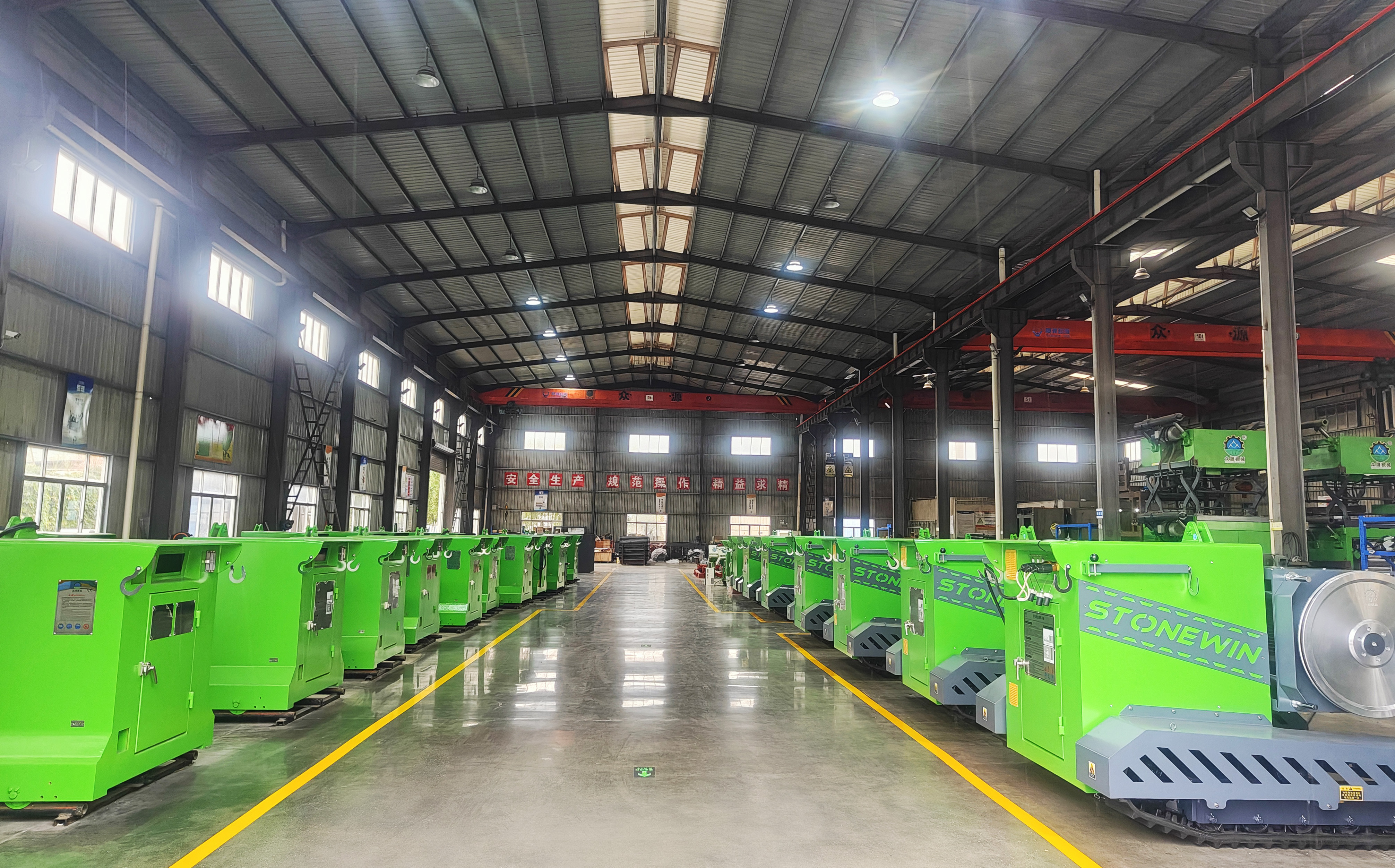
Assembly area for stone quarrying wire saw machines. Image: Stonewin.
From Standards to the Cutting Floor: Guarding, Procedures, Training
The value of a certificate is realised only when the design logic transfers into operating discipline. Three control layers do most of that work on a wire saw installation.
Guarding against wire-saw injury
Diamond wire running at speed is the defining hazard of the machine class. The diamond wire saw itself is specified with a diameter range of φ3.5 to 12 mm across ZY, ZM, ZG and ZC series models, and it is the consumable that operators handle most often. Guarding design, interlock logic and access control are the engineering answer to that exposure — and they are precisely what EN ISO 12100:2010 pushes back into the design stage rather than leaving to site improvisation.
Documented standard operating procedures
Information for use is the third tier of the hierarchy, which means procedures are part of the safety concept rather than an administrative extra. A site that receives a CE-marked machine should expect an operating procedure that matches the actual configuration delivered, including block loading, wire tensioning, cut start-up and shutdown, and intervention rules for a broken wire.
Operator safety training
No standard can train an operator. What a standard can do is define what the operator must be trained on. That distinction matters in plants that run multiple shifts: the certificate fixes the machine-side requirement, while the plant carries the responsibility for the human side of the risk.
Purchasing implication: a certificate is only useful when the buyer can retrieve the documents behind it — the configuration that was assessed, the electrical design, the guarding arrangement, the procedures issued with the machine, and the training content provided to the buyer's team.
Why Quarry and Slab Plants Treat Certification as an Operating Asset
The commercial argument for reading certification closely is driven by where these machines go. Stonewin lists typical application markets including India, Turkey, Algeria, Bulgaria, Egypt, South Africa, Thailand, Cambodia, Iran, Yemen, Italy, Poland, Greece, Spain and Brazil — a spread that covers several regulatory environments and several very different levels of local enforcement.
For a European installation, conformity with the relevant machinery requirements is a market-entry condition. For plants outside the EU, the same document performs a different function: it is a screening signal in supplier qualification, an input to insurance and internal risk reviews, and increasingly a condition set by corporate buyers of finished slabs who audit their upstream suppliers.
The manufacturer's own profile explains why documentation discipline has to be systematic rather than case-by-case. Stonewin operates two intelligent manufacturing bases in Fujian and three R&D centres covering stone quarrying, processing and diamond tools, with a facility of approximately 46,667 square metres, around 300 staff, an R&D team of 50 engineers and technicians, and an annual production capacity of 600 units of stone processing machinery. Export business accounts for roughly 50% of sales. A producer shipping that volume into that many jurisdictions cannot treat certificates as a one-off project.
Certification versus Conventional Procurement Practice
The practical difference between a documentation-led purchase and a specification-only purchase is easiest to see side by side.
| Evaluation point | Documentation-led approach | Specification-only approach |
|---|---|---|
| Risk assessment | Provided as part of the technical file and traceable to the machine | Assumed, or reconstructed by the buyer after delivery |
| Electrical design | Control system, stopping functions and isolation documented against EN 60204-1:2018 | Verified only at commissioning, if at all |
| Guarding | Defined at design stage and matched to the delivered configuration | Often supplemented on site by the plant |
| Operating information | Procedures and warnings issued with the machine | Accumulated informally by operators |
| Traceability | Certificate number, issuing body and standard versions identifiable | Depends on supplier statements without reference documents |
Neither approach changes the physics of a wire saw. The difference is who carries the uncertainty — the manufacturer at design stage, or the plant after installation.
Where the Certificate Stops: Limits Buyers Should Know
A credible reading has to include the boundaries, because they determine what still needs to be verified.
- Configuration scope. Stonewin states that the machine body material can be customised according to customer requirements. Where a machine deviates from the assessed configuration, the buyer should confirm in writing that the delivered unit remains inside the certificate's scope.
- Installation and site works. The machine requires a foundation and supporting equipment including the diamond wire saw. Civil works, foundation quality, power supply quality and site layout are outside the certificate.
- Operating behaviour. Training, supervision, shift discipline and maintenance execution are the plant's responsibility, not the certificate's.
- Local regulation. CE conformity is not a substitute for national occupational safety rules in the destination market, several of which impose additional obligations on the operator.
- Performance. Nothing in the certificate speaks to cutting output, slab quality or energy consumption. Those require separate commercial and technical verification.
A Practical Verification Checklist
For procurement teams preparing a purchase order, six checks convert the certificate into usable evidence:
- Request the certificate copy and confirm the number, the issuing body, the product code and the standard versions match the order.
- Confirm the specific model — from ZY-MW5 through ZY-MW90 — and the chosen tensioning configuration fall inside the assessed product definition.
- Request the electrical documentation and confirm that stopping functions, isolation and control architecture are described.
- Request the guarding arrangement for the configuration being purchased, not for the product family in general.
- Request the operating procedures and the training content that will be handed over with the machine.
- Confirm the environmental envelope matches the site — temperature, humidity and altitude limits.
Market Context: Compliance as a Commercial Variable
The commercial weight of certification is rising with the size of the installed base. Fortune Business Insights estimated the global stone processing machinery market at USD 20.86 billion in 2024 and projected a compound annual growth rate of 5.5% from 2026 to 2034. Growth of that order implies continued equipment investment across quarrying and slab processing regions, and with it a larger population of machines whose safety documentation will eventually be examined — by regulators, insurers, or downstream buyers auditing their supply chain.
For manufacturers, this shifts certification from a market-entry formality to a recurring documentation obligation across a product range that spans multiple models and configurations. For buyers, it shifts the question from whether a supplier holds a certificate to whether the supplier can retrieve the specific evidence behind it on request.
Future Outlook
Two developments are likely to shape how stone plants read certificates over the next several years. The first is digital traceability: machines that already support remote viewing via the Internet of Things generate operating records that can be matched against documented procedures, which makes the information-for-use tier of the safety hierarchy far easier to audit than it was when records lived in paper logbooks.
The second is buyer-driven verification. As slab and tile buyers extend environmental and safety questionnaires upstream, a quarry or processing plant's ability to produce machine-level conformity documentation becomes part of its own commercial standing. In that environment, a certificate number such as IN-XM-5805-23069 is not a badge to display once. It is an index into a file that has to stay complete, current and matched to the machine actually installed.
Frequently Asked Questions
What does CE certificate IN-XM-5805-23069 actually attest to?
It records that a defined product — the Stonewin multi wire saw machine, product code 4279 — was assessed by SGS against EN ISO 12100:2010 and EN 60204-1:2018. It attests to a design-stage conformity assessment against those standards. It does not attest to the safety performance of any specific installation, to cutting output, or to the quality of site works.
What does EN ISO 12100:2010 require a machine manufacturer to do?
It requires an iterative risk assessment and risk reduction process: identify hazards, estimate and evaluate risk, then reduce risk using a hierarchy that runs from inherently safe design, through safeguarding and complementary protective measures, to information for use. The outputs are a technical file and the operating information supplied with the machine.
Why does EN 60204-1:2018 matter specifically for stone processing machines?
Because the electrical and control systems operate in dust-exposed, humid conditions. Stonewin specifies an operating envelope of 5°C to 40°C, humidity not exceeding 50% at 40°C and 90% at 20°C, at altitudes up to 1000 m, and states that the multi wire saw application is certified for dust-exposed stone processing environments. Those conditions define what the electrical design has to withstand, which is exactly the scope of EN 60204-1:2018.
Does the certificate cover every model in the multi wire saw range?
The certificate refers to a defined product under product code 4279, while the range itself spans models ZY-MW5 through ZY-MW90 in side-tension and top-tension configurations, with machine body material customisable on request. Buyers should confirm in writing that the specific model and configuration ordered fall within the assessed product definition.
Can CE certification replace operator training and internal procedures?
No. Information for use is the final tier of the EN ISO 12100 risk-reduction hierarchy, which means procedures and training are treated as a required layer rather than an optional extra. The certificate establishes the machine-side requirement; the plant remains responsible for training, supervision and maintenance discipline.
What documents should a buyer request before accepting delivery?
The certificate copy with number, issuing body and standard versions; the electrical documentation covering stopping functions, isolation and control architecture; the guarding arrangement for the delivered configuration; the operating procedures and training content supplied with the machine; and written confirmation that the site's temperature, humidity and altitude conditions fall within the specified envelope.
A full technical catalogue covering the multi wire saw range and related stone processing equipment is available for download: Stonewin product catalogue (PDF).
¿Tiene preguntas o necesita más detalles?
Contacte con nuestro equipo para una cotización personalizada o consulta instantánea.
Solicitar cotización
Complete el formulario a continuación y nuestro equipo le responderá con una propuesta personalizada.
Chat directo de WhatsApp
¿Prefiere chatear en tiempo real? Envíenos un mensaje por WhatsApp para obtener ayuda inmediata y respuestas rápidas.
- Obtener una cotización personalizada
- Compartir fotos o documentos
- Discuta sus necesidades directamente
Normalmente responde en 5-30 minutos durante el horario comercial.