
Stone Crushing Production Line Constraints: Standards and Limits
Stone Crushing Production Line Constraints: Standards and Limits
Certification scope, feed opening, discharge grading and grid voltage decide whether a stone crushing production line reaches its rated tonnage — not the crusher nameplate alone.
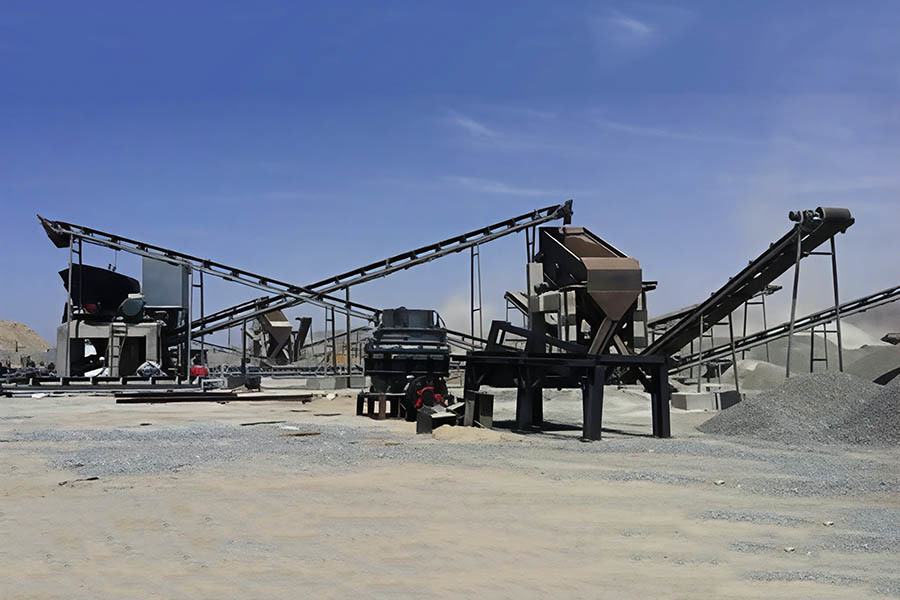
A stone crushing production line is only as capable as its tightest constraint. Buyers normally begin with two numbers — target tonnage and rock type — but the configuration that survives import clearance, permitting and commissioning is defined by a sequence of hard limits. Maximum feed lump must fit the crusher feed opening. The required reduction ratio must fit the number of crushing stages. The finished grading must fit the number of screen decks. The installed power must fit the available grid. The certification scope must cover the specific model being shipped to the destination market.
Shandong Lianbang Heavy Industry Co., Ltd. is a China-based manufacturer of sand-stone crushing, sand-making and solid-waste recycling equipment, registered in 2013 in Linyi, Shandong Province, and operating under the brand trademark Shanyuan LBZG. The company supplies standalone machines, EPC general contracting for complete sand-stone production lines, and tyre-type mobile crushing and screening stations, and publishes model-level parameters and certification documents that buyers can check against the constraints described below.
Why Constraint Checking Comes Before Capacity Comparison
Two crushing lines can carry the same nominal tonnage and behave completely differently, because catalog capacity is a value obtained under stated ideal test conditions. Actual throughput varies with raw material hardness, feed size, mud and moisture content, power supply stability, feeding continuity and the wear condition of consumable parts. A reasonable performance deviation between catalog and site figures should be expected, and a line specified without headroom will simply run below its target from the first month.
For that reason, experienced buyers evaluate a line in this order:
- Feed geometry first. Can the primary crusher physically accept the largest lump the quarry delivers?
- Capacity headroom second. Is the rated capacity of the limiting machine 10–20% above the actual demand?
- Chain matching third. Can the vibrating feeder, vibrating screen and belt conveyor carry what the crusher produces?
- Compliance fourth. Does the certification and documentation set match the destination market and the specific model?
Only after those four checks does it make sense to compare one aggregate crushing equipment package against another.
The Constraint Stack: Six Checks That Decide Real Output
1. Feed opening versus the largest lump
The practical rule is that the maximum feed lump should be roughly 0.8–0.85 of the feed opening width, and the rated capacity of the primary crusher should be at least 1.1–1.2 times the target output to avoid full-load operation. Applied to a limestone quarry delivering material up to 500 mm, a PE-600×900 jaw crusher with a 600 × 900 mm feed opening and a maximum feed size of 520 mm sits inside the rule, with a rated capacity of 50–150 t/h and a 75 kW motor. A PE-500×750 unit accepts up to 480 mm and would be marginal for the same feed.
The same arithmetic governs a small stone crusher or a small gold ore crusher used on a mining crushing production line: the opening, not the price tag, decides whether the machine can be fed at all.
2. Reduction ratio and the number of stages
Each crusher type has a characteristic reduction band. A PEX-250×750 secondary fine jaw crusher takes feed up to 210 mm and delivers 25–60 mm through an adjustable discharge setting, with a 22 kW motor. A PYB-1750 spring cone crusher accepts a 215 mm feed opening and produces a 25–60 mm output at 280–480 t/h with a 155 kW motor and a 50.3 t operating weight. Where a single-pass solution is acceptable, a PC-1000 strong-impact box-type crusher performs one-time forming crushing on feed up to 450 mm with an installed power of 90–110 kW.
Stage count is therefore a constraint, not a preference. If the required reduction cannot be reached in two stages, a third stage — usually a cone crusher or a sand making machine — is mandatory.
3. Matching the conveying and screening chain
Under-delivery on stone crushing production lines frequently originates outside the crusher. A YK circular vibrating screen in the 3YK-1548 configuration has three decks, screen holes below 50 mm, a capacity range of 15–200 t/h and a 7.5 kW motor. A 2YK-2470 two-layer screen carries the same 15–200 t/h band with a 22 kW motor and an 8.5 t total weight.
Belt conveyor constraints are equally specific. A B800 belt conveyor with an 800 mm belt width conveys 280–500 t/h at 1.0–2.0 m/s, and its drive power depends on centre distance: 5.5–7.5 kW up to 10 m, 7.5–11 kW for 10–20 m, and 11 kW for 20–30 m. A B1200 heavy-duty conveyor raises the conveying capacity to 650–1200 t/h. Specifying a conveyor by belt width while ignoring length is a common and avoidable error.
4. Installed power and the local grid
Power is a two-sided constraint: the machines must be rated for the site supply, and the site supply must be able to start them. Mobile equipment in the LBZG range is stated to support 380 V / 440 V. Stationary production lines can be customised for 380 V / 440 V / 415 V / 660 V supplies, with motor brand, colour, logo, line layout, capacity and output grading, automation level and quartz or sand production line configuration also adjustable under OEM / ODM arrangements.
Large machines set the ceiling for the whole line. A PE-1200×1500 primary jaw crusher runs a 200 kW motor at a 109 t operating weight; a PYB-2200 spring cone crusher uses 280 kW at 83 t; a PC-1600×1600 hammer crusher, described as the largest model in the PC series, uses 450–560 kW at 76 t with a throughput range of 500–1000 t/h. Those figures must be checked against transformer capacity before the layout is fixed.
5. Product grading and particle shape
Where the finished product is manufactured sand for concrete, grading is a specification, not an outcome. The EIS-1200 intelligent environmental dry-type sand making system is rated at 160–220 kW with a feed size up to 50 mm and a stated fineness modulus of 2.3–3.0. The EIS-1000 model takes feed up to 45 mm at 140–180 kW with dry-type production and intelligent monitoring.
Shaping equipment carries its own feed constraint. A VSI-7611 vertical shaft impact sand maker uses a rock-on-rock chamber at 110–150 kW, but its maximum feed size is 35 mm for soft material and 30 mm for hard material, so it must be fed screened undersize rather than crusher run.
6. Site conditions and mobility
Whether a line should be fixed or mobile is a constraint decision driven by project life, site stability and raw material distribution. A tyre-type mobile crushing station integrates feeding, crushing, screening and conveying on a chassis, requires no concrete foundation, and can be relocated as a whole. The LBZG mobile range includes the YCG-J750 mobile jaw station (PE-750×1060 host, 110–230 t/h), the YCG-I1214 mobile impact station (PF-1214 host, 100–180 t/h), the YCG-C160 mobile cone station (CS-160 host, 90–210 t/h), the YCG-VSI8518 mobile sand-making station (100–180 t/h) and the YCG-S2460 mobile screening station with 2–3 decks and an 80–300 t/h screening capacity.
The limit is equally clear: a single mobile unit has an upper capacity ceiling, and for very high tonnage a fixed line remains the appropriate choice.
Certification and Documentation Constraints for Imported Lines
Certification is the constraint most often discovered too late, and it has three distinct layers: the manufacturer's quality system, the machine-level conformity mark, and the traceable technical evidence behind them.
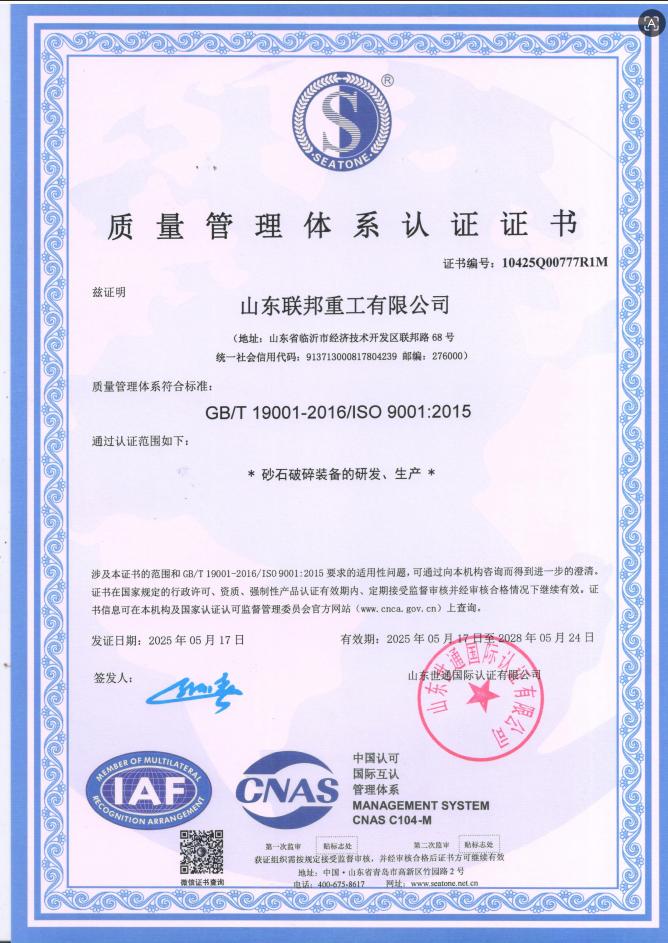
At system level, Shandong Lianbang Heavy Industry holds ISO 9001 quality management, ISO 14001 environmental management and OHSAS 18001 occupational health and safety system certifications, together with CE export certification for foreign trade projects, and states that it participates in revising national industry standards for crushers. Its ISO 9001 certificate, number 10425Q00777R1M, was issued by Shandong Seatone International Certification Co., Ltd. against GB/T 19001-2016 / ISO 9001:2015 for the research, development and production of sand-stone crushing equipment, issued on 2025-05-17 and valid to 2028-05-24.
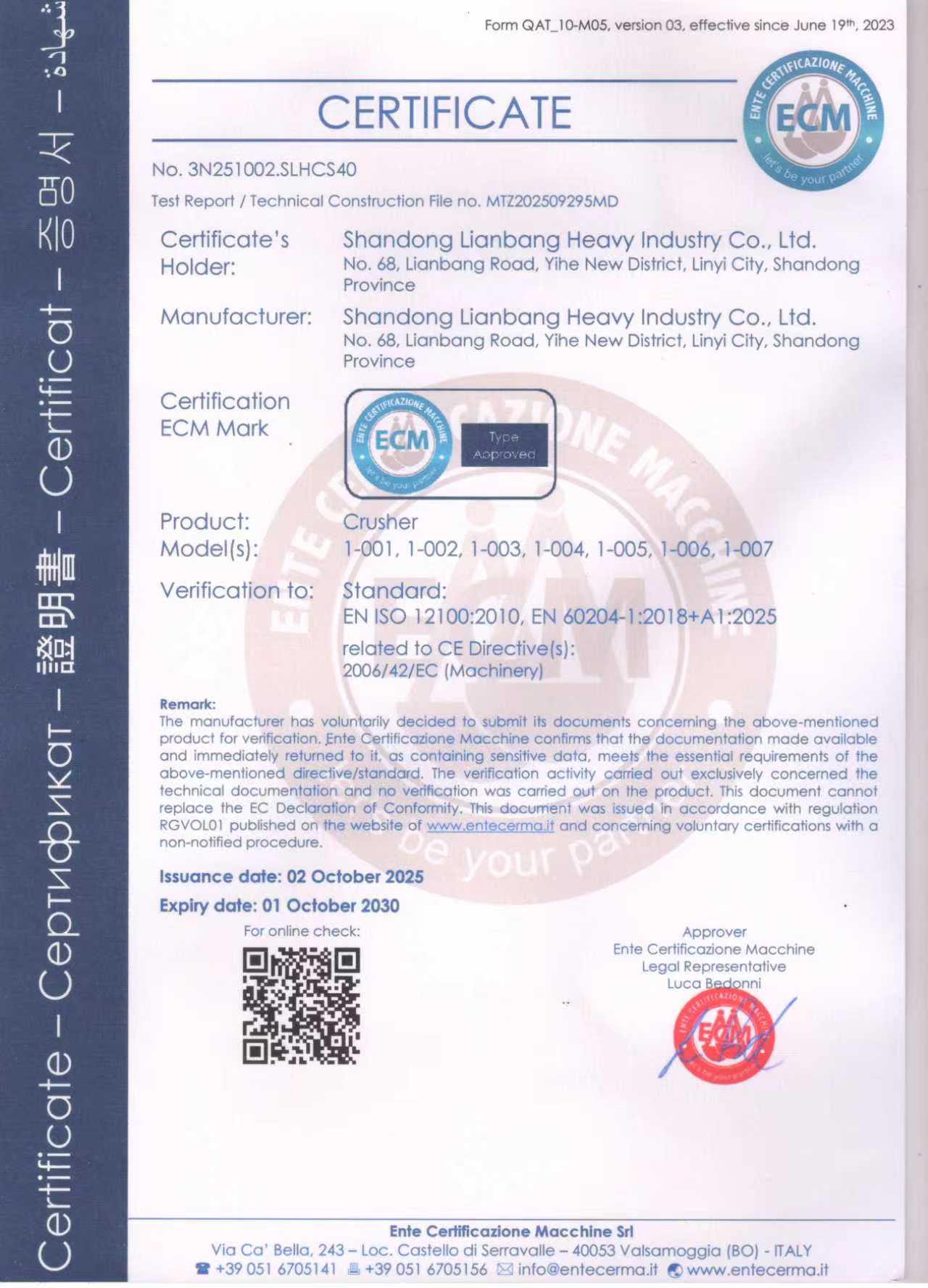
At machine level, the CE Mark certificate number 3N251002.SLHCS40 was issued by Ente Certificazione Macchine (ECM) for the EU market, assessed under Directive 2006/42/EC (Machinery) against EN ISO 12100:2010 and EN 60204-1:2018+A1:2025, issued on 2025-10-02 with an expiry date of 2030-10-01. The certificate scope covers listed models including the PF-1214 and PF-1315 impact crushers, the PX and PC series crushers, YK screens, XS and FG sand washers, PEX jaw crushers, MB rod mills and the YCG mobile stations (YCG-J750, YCG-I1214, YCG-C160, YCG-VSI8518 and YCG-S2460).
For mobile units specifically, buyers should note that ISO 21873-2:2019 specifies safety requirements and verification for mobile crushers used to crush rock or reprocess construction materials. It is a distinct standard from the general machinery directive and is worth raising explicitly during procurement of a construction waste mobile crushing station.
At evidence level, patent registrations provide traceable technical documentation. Relevant examples granted by the China National Intellectual Property Administration (CNIPA) under China's Patent Law include:
- Utility model ZL 2019 2 2282885.X for a shock-absorbing device for jaw crushers, covering PE series models including PE-250×400, PE-500×750, PE-600×900, PE-750×1060, PE-900×1200 and PE-1200×1500, issued 2020-09-11 and valid to 2029-12-18.
- Utility model ZL 2022 2 1008598.5 for a new-type cone crusher, covering the PYB-900, PYB-1200 and PYB-2200 spring cone crushers together with the CS-75, CS-160 and CS-220 hydraulic cone crushers, issued 2022-08-19 and valid to 2032-04-24.
- Utility model ZL 2019 2 2303517.9 for an aggregate distributor with split-flow function for mobile crushing stations, covering the YCG range, issued 2020-09-11 and valid to 2029-12-20.
- Utility model ZL 2023 2 1996237.0 for a hammer crusher regulator, covering the PF-1214 and PF-1315 impact crushers, issued 2024-02-09 and valid to 2033-07-27.
- Utility model ZL 2024 2 2590897.X, issued 2025-07-18 and valid to 2034-10-25, covering the YCG mobile crushing station series.
| Document type | Reference number | Issuer and scope | Validity |
|---|---|---|---|
| CE Mark | 3N251002.SLHCS40 | Ente Certificazione Macchine (ECM); EU market; Directive 2006/42/EC; EN ISO 12100:2010, EN 60204-1:2018+A1:2025 | Issued 2025-10-02; valid to 2030-10-01 |
| ISO 9001 | 10425Q00777R1M | Shandong Seatone International Certification Co., Ltd.; GB/T 19001-2016 / ISO 9001:2015; R&D and production of sand-stone crushing equipment | Issued 2025-05-17; valid to 2028-05-24 |
| Utility model patent (jaw shock absorber) | ZL 2019 2 2282885.X | CNIPA; China market; PE series jaw crushers | Issued 2020-09-11; valid to 2029-12-18 |
| Utility model patent (new-type cone crusher) | ZL 2022 2 1008598.5 | CNIPA; China market; PYB and CS cone crushers | Issued 2022-08-19; valid to 2032-04-24 |
| Utility model patent (mobile station distributor) | ZL 2019 2 2303517.9 | CNIPA; China market; YCG mobile crushing stations | Issued 2020-09-11; valid to 2029-12-20 |
Two Worked Configurations and Their Binding Constraints
The tables below show how the constraint stack resolves into a concrete equipment list. They are parameter-based examples, not quotations, and site data should be confirmed before ordering.
Example A — limestone aggregate line, feed up to 500 mm, target around 150 t/h
| Stage | Equipment | Key published parameters | Constraint it satisfies |
|---|---|---|---|
| Feeding | ZSW-490×96 vibrating feeder | Trough 4900 × 960 mm; capacity 120–210 t/h | Feeds the primary crusher above its own rated throughput |
| Primary | PE-600×900 jaw crusher | Feed opening 600 × 900 mm; max feed ≤520 mm; output 65–130 mm; 50–150 t/h; 75 kW; 16.6 t | 500 mm limestone sits inside the 520 mm limit; capacity covers the target with margin |
| Secondary | PF-1214 impact crusher | Rotor Φ1250 × 1400 mm; max feed 400 mm; 80–180 t/h; 132–160 kW | Accepts the 65–130 mm jaw discharge and produces cubical aggregate |
| Screening | 3YK-1548 vibrating screen | 3 decks; screen holes below 50 mm; 15–200 t/h; 7.5 kW; 4.8 t | Grading capacity above line output |
| Conveying | B800 belt conveyor | Belt 800 mm; 280–500 t/h; 11 kW at 20–30 m | Conveying capacity well above the crusher output at the longest span |
Example B — granite and basalt line, target 150–200 t/h
| Stage | Equipment | Key published parameters | Constraint it satisfies |
|---|---|---|---|
| Primary | PE-750×1060 jaw crusher | Feed opening 750 × 1060 mm; max feed ≤630 mm; output 80–140 mm; 100–180 t/h; 110 kW | Hard-rock primary duty with adequate opening |
| Secondary | CS-160 hydraulic cone crusher | Cone diameter 1295 mm; CSS 13–51 mm; 109–181 t/h fine, 132–253 t/h medium; 185 kW | Compression crushing for abrasive granite and basalt |
| Alternative secondary | PYB-1750 spring cone crusher | Feed opening 215 mm; output 25–60 mm; 280–480 t/h; 155 kW; 50.3 t | Lower-investment secondary option with larger capacity headroom |
| Shaping / sand | VSI-7611 sand maker | Max feed 35 mm soft / 30 mm hard; 110–150 kW; rock-on-rock | Requires screened undersize feed, not crusher run |
| Screening | 4YK-1854 vibrating screen | 4 decks; screen holes below 50 mm; 15–200 t/h; 11 kW; 6.2 t | Four-product cut for shaped aggregate and sand |
Where LBZG Crusher Sits in the Supply Constraint Picture
Shandong Lianbang Heavy Industry operates two production bases covering a total area of 120,000 m², with 40,000 m² of standard workshops and more than 150 sets of processing equipment. The company reports around 110 employees, including more than 40 R&D personnel, and a registered capital of 50 million Yuan. Its technical origins trace back to Chengming Machinery, an affiliated enterprise established in 1996. Products are sold across all Chinese provinces and municipalities and to more than 40 overseas countries, with an export ratio of 30% and main markets in the Middle East, Central Asia, Southeast Asia and Africa.
Three supply-side constraints matter to a buyer evaluating this kind of supplier:
- Production and lead time. Stated monthly capacity is approximately 170 sets, with a regular lead time of 15–30 days and a minimum order quantity of one set. Urgent orders are described as negotiable.
- Quality gate. Every unit is described as receiving a 100% pre-shipment test plus on-site installation and commissioning.
- Service reach. The company reports 8 overseas offices, 6 domestic branches, 10 local offices and 60+ professional service staff covering more than 40 Belt & Road countries, with a 1-year warranty, remote guidance plus on-site repair, and spare parts held in stock at its Linyi location.
The company's stated qualification profile includes National High-tech Enterprise status (re-recognised in 2023), Shandong Provincial-level Specialized, Refined, Differential & Innovative SME status announced by the Shandong Provincial Department of Industry and Information Technology, National-level Science-and-Technology-Oriented SME status, a municipal-level engineering laboratory, a municipal-level enterprise technology center and a provincial-level 'One Enterprise, One Technology' R&D center, together with the Linyi Mayor Quality Award. It also reports industry-university-research cooperation with China University of Mining and Technology and Shandong University.
Reference experience is documented across central state-owned enterprises and overseas partners: China Railway Construction Corporation for the Lunan High-Speed Railway aggregate supply over a 5+ year duration; China State Construction Engineering for manufactured sand; Sinoma Group and CNBM for building-material aggregate lines; Shenhua Group for coal-related aggregate processing; an overseas Belt & Road distributor for a local quarry development; and a construction waste recycling company running mobile stations for more than two years.
Application Scenarios and Their Specific Constraints
Different end uses impose different binding constraints on the same equipment range. The following table maps the primary constraint to each typical project type.
| Project type | Binding constraint | Typical equipment focus |
|---|---|---|
| Overseas quarry and Belt & Road infrastructure | Voltage and climate adaptation; long-distance service support | Full equipment set plus spare parts kit; adaptation to 380 V / 440 V / 415 V / 660 V |
| Highway and railway construction | Strict gradation and particle shape; 24/7 operation | Complete aggregate and sand production line with dust-removal system |
| High-speed rail aggregate supply | Railway ballast specification; fineness modulus 2.3–3.0; stable grain-size control | Centralised control system plus full crushing and screening line |
| Hydropower engineering | High-strength aggregate specification; wear-resistant chamber; remote-site serviceability | Secondary crusher with wear-resistant chamber; long-term continuous operation |
| New town and airport construction | Large output, stable quality, dust suppression | Complete line plus mobile backup for multi-site projects |
| Construction and demolition waste recovery | Mobility, low noise, low dust, zero concrete foundation | Construction waste mobile crushing station with magnetic separator and dust-removal system |
| Solid hazardous waste disposal | Sealing and corrosion resistance; negative-pressure dust control | Feeder, crusher, screen, conveyor and negative-pressure enclosure; explosion-proof motor option |
Market Context: Why Constraint Discipline Is Increasingly Commercial
The global stone crushing equipment market was estimated at USD 8.47 billion in 2024, according to Market Research Future. On the trade side, China was the leading exporter of machines to crush or grind stone, ores and minerals in 2024, with exports valued at USD 1.38 billion, based on OEC data for HS code 847420. Jaw crushers held a 35.2% share of the crusher market in 2025, reflecting their role as the default primary crushing machine, per Polaris Market Research.
Downstream demand is equally concrete. The United States produced 1.5 billion tons of crushed stone in 2023, valued at over USD 24 billion, according to USGS figures cited by Research Nester. Growth-rate forecasts for the same equipment market vary noticeably between research houses, largely because of differences in whether parts and service revenue are included — a reminder that headline growth percentages should be treated as methodology-dependent rather than as procurement inputs.
Regulatory pressure is a second commercial driver. A 2026 revision of China's mandatory energy efficiency standards is reported to add standby power limits to industrial machinery, which may affect specifications for lines built for China-based production. Buyers should confirm current applicability rather than assume it.
Comparison with Traditional Approaches — and Where the Limits Are
Constraint-based specification often conflicts with the lowest-purchase-price instinct. The following comparison sets out the trade-offs honestly, including the situations where a given approach should not be used.
| Decision | Preferred choice | Alternative | Documented limit of the alternative |
|---|---|---|---|
| Secondary crushing of hard, abrasive rock such as granite and basalt | CS or PY cone crusher using compression crushing | PF impact crusher | Impact crushers produce good cubic shape but blow bars wear quickly on hard rock, raising operating cost; impact crushers are not recommended as the main hard-rock crusher |
| Secondary crushing of medium-hard brittle material such as limestone | PF impact crusher for cubical aggregate | PC or PCX hammer crusher | Hammer crushers offer higher reduction ratio and lower investment but produce more fines and handle moist or sticky material poorly; high-silica limestone accelerates hammer wear |
| Project layout | Fixed line for long-life, high-tonnage quarries | Mobile crushing station | A single mobile unit has an upper capacity ceiling; for very high tonnage a stationary line is preferred |
| Primary crushing stage | PE series jaw crusher | Cone crusher as primary | Cone crushers are limited on feed size and are not suitable as a first crushing stage |
Three further boundaries are worth stating plainly, because they are frequently discovered after purchase rather than before:
- Catalog performance is conditional. Full published output cannot be guaranteed without matching on-site conditions; heavy clay content, uneven feeding and worn consumables reduce both output and product cleanliness.
- Wear parts are consumables. Hammers, sieve plates, spiral blades and screen meshes are direct-contact parts subject to normal production wear and fall outside the warranty coverage of the main machine body. In hard-rock duty, periodic inspection and replacement are routine rather than exceptional.
- Adjustment has limits. Vibration parameters on screens should not be altered without authorisation, and non-original spare parts can cause equipment failure that the warranty does not cover.
For a low-cost crusher selection, the honest position is that purchase price is one of three cost layers, alongside civil works and consumable consumption. Compression crushing machines typically carry a higher initial investment but a longer wear-part life on abrasive rock, while impact and hammer machines carry lower entry cost with faster consumable turnover on the same material.
Future Outlook
Three directions appear to be shaping the next specification cycle. The first is dry-type sand production, which reduces water consumption and dust load in manufactured sand plants; the EIS-1000 and EIS-1200 intelligent environmental dry-type sand making systems, described in the company's product data as a National 'Robinson Cup' first-prize design with low dust emission, are examples of that direction. The second is monitoring and control, where the company holds a Chinese domestic software copyright for its Intelligent Operation Monitoring Software for Crushing and Screening Production Line V1.0. The third is mobility, where tyre-type stations continue to be deployed for demolition waste and dispersed quarrying work, with the understanding that fixed lines retain the advantage in very high tonnage duty.
For buyers, the practical implication is that constraint documentation — certified model scope, published parameters, wear-part policy and service reach — will matter more in evaluation, not less, as equipment ranges widen and supply chains lengthen.
FAQ
What certifications and standards should be verified before importing a complete stone crushing production line?
Buyers should confirm that the supplier holds ISO 9001 quality management certification covering the relevant product scope, that machine-level conformity documentation exists for the destination market — CE Mark under Directive 2006/42/EC for the EU, for example — and that full English technical documentation including manuals, drawings and spare-parts lists is supplied. Shandong Lianbang Heavy Industry holds ISO 9001 certificate 10425Q00777R1M valid to 2028-05-24 and CE Mark certificate 3N251002.SLHCS40 valid to 2030-10-01, and states that it provides material and welding inspection reports, factory test-run records and shipping documents. For mobile crushers, ISO 21873-2:2019 sets out safety requirements and verification and is a separate consideration from the general machinery directive.
For a quarry project, should I choose a stationary crushing production line or a wheel-type mobile crushing plant?
The decision depends on project service life, site stability and raw material distribution. Permanent quarries with stable, high output requirements over a long service life generally obtain better cost performance from a stationary line configured with a jaw crusher, a cone or impact crusher, a circular vibrating screen and belt conveyors. Short-term projects, scattered quarry points, frequent site transfers and sites without good foundation conditions generally favour a wheel-type mobile plant, which integrates feeding, crushing and screening, requires no heavy foundation, and reduces raw stone hauling cost. The boundary is capacity: a single mobile unit has an upper limit, and for very high tonnage a fixed line remains appropriate.
What are the main risks when purchasing a stone crusher for a quarry?
The recurring risks are quality risk (defective frame, casting or wear parts), application risk (a model unsuited to feed hardness or size), safety risk (missing guards or electrical protection), delivery risk (schedule or document errors) and compliance risk (certificates that are expired or do not match the specific machine). These typically arise when buyers select on price alone without quality verification, when feed data is not shared clearly, when a supplier lacks export safety-standard experience, or when certificate scope does not correspond to the shipped model. Mitigation measures include requesting material certificates, third-party inspection or factory test-run records, confirming model and chamber selection against actual feed data, and requiring document and lead-time terms in the contract.
For the primary crushing stage, is a jaw crusher or a cone crusher the right choice?
The jaw crusher is the conventional primary crusher. It handles coarse crushing across material hardness levels, accepts large feed sizes, has a simple structure and is straightforward to maintain. The cone crusher is generally used for medium and fine crushing because its feed size is limited, which makes it unsuitable as the first crushing stage. For extremely hard material such as granite or basalt at high capacity, the standard approach is a combined jaw crusher (primary) plus cone crusher (secondary) circuit. Where the target is finished material below 50 mm or a premium aggregate with strict particle-shape requirements, additional stages are needed.
Will the actual output of a crusher, screen or sand washer differ from the catalog parameters?
Yes, within limits. Catalog rated data is obtained under ideal standard test conditions. Actual throughput varies with raw material hardness, feed size, mud and moisture content, power supply stability, feeding continuity and the wear condition of consumable parts, so a reasonable performance deviation should be expected. Full catalog output cannot be guaranteed without matching on-site conditions. For screens, mesh clogging or abrasion, high material moisture, altered excitation force and ageing springs all degrade performance. For hammer crushers, discharge size depends on sieve plate aperture, hammer wear and raw rock hardness, which means brand-new particle performance cannot be maintained permanently.
What material should be selected for crusher wear parts, and how long do they last?
Material selection balances hardness and toughness. Jaw crushers typically use high-manganese steel jaw plates, with higher-manganese grades for hard rock. Impact crushers may use high-chromium cast iron where abrasion dominates at low impact, or martensitic alloy steel where impact loads are high. Hammer crushers commonly use composite or alloy hammers. Indicative service life is three to six months for jaw plates, one to three months for blow bars, one to four months for hammers, and three to six months for cone crusher bowl liners and mantles, with actual life depending on material hardness, silica content, feed size and operating practice.
For readers who need the underlying equipment and parameter documentation, the company brochure is available at Shandong Lianbang Heavy Industry brochure.