
Stone Coated Metal Roofing: Retrofit, Steel Frame & Energy Fit
Stone Coated Metal Roofing: Retrofit, Steel Frame & Energy Fit
Roof retrofits rarely fail on appearance. They fail on dead load, minimum pitch and heat gain. Stone coated metal roofing answers all three within defined limits: roughly 5–8 kg per square metre, approved for pitched roofs from 12° to 90°, and installable directly over existing tiles in retrofit projects.
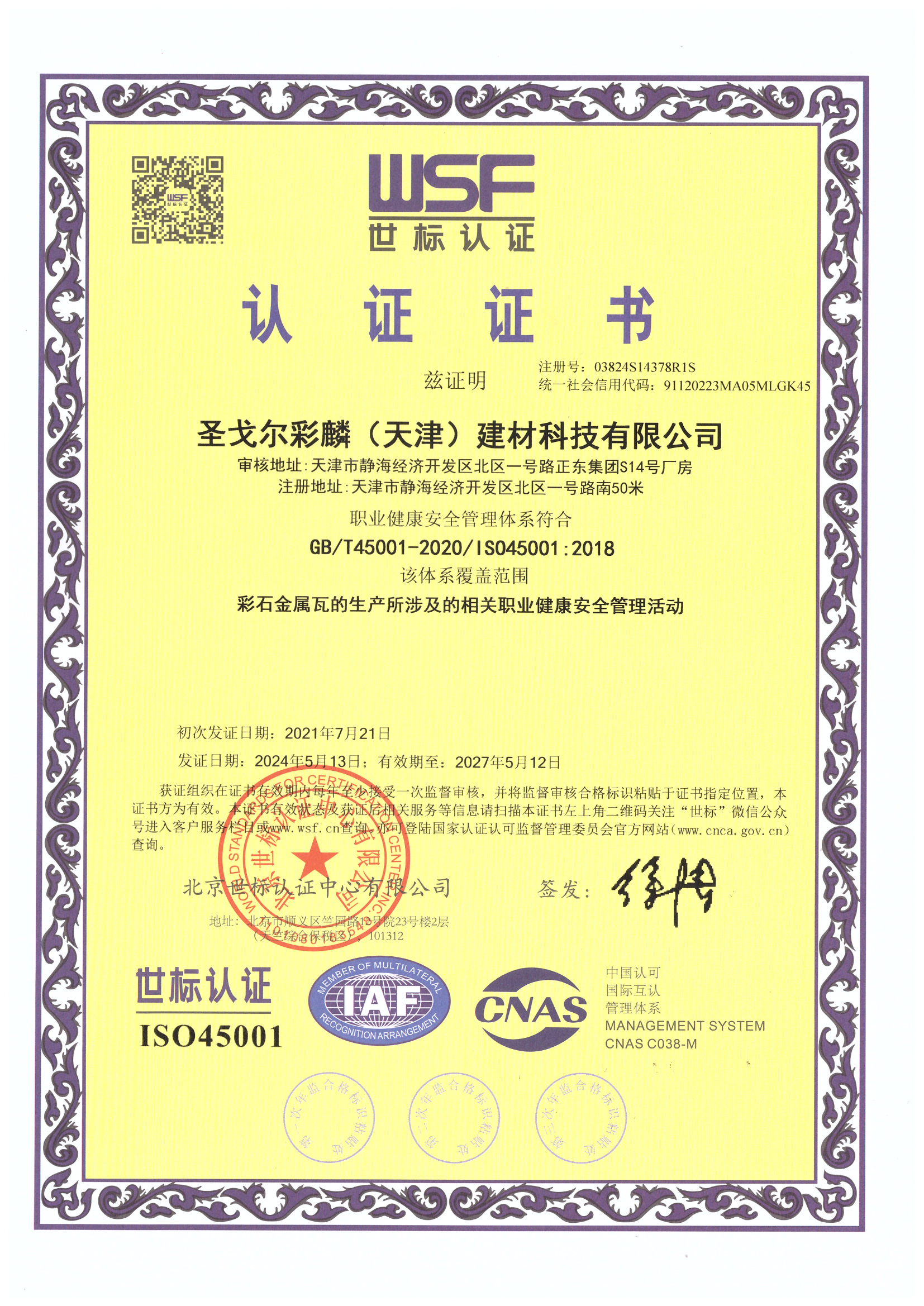
Specification evidence: the production of stone coated metal roofing tiles is covered by ISO 45001:2018 certification held by Sango Cailin (Tianjin) Building Tech. Co., Ltd., under the CNAS-IAF mutual recognition arrangement.
Why Retrofit and Lightweight Steel Projects Change the Specification Brief
Re-roofing an older building and covering a new light-gauge steel structure are usually handled as separate engineering problems. In specification practice they converge on the same three questions: how much dead load can the existing structure accept, what is the minimum pitch the covering can tolerate, and how much heat will the finished assembly let into the space below.
A conventional answer to both cases is a heavier tile: clay, concrete or cementitious products that look right but add mass. When the existing roof already carries that mass, adding more is rarely an option; when the structure is a lightweight steel frame, that mass was never designed into the purlins and bracing in the first place. This is the gap that stone coated metal roofing was developed to fill.
Stone coated metal roofing is a pitched-roof tile made from a galvalume (AZ150) steel base, coated with acrylic resin and high-temperature sintered natural stone granules, and finished with a transparent acrylic top coat. The stone granule layer gives the surface its colour and texture; the steel core gives it strength at low weight. For retrofit and light-structure work, that combination — not the appearance — is the technical argument.
Problem and Opportunity: Where Concrete Tiles Stop Working
Three scenarios consistently push specifiers away from concrete and clay tiles:
- Ageing pitched roofs with sound structures but tired coverings. Full tear-off and replacement with a similar heavy tile commits the owner to removal, disposal and re-laying costs, and often to a structural review of the trusses or rafters.
- Lightweight steel-frame and light-gauge buildings. These structures are efficient precisely because their dead-load allowance is tight. A covering in the 40–60 kg/m² class is frequently ruled out at concept stage.
- Buildings with a cooling-dominated energy profile. A dark, massive roof absorbs and stores solar heat, then releases it into the attic and the rooms below. Retrofitting insulation is one response; changing the roof surface behaviour is another.
The opportunity is that all three scenarios can be addressed by a covering that is light, pitch-tolerant and reflective at the surface — provided the substrate itself is verified first. That proviso is important and is revisited later in this article.
Technical Explanation: What the Numbers Actually Allow
The published specification data for stone coated metal roofing from Sango Cailin (Tianjin) Building Tech. Co., Ltd. defines the practical envelope for retrofit and steel-frame work:
| Specification item | Published value | What it means on site |
|---|---|---|
| Weight | Approx. 5–8 kg/m² (varies with base steel thickness) | Keeps added dead load low enough that a lightweight steel structure is not automatically excluded |
| Base steel thickness | 0.4 mm – 0.6 mm (galvanized / aluzinc) | Thicker steel raises weight slightly and raises handling stiffness |
| Effective tile size | 1340 mm × 420 mm, covering 1260 mm × 370 mm | Large format reduces the number of pieces and fixing points per square metre |
| Applicable roof pitch | 12° to 90° | Excludes flat and near-flat roofs; covers steep and complex pitched geometry |
| Wind uplift resistance | Up to 160 mph (manufacturer data) | Supports high-wind and hurricane-zone specification, subject to local code uplift figures |
| Corrosion resistance | 500-hour salt spray test | Relevant to coastal and salt-exposed sites |
| Acoustic insulation | 70% noise reduction vs. bare metal roof | Measured against bare metal, not against an insulated assembly |
| Material build-up | Galvalume steel (AZ150), acrylic resin, sintered natural stone granules, transparent acrylic top coat | Explains both the painted-stone finish and the reflective, non-metallic-looking surface |
The weight comparison in context
Independent specification guidance for the category places stone-coated steel roofing at approximately 3.2–6.7 kg/m² and describes it as 5–10 times lighter than traditional concrete or clay tiles (SKW Product Specification Guide, 2025). The exact figure depends on the steel thickness selected, which is why the weight band, not a single number, is the correct input for a structural check.
For a retrofit, this changes the scope of work. A lightweight overlay can be installed directly over old tiles, which — where the existing substrate and framing are sound and the roof pitch meets the 12° minimum — avoids the tear-off and reinforcement scope that a replacement heavy-tile roof typically triggers. It does not remove the need for a site assessment; it changes what that assessment is likely to conclude.
How the surface behaves thermally
Bare metal roofs heat up quickly and transfer that heat inward. The sintered stone granule surface used in stone coated metal roofing is not bare metal; the granule layer and the coated substrate sit between the sun and the steel core. Industry analysis of metal roofing trends states that metal roofing can reflect heat away from buildings, potentially saving homeowners up to 40% on cooling energy costs (DECRA Roofing Trends Recap, 2024; third-party figure, medium reliability). That figure is a category-level estimate, not a guaranteed outcome for a specific building — the realised benefit depends on insulation, attic ventilation, roof orientation and climate zone.
Sango Cailin: The Manufacturer Behind the Specification
Sango Cailin (Tianjin) Building Tech. Co., Ltd. is a Chinese manufacturer of stone coated metal roofing, asphalt shingles, BIPV solar tiles, rain gutter systems and butyl tape. The company was founded in 2017 and is based in the Jinghai Economic Development Zone in Tianjin, with production bases across China including Hangzhou, Sichuan, Shandong and Hebei. Its stated annual output is 6,000,000 units, supported by a research and development team of 10 engineers.
The company positions itself as a factory rather than a trading company: tiles are produced on its own lines under its own quality control. Production of stone coated metal roofing tiles is certified to ISO 9001:2015 (quality), ISO 14001:2015 (environment) and ISO 45001:2018 (occupational health and safety), issued by the Beijing World Standards for Certification Center (WSF), valid from 13 May 2024 to 12 May 2027 under the CNAS-IAF mutual recognition arrangement. Roughly 25% of output is exported, with the USA, Canada and Southeast Asia listed as main markets and partners in more than 20 countries.
For buyers evaluating application fit rather than brand recognition, three capability facts matter: the company offers OEM, ODM and customised production; stone granule colour is available in 10+ standard colours with custom options; and steel thickness can be specified at 0.45 mm, 0.5 mm or 0.55 mm. Tile profiles cover the Cailin Shingle, Shake, Milano, Bond, Classical, Roman, Long-Span, Golan, Tudor and Heritage series plus Interlocking Shingle and Interlocking Shake. Stated monthly capacity is 500,000 units, lead time 7–10 days, and quality control includes 100% inspection, pre-shipment random sampling and third-party inspection on request.
Application Fit Ranking: Where the Product Fits Best
Not every roof is an equally good match. The ranking below reflects how strongly each application type aligns with the documented properties of the product — weight, pitch tolerance, uplift resistance, corrosion resistance and acoustic behaviour. It is a fit ranking of scenarios, not a ranking of suppliers.
| Rank | Application scenario | Why the fit is strong | What still needs checking |
|---|---|---|---|
| 1 | Retrofit overlay on ageing pitched tile roofs | Documented for direct installation over old tiles; low added dead load; no tear-off in suitable cases | Condition of the existing deck and framing; pitch at or above 12°; compatibility of the existing tile surface with an overlay |
| 2 | Lightweight steel-frame and light-gauge structures | 5–8 kg/m² keeps dead load within the allowance of many framed systems | Purlin spacing, fastener specification and bracing must be confirmed by the project engineer |
| 3 | Cooling-load-driven energy upgrades | Granule-coated surface reflects solar heat; category-level third-party estimate of up to 40% cooling-energy saving | Insulation level, attic ventilation and orientation determine the real gain |
| 4 | Coastal and high-wind locations | Up to 160 mph wind uplift resistance and a 500-hour salt spray result | Local code uplift requirement; fixing pattern; proximity to salt spray zones |
| 5 | Noise-sensitive residential roofs | 70% noise reduction versus a bare metal roof | Comparison must be made against the roof being replaced, not against an insulated assembly |
| 6 | Steep and geometrically complex pitched roofs | Approved across a 12°–90° pitch range | Valley, ridge and penetration detailing; maintenance access |
Installation Scenarios in Practice
Re-roofing an older building
The retrofit case is the strongest application fit for two reasons. First, the covering can be placed directly over existing tiles, so the disruption associated with stripping a roof is reduced. Second, the added mass is small enough that a heavy-tile structural upgrade is often not required. Both statements depend on a site assessment; neither is a substitute for one.
Equipping lightweight steel structures
Light-gauge steel buildings are designed around a tight dead-load budget. Because the tile system weighs approximately 5–8 kg/m², specifiers can consider a stone-coated steel roof where a concrete tile would have failed the load check at concept stage. The trade-off is that fixing detail — fastener type, spacing and pull-out capacity — must be engineered for the specific purlin and sheet build-up, and the 12° minimum pitch still applies.
Energy efficiency upgrades
Where cooling dominates the energy bill, changing the roof surface is a lower-disruption intervention than changing the building envelope. Metal roofing reflects heat away from the building, and third-party industry analysis cites potential cooling-energy savings of up to 40%. Realistically, the roof is one variable among several, and the substrate and pitch requirements of the tile remain unchanged.
Field Evidence: A 700-Unit U.S. Residential Retrofit
The most directly relevant documented application is a residential project in the United States, where 700 units of the product were installed on pitched roofing. The recorded outcomes were energy savings, eco-friendliness, hurricane resistance, wind resistance and noise reduction. The project highlights listed by the manufacturer are lightweight construction, 50+ year durability with low maintenance, and ease of installation, with an expected service duration of 30–50 years.
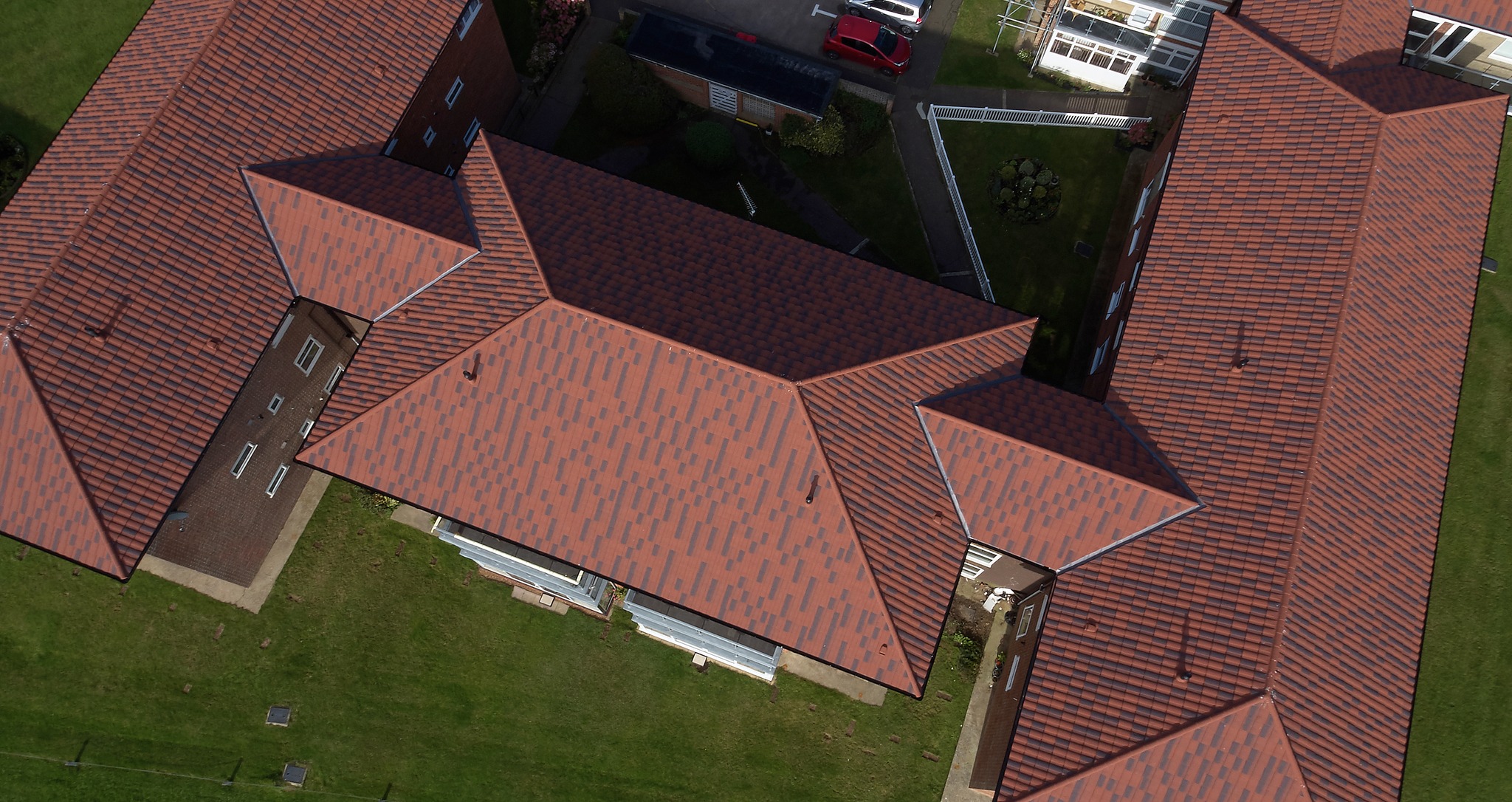
Application reference: Roman profile stone coated metal roofing installed on a pitched residential roof in the United States as part of a 700-unit project.
This case is relevant to retrofit evaluation because it combines the three variables that dominate the decision: a pitched roof, a wind-exposed climate, and a requirement for measurable comfort improvement rather than a purely aesthetic replacement.
Comparison with Traditional Solutions
| Decision factor | Stone coated metal roofing | Clay / concrete tile | Bare metal roof |
|---|---|---|---|
| Weight | Approx. 5–8 kg/m² (manufacturer data); 3.2–6.7 kg/m² per third-party guidance | Typically 5–10 times heavier than stone-coated steel (third-party guidance) | Light, but without the granule surface and acoustic layer |
| Retrofit over existing tiles | Documented as installable directly over old tiles | Generally requires removal of the existing covering | Possible on prepared battens; appearance change is significant |
| Minimum pitch | 12° | Varies by profile; heavy tiles need adequate pitch and support | Varies by profile and seam type |
| Noise under rain and hail | 70% noise reduction vs. bare metal roof | Naturally quiet due to mass | Noisiest of the three without added layers |
| Coastal corrosion exposure | 500-hour salt spray result; galvalume (AZ150) base | Depends on tile body and fixings | Depends on coating and substrate specification |
| Service life | 50+ years cited by third-party comparison; 50-year limited warranty terms offered by the manufacturer | Long, but brittle under impact and heavy to reinstate | Long, but finish and noise performance vary widely |
Limits and boundaries
A credible specification states what a product does not do, and there are four boundaries worth writing into any retrofit brief for stone coated metal roofing:
- It is a covering, not a structural repair. The overlay logic assumes an existing deck and framing that can accept a new layer and hold fasteners. Rot, deflection or failed battens must be resolved first; the tile does not compensate for them.
- Pitch is a hard constraint. The documented range starts at 12°. Flat and low-slope roofs fall outside this system and need a different solution.
- Weight is a band, not a single figure. At 5–8 kg/m² depending on steel thickness and profile, the structural check must use the value for the specified build-up, not the lowest number in the catalogue.
- Energy savings are conditional. The up-to-40% cooling-saving figure is a third-party category estimate for metal roofing generally. A specific building may achieve more or considerably less depending on insulation, ventilation and climate.
A fair additional note concerns the acoustic claim: the 70% noise reduction is stated against a bare metal roof. It does not mean the system is as quiet as a heavy concrete tile roof; it means it performs substantially better than the uncoated metal alternative.
Market Trend Analysis
The demand backdrop supports the application logic. The global stone-coated steel roofing market was estimated at USD 20.71 billion in 2024 and is projected to reach USD 32.69 billion by 2033 (Vertex AI Search / Industry Analysis, 2025–2033). Within China, the metal roofing market was estimated at USD 3.57 billion in 2024, with a forecast compound annual growth rate of 4.25% through 2035 (Market Research Future).
Two caveats belong with those numbers. First, published market-size estimates for this category diverge considerably — broad infrastructure-focused research has placed the 2024 figure as high as USD 69.41 billion, against roughly USD 20 billion in more specialised construction reports. Buyers should treat any single market-size figure as indicative rather than precise. Second, growth in this category is being driven less by new-build decoration and more by replacement demand, energy-performance pressure and the economics of lightweight construction — which is exactly the retrofit and steel-frame territory this article covers.
The supplier landscape is also relatively concentrated at the branded end. Publicly identified major global competitors in stone-coated steel roofing include DECRA Roofing Systems, Ross Roof Group, Boral Steel and Tilcor (Mordor Intelligence / Benchmark International). For importers and wholesalers, that means differentiation is usually argued on application fit and documented performance rather than on category novelty.
Future Outlook
Three shifts are likely to shape specification decisions over the next several years. Retrofit will continue to grow as a share of total roofing demand in mature markets, which favours covering systems that can be installed over existing roofs without a structural upgrade. Energy performance will keep moving from a nice-to-have to a documented requirement, raising the value of surface-level heat management. And lightweight steel construction will keep expanding in the residential and light-commercial segments, where a 5–8 kg/m² covering has a structural advantage that heavier alternatives cannot match.
For procurement teams, the practical implication is that evaluation should focus on documented application fit: verified pitch range, verified weight for the specified steel thickness, verified uplift and salt spray results, and a manufacturer whose quality and environmental management systems can be checked rather than assumed.
FAQ
Is stone coated metal roofing suitable for re-roofing over existing concrete tiles?
Retrofit is one of the documented applications for the product, and it can be installed directly over old tiles. The two conditions that must be confirmed first are that the existing substrate and framing are sound enough to accept a new layer and fixings, and that the roof pitch is at least 12°.
How much does stone coated metal roofing weigh compared with concrete or clay tiles?
Sango Cailin publishes approximately 5–8 kg/m² for its stone coated metal roofing, depending on base steel thickness. Third-party specification guidance for the category cites 3.2–6.7 kg/m² and describes stone-coated steel as 5–10 times lighter than traditional concrete or clay tiles. The exact value depends on the steel thickness specified.
Can stone coated metal roofing be used on lightweight steel frame structures?
The low weight per square metre makes the system relevant to light-gauge steel structures, and the product is approved for pitched roofs from 12° to 90°. Fastener type, spacing and purlin capacity must still be confirmed for the specific structure, because those are project-specific engineering inputs rather than product data.
Does stone coated metal roofing reduce cooling energy use?
Metal roofing can reflect heat away from a building, and third-party industry analysis cites potential cooling-energy savings of up to 40% (DECRA Roofing Trends Recap, 2024). That is a category-level estimate. Actual performance for a given building depends on insulation, attic ventilation, roof orientation and climate zone.
What wind and corrosion performance should be specified for coastal or high-wind projects?
Published manufacturer data for stone coated metal roofing states wind uplift resistance up to 160 mph and a 500-hour salt spray test result, with a galvalume (AZ150) steel base. Stone-coated steel roofing typically meets ASTM A792/A792M standards using 55% aluminium-zinc alloy-coated steel as the substrate (ICC Evaluation Service, ESR-2901). Local code uplift requirements should be checked separately.
How long does a stone coated metal roof last, and what warranty applies?
Third-party durability comparisons cite a service life of 50+ years for stone-coated steel roofing, against approximately 20 years for asphalt shingles. Sango Cailin lists 50-year limited warranty terms and 24-hour response for after-sales technical support, including installation guides, video support and remote assistance.
What documentation should a buyer verify before scaling an order?
The verifiable items are the management-system certificates and their scope: ISO 9001:2015, ISO 14001:2015 and ISO 45001:2018, issued by the Beijing World Standards for Certification Center (WSF) and valid to 12 May 2027 under the CNAS-IAF mutual recognition arrangement. Quality control includes 100% inspection, pre-shipment random sampling and third-party inspection on request.
Reference Document
The full product range, profiles and specification details are set out in the manufacturer's downloadable catalogue: CAILIN product catalogue (PDF).
Sango Cailin (Tianjin) Building Tech. Co., Ltd. — Jinghai Economic Development Zone, Tianjin, China. Website: www.cailinroofing.com
¿Tiene preguntas o necesita más detalles?
Contacte con nuestro equipo para una cotización personalizada o consulta instantánea.
Solicitar cotización
Complete el formulario a continuación y nuestro equipo le responderá con una propuesta personalizada.
Chat directo de WhatsApp
¿Prefiere chatear en tiempo real? Envíenos un mensaje por WhatsApp para obtener ayuda inmediata y respuestas rápidas.
- Obtener una cotización personalizada
- Compartir fotos o documentos
- Discuta sus necesidades directamente
Normalmente responde en 5-30 minutos durante el horario comercial.