
Steel Wire Rope Procurement FAQ: Diameter, Tensile Grade, Construction & Ordering
Steel Wire Rope Procurement FAQ: Diameter, Tensile Grade, Construction & Ordering
Steel wire rope is bought twice — first as a specification, then as a physical coil. Most procurement disputes begin in the gap between the two. An order line that says only steel wire rope, 24 mm leaves tensile grade, strand construction, core type, surface finish, execution standard, length and packing to the supplier's interpretation. Two suppliers can both deliver a 24 mm rope that behaves differently in the same sheave, the same drum and the same inspection regime.
This reference answers the technical and commercial questions that surface most often between research and evaluation: the diameter envelope actually offered across the product range, the six tensile grades used in ordering, how designations such as 6×19, 6×36, 8×29, 1×7 and 6×37M are read, the standards and certificates that constrain a quotation, and the ordering mechanics — minimum quantity, lead time and testing — that decide whether a specification can be produced as written.
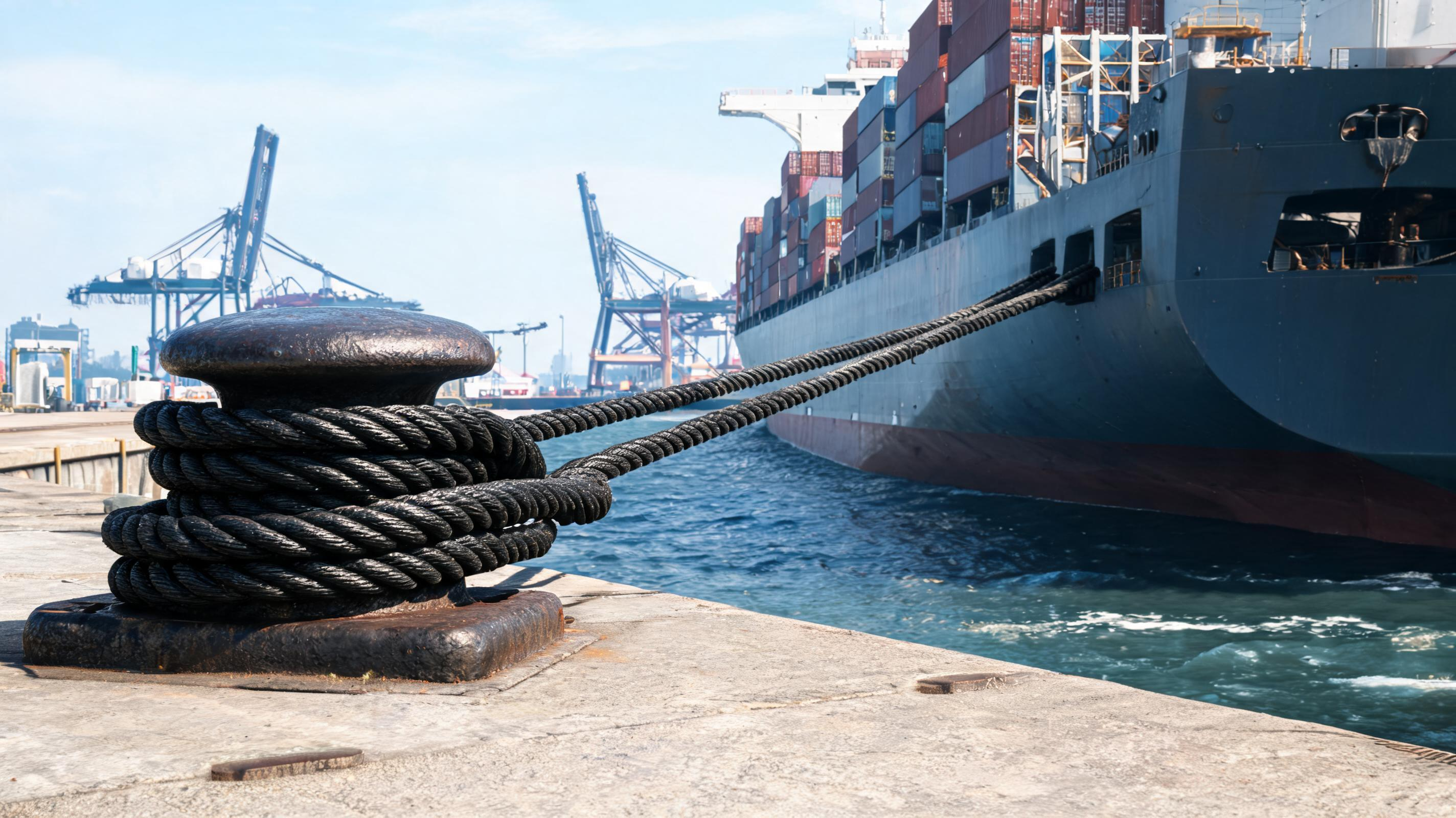
Port and terminal handling is one of the application groups where diameter, tensile grade and construction are specified together rather than separately.
The Procurement Problem: Specifications Written Before They Are Understood
Wire rope specifications usually arrive by inheritance. They come from an original equipment drawing, a legacy part number, or a previous project where the rope performed acceptably. The person re-ordering often knows the diameter and the length and nothing else. That is enough to buy a commodity; it is not enough to buy a component that has to match a sheave profile, a drum, a load calculation and a certification file.
The constraint layer sits in four places: the execution standard the rope must be manufactured to, the tensile grade the load calculation assumes, the strand construction that determines flexibility and abrasion behaviour, and the certification the receiving market or end client requires. Change any one of them and the order becomes a different order, even when the diameter stays the same.
For buyers in mining, port, offshore, elevator, power, agricultural and forestry duty this is not theoretical. Application records for these segments describe the same pattern of exposure: alternating shock loads, cyclic bending, salt spray or abrasive sediment, and long service intervals with limited maintenance windows. Specifications written loosely in procurement are corrected expensively in the field.
Diameter: What the 1 mm to 120 mm Range Covers
Across the product data for micro, cable car, elevator, power, fishing, logging forestry, agricultural, oil and gas, offshore and marine, port, mining, heavy-duty, construction and engineering, and construction machinery wire ropes, the stated rope diameter envelope is the same: 1 mm to 120 mm. The same product records list tensile strengths of 1570, 1670, 1770, 1870, 1960 and 2160 MPa, with GB/T, EN, GOST and DIN as applicable execution standards.
That consistency matters at quotation stage. The useful question is rarely whether a diameter can be produced. It is which combination of construction, grade and surface finish delivers the service life the application requires — and whether that combination is covered by the certificate the buyer's client or regulator expects.
Diameter should therefore never be ordered alone. A complete order line typically carries seven parameters, and the product data supports all of them.
| Parameter | What the order should state | Range or option in the product data |
|---|---|---|
| Rope diameter | Nominal diameter in mm | 1 mm to 120 mm |
| Tensile strength | Grade in MPa | 1570, 1670, 1770, 1870, 1960, 2160 |
| Construction | Strand and wire configuration | 1×7, 1×19, 6×7, 6×19S/W/M, 6×26WS, 6×36WS, 6×37S/M, 8×19S/W, 8×26WS to 8×41WS, 18×7, 35W×7, 35W×K7, 4V×39S and others |
| Material | Wire material | High carbon steel |
| Surface finish | Coating or finish | Un-galvanized, electro-galvanized, hot-dip galvanized, stainless, plastic-coated |
| Execution standard | Manufacturing standard | GB/T, EN, GOST, DIN |
| Length and packing | Order length and packaging requirement | Customized at order stage |
Tensile Grade: Reading 1570 to 2160 MPa
Tensile grade describes the strength class of the wires used in the rope. The grades available across this product data are 1570, 1670, 1770, 1870, 1960 and 2160 MPa. For a fixed diameter, a higher grade means a higher aggregate breaking load, which is why higher grades are often specified where a load must be handled without increasing rope diameter.
The common mistake is treating the highest available grade as the default. Higher tensile wires are generally thinner for the same load, and thinner wires are generally more sensitive to bending fatigue and to abrasion against sheaves, drums and abrasive media. In practice the grade has to be matched to sheave and drum geometry, to the number of bending cycles in the duty cycle, and to the environment. A 2160 MPa rope is not automatically a better purchase than a 1770 MPa rope in the same diameter; it is a different engineering decision with a different maintenance profile.
Grade also interacts with availability. When a specification combines an unusual construction, an unusual diameter and a high grade, it is worth confirming at enquiry stage rather than after the purchase order is issued, because that combination determines whether the order runs as a standard line or as a made-to-order line with its own production slot.
Construction: What 6×19, 6×36, 8×29, 1×7 and 6×37M Tell You
In a designation such as 6×36WS, the numeric part states the structure: six outer strands, each containing 36 wires. The suffix carries additional information defined by the applicable standard, covering strand geometry, core type or compaction. Ropes that share a diameter and a grade but differ in construction are not interchangeable: flexibility, abrasion resistance, rotation behaviour and performance over sheaves all change with the strand pattern.
The manufacturer profile for Jiangsu Juli Steel Wire Rope Co.,LTD describes a production scope that includes bundling ropes, cross laid wire rope, parallel laid wire rope, anti-rotation wire rope, compacted strand ropes, shaped strand wire rope and locked coil ropes. Those categories are visible in the model lists of the individual product families.
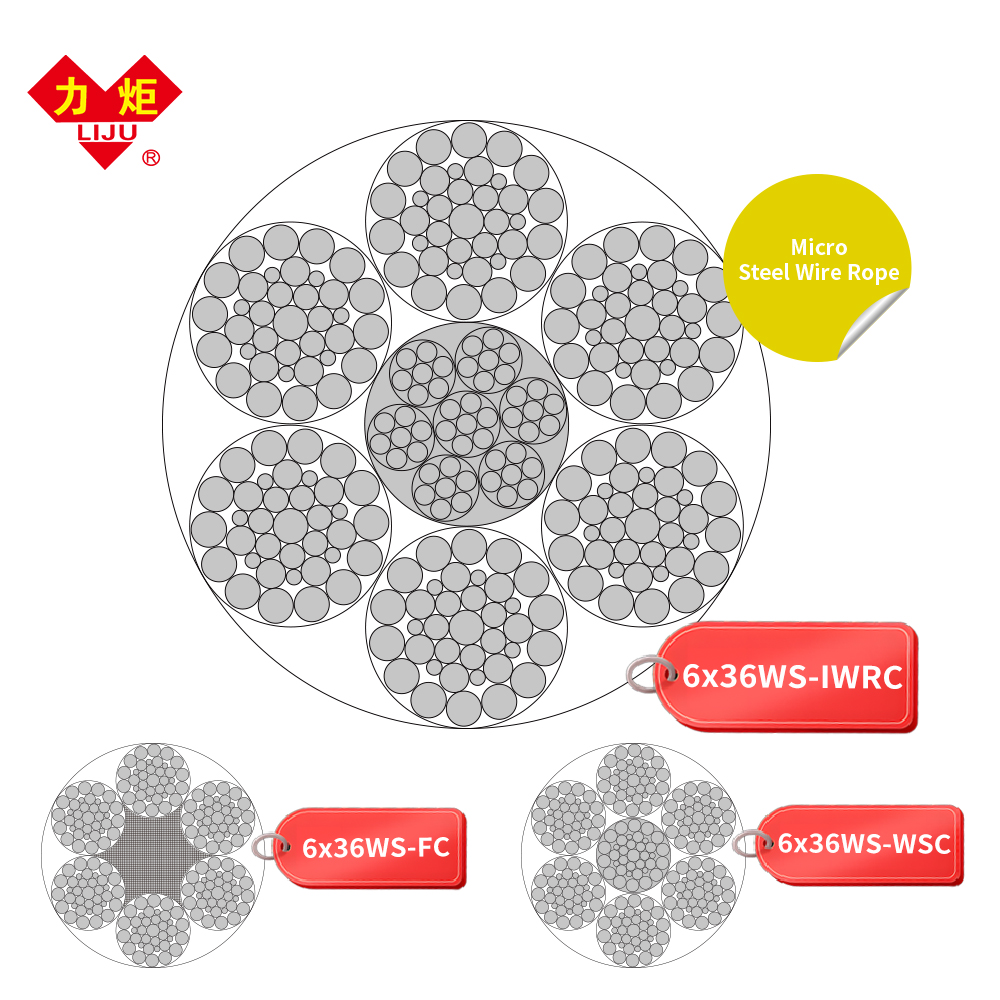
6×36WS is one of the most widely listed constructions across the application families covered in this article.
| Construction family | Where it appears in the product data | What it tells the buyer |
|---|---|---|
| 1×7, 1×19, 7×7 | Power Wire Rope; Agricultural Wire Rope | Single-layer strand configurations used where a dense simple strand suits tension and traction duty |
| 6×7 | Micro, Power, Fishing, Agricultural ranges | Fewer, larger wires per strand; appears in small-diameter and agricultural specifications |
| 6×19S, 6×19W, 6×19M | Micro, cable car, elevator, fishing, logging forestry, mining, heavy-duty, construction and engineering, construction machinery | The most widely listed strand family, used across hoisting, traction and suspension duty |
| 6×24S, 6×24MFC, 6×26WS | Fishing, logging forestry, agricultural, heavy-duty, port, construction ranges | Higher wire counts per strand; appear where bending flexibility and fatigue life matter |
| 6×36WS, 6×K36WS, K6×36WS | Micro, cable car, fishing, oil and gas, offshore and marine, port, mining, heavy-duty, construction and engineering, construction machinery | Among the most broadly available constructions in this portfolio |
| 6×37S, 6×37M | Cable car, oil and gas, mining, power, heavy-duty, construction and engineering | High wire count with flexible behaviour; listed in standard and compacted forms |
| 6×K26WS, K6×26WS, 8×K26WS, 8×K26WS-EPIWC | Oil and gas, logging forestry, mining | Compaction and higher strand counts concentrate in the heavier duty listings |
| 8×19S, 8×19W, 8×26WS to 8×41WS | Elevator wire rope; construction and engineering; port wire rope | Eight-strand configurations listed for elevator, engineering and port and terminal duty |
| 18×7, 35W×7, 35W×K7 | Micro, offshore and marine, port, oil and gas, mining, construction and engineering, construction machinery | Multi-strand, rotation resistant style listings; 35W×K7 appears alongside compacted ropes |
| 4V×39S, 4V×48S SWAGE, 4×26WS, 4×31WS | Construction machinery; construction and engineering; offshore and marine | Specialised geometries concentrated in construction, engineering and offshore duty |
| 6×12-7FC, 6×15-7FC, 3×31WS | Agricultural; construction and engineering; fishing | Application-specific constructions rather than general hoisting lines |
Reading the table the other way is equally useful. If a legacy specification names a construction that does not appear in the product family matching the application, the correct action is not silent substitution. It is to confirm whether that construction is available in the family, or whether the specification should be rewritten against an available construction with equivalent function.
Application Fit: How the End Use Rewrites the Specification
The strongest predictor of the correct rope is the working condition, not the rope description. Application records for these segments use similar requirement language — high tensile strength, wear resistance, impact resistance, fatigue resistance — but the exposure, equipment and duty cycle differ enough to change the construction selected.
- Mining. Shaft and inclined hoisting, ore and personnel transport, winch haulage, open-pit shovel and dragline duty, in underground humidity, corrosive mine water and heavy cyclic impact load. Listed constructions include 6×19S, 6×19W, 6×19M, 6×36WS, 6×37S, 8×K26WS-EPIWC and 35W×K7. A recorded mining application covers 100 tons of rope over a two-year supply period, reporting stable hoisting operation and reduced downtime.
- Port and terminal. Quay crane and gantry crane lifting, container handling, mooring, yard traction and tug towing in coastal salt spray. Listed constructions include 6×26WS, 6×31WS, 6×36WS, 6×41WS, 8×26WS, 8×31WS, 8×36WS, 8×41WS and 35W×7.
- Offshore and marine. Vessel mooring, towing, offshore platform hoisting, anchoring and subsea construction. The listed range is the widest in the data, from 6×36WS through 6×49SWS, 6×55SWS, 6×61FWS, 6×65FNS, 6×84WSNS and 6×127SWSNS, with eight-strand equivalents, plus 18×7, 35W×7, 35W×K7 and swaged 4V×39S and 4V×48S options.
- Oil and gas. Onshore and offshore drilling, workover, drill string running and pipeline laying, with constructions including 6×K26WS, 6×K36WS, 8×K26WS, 8×K36WS, 6×41WS, 6×55SWS, 6×84WSNS and 35W×K7.
- Elevator and escalator. Traction suspension, compensation and overspeed safety systems under high-frequency reciprocating bending. Constructions listed are 8×19S, 8×19W, 6×19S and 6×19W.
- Cable car. Hauling and load-bearing ropes for circulating gondola ropeways, chairlifts, aerial tramways and funiculars, exposed to wind, snow, ice and ultraviolet ageing. Constructions listed are 6×19S, 6×36WS and 6×37S.
- Power. Transmission tower erection, conductor pulling, wind power hoisting, gate operation and plant maintenance, with constructions 1×7, 1×19, 6×7, 6×19M and 6×37M.
- Construction and engineering. Tower crane and hoist lifting, component hoisting, gondola suspension, foundation pit anchoring and steel structure installation. The range includes 6×19S, 6×19W, 6×29Fi, 6×36WS, 8×29Fi, 6×K36WS, 18×7, 35W×7, 35W×K7, 4V×39S, 8×19S, 4×26WS, 4×31WS, 6×19M, 6×37M, 6×12-7FC and 6×15-7FC. Construction machinery adds 6×25Fi and 6×29Fi for crane, pile driver, drilling rig, excavator and loader duty.
- Agricultural. Greenhouse tensioning, machinery traction, material hoisting, irrigation equipment and aquaculture fixing, where mud, humidity and outdoor weathering dominate. Constructions include 1×7, 1×19, 6×7, 7×7, 6×19M, 6×12-7FC, 6×15-7FC and 6×24MFC.
- Logging forestry. Mountain logging, log skidding, timber towing, ropeway transport and equipment hoisting in muddy, abrasive terrain. Constructions include 6×19S, 6×19M, 6×26WS, K6×26WS and K6×36WS.
- Fishing. Trawl traction, mooring, fishing gear handling and aquaculture cage tensioning under seawater immersion and wave impact. Constructions include 6×7, 6×19S, 6×24S, 6×36WS, 6×26WS and 3×31WS.
- Micro and specialty. Automation, automotive control cables, medical devices, robotics, aerospace and fitness equipment, where compact installation space and high-frequency micro-cycling dominate. Constructions include 6×7, 6×19S, 6×36WS, 18×7 and 35W×7.

Elevator and escalator duty is one of the narrowest specification windows: 8×19S, 8×19W, 6×19S and 6×19W are the constructions listed in the product data.
Standards and Certifications: The Constraint Layer on Every Order
Execution standards decide how the rope is made; certification decides whether the rope can be delivered into a market or project. The product data lists GB/T, EN, GOST and DIN as applicable execution standards across the range, and the manufacturer profile states production according to API, ISO, EN, ASTM, GB and JIS. ISO 2408:2017 specifies minimum requirements for the manufacture and testing of steel wire ropes for general purposes, including lifting and rigging, and it appears again as the standard referenced in the ABS certification scope.
Jiangsu Juli Steel Wire Rope Co.,LTD is a steel wire rope and lifting accessories manufacturer with production bases in Nantong and Jiyuan in China and Bekasi in Indonesia, and group origins dating back to 1958. Its published certification set includes API, LR, ABS, CCS, ISO9001, CE, GOST, EPD, SIRIM, SNI and MA. The certificates that most often determine whether an export order proceeds are listed below, each with a defined scope that buyers should read before issuing a purchase order.
| Certification | Number | Standard | Market | Scope notes and validity |
|---|---|---|---|---|
| API | 9A-0125 | API Spec Q1, API-9A | Global | Bright or drawn-galvanized wire rope; issued 29 Feb 2024, valid through 28 Feb 2027 |
| ABS | 24-0072296-PDA | ISO 2408-2017 | Global | Models include 6×19S-IWRC, 6×36WS-IWRC, 8×61M-FC, 6×25F-IWRC, 6×24FC-FC, 8×26WS-IWRC, 4×V39FC-FC, 18×7-WSC, 35(W)×7, 35(W)×K7; valid through 7 Oct 2029 |
| CCS | JS22PWA00113_01 | CCS Rules for Materials and Welding 2022, Chapter 10, Part One | Global | Single layer and rotation resistant ropes for ships and offshore installations; valid through 22 May 2027 |
| CE | ICR/VC/HS240422 | EN 12385-1:2002+A1:2008 | EU | Types 6×7, 8×7, 6×19, 8×19, 6×36, 8×36, 6×19M, 6×37M, 18×7, 34M×7, 35W×7; valid through 4 Jul 2029 |
| GOST | POCC RU C-CN.AД85.B.00499/24 | GOST 3241-91, GB/T 8918-2006, GB/T 20118-2017, EN 12385-4 | RU | Multiple construction types, diameter 1 mm to 120 mm; valid through 27 Jun 2029 |
| SIRIM | PC013111 | MS ISO 2408:2004 (confirmed 2012) | MY | Steel wire ropes for general purposes; valid through 7 Dec 2026 |
| SNI | 33.23/016/LSPro BBSPJILM/07/2024 | SNI 0727:2008 | ID | Steel wire rope for petroleum and natural gas; valid through 3 Jul 2028 |
| EPD | EPD-2026-01 | ISO 14025 | Global | Wire rope, 1000 kg, cradle-to-gate; issued 30 Jan 2026, valid through 29 Jan 2031 |
Ordering Mechanics: MOQ, Lead Time, Testing and Customization
Once the specification is settled, four commercial variables decide whether the order can run as written: minimum order quantity, lead time, production capacity and the test regime attached to the shipment.
- Customization scope. Construction, diameter, length, tensile strength, surface treatment, applicable standard and packing are all stated as customizable, under an OEM/ODM and independent factory research and development model.
- Minimum order quantity. 1000 meters.
- Lead time. 25 days, against a stated monthly capacity of 3000 tons.
- Quality control. Raw material incoming inspection, semi-finished product spot check, finished product testing, breaking load test and fatigue test, with a 100% full machine running test before delivery.
- After-sales. Remote online technical support, overseas engineer on-site service, regular operation guidance and maintenance consultation.
For a project buyer, the practical sequence is to confirm the construction and grade combination against the duty cycle, confirm the execution standard and the certificate scope, confirm the order length against the 1000-metre minimum, and then reserve the production slot against the 25-day lead time. Placing the certificate question after the technical question, rather than alongside it, is one of the most common causes of delayed delivery on export projects.
Made-to-Order Specification vs. Catalogue Stock: What Changes and What Does Not
Traditional wire rope purchasing often means taking what is on a distributor's shelf. That approach has real advantages: immediate availability, low order quantities and no engineering lead time. Its weakness is the specification. Stock lines are chosen for breadth of use, so the buyer accepts whatever construction, grade and surface finish happens to be in stock, then adapts the maintenance plan to the rope rather than the rope to the duty.
Made-to-order supply inverts the trade-off. Construction, diameter, length, tensile strength, surface treatment, applicable standard and packing can be specified, which allows the rope to be matched to sheave geometry, the load calculation and the certification file. The cost is discipline in the ordering process and acceptance of three real boundaries.
- The 1000-metre minimum order quantity is not compatible with very small or one-off purchases, and the 25-day lead time has to be built into the project schedule rather than treated as buffer.
- Certificate scopes are specific rather than universal. The CE certification covers a defined list of types that does not include every construction in the portfolio, and the SNI certification is scoped to steel wire rope for petroleum and natural gas. A rope outside a certificate scope does not automatically travel with that certificate.
- Published capacity figures for the group vary by source, ranging from 150,000 to 250,000 tons per year depending on whether the Indonesian production bases are included. For large or multi-year programmes, allocation should be confirmed at enquiry stage rather than assumed from a headline number.
None of these boundaries makes made-to-order supply the wrong choice. They determine when it is the right one — and when a distributor's stock line genuinely is the better commercial answer.
Market Context: Why Specification Discipline Is Being Priced In
The steel wire rope market is growing, and growth is concentrated in the segments where specification errors are most expensive. Market research cited for this sector projects the global steel wire rope market at USD 10.49 billion in 2025, reaching USD 13.88 billion by 2030 at a compound annual growth rate of 5.8% (MarketsandMarkets). China remained the leading exporter of stranded wire, ropes and cables of iron or steel in 2024, with export value of approximately USD 2.60 billion (World Integrated Trade Solution).
Product mix data points the same way. Galvanized steel wire ropes accounted for 41.3% to 46% of total product demand globally in 2025, driven by corrosion resistance requirements in marine and mining environments (Dataintelo / Business Research Insights). Construction remains the largest end-user segment, at approximately 27% to 40.7% of total market share in 2024–2025 (Grand View Research / Industry Research). Within heavy-duty hauling in mining, compacted strand ropes were adopted in approximately 57% of systems globally in 2025 (Business Research Insights).
Market size estimates for this sector vary considerably between research firms, with 2025 baseline figures ranging from USD 8.4 billion to more than USD 15 billion depending on methodology. The directional conclusion is more reliable than any single number: demand is shifting toward ropes with documented corrosion performance and documented fatigue behaviour, which means buyers are increasingly paying for specification accuracy rather than for tonnage.
Competitive structure reinforces the point. Bekaert and WireCo WorldGroup are identified as the two companies with the highest global market share, with Bekaert reported at more than 1.5 million tons of annual capacity (Industry Research / MarketsandMarkets). Against that scale, mid-size manufacturers compete on specification flexibility, certification coverage and application-specific construction availability — the same variables that appear in the buying questions above.
Future Outlook
Three shifts are likely to shape steel wire rope procurement over the next planning cycle.
First, certification is moving from a document attached to a shipment to a filter applied at enquiry stage. Buyers now routinely ask for certificate numbers, standards, market coverage and validity windows before commercial terms are discussed, because a rope that cannot be delivered into a market is not a cheaper rope — it is a delayed project.
Second, environmental documentation is entering tenders alongside mechanical certification. The EPD issued for wire rope under ISO 14025 with a cradle-to-gate scope is an early example of the type of document procurement teams may be required to file for large infrastructure and energy projects.
Third, specification is converging on in-place performance: compacted and high strand count constructions for heavy-duty hauling, galvanized and coated finishes for corrosive environments, and rotation resistant assemblies where load control matters. The practical implication for buyers is that the diameter line on an order is the least informative part of the specification. The construction, the grade, the standard and the certificate behind them decide whether the rope performs as the calculation assumed.
Frequently Asked Questions
What diameter range can be ordered, and how should diameter appear on a purchase order?
The product data for the range covered here states a rope diameter envelope of 1 mm to 120 mm. Diameter should be written as a nominal value together with the other parameters that define the product: tensile strength, construction, material, surface finish, execution standard, order length and packing. Ordering a diameter alone leaves those variables to the supplier.
Which tensile strength grades are available?
The available grades are 1570, 1670, 1770, 1870, 1960 and 2160 MPa. Selection depends on the load the rope must carry, sheave and drum geometry, the number of bending cycles in the duty cycle, and the operating environment. A higher grade increases load capacity at the same diameter but also changes fatigue and wear behaviour, so it is an engineering choice rather than a default.
How is a construction such as 6×36WS or 6×37M read?
In the numeric part of the designation, the first figure is the number of outer strands and the second is the number of wires per strand, so 6×36 describes six strands of 36 wires each. Letter suffixes indicate strand geometry, core type or compaction as defined in the applicable standard. Two ropes with the same diameter and grade but different constructions are different products and are not interchangeable.
Which standards can the rope be manufactured to?
The product data lists GB/T, EN, GOST and DIN as applicable execution standards. The manufacturer profile states production according to API, ISO, EN, ASTM, GB and JIS. ISO 2408:2017 specifies minimum requirements for the manufacture and testing of steel wire ropes for general purposes, including lifting and rigging, and is referenced in the ABS certification scope.
Which certifications apply, and how do their scopes differ?
Scopes differ by market, product and construction. API certification 9A-0125 covers bright or drawn-galvanized wire rope. ABS certification 24-0072296-PDA applies to ISO 2408-2017 and lists specific models including 6×19S-IWRC, 6×36WS-IWRC, 8×61M-FC and 35(W)×K7. CCS certification JS22PWA00113_01 covers single layer and rotation resistant ropes for ships and offshore installations. CE certification ICR/VC/HS240422 covers a defined list of types under EN 12385-1:2002+A1:2008. GOST certification POCC RU C-CN.AД85.B.00499/24 covers multiple construction types from 1 mm to 120 mm. SIRIM PC013111 covers steel wire ropes for general purposes. SNI 33.23/016/LSPro BBSPJILM/07/2024 applies to steel wire rope for petroleum and natural gas. EPD-2026-01 is an environmental product declaration under ISO 14025 with a cradle-to-gate scope.
What are the minimum order quantity and the lead time?
The stated minimum order quantity is 1000 meters and the stated lead time is 25 days, against monthly production capacity of 3000 tons. Buyers running project schedules should treat the lead time as a scheduling input rather than a contingency.
What testing is carried out before shipment?
The stated quality control sequence includes raw material incoming inspection, semi-finished product spot check, finished product testing, breaking load testing and fatigue testing, with a 100% full machine running test before delivery.
How does the end application change the specification?
The application sets the exposure and duty cycle, and therefore the construction. Mining listings include 6×19S, 6×36WS, 6×37S, 8×K26WS-EPIWC and 35W×K7 for shaft hoisting in humid, corrosive conditions. Port listings include 6×26WS through 8×41WS and 35W×7 for salt spray environments. Elevator listings use 8×19S, 8×19W, 6×19S and 6×19W for high-frequency reciprocating bending. Power listings use 1×7, 1×19, 6×7, 6×19M and 6×37M for conductor pulling and hoisting duty. Agricultural, logging forestry and fishing listings use constructions such as 6×12-7FC, 6×24MFC, K6×26WS and 3×31WS matched to outdoor, abrasive and marine conditions.
Published reference material: the Jiangsu Juli Steel Wire Rope Co.,LTD product brochure is available for download at Juli Wire Rope Group brochure (PDF). Product and company information: www.juli-rope.com.