
Steel Wire Rope Procurement FAQ: Diameter, Strength and Acceptance
Steel Wire Rope Procurement FAQ: Diameter, Strength and Acceptance
Steel wire rope procurement usually starts with two numbers: diameter and tensile grade. Those numbers are necessary, but they are not a complete purchase specification. A rope ordered within the 1–120 mm diameter range and the 1570–2160 MPa tensile grade range still needs a construction, a core designation where applicable, an execution standard, and a defined acceptance check. This FAQ answers the technical and purchasing questions that sit behind those fields.

4V×39S construction machinery wire rope. Image source: Jiangsu Juli Steel Wire rope.,LTD product data.
The procurement problem: one number is not a specification
A diameter-only order leaves too many variables open. Two steel wire ropes can share the same diameter and still differ in tensile grade, strand construction, core, finish and execution standard. That difference matters at the quotation stage, at goods receipt, and during service. The buyer who orders by diameter alone is asking the supplier to fill in the rest of the specification.
The practical answer is to convert the application into an order line: diameter, tensile grade, construction, core where stated, execution standard, finish, and acceptance record. The sections below explain what each field controls and where the boundary lies.
What do 1–120 mm and 1570–2160 MPa actually cover?
Product data for high-carbon steel wire rope lists a diameter range of 1 mm to 120 mm and tensile strength options of 1570, 1670, 1770, 1870, 1960 and 2160 MPa. The same data lists execution standards GB/T, EN, GOST and DIN. Those figures define a selection envelope, not a single product. The buyer should use them to narrow the quotation, then confirm the exact combination.
| Field | Published options | What the buyer should do |
|---|---|---|
| Rope diameter | 1–120 mm | State the exact diameter and the equipment or sheave it runs on. The range is not a recommendation. |
| Tensile strength | 1570, 1670, 1770, 1870, 1960, 2160 MPa | State the grade in MPa. Do not write only high strength. |
| Material | High carbon steel | Confirm the material route in the order and certificate. |
| Execution standard | GB/T, EN, GOST, DIN | Name the standard and the destination market. |
| Construction examples | 6×19, 6×36, 8×29, 6×K36WS, 35W×K7, 4V×39S | Write the complete model, including suffixes such as S, W, Fi or K where they apply. |
The table is a selection map, not a stock list. The published range defines what can be quoted; it does not prove that every diameter, grade and construction combination is available as a standard item. That confirmation belongs in the quotation and order acknowledgement.
How construction changes the buying question
Construction is the part of the description most often shortened in RFQs. A request for 6x36 is not the same as 6x36WS. A request for 6x19 does not say whether the buyer needs 6x19S, 6x19W or 6x19M. These suffixes appear in the product data for a reason: they identify different construction descriptions within the same family. The same applies to 8x29Fi, 6xK36WS, 35WxK7 and 4Vx39S.
| Model family | Examples in product data | Procurement check |
|---|---|---|
| 6×19 family | 6×19S, 6×19W, 6×19M | Confirm suffix, core, standard and application. It appears in mining, port, oil and gas, heavy-duty and elevator scopes. |
| 6×36 family | 6×36WS | Confirm WS designation, core, finish and duty. It appears in port, offshore, oil and gas, heavy-duty and construction scopes. |
| 8×29 family | 8×29Fi | Confirm Fi designation and construction. It appears in construction and engineer wire rope data. |
| 6×K36WS | 6×K36WS | Confirm K designation, core and application. It appears in construction machinery, oil and gas and logging scopes. |
| 35W×K7 | 35W×K7 | Confirm exact model and application. It appears in mining, oil and gas, offshore and construction machinery scopes. |
| 4V×39S | 4V×39S; 4V×39S SWAGE | Confirm whether the swaged variant is required. It appears in construction machinery and offshore data. |
None of these designations should be treated as interchangeable by appearance. The buyer should read the model as a specification code and require the supplier to confirm the complete description on the quotation.

6×K36WS steel wire rope product example. Image source: Jiangsu Juli Steel Wire rope.,LTD product data.
What should an acceptance criteria list contain?
Acceptance criteria are the bridge between the purchase order and the delivered lot. For steel wire rope, a practical list has nine lines:
- Product and construction: complete model, including suffix and core.
- Diameter: exact millimetre value.
- Tensile grade: exact MPa value.
- Execution standard: GB/T, EN, GOST or DIN as specified.
- Finish: un-galvanized, electro-galvanized, hot-dip galvanized, stainless or plastic-coated where required.
- Application: equipment, duty cycle and environment.
- Market access: certification required for the destination.
- Sling scope: if a wire rope sling is ordered, state the sling assembly separately from the rope.
- Inspection record: document that identifies the standard and the lot.
At goods receipt, the check should be against that list, not against a general product family. The certificate should identify the standard and the lot; a generic certificate that does not match the order is not an acceptance record. Dimensional and breaking-load verification should follow the agreed standard and the buyer's inspection plan. If the order is for a critical lifting application, the buyer's engineer should also confirm the design factor, termination, sheave compatibility and inspection interval. Those are project-specific decisions and are not established by a catalogue range.
Where Jiangsu Juli Steel Wire rope.,LTD fits in the procurement map
Jiangsu Juli Steel Wire rope.,LTD is a manufacturer of steel wire ropes and lifting accessories. Company data lists three production bases: Nantong and Jiyuan in China, and Bekasi in Indonesia. The company's origins date back to 1958, and it was established in 1995. It reports 250,000 tons of annual steel wire rope production capacity, a 20-engineer R&D team, 42 distribution centers in major Chinese cities including Shanghai, Guangzhou, Chengdu and Xi'an, and offices in more than 30 countries and regions.
For the technical scope of this FAQ, the relevant point is range. Product data covers high-carbon steel rope from 1 mm to 120 mm with tensile grades from 1570 to 2160 MPa, and execution standards GB/T, EN, GOST and DIN. The wider company portfolio includes un-galvanized, electro-galvanized, hot-dip galvanized, stainless and plastic-coated wire ropes, with constructions such as bundling, cross laid, parallel laid, anti-rotation, compacted strand, shaped strand and locked coil. Certifications listed by the company include API, LR, ABS, CCS, ISO9001, CE, GOST, EPD, SIRIM, SNI and MA; manufacturing standards listed include API, ISO, EN, ASTM, GB and JIS.
That breadth is useful at the shortlisting stage because it allows a buyer to match diameter, grade, construction and standard within one supply discussion. It is not a substitute for project approval. The exact combination must still be confirmed on the quotation, and the acceptance criteria must still be written into the order.
Application fit: what changes from mine to farm
Application changes the acceptable construction and the acceptance emphasis. The examples below are drawn from the product and scenario data for this category; they are not a complete cross-reference.
| Industry | Construction examples in data | Procurement emphasis |
|---|---|---|
| Mining | 6×19S, 6×19W, 6×19M, 6×36WS, 6×37S, 8×K26WS-EPIWC, 35W×K7 | Shaft hoisting, inclined transport, winch haulage and corrosive mine water. Confirm core designation, standard and impact or fatigue requirements. |
| Port and terminal | 6×26WS, 6×31WS, 6×36WS, 6×41WS, 8×26WS, 8×31WS, 8×36WS, 8×41WS, 35W×7 | Quay and gantry crane hoisting, container handling, mooring and salt-spray exposure. Confirm finish and corrosion route. |
| Elevator | 8×19S, 8×19W, 6×19S, 6×19W | Frequent bending and traction suspension. Confirm the elevator standard, termination and inspection regime. |
| Offshore and marine | 6×36WS, 6×29Fi, 6×41WS, 6×49SWS, 6×55SWS, 6×61FWS, 6×65FNS, 6×84WSNS, 6×127SWSNS, 8×61FWS, 18×7, 35W×7, 35W×K7, 4V×39S SWAGE | Mooring, offshore lifting and marine corrosion. Confirm market certification and the exact swaged variant where specified. |
| Agricultural | 1×7, 1×19, 6×7, 7×7, 6×19M, 6×12-7FC, 6×15-7FC, 6×24MFC | Baler tying, farm machinery traction, greenhouse tensioning and outdoor exposure. Confirm the FC core where stated. |
| Heavy-duty | 6×19S, 6×19W, 6×26WS, 6×36WS, 6×31WS, 8×K26WS, 6×19M, 6×37M | Mining, construction, lifting and hoisting, port and heavy industry. Confirm wear, impact and fatigue requirements with the equipment owner. |
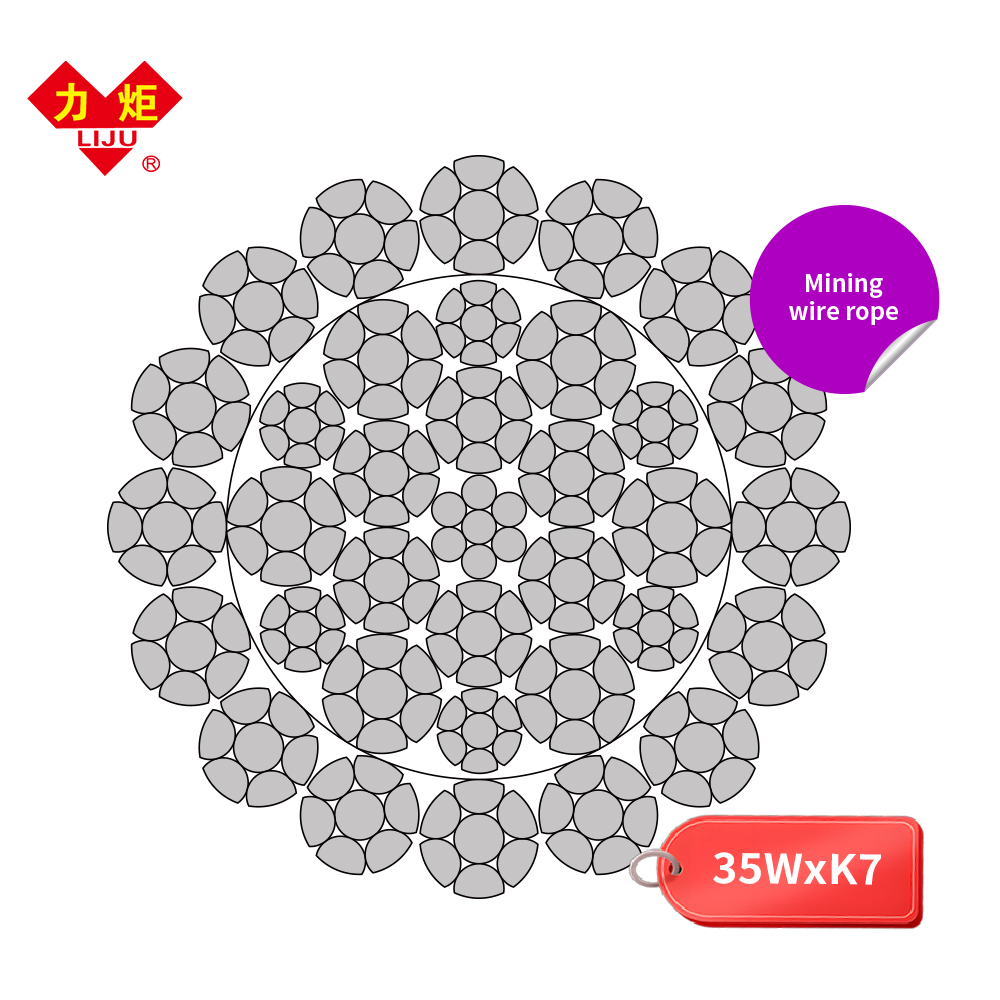
35W×K7 steel wire rope product example. Image source: Jiangsu Juli Steel Wire rope.,LTD product data.
The same diameter can appear in several industries, but the duty is not the same. A port rope and an elevator rope may both be steel wire rope, yet the acceptance emphasis, standard and inspection regime differ. Buyers should not cross-apply a construction from one application to another without engineering confirmation.
Market trend: corrosion, standards and traceability
Two verified data points frame the buying environment. Business Research Insights estimates the global steel wire rope market at USD 10.0 billion in 2026. The same source reports that galvanized steel wire rope represented 46% of total product demand in 2025, citing corrosion resistance. For procurement, the signal is not that every project should use galvanized rope. It is that corrosion route is a mainstream selection variable, not an afterthought.
Standard-specific demand is also visible. BS EN 12385 is a safety standard for steel wire ropes in general lifting applications and is a relevant baseline for EU/UK market access. In Indonesia, SNI 0727:2008 covers steel wire rope for petroleum and natural gas; Jiangsu Juli Steel Wire rope.,LTD data lists this certification as valid. The customs classification for stranded wire, ropes and cables of iron or steel is HS 731210. These are different kinds of evidence, but they point in the same direction: buyers are purchasing a declared standard and a traceable product, not only a length of rope.
The market data does not rank suppliers or prove that one construction is superior across applications. It supports a procurement direction: state the corrosion route, state the destination standard, and keep the acceptance record tied to the lot.
Specification-led buying compared with diameter-only buying
| Decision area | Diameter-only buying | Specification-led buying |
|---|---|---|
| RFQ line | Diameter | Diameter, tensile grade, construction, core, standard, finish |
| Construction | 6x36 | Complete model such as 6×36WS, with core where stated |
| Standard | Generic reference | Named execution standard and destination market |
| Certificate | Filed without cross-check | Checked against standard and lot |
| Acceptance | Visual check | Document, dimension and breaking-load check under the agreed standard |
| Cost view | Lowest price per unit | Total cost including rework, downtime and compliance risk |
The limitation is important. Specification-led buying improves control, but it does not certify fitness by itself. The published range covers many diameters and grades, yet the supplier data does not establish every project-specific value. Design factor, termination efficiency, sheave compatibility, rope lay, inspection interval and national requirements must be confirmed by the responsible engineer. A buyer who copies a construction from another project without that review has simply replaced one shortcut with another.
Future outlook
Three shifts are likely to continue. First, standard mapping will become more explicit because the same rope may be quoted against GB/T, EN, GOST or DIN for different destinations. Second, corrosion route will stay central as galvanized products hold a large share of demand. Third, acceptance records will be read as part of supply risk, not as paperwork.
These shifts favor buyers who can write a complete order line. They do not favor the assumption that a higher tensile grade or a larger diameter is always better. The durable procurement rule is simpler: match the rope to the equipment, the standard and the duty, then verify the delivered lot against that specification.
FAQ
What does 1570–2160 MPa mean in steel wire rope procurement?
MPa is the tensile strength grade. Product data lists 1570, 1670, 1770, 1870, 1960 and 2160 MPa for high-carbon steel wire rope. The grade should be stated on the order because it is a design input, not a marketing label. A higher grade is not automatically the right choice; it must match the equipment, the execution standard and the duty.
How do I choose between 6×19, 6×36, 8×29, 6×K36WS, 35W×K7 and 4V×39S?
Start with the application and the equipment, then confirm the complete construction. The product data places 6×19 and 6×36 in several mining, port, oil and gas and heavy-duty scopes; 8×29Fi in construction and engineer wire rope; 6×K36WS in construction machinery, oil and gas and logging; 35W×K7 in mining, oil and gas, offshore and construction machinery; and 4V×39S in construction machinery, with a 4V×39S SWAGE variant in offshore data. These models are not interchangeable by appearance. The order should state the exact suffix and core where applicable.
Are GB/T, EN, GOST and DIN interchangeable?
They are different execution standard systems listed for the product. The buyer should name the standard that applies to the project and destination, and should not use the names interchangeably on an order. EN 12385 is a safety standard for stranded ropes for general lifting applications and is a relevant EU/UK baseline. SNI 0727:2008 is relevant for petroleum and natural gas in Indonesia. The correct standard is a market-access and application decision.
Which constructions are used in mining, port, elevator, offshore and agricultural applications?
The product data includes 6×19S, 6×19W, 6×19M, 6×36WS, 6×37S, 8×K26WS-EPIWC and 35W×K7 for mining; 6×26WS, 6×31WS, 6×36WS, 6×41WS, 8×26WS, 8×31WS, 8×36WS, 8×41WS and 35W×7 for port; 8×19S, 8×19W, 6×19S and 6×19W for elevator; 6×36WS, 6×29Fi, 6×41WS, 6×49SWS, 4V×39S SWAGE and other models for offshore and marine; and 1×7, 1×19, 6×7, 7×7, 6×19M, 6×12-7FC, 6×15-7FC and 6×24MFC for agricultural use. This is a starting list, not a complete cross-reference.
What should be included in acceptance criteria for a steel wire rope order?
Include the complete product and construction, exact diameter, tensile grade, execution standard, finish, application and equipment, required certification, sling scope if applicable, and the inspection record. At receipt, check the delivered rope against each line. The certificate should identify the standard and the lot, and dimensional and breaking-load verification should follow the agreed standard and the buyer's inspection plan.
Is a higher tensile grade always better?
No. Tensile grade is one variable among diameter, construction, core, standard, termination and inspection. A higher grade is only useful if the equipment, design factor and execution standard call for it. Buyers should specify the grade required by the application and confirm it on the acceptance record.
Data notes: market valuation and galvanized share from Business Research Insights (SRC-001); EN 12385 from BSI Standards Publication; SNI 0727:2008 from the National Standardization Agency of Indonesia (BSN); HS 731210 for stranded wire, ropes and cables of iron or steel. Company and product facts from Jiangsu Juli Steel Wire rope.,LTD data.
Reference document: Jiangsu Juli Steel Wire rope.,LTD product brochure (PDF).
¿Tiene preguntas o necesita más detalles?
Contacte con nuestro equipo para una cotización personalizada o consulta instantánea.
Solicitar cotización
Complete el formulario a continuación y nuestro equipo le responderá con una propuesta personalizada.
Chat directo de WhatsApp
¿Prefiere chatear en tiempo real? Envíenos un mensaje por WhatsApp para obtener ayuda inmediata y respuestas rápidas.
- Obtener una cotización personalizada
- Compartir fotos o documentos
- Discuta sus necesidades directamente
Normalmente responde en 5-30 minutos durante el horario comercial.