
Steel Fabrication: Capability, Limits, and Buyer Fit
↵
Steel Fabrication: Capability, Limits, and Buyer Fit
Steel fabrication is not a single process. It is a chain of decisions that turns steel plate, tube, section, and casting into structural frames, chassis, skids, pressure-retaining components, and heavy welded assemblies. For industrial buyers, the practical question is rarely whether a supplier can cut and weld steel. It is whether that supplier can hold the required geometry, document the work, and remain a reliable fit when the component becomes large, heavy, or safety-critical.
This industry reference explains how to evaluate steel fabrication capability without relying on generic supplier claims. It uses verifiable facts from Openex fabrication, a custom metal fabricator based in China, and separates what an integrated fabrication model can do well from the projects where it is not the right choice.
The Buyer Problem: Similar Quotes, Different Capability
Steel fabrication procurement often begins with a drawing package and a request for quotation. Several suppliers respond with prices that appear comparable. The differences that determine project success are frequently invisible in the quotation: maximum workpiece size, plate thickness range, welding procedure control, post-weld machining capacity, inspection methods, and surface treatment options.
A fabricated steel frame that leaves a supplier without post-weld machining may meet nominal dimensions but fail alignment at assembly. A large welded structure that is not stress-relieved may distort during machining. A pressure-retaining component that lacks full non-destructive testing may create a compliance risk that only appears at final inspection. These are not hypothetical concerns in heavy industry; they are the normal consequences of separating fabrication from machining, inspection, and documentation.
The opportunity for buyers is to treat steel fabrication as an integrated capability rather than a commodity service. When one supplier controls cutting, forming, welding, machining, inspection, and finishing, the number of interfaces falls. That does not automatically make the supplier suitable for every project, but it changes the risk profile. The buyer’s task is to verify where the supplier’s capability actually ends.
What Steel Fabrication Covers
In industrial supply, steel fabrication usually refers to the conversion of steel stock into finished or semi-finished components and assemblies. The process envelope commonly includes:
- Material preparation: plate, tube, section, and bar selection; cutting to size; edge preparation.
- Forming: laser cutting, shearing, punching, stamping, bending, roll forming, and heavy plate rolling.
- Welding: manual, semi-automatic, robotic, and structural welding of carbon steel, stainless steel, and other metals.
- Machining: CNC milling, drilling, boring, turning, and large-scale machining after welding to correct distortion and achieve tight tolerances.
- Surface treatment: sand blasting, painting, powder coating, hot dip galvanizing, and other anti-corrosion finishes.
- Inspection: dimensional inspection, welding inspection, non-destructive testing, and material verification.
Openex fabrication, the trading name of Xiamen Openex Mechanical Technology Ltd., is a custom metal fabricator established in 2009. The company reports more than 15 years of experience in metal fabrication. Its stated business focus includes laser cutting, bending, punching and stamping, welding, machining, assembling, roll forming, casting, forging, galvanizing, and powder coating. This range matters because it allows a buyer to place several process steps under one contract instead of coordinating separate vendors.
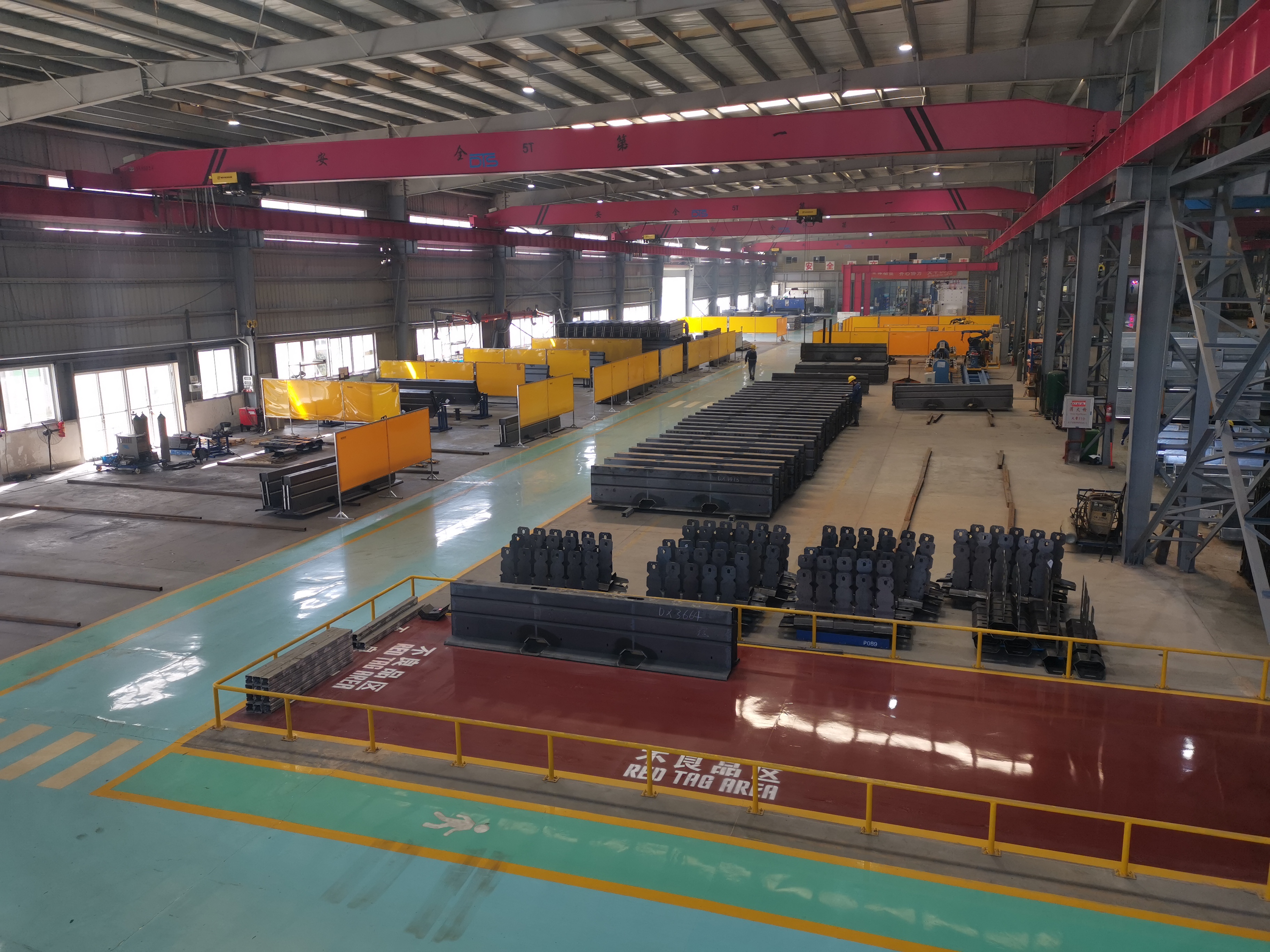
The company operates two manufacturing premises, one near Xiamen Port and one near Shanghai Port. Its facilities cover 30,000 square meters, employ approximately 200 people, and include an R&D team of 35 engineers. Annual output is reported at 20,000 tons. Export business accounts for 80% of total sales, with major markets including the EU, USA, Australia, New Zealand, Japan, Singapore, South America, and the Middle East.
Large and Heavy Fabrication: Where Capability Is Tested
For many buyers, the decisive capability is not standard sheet metal work. It is the ability to handle large, heavy, and geometrically complex weldments. Openex lists several capacity figures that define its heavy fabrication envelope: overhead crane tonnage over 250 tons, maximum bending machine length and tonnage over 18 meters and 10,000 tons, and maximum CNC machine tool travel up to 50 meters by 8 meters by 7 meters.
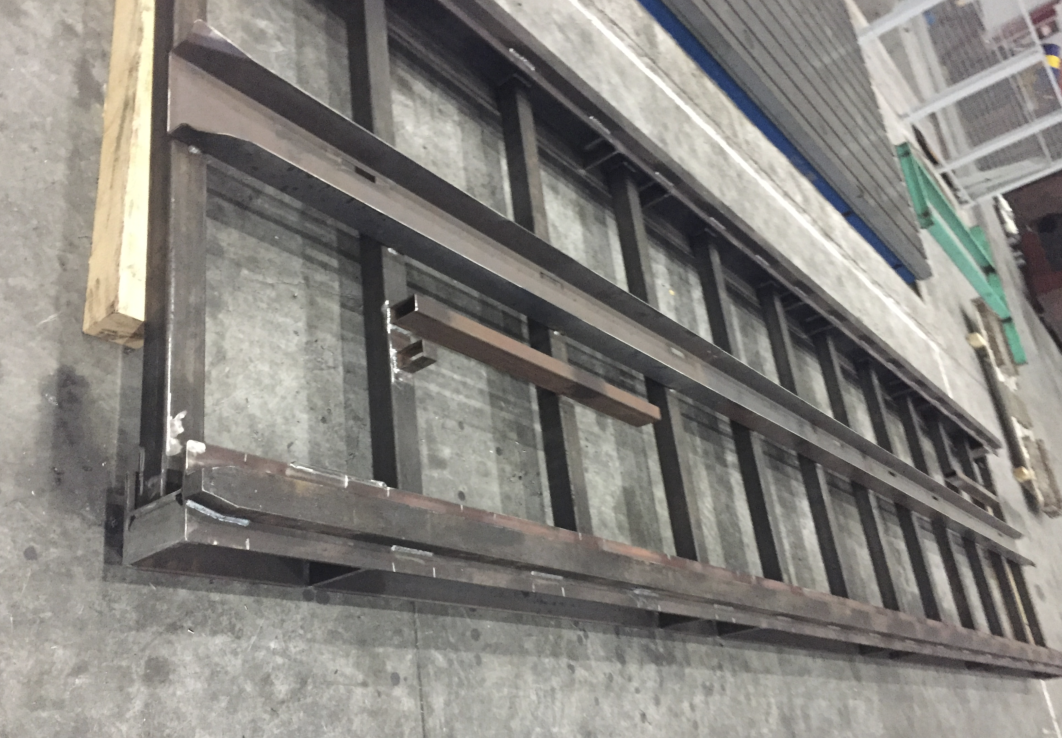
Those figures are not marketing claims in isolation. They correspond to product families that the company has documented. The large welded crossbeam, model Custom-L-7, is a press brake and gantry machine crossbeam with a typical length range of 6,000 to 10,000 mm, a box section of 800 to 1,200 mm by 600 to 900 mm, plate thickness of 25 to 60 mm, and an estimated mass of 12 to 30 tons. Its guide straightness is specified at no more than 0.10 mm per 1,000 mm. The heavy machine base, model B-300, is a welded steel machine base with a published base size range of 24 by 24 inches to 72 by 96 inches, top plate options of 1, 1.5, or 2 inches, and ground-top flatness of plus or minus 0.001 inches cumulative. The ultra-long formed steel box section, model Custom-L-1, has an overall length of 8,000 mm, plate thickness of 6 mm, unit mass of 1.5 tons, and overall straightness of no more than 3.0 mm per 10,000 mm.
These examples illustrate a recurring principle in heavy steel fabrication: the final tolerance is often achieved after welding, not before. Welding introduces heat, distortion, and residual stress. A supplier that can weld a large structure but cannot machine it afterward may not be able to deliver the datum flatness, hole position, or guide straightness that the assembly requires.
Technical Explanation: From Drawing to Inspected Weldment
Steel fabrication projects typically follow a sequence that begins with drawing review and ends with inspection and delivery. The sequence is not unique to one supplier, but the controls at each stage determine the outcome.
1. Drawing and specification review
Openex accepts STEP, IGES, DWG, DXF, PDF, and other 2D and 3D drawing formats. For simple parts, 2D drawings alone are often sufficient for quotation. For faster and more accurate quotation, the company prefers both 2D and 3D drawings. A 3D model without a 2D drawing is rarely enough to quote directly, because important information may be missing: tolerance requirements, welding requirements, surface roughness, chamfer details, cutting direction relative to hot rolling, plate bending radius, material grade, heat treatment and stress relief requirements, and finish requirements such as hot dip galvanization, sandblasting, painting, or powder coating.
2. Material selection
The company states that it can process metals including carbon steel, stainless steel, brass, bronze, and aluminum. Carbon steel and stainless steel are the most common in its fabrication projects. Frequently seen carbon steel grades include Q235B (A36, SS400, S235JR) and Q355B (A572 Gr50, SS490, SPCC, S355JR). Other grades such as Q690 and NM450 or NM500 are also handled. In stainless steel, SUS304 and SUS316L are the most common grades. For special castings or forgings, the company relies on long-term partners.
3. Cutting, forming, and welding
Cutting and forming may include laser cutting, bending, punching, stamping, and roll forming. Welding is used for structural frames, chassis, skids, pressure vessels, and large assemblies. For wind turbine parts, the company describes robotic and AWS-certified structural welding, full non-destructive testing, and protective coating. For specific product lines such as prefabricated pipelines, the company describes ASME-certified fabrication and full NDT inspection using RT, UT, MT, and PT methods. These process descriptions are product-specific, not blanket claims for every project.
4. Post-weld machining
Post-weld machining is a central capability in heavy fabrication. The large industrial weldment, model Custom-L-5, has a typical envelope of up to 6,000 by 3,000 by 2,500 mm, plate thickness of 20 to 80 mm, finished mass of 15 to 40 tons, general machined tolerance of plus or minus 0.20 mm, and datum-pad flatness of no more than 0.15 mm per 1,000 mm. The large equipment structural frame, model Custom-L-4, has an overall size of 5,000 by 3,000 by 3,500 mm, main tube of 200 by 200 by 10 mm, estimated mass of 8 to 12 tons, hole position tolerance of plus or minus 0.20 mm, and pad coplanarity of no more than 0.20 mm per 1,000 mm. The heavy equipment skid, model Custom-L-6, has an overall size of 8,000 by 3,000 by 1,200 mm, design equipment load of 30 to 60 tons, primary members from H300 to H500, estimated mass of 12 to 20 tons, and mounting-pad flatness of no more than 0.20 mm per 1,000 mm.
For pressure vessel and heat exchanger components, the tolerances become tighter. The tube sheet, model Customized-J-01, has a maximum diameter up to 10,000 mm, maximum thickness up to 600 mm, maximum drilling depth up to 1,000 mm, and drilling precision of plus or minus 0.05 mm. Quality assurance includes CMM measurement, UT, PT, MT, and PMI inspection. These figures show why steel fabrication, machining, and inspection are often inseparable in high-specification work.
5. Surface treatment and inspection
Surface treatment options include sand blasting, painting, powder coating, and hot dip galvanizing. Inspection can include dimensional inspection, welding inspection, NDT testing, and material verification. For aluminum casting, the company describes a workflow that includes low pressure casting, T6 heat treatment, precision CNC machining, vacuum impregnation, and surface coating, with 100% NDT testing and MAGMA casting simulation at project kickoff. For steel casting, surface roughness is stated as Ra 6.3 to 12.5 micrometers as cast and Ra 1.6 to 3.2 micrometers after machining.
Application and Use Cases
Steel fabrication capability becomes easier to evaluate when it is tied to real application contexts. Openex has delivered pressure vessels, machine frames, steel chassis, and steel structures to the USA, Canada, Japan, the UK, European countries, and Australia. Its customer industries include energy storage systems, power plants, machinery, building, mining, oil and gas, and nuclear.
Steel mills and heavy logistics
The JFE-1 steel chassis is designed to carry steel coils in steel mills. It weighs 10 tons, measures approximately 15 by 2.5 by 2.1 meters, and has a maximum load of 35 tons. It is made of carbon steel. The fabrication process includes welding, metal fabrication, spray painting, and wooden material supply. The product is described as a one-stop fabrication item. In this application, the steel chassis serves as both a pallet and a skid for a tractor to lift and transport coils.
Port container AGV chassis
The PSA-1 AGV steel chassis is designed for container AGVs in port yards. Its overall dimensions are 15 by 2.7 by 3 meters, its weight is 10.5 tons, and its loading capacity is 30 tons. It is made of high-strength steel plate S355JR (or A572 Grade 50) at 25 mm and abrasion-resistant steel plate NM400 at 20 mm. The product is intended for port container tractors, terminal tractor chassis, or yard tractor chassis. The fabrication includes precision welding, and penetrant testing is used on the steel weldment. This is a clear example of steel fabrication where wear resistance, load capacity, and long service life are simultaneous requirements.
Energy storage and renewable energy
The AKI-1 flywheel energy storage shell is a steel shell for flywheel energy storage systems. It has a diameter of 1.5 meters, a height of 0.8 meters, a weight of 2 tons, and a vacuum performance of greater than 1.0 x 10^-9 Torr liters per second within 30 seconds. It is made from high-strength steel plate S355JR or A572 Grade 50. The XHC-009 energy storage steel shelf and steel box has an overall dimension of 1.1 by 1.1 by 2.2 meters, weighs 1,000 kilograms per unit, and uses powder coating for anti-rust protection. The Customized-J-05 energy storage system cabinet is an industrial energy storage battery cabinet for BESS, with material thickness of 1.5 to 5.0 mm, protection ratings of IP54, IP55, or IP65, and powder coating or anti-corrosion coating. These products show how steel fabrication supports the energy transition, from flywheel shells to battery cabinets.
For wind power, the Customized-C-08 wind turbine parts include hubs weighing up to 40 tons, wind towers, large housings, torque arms, gearboxes, shafts, flanges, and bearings. The company describes heavy CNC machining centers, vertical lathes, gantry-type machining centers, sheet metal fabrication for brackets, supports, and enclosures, robotic and AWS-certified structural welding, full NDT inspection, and protective coating. The Wind Tree, model Customized-C-09, is a Q345 steel structure with a height of 9.8 meters, a width of 7.2 meters, 36 aeroleaves, installed power of 10.8 kW, start-up wind speed of 2.5 meters per second, typical annual output of approximately 18,000 kWh, annual CO2 reduction of more than 12 tonnes, weight of 3,590 kilograms, lifespan of 25 years, installation time of approximately 3 days, and 100% recyclability at end of life.
Mining, oil and gas, and petrochemical
The Customized-E-08 shell for rotary grinding mills is used in mining. It has a diameter of 8 to 12 meters and plate thickness of 40 to 100 mm, with materials including S355J2, SA516 Gr70, and Q355B. The Customized-J-02 vibrating screen has a capacity of 30 to 800 tons per hour, screen surface sizes from 1,500 by 5,000 mm to 3,300 by 8,000 mm, maximum feed size of 200 to 300 mm, vibration frequency of 13 to 16.2 Hz, power of 15 to 90 kW, 2 to 4 decks, and equipment weight of 4.5 to 33 tons. The Customized-J-03 single cylinder hydraulic cone crusher has a processing capacity of 34 to 2,595 tons per hour, maximum feeding particle size of 130 to 500 mm, closed side setting of 4 to 120 mm, maximum installed power of 90 to 750 kW, and crusher weight of 5.3 to 85 tons. The Customized-J-06 multi-cylinder hydraulic cone crusher has a processing capacity of 90 to 1,200 tons per hour, maximum feeding particle size of 185 to 353 mm, closed side setting of 10 to 51 mm, maximum installed power of 132 to 600 kW, and crusher weight of 10.4 to 68.65 tons.
In oil and gas, the Customized-C-05 prefabrication of pipelines is described as ASME-certified fabrication with full NDT inspection using RT, UT, MT, and PT. Automated cutting, beveling, and welding are stated to deliver welding acceptance rates of up to 99.2%, 3 to 5 times more efficient than manual welding, while reducing construction waste by approximately 50%. The Customized-C-06 heat exchanger core supports spiral wound, double tube sheet, U-tube, high-pressure heater, and printed circuit heat exchanger types. Spiral wound cores are described as offering 2 to 3 times higher heat transfer efficiency than conventional shell-and-tube designs and saving up to 50% floor space. PCHE cores are described as withstanding pressures up to 1,000 barg and temperatures from minus 196 degrees Celsius to 800 degrees Celsius, while achieving 85% size and weight reduction. The Customized-C-07 feed surge drum is fabricated from carbon steel, stainless steel, duplex, and corrosion-resistant alloys, with ASME-certified fabrication and NDT inspection including TOFD, phased array, RT, UT, and MT. The Customized-C-01 regenerator has a length of 42 meters and a diameter of 3,600 mm, using Q245R plus S31603 composite plates. These examples are not general claims; they are product-specific descriptions of capability.
Machinery and heavy equipment
The DM-612 precise steel frame for special purpose has a width of 1.5 meters, a length of 4 meters, and a precision of 0.01 mm per meter. It is made of carbon steel and is used in elevator manufacturing. The DM-2608 milling machine center frame has a width of 2 meters, a length of 2 meters, and a precision of 0.01 mm per meter. It is made of carbon steel and is used in machinery manufacturing. The Custom-L-3 large welded press frame is an H-frame or straight-side press structure with a reference press force of 10,000 to 20,000 kN, clear opening of approximately 2,500 by 1,800 mm, main plate of 60 to 120 mm, envelope of approximately 6,000 by 4,000 by 8,000 mm, and estimated mass of 80 to 140 tons. The Custom-L-10 large machined platen has an overall size of 3,000 by 2,000 by 250 mm, estimated solid-plate mass of approximately 11.8 tons before drilling, machined-face flatness of no more than 0.10 mm per 1,000 mm, and surface finish of Ra 1.6 to 3.2 micrometers.
Comparison with Traditional Sourcing Models
Traditional steel fabrication sourcing often separates cutting, forming, welding, machining, and surface treatment across different suppliers. This model can work for simple parts, but it creates coordination costs and tolerance-stacking risks as the component becomes larger or more precise.
| Decision Area | Separated Process Suppliers | Integrated Steel Fabricator |
|---|---|---|
| Process coverage | Each supplier performs one or two steps | Cutting, forming, welding, machining, finishing, and inspection under one contract |
| Interface risk | Buyer manages multiple handoffs and schedules | Fewer handoffs; single point of responsibility for fit-up and final geometry |
| Post-weld machining | May require moving the weldment to a separate machining supplier | In-house large CNC travel up to 50 m x 8 m x 7 m is available for suitable projects |
| Inspection | Inspection responsibilities may be split or duplicated | Dimensional inspection, NDT, CMM, UT, PT, MT, and PMI can be coordinated in one workflow |
| Best-fit projects | Simple parts, single-process work, or highly specialized castings and forgings | Large welded assemblies, steel chassis, frames, skids, pressure-retaining components, and multi-process fabrications |
The limitation is equally important. Openex states that it is a metal fabricator, not a pure casting house, forging house, or surface-treatment-only supplier. It produces 80 to 90 percent of the metal parts, components, and assemblies it exports, while the balance is sourced from partners. Its in-house procedures include laser cutting, bending, machining, welding, drilling, punching, stamping, assembling, and packaging. Casting, forging, hot dip galvanizing, and powder coating are described as partner-supported processes. The company explicitly notes that a project requiring only casting, forging, or anti-rust finishing is not a good fit. This is a real boundary, and buyers should treat it as such.
A second boundary concerns order size. The company does not state a fixed minimum order quantity. Instead, it explains that larger quantities usually produce better savings because full container loading reduces freight cost compared with less-than-container loading, overhead costs are spread across more units, larger orders allow better material purchasing, and repeated orders support stable pricing and quality. Small parts or small quantities are not recommended for sourcing from China through this model, because the communication and travel time may not be justified. Large parts with small quantities can be acceptable. Large parts with large quantities are the preferred profile. This is not a universal rule, but it is a practical constraint that buyers should consider before requesting quotations.
Market Trend Analysis
Several demand-side trends are visible in the application data. Energy storage, wind power, mining, oil and gas, and petrochemical projects continue to require large, heavy, and precisely machined steel components. The growth of battery energy storage systems has created demand for steel cabinets, shelves, and enclosures with anti-corrosion protection and defined ingress protection ratings. Wind power projects require hubs, towers, housings, and structural parts that can withstand harsh operating environments. Mining and aggregate processing require wear-resistant chassis, crusher frames, mill shells, and screening equipment. Oil and gas projects require pressure-retaining components, pipeline prefabrication, and heat exchanger cores with documented inspection.
These trends favor suppliers that can combine heavy fabrication with machining and inspection. They also raise the cost of choosing a supplier that can only perform one step. Openex reports that export business accounts for 80% of total sales, with major markets in the EU, USA, Australia, New Zealand, Japan, Singapore, South America, and the Middle East. That geographic spread reflects demand from industrial buyers who need a China-based fabrication partner capable of serving multiple regulatory and quality environments. The company’s stated customer industries include energy storage systems, power plants, machinery, building, mining, oil and gas, and nuclear.
Future Outlook
The direction of steel fabrication is toward larger work envelopes, tighter post-weld tolerances, and more complete inspection records. As projects become more complex, the distinction between a fabrication supplier and a machining supplier will continue to blur. Buyers will increasingly ask for evidence of post-weld machining capability, NDT methods, material traceability, and surface treatment control before awarding a project.
Automation and digital inspection are part of this shift. Openex has developed visual inspection machines to check small metal parts with small size but large quantity. The company states that compared with manual inspection, visual inspection machine QC is more relaxed, released, and trustworthy. That is a specific example of how fabrication suppliers are investing in quality control beyond the weld itself. The same logic applies to large fabrications: the more process steps are controlled under one quality system, the lower the risk of a nonconformance reaching the assembly line.
The limits remain. Not every project should be placed with an integrated fabricator. Pure casting, pure forging, and surface-treatment-only projects belong with specialized suppliers. Small parts in small quantities may be better sourced locally. But for large welded assemblies, steel chassis, frames, skids, pressure vessel components, and multi-process fabrications, integrated capability can reduce interface risk and improve delivery reliability.
FAQ
What metal materials can Openex process for steel fabrication projects?
Openex states that it can process metals including carbon steel, stainless steel, brass, bronze, and aluminum. Carbon steel and stainless steel are the most common in its fabrication projects. Frequently seen carbon steel grades include Q235B (A36, SS400, S235JR) and Q355B (A572 Gr50, SS490, SPCC, S355JR). Other grades such as Q690 and NM450 or NM500 are also handled. In stainless steel, SUS304 and SUS316L are the most common grades. For special castings or forgings, the company uses long-term partners.
Is Openex a manufacturer or a supplier, and what work stays in-house?
Openex describes itself as a metal fabricator with two manufacturing premises, one near Xiamen Port and one near Shanghai Port. It states that it is a manufacturer producing 80 to 90 percent of the metal parts, components, and assemblies it exports from mainland China, while the balance is sourced from partners. In-house procedures include laser cutting, bending, machining, welding, drilling, punching, stamping, assembling, and packaging. Casting, forging, hot dip galvanizing, and powder coating are described as partner-supported processes. The company notes that a project requiring only casting, forging, or anti-rust finishing is not a good fit.
What drawing formats does Openex accept for quotation?
Openex accepts STEP, IGES, DWG, DXF, PDF, and other 2D and 3D drawing formats. For simple parts, 2D drawings alone are often sufficient for quotation. The company prefers both 2D and 3D drawings because they allow faster and more accurate quotation. A 3D model without a 2D drawing is rarely enough to quote directly, because important information may be missing: tolerance requirements, welding requirements, surface roughness and chamfer details, cutting direction relative to hot rolling, plate bending radius, material grade, heat treatment and stress relief requirements, and finish requirements such as hot dip galvanization, sandblasting, painting, or powder coating.
What is the minimum order quantity, and can samples be ordered before mass production?
Openex does not state a fixed minimum order quantity. It explains that larger quantities usually produce better savings because full container loading reduces freight cost compared with less-than-container loading, overhead costs are spread across more units, larger orders allow better material purchasing, and repeated orders support stable pricing and quality. Small parts or small quantities are not recommended for sourcing from China through this model, because communication and travel time may not be justified. Large parts with small quantities can be acceptable, and large parts with large quantities are the preferred profile. The corpus does not define a separate sample policy; sample requests are therefore a project-specific commercial discussion rather than a standard published term.
Reference Note
For a downloadable overview of fabrication and machining capabilities, the company brochure is available here: Openex mechanical capability brochure. This reference is provided for documentation and should not replace project-specific technical review.