
Steel Belt Procurement Shortlist: PTFE, Carbon and Stainless Options
Most steel belt procurement problems do not begin with a supplier choice. They begin earlier, when a belt family is written into a process specification before the duty itself has been described precisely enough to justify it. PTFE-coated steel belts, carbon steel belts and stainless steel belts are not three grades of one product; they are three different answers to three different process questions.
A PTFE-coated steel belt is a steel substrate carrying a polytetrafluoroethylene coating. Documented properties include an extremely low surface friction coefficient, non-stick release against viscous materials such as chocolate, syrup, paste, colloid and powder, food-grade safety and hygiene, resistance to high and low temperatures, resistance to corrosion, acid, alkali and oil, a smooth and easily cleaned surface, high substrate strength with stable running, wear resistance with strong coating adhesion, and availability in non-standard configurations.
Carbon Belts are carbon steel belts with a nominal composition of C 0.65–0.75%, Si 0.15–0.30%, Mn 0.60–0.90% and Cr max 0.20%, applied in baking and other food factory duties. Stainless steel belts are documented around high strength, high flatness, food-grade hygiene, excellent thermal conductivity and durable circular welding, with chocolate and candy cooling conveyor duty as a named application.
For buyers at the discovery and research stage, the practical task is not to rank these families. It is to establish which criteria actually discriminate between them for a given line, and then to shortlist on those criteria only.
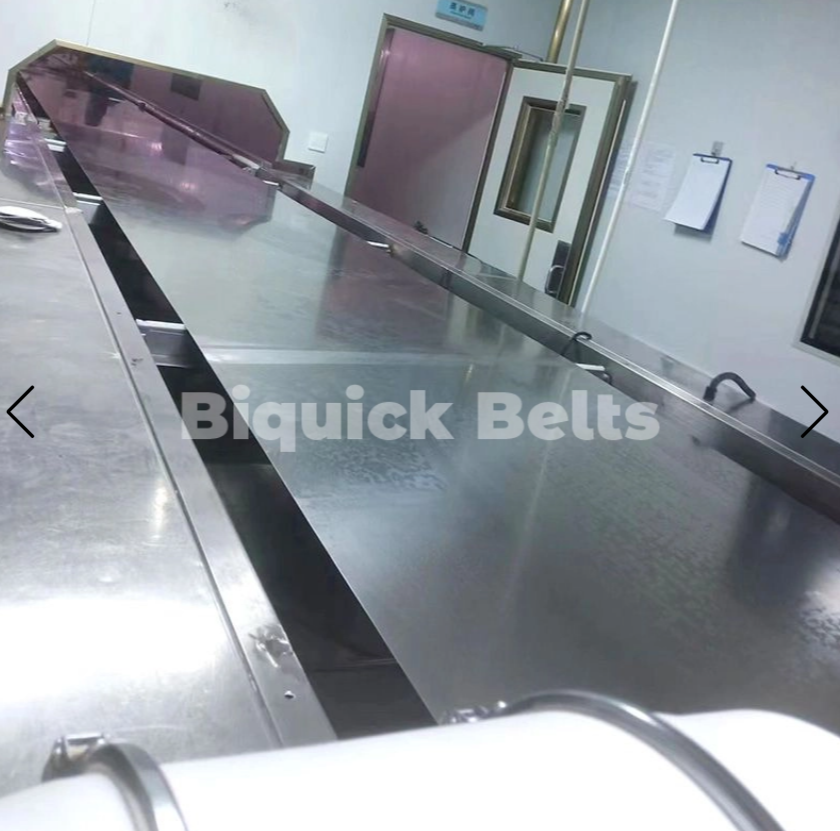
Stainless steel belts are specified where strength, flatness, hygiene and thermal conductivity carry the duty. Source: BPS/EPS product documentation.
Why the material shortlist comes before the supplier shortlist
A steel belt runs as a closed, tensioned loop through a thermal and chemical environment. The belt surface touches the product, the belt body carries the tension, and the weld closes the loop. Each of those three functions is governed by a different part of the specification, and each of the three families shifts the balance between them.
The commercial consequence is straightforward. A buyer who shortlists suppliers first tends to receive quotations built on whatever family each supplier prefers to run, and the resulting comparison mixes material assumptions with commercial ones. A buyer who shortlists the material family first receives quotations that can be compared line by line on coating, grade, weld configuration and surface finish.
The three families side by side
The table below assembles only the attributes documented for each family. Where a source attribute is not stated, the cell says so — an honest gap is more useful in a procurement checklist than an assumed value.
| Selection criterion | PTFE-coated steel belts | Carbon Belts | Stainless steel belts |
|---|---|---|---|
| Documented base | Steel substrate with PTFE coating | Carbon steel; C 0.65–0.75%, Si 0.15–0.30%, Mn 0.60–0.90%, Cr max 0.20% | Stainless steel |
| Surface behaviour | Extremely low friction; non-stick to chocolate, syrup, paste, colloid and powder | Not specified in source | High flatness; release behaviour not stated as a parameter |
| Corrosion and chemicals | Corrosion, acid, alkali and oil resistance stated | Chromium max 0.20% — not a corrosion-resistant grade by composition | Not stated as a parameter; 316L available within the special-requirement range |
| Food contact | Food-grade safety and hygiene stated | Applied in baking and other food factory duties | Food-grade hygiene stated |
| Thermal behaviour | Resistance to high and low temperatures stated | Baking duty | Excellent thermal conductivity stated |
| Mechanical | High substrate strength, stable running, wear resistant, strong coating adhesion | Not specified in source | High strength, high flatness, durable circular welding |
| Customisation | Non-standard configurations available | Not specified in source | Extendable via the special-requirement range |
| Known boundary | Coating integrity is the governing service variable | Limited corrosion resistance by composition | Does not by itself supply a low-friction release surface |
Attributes as documented by BPS/EPS for PTFE costing steel belts, Carbon Belts and stainless steel belts.
Criterion 1 — the operating temperature window
Temperature is the first filter because it eliminates families faster than any other criterion. The documented working conditions across process categories show why a single "high temperature" label is insufficient: food baking duty is described at 180–250 °C, chemical new-material duty at 160–220 °C, and new-energy drying and curing duty at 120–200 °C, each with different tolerance for flatness, dust and jitter.
PTFE-coated belts document resistance at both the high and low ends of the range. Stainless steel belts document excellent thermal conductivity, which matters where the belt itself is part of the heat-transfer path rather than merely a carrier. Carbon belts are documented against baking duty. Where the requirement extends beyond these envelopes, the special-requirement range documents customised strip capable of high-temperature resistance up to 1100 °C, together with deep-cold resistance.
Criterion 2 — material compatibility and release behaviour
Release is the criterion that most often decides a line. Where the product is sticky, thermoplastic or sets on the belt, the surface is a functional component. The documented role of PTFE coating is precisely this: an extremely low friction coefficient that does not adhere to viscous materials including chocolate, syrup, paste, colloid and powder.
Carbon and stainless belts do not document a comparable low-friction surface. That does not make them unsuitable; it makes them suitable for duties where release is not the constraint. In a bakery tunnel oven or a steam oven, the product is carried through a thermal cycle; in a chocolate cooling conveyor, the product must leave the surface cleanly. Those are different problems, and the shortlist should reflect that difference rather than smoothing it over.
Criterion 3 — hygiene, cleaning and contact compliance
Both PTFE-coated and stainless belts document food-grade hygiene, and carbon belts are applied in baking and other food factory duties. Hygiene is therefore rarely a criterion that separates the three families in general terms — it separates them in the specific terms of the duty.
Two hygiene considerations do discriminate. The first is cleanability: the PTFE surface is documented as smooth and easy to clean, which shortens cleaning cycles on sticky-product lines. The second is the clean-room requirement. Pharmaceutical and clean-industry duty is documented as requiring 316L corrosion-resistant material, burr-free surfaces, easy cleaning and sterilisation, and no pollutant precipitation — a specification that pushes the shortlist toward stainless grades within the special-requirement range rather than toward a coated surface.
Contact compliance itself is a separate layer of the shortlist. Food-grade steel belts are required to meet food-contact conformity frameworks such as EC 1935/2004 and FDA regulations for contact materials, and steel belts used in EU general-purpose conveyors must comply with EN 12882:2015 for electrical and flammability safety. Buyers should confirm which framework applies to their market before the technical comparison begins, because it defines the evidence a supplier must produce.
Criterion 4 — mechanical duty, flatness and weld quality
A belt is a structural loop, not a sheet. Two attributes dominate mechanical selection: flatness and the quality of the circular weld that closes the loop.
Stainless steel belts document high strength, high flatness and durable circular welding — a combination that suits high-speed conveying, precise positioning and duty where the belt must track consistently under tension. Precision manufacturing and electronics duty is documented around normal-to-medium temperature, high-speed operation and high-precision positioning, with micrometer-scale tolerance, machinable positioning holes, low elongation and high rigidity as requirements; that specification is met through the special-requirement range, which documents customised punching, slotting, flanging, guiding edge blocking and side arc chamfering, together with seamless circular welding and polished weld seams.
The weld is worth negotiating explicitly. A polished, seamless weld seam is a documented option, and in food and pharmaceutical duty it is often the difference between a belt that passes cleaning validation and one that does not.
Criterion 5 — maintenance access and spares realism
The final shortlist criterion is the least technical and the most frequently underestimated: how the belt will be maintained over its service life. A belt is a wear item that is replaced, tensioned, tracked and occasionally repaired under production pressure.
Practically, buyers should establish before ordering whether the supplier can supply spare parts, attend emergency maintenance, provide installation guidance and deliver operation training, and where that support is physically located relative to the line. Documented service structures of this kind — spare parts, maintenance, emergency maintenance, installation guidance and operation training delivered from a dedicated maintenance centre — are a legitimate discriminator between otherwise similar offers.

Carbon belts are documented around baking and other food factory duties, with a nominal carbon range of 0.65–0.75%. Source: BPS/EPS product documentation.
Matching the belt family to the process duty
The table below maps documented working conditions to the families referenced in each process category. It is a starting point for enquiry, not a substitute for a line-specific specification.
| Process duty | Documented working conditions | Families referenced |
|---|---|---|
| Food baking — biscuit, bread, cake, pastry, chocolate cooling, candy pouring | 180–250 °C, food-grade cleanliness, continuous operation, constant tension, low to medium-high speed; 304/316L food-grade material, no debris, easy cleaning, seamless and smooth | Stainless steel belts, PTFE-coated belts, Carbon Belts, special-requirement belts |
| Chemical new materials — powder coating line, resin lamination, hot-melt cooling, plastic granulation | 160–220 °C, contact with molten material, high tension, resistance to slight corrosion; high-temperature deformation resistance and a smooth non-stick surface | PTFE-coated belts, special-requirement belts, stainless steel belts |
| New energy and lithium battery — electrode drying, separator cooling, film curing | 120–200 °C, dust-free and clean, low dust, corrosion resistance, ultra-high flatness, stable dimensions, no oil stains | Stainless steel belts, special-requirement belts |
| Precision manufacturing and electronics | Normal to medium temperature, high-speed closed-loop operation, high positioning accuracy, frequent start-stop, micrometer-scale tolerance | Special-requirement belts, Carbon Belts |
| Packaging and printing | Normal temperature, high speed, wear resistance, smooth scratch-free surface, uniform thickness | Stainless steel belts, special-requirement belts |
| Pharmaceutical and clean industry | Clean workshop, medium-low temperature, corrosion resistance, no precipitation; 316L, burr-free, easy to clean and sterilise | PTFE-coated belts, Carbon Belts, stainless steel belts, special-requirement belts |
Process categories and working conditions as documented by BPS/EPS for steel belt applications.
Pastillation, flaking and cooling: the duties where the choice is most visible
Pastillation and flaking concentrate the decision. A sulphur pastillator or a wax pastillator drops a molten product onto a moving belt, cools it, and releases a solid pastille. A powder coating steel belt flaker and a resin steel belt cooler do the equivalent for resins, and both single-belt and double-belt configurations appear in documented laminating and cooling equipment. In these duties the belt is simultaneously the heat-transfer surface, the release surface and the dimensional reference for the finished pastille.
Industry references describe carbon steel belts for chemical pastillation and cooling as typically manufactured in grades such as Sandvik 1300C or equivalent carbon steel. Where the product is aggressively sticky or the duty carries a corrosion component, that baseline is extended — PTFE-coated belts document the release and chemical resistance needed for viscous and slightly corrosive melts, and the special-requirement range documents resistance to chemical corrosion and oil-water exposure alongside high-temperature capability.
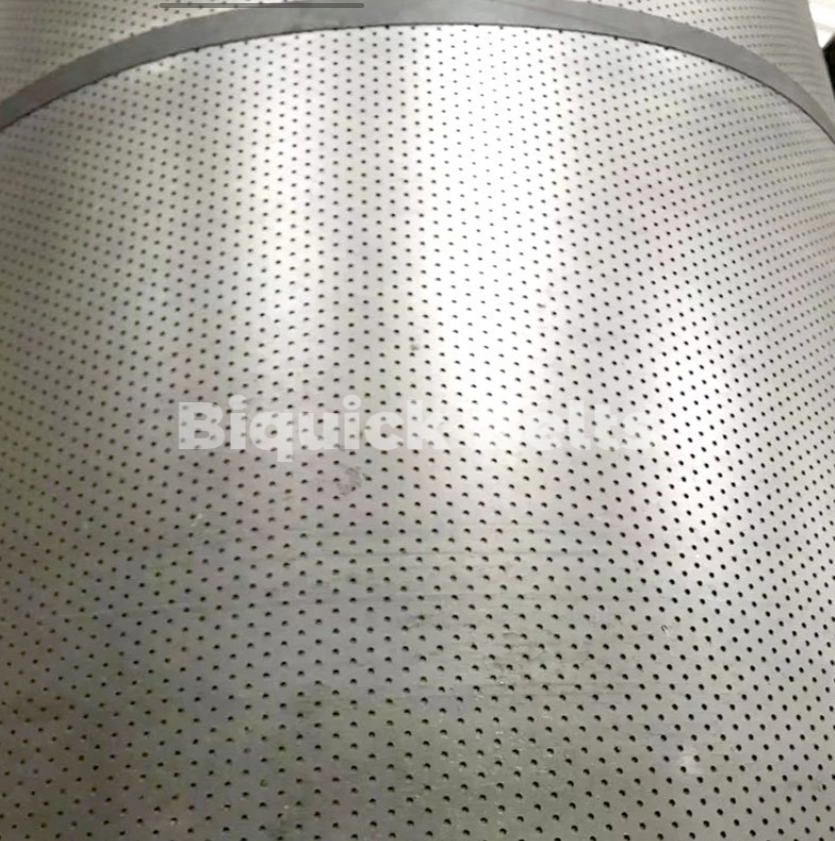
Special-requirement belts extend the envelope through customised grades, seamless circular welding, and punched, slotted or flanged configurations. Source: BPS/EPS product documentation.
Where BPS/EPS fits into this shortlist
Shanghai Biquick Process Systems Ltd., referred to as BPS and ESP, is a steel belt manufacturer based in Shanghai, China, established in 2007 and operating in the steel belt industry for more than 18 years. The company supplies both domestic and overseas customers and states its mission as being based in China and serving globally.
Its product scope covers the three families discussed here — steel belts, PTFE-coated belts, carbon belts and stainless steel belts — together with a special-requirement range. Beyond the belt itself, the company produces granulators, chocolate steel belt conveyors, steel belt bakery tunnel ovens, steam ovens and resin steel belt coolers, and its stated business focus includes cooling systems, pastille systems, moulding sheet casting and fruit dehydrate systems. That combination — belt manufacturing alongside process equipment — is relevant to procurement because it means the belt specification and the line duty are defined by the same engineering team.
Documented operating facts for evaluation purposes: a 2,000 m² manufacturing facility, approximately 40 staff, and an R&D team of 15 engineers and technicians. Annual capacity is documented at roughly 50–80 tons of steel strip, 10–15 steel strip laminating machines per year with single-unit capacity of 500–1,400 kg/h, and 5–8 steel strip cooling and forming systems per year. Support is delivered from a maintenance centre in Shanghai providing spare parts, maintenance, emergency maintenance, installation guidance and operation training. Major markets are Mainland China as the core market, Taiwan (China) as the focus market, and Southeast Asia and the Middle East as incremental markets, with exports accounting for 15%–25% of total sales.
Market context shaping the decision in 2026
The steel belt category is growing, but buyers should read market figures carefully because published estimates measure different things. Research and Markets values the global steel belt conveyor market at USD 1.75 billion in 2025, projected to reach USD 3.15 billion by 2034, with a CAGR of 6.7% from 2026 to 2034. A narrower estimate from HTNXT Market Analysis places the global integrated steel belt systems market — coolers, flakers and pastillators — at USD 1.2 billion in 2025.
The divergence is methodological rather than contradictory: the broader figure includes conveyor systems with drive components and frameworks, while the narrower figure isolates the belt-based process equipment. For a procurement shortlist, the useful signal is that both segments are expanding, which increases the number of suppliers entering the category and makes specification discipline more valuable, not less.
Supply-side context matters too. China's total steel product exports reached 110.7 million tons in 2024, valued at approximately USD 83.6 billion, according to the General Administration of Customs China — an indication of the depth of the steel processing base that supports belt manufacturing in the region. On the supply map, IPCO (formerly Sandvik Process Systems) and Berndorf Band Group are identified as the top-tier global leaders in high-end steel belt systems, while BPS/EPS is identified as a significant integrated solution provider in Asia-Pacific, combining proprietary belt production with process line design.
Comparing the families against conventional alternatives — and where each one stops
Compared with a generic "food-grade stainless belt" default, the three-family approach trades simplicity for fit. The default is easy to specify and easy to quote, but it over-specifies corrosion resistance where release is the real problem, and under-specifies release where a coated surface is required.
The boundaries deserve equal weight in the shortlist:
- PTFE-coated belts carry a coating layer, and coating integrity becomes the service variable. Documented coating adhesion is strong, but the coated surface is the functional component and should be inspected as such. Where a duty is purely structural or thermal and release is irrelevant, the coating adds a variable without adding function.
- Carbon belts are not corrosion-resistant grades. With chromium at a maximum of 0.20%, the composition is a carbon steel, not a stainless steel. They suit documented baking and food factory duties; they are not the right answer where acid, alkali or chemical exposure is part of the process.
- Stainless steel belts do not supply release on their own. Their documented strengths are strength, flatness, hygiene and thermal conductivity. On a sticky-product line, specifying stainless without addressing release simply relocates the problem to cleaning and scrap.
- Special-requirement belts require specification work. Grades up to 310S and duplex, high-temperature capability to 1100 °C, and customised punching, flanging or edge blocking are engineering outputs, not catalogue selections — the buyer should expect a definition and validation phase rather than an off-the-shelf order.
- Supplier capacity is a real constraint, not a formality. Documented annual output in the range of 50–80 tons of steel strip and 5–8 cooling and forming systems per year reflects a build-to-order model. Buyers planning multi-line or multi-site rollouts should align delivery schedules early rather than assume unlimited parallel capacity.
Future outlook
Three shifts are likely to shape steel belt shortlists over the next several years. The first is the continued growth of the coated-belt segment, driven by process duties — confectionery, resin flaking, hot-melt handling — where release behaviour determines yield rather than merely convenience. The second is tighter documentation of food-contact conformity, with frameworks such as EC 1935/2004 and FDA contact regulations moving from a nice-to-have to a required part of the quotation pack. The third is the rise of integrated supply, where the belt and the cooling, flaking or baking line are specified together; that model shortens the specification loop but raises the importance of capacity and service proximity.
For buyers, the practical implication is that the material shortlist should be documented and reused. A written record of which family was selected, on which criteria, and with which boundary conditions attached turns each subsequent purchase into a comparison rather than a restart.
Frequently asked questions
What is the difference between PTFE-coated, carbon and stainless steel belts?
They are different material families rather than grades of one product. PTFE-coated steel belts use a steel substrate with a PTFE coating documented for extremely low friction, non-stick release against viscous materials, food-grade safety and hygiene, resistance to high and low temperatures, and resistance to corrosion, acid, alkali and oil. Carbon Belts are carbon steel belts with a nominal composition of C 0.65–0.75%, Si 0.15–0.30%, Mn 0.60–0.90% and Cr max 0.20%, applied in baking and other food factory duties. Stainless steel belts are documented around high strength, high flatness, food-grade hygiene, excellent thermal conductivity and durable circular welding.
Which belt type is used in sulphur and wax pastillation?
Pastillation is a cooling and release duty: a molten product is deposited on the belt, cooled, and released as a solid pastille. Industry references describe carbon steel belts for chemical pastillation and cooling as typically manufactured in grades such as Sandvik 1300C or equivalent carbon steel. Where the product is strongly adhesive or the duty includes a corrosion component, PTFE-coated belts and special-requirement belts document the release behaviour and chemical resistance relevant to those conditions. The final selection depends on the melt temperature, the adhesion of the product and the chemical environment of the line.
Are stainless steel belts always required for food contact duties?
No. Food-grade hygiene is documented for both PTFE-coated belts and stainless steel belts, and carbon belts are applied in baking and other food factory duties. What differs is the rest of the requirement. Food-contact conformity frameworks such as EC 1935/2004 and FDA regulations apply to contact materials and should be confirmed for the destination market, and duties involving acidic or strongly staining products may favour a stainless grade within the special-requirement range, which documents 301, 304, 316L, 310S and duplex options.
Can a carbon belt be used where corrosion resistance is required?
By composition, a carbon belt with chromium at a maximum of 0.20% is not a corrosion-resistant stainless grade. Where acid, alkali or chemical exposure is part of the process, the documented options are the PTFE-coated belt, which states corrosion, acid, alkali and oil resistance, or a stainless grade from the special-requirement range, which documents resistance to chemical corrosion. Using a carbon belt in a corrosive duty is a specification mismatch rather than a maintenance issue.
How should a buying team match a belt family to a cooling or flaking line?
Start from the documented working conditions of the process category. Chemical new-material duty is described at 160–220 °C with contact with molten material and a requirement for a smooth non-stick surface; new-energy drying and curing duty is described at 120–200 °C with ultra-high flatness, low dust and stable dimensions; food baking duty is described at 180–250 °C with food-grade cleanliness and easy cleaning. The family that satisfies the temperature, release and hygiene conditions simultaneously is the shortlist candidate; families that satisfy only one or two conditions should be treated as fallback positions, not equivalents.
What information should a buyer include in a steel belt enquiry?
At minimum: process duty and product type, operating temperature range including excursions, chemical exposure, required surface finish and release behaviour, belt dimensions including width and circumference, tension and speed, weld configuration — seamless circular welding with polished seams is a documented option — and any cleaning or sterilisation regime. Where the duty falls outside standard configurations, the special-requirement range documents customised punching, slotting, flanging, guiding edge blocking and section thickening, so non-standard geometry should be stated at enquiry stage rather than after quotation.
Closing note
A steel belt shortlist built on temperature, compatibility, hygiene, mechanical duty and service access produces quotations that can be compared on substance. The families themselves do not compete on prestige; they compete on fit, and the fit is determined before the first supplier conversation.
The BPS/EPS product brochure covering steel belts, PTFE-coated belts, carbon and stainless grades, and process equipment is available for download: BPS/EPS English product brochure.
¿Tiene preguntas o necesita más detalles?
Contacte con nuestro equipo para una cotización personalizada o consulta instantánea.
Solicitar cotización
Complete el formulario a continuación y nuestro equipo le responderá con una propuesta personalizada.
Chat directo de WhatsApp
¿Prefiere chatear en tiempo real? Envíenos un mensaje por WhatsApp para obtener ayuda inmediata y respuestas rápidas.
- Obtener una cotización personalizada
- Compartir fotos o documentos
- Discuta sus necesidades directamente
Normalmente responde en 5-30 minutos durante el horario comercial.