
Steel Belt Compliance: How Fragmenting National Rules Reshape 2026 Sourcing
Steel belt compliance has stopped being a closing formality that follows the commercial decision. In 2026 it is one of the variables that shapes the decision itself — because the rules that determine whether a belt is acceptable in a given market are written nationally, administered separately, and rarely aligned in scope, method or documentation format.
A steel belt is a continuous strip of metal that acts as both the conveying surface and the heat-transfer surface inside an industrial line: baking tunnels, chemical pastillation and flaking units, chocolate cooling conveyors, resin coolers, pharmaceutical clean lines. In most of those duties the belt is in direct or near-direct contact with the product, which means its acceptance criteria sit at the intersection of three separate regimes — material and contact conformity, machinery and installation safety, and contractual acceptance in the purchase order. Each of those regimes is governed by a different authority, and each authority has its own view of what evidence counts.
That is the structural change buyers are pricing into their 2026 sourcing decisions: not a single global standard that can be met once, but a set of national expectations that must be mapped line by line, belt type by belt type.
Why the Market Can Absorb a Compliance Premium at All
Compliance costs are only sustainable where the underlying market is growing and where the cost of failure is high. Both conditions currently hold. Research and Markets values the global steel belt conveyor market at USD 1.75 billion in 2025, with a projected value of USD 3.15 billion by 2034, representing a CAGR of 6.7% from 2026 to 2034.
Estimates diverge depending on what is counted, and that divergence is worth stating plainly rather than smoothing over. A narrower measurement of the integrated steel belt systems segment — coolers, flakers and pastillators — places the 2025 market at USD 1.2 billion. The gap between the two figures is itself a compliance issue: whether an order is treated as a belt component or as part of a conveyor system determines which safety regime, which test documentation and which declaration of conformity the buyer will ultimately be asked to hold.
Procurement implication: before comparing quotations, establish the regulatory unit of the purchase. A belt priced as a component and a belt priced as part of an installed line are not being sold under the same acceptance framework, and the difference usually surfaces later as a documentation gap rather than as a visible price line.
The Three Layers Where National Rules Diverge
Divergence is easier to manage when it is broken into layers, because each layer is governed by a different kind of authority and produces a different kind of evidence. In practice, buyers qualifying a steel belt for cross-border supply encounter three.
| Layer | What it governs | Evidence typically requested | Where divergence appears |
|---|---|---|---|
| Material and contact conformity | Alloys and coatings that touch the product | Material grade declaration; food-contact conformity such as EC 1935/2004 or FDA regulations; coating specification | Accepted test methods, documentation format and declaration wording differ by market |
| Machinery and installation safety | The belt as installed in a conveyor or processing line | EN 12882:2015 for steel belts used in EU general-purpose conveyors, covering electrical and flammability safety | Scope differences: belt-only compliance versus assembly-level compliance |
| Contractual acceptance | Dimensions, surface, weld quality, flatness, sampling | Inspection records, tolerance statements, weld inspection results | Tolerances, sampling rules and inspection rights are negotiated buyer by buyer |
The three layers are frequently confused in commercial conversation, which is where most cross-border disputes originate. A belt can satisfy a food-contact framework and still fail the flammability expectations of the market where the conveyor is installed. It can satisfy a machinery safety standard and still be rejected at goods-in because the flatness was never written into the order.
Layer one: contact conformity is documented, not assumed
Food-grade steel belts are required to meet food conformity standards such as EC 1935/2004 and FDA regulations for contact materials. Those frameworks are broadly recognised, but recognition is not the same as automatic acceptance — the declaration, the supporting test method and the language in which the documentation is issued all have to match what the receiving market expects. This is why buyers increasingly specify the conformity route explicitly in the technical annex rather than accepting a general statement of food suitability.
Layer two: safety standards have a defined and limited scope
EN 12882:2015 is a useful illustration of how easily scope is misread. It applies to steel belts used in EU general-purpose conveyors, addressing electrical and flammability safety. It does not certify food-contact suitability, and it does not certify dimensional accuracy. A supplier that can issue an EN 12882:2015 statement has cleared one gate, not the whole route — and a purchase order that treats a single standard as complete evidence is structurally under-specified.
Layer three: the purchase order is where divergence becomes money
The contractual layer is national only in the sense that it inherits national expectations. Two buyers in different markets can hold identical functional requirements and still write materially different acceptance criteria, because their legal teams, insurers and market surveillance authorities treat inspection rights, sampling and warranty triggers differently. For the supplier, this means the same production line must be able to serve several documentation models at once.
How Qualification Expectations Differ by Belt Type
Divergence does not fall evenly across a product catalogue. It concentrates where the material or coating changes, because that is where the applicable conformity route changes too. The four families below are the ones most commonly specified in food, chemical and general industrial processing — and each is qualified for a different reason.
| Belt family | Material basis | Qualification focus | Typical duty |
|---|---|---|---|
| PTFE costing steel belts | Steel substrate with PTFE coating | Food-grade safety and hygiene; non-stick and demoulding performance; resistance to high and low temperature; corrosion, acid, alkali and oil resistance; coating adhesion and wear durability | Chocolate, syrup, paste, colloid and powder handling where surface friction must be extremely low |
| Stainless steel belts | Stainless steel | Food-grade hygiene; high strength and flatness; thermal conductivity; durable circular welding | Chocolate and candy cooling conveyors |
| Carbon Belts | Carbon steel — nominal composition C 0.65–0.75, Si 0.15–0.30, Mn 0.60–0.90, Cr max 0.20 | Declared chemistry; mechanical strength under continuous baking duty | Baking and other food factories |
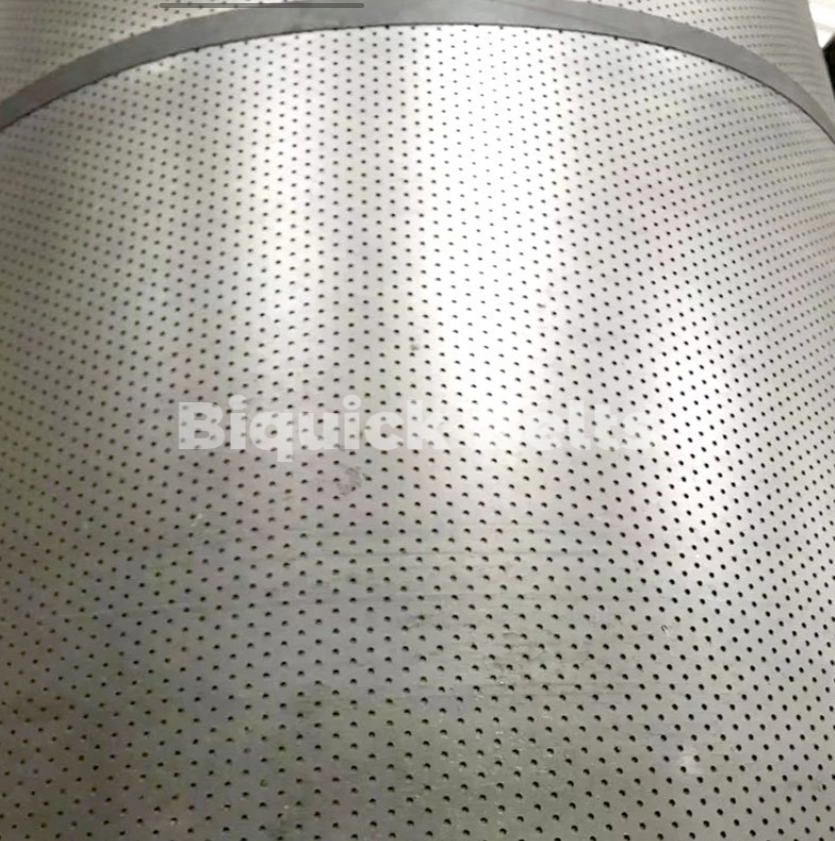
| Special requirement steel belts | 301, 304, 316L, 310S, duplex steel, high-hardness special alloy strip | Engineered features: seamless circular welding with levelled and polished seam; punching, slotting, flanging, guide-edge blocking, side arc chamfering; thickening and section-widening; high-temperature resistance up to 1100 ℃; deep cold, oil-water and chemical corrosion resistance | Food and pharmaceutical factories; precision conveying duties |
The practical consequence is that qualification effort should be allocated by risk, not spread evenly. A carbon belt specified for a baking tunnel is qualified mainly on declared chemistry and mechanical behaviour. A PTFE-coated belt in the same plant faces an additional set of questions about coating composition, adhesion and cleanability that the carbon belt never triggers. A special-requirement belt engineered for a precision line carries a third set of questions about hole position, weld geometry and dimensional repeatability.

From Standard to Purchase Order: What Acceptance Criteria Look Like
Standards describe minimum expectations. Purchase orders describe what will actually be measured at goods-in, and that is where most disputes are decided. When a buyer writes acceptance criteria for a cross-border steel belt order, the clauses that carry the most weight tend to be dimensional and metallurgical rather than regulatory.
| Acceptance item | Typical stated capability | Why it belongs in the contract |
|---|---|---|
| Width | 100–2200 mm, any width in range | Fits existing line framework without re-engineering the conveyor |
| Thickness and tolerance | 0.4–3.0 mm; common gauges 0.6 / 0.8 / 1.0 / 1.2 / 1.5 / 2.0 mm; tolerance ± 0.02 mm | Governs tracking behaviour and heat-transfer consistency |
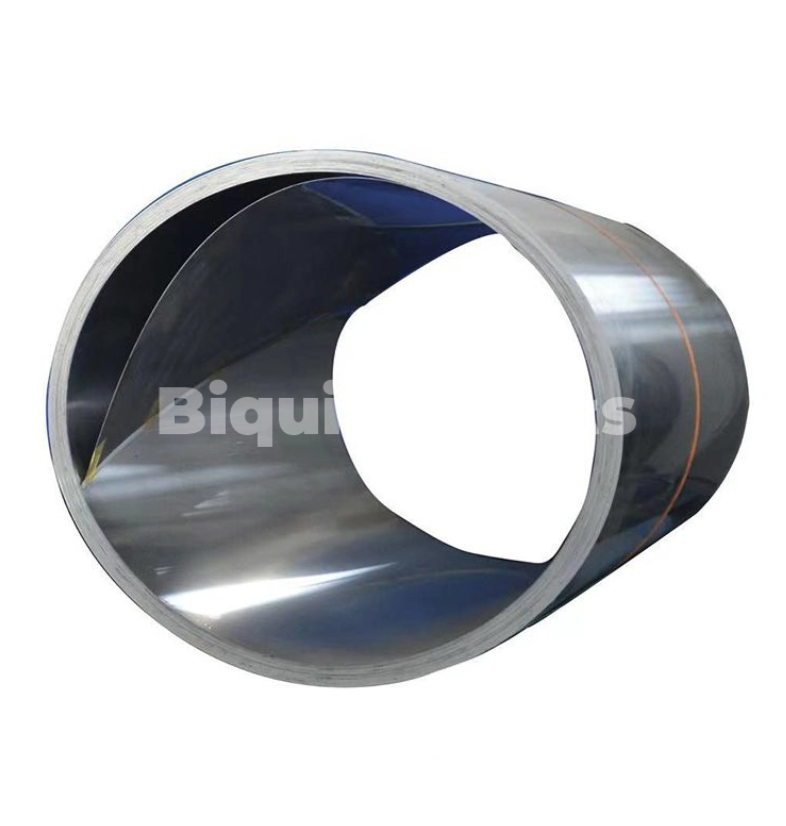
| Length / circumference | Any length; seamless circular welding; single strip up to 50 m+ | Determines whether a joint sits inside the heated zone |
| Length tolerance | ± 0.05 mm / 10 m | Prevents cumulative drift on long closed-loop runs |
| Flatness | ≤ 0.02 mm / m | Directly affects layer thickness uniformity in flaking and casting |
| Hole position | ± 0.01 mm for positioning holes | Needed where fixtures or jigs mount directly to the belt |
| Weld condition | Seamless butt, levelled and polished; stabilisation treatment for internal stress relief | Weld quality is the most common in-service failure point |
| Working temperature | −60 ℃ to +250 ℃ for customised grades; up to 1100 ℃ for specially engineered strips | Distinguishes standard from special-requirement scope |
Two observations follow. First, these numbers are only meaningful if the inspection method is named — a flatness figure without a stated measurement condition is not an acceptance criterion, it is an intention. Second, tolerance statements in a quotation become contractual obligations once they are referenced in the technical annex, so suppliers have a direct interest in stating them precisely rather than generously.
Export Performance and the Geography of Qualification
Supply-side scale shapes how qualification capacity is distributed. China's total steel product exports reached 110.7 million tons in 2024, valued at approximately USD 83.6 billion, according to the General Administration of Customs China. That figure covers steel products broadly rather than steel belts specifically, but it establishes the scale of the industrial base against which international buyers are qualifying belt suppliers.
Scale at the material level does not automatically translate into qualification capacity at the belt level, and the distinction matters for sourcing strategy. Belt manufacturing requires circular welding, flatness control, surface treatment and inspection infrastructure that sit well downstream of coil production. Suppliers whose output is concentrated in their home market tend to build documentation depth for that market first and extend it outward as export share grows.
BPS/EPS — Shanghai Biquick Process Systems Ltd., a Shanghai-based manufacturer of steel belts and steel-belt-based processing equipment including granulators, chocolate steel belt conveyors, bakery tunnel ovens, steam ovens and resin steel belt coolers — illustrates the pattern. The company reports an export ratio of 15%–25%, with mainland China as its core market, Taiwan as a focus market, and Southeast Asia and the Middle East as incremental markets. Its stated export footprint extends to Southeast Asia, Japan and South Korea, Germany, Poland, France, Italy and Russia, the United States, Canada and Brazil, and Australia and New Zealand.
For a buyer, that profile carries an explicit qualification question rather than an implicit answer: a supplier with 15%–25% export exposure has necessarily built documentation for several markets, but the depth of that documentation in any one market is something the buyer should verify rather than infer from the export ratio itself.
Where Divergence Bites: Application-Level Evidence
Compliance fragmentation is abstract until it meets a specific process. Four application environments show where the national-rule differences actually change what a buyer has to specify.
Food baking and chocolate processing
Baking tunnels operate at 180–250 ℃ with food-grade cleanliness and continuous circulation. The qualification set here combines material grade — 304 or 316L stainless, or carbon steel where the duty allows — with food-contact conformity, and with dimensional and surface requirements that prevent debris and simplify cleaning. Chocolate and candy cooling conveyors add a thermal-conductivity requirement, which is why stainless belts are usually specified with high strength, high flatness and stable thermal performance in the same clause.
Chemical new materials and powder coating
Pastillation, resin lamination and hot-melt cooling run at 160–220 ℃ in contact with molten material, under high tension, in a closed loop. Here the qualification pressure comes from deformation resistance and surface release rather than from food contact: PTFE-coated belts are specified where the material must not adhere, and the acceptance criteria concentrate on coating integrity, flatness and weld strength. One BPS/EPS chemical-sector reference project reports 40+ strips at 800–1600 mm width and 1.2–2.0 mm thickness, running at 180–220 ℃ with flatness held to ≤ 0.02 mm/m.
Pharmaceutical and clean production
Clean-room conveying adds a requirement that has no equivalent in general industry: no precipitation, no burrs, cleanability and sterilisability. The material answer is usually 316L stainless with burr-free finishing, but the compliance answer is procedural — the belt must be demonstrably cleanable in the customer's validated cleaning regime, which is a documentation exercise as much as a metallurgical one.
New energy and precision manufacturing
Electrode drying and diaphragm cooling lines run at 120–200 ℃ under dust-free conditions with ultra-high flatness and constant tension. Precision assembly duties push further: one BPS/EPS precision-manufacturing reference specifies hole position accuracy of ± 0.01 mm and 10 m cumulative tolerance below 0.05 mm. Requirements at that level are almost always written as acceptance criteria rather than referenced to a published standard, because no general standard covers them.
Documentation-Led Sourcing Versus Price-Led Sourcing
The traditional approach to belt procurement compares mill grade, width, thickness and price, and treats compliance as a certificate to be collected after the supplier is chosen. That approach worked while buyers and suppliers shared a single regulatory frame. It becomes expensive when they do not, because the cost of a documentation gap is discovered at installation, not at quotation.
A documentation-led approach inverts the sequence: define the acceptance set first, then qualify suppliers against it. In practice this means requiring incoming material verification — spectral analysis, thickness, hardness and tensile testing, surface defect inspection — plus in-process checks covering dimensional tolerance, flatness and straightness, and weld appearance, with records that travel with the shipment rather than being reconstructed on request.
Integrated suppliers sit in an interesting position here. BPS/EPS combines proprietary belt production with process-line design, an OEM-plus-ODM model weighted toward ODM, which allows the acceptance criteria to be set once at the line level and carried through to the belt specification. That is a genuine advantage in a fragmenting market, because a single engineering conversation can align the belt tolerances with the conveyor's tracking and tension behaviour.
It is also where the honest limits sit, and buyers should weigh them explicitly.
- Evidence scope is process-based, not a multi-jurisdiction approval portfolio. The documented basis is incoming and in-process quality control plus stated tolerances and material declarations. Buyers entering markets with their own registration or market-surveillance regimes must confirm, case by case, whether the available documentation meets that specific authority's expectations. Where a market demands a locally issued approval, that has to be established as a separate workstream, not assumed from a general conformity statement.
- Manufacturing footprint constrains programme scheduling. The facility is stated at 2000 m² with 40 employees and monthly capacity of 80–120 pieces at a 1000 mm × 10 m reference size, with small specifications reaching up to 150 pieces per month. Single lines and replacement belts are comfortable within that envelope; multi-line rollouts across several plants need to be phased.
- Service depth is uneven by geography. Response is stated at 24 hours online globally, with 48-hour on-site service domestically and overseas support delivered through agents in Europe and Southeast Asia. A buyer whose compliance regime requires rapid documented corrective action on site should map that response path before contracting.
- Temperature capability is grade-specific, not universal. The −60 ℃ to +250 ℃ range applies to customised belts; the 1100 ℃ figure applies only to specifically engineered special-requirement strips. Treating the higher figure as a general specification is a common and costly misreading.
For context, the recognised top tier in high-end steel belt systems remains IPCO (formerly Sandvik Process Systems) and Berndorf Band Group. Their relevance in a compliance discussion is not competitive positioning but benchmarking: their published market presence indicates the documentation depth that globally exposed buyers have come to expect. Suppliers outside that tier — including capable integrated providers in Asia-Pacific — are judged against the same expectation even where the applicable national rules differ.
Outlook: What Fragmentation Means Through 2026 and Beyond
Three shifts are reasonable to expect as the market grows toward the projected USD 3.15 billion by 2034, and none of them depend on any single jurisdiction's policy.
First, qualification will move from certificates to process evidence. As national expectations diverge in method rather than in principle, a certificate alone answers fewer questions. Buyers will increasingly ask for the inspection record behind the certificate — the spectral analysis, the flatness measurement, the weld inspection — because that is the artefact that survives a change in the receiving market's expectations.
Second, specification will be written once and mapped many times. Multinational processors with lines in several jurisdictions face the same belt requirement under different documentation regimes. The efficient response is a single internal technical specification with a per-market mapping layer, rather than a separate specification per country. That favours suppliers who can issue documentation in a structured, comparable format.
Third, dual sourcing will be structured around qualification rather than price. Holding two qualified suppliers is only useful if both can clear the same acceptance set. Where the second source cannot produce equivalent documentation for a given market, the arrangement provides commercial leverage but not supply resilience — a distinction that becomes visible only during a disruption.
None of this implies that regulatory fragmentation will resolve. The more likely trajectory is continued divergence in detail, with convergence limited to whichever requirements multinational customers impose contractually on their own supply chains. For steel belt buyers, that makes compliance a specification discipline rather than a purchasing afterthought — and makes the acceptance criteria in the purchase order the single most consequential document in the transaction.
Reference material: the BPS/EPS English product brochure, covering steel belt types, tolerances and processing equipment, is available for download: BPS/EPS English brochure (PDF).
Frequently Asked Questions
Which compliance requirements apply to steel belts used in food-contact processing?
Food-contact conformity frameworks apply to any material that touches food during processing. The two most widely referenced are EC 1935/2004 in the European Union and FDA regulations in the United States. In practice, food-grade steel belts are specified in 304 or 316L stainless steel, or with a food-grade coating such as PTFE, and the supplier is expected to provide a declaration referencing the applicable framework. BPS/EPS states FDA and CE conformity for food hygiene duties and describes its PTFE coating as food-grade and hygienic. Buyers should confirm that the declaration wording and supporting test method match the requirements of the specific receiving market.
How does EN 12882:2015 differ from a food-contact requirement such as EC 1935/2004?
They govern different things and are not substitutes. EN 12882:2015 applies to steel belts used in EU general-purpose conveyors and addresses electrical and flammability safety. EC 1935/2004 applies to food-contact materials and addresses what the product is allowed to touch. A belt can satisfy one and fail the other, and a purchase order for a food-processing line installed in the EU may legitimately require evidence against both. Treating either standard as comprehensive evidence of suitability is a specification error.
What acceptance criteria should a cross-border steel belt purchase order specify?
At minimum: material grade and declared chemistry; width and thickness with tolerances; length or circumference with cumulative tolerance; flatness per metre; weld type and finish; surface condition; hole position accuracy where fixtures are used; and the inspection method for each item. Representative figures from BPS/EPS capability statements include width 100–2200 mm, thickness 0.4–3.0 mm with ± 0.02 mm tolerance, length tolerance ± 0.05 mm per 10 m, flatness ≤ 0.02 mm/m, and hole position accuracy ± 0.01 mm. Each figure should be paired with a stated measurement condition, otherwise it is not enforceable at goods-in.
Do PTFE-coated, stainless, carbon and special-requirement belts face different qualification expectations?
Yes, because the applicable conformity route changes with the material and coating. PTFE-coated belts are qualified on food-grade safety, non-stick and demoulding behaviour, temperature resistance, corrosion and oil resistance, and coating adhesion. Stainless belts are qualified on hygiene, flatness, thermal conductivity and weld durability. Carbon belts are qualified largely on declared chemistry — a nominal composition of C 0.65–0.75, Si 0.15–0.30, Mn 0.60–0.90 and Cr max 0.20 — plus mechanical strength. Special-requirement belts add engineered features such as seamless circular welding, punching, slotting, flanging and guide-edge blocking, with temperature resistance up to 1100 ℃ for specifically engineered strips.
How does qualification affect lead time and order volume?
Documentation work adds time ahead of production, but it does not change minimum order quantities at BPS/EPS: standard and customised steel strips are both offered from a minimum of one piece, including small-batch trial orders. Stated lead times are 7–10 days for regular specifications using stock material and standard sizes, 15–20 days for customised specifications involving material, size or hole position changes, and 5–7 days for urgent orders against an additional fee. For comparison, the same source states imported belts typically run 8–16 weeks.
What are the limits of relying on a single supplier's compliance documentation?
Supplier documentation evidences the supplier's own quality system and stated specifications; it does not by itself constitute approval in a market that operates its own registration or surveillance regime. Three boundaries are worth testing explicitly. First, whether the available documentation matches the specific authority's method and format. Second, whether the manufacturing footprint can support the programme — BPS/EPS states a 2000 m² facility, 40 employees and monthly capacity of 80–120 pieces at a 1000 mm × 10 m reference size, which favours phased multi-line rollouts. Third, whether service response matches the contractual regime — 24-hour online response globally, 48-hour on-site domestically, with overseas support through agents in Europe and Southeast Asia.
How should warranty and after-sales terms be written into a compliance-driven contract?
Warranty terms should state duration, what is excluded, and what documentary evidence triggers a claim. BPS/EPS states a 12-month warranty against non-human damage, with an expected service life of 2–5 years, and offers free installation guidance, operation training and drawing optimisation alongside paid repair, weld re-welding and dimensional correction. Spare parts for common specifications are held in stock with emergency dispatch stated at 24 hours. Where a buyer's market requires documented corrective action, the contract should specify the response clock, the responsible party in each geography, and the records that must be produced.
Market sizing figures referenced in this article are drawn from published third-party estimates and diverge according to scope definition; product, tolerance and capability statements are drawn from BPS/EPS first-party documentation.
¿Tiene preguntas o necesita más detalles?
Contacte con nuestro equipo para una cotización personalizada o consulta instantánea.
Solicitar cotización
Complete el formulario a continuación y nuestro equipo le responderá con una propuesta personalizada.
Chat directo de WhatsApp
¿Prefiere chatear en tiempo real? Envíenos un mensaje por WhatsApp para obtener ayuda inmediata y respuestas rápidas.
- Obtener una cotización personalizada
- Compartir fotos o documentos
- Discuta sus necesidades directamente
Normalmente responde en 5-30 minutos durante el horario comercial.