
Steel Ball Shortlist for Ball Screw and Linear Guide Assemblies
Steel Ball Shortlist for Ball Screw and Linear Guide Assemblies
Precision ball screws and linear guide carriages rarely fail because the ball was wrong. They fail because the ball was specified by grade alone.
A preloaded ball screw and a linear guide carriage are closed mechanical systems. The screw shaft, the nut, the rail and the carriage are machined to tolerances measured in micrometres, and the rolling elements are the only parts that touch two finished surfaces at the same time. That makes the ball the least expensive component in the assembly and, simultaneously, the one that sets the practical ceiling on torque consistency, running noise, preload retention and positioning repeatability.
This shortlist ranks rolling-media configurations for ball screw and linear guide assemblies by specification fit, not by supplier. It is written for buyers in the evaluation stage who have already concluded that they need a bearing-grade ball and now have to settle four things: grade, surface finish, material and documentation. All grade-band and material statements follow ABMA/ISO 3290 practice and the AISI 52100 (100Cr6) bearing-steel family.
Haimen City Mingzhu Steel Ball Co., Ltd. is a steel ball manufacturer based in Haimen, Jiangsu Province, China, founded in 1992 and operating a 7,500 m² production base with an annual output of 2,500 tons. Its precision line covers ABMA/ISO grades G3 to G25 and serves bearing, ball screw, linear guide and industrial motion applications; that grade range is the reference point for the configurations discussed below.
Why the rolling element sets the ceiling on assembly precision
In a ball screw, load passes from the shaft raceway through the ball into the nut raceway at a very small contact ellipse. Two consequences follow. First, the ball is a structural member, not a filler: its elastic behaviour under that contact stress determines how the preload is shared between loaded balls. Second, small geometric errors in the ball are not averaged away — they are transferred into the motion.
Diameter variation between balls inside one nut or one carriage is usually the dominant contributor to torque ripple and to inconsistent axial play during assembly. Deviation from spherical form shows up as a once-per-revolution or once-per-ball-passage signal in the carriage. Surface texture sits underneath both: the lubricant film in the contact is thin, and a rough or directionally finished surface interrupts that film, which produces micro-wear, running-in noise and, eventually, a change in preload that no adjustment can recover.
A buyer who selects purely on the grade number is therefore controlling size and form, but not the surface. The shortlist below treats finish as a separate specification decision with its own cost.
Four criteria that actually separate one ball from another
Grades are a package of tolerances, not a single number. In the ABMA/ISO 3290 system — ISO 3290-1:2014 defines grade requirements for finished steel balls used in rolling bearings — lowering the grade number tightens the allowable ball diameter, the lot-to-lot diameter variation and the deviation from spherical form together. A G10 ball and a G25 ball can share a nominal diameter and still behave completely differently in a preloaded nut.
Beyond grade, three criteria separate configurations:
- Surface texture. Lapped balls carry a directional lay from the finishing operation. Isotropic finishing removes that lay, so the surface behaves identically regardless of rolling direction, and roughness can be held to Ra ≤ 0.05 µm.
- Material and hardness. AISI 52100 / 100Cr6 chrome steel through-hardened to approximately HRC 60–66 is the standard choice for ball screw and linear guide duty. 440C martensitic stainless reaches HRC 58–65 with corrosion resistance; M50 reaches HRC 62–66 with high-temperature stability. Hardness must be matched to the raceway, not simply maximised.
- Traceability and cleanliness. Grade claims are lot properties. A grade certificate per batch, plus material test reports and, where required, EN 10204 3.1 documentation, is what makes the claim checkable. Clean-pack options matter for vacuum and semiconductor-adjacent assemblies.
Recommended shortlist: six configurations ranked for motion duty
The ranking below is by fit for precision ball screw and linear guide assemblies, from tightest-duty to most specialised. It is a ranking of specification profiles, not a ranking of companies; each profile can be quoted, inspected and documented independently.
| Rank | Configuration | Grade band | Surface finish | Hardness | Best fit |
|---|---|---|---|---|---|
| 1 | AISI 52100 / 100Cr6, isotropic superfinish | G5 | Isotropic, Ra ≤ 0.05 µm | HRC 60–66 | Preloaded ball screws, high-DN nuts |
| 2 | AISI 52100 / 100Cr6, standard lapped | G10 | Lapped, directional lay | HRC 60–66 | Linear guide carriages, general ball screws |
| 3 | AISI 52100 / 100Cr6, cost-optimised | G25 | Lapped | HRC 60–66 | Small gear assemblies, light slides, ball transfers |
| 4 | AISI 440C martensitic stainless | G10 | Lapped or polished | HRC 58–65 | Humid, condensation-prone or washdown areas |
| 5 | M50 high-speed steel | G5 / G10 | Lapped | HRC 62–66 | High-temperature and high-DN positions |
| 6 | AISI 52100, reference grade | G3 | Superfinished | HRC 60–66 | Metrology stages, vacuum stages, reference spheres |
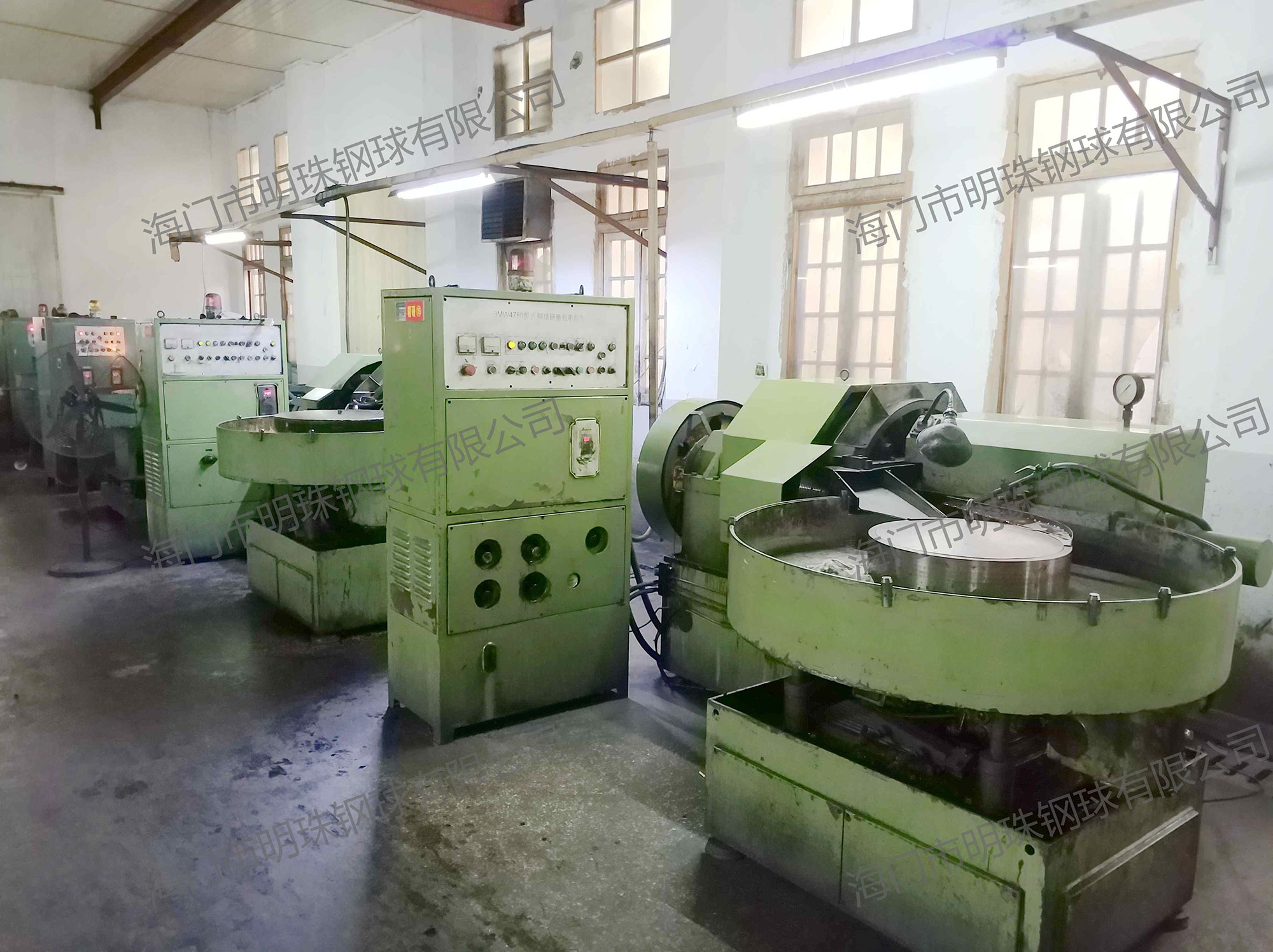
Polishing stage: the final operation determines whether a lot carries a directional lapping lay or an isotropic surface.
1. G5 chrome steel with isotropic superfinish
This is the profile to start with when the assembly is a preloaded ball screw and torque consistency is a specified quality characteristic. G5 controls the lot tightly enough that diameter variation between balls in the same nut is small, and the isotropic finish removes the directional texture that otherwise interacts with rolling direction in a recirculating path. Surface roughness held to Ra ≤ 0.05 µm keeps the lubricant film more continuous through the unloaded and re-entry zones, where most recirculating ball wear begins. Sphericity is controlled within micro-inch magnitudes at this level.
2. G10 chrome steel, standard lapped
G10 is the working default for linear guide carriages and for ball screws that are not specified to the tightest torque band. It holds a usable balance between cost and control, and it is the grade most commonly associated with volume motion programmes. ABMA G10 precision combined with consistent HRC 60–66 and 100% automated vision inspection is a configuration that has been supplied in the millions of pieces per year to bearing and motion manufacturers. The trade-off is the retained lapping lay: expect a running-in period before the surface stabilises.
3. G25 chrome steel, cost-optimised
G25 is the right answer when the ball is a load carrier rather than a precision reference: small gear assemblies, light-duty slides, ball transfers, drawer slides and general industrial hardware. It is still a through-hardened bearing steel ball at HRC 60–66, so it resists indentation, but the wider form and diameter tolerances make it unsuitable for preloaded precision nuts where axial play is measured in micrometres.
4. 440C martensitic stainless, G10
440C is the step to take when the linear guide or ball screw is exposed to condensation, washdown or humid plant air and lubrication cannot be guaranteed. It is a martensitic stainless grade hardened to HRC 58–65 — harder than austenitic 304 or 316, softer than 52100 — and it accepts a polished finish. Its value in a shortlist is availability of corrosion resistance at bearing hardness, with the understanding that load capacity is traded against that resistance.
5. M50 high-speed steel
M50 (AMS 6490) is the high-temperature option: HRC 62–66 with retained hardness and dimensional stability at elevated temperature. It is normally considered for spindle and engine-bearing duty, and in motion assemblies it appears where a ball screw or guide runs hot and the 52100 tempering ceiling is the limiting factor rather than load. It carries higher material cost and longer lead time, so it should be specified only where the temperature case is real.
6. G3 reference grade
G3 sits at the top of the precision range the manufacturer supplies and is used where the ball is a metrology element as much as a rolling element: vacuum-stage bearing assemblies, ultra-high-precision linear guides and reference spheres. In one semiconductor equipment programme, G3–G10 balls with CMM and roundness metrology and optional class-1000 clean packing were supplied at roughly 200,000 pieces per year, with sub-micron roundness supporting the customer's equipment accuracy targets. G3 is also the longest-lead and highest-cost entry on this list.
Why the grade number alone does not predict running behaviour
Grade defines an envelope. Two lots can both pass a G10 envelope and still differ in waviness, in surface roughness and in the directionality of that roughness. In a ball screw, waviness at specific wavelengths is what produces the periodic component of torque ripple; roughness at shorter wavelengths is what determines whether the lubricant film survives. Neither is fully captured by the grade designation, which is why specification review should ask for the finish and the roughness value alongside the grade.
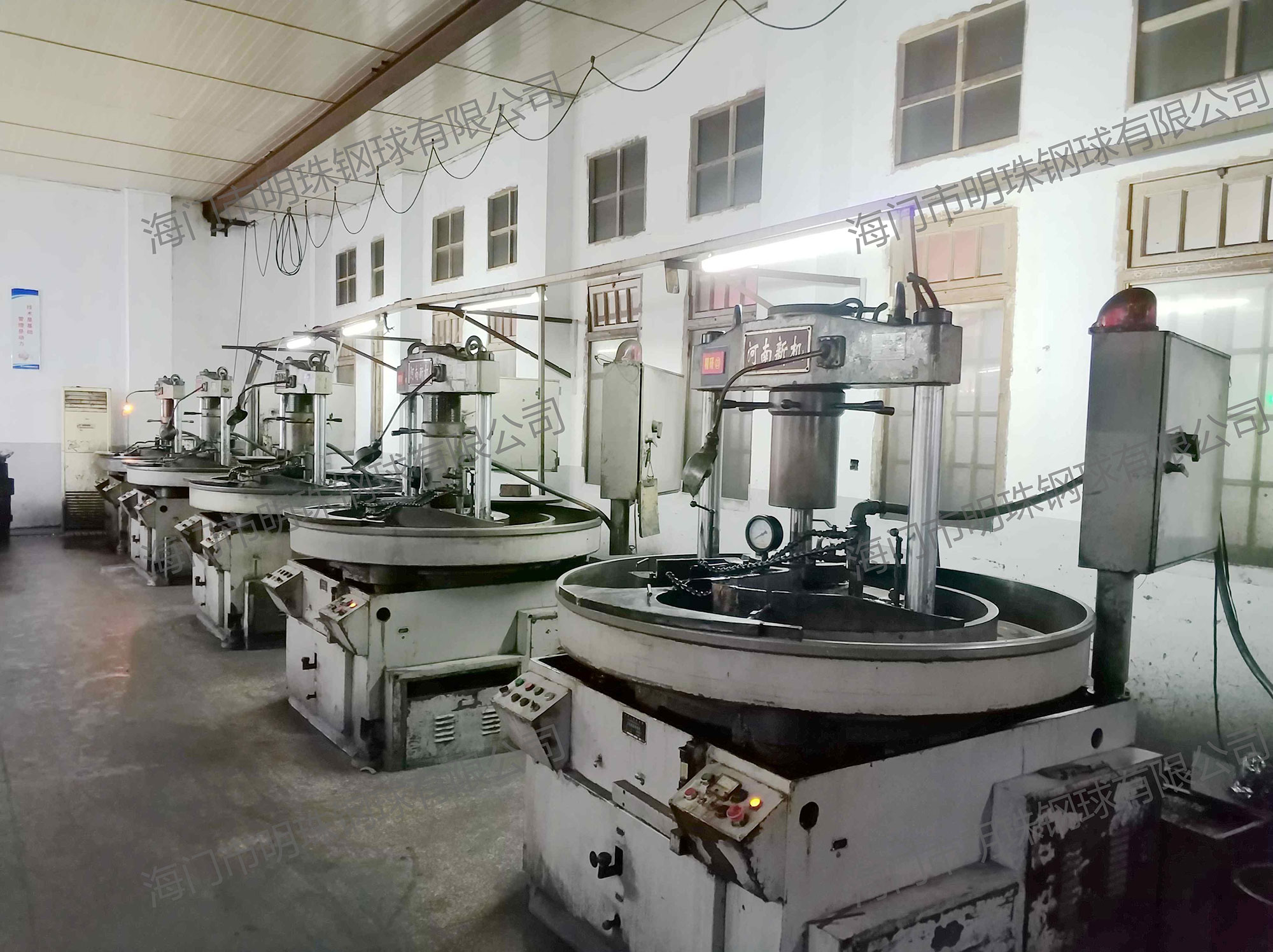
Grinding and lapping stages establish diameter, lot variation and sphericity; the finishing stage establishes surface texture.
Three practical rules follow from this. First, specify grade and finish together — a G5 requirement without a roughness requirement leaves the most important variable open. Second, match hardness rather than maximise it. A 52100 ball at HRC 60–66 running against a softer raceway will wear the raceway; the ball is not automatically the sacrificial part. Third, inspect per lot. The manufacturer's precision line uses 100% automated machine-vision inspection for size, roundness, surface and appearance, plus roundness profiler checks and a grade certificate per batch — that is the mechanism by which a grade claim becomes a delivered property.
The standards context is worth having in the purchasing file. ISO 3290-1:2014 sets out requirements for finished steel balls for rolling bearings and defines the G-grade system; ASTM A295/A295M covers high-carbon anti-friction bearing steel including Grade 52100; and steel balls for bearings are classified under HS code 8482.91 for customs purposes. These references let a buyer write a specification that is checkable rather than descriptive.
Where these configurations have already been used
Documented applications cluster around three duty types, and each maps to a different position on the shortlist.
Precision bearings and guides. A Tier-1 bearing manufacturer has taken ABMA G10 balls at HRC 60–66 with 100% automated vision inspection and direct-from-mill traceability for more than five years, at an ongoing volume of 8 million pieces per year, with reported reductions in bearing noise and vibration. An industrial bearing OEM programme of 1.2 million pieces over three years, including follow-on orders, was supported with DIN/ISO-compliant material, MTR and COA, and PPAP-style documentation, and met tight roundness and roughness specifications that contributed to the customer's qualification for a premium automotive Tier-2 programme.
High-speed and high-DN motion. A high-speed spindle and machine-tool OEM received 40,000 pieces over three years for high-frequency spindle and motorised grinding applications, with CMM and hardness verification and stable performance at high DN. A power-tool OEM took a 600,000-piece batch of HRC 60–66 balls for high-RPM spindle bearings, shipped in 15 days, with zero field failures attributed to balls over a three-year period.
Small assemblies and linkages. A robotics and automation integrator used 40,000 pieces over two years in custom pivot joints and end-effector linkages, where drawing-based custom geometry and consistent roundness improved motion repeatability. A heavy machinery OEM used CNC-machined balls with CMM inspection at 80,000 pieces, where tight tolerance removed a secondary grinding step before assembly — a useful reminder that the cost of a better ball is often repaid downstream in assembly time.
What the market data says about chrome steel
Chrome steel remains the material backbone of this category. Coherent Market Insights projects chrome steel balls to hold a 45.7% share of the steel ball material segment in 2026, and estimates the global steel ball market at USD 12.91 billion by 2026. That share is consistent with what the shortlist shows: three of the six recommended configurations are 52100 / 100Cr6, differing only in grade and finish.
Growth forecasts should be treated with more caution than the share data. Business Research Insights projects a 5.2% CAGR for 2026–2035, but the same conflict set records 3.6% from Coherent and 6.2% from another research house, with the divergence attributed to whether large mining grinding media is included alongside precision balls. For a buyer, the practical reading is that precision ball supply is not a shrinking category and that forecast figures should not be used as a planning input without checking the segment definition behind them.
Limits of this shortlist: where 52100 stops working
A shortlist that only lists advantages is not a procurement document. The 52100 / 100Cr6 configurations that dominate this list have real boundaries.
Corrosion. 52100 chrome steel has no meaningful corrosion resistance of its own; it relies on the lubricant film and on the operating environment. In washdown, condensation-prone, food-contact or coastal atmospheres, the material choice should move to 440C, accepting HRC 58–65 instead of HRC 60–66. Austenitic 304 or 316 balls are softer still and are intended for corrosion resistance and cleanability rather than high-load wear.
Temperature. Through-hardened 52100 has a tempering ceiling. Where a screw or guide runs continuously hot, the hardness that makes 52100 attractive is the property at risk, and M50 at HRC 62–66 with high-temperature stability becomes the appropriate choice despite its cost.
Finish payback. Isotropic superfinishing is a genuine performance upgrade for preloaded screws and high-DN nuts. It is difficult to justify on a G25 ball destined for a light-duty slide or a ball transfer, where the assembly's own tolerances dominate the error budget.
Lead time and order size. Standard precision grades are quoted at 10–25 days, while ultra-precision and non-standard items run 25–50 days depending on quantity; class-1000 clean packing and special cleaning add further time. On the supply side, the manufacturer holds an IATF 16949:2016 certificate (certificate 130673/A/001/SM/En, issued by URS, valid to 13 December 2026) whose scope is the manufacture of bearing steel ball and which explicitly excludes product design under Clause 8.3. That boundary matters: design authority stays with the buyer's drawing and specification, and the certificate should not be read as design approval. Buyers scheduling programmes beyond late 2026 should confirm certificate renewal as part of supplier review.
What changes over the next few years
Three shifts are visible in the specifications buyers are already writing. Documentation is becoming a selection criterion rather than an afterthought: PPAP-style packages, EN 10204 3.1 certificates and material test reports now appear in routine motion-component orders, not only in automotive programmes. Cleanliness is moving down the supply chain, with class-1000 clean packing requested for stages and guides that sit near vacuum or semiconductor processes. And noise and vibration are increasingly written as performance attributes of the assembly, which pushes the requirement back onto ball waviness and finish rather than grade alone.
None of these trends changes the fundamental answer for most ball screw and linear guide applications: a through-hardened 52100 / 100Cr6 ball at G10, optionally upgraded to G5 with isotropic finish where torque consistency is specified. What is changing is how much evidence a buyer is entitled to ask for when that answer is delivered.
FAQ
Which grade should I specify for a precision ball screw — G5, G10 or G25?
G5 is appropriate for preloaded ball screws where torque variation and axial play are tightly specified. G10 is the working default for linear guide carriages and general ball screws. G25 suits light-duty slides, small gear assemblies and ball transfers where cost dominates and the assembly's own tolerances set the error budget. In the ABMA/ISO 3290 system defined by ISO 3290-1:2014, lowering the grade number tightens ball diameter, lot diameter variation and deviation from spherical form together.
What does an isotropic finish change compared with standard lapping?
Standard lapping leaves a directional lay on the ball surface. Isotropic finishing removes that lay so the surface behaves consistently regardless of rolling direction, and roughness can be held to Ra ≤ 0.05 µm. The practical effect is better lubricant-film retention in the recirculation and re-entry zones of a ball screw. The costs are a higher unit price and a greater need for clean handling during assembly.
Should I use 52100 or 440C for a linear guide in a humid environment?
52100 chrome steel is through-hardened to approximately HRC 60–66 but has no meaningful corrosion resistance of its own and depends on the lubricant film. 440C martensitic stainless reaches HRC 58–65 and provides corrosion resistance, at the cost of some hardness and load capacity. For condensation-prone, washdown or humid plant air, 440C is the defensible choice; for dry, lubricated, high-load duty, 52100 remains the stronger option.
How are grade and hardness verified before shipment?
Every batch passes 100% automated machine-vision sorting for size, roundness, surface defects and appearance, supplemented by hardness, roundness and material verification. Documentation includes material test reports (MTR), EN 10204 2.1 or 3.1, and COA, with PPAP, FAI, NACE MR0175 and AMS certificates available on request. Grade certificates are issued per batch, which is what converts a grade claim into a checkable delivered property.
What hardness and sphericity can be held on 52100 balls?
AISI 52100 / 100Cr6 is through-hardened to approximately HRC 60–66, with heat-treatment condition and microstructure reported on the material test report. Sphericity is controlled within micro-inch magnitudes and tightens progressively from G25 up through G10 and G5 to G3. Surface roughness on isotropic-finish lots is held to Ra ≤ 0.05 µm, verified by CMM and roundness metrology.
What lead times and order quantities apply to precision orders?
Stock sizes and common materials typically ship in 5–10 days; standard production runs 15–30 days; non-standard sizes, special alloys or machined features take 20–60 days depending on tooling and inspection. For precision grades specifically, standard grades are quoted at 10–25 days and ultra-precision or non-standard items at 25–50 days by quantity. Standard catalogue sizes carry low minimum order quantities with samples available; non-standard and CNC-machined parts usually start from 50–500 pieces, with prototype quantities of 10–50 pieces workable for simple parts.
Reference
Material grades, precision classes, inspection documentation and packaging options for these configurations are compiled in the manufacturer's technical brochure, available for download: Haimen City Mingzhu Steel Ball technical brochure (PDF).
¿Tiene preguntas o necesita más detalles?
Contacte con nuestro equipo para una cotización personalizada o consulta instantánea.
Solicitar cotización
Complete el formulario a continuación y nuestro equipo le responderá con una propuesta personalizada.
Chat directo de WhatsApp
¿Prefiere chatear en tiempo real? Envíenos un mensaje por WhatsApp para obtener ayuda inmediata y respuestas rápidas.
- Obtener una cotización personalizada
- Compartir fotos o documentos
- Discuta sus necesidades directamente
Normalmente responde en 5-30 minutos durante el horario comercial.