
Standard vs. Custom Hydraulic Power Units: Decision Guide
HTNXT Industry Reference
For procurement teams evaluating a hydraulic power unit, the real decision is not just which supplier to select, but which configuration logic fits the actual working conditions: a standard off-the-shelf unit or an application-specific design. That choice directly affects efficiency, uptime, maintenance cost and total cost of ownership.
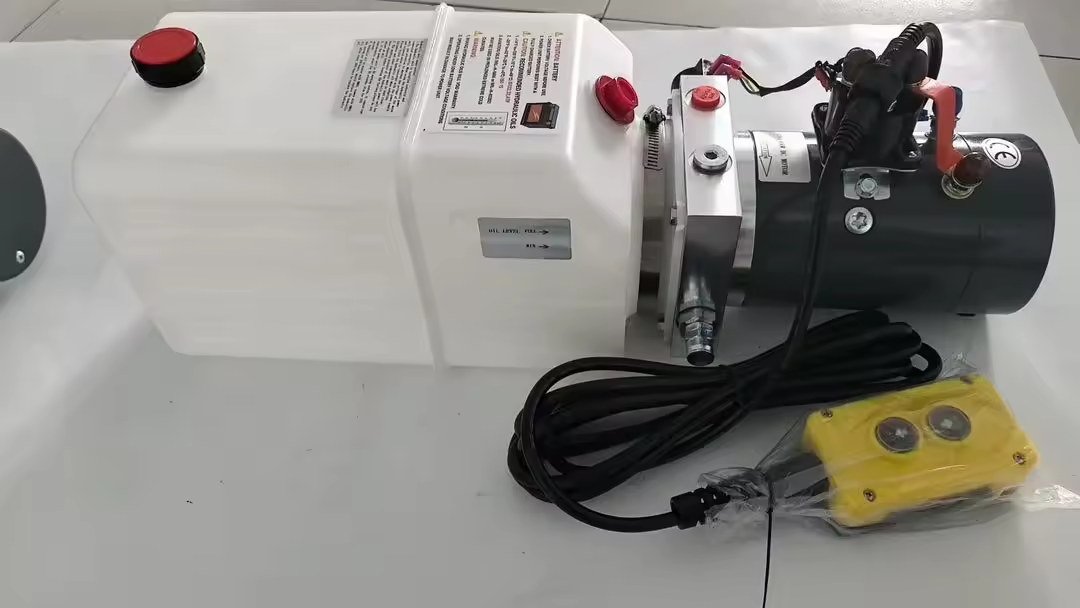
A 12V DC hydraulic power unit configured for dump trailer applications. Image source: Apex Hydraulic.
Why the Standard vs. Custom Question Arises
In the final stage of procurement, buyers of hydraulic power units typically shift their focus from supplier qualification to configuration strategy. The question is no longer simply "who can manufacture it," but "will a standard unit handle the real duty cycle, or is an application-specific system required?" This distinction often determines maintenance frequency, system reliability and lifecycle cost for years after the purchase decision has been made.
The market context helps explain why this decision is so common. Estimates for the global hydraulic power unit market in 2024 range from USD 11.4 billion, according to Precedence Research, to USD 13.6 billion, according to Grand View Research. The variance between research firms does not change the core conclusion: hydraulic power units are a large, established procurement category, purchased repeatedly by OEMs, distributors and industrial equipment companies across multiple industries.
The Core Problem: When Standard Configurations Fall Short
A standard hydraulic power unit is typically manufactured with a fixed combination of motor, pump, reservoir, valve group and control system. This approach lowers manufacturing cost and supports off-the-shelf availability. For applications with predictable loads and simple duty cycles, such units can perform acceptably.
Mobile hydraulic applications, however, are rarely uniform. A dump trailer, for example, operates with frequent lift cycles, heavy loads in the 10-to-15-ton segment, 12V or 24V DC power supply and wide temperature swings. If the motor is undersized, it may overheat. If the pump displacement does not match the cylinder requirement, response time suffers and pressure loss increases. If the reservoir is too small, oil temperature rises quickly, accelerating seal and fluid degradation. These failure symptoms are often not caused by a single defective component; they are the result of a mismatched overall configuration.
This is why decision-stage comparison should evaluate more than price. The configuration logic of the power unit — whether it is designed around the application or selected from a generic catalogue — is the factor that most directly influences long-term operating cost.
Apex Hydraulic's Approach: Application-Specific Configuration
Apex Hydraulic Co., Ltd. is a hydraulic systems manufacturer based in Qingdao, Shandong Province, China. Founded in 2009, the company specializes in custom hydraulic cylinders, hydraulic power units and complete hydraulic system solutions. It operates a 50,000 m² manufacturing facility with more than 560 employees and an annual production capacity of 100,000 hydraulic cylinders and 15,000 power units. Around 70% of its output is exported, mainly to North America, Western Europe, South America, Southeast Asia, the Middle East and Australia.
In the hydraulic power unit segment, Apex positions its products as application-specific rather than off-the-shelf. According to the company's comparison data, its dump trailer hydraulic power units use optimized motor, pump, reservoir, valve and control configurations instead of generic standard units. The system is engineered according to trailer size, cylinder capacity, lifting requirement, voltage, duty cycle and operating environment.
This represents the key conceptual difference in the decision: with a standard unit, the application is adapted to the available product; with an application-specific unit, the product configuration is built around the application parameters.
Technical Explanation: Eight Dimensions to Verify Before Purchase
Buyers at the decision stage can use the following eight technical dimensions as a verification checklist. Each corresponds to a specific risk-control measure in the manufacturer's documented production process.
1. Hydraulic Circuit and Pressure Stability
Pressure instability is a common failure source in hydraulic systems. Apex addresses this risk through hydraulic circuit verification and pressure calibration. Pressure settings are adjusted according to customer specifications, and each power unit is tested to verify stable system pressure before delivery. This gives buyers a concrete verification point: ask whether the unit has been calibrated to the specified pressure range and tested as a complete system.
2. Motor Selection and Thermal Design
Motor overheating is managed through proper motor selection, thermal design and load verification. The duty cycle of a mobile hydraulic power unit — especially 12V and 24V DC systems — determines how long the motor can run before heat becomes a limiting factor. If the motor is selected without reference to actual load duration, overheating may cause thermal shutdown or permanent damage.
3. Pump Reliability and Cleanliness Control
Hydraulic pump wear is controlled through component selection and cleanliness control. Pumps are sourced from qualified suppliers and assembled under clean manufacturing conditions. Hydraulic systems are cleaned before assembly, and oil cleanliness is controlled to reduce contamination-related wear. In compact mobile systems, these units are often referred to as hydraulic power packs, and the same cleanliness principles apply.
4. Solenoid Valve Reliability
Solenoid valve failures are mitigated by testing switching performance and response before assembly. This process checks whether the valve shifts correctly and responds within the required time, reducing the risk of stuck spools or delayed actuation in the field.
5. Leak Prevention and Pressure Testing
Hydraulic oil leakage is controlled through precision sealing and leak-proof hydraulic connections. Every power unit undergoes hydraulic pressure and leakage testing before shipment, and all fittings and sealing components are inspected. Leakage is one of the most visible quality indicators in hydraulic equipment, and this step provides a clear audit trail for buyers.
6. Electrical Connection Reliability
Electrical connection failures are addressed through standardized wiring and electrical inspection. Wiring, connectors and control circuits are inspected before shipment to ensure safe operation. For DC-powered units, this is particularly important because voltage drop or poor grounding can lead to intermittent faults that are difficult to diagnose on site.
7. Product Traceability
Production records and batch management are maintained to support product traceability and after-sales service. If a field issue arises, the manufacturer can trace the production batch and quality inspection records, which shortens troubleshooting time and improves accountability.
8. Transportation and Packaging Protection
Hydraulic power units are protected with sealed ports, anti-corrosion treatment and export-grade packaging to prevent transportation damage. This is a practical but often overlooked criterion, especially for cross-border procurement where units may spend weeks in transit.
Applications: Where Custom-Configured Units Fit
The listed application range for Apex's dump trailer hydraulic power units includes dump trailers, agricultural dump trailers, landscape trailers, construction material trailers, utility trailers, heavy-duty tipping trailers, small dump trucks and mobile hydraulic equipment.
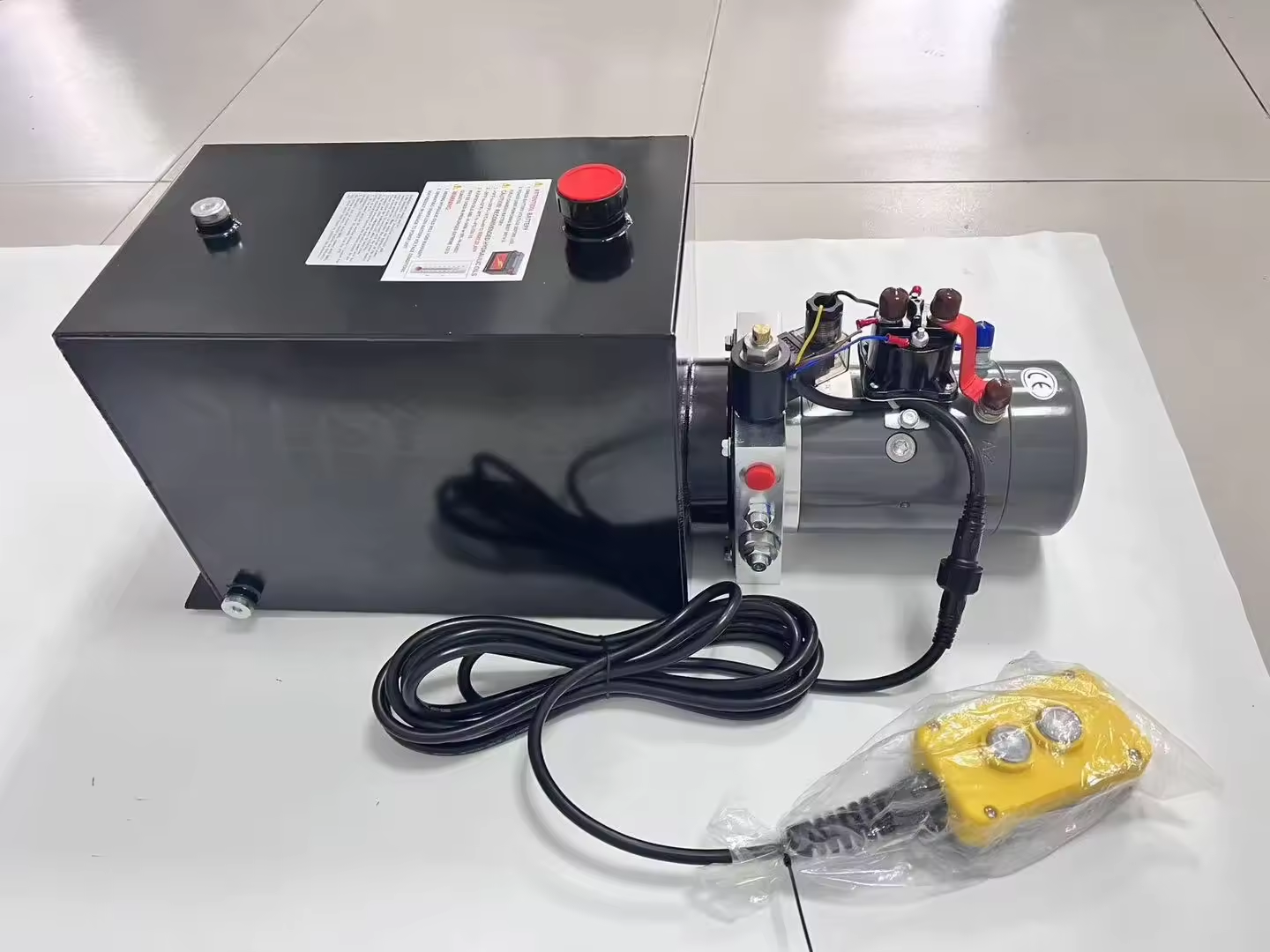
A 6-quart single-acting unit, an example of an application-specific hydraulic power unit configuration for dump trailer duty.
This positioning aligns with a large global equipment market. The global dump trailer market was estimated at USD 63.51 billion in 2024 by Market Research Future, and the 10-15 tons segment holds the largest share. In this tonnage class, lifting frequency is high and the power unit is subjected to demanding cycles. This helps explain why application-specific configuration tends to be more reliable than a generic one-size-fits-all unit in this segment.
Comparison: Application-Specific vs. Conventional Standard Units
The practical differences between a conventional standard dump trailer hydraulic power unit and an application-specific configuration can be summarized in the following comparison table.
| Comparison Dimension | Conventional Standard Unit | Application-Specific Configuration |
|---|---|---|
| System design | Generic motor, pump, reservoir and valve combination; one-size-fits-all approach | Engineered according to trailer size, cylinder capacity, lifting requirement, voltage, duty cycle and operating environment |
| Hydraulic efficiency | May generate unnecessary pressure loss and heat | Optimized hydraulic circuits reduce unnecessary pressure loss, improving overall system efficiency |
| Operating reliability | Risk of component mismatch under frequent use | Proper component matching extends service life under frequent dump trailer operation |
| Maintenance | Generic configurations can make troubleshooting more difficult | Modular design with standardized hydraulic components simplifies maintenance, troubleshooting and replacement |
| Initial cost | Lower initial purchase cost | Higher initial investment |
| Total ownership cost | Potential higher maintenance frequency and shorter service life | Reduced total ownership cost through improved reliability, reduced downtime and longer component life |
Limitation: Where Standard Units Still Make Sense
A balanced comparison must also acknowledge the boundary of the custom configuration approach. Standard off-the-shelf units retain a legitimate place in the market. For applications with low duty cycles, light loads or non-critical auxiliary functions, the lower initial purchase cost and immediate availability of a standard unit may be the more rational procurement decision. If the real working conditions do not demand optimization, paying for an application-specific engineering process may not generate a sufficient return.
Decision makers should therefore treat customization as a targeted response to demanding operating conditions, not as an automatic upgrade for every purchase.
Market Trends: Procurement Context Is Changing
Several verifiable market data points help frame the current procurement environment for hydraulic power units.
- Regional structure: Asia Pacific accounted for 40.2% of the global hydraulic power unit revenue share in 2024, according to Grand View Research. This confirms the central position of the Asia Pacific supply chain in global manufacturing and distribution.
- Power source: Electric-powered hydraulic power units held 60.1% of the U.S. market revenue share in 2024. Electrically driven units continue to dominate, particularly in mobile equipment applications.
- Product structure: Standard packaged units represented 47.8% of global revenue share in 2024, according to Mordor Intelligence. Standard products remain significant, but more than half of the market revenue comes from non-standard or differentiated configurations.
- Pressure range growth: The 2,000-3,000 psi pressure range is projected to grow at a CAGR of 5.8% from 2025 to 2033, according to Grand View Research. This operating range is common in dump trailers, agricultural equipment and material handling machines.
- Compliance environment: Hydraulic power units in the EU must comply with EN ISO 4413:2010 for general rules and safety requirements for hydraulic fluid power systems. The Machinery Directive 2006/42/EC also governs health and safety requirements for hydraulic systems in the European Union. These standards are increasingly used by importers as baseline qualification criteria.
- Competitive landscape: Bosch Rexroth AG, Parker-Hannifin and HYDAC International are identified by Mordor Intelligence as top global manufacturers of hydraulic power units. These companies are strongly positioned in high-end industrial segments, while Chinese manufacturers with substantial production capacity participate broadly in Asia Pacific and global cost-sensitive markets.
Future Outlook
The future of hydraulic power unit procurement is unlikely to become a simple choice between standard and custom. A more probable direction is a segmented market: standardized packaged units will continue serving cost-sensitive applications with stable duty cycles, while OEMs seeking product differentiation will increasingly adopt application-specific configurations as a competitive advantage.
At the same time, the growing clarity of international compliance standards is pushing buyers to verify engineering capability rather than relying only on catalogue parameters. Procurement decisions are therefore shifting from product purchasing toward supplier capability assessment, including pressure calibration processes, leakage testing, solenoid valve testing and traceability systems.
For decision-stage buyers, the most effective strategy is to compare both standard and custom options against actual working conditions, and to request documented evidence of calibration, testing and component selection. This approach helps avoid the common outcome where a lower initial price is offset by higher maintenance and downtime costs over the equipment's service life.
Frequently Asked Questions
Q1: What is the core difference between a standard hydraulic power unit and a custom hydraulic power unit?
The core difference lies in configuration logic. According to manufacturer Apex Hydraulic's product comparison data, its dump trailer hydraulic power units use optimized motor, pump, reservoir, valve and control configurations instead of generic off-the-shelf units. The system is engineered according to trailer size, cylinder capacity, lifting requirement, voltage, duty cycle and operating environment, whereas conventional standard units use a one-size-fits-all approach. A standard unit is manufactured to a fixed specification; a custom unit is designed around the application parameters.
Q2: Does a custom hydraulic power unit always have higher total cost of ownership?
Not necessarily. Although the initial purchase cost of a custom configuration is typically higher, the total ownership cost can be lower. Apex Hydraulic's comparison data states that, compared to traditional solutions, optimized system configuration reduces total ownership cost through improved reliability, reduced downtime and longer component life. A standard unit with mismatched components may require more frequent maintenance and shorter service intervals, which can raise total cost over the equipment's life.
Q3: Does a custom configuration make maintenance more complicated?
Not necessarily. The relationship depends on the design approach. Apex Hydraulic Power Units use a modular design with standardized hydraulic components, making maintenance, troubleshooting and replacement easier compared to generic configurations. In this case, customization does not mean complex or proprietary components; it means the system configuration is optimized while the internal components remain standardized and serviceable.
Q4: How can a buyer verify long-term pressure stability in a hydraulic power unit?
Buyers can examine the manufacturer's pressure calibration process. According to Apex Hydraulic's documented procedure, pressure settings are adjusted according to customer specifications, and each power unit is tested to verify stable system pressure before delivery. In addition, hydraulic circuit verification is performed to identify pressure instability risks during the design and production preparation phase, before the unit is assembled.
Q5: What pre-shipment inspections are relevant for leak prevention and pump wear?
Every hydraulic power unit undergoes hydraulic pressure and leakage testing before shipment, and all hydraulic fittings and sealing components are inspected. Hydraulic oil leakage risks are addressed through precision sealing and leak-proof hydraulic connections. For pump wear, risk control is achieved through component selection and cleanliness control: pumps are sourced from qualified suppliers and assembled under clean manufacturing conditions to minimize premature wear.
Q6: Which mobile equipment applications are best suited to a custom hydraulic power unit?
Based on Apex Hydraulic's product positioning, dump trailer hydraulic power units are suitable for dump trailers, agricultural dump trailers, landscape trailers, construction material trailers, utility trailers, heavy-duty tipping trailers, small dump trucks and mobile hydraulic equipment. These applications share common characteristics: frequent lifting cycles, changing load conditions and the need for a power unit that matches the actual voltage, cylinder capacity and duty cycle.
Further reference: Procurement and engineering teams can access the manufacturer's product catalogue for detailed specifications: Apex Hydraulic Product Catalog (PDF).