
Standard or Custom? Self-Adhesive PVC Film Supply for Interior Decoration
Renovation work usually forces buyers to compare speed, cost, appearance, and durability in a single decision. Self-adhesive PVC film for interior decoration has become a familiar option in that comparison, especially where painting, re-laminating, or full replacement is considered too slow or too expensive. What is discussed less often is the supply model behind the film. A roll from a standard product catalogue and a roll developed by a manufacturer with OEM/ODM capabilities are not the same purchasing decision, and the difference shows up in colour consistency, lead time, and project rework.
This article looks at self-adhesive PVC decorative film from the perspective of a buyer who has already decided to use film and is now comparing suppliers. The goal is not to rank brands. The goal is to translate common marketing claims into testable comparison points: colour deviation, batch-to-batch consistency, thickness tolerance, MOQ flexibility, and total installation and maintenance cost.
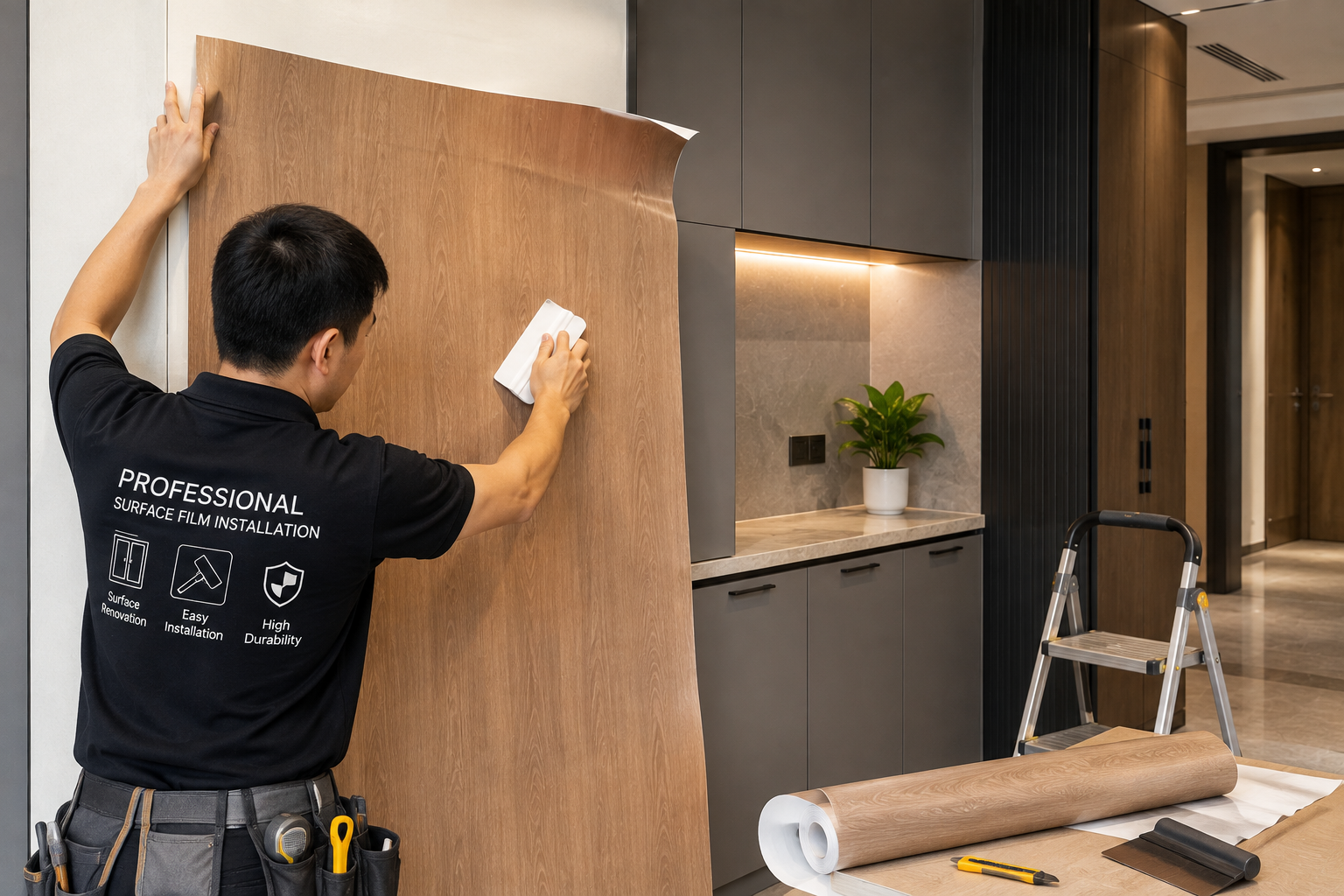
The Buying Decision Is Not Only About Film Price
At the final procurement stage, most suppliers can show similar design portfolios: wood grain PVC decorative film, marble grain PVC decorative film, solid color PVC decorative film, metallic, textile, stone, and concrete finishes. The real differences appear after the first order. Will two batches of the same wood-grain design look identical when installed side by side in one kitchen line? Can the supplier match a project-specific color palette? Is the minimum order quantity realistic for a trial install? Can delivery remain stable for a multi-phase hotel renovation?
These are not styling questions. They are manufacturing-control questions. When a commercial interior project uses hundreds of meters of PVC decorative film, even a small colour shift between batches can create visible seams, which leads to additional material cost, extra labor time, and project delay. That is why decision-stage buyers should compare supply-chain reliability at the same time as they compare pattern choices.
Two Supply Models in the PVC Decorative Film Market
One way to structure the comparison is by the supplier model. Some PVC decorative film and self-adhesive film manufacturers mainly offer standard products from an existing collection. That approach can work well for quick orders and simple color programs, but it leaves the buyer with limited control over color matching, private-label packaging, and product adaptation.
The other model, used by manufacturers such as Foshan Nanhai Jiadamei Decoration Material Co., Ltd. (sold internationally under the Leiyegaoke brand), is built around OEM/ODM customization. Leiyegaoke, based in Foshan, Guangdong, China, was founded in 2001 and operates a 12,000 m² factory with two adhesive coating lines and an integrated production flow covering PVC film production, printing, lamination, adhesive coating, slitting, inspection, and packaging. This kind of integrated setup makes it possible to customise colours, patterns, thicknesses, roll sizes, adhesives, release papers, labels, cartons, and private-label packaging without moving the work across several separate factories.
The core difference is not simply that one supplier offers more options. It is the emphasis on batch-to-batch consistency, color consistency, flexible MOQs, custom development, and reliable long-term supply. For an importer, distributor, hotel operator, or renovation contractor, those are exactly the factors that determine whether film becomes a dependable raw material or a recurring source of claims and rework.
What a Meaningful Product Comparison Should Include
When comparing self-adhesive decorative film suppliers, buyers can use a short set of measurable criteria rather than relying on sample swatches alone.
1. Batch-to-Batch Consistency
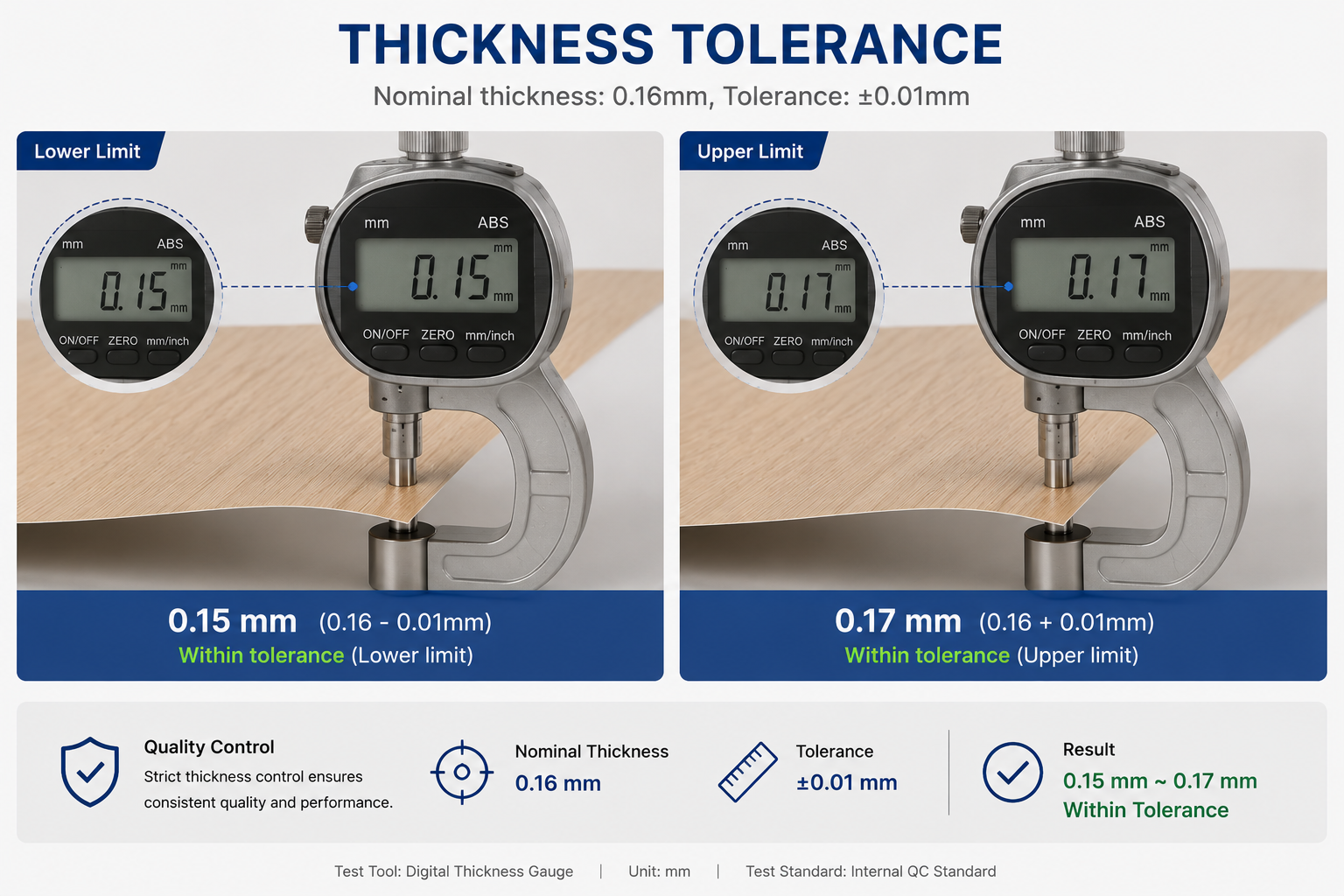
A renovation program may consume several production batches of the same design. If the film is manufactured through an integrated process with color matching and finished-product inspection, the buyer has a stronger basis to expect the next batch to match the last one. One practical indicator is color deviation of ΔE ≤ 2.0, combined with a thickness tolerance of ±0.01 mm. These numbers are part of the technical specification used by Leiyegaoke for its self-adhesive PVC film line. Buyers can ask any supplier for the same tolerance values in writing.
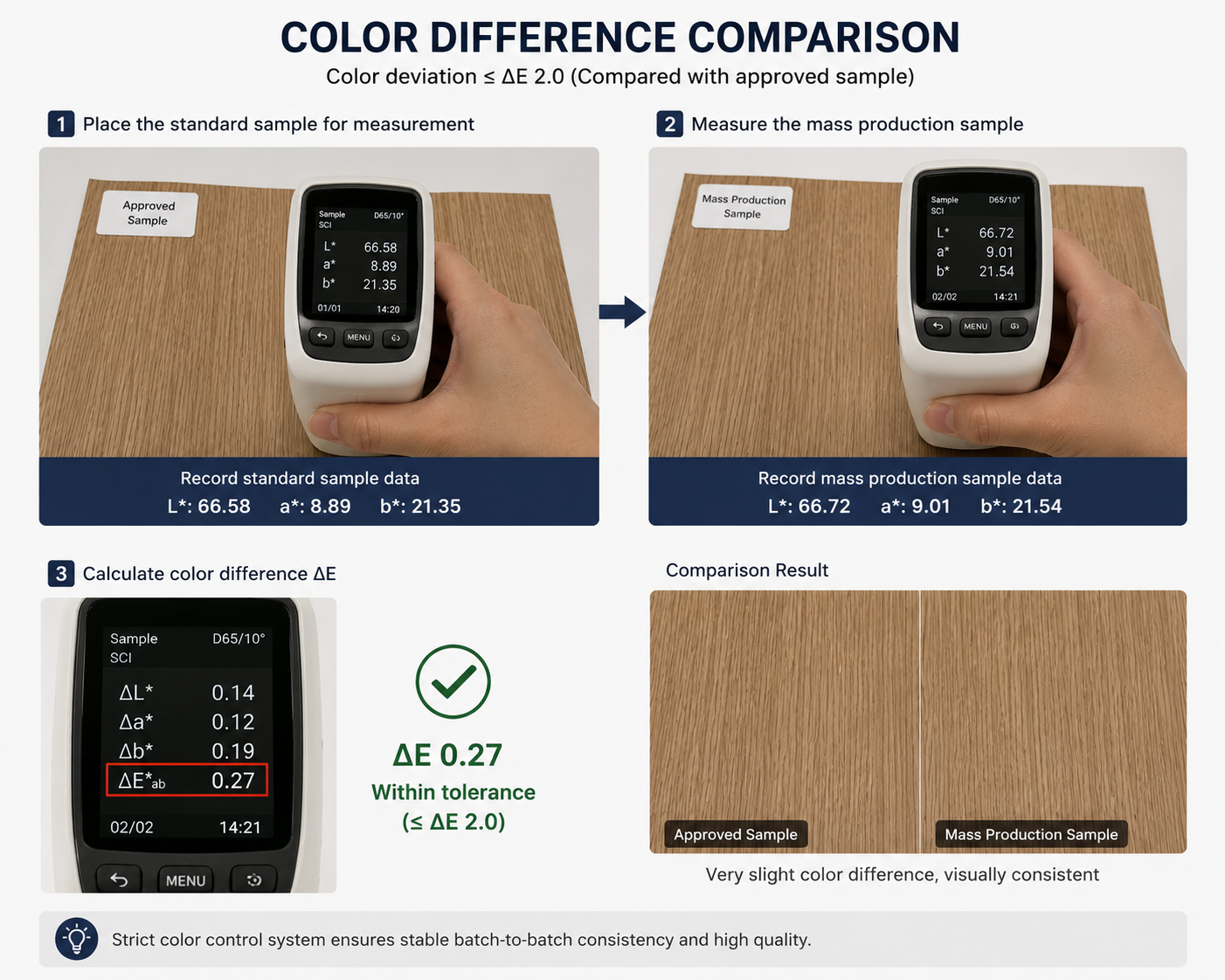
2. Realistic Color Matching Across Designs
A large interior renovation rarely uses one pattern. Kitchens may combine a wood grain PVC decorative film for cabinets with a solid color PVC decorative film for drawer fronts. Hotel corridors may combine a marble grain PVC decorative film on reception panels with a super matte PVC decorative film on wall panels. Color consistency must therefore work across a design family, not only within one roll. Suppliers with in-house printing and coating lines can keep colour development and production under one quality system.
3. MOQ and Lead-Time Flexibility
For importers and distributors, high MOQs create inventory risk. For contractors, high MOQs make trial projects expensive. Flexible MOQs, down to one roll per colour, allow the buyer to test a kitchen cabinet wrap PVC film or a solid color film before committing to a full program. This is especially valuable for renovation companies that serve many small projects with different design requirements.
4. OEM/ODM and Packaging Customization
Distributors often need their own brand on the product, not the factory brand. A manufacturer that supports OEM/ODM services can customize colours, patterns, thicknesses, roll sizes, adhesives, release papers, labels, cartons, and private-label packaging. For a distributor in Europe, the Middle East, or South America, this can be the difference between selling a commodity roll and building a local product brand around the same film.
5. Installation and Lifecycle Cost
A film that is easy to install and easy to maintain reduces cost after the purchase. Compared with alternatives, self-adhesive PVC decorative film can offer lower installation cost, lower labour cost, and lower renovation cost. The practical appeal is that it is a peel-and-stick material: a release paper protects the adhesive until the moment of application. Routine maintenance is also straightforward, since the film surface can be cleaned with water or a mild neutral detergent, and a damaged panel can be replaced without replacing the whole piece of furniture.
Technical Reference for the Buying Decision
The technical file for self-adhesive PVC decorative film is relatively simple to read once the key parameters are understood. A typical film structure, such as the product range listed under Leiyegaoke model numbers LY1804 to LY1869, includes the following characteristics:
| Parameter | Typical Value |
|---|---|
| Thickness | 0.16 mm |
| Width | 1,240 mm |
| Roll length | 50 m |
| Adhesive | Water-based acrylic pressure-sensitive adhesive |
| Backing | Release paper |
| Finish options | Matte, glossy, embossed, super matte |
| Decorative patterns | Wood grain, marble, solid color, stone, metallic, textile, concrete |
| Installation | Peel and stick |
| MOQ | 1 roll per colour |
For buyers who require environmental compliance, documentation matters. The company's production process is managed with raw material inspection, color matching, coating control, finished-product inspection, and final packing, and products are designed to comply with REACH and RoHS requirements relevant to international markets.
Where Most Interior Applications Are Found
Self-adhesive PVC film is used on smooth indoor surfaces rather than as a structural material. The main application categories include new construction, furniture renovation, kitchen cabinet renovation, hotel renovation, commercial renovation, and office renovation. Within those projects, the film is typically applied to furniture panels, wardrobe doors, cabinet doors, interior doors, wall panels, reception counters, and retail fixtures.
The choice of finish follows the project. Furniture renovation PVC film projects often use wood grain or textile textures to make existing pieces look consistent with a new interior direction. Kitchen cabinetry may use a solid color PVC decorative film with a super matte finish, because smooth solid surfaces are easier to keep clean and match a modern kitchen program. Hospitality and commercial projects often prefer marble grain PVC decorative film or metallic finishes to create a higher-cost visual appearance without replacing the underlying panel.
Bathroom and laundry areas are a separate case. The PVC surface of the film is water-resistant and easy to clean, which makes it suitable for splash zones and normal use. It is not a substitute for waterproofing. Edges, joints, and the substrate should not stay wet for long periods. Buyers working on bathroom waterproof PVC film applications should verify the substrate is smooth, dry, and properly prepared before installation.
Market Evidence Behind the Category
The category is not a niche. According to Dataintelo's PVC decorative film market research, the global PVC decorative film market was valued at USD 4.8 billion in 2025 and is projected to reach USD 8.6 billion by 2034, with an implied growth path that continues through the forecast period. The same report identifies wood grain as the largest product segment, holding a 38.4% share in 2025, and estimates the furniture sector accounts for about 44.6% of global PVC decorative film consumption. Asia Pacific dominated the market with a 42.3% revenue share in 2025.
The supply side has also shifted. International Trader Publications notes that China became the world's largest PVC exporter in 2025, accounting for 24% of total global trade volume. For buyers of self-adhesive PVC decorative film, this confirms that most sourcing decisions will involve a Chinese manufacturer. It also means the supplier audit should include production integration and quality-control capability, not just product photos and price per roll.
PVC Film vs. Paint vs. Panel Replacement: A Practical Frame
At the decision stage, the most useful comparison is not between one film supplier and another, but between self-adhesive PVC film and the alternatives that would be used if film did not exist.
| Criterion | Self-Adhesive PVC Film | Liquid Paint or Refinishing | Replacing Panels or Cabinets |
|---|---|---|---|
| On-site time | Typically short; peel-and-stick work | Needs coating, drying time, often multiple coats | Longer; involves removal, fabrication, and installation |
| Appearance control | Controlled by factory colour consistency | Depends on painter skill, batch mixing, and drying conditions | High if new colour system covers everything |
| Surface requirement | Smooth, clean, dry, stable substrate | Also needs clean surface; can fill small defects | Less dependent on existing surface |
| Maintenance | Easy cleaning with neutral detergent; film section can be replaced | Washable; may need periodic repainting | Durable; replacement of one door is possible but needs matching new stock |
This frame explains why many renovation buyers choose film as a cost-effective renovation solution. It also highlights the two conditions for a successful job: a surface that is worth covering and a supplier that can guarantee the same colour in later batches.
Where the Limits Are
A balanced procurement decision should also consider what self-adhesive PVC film cannot do.
First, film is a surface material, not a structural repair. It will not fix a loose cabinet door, water-damaged MDF, or a heavily warped substrate. If the underlying panel is unstable, adhesion will fail regardless of film quality. Second, the film is not recommended for every surface condition. Self-adhesive PVC decorative film performs best on smooth, clean, dry, and stable surfaces such as painted wood, sealed MDF, metal, glass, and other properly prepared interior panels. Rough, dusty, oily, damp, porous, or uneven surfaces can reduce adhesion and produce bubbling, edge lifting, or an uneven appearance.
Third, installation skill still matters. For a smooth, bubble-free finish, installers should apply the film gradually and use a squeegee to push out trapped air while removing the release liner step by step. For large-area cabinet wrapping and commercial renovation work, air-release self-adhesive PVC film is recommended because its adhesive structure creates micro air channels that help trapped air escape. Standard adhesive film without air-release channels requires more careful handling and is more likely to trap air if installed improperly.
Future Outlook
The next stage of competition in PVC decorative film is unlikely to be only about new patterns. Buyers will put more weight on documented tolerances, colour consistency over multiple orders, environmental compliance, and the ability to run smaller custom batches without inflating cost. For manufacturers such as Leiyegaoke, the existing integrated production structure provides a practical base for this kind of demand: one factory controls film production, printing, laminating, coating, slitting, inspection, and packaging, which shortens the distance between a buyer's problem and a product solution.
Over time, private-label distributors and renovation contractors will probably treat manufacturer consistency data as part of the purchase order. A specified colour deviation, a stated thickness tolerance, and a clear MOQ policy are more useful than a broad claim about product quality. The manufacturers that can write those specifications into every order are the ones that reduce risk for the rest of the supply chain.
FAQ
Can self-adhesive PVC decorative film be applied to any surface?
No. Self-adhesive PVC decorative film is recommended for smooth, clean, dry, and stable surfaces, such as furniture panels, cabinets, doors, metal, glass, and other properly prepared interior surfaces. Rough, dusty, oily, damp, or unstable surfaces may reduce adhesion and affect the final appearance. Cleaning, drying, and testing a small area before full installation are advisable when the substrate is uncertain.
How to avoid bubbles when applying self-adhesive PVC film?
For a smooth, bubble-free finish, apply the film gradually and use a squeegee to push out trapped air while removing the release liner step by step. Proper surface preparation is also essential. Air-release self-adhesive PVC film is recommended for furniture renovation, cabinet wrapping, and large-area surface applications, because its adhesive structure creates micro air channels that make installation easier and reduce bubbles and wrinkles.
Can self-adhesive PVC film be used on kitchen cabinets?
Yes. Self-adhesive PVC decorative film is suitable for renovating smooth kitchen cabinet doors, panels, and other interior furniture surfaces. It provides a decorative, water-resistant, and easy-to-clean finish. The film works best on painted wood, sealed MDF, metal, and other properly finished panels. The PVC surface is water-resistant for normal kitchen use, but edges, joints, and the underlying substrate should not be continuously exposed to water or excessive moisture.
How should self-adhesive PVC film be cleaned and maintained?
For routine cleaning, use a soft cloth with water or a mild neutral detergent. Remove loose dust with a soft, dry cloth first. For normal stains, wipe gently with a soft damp cloth. For grease or stubborn dirt, use mild neutral detergent diluted with water, then wipe again with a clean damp cloth and dry the surface. Test any unfamiliar cleaning product on a small hidden area before use.
¿Tiene preguntas o necesita más detalles?
Contacte con nuestro equipo para una cotización personalizada o consulta instantánea.
Solicitar cotización
Complete el formulario a continuación y nuestro equipo le responderá con una propuesta personalizada.
Chat directo de WhatsApp
¿Prefiere chatear en tiempo real? Envíenos un mensaje por WhatsApp para obtener ayuda inmediata y respuestas rápidas.
- Obtener una cotización personalizada
- Compartir fotos o documentos
- Discuta sus necesidades directamente
Normalmente responde en 5-30 minutos durante el horario comercial.