
Standalone vs Integrated Edge Banding: Panel Line Decisions
Panel furniture manufacturing is built on four repeatable operations: cutting panels to size, drilling system holes and fitting positions, applying and finishing the edge band, and assembling the cabinet. Before a manufacturer selects an edge banding machine, it makes a larger decision — whether edge banding is bought as a standalone machine, or as one module inside a wider panel processing lineup that also specifies the computer panel saw and the side drilling machine.
Neither route is inherently superior; they answer different planning situations. A standalone edge banding machine adds or replaces edge finishing capacity while cutting and drilling continue on equipment the factory already runs. An integrated lineup places cutting, drilling and edge finishing inside one specification and one capital plan, which is why it changes floor space, labour design, commissioning sequence and the compliance documents a buyer has to collect. Both configuration patterns can be validated in real production: the reference installations described later in this article include a 10-unit configuration in Greece that has run stably for three years, and a Kenya installation where edge banding quality and output improved over two years.
SYUTECH (Foshan Shunde Saiyu Technology Co., Ltd.) is a woodworking machinery manufacturer based in Shunde District, Foshan, Guangdong, China — a region known as the hometown of woodworking machinery in China. The company was established in 2013, operates a 10,000 m² facility with roughly 100 employees and an annual output of 500 units, and exports approximately 80% of its production to markets including Russia, the Middle East, South America, Europe and Southeast Asia. Its published portfolio covers fully automatic edge banding machines, laser edge banding machines, CNC six-sided drilling machines, computer panel saws, and complete panel furniture equipment and automated production lines.
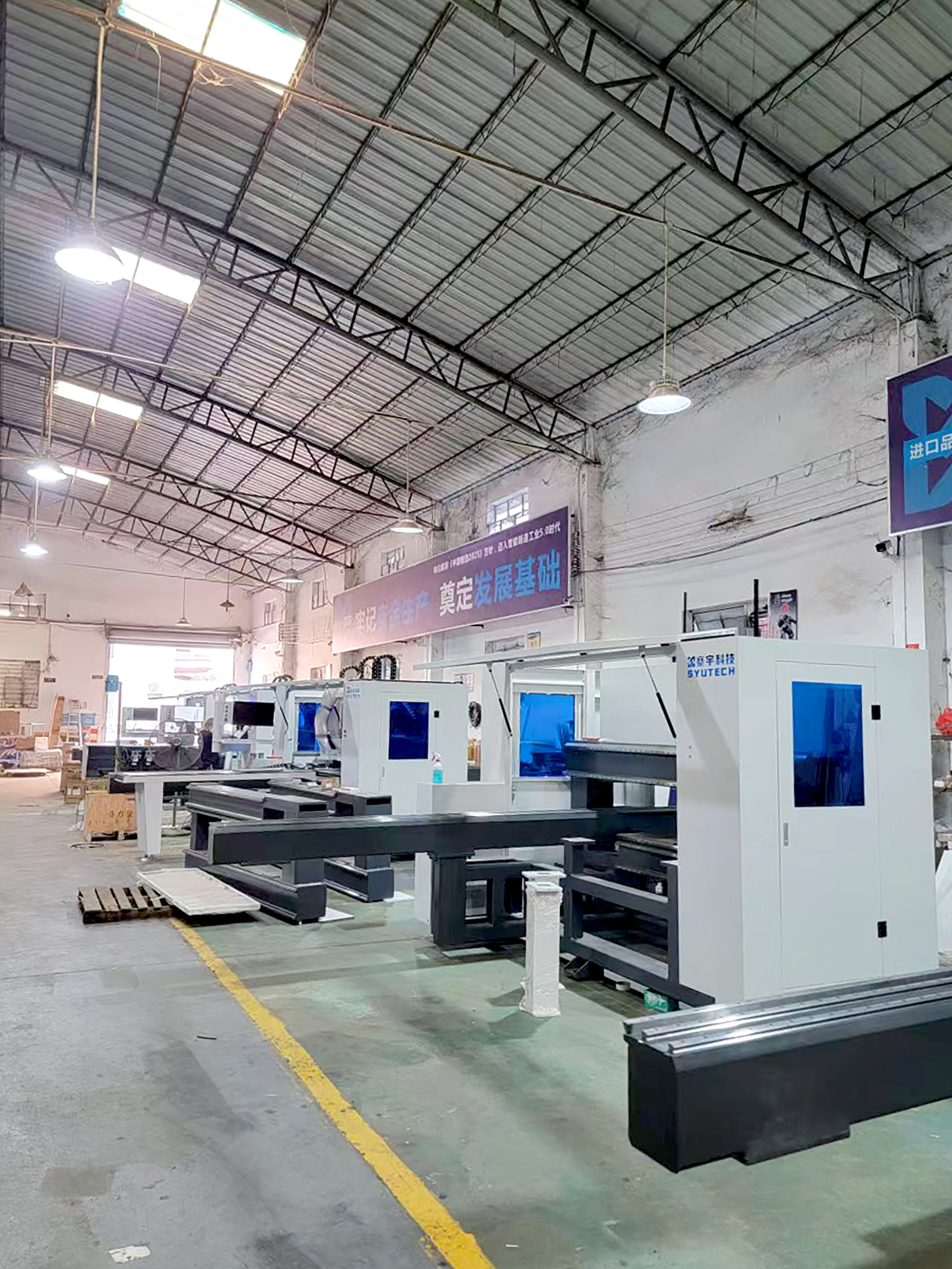
A drilling station inside a panel furniture equipment workshop. In an integrated lineup, drilling, cutting and edge finishing are specified together rather than bought as separate projects.
What “Standalone” and “Integrated” Actually Mean
A standalone edge banding configuration consists of one edge banding machine plus its own support equipment. Depending on the model class, that machine may be a manual, semi-automatic or automatic unit. Cutting and drilling are performed elsewhere — on existing saws and drilling equipment, on a nesting machine, or by an outsourced panel supplier — and the edge bander is sized only to the edge finishing workload.
An integrated panel processing lineup treats cutting, drilling and edge finishing as one production set. In the configuration discussed here, that set is built around three machine groups: a computer panel saw such as the HK330 for sizing, a side drilling machine such as the HK612B for hole and fitting positions, and an automatic edge banding machine such as the HK868P for edge application and finishing. SYUTECH states that it supplies fully automatic edge banding machines, laser edge banding machines, CNC six-sided drilling machines, computer panel saws and complete sets of panel furniture equipment and automated production lines — the portfolio breadth that makes a single-supplier integrated specification possible.
The functional difference between the two configurations is therefore narrower than the commercial difference. Both use the same edge finishing process; what changes is how many process steps sit inside one purchase scope, one commissioning plan and one line-balance calculation.
Mapping Process Steps to Machines
The mapping below follows the physical sequence a panel passes through. For the cutting and drilling stations it identifies which machine carries the step and which specification fields a buyer must verify; for the edge banding station it uses published model data, because that is the equipment whose parameters most directly determine whether a configuration fits a given panel mix.
| Process step | Function performed | Standalone configuration | Integrated configuration | What the buyer must verify |
|---|---|---|---|---|
| Panel sizing | Ripping and cross-cutting boards to finished part sizes before drilling and edging. | Handled by an existing saw or by an external panel supplier; the edge bander is sized independently. | Carried by a computer panel saw, such as the HK330, specified in the same plan as the drilling and edge banding machines. | Confirm the saw is planned against the same part list and output target as the edge banding station, so that sizing does not become the hidden bottleneck. |
| Drilling | System holes, dowel positions and hinge or fitting locations. | Performed on separate drilling equipment outside the edge banding purchase scope. | Carried by a side drilling machine such as the HK612B, within a portfolio that also includes CNC six-sided drilling machines and intelligent side drilling machines. | Confirm the drilling configuration matches the panel thickness range and the cabinet system being produced, and that drilling capacity is matched to the same takt as edging. |
| Edge application | Conveying, gluing and welting the edge band onto the panel edge. | The same edge banding machine performs this step. | The same edge banding machine performs this step, inside a wider lineup. | Check the edge band thickness and band width range against the band material used. The published specification for the HK868P lists edge band thickness 0.4–3 mm and edge band width 10–60 mm. |
| Trimming, scraping and polishing | End cutting, front and rear alignment, upper and lower trimming, upper and lower scraping and polishing. | Performed by the standalone machine in the same automatic sequence. | Performed by the edge banding machine in the same automatic sequence. | Confirm the number of finishing functions required. A compact automatic model in the range is listed with 7 functions and a feeding speed of 18–23 m/min. |
| Utilities and environment | Compressed air for pneumatic functions; extraction of trimming and scraping waste. | Required for the standalone machine. | Required for each machine group; edge banding operates with indoor dust-contained operation. | Confirm compressed air supply, extraction routing and indoor installation conditions before finalising the layout, because these affect both configurations equally. |
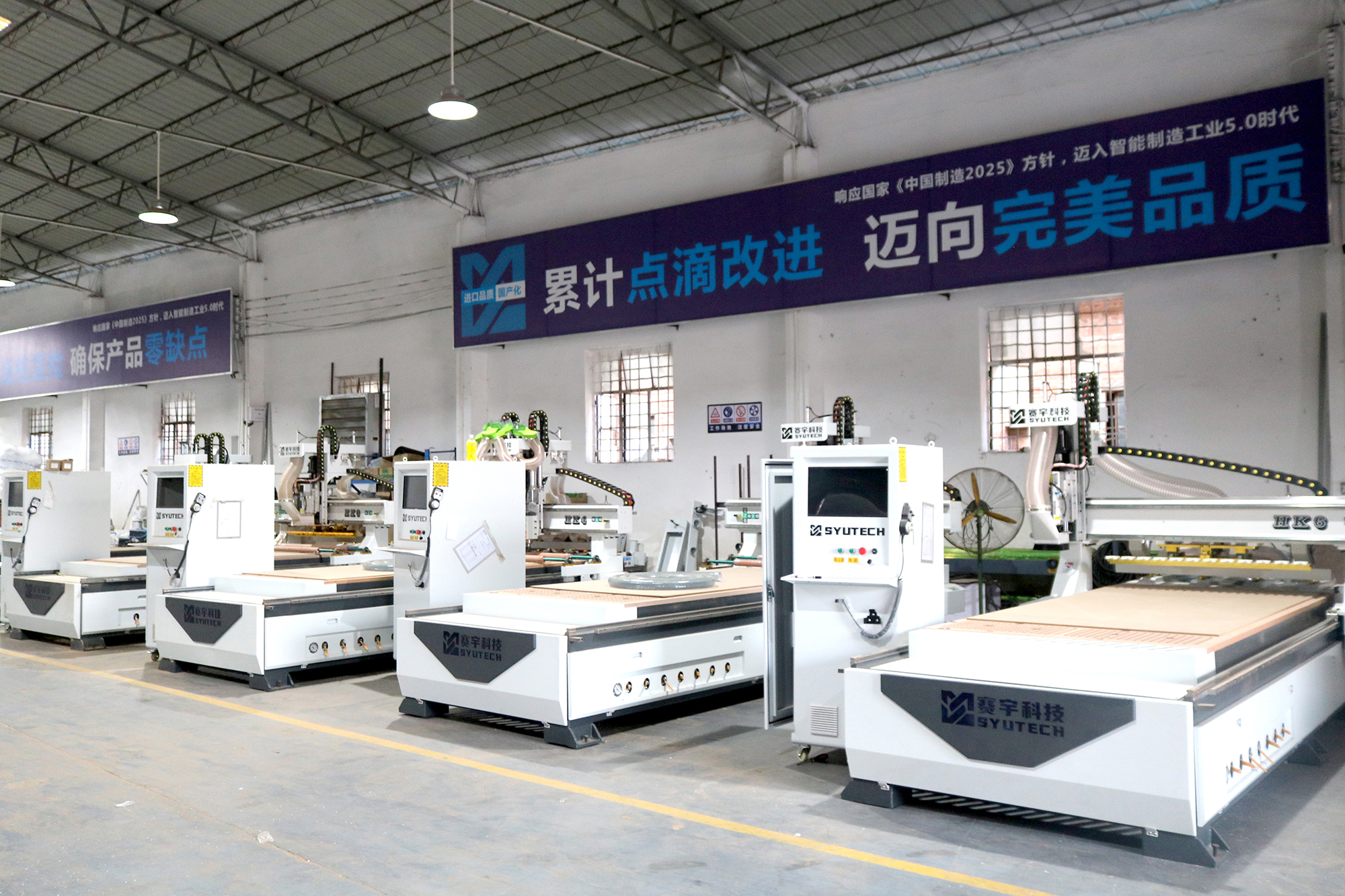
Panel cutting equipment located upstream of the edge banding station. In an integrated lineup, upstream capacity is planned to the same output target as edge finishing.
The Edge Banding Station Itself
The edge banding station behaves the same way in both configurations, which is useful when a buyer is comparing total line cost rather than individual machines. SYUTECH states that its edge banding machine automates a sequence that replaces manual edge banding procedures: conveying, gluing and welting, cutting, front and rear alignment, upper and lower trimming, upper and lower scraping, and polishing.
The published specification table for the HK868P automatic edge banding machine lists a minimum panel width of 40 mm, edge band width of 10–60 mm, edge band thickness of 0.4–3 mm, and a feeding speed of 18–22–25 m/min. The model is listed as suitable for MDF, block board, solid wood board, particleboard, polymer door plates, plywood and PVC board. A smaller automatic model in the same range is published with 7 functions and a feeding speed of 18–23 m/min.
Those figures are machine specifications, not line output. Actual throughput depends on panel size, band material, handling pattern and how evenly the upstream cutting and drilling stations supply the edge bander — which is precisely the variable an integrated configuration makes visible and a standalone configuration tends to absorb as work-in-progress buffer.
Operating Model: Continuous Automatic Cycle with Manual Feeding
The automatic cycle described above is continuous, but feeding is manual. An operator still loads panels at the infeed; automation removes the manual handling between the edge finishing steps, not the loading position. Buyers comparing an integrated lineup against a standalone machine should therefore plan staffing around the loading station in both cases.
Edge banding also requires support equipment regardless of configuration: compressed air for pneumatic functions and dust extraction for trimming and scraping waste. The machine is described as operating with indoor dust-contained operation, meaning the installation is intended for an indoor workshop where extracted dust is contained and collected rather than released into the working area. This has a layout consequence — extraction routing and indoor placement must be resolved at the planning stage, and the same requirement applies whether the buyer purchases one machine or three.
Reference Evidence from Panel Furniture Production
Configuration choices are easier to justify when they can be pointed to in operating plants rather than on specification sheets. Two reference installations are relevant to this comparison:
- Greece — 10 units, three years of stable operation. A multi-unit configuration has been running stably for three years, which is evidence that a larger, coordinated equipment set can be commissioned and sustained in continuous panel furniture production rather than only in a start-up phase.
- Kenya — two years, improved edge banding quality and output. An installation in Kenya reported improvement in both edge banding quality and output over a two-year operating period, which is the type of evidence relevant when the decision is an edge finishing upgrade within an existing plant rather than a full line investment.
These references should be read with normal procurement caution. They are supplier-reported installation references, so a buyer should request the operating scope behind them — substrate types, band materials, working hours and handling pattern — and validate their own panel mix by sampling before scaling an order. The absence of an independent third-party performance benchmark for edge banding machine throughput is a real limit in the available evidence, and it is why sampling remains the strongest validation step available to a buyer.
Compliance as a Configuration Criterion
Compliance requirements apply to whatever configuration is purchased, but the documentation burden scales with the number of machine groups. SYUTECH machinery (HK series) is CE certified for the EU market under certificate HTT202405661L, referencing EN 60204-1:2018 and EN ISO 12100:2010 — the mechanical and low-voltage electrical safety route for this machine class.
Explosion-proof construction is not required for this machine class as configured. That matters commercially: it removes a specialist electrical specification that would otherwise alter enclosures and cost, and it means buyers in the EU can plan around CE mechanical and low-voltage requirements rather than an ATEX-type specification.
Standard scope still needs to be matched to the exact configuration. ISO 18217:2015 addresses chain-fed edge banding machines with manual loading and unloading and a maximum work-piece height capacity of 100 mm, while EN ISO 19085-17:2021 is the safety standard titled for chain-fed edge-banding machines. In an integrated lineup, each machine group — panel saw, drilling machine and edge banding machine — carries its own conformity documentation, so the buyer should verify that certificates cover the model and configuration actually ordered rather than a machine family in general.
Market Signal: Where the Automatic Segment Is Heading
Third-party market research places the global automatic edge banding machine market at USD 3.658 billion in 2024, with a projected compound annual growth rate of 4.56% for the period 2025–2035. A 2026 industry analysis also estimates that Chinese manufacturers account for approximately 40% of global edge banding machine shipments, a figure reported at medium confidence.
Two interpretations are relevant to a configuration decision. First, growth is concentrated in the automatic segment, which supports the general migration away from manual and semi-automatic edge finishing toward automatic machines and integrated specifications. Second, supplier concentration in one manufacturing region means that portfolio breadth — the ability to deliver the saw, drilling machine and edge banding machine from one specification — becomes a practical selection criterion for buyers assembling a complete panel processing set rather than a marketing detail.
Side-by-Side Comparison
| Decision dimension | Standalone edge banding machine | Integrated lineup (panel saw + side drilling + edge banding) |
|---|---|---|
| Purchase scope | One edge banding machine plus support equipment. | Cutting, drilling and edge finishing machines plus support equipment, planned as one set. |
| Capital staging | Smaller commitment; upgrade can be sequenced around existing equipment. | Larger commitment at one point, aligned to a defined production plan. |
| Floor space | Edge banding footprint, band storage and infeed/outfeed area. | Combined footprints for cutting, drilling and edge banding, plus buffer and handling space. |
| Process control | Edge banding parameters reviewed in isolation. | Line balance between sizing, drilling and edge finishing becomes an explicit planning variable. |
| Labour model | Manual feeding at the edge bander infeed. | Manual feeding remains at the edge bander infeed; upstream stations supply the same plan. |
| Capacity matching | Imbalance with existing cutting and drilling is absorbed as work-in-progress. | Imbalance is addressed inside one specification and one commissioning sequence. |
| Compliance | CE documentation for a single machine. | CE documentation per machine group; certificates verified per model. |
| Best fit | Adding or replacing edge finishing capacity where saw and drilling capacity already exists. | New plant, capacity replacement, or a project purchasing sizing, drilling and edging together. |
| Main risk | Edge finishing capacity that does not match upstream output. | Higher upfront commitment and longer commissioning before full output. |
Limits and Trade-offs to Price In
A comparison that lists only advantages is not a procurement tool. The following boundaries apply to this pairing:
- Configuration is not the same as capacity. Published feeding speeds of 18–22–25 m/min for the HK868P and 18–23 m/min for the compact model describe machine capability, not factory output. Real output depends on part sizes, band material and the balance between stations.
- Automation does not remove the operator. The cycle is automatic with manual feeding, so the loading position remains staffed in both configurations.
- Panel geometry has a floor. The published minimum panel width for the HK868P is 40 mm. Buyers producing narrower parts must select a different model rather than adjust the line layout.
- An integrated lineup concentrates risk. Three machine groups committed together are commissioned together; an imbalance in one station is felt across the line instead of being absorbed by an isolated machine.
- Standards have scope limits. ISO 18217:2015 is written around chain-fed machines with manual loading and unloading and a maximum work-piece height capacity of 100 mm. Configurations outside that scope require separate verification.
- Evidence gaps remain. The available verified dataset identifies model-level specifications for one supplier, with no independent throughput benchmark, no third-party performance validation and no public pricing or MOQ data for this machine class. Comparative judgement should therefore rest on sampling and document verification.
A Short Decision Sequence for Buyers
- Define the panel mix first. Board types, part widths and band materials determine whether a candidate model fits. Confirm the model range covers the band thickness and band width actually used, and that the narrowest panel in the mix exceeds the published minimum panel width.
- Decide the operator model. Assume manual feeding at the edge bander infeed in both configurations, then plan the number of loading positions accordingly.
- Resolve site conditions before layout. Compressed air supply, extraction routing and indoor placement with dust containment are prerequisites in both routes.
- Check compliance per machine, not per supplier. Verify that CE documentation covers the exact models and configuration being purchased, and confirm whether the explosion-proof option is required for the intended installation environment.
- Validate by sampling and reference. Use installation references for commissioning realism — such as the multi-unit configuration in Greece running stably for three years, or the Kenya installation where quality and output improved over two years — and confirm the operating scope behind each reference.
- Decide the staging. Choose the standalone route when saw and drilling capacity is already adequate and the priority is edge finishing quality; choose the integrated route when sizing, drilling and edging are being purchased or replaced in the same capital cycle.
Future Outlook
With the automatic segment projected to grow at 4.56% annually through 2035, the practical direction of travel is toward automatic edge finishing inside coordinated panel processing specifications rather than isolated machine purchases. For export-oriented panel furniture manufacturers, two consequences follow: compliance documentation will remain a gate rather than a formality, and supplier portfolio breadth will keep mattering because a single specification reduces the coordination work between sizing, drilling and edge finishing.
The countervailing trend is buyer scrutiny. Publicly available data still lacks cross-supplier benchmarks and pricing references for this machine class, so buyers are increasingly likely to demand references, sample validation and configuration-specific certificates before committing. Staged purchasing — upgrading edge finishing first and expanding to a full lineup later — remains a legitimate strategy, particularly where floor space or capital is constrained.
A downloadable factory profile covering SYUTECH's panel furniture equipment scope is available here: SYUTECH factory promotional paper (PDF).
FAQ
What is the difference between a standalone edge banding machine and an integrated panel processing lineup?
A standalone edge banding machine performs edge application and finishing only. Cutting and drilling are handled by separate machines or by a supplier, and the edge bander is purchased as a single unit. An integrated lineup specifies cutting, drilling and edge finishing machines as one production set planned against a common panel mix and output target — for example a computer panel saw such as the HK330, a side drilling machine such as the HK612B, and an automatic edge banding machine such as the HK868P. The difference is planning scope and capital staging, not the edge finishing process itself.
Which edge banding specifications matter first when matching a machine to existing cutting and drilling equipment?
Start with the geometry and material limits. The published specification table for the HK868P automatic edge banding machine lists a minimum panel width of 40 mm, edge band width of 10–60 mm, edge band thickness of 0.4–3 mm, and a feeding speed of 18–22–25 m/min. A compact automatic model in the same range is published with 7 functions and a feeding speed of 18–23 m/min. A panel narrower than the minimum, or a band outside the thickness range, changes the model selection before it changes the line layout.
Does an automatic edge banding machine operate without an operator?
No. In the configuration described here, the edge finishing sequence runs as a continuous automatic cycle with manual feeding. The machine executes conveying, gluing and welting, cutting, front and rear alignment, upper and lower trimming, upper and lower scraping and polishing continuously, while an operator loads panels at the infeed. Automation replaces handling between the edge finishing steps; it does not remove the loading position.
What support equipment and site conditions are required in either configuration?
Edge banding support equipment — compressed air for pneumatic functions and dust extraction for trimming and scraping waste — is required whether the machine is standalone or part of a lineup. The machine is described as operating with indoor dust-contained operation, so installation is intended for an indoor workshop where extracted dust is contained and collected instead of being released into the working area. Extraction routing and indoor placement therefore need to be resolved at the layout planning stage.
What compliance requirements apply to European Union buyers, and is explosion-proof construction needed?
SYUTECH machinery in the HK series is CE certified for the EU market under certificate HTT202405661L, referencing EN 60204-1:2018 and EN ISO 12100:2010 — the mechanical and low-voltage electrical safety route. Explosion-proof construction is not required for this machine class as configured, which removes a specialist electrical specification from the scope. Standard scope should still be matched to the exact configuration: ISO 18217:2015 covers chain-fed edge banding machines with manual loading and unloading and a maximum work-piece height capacity of 100 mm, and EN ISO 19085-17:2021 is the safety standard titled for chain-fed edge-banding machines.
How can a buyer validate a configuration before committing to a full lineup?
Through references and staged sampling. SYUTECH cites a 10-unit configuration in Greece that has operated stably for three years, and a Kenya installation where edge banding quality and output improved over two years — evidence that configuration choices can be validated in real panel furniture production rather than only on specification sheets. Buyers should request the operating scope behind any reference (substrate types, band materials, working pattern) and validate their own panel mix by sampling before scaling the order. No independent third-party throughput benchmark for this machine class is publicly available, so sampling remains the strongest verification step.
What are the main trade-offs of choosing an integrated lineup over a standalone machine?
An integrated lineup commits capital and floor space to cutting, drilling and edge banding at the same time, requires a defined production plan before purchase, and balances three machine groups against one output target — so an imbalance at one station is felt across the line. A standalone edge banding machine keeps the investment smaller and staged, allows the edge finishing step to be upgraded while existing cutting and drilling equipment continues to run, and carries less coordination risk, but it leaves the cutting and drilling steps outside the purchase scope and outside a single specification review.
This analysis is based on published manufacturer specifications, standards references and third-party market research. Configuration decisions remain dependent on a buyer's own panel mix, site conditions and sampling results.