
Stamped vs. Brazed Aluminum Cooling Plates: A 2026 Process Benchmark for EV and BESS
In the rapidly evolving landscape of electric vehicle (EV) and battery energy storage system (BESS) thermal management, the choice of cooling plate manufacturing process has become a critical procurement decision. As battery power densities increase and system integrators demand longer cycle life, the performance of the cooling plate — whether stamped or brazed — directly influences thermal uniformity, system weight, and overall reliability.
Aluminum liquid cooling plates, typically fabricated from Aluminum 3003, have emerged as the dominant thermal interface for battery modules. However, procurement professionals face a nontrivial choice between two core production methods: stamping and brazing. Each process carries distinct trade-offs in design flexibility, production cost, lead time, and long-term durability.
Why Process Matters More Than the Datasheet
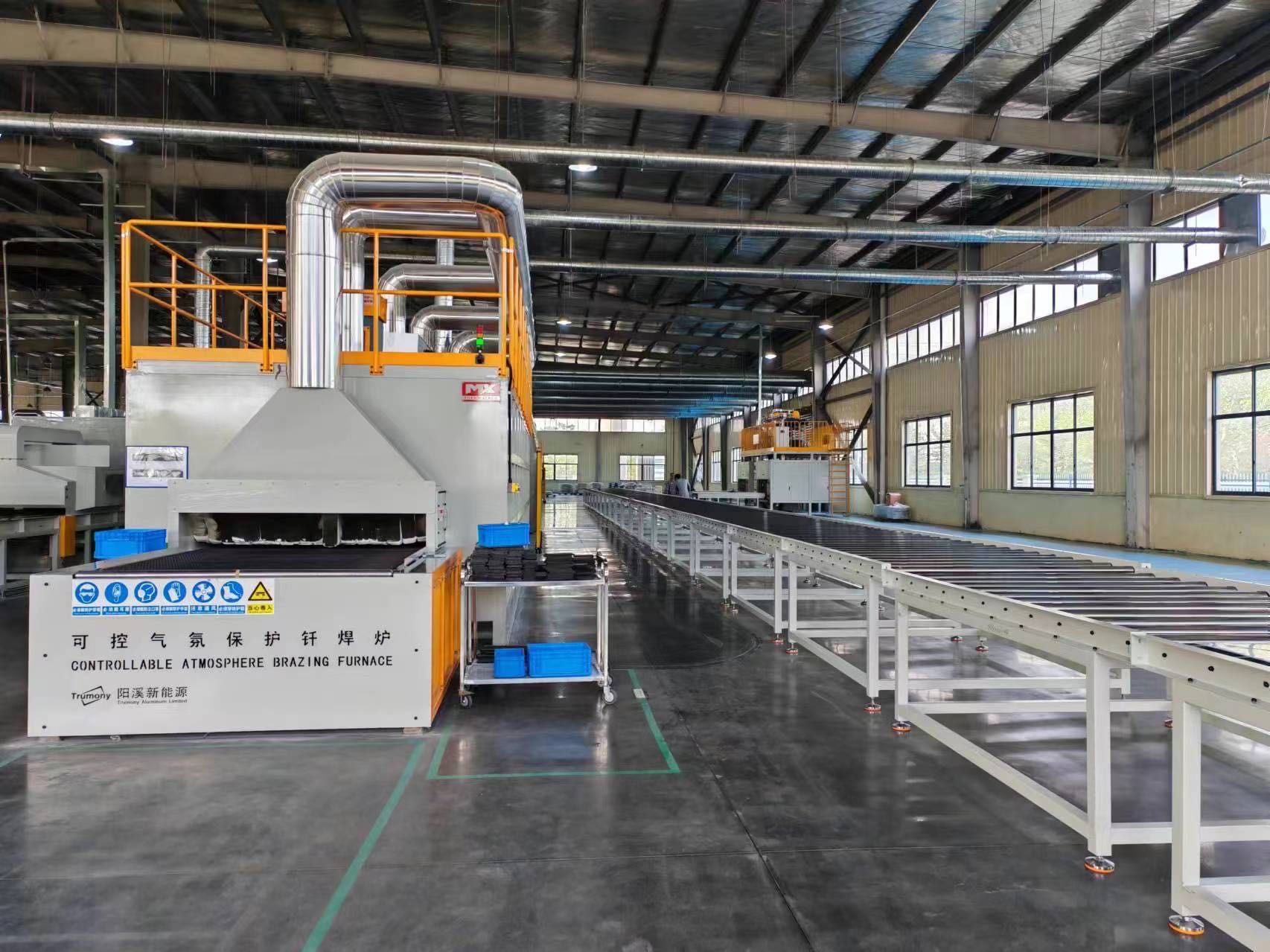
A cooling plate's thermal performance is not solely a function of material thickness or coolant flow rate — it is largely determined by how internal channels are formed. Stamped cooling plates are produced by pressing two aluminum sheets to create a cavity pattern, then joining them. Brazing cooling plates, in contrast, involve a furnace-brazed assembly where a clad aluminum sheet melts and bonds at high temperature, forming continuous internal channels without the stress concentrations often present in stamped joints.
Trumony Aluminum Limited, headquartered in Suzhou and founded in 2017, manufactures both stamped cooling plates and brazing cooling plates under the same quality management systems (ISO 9001 and IATF 16949 certified). The company operates 100,000 square meters of standard workshops and testing centers, with 220 employees and an annual output capacity of 600,000 units. This dual-process capability allows Trumony to match the appropriate manufacturing method to the client's application-specific requirements.

Application Scenarios Across EV and BESS
Real-world deployments illustrate how process choice aligns with use case. One case involves a German automotive OEM client that purchased 2,000 units of Trumony cooling plates for a paint shop application. The project achieved 2 years of stable operation, with low noise cited as a highlight. For a Vietnamese automotive OEM, Trumony supplied 60,000 units for battery pack cooling, operating stably over a 20-year design life — an extreme longevity requirement that favors robust brazing construction.
On the energy storage side, a Chinese ESS PACK OEM procured 3,000 units for container-grade ESS applications, achieving stable operation over 15 years. The client noted low noise, low cost, and fast lead time as key differentiators. These cases demonstrate that Trumony's cooling plates — whether stamped or brazed — can meet diverse performance criteria, from volume-driven projects to long-life infrastructure.

Market Trends Driving Process Evaluation
Several trends are pushing procurement teams to look beyond basic specifications. First, the global shift toward 800V EV architectures increases thermal load, demanding more precise internal flow paths — a strength of brazing. Second, the growing BESS market, especially in utility-scale projects, requires cooling plates that can operate reliably for 15–20 years in outdoor conditions, which places a premium on corrosion resistance and joint integrity. Third, the need for faster time-to-market has made stamped cooling plates attractive for rapid prototyping and mid-volume production.
Trumony's export ratio of 40%, with main markets in the EU, USA, and India, reflects its ability to serve diverse regulatory and quality expectations. Its OEM capability — with monthly capacity of 500,000 units, lead time of 30 days, and MOQ as low as 1 unit — provides flexibility that is increasingly valued in a market where customization is the norm. The company also offers optional tests such as helium tightness, voltage resistance, and hydrostatic strength, which are indicators of thorough quality control.
Comparison with Traditional Solutions
Compared with conventional fin-and-tube heat exchangers or die-cast cold plates, stamped and brazed aluminum cooling plates offer superior flatness and direct battery contact area, leading to better heat transfer coefficients. One honest limitation, however, is that stamped cooling plates, while cost-effective for high-volume runs, may have limited ability to form complex three-dimensional internal channels. In applications requiring intricate flow paths — such as those with multiple independent circuits or extreme pressure-drop constraints — brazed construction is often the preferred choice, albeit at a higher unit cost and longer production lead time due to the furnace cycle.
Future Outlook
As EV and BESS markets continue to grow, the cooling plate procurement decision will likely become even more process-centric. Suppliers like Trumony that offer both stamped and brazed platforms, supported by compliance with ISO 9001 and IATF 16949, are better positioned to serve buyers who need a single qualified source across multiple programs. The industry is also moving toward larger format cooling plates (e.g., blade battery form factors) and integrated designs that combine cooling with structural function — further blurring the line between component and subsystem. In this environment, the ability to customize thickness, cooling efficiency, and material compatibility (Al 3003 remains the baseline) will be a enduring advantage.
Frequently Asked Questions
What certifications does Trumony hold for its cooling plate production?
Trumony has passed ISO 9001 (certificate number 132998, issued by IAF, valid until 2026-09-21) and IATF 16949 (certificate number 0489498, issued by IATF, valid until 2026-11-26) quality management systems for its cooling components.
What is the monthly production capacity for OEM cooling plates?
Trumony offers OEM production with a monthly capacity of 500,000 units for cooling plates, a standard lead time of 30 days, and a minimum order quantity of 1 unit. 100% air leakage test and dimensional test are included; optional tests include helium tightness, voltage resistance, and hydrostatic strength.
Can Trumony produce both stamped and brazed cooling plates?
Yes. Trumony manufactures both stamped cooling plates (model TR-20260227) and brazing cooling plates (model TR-20260220), as well as other types such as water cooling plates and EV cooling plates, all using Aluminum 3003 material.
What are the typical lead times for a custom cooling plate?
For OEM orders, Trumony's standard lead time is 30 days. Customization options include dimension, cooling efficiency, and logo. After-sales support is provided remotely.