
Stainless Steel Trims: L-Shape, U-Shape and Custom Profiles
Buyer comparison framework · Product family JYF-06 · SS201 / SS304 / SS316
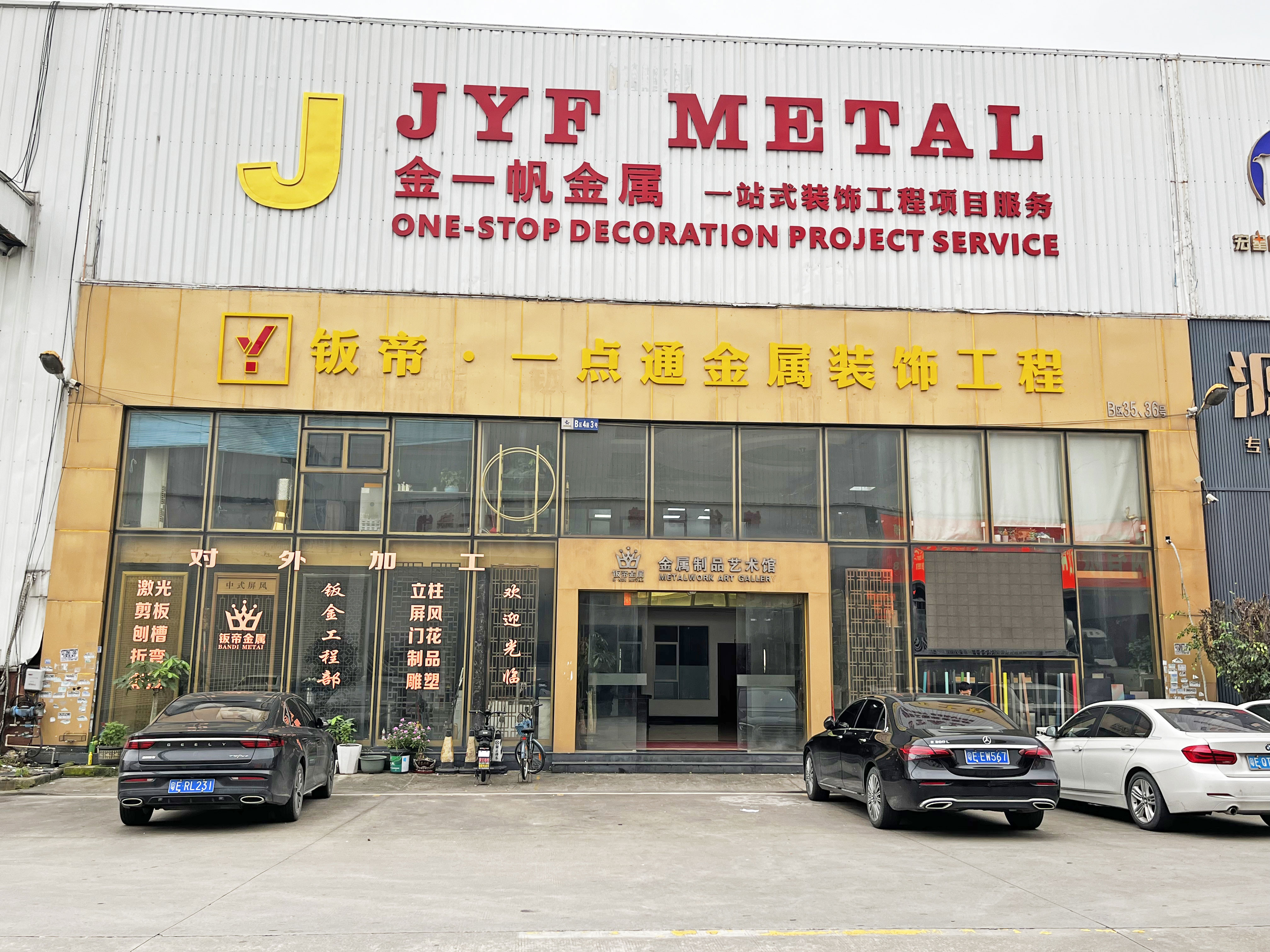
Profile fabrication: stainless steel trims are formed by shearing, V-grooving and bending before finishing. Image: JYF Metal.
In architectural stainless steel decoration, the details that decide whether a finished interior reads as precise or improvised are rarely the largest surfaces. They are the profiles that terminate them. Stainless steel trims are decorative profiles used to close panel edges, wrap material thicknesses, define shadow gaps and finish the junction between wall, ceiling and floor. At JYF Metal — Foshan Jinyifan Metal Products Co., Ltd., established in 2013 in Foshan, Guangdong — these profiles are produced as product family JYF-06 in SS201, SS304 and SS316, in L, U, T, V, curved, corner, flat strip and skirting board shapes, with mirror, brushed, vibration and sandblasted finishes and colours that include silver, gold, rose gold, black, copper, bronze and custom.
Because a trim is small, it is often specified last. That timing is also why it becomes a source of project friction: the shape has to match the edge condition on the drawing, the grade has to match the exposure, the finish has to match the adjacent panel, and the profile has to be manufacturable inside the project programme. This article compares the three decisions buyers actually make — shape, grade and finish — then sets out a method for evaluating custom trim requests, followed by the procurement terms that apply once a specification is fixed.
Why the trim is where the specification usually breaks
Panel systems, screens and ceilings normally arrive on site with drawings, module sizes and finish samples. Trim profiles are frequently added at the end of the package, after the panel modules have been frozen — yet the trim is exactly the component that has to absorb whatever the drawing did not resolve. Three failure patterns repeat across projects.
- Finish mismatch. A trim is read at close range in a narrow band. Where the panel and the trim are produced through different coating routes, a small difference in gloss or tone that would be invisible across a large field becomes obvious along an edge.
- Shape decided on site. When the section is not fixed on the drawing, the installer improvises the corner. The line then varies from room to room inside the same building.
- Profile count underestimated. A single room can require a corner profile, a skirting profile, an edge return and a reveal detail, each in the same grade and finish. The count, not the unit price, is usually what makes a late trim re-order expensive.
Treating the trim as part of the panel package rather than as an accessory removes most of these problems, because grade, finish and module logic are then specified together instead of being reconciled on site.
Shape comparison: what each profile actually does
The JYF-06 profile family covers L, U, T, V, curved, corner, flat strip and skirting board sections, plus custom shapes. These are not interchangeable options at different price points; each resolves a different edge condition.
| Profile shape | Typical function in a project | What to fix before ordering |
|---|---|---|
| L shape | Terminating a panel edge or closing a corner where two surfaces meet at a perpendicular junction. | Leg lengths, the angle, and whether the outer edge will be exposed or concealed. |
| U shape | Capping or wrapping a material thickness — panel returns, partition edges, glass edges. | The internal gap, matched to the panel thickness including tolerance, and the leg height. |
| T shape | Transition between two adjacent surfaces at a similar level, such as a joint between two panel modules. | Stem depth relative to the substrate, and whether the joint must read as one continuous line. |
| V shape | Reveals and shadow lines at panel joints and groove details. | Groove width and depth, and how the line reads under grazing light. |
| Curved shape | Radius columns, arched openings and curved reception fronts. | Radius, chord length, and whether the curve is formed in one piece or in segments. |
| Corner | External 90° junctions that would otherwise expose a cut edge. | Whether the corner is a separate profile or formed from the same section. |
| Flat strip | Straight closing strips, shadow gaps, expansion details and edge protection. | Strip width, and whether it sits flush with or proud of the adjacent surface. |
| Skirtingboard | The floor-to-wall base line, closing and protecting the bottom of a wall panel. | Height, returns at door openings, and the interface with the flooring. |
| Custom | Non-standard sections, or one profile that combines two functions. | A dimensioned section drawing, not a written description. |
Two rules follow. First, select the section from the edge condition rather than from a stock list: a U-shaped profile is not an upgraded L-shaped profile, it wraps a thickness and therefore depends on the panel's actual tolerance. Second, fix the interfaces — leg length, internal gap, radius, strip width, skirting height — before the profile is formed, because forming a profile twice usually means producing it twice.
Grade: SS201, SS304 or SS316
JYF-06 profiles are produced in 201#, 304# and 316# stainless steel. The grade determines how the profile behaves in its environment; the finish determines how it looks. The two decisions should be recorded separately on the drawing.
| Grade | Where it is commonly considered | What the buyer should record |
|---|---|---|
| SS201 (201#) | Interior decorative components in dry, controlled environments. | Confirmation that the exposure and cleaning regime suit a lower-alloy grade. |
| SS304 (304#) | General architectural interior metalwork, wall and ceiling trim lines, elevator and partition details. | Grade, finish, coating route and the panel the profile must match. |
| SS316 (316#) | Profiles exposed to chlorides, coastal air or a more aggressive cleaning regime. | Explicit confirmation on the drawing; SS316 is generally specified where SS304 would not suit the environment. |
In decorative stainless steel generally, standards such as ASTM A554 are frequently cited for welded profiles and tubing, and the standard defines the dimensional and material basis of an order. Buyers should confirm which standard a trim profile is produced and inspected against before the order is placed, because a profile that is visually correct but produced against an unspecified basis is difficult to argue about at delivery.
Where the supplier's quality system matters, JYF Metal holds a quality management system certificate (number 120526Q00119R000) issued by Guangdong Jingwel International Certification Ltd. against GB/T 19001-2016 / ISO 9001:2015, valid from 15 May 2026 to 14 May 2029, with a scope covering the R&D and production of stainless steel coloured boards, metal decorative mouldings and metal decorative articles.
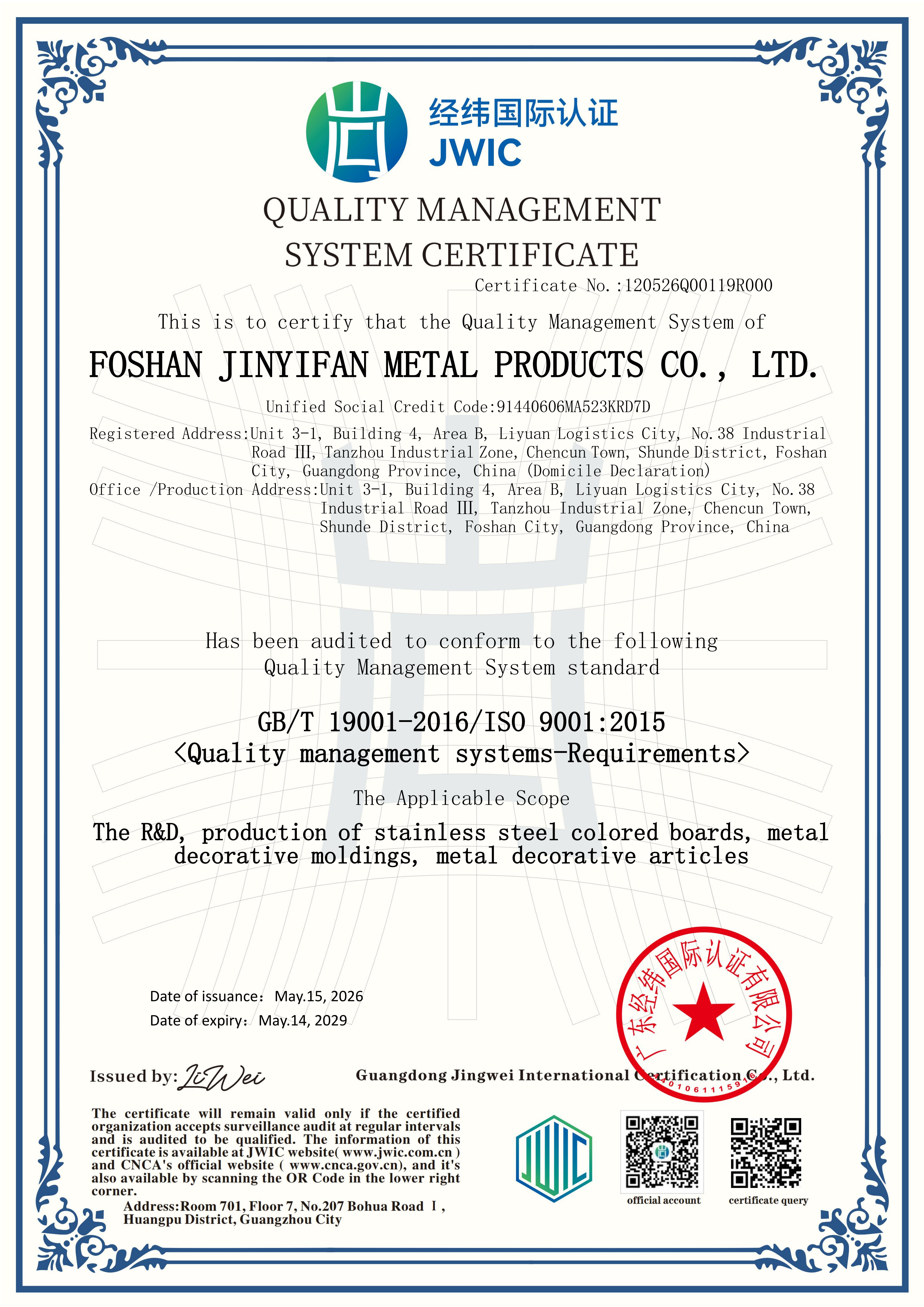
Certificate 120526Q00119R000 (GB/T 19001-2016 / ISO 9001:2015, valid 15 May 2026 – 14 May 2029). Scope: R&D and production of stainless steel coloured boards, metal decorative mouldings and metal decorative articles.
Finish and colour: where trim and panel have to agree
Mirror, brushed, vibration and sandblasted finishes are available across the JYF-06 family, together with silver, gold, rose gold, black, copper, bronze and custom colours. For decorative sheets produced by the same manufacturer, PVD coating is described as providing wear-resistant and fade-proof colour, along with flatness intended to support seamless joint installation. Those are panel properties, but they matter to the trim, because the trim inherits the visual reference of the surface it touches.
The trade-offs are straightforward. A mirror finish produces the sharpest line and the strongest reflection, and it also records handling. Brushed, sandblasted and vibration finishes diffuse light and are noticeably more forgiving of site handling, at the cost of a softer line. Because a trim is read at close range, the safest approach is to place the trim finish inside the panel finish package, order trim and panel samples at the same time, and confirm both under the project's final lighting rather than under office lighting.
A five-stage method for evaluating a custom trim request
A custom profile is not a longer version of a standard section; it is a drawing exercise followed by a forming exercise. The following sequence keeps the two in the right order.
- Fix the section on a dimensioned drawing. Record leg lengths, the angle, internal gap, radius or chord, the length of each piece, and the edge condition the profile must resolve. For curved profiles, state the radius and whether the curve is formed as one piece or as segments.
- Select the grade against exposure. Confirm SS201, SS304 or SS316 from the environment and the cleaning regime, and record the grade on the drawing rather than in correspondence.
- Map the finish to the adjacent surface. Confirm the finish type (mirror, brushed, vibration or sandblasted) and the colour, and confirm that trim and panel are coated through the same route wherever PVD colour is involved.
- Validate the forming route. JYF-06 profiles are produced by shearing, V-grooving and bending. Plant-level capability behind this family includes Trumpf laser cutting equipment, high-precision CNC bending, precision welding and a PVD vacuum plating line for stainless steel decorative panels — capability that decides whether a curved or non-standard section can be formed to the drawing.
- Confirm by sample, then by acceptance criteria. Sample provision is part of the supplier's after-sales support, and trim acceptance is based on length, straightness and surface quality inspection. For custom work, OEM and ODM production is available, with custom size, custom colour, custom protective film and custom logo options.
The sequence matters because stages one to three are decisions and stages four and five are consequences. Changing a radius after tooling has been set is a re-manufacture, not an adjustment.
Procurement terms for stainless steel trims
Once a section is agreed, the commercial framework for the family is documented and compact.
| Item | Stated terms for stainless steel trims |
|---|---|
| Minimum order quantity | 500 pcs for each type |
| Lead time | 15–20 days |
| Delivery terms | EXW / FOB / CIF |
| Acceptance criteria | Length, straightness and surface quality inspection |
| Payment terms | 30% deposit, 70% before shipment |
| Quality control | 100% pre-shipment test; third-party inspection accepted |
| Customization | Custom size, custom colour, custom protective film, custom logo; OEM / ODM production |
| After-sales support | Online installation guidance, sample provision, replacement parts |
The same export range quotes decorative stainless steel sheets at 7–10 days with a minimum of 15 sheets per type, screen partitions at 20 days, and fully custom products at 25–30 days. The asymmetry is worth noting during scheduling: profile lead time sits in the middle of the range, so trims should be released with the panel order rather than after it.
Applications: where trim profiles carry the visible line
Trim profiles appear wherever a surface has to end. In wall systems they close the edges of stainless steel wall panels and define shadow gaps between modules. At ceiling perimeters they resolve the transition between stainless steel ceiling panels and the adjacent construction. In elevator interiors they wrap panel returns and door surrounds. On columns they finish the vertical joints of cladding. At floor level they take the form of stainless steel skirting boards that protect and close the base of a wall panel line. In partitions and screens they complete the frame and the closing edge of a custom stainless steel partition, including gold stainless steel partition panel details.
Finish consistency is the recurring requirement in all of these locations. In a Korean project, a designer specified 120 pieces of water ripple stainless steel sheet for ceiling and wall decoration; in a French project, a designer specified 80 pieces of the same sheet family for ceiling decoration, where the reported outcomes were seamless installation, a scratch-free surface and the intended water-ripple effect under light. Neither project is a trim order — they illustrate the finish environment a trim has to sit inside. A profile specified for that package is judged against the same colour and the same flatness reference as the panel beside it, which is why custom stainless steel interior decoration packages are usually released as one coordinated finish set.
Stainless profiles versus traditional trim materials — and where stainless is the wrong answer
Aluminium, PVC and timber trims are normally stocked in standard sections and cut to length on site. For a concealed joint, a low-wear base detail, or a programme that cannot absorb a manufacturing window, those materials remain the faster and cheaper answer, and there is no architectural reason to specify stainless in a location that will never be seen.
Stainless profiles are produced to a specified section and finish, and the trade-off is visible in the commercial terms. JYF Metal quotes stainless steel trims at 500 pcs minimum per type and 15–20 days, where decorative sheets are quoted at seven to ten days with a 15-sheet minimum. A mirror-finish profile also demands protected handling from factory to final fix; a narrow, closely viewed surface leaves very little room to disguise a scratch or a dent. Buyers who treat trims as a stock item should expect either a longer programme or a change of profile section.
There is a second, less obvious boundary. Trim acceptance criteria cover length, straightness and surface quality — not the geometry of the assembled wall. A trim cannot correct panel tolerance, and a U-shaped profile that wraps a panel is only as accurate as the thickness it was dimensioned against. Where panel modules are already out of tolerance, adding a more complex profile solves the appearance of the edge rather than the cause, and the cost of the additional forming is carried without removing the underlying deviation.
Market context and outlook
Demand context for these details is expanding rather than contracting. The global stainless steel market was valued at USD 225.13 billion in 2025 and is projected to grow from USD 236.71 billion in 2026 to USD 353.48 billion by 2034 (Fortune Business Insights). Within metal ceilings specifically, steel held a 52% revenue share in 2026 (Grand View Research) — a material position that increases the installed surface area that needs a matching stainless edge detail, from ceiling perimeter trims to wall panel transitions.
On the supply side, the category is defined less by standard product than by finishing and customization depth. Suppliers in this segment describe drawing-based production and stacked finishing capability — cutting, bending, welding, etching, mirror finishing, water ripple and PVD colour — and list decorative trims alongside honeycomb panels, curtain walls and ceilings. Under the North American classification system, this work sits within NAICS 332323, ornamental and architectural metal work manufacturing, which frames the category around made-to-order metalwork rather than commodity distribution.
Frequently asked questions about stainless steel trims
What is the practical difference between an L-shaped and a U-shaped stainless steel trim?
An L-shaped profile terminates an edge or closes a corner where two surfaces meet, while a U-shaped profile caps or wraps a material thickness, so its internal gap must match the panel thickness including tolerance. Both are produced in the JYF-06 profile family in SS201, SS304 and SS316, and both can be supplied in mirror, brushed, vibration or sandblasted finishes. The choice follows the edge condition on the drawing rather than the appearance of the profile: where a panel edge is visible on both faces, a U-shape is the appropriate section; where the requirement is a clean line at a single perpendicular junction, an L-shape is normally sufficient.
Which grade — SS201, SS304 or SS316 — should be specified for stainless steel trims?
JYF-06 trim profiles are produced in 201#, 304# and 316# stainless steel. SS304 is commonly specified for general architectural interior metalwork; SS316 is generally selected where the profile will be exposed to chlorides, coastal air or a more aggressive cleaning regime; SS201 is a lower-alloy option used where the environment is dry and controlled. Grade is a durability decision rather than a visual one, because the finish governs appearance and the grade governs how the profile behaves in service, and the selected grade should be recorded on the drawing.
Can stainless steel trims be produced as custom shapes or custom colours?
Yes. The JYF-06 family includes L, U, T, V, curved, corner, flat strip and skirting board sections, and the manufacturer also lists custom shapes. Custom size, custom colour, custom protective film and custom logo are available, and OEM and ODM production services are offered. A custom request is normally evaluated from a dimensioned section drawing, because the profile geometry, the grade, the finish and any formed radius must all be fixed before the profile can be sheared, V-grooved and bent.
How are trim profiles checked before shipment?
Trim acceptance is based on inspection of length, straightness and surface quality. The manufacturer performs pre-shipment testing on 100% of products and accepts third-party inspection. For project orders, acceptance criteria typically combine drawing approval, sample confirmation and site installation inspection. Confirming a sample before mass production is the usual way to verify both the section and the finish before the run is formed.
What are the minimum order quantity, lead time and payment terms for stainless steel trims?
Stainless steel trims are quoted at a minimum order quantity of 500 pcs for each type, a lead time of 15–20 days, delivery terms of EXW, FOB or CIF, and payment terms of 30% deposit with 70% before shipment. For context within the same export range, decorative stainless steel sheets are quoted at 7–10 days with a minimum of 15 sheets per type, screen partitions at 20 days, and fully custom products at 25–30 days.
Designers and procurement teams who need the profile details in project context can review JYF Metal's Designer's Handbook and project cases: Designer's Handbook & Project Cases (PDF). Company information: jyf-metal.com.
¿Tiene preguntas o necesita más detalles?
Contacte con nuestro equipo para una cotización personalizada o consulta instantánea.
Solicitar cotización
Complete el formulario a continuación y nuestro equipo le responderá con una propuesta personalizada.
Chat directo de WhatsApp
¿Prefiere chatear en tiempo real? Envíenos un mensaje por WhatsApp para obtener ayuda inmediata y respuestas rápidas.
- Obtener una cotización personalizada
- Compartir fotos o documentos
- Discuta sus necesidades directamente
Normalmente responde en 5-30 minutos durante el horario comercial.