
Stainless Steel Sheet Fabrication: A Buyer's Process Guide
Stainless Steel Sheet Fabrication: A Buyer's Process Guide
Stainless steel sheet fabrication is the conversion of flat stainless steel sheet, coil or strip into finished parts, components and assemblies through cutting, forming, joining, machining and finishing operations. It belongs to the wider sheet metal fabrication category, but it is not carbon steel fabrication with a different material grade substituted. Stainless steel work-hardens as it is formed, springs back differently after bending, marks easily on visible surfaces and moves more under welding heat. Process control, tooling condition and handling discipline therefore decide whether a stainless component meets the drawing or becomes rework.
The requirement reaches a fabricator in many shapes: a mirror-finish enclosure for a roll-to-roll coating line, a 316L housing for industrial washing equipment, a stainless powder silo, a battery energy storage cabinet, a tube sheet for a heat exchanger, or a vacuum chamber shell. For engineers and sourcing teams at the awareness and research stage, the useful question is not whether stainless steel is superior to carbon steel. It is which forming route, which grade and which supplier discipline a specific part actually requires, and what evidence a supplier can show for each of them.
Why stainless steel sheet behaves differently from carbon steel
Three material characteristics drive most process decisions. First, stainless steel work-hardens: each forming operation raises local yield strength and reduces the remaining ductility, so a forming sequence that is routine on mild steel sheet may need different tool radii, more intermediate steps or a stress-relief decision. Second, springback after bending is significant and grade-dependent, which is why bend allowances are normally validated on a first article rather than assumed from a table. Third, stainless surfaces are unforgiving: a mirror, brushed or 2B finish that is scratched during handling cannot always be restored without re-finishing the whole panel.
Welding adds a fourth variable. Stainless steel conducts heat less readily than carbon steel, so heat concentrates at the joint, and distortion tends to appear as bowing, twisting or opening of features that were formed accurately in the flat state. On assemblies that combine long formed sections with circular openings, a common shape in process-equipment work, controlled sequencing and fixturing matter more than welding speed. In one such part described by Openex, a 7,000 mm mirror-finish welded process-equipment enclosure, the stated engineering objective is to integrate rolling, bending, welding and continuous machining while limiting surface scratches, distortion around circular openings and overall dimensional deviation.
None of this makes stainless steel difficult in absolute terms. It makes the material specification-sensitive, which is why the same drawing can produce different results at two fabricators with different tooling, handling practices and inspection discipline.
The stainless steel sheet fabrication process chain
Stainless steel sheet fabrication is normally organised as a chain rather than as a single operation, and the buyer's drawing package has to support every step in that chain.
| Process step | What it produces | What the fabricator needs from the buyer |
|---|---|---|
| Cutting | Flat blanks from sheet or coil, nested to limit waste; fiber laser cutting is used for stainless work | 2D geometry with dimensions, material grade and sheet thickness |
| Punching and stamping | Holes, slots, louvers, tabs and formed features produced in volume | Hole schedules, tolerance class, burr and edge condition |
| Bending and press-brake forming | Boxes, channels, brackets, cabinets and enclosures from flat blanks | Bend lines, bend radius, tolerance, and the direction of bending relative to the rolling direction of the sheet |
| Roll forming | Long, constant-section profiles where the section is consistent over the full length | Section drawing, overall length and straightness requirement |
| Welding | Welded assemblies, housings and frames; spot welding, robotic welding and manual welding are used, including AWS certified structural welding | Weld specification, weld size and placement, whether welds are to be dressed, and the inspection level |
| Machining | Bores, machined faces, mounting pads and fitment surfaces after welding | Tolerance, datums and flatness requirements that survive the welded condition |
| Assembly and testing | Sub-assemblies and finished units, including fitting of supplied components | Assembly sequence, interface dimensions and test requirements |
| Surface finishing | Sand blasting, painting, and through partner facilities hot-dip galvanizing and powder coating | Finish specification, colour and corrosion expectation |
Sheet-based geometries requested in this category tend to fall into recognisable families: metal boxes and enclosures, cabins and covers, cones and transition pieces, closures and end caps, and petal-type segments used in round or conical assemblies. Which of these a given supplier can make depends on the forming equipment actually available. At Openex, the confirmed in-house forming routes are laser cutting, bending, punching and stamping, welding, machining, assembling and roll forming; casting and forging are supplied through long-term partner facilities.
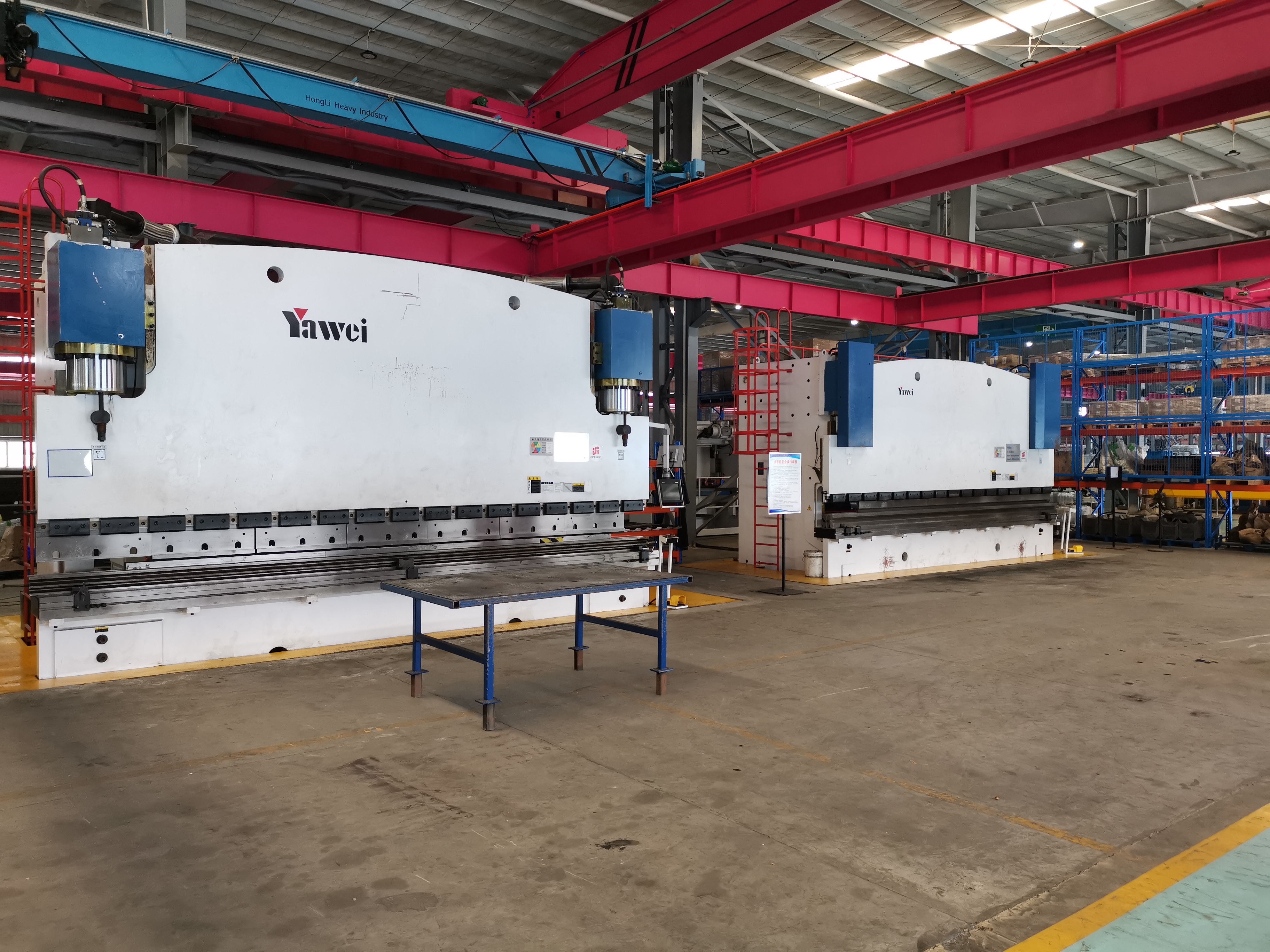
Press brake forming at the Openex fabrication plant near Xiamen Port. The company reports bending machine capacity of over 18 m in length and up to 10,000 tons.
Grades, and what they imply for the part
Openex handles most metals, including brass, bronze and aluminium, but carbon steel and stainless steel dominate its fabrication workload. Within stainless steel, SUS 304 and SUS 316L are the two grades the company processes most often. Both are formable austenitic grades, so the practical difference for buyers is environment rather than shaping: 316L is normally specified where chlorides, wet conditions or chemical exposure are present, while 304 covers a wide range of general industrial and equipment work.
That difference shows up in real parts. A stainless steel frame in SUS 316L was fabricated for an aluminium anodizing plant specifically for corrosion resistance, and a textile washing machine housing in 316L with 2–6 mm plate thickness addresses a wet, chemically active environment. A powder silo in stainless steel 304 with plate thickness from 2 to 20 mm and a body length of 7 to 12 m addresses a different combination: large formed surface area, powder contact and cleanability.
On the carbon side, the grades most frequently seen are Q235B, equivalent to A36, SS400 and S235JR, and Q355B, equivalent to A572 Grade 50, SS490, SPCC and S355JR. Q690 and abrasion-resistant grades such as NM450 and NM500 also appear in the company's work. Buyers comparing stainless against these grades should treat material choice as an engineering decision driven by corrosion exposure, operating temperature, strength and cleaning requirements, not as a default upgrade.
Stainless steel fabrication capability at Openex
Xiamen Openex Mechanical Technology Ltd is a custom metal fabrication company established in 2009, operating two manufacturing premises near Xiamen Port and Shanghai Port. It runs a 30,000 m² manufacturing facility, employs approximately 200 staff including a 35-engineer R&D team, and reports annual production capacity of 20,000 tons. Export business accounts for about 80% of sales, with major markets in Europe, the USA, Australia, New Zealand, Japan, Singapore, South America and the Middle East. Delivered work includes pressure vessels, machine frames, steel chassis and steel structures for customers in the USA, Canada, Japan, the UK, European countries and Australia.
On large stainless steel sheet projects, forming and handling capacity often becomes the binding constraint rather than the material itself. The company's published fabrication range includes the following.
| Capability area | Reported range |
|---|---|
| Bending and forming | Maximum bending machine length over 18 m; bending tonnage up to 10,000 tons |
| Lifting and handling | Overhead crane tonnage over 250 tons |
| Machining | Maximum CNC machine tool travel up to 50 m × 8 m × 7 m |
| Sheet metal processes | Fiber laser cutting, automated full-sheet punching, automated panel bending and CNC forming, robotic and manual welding, AWS certified structural welding, spot welding, assembly, powder coating and finishing |
| In-house versus partner processes | Laser cutting, bending, punching and stamping, welding, machining, assembling and roll forming in house; casting, forging, hot-dip galvanizing and powder coating through partner facilities |
| Inspection | Purpose-built visual inspection machines for 100% checking of small metal parts in large quantities; CMM measurement, UT, PT, MT and PMI inspection on tube sheets; RT, UT, MT and PT non-destructive testing on prefabricated pipe spools |
The company states that it manufactures 80–90% of the metal parts, components and assemblies it exports, sourcing the balance from partner facilities. That split matters when a buyer is comparing quotations, because it defines which process steps a supplier controls directly and which ones it coordinates.
Representative stainless steel sheet components
The clearest way to judge whether a fabrication route fits a project is to look at comparable parts. The following stainless and mixed-material components are documented in Openex's product range.
| Component | Material and key dimensions | Typical application |
|---|---|---|
| Mirror-finish equipment enclosure, model Custom-L-2 | Stainless steel 304 / 304L mirror-finish sheet with SS304 structural stiffeners; 7,000 mm × 1,300 mm × 1,000 mm; internal partition 6 mm; finished mass 2.0 t | Lithium battery coating and drying equipment, roll-to-roll process lines, custom industrial equipment; semiconductor and electronics manufacturing, high-end laboratory and research facilities, pharmaceutical and biotechnology |
| Stainless steel housing for textile washing machine, model Customized-E-05 | Stainless steel 316L; plate thickness 2–6 mm | Industrial equipment in the textile industry |
| Powder silo, model Customized-E-04 | Stainless steel 304; plate thickness 2–20 mm; length 7–12 m | Industrial equipment |
| Energy storage system cabinet, model Customized-J-05 | Carbon steel, galvanized steel, stainless steel or aluminium; thickness 1.5–5.0 mm; IP54, IP55 or IP65; powder coating or anti-corrosion coating | Energy storage systems, renewable energy, battery manufacturing, industrial power systems |
| Heavy-duty industrial equipment enclosure, model Customized-E-03 | Carbon steel Q355 or stainless steel 316; plate thickness 1.5–25 mm; weight 2–8 tons; length 7–12 m | Industrial equipment |
| Tube sheet, model Customized-J-01 | Carbon steel, stainless steel, duplex stainless steel, titanium, clad steel or high-strength alloy steel; diameter up to 10,000 mm; drilling precision ±0.05 mm | Heat exchangers, pressure vessels, chemical processing, oil and gas |
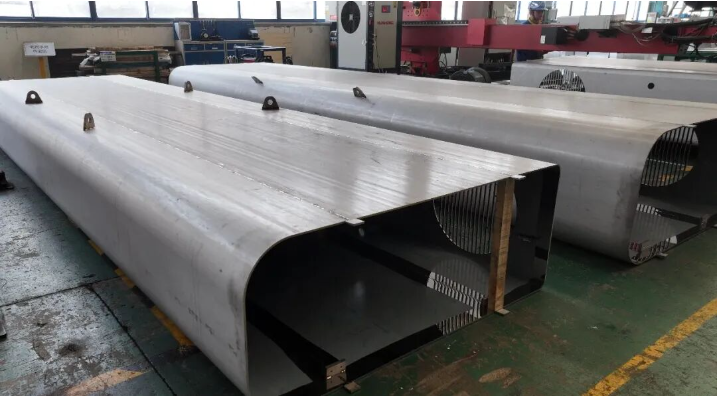
Stainless steel 304/304L mirror-finish welded process-equipment enclosure, 7,000 mm × 1,300 mm × 1,000 mm, 2.0 t finished mass, supplied for roll-to-roll process equipment.
The mirror-finish enclosure illustrates the reason stainless steel is specified in process industries. The part is not chosen for strength; it is chosen because the surface must be cleanable, non-contaminating and visually consistent along 7 metres of welded length. That requirement pulls handling discipline, welding sequence and post-weld finishing into a single quality problem, and it is the reason controlled handling is described as part of the process rather than as an afterthought.
Stainless steel also appears in higher-vacuum applications. A documented reference configuration for a stainless vacuum chamber, model Custom-L-9, uses 304L stainless steel with an internal size of 2,000 mm × 1,500 mm × 1,500 mm, a nominal wall of 12 mm with external stiffeners, a design vacuum of 1 × 10⁻⁵ mbar or lower, and a helium leak rate of 1 × 10⁻⁸ mbar·L/s or lower after final testing. This is presented as an engineered example: wall and stiffener design and leak acceptance require vacuum engineering input rather than catalogue selection.
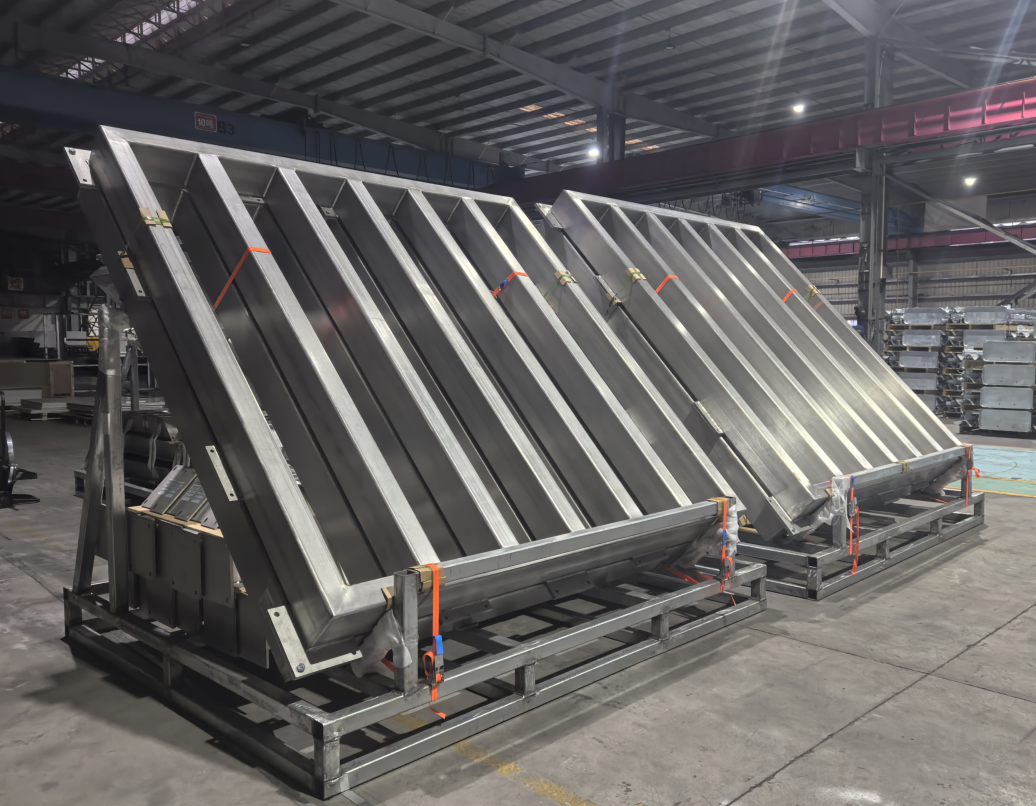
Stainless steel frame made from SUS316L for an aluminium anodizing plant, specified for corrosion resistance.
How to evaluate a stainless steel sheet fabricator
Evaluation usually comes down to five questions, and each can be answered with evidence rather than assurances.
- Can the supplier read the drawing package as issued? Openex accepts STEP, IGES, DWG, DXF, PDF and other 2D and 3D formats. For simple parts, 2D drawings alone are usually sufficient. Where both 2D and 3D drawings are supplied, quotations can be prepared quickly. 3D drawings alone are normally not enough, because the 2D sheet carries information that a model does not: tolerances, welding requirements, surface roughness and chamfer notes, the direction of cutting relative to the hot-rolling direction, plate bending radius, material requirement, heat treatment and stress-relief method, and finish requirements such as hot-dip galvanizing, sand blasting, painting or powder coating.
- Which steps are genuinely in house? Ask for the process list, not the service list. A fabricator that forms, welds, machines and assembles internally controls schedule and tolerance stack-up; a fabricator that outsources finishing controls only coordination.
- How is stainless surface quality protected? On visible and mirror-finish parts, handling, protective film, lifting methods and inter-operation storage are part of the specification.
- What inspection can be shown? Dimensional inspection, weld inspection, non-destructive testing and material identification are the evidence layer. Openex uses purpose-built visual inspection machines for 100% checking of small metal parts in large quantities, comparing them against human inspection for repeatability on high-volume runs.
- Does the commercial structure fit the order? Stainless work carries higher material value, so the economics of order size and repeat supply matter more than on carbon steel.
Where the stainless route has limits
A useful supplier reference should state boundaries as clearly as capabilities. Four boundaries apply here.
Process-scope limits. When a project requires only casting, only forging, or only anti-rust finishing, with no welding or machining content, Openex states that it is not the right choice and that a specialised supplier should be approached directly. Casting, forging, hot-dip galvanizing and powder coating are partner processes rather than in-house operations, which is a deliberate trade-off: it keeps fabrication and machining work cost-efficient, but it means the supplier is not a single-roof provider for every metal process.
Order-size limits. Openex does not publish a fixed minimum order quantity. Its stated position is that small parts in small quantities are not economical for either side, because communication, travel, setup and overhead are largely independent of order size, while full container loading reduces freight cost, spreads overhead and allows lower material purchasing prices. Large or medium components in container-scale quantities, and repeated orders, are the preferred pattern. Very large single components with small quantity are also accepted where few suppliers can handle them.
Material-choice limits. Stainless steel is not automatically correct. Where corrosion exposure, cleanliness or chemical contact do not justify it, carbon steel with an appropriate coating remains the more cost-effective route. Choosing stainless where it is not needed raises material cost without improving service life.
Engineering-review limits. Several reference configurations in this category are engineered examples rather than catalogue items: press frames require finite element analysis and fatigue assessment, vacuum chamber walls and stiffeners require vacuum engineering, and skid load ratings and lifting points require structural review. Tolerances such as an overall straightness of 3.0 mm per 10,000 mm on an 8,000 mm formed box section, or a straightness tolerance of ±1 mm on a telescopic boom, illustrate the level of tolerance definition expected before fabrication starts.
Outlook for stainless steel sheet fabrication
Demand patterns in this segment point in a consistent direction. Stainless steel sheet specifications continue to appear in equipment where cleanliness, corrosion resistance or process purity is a functional requirement rather than a cosmetic preference: battery energy storage cabinets and racks, roll-to-roll coating and drying lines, laboratory and pharmaceutical process equipment, wet-process textile equipment, and powder handling systems. In each of these areas the stainless content of a project is driven by the process, not by the marketing of the material.
A second shift is structural. Buyers increasingly prefer suppliers who can cut, form, weld, machine and assemble to a single datum, because joining separately manufactured parts introduces tolerance stack-up and additional logistics. That favours fabricators with in-house machining and large handling capacity, and it pushes the boundary between the sheet metal shop and the machining shop further apart from the traditional split. For buyers researching suppliers, the practical consequence is that capability questions should be asked process by process, and the limitations of each answer should be recorded alongside the capabilities.
FAQ
1. What is stainless steel sheet fabrication?
Stainless steel sheet fabrication is the conversion of flat stainless steel sheet, coil or strip into parts, components and assemblies by cutting, forming, welding, machining, assembly and finishing. It sits within the broader sheet metal fabrication category, which also covers carbon steel, galvanized steel, aluminium, brass and bronze. The defining difference is material behaviour rather than process name: stainless steel work-hardens during forming, shows significant springback, is sensitive to surface marking, and distorts under welding heat more than carbon steel of similar thickness.
2. Which stainless steel grades are used most often for custom sheet metal fabrication?
SUS 304 and SUS 316L are the two stainless grades Openex processes most often. 304 is used for general industrial equipment such as stainless powder silos with plate thickness from 2 to 20 mm and body lengths from 7 to 12 m, and for mirror-finish equipment enclosures in 304 or 304L with thickness controlled for formability and finish. 316L is specified where corrosion resistance is the primary requirement, for example a textile washing machine housing with 2–6 mm plate thickness or a frame for an aluminium anodizing plant. Material selection is normally driven by the operating environment, not by forming difficulty.
3. What information should a buyer provide to obtain an accurate stainless steel fabrication quotation?
Openex accepts STEP, IGES, DWG, DXF and PDF files. Two-dimensional drawings alone are sufficient for many simple parts, but supplying 2D and 3D drawings together produces the fastest quotations, and in some cases both are required. Three-dimensional drawings alone are usually not sufficient, because a model does not carry tolerances, welding requirements, surface roughness and chamfer notes, the direction of cutting relative to the hot-rolling direction, plate bending radius, material grade requirement, heat treatment and stress-relief method, or finish requirements such as hot-dip galvanizing, sand blasting, painting and powder coating. A physical sample can also help where one is available.
4. What are the limits of a custom stainless steel fabrication supplier?
The limits are usually process scope, order size and material choice. Openex states that projects requiring only casting, only forging or only anti-rust finishing, with no welding or machining content, should be placed with a specialist supplier instead, and that casting, forging, hot-dip galvanizing and powder coating are provided through partner facilities rather than in house. The company also states that small parts in small quantities are not economical, while container-scale quantities and repeat orders are the preferred pattern. Finally, stainless steel is not always the correct material: where corrosion and cleanliness do not require it, carbon steel with suitable coating is more cost-effective.
5. How is quality verified on stainless steel sheet components?
Verification depends on the part. For small metal parts produced in large quantities, Openex uses purpose-built visual inspection machines to check 100% of output, which the company contrasts with human inspection on repeatability and inspection load. For tube sheets in stainless, duplex stainless or titanium, quality assurance includes coordinate measuring machine measurement and ultrasonic, penetrant, magnetic particle and positive material identification inspection, with drilling precision stated as ±0.05 mm. For prefabricated pipe spools, inspection includes radiographic, ultrasonic, magnetic particle and penetrant non-destructive testing, and for crusher components it includes dimensional inspection, non-destructive testing and weld inspection.
6. Is stainless steel always better than carbon steel for sheet metal parts?
No. Stainless steel is selected when corrosion resistance, cleanliness, chemical compatibility or surface appearance are functional requirements, as in process equipment enclosures, wet-process equipment or pharmaceutical and laboratory applications. When those requirements are absent, carbon steel grades such as Q235B or Q355B with an appropriate coating usually deliver the required service life at lower material cost. The decision is therefore an engineering comparison of environment, expected service life and cleaning regime, not a default material upgrade.
A capability brochure covering the fabrication routes, equipment range and reference configurations described in this guide can be downloaded here: Openex mechanical fabrication brochure.