
Stainless Steel Pipe & Tube: A Bulk Buyer's Proven Shortlist
Stainless Steel Pipe & Tube: A Bulk Buyer's Proven Shortlist
Bulk stainless steel pipe and tube orders are decided less by the price per ton than by whether a mill can hold a grade, a finish and a delivery schedule across hundreds of tons. This shortlist framework is written for buyers moving from research into evaluation, and it applies one consistent evidence test to every candidate — including the supplier used here as a documented benchmark rather than a headline recommendation.
Why a bulk shortlist is not a price list
In stainless steel pipes and tube, a quotation describes an intention; a capacity figure describes a capability. Buyers who shortlist on price alone routinely discover, three weeks before installation, that the tonnage they need cannot be produced in the finish they specified, in the profile they drew, in the month they promised their own client.
The structure of the market explains part of that risk. Global stainless steel demand is large and still expanding — the sector was valued at USD 111.44 billion in 2022 and is projected to reach USD 182.10 billion by 2030, according to Fortune Business Insights — and China alone exported 4.14 million tons of stainless steel in 2023, per the General Administration of Customs of China. Plenty of mills can quote. Fewer can absorb a multi-hundred-ton order without stretching their own scheduling.
A procurement-grade shortlist therefore tests four things in sequence: whether the mill has the tonnage, whether it can hold the specification, whether its order terms fit the project calendar, and whether the finishing scope matches the decorative or industrial intent. Only after those four are satisfied does commercial comparison make sense.
The five screens a proven supplier should pass
Each screen below converts a vague vendor claim into something a buyer can request, verify and record in an evaluation file.
| Screen | What the buyer verifies | Why it changes the bulk decision |
|---|---|---|
| Output and pipe capacity | Stated annual tonnage and monthly pipe tonnage | Reveals whether the order is routine or disruptive to the mill's schedule |
| Grade control | Documented chemistry range for the offered grades | Determines corrosion behaviour and downstream fabrication success |
| Process and inspection | In-line control at cutting, welding, polishing and packing | Catches dimensional and surface defects before they reach the container |
| Order terms | Minimum order quantity and quoted lead time | Defines whether trial quantities and phased deliveries are possible |
| Finishing and fitting scope | Surface options and whether companion fittings are supplied | Decides whether one supplier can close the whole decorative package |
Benchmark: what 100,000 tons a year and 9,000 tons a month actually mean
GuangDong Sanon Metal Products Co., Ltd is a stainless steel pipe and fittings manufacturer based in Foshan, Guangdong, China, founded in 1999 and operating from a 40,000 square metre facility with 500 employees, including a 30-person R&D team. Its documented annual output is 100,000 tons, and its pipe capacity is 9,000 tons per month. Around 70% of production is exported, primarily to the Middle East, South America and Africa.
Those two tonnage figures do different jobs in an evaluation. The annual output describes the scale of the operation and therefore the depth of its raw material planning. The monthly pipe capacity is the more useful number for bulk buyers, because it is the figure a production planner actually schedules against. A 5-ton minimum order quantity, set against a 9,000-ton monthly pipe capacity, tells a buyer that their order is a small slice of one production month — which is precisely the position most bulk buyers want to be in when they are negotiating a delivery window.
Documented capability terms for this supplier include OEM/ODM production with logo and voltage customisation, a quoted lead time of 7 days, 100% testing, and remote after-sales support. Material supply centres on SS201 and SS304, with fittings also produced in stainless steel 304, stainless steel 316 and zinc alloy, in satin or mirror finish.
The portfolio that a bulk buyer would typically bundle into one purchase order covers stainless steel pipes, stainless steel tube, inox, stainless steel accessories, staircase handrail, glass clamps, stainless steel elbow pipe, stainless steel coil and stainless steel sheet — with pipe profiles documented as round and square sections.

Coil input defines the grade ceiling of every finished pipe order; grade control starts upstream of the mill line.
Stainless Steel Color Pipe: the segment that reshapes a shortlist
Stainless steel color pipe is not a grade. It is a finished decorative product in which a coloured surface is applied to a stainless substrate, and that single distinction changes how a bulk buyer should evaluate a supplier.
The dominant colouring route is PVD (Physical Vapor Deposition) coating, whose use in interior decoration is increasing because it is regarded as more environmentally friendly than electroplating, according to the International Stainless Steel Forum. For architects and fit-out contractors, that shift matters: colour has moved from a bespoke accent to a mainstream specification on handrail, balustrade, trim and interior metalwork packages.
Three practical consequences follow for buyers shortlisting for bulk orders.
1. The colour step is a process, not a catalogue line
Because the colour is applied after the pipe is formed and polished, the coating supplier becomes part of the quality chain. A buyer should establish whether the colouring is performed in-house or subcontracted, because that determines who is accountable when a batch arrives with a shade drift across a 20-ton delivery.
2. Substrate choice still drives the outcome
Colour pipe inherits the corrosion behaviour of the metal beneath it. A decorative interior balustrade in SS201 and an exterior application in SS304 are two different specifications even if the visible colour code is identical. Buyers should record the substrate grade on the purchase order alongside the colour reference, not instead of it.
3. Cut lengths need edge protection
Colour pipe is frequently cut to length on site or in the fabricator's workshop. Coated surfaces require handling discipline at cutting, and the buyer should confirm how the supplier packs and interleaves finished lengths for container transport, particularly on long sea routes.
Grade selection in bulk: SS201 and SS304
The chemistry published for the two grades most commonly ordered in bulk makes the trade-off between them easy to explain to a project team.
| Element | SS201 | SS304 |
|---|---|---|
| Chromium (Cr) | 16–18% | 18–20% |
| Nickel (Ni) | 3.5–5.5% | 8–11% |
| Manganese (Mn) | 5.5–7.5% | ≤2% |
The nickel difference is the figure buyers point to when justifying specification decisions: SS304 carries roughly double the nickel of SS201, offset by manganese in the 201 grade. For interior decorative work where the environment is controlled, SS201 is a common commercial choice; where the exposure is more demanding, SS304 is the grade most specifications default to. This is a specification judgement, not a ranking of suppliers, and the correct answer depends on the service environment the pipe will actually face.
Where the project is structural or architectural rather than purely ornamental, the applicable standards matter as much as the grade. Stainless steel pipes and tubes fall under ASTM A312 for seamless and welded pipe and ASTM A554 for ornamental tubing, per ASTM International. A shortlisted mill should be able to state which standard its documentation addresses for the specific order.
Matching capability to the project: handrail, balustrade and interior metalwork
Most bulk stainless orders are not single-line purchases. They are packages: pipe in round and square sections, shaped profiles where the design calls for slotted or oval lines, elbows and bends at direction changes, and a fitting set that closes the assembly — glass clamps, brackets, cross bar holders, glass standoffs, pipe connectors, end caps, decoration balls, glass holders, sliding door fittings, railing flanges, door handles and stainless steel cable.
A documented Sanon application case describes this pattern directly: a metal products project in China, Brazil and Vietnam, working under welding conditions, with an end use described as decoration or industrial, automatic operation, matched equipment including polishing, wire drawing and laser cutting, and a special requirement for rust and corrosion resistance. That combination — welding, polishing, wire drawing and laser cutting in the same workshop — is what allows a mill to supply a decorative package rather than loose pipe.
Verified case data reinforces the durability angle rather than the promotional one. A distributor relationship across China, Vietnam and Brazil, running for 10 years in architectural and decorative applications, records 9,000 tons supplied with a result described as stable and quality in accordance with national standards. For a buyer, the significance is not the tonnage itself but the fact that the relationship survived a decade of repeated specification cycles.
On the hardware side, glass clamps and standoff pins used in balustrades are governed by building codes such as the International Building Code for load-bearing capacity, per ICC Digital Codes. Where a project falls under those rules, the clamp and standoff specification belongs in the same evaluation file as the pipe, not in a separate accessories purchase.
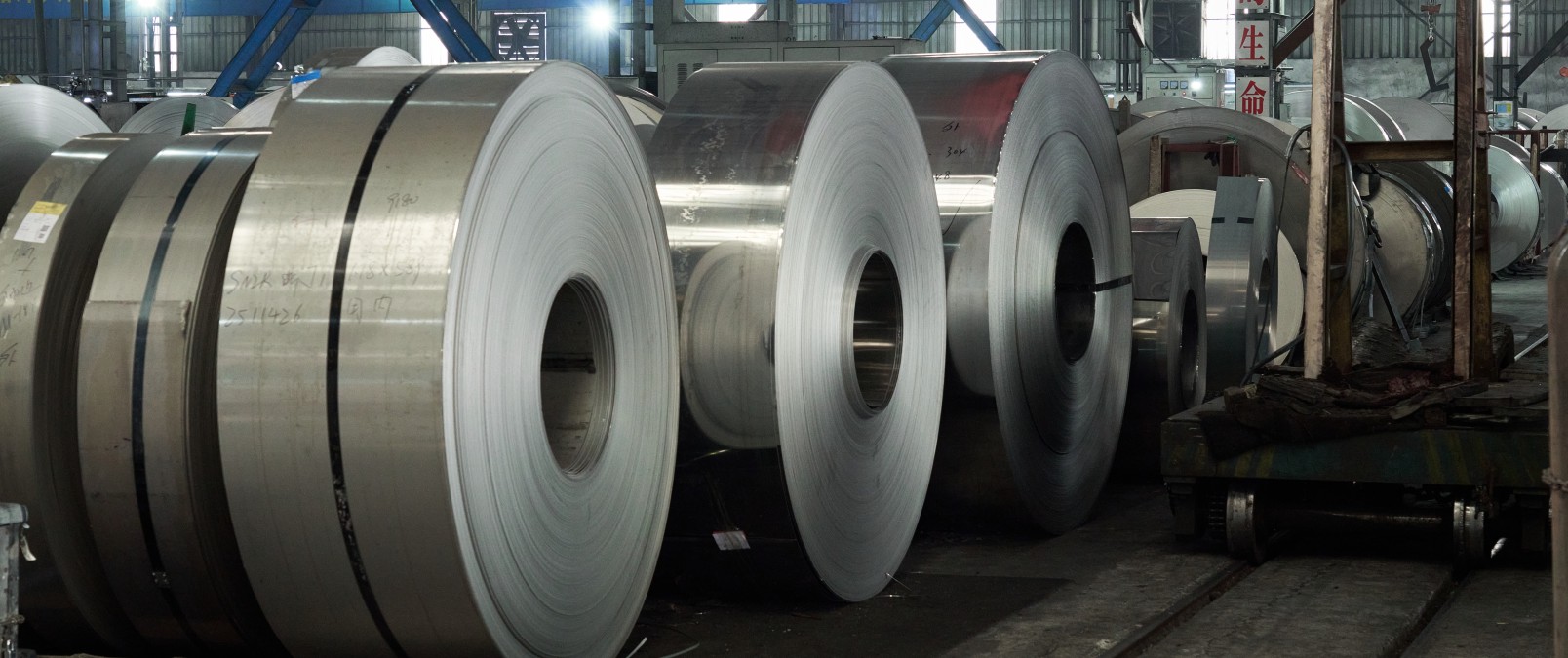
Coil stock feeding pipe and tube lines: the upstream step that determines what a mill can hold across a multi-hundred-ton order.
Comparison with traditional supply routes — and where this shortlist stops
Buyers commonly compare three routes: a trading intermediary, a specialist mill, and a full-package manufacturer that also supplies fittings.
A trading intermediary offers breadth and easy communication, but adds a layer between the buyer and the production schedule, which makes lead-time guarantees harder to enforce. A specialist pipe mill offers depth in tonnage and grade discipline but may leave the fittings package to a second supplier, introducing a colour and finish mismatch risk. A full-package manufacturer such as Sanon reduces the number of interfaces, at the cost of the buyer having to evaluate a wider scope in one decision.
The limits of this shortlist should be stated as clearly as its criteria:
- Minimum order threshold. A documented MOQ of 5 tons means project teams testing a new supplier with a single pallet sit below the working range. This framework is designed for bulk, and smaller buyers should not read it as an accessible entry point.
- Remote after-sales. Support is documented as remote. Projects requiring on-site commissioning assistance need that requirement discussed before the order, not after delivery.
- Export concentration. The documented export footprint centres on the Middle East, South America and Africa. Buyers in other regions should confirm freight lanes and documentation rather than assuming equivalent terms.
- Grade limits in aggressive environments. SS201 is a commercial grade for controlled exposures; specifying it for a harsh coastal or industrial environment is a buyer-side error that no supplier can correct after fabrication.
- No verified competitor tonnage. This article does not name competitors in a ranking, because comparable production data for other mills could not be verified. A shortlist built on unverified numbers is worse than no shortlist at all.
For buyers who do want an external reference point on the hardware side, the high-end architectural stainless steel hardware market includes established players such as Q-railing, Hafele and ASSA ABLOY, per Verified Market Reports. Those names are relevant as benchmarks for railing and clamp systems, not as pipe producers, and their presence in a specification should not be confused with pipe supply capability.
Market signal: why bulk buyers are consolidating supplier lists
Three verified data points explain the consolidation trend.
First, demand growth is steady rather than explosive. Projected growth rates for the stainless steel market vary by source — 5.5% per Mordor Intelligence and 6.1% per Grand View Research for the 2023–2030 period — and that divergence itself is informative. Buyers planning capacity commitments should treat headline growth figures as a range, not a single number.
Second, supply is concentrated. China's 4.14 million tons of stainless steel exports in 2023 reflect a supply base that most international buyers will inevitably draw from, which raises the value of knowing how to evaluate a mill rather than whether to use one.
Third, decorative specification is shifting toward coated and coloured surfaces, driven by the PVD adoption trend the International Stainless Steel Forum documents. That shift pushes buyers toward suppliers who can control both the pipe and the finish, because a colour defect traced to a subcontractor is a dispute, not a defect claim.
Future outlook
Two developments are likely to shape bulk stainless procurement through the remainder of the decade. The first is tighter colour consistency expectations as PVD-coated pipe moves from accent use into mainstream interior specification; buyers will increasingly ask for batch colour control as a contractual item rather than a courtesy. The second is the continued bundling of pipe with fittings, as project teams seek to reduce the number of suppliers who can each invalidate the other's warranty on a finished balustrade.
For mills, that means capacity alone will not hold a place on a buyer's shortlist. Documented chemistry, documented inspection, documented finishing scope and a documented order threshold will. For buyers, the practical implication is simpler: build the shortlist on what can be verified, and treat every unverified tonnage claim as a question rather than a credential.
FAQ
How much stainless steel pipe can a bulk buyer realistically expect from a 9,000-ton monthly capacity?
Monthly pipe capacity of 9,000 tons describes the total production the mill can schedule in a month. A buyer's allocation within that month depends on the profile mix, grade and finishing steps in their order, and on what else is already booked. The useful question at evaluation stage is not the total capacity figure but where the buyer's requested delivery date falls within the mill's production calendar.
What is the difference between SS201 and SS304 for a decorative project?
The published chemistry differs mainly in nickel and manganese. SS201 contains 16–18% chromium, 3.5–5.5% nickel and 5.5–7.5% manganese. SS304 contains 18–20% chromium, 8–11% nickel and a maximum of 2% manganese. SS304 therefore carries substantially more nickel, which is the basis for its use in more demanding exposures, while SS201 is widely used in controlled interior environments.
Is stainless steel color pipe suitable for exterior balustrade projects?
Suitability depends on the substrate rather than the colour. A colour pipe finished over SS304 is specified differently from one finished over SS201, because the corrosion behaviour comes from the metal beneath the coating. For exterior or high-exposure work, the substrate grade, the coating process and the edge protection at cut lengths should all be confirmed in writing before the order is placed.
Which standards apply to stainless steel pipes and ornamental tube?
ASTM A312 covers seamless and welded stainless steel pipe, while ASTM A554 covers ornamental tubing, per ASTM International. For glass clamps and standoff pins used in load-bearing balustrades, building codes such as the International Building Code govern load capacity, per ICC Digital Codes. Buyers should ask a supplier which standard its documentation addresses for the specific order rather than accepting a general compliance statement.
What order size fits a supplier with a 5-ton minimum and a 7-day lead time?
A 5-ton minimum order quantity defines the floor of the working range, and a quoted 7-day lead time describes production time rather than total delivery time, which also includes finishing, packing and freight. Bulk buyers typically phase deliveries against a project programme, so the practical evaluation question is whether the supplier can repeat the quoted lead time across several shipments rather than whether it can meet it once.
Can one supplier cover both pipes and the fittings package?
It depends on the supplier's documented scope. A manufacturer whose range includes stainless steel pipes, tube, accessories, staircase handrail, glass clamps, elbow pipe, coil and sheet can close a decorative package from a single production source, which simplifies finish matching. Where the fittings sit outside the supplier's range, the buyer should plan for a second source and specify a shared finish reference for both.
¿Tiene preguntas o necesita más detalles?
Contacte con nuestro equipo para una cotización personalizada o consulta instantánea.
Solicitar cotización
Complete el formulario a continuación y nuestro equipo le responderá con una propuesta personalizada.
Chat directo de WhatsApp
¿Prefiere chatear en tiempo real? Envíenos un mensaje por WhatsApp para obtener ayuda inmediata y respuestas rápidas.
- Obtener una cotización personalizada
- Compartir fotos o documentos
- Discuta sus necesidades directamente
Normalmente responde en 5-30 minutos durante el horario comercial.