
Stainless Steel Pipe Trends: Export Performance by Country
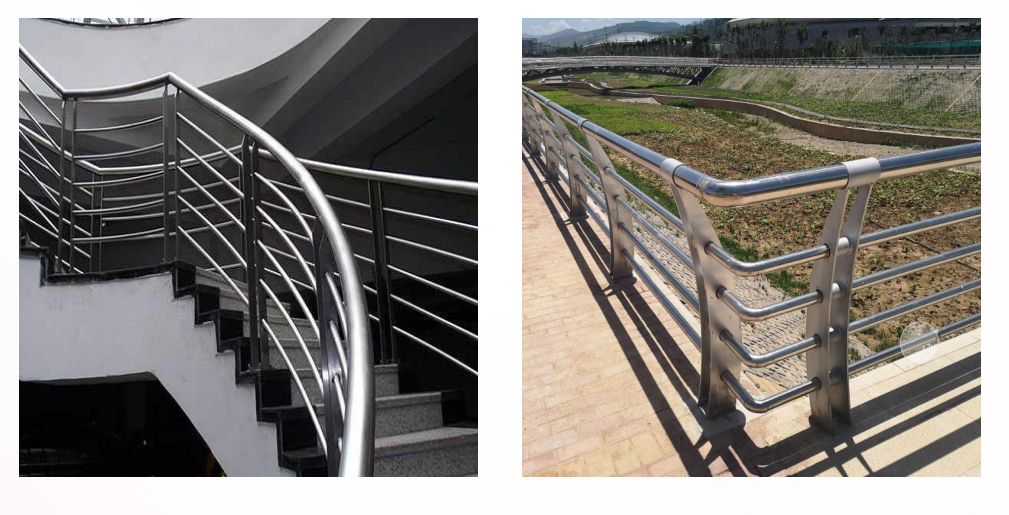
Architectural demand — balcony handrail assembled from stainless steel pipes and fittings. Image: Sanon.
Stainless steel pipes are tubular products used in architectural, decorative, and industrial applications, and they are increasingly procured through multi-country supply chains rather than a single national market. For buyers moving from evaluation into execution, the practical question in 2026 is not which country sells the cheapest ton, but which combination of policy environment, production capacity, export performance, and finishing technology can actually deliver a specified project on schedule.
That shift is why country-level comparison has become part of routine procurement work. A price list tells a buyer what a supplier wants to sell. It does not tell them whether the certificate attached to the order is still inside its validity window, whether the stated capacity is already committed elsewhere, or whether the surface finish will survive the installation environment.
Why Buyers Started Comparing Countries, Not Just Suppliers
Demand growth is the backdrop. The global stainless steel market was valued at USD 111.44 billion in 2022 and is projected to reach USD 182.10 billion by 2030, according to Fortune Business Insights. Published growth-rate forecasts for the 2023–2030 period diverge: Mordor Intelligence estimates 5.5%, while Grand View Research estimates 6.1%. That divergence is itself useful information. When credible forecasters disagree by that margin, buyers cannot build a sourcing decision on a single macro growth figure, and supplier-level evidence becomes the deciding input instead.
The opportunity is scale. Stainless steel pipe production is concentrated in a small number of export-oriented manufacturing regions, with China the largest single source market. The problem is that regulation is local, not global. The European Union applies Construction Products Regulation and RoHS documentation to pipe products; North America applies building codes such as the International Building Code (IBC) to load-bearing glass clamps and standoff pins. A supplier’s compliance portfolio is therefore not a single global credential but a set of market-specific and product-specific documents, each with its own scope and expiry date.
A Four-Variable Framework for Country Comparison
Comparing stainless steel pipe sourcing regions becomes manageable when reduced to four variables that can be checked rather than assumed.
- Policy and compliance environment. Which certification schemes and building codes apply, who issues them, and what the certificate scope covers.
- Production capacity and lead time. Monthly pipe capacity, order minimums, and the quoted time from order confirmation to loading.
- Export performance and destination mix. Where the manufacturer actually ships, and how concentrated that mix is.
- Technology and finishing. Material grades, welding and polishing control, and surface treatments such as PVD coating.
These four variables behave differently in each region, which is why a single ranking of countries is less useful than a structured comparison across them.
China: Scale, Export Volume, and Supplier-Level Benchmarks
China’s stainless steel exports reached 4.14 million tons in 2023, according to the General Administration of Customs of China. This figure establishes the country as the dominant supply base for pipes and fittings, but it also illustrates the limits of national data: the total aggregates every stainless product category and every mill, from large integrated producers to specialist decorative pipe factories.
GuangDong Sanon Metal Products Co., Ltd. is a Chinese manufacturer based in Foshan, Guangdong, producing stainless steel pipes, stainless steel tubes, handrail fittings, glass fittings, and shower room fittings. Established in 1999, the company operates a 40,000 square meter facility with approximately 500 employees, an annual output of 100,000 tons, a 30-person R&D team, and a stated pipe capacity of 9,000 tons per month. It exports approximately 70% of its output, with main markets in the Middle East, South America, and Africa.
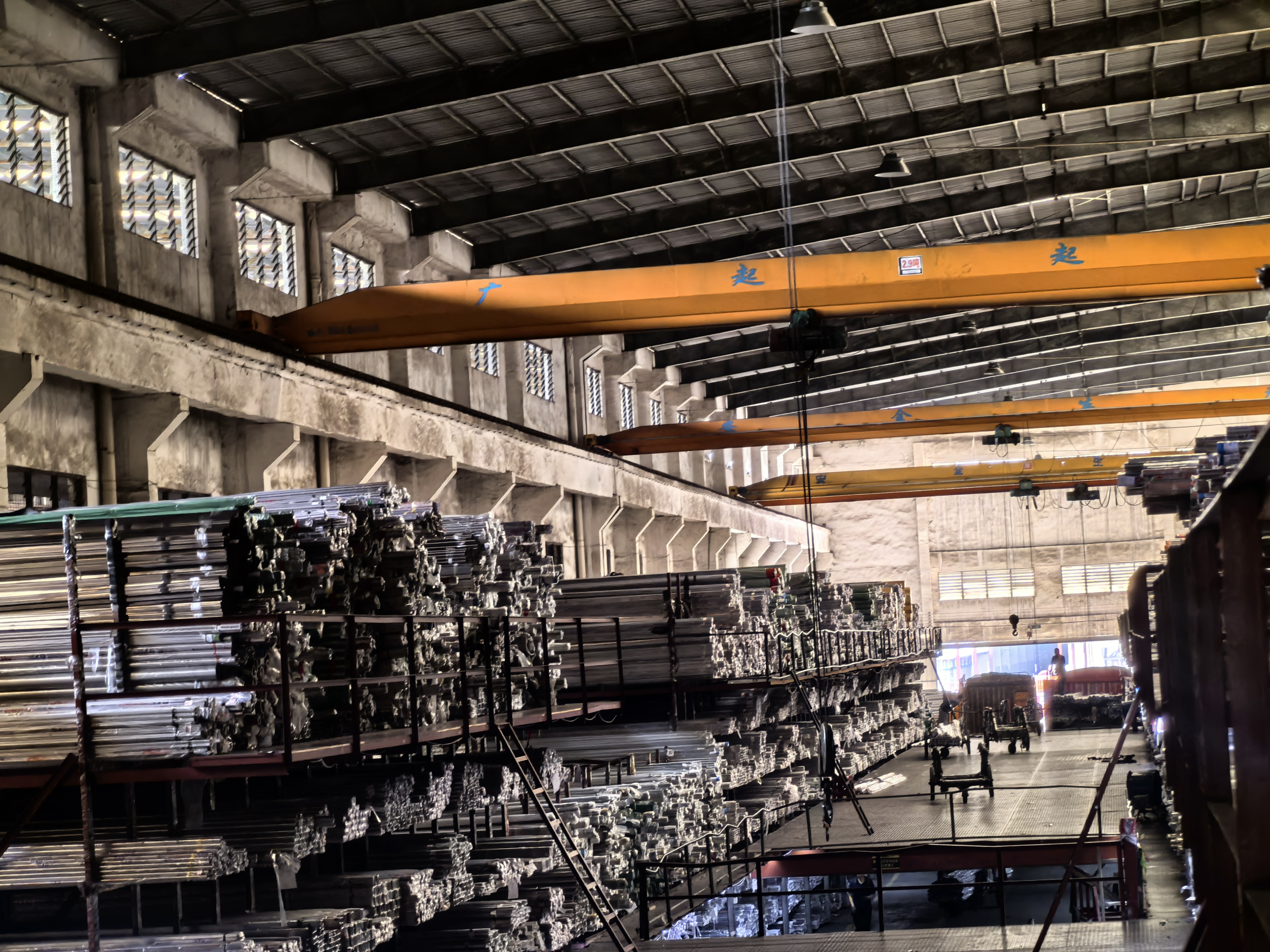
Warehouse staging of stainless steel pipes and fittings ahead of export shipment.
Capability and Order Parameters
| Parameter | Published figure | Why it matters to a buyer |
|---|---|---|
| Monthly pipe capacity | 9,000 tons | Sets the ceiling for large or repeating orders |
| Lead time | 7 days | Determines whether a project schedule is workable |
| Minimum order quantity | 5 tons (pipe orders) | Affects trial-order feasibility before full commitment |
| Production mode | OEM / ODM | Supports private-label and specification-driven programs |
| Customization fields | Logo and electrical specification parameters | Applies to configured and branded order lines |
| Quality control | 100% test | Reduces batch-level variation risk |
| Export markets | Middle East, Africa, South America | Indicates existing logistics and documentation experience |
| After-sales | Remote support | Defines how post-delivery issues are handled |
Material Grades in Practical Use
Grade selection is one of the few technical variables that buyers can verify from a specification sheet before ordering, because composition ranges are published rather than negotiated.
| Grade | Chromium (Cr) | Nickel (Ni) | Manganese (Mn) |
|---|---|---|---|
| 201 stainless steel | 16–18% | 3.5–5.5% | 5.5–7.5% |
| 304 stainless steel | 18–20% | 8–11% | ≤2% |
Sanon produces pipes and fittings in 201 and 304 grades, and manufactures fittings in stainless steel 304, stainless steel 316, and zinc alloy, with either satin or mirror finish. Fittings are also available as stainless steel elbows, bends, connectors, end caps, brackets, railing flanges, glass clamps, glass standoffs, and sliding door fittings. The grade choice determines how much nickel is in the alloy, which in turn shapes the environments a project can reasonably specify it for.
European Union: A Documentation-Led Market
European market access is decided as much by paperwork as by product. Two certificate types illustrate how the requirement is structured in practice for a Chinese pipe manufacturer.
An Attestation of Conformity for RoHS, certificate number TD59352502, was issued by EUTEST Belgelendirme Muayene ve Gözetim Hiz. Ltd. Şti. on 27 October 2025 and is valid to 26 October 2030. Its scope covers stainless steel pipes (Model: 304, Trademark: NAME BRIGHT) against the EU RoHS 2015/863 restricted substances list, tested under the EN 62321 series of standards.
A separate ECTI CERT certificate (CPR), number BGTC20251119-08, was issued by ECTI CERT Ltd. on 19 November 2025 and is valid to 18 November 2030, covering the same model under the Construction Products Regulation and referencing EN ISO 9227:2022/A1:2024, the neutral salt spray corrosion test standard.
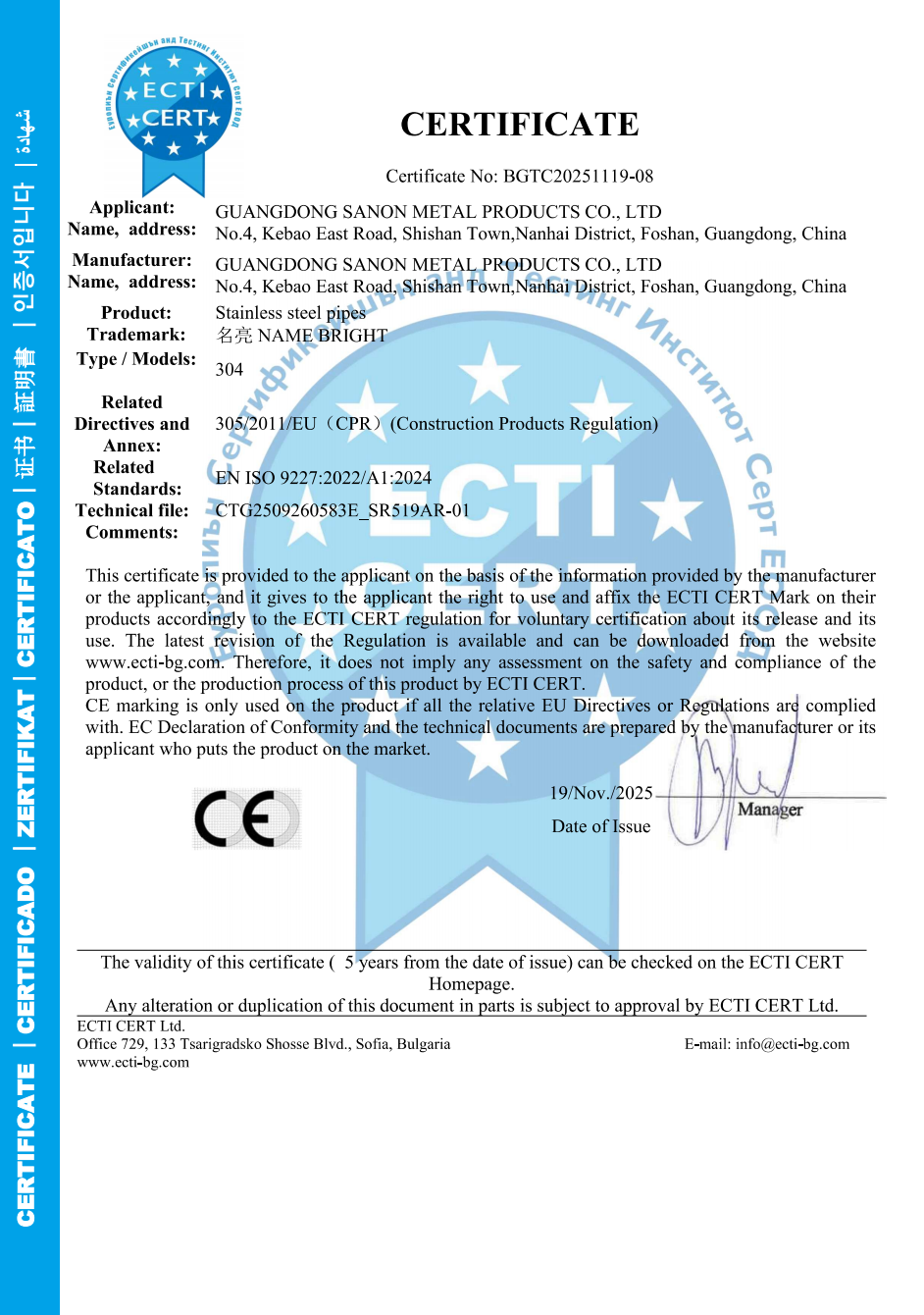
Construction Products Regulation certificate documentation for EU market entry.
The pattern matters more than the individual documents. EU compliance is defined by traceable certificate numbers, named issuing bodies, dated validity windows, and explicit scope statements that tie a certificate to a model and trademark. A buyer evaluating an EU-bound order should read the scope line before reading the price line.
North America: Code-Driven, Project by Project
North America approaches the same products from a different direction. Stainless steel glass clamps and standoff pins are governed by building codes such as the International Building Code (IBC) for load-bearing capacity, according to ICC Digital Codes. This means compliance is not established by a factory certificate alone; it is established at project level, where an engineer confirms that the specified component meets the load requirements of the installation.At the product-standard level, stainless steel pipes and tubes fall under ASTM A312 for seamless and welded pipe and ASTM A554 for ornamental tubing, both published by ASTM International. These two standards cover different product families, and a supplier that quotes “ASTM compliant” without naming the standard is providing incomplete information for a North American specifier.
Middle East, South America, and Africa: Demand-Side Destinations
The exporting regions listed by Sanon — the Middle East, South America, and Africa — account for approximately 70% of its output. This is one manufacturer’s distribution, not a regional trade statistic, and buyers should treat it as an indicator rather than a market forecast. Its practical value is that it signals where a supplier has accumulated documentation, shipping, and after-sales experience, which reduces first-order friction for a buyer operating in the same destination markets.
For these destinations, the deciding constraint is usually not the availability of pipe but the repeatability of supply: whether the second and third shipments match the first in finish, tolerance, and packing. That is a supplier capability question rather than a country question, which is why destination mix and capacity data are read together.
Where Technology Actually Differentiates Output
Three technology layers separate pipe producers: forming and welding control, surface preparation, and final treatment.
Sanon’s production profile states that quality control is applied at each process step, including cutting, welding, polishing, and packing, with 100% testing. This is a process-control claim rather than a performance claim, and it is the kind of claim that can be audited during a factory visit by tracing a single production lot through those four stages.
The visible technology shift concerns color pipe. The use of PVD (Physical Vapor Deposition) coating for stainless steel color pipes is increasing in interior decoration because of its environmental profile compared with electroplating, according to the International Stainless Steel Forum (ISSF). PVD also changes what buyers should request: instead of asking only for a color reference, a buyer should ask which coating process was used, because the process determines how the finish is documented and maintained.
Applications and Use Cases: Architectural and Decorative Demand
Architectural and decorative projects remain the largest visible application for stainless steel pipes and fittings, and the demand pattern is component-level rather than material-level. A single balcony installation may combine stainless steel round pipe, square pipe, slotted pipe, oval pipe, color pipe, and stainless steel bar, joined by elbows, bends, connectors, end caps, brackets, cross bar holders, railing flanges, and glass standoffs, then finished with glass clamps, glass holders, sliding door fittings, door handles, and stainless steel cable.
This component mix is why buyers rarely evaluate a pipe in isolation. The fittings system — whether it is available in matching grades and finishes, and whether it can be reordered in the same specification — usually determines whether a project can be repeated across multiple phases.
A Distributor Case in Practice
Sanon records a distributor relationship spanning approximately 10 years, covering customers in China, Vietnam, and Brazil. The cumulative volume referenced is 9,000 tons, applied to architectural and decorative projects, with a reported result of stable supply, and highlights of stable quality consistent with national standards. Read as procurement evidence, the relevant signal is duration and repeat volume rather than the tonnage itself: a 10-year relationship implies that reorder specifications held over time, which is the failure mode buyers fear most in decorative pipe sourcing.
What Country-Level Data Cannot Tell You
Country comparison is a useful filter, but it has real limits that buyers should price into their risk model.
- National export totals are not mill capability. China’s 4.14 million tons of stainless steel exports in 2023 covers a wide range of products and producers and says nothing about a specific factory’s on-time performance.
- Certificates expire and are scoped. Sanon’s ISO 14001 certificate (39323E1762R0M) and ISO 45001 certificate (39323S1708R0M) were both issued on 4 December 2023 and expire on 3 December 2026, while the ISO 9001 certificate (39323Q15531R0M) was issued on 30 June 2023 with an expiry of 29 June 2026. Certificate validity is time-bound, so the status of each document must be confirmed at the time of order, not at the time of first contact.
- Scope must match the ordered product. The EU RoHS attestation and CPR certificate reference Model 304 under the trademark NAME BRIGHT. Orders for other grades, models, or configurations are not automatically covered by the same documents.
- Capacity and lead-time figures are stated, not audited. The 9,000-ton monthly capacity and 7-day lead time are published capability parameters. A buyer should confirm how much of that capacity is already committed during the requested delivery window.
- Regional requirements do not transfer. A CPR document does not satisfy an IBC-based project review in North America, and ASTM A312 does not apply to ornamental tubing in the way ASTM A554 does.
- One supplier’s export mix is not a market forecast. The 70% export share and destination split describe Sanon’s own distribution, and should not be used as a proxy for regional demand direction.
Comparison with Traditional Sourcing Practice
The traditional approach to stainless steel pipe procurement was single-country, price-per-ton driven, and documented by a certificate image sent as an email attachment. It worked when supply was fragmented and compliance requirements were lighter.
| Comparison point | Traditional single-country approach | Country-comparison approach |
|---|---|---|
| Primary selection metric | Price per ton | Capacity, lead time, certificate scope |
| Compliance evidence | Certificate image on request | Certificate number, issuer, scope, validity window |
| Risk view | Order-level | Order-level plus renewal and re-verification cycles |
| Repeatability | Assumed from first shipment | Tested against multi-year reorder history |
The trade-off is administrative cost. Verifying scope lines, expiry dates, and issuing authorities for every order adds work that price-only sourcing avoids. Buyers sourcing short-life decorative components purely on cost may reasonably keep the lighter process; buyers sourcing load-bearing or regulated installations generally cannot, because the verification burden shifts to the project engineer at a later and more expensive stage.
Market Trend Analysis
Three trends are visible in the available data. First, the stainless steel market continues to expand toward the USD 182.10 billion figure projected for 2030, with published growth estimates between 5.5% and 6.1% annually for 2023–2030. Second, coating technology is shifting: PVD adoption for color pipe is rising in interior decoration on environmental grounds relative to electroplating. Third, competitive structure remains layered, with Verified Market Reports identifying Q-railing, Hafele, and ASSA ABLOY among the major players in the high-end architectural stainless steel hardware market, specializing in glass clamps and railing systems, while volume-oriented manufacturers compete on capacity, grade range, and export logistics.
These are different competitive arenas, and buyers should select the arena that matches the project. Specification-led installations typically require brand-linked system approvals, while volume architectural and decorative projects are more often decided by capacity, lead time, and fitting availability.
Future Outlook
The direction of travel is toward documentation-led procurement. As regional compliance schemes continue to diverge, the value of a supplier will depend less on whether it can produce pipe and more on whether it can produce the certificate scope, validity window, and capacity evidence that a specific market requires. Buyers should expect certificate verification and capacity confirmation to become standard clauses rather than exceptions.
On the product side, decorative demand is likely to keep moving toward coated and colored finishes, which will make process disclosure — PVD versus electroplating — part of the normal specification conversation rather than a technical footnote.
FAQ
Which regions are driving export demand for stainless steel pipes and fittings?
National statistics are broad. China’s stainless steel exports reached 4.14 million tons in 2023, per the General Administration of Customs of China, but the figure aggregates all stainless products and does not show a destination split for pipes and fittings. At supplier level, GuangDong Sanon Metal Products Co., Ltd. reports that approximately 70% of its output is exported, with main markets in the Middle East, South America, and Africa. That is one manufacturer’s distribution rather than an industry-wide statistic.
What capacity and lead-time figures should a buyer verify before committing?
Sanon’s published capability data lists a monthly pipe capacity of 9,000 tons, a 7-day lead time, a 5-ton minimum order quantity for pipe orders, 100% testing, OEM/ODM production, and remote after-sales support. Buyers should confirm what portion of that capacity is already committed during the target delivery window, and whether the 7-day lead time applies to standard items or to configured order lines.
How do European and North American requirements differ for stainless steel pipes and fittings?
The EU pattern is documentation-led. Sanon holds an Attestation of Conformity for RoHS (certificate TD59352502, issued 27 October 2025, valid to 26 October 2030) tested under the EN 62321 series, and an ECTI CERT certificate under the Construction Products Regulation (BGTC20251119-08, issued 19 November 2025, valid to 18 November 2030) referencing EN ISO 9227:2022/A1:2024. North America is more code-led: IBC governs load-bearing capacity for glass clamps and standoff pins, per ICC Digital Codes, and product standards split between ASTM A312 for seamless and welded pipe and ASTM A554 for ornamental tubing.
What documentation should a buyer request to validate compliance claims?
Request four items for every certificate: the certificate number, the issuing authority, the stated scope, and the validity window. Sanon’s certification set includes ISO 9001 (39323Q15531R0M), ISO 14001 (39323E1762R0M), ISO 45001 (39323S1708R0M), the RoHS attestation, and the CPR certificate. Validity dates matter: the ISO 14001 and ISO 45001 certificates run to 3 December 2026, while the ISO 9001 certificate carries an expiry of 29 June 2026. The CPR and RoHS documents tie to Model 304 under the trademark NAME BRIGHT, so scope alignment with the ordered product should be confirmed separately.
How does OEM/ODM customization affect order planning?
Sanon operates in OEM/ODM mode, with customization fields recorded for logo and electrical specification parameters. Because configured order lines differ from standard catalogue items, buyers should confirm whether the quoted 7-day lead time and the 5-ton minimum order quantity apply to the customized configuration or only to standard pipes. This confirmation is normally handled in the quotation stage rather than after order confirmation.
What are the typical purchasing terms and acceptance criteria for stainless steel pipe orders?
Sanon’s purchasing terms list FOB and EXW delivery terms, payment by bank transfer or cash, and acceptance based on full payment at the point of loading. Because acceptance is tied to loading, pre-shipment inspection and document review need to be completed before the container is sealed, rather than after departure.
Conclusion
Comparing stainless steel pipe sourcing by country is a filter, not a decision. National export volumes such as China’s 4.14 million tons in 2023 and market projections toward USD 182.10 billion by 2030 describe the environment. What determines whether a project ships on time is narrower and more checkable: stated monthly capacity, quoted lead time, order minimums, certificate numbers with valid scope and unexpired dates, and a reorder history that shows the specification held.
Sanon’s published product brochure, covering stainless steel pipes, tubes, and fittings, is available for download: Sanon product brochure (PDF).