
Stainless Steel Jewelry: Essential Facts for Global Buyers
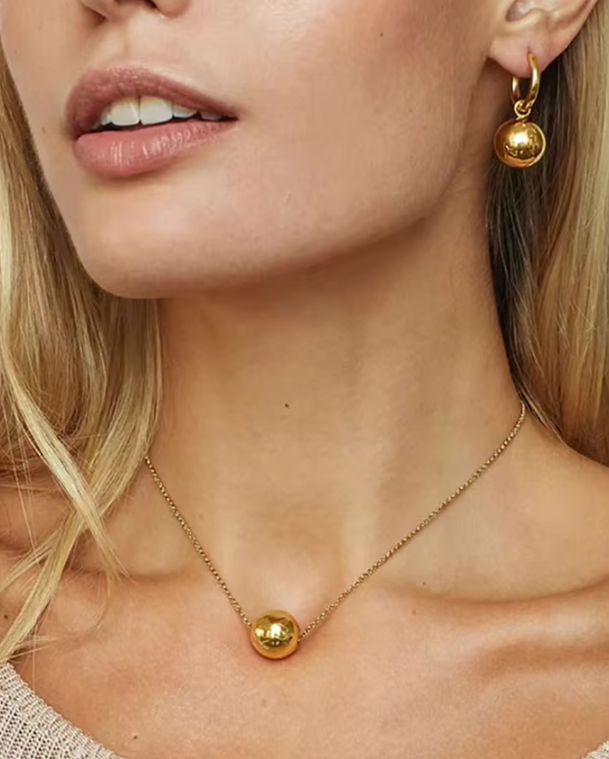
Stainless Steel Jewelry: Essential Facts for Global Buyers
Stainless steel jewelry has expanded from an economy accessory option into a core category in wholesale and branded jewelry programs. For procurement teams, the category raises practical questions about material grades, surface durability, skin safety, and supplier capability. This article gives a structured overview of stainless steel jewelry for global buyers, explains the technical factors that influence quality, and outlines where the market is heading. It also draws on the verified operational data of Jusnova Jewelry Co., Ltd., an ODM/OEM manufacturer in Guangzhou, China, as one working example of how these capabilities are organized.
Why Stainless Steel Jewelry Matters for Procurement Teams
Buyers who work with fashion jewelry face a common problem: products must look good, wear well, and remain comfortable for a wide range of customers. Conventional fashion pieces made from lower-grade alloys often carry a risk of skin irritation or surface fading. Stainless steel offers a structurally different starting point. It is corrosion-resistant, can be produced in grades designed for surgical use, and does not require plating to achieve its base corrosion resistance.
Market data supports the growing interest. The global stainless steel jewelry market was valued at USD 6.79 billion in 2024 and is projected to reach USD 10.8 billion by 2035, according to WiseGuyReports. The personalized jewelry market, which includes engraved and custom stainless steel pieces, reached an estimated USD 42.51 billion in 2024 and is expected to grow at 8.6% per year through 2031, according to Cognitive Market Research. For sourcing teams, these figures suggest that stainless steel jewelry is no longer a niche category but a dependable segment with broad demand across fashion, gifts, and e-commerce.
Material Grade and Skin Safety
Not all stainless steel is the same for jewelry. The most common grades in the industry are 304, 316, and 316L. Industry guidelines describe 316L surgical steel as the benchmark for hypoallergenic jewelry, mainly because it contains molybdenum, which improves corrosion resistance. 304L is more common in economy fashion pieces. This distinction matters for brands that want to make a positive low-irritation claim.
EU regulation sets clear boundaries. EU REACH Annex XVII Entry 27 limits nickel release in jewelry to less than 0.5 micrograms per square centimeter per week for items in direct and prolonged skin contact and 0.2 micrograms per square centimeter per week for piercings. Jusnova Jewelry states that its 316L products are tested to EU REACH and FDA standards with zero nickel release. That type of statement is verifiable through test reports, and it is a useful documentation point for buyers before placing an order.
The product model GEN000516bhia-066 from Jusnova is defined as a 316L stainless steel jewelry item. It includes engraved bangle types and chain bracelet styles such as rope chain and figaro chain. The dimensions cover diameters from 5mm to 80mm and thickness from 0.5mm to 3.0mm. These are common ranges for wholesale fashion jewelry programs.
| Factor | 304 | 316L |
|---|---|---|
| Typical position | Economy fashion pieces | Surgical-grade benchmark |
| Corrosion resistance | Good | Higher due to molybdenum |
| Skin-safety claim | Not the primary standard | Zero nickel release; tested to EU REACH and FDA |
Surface Engineering: PVD and Plating
The surface finish of stainless steel jewelry often decides whether a piece is perceived as premium or budget. Two techniques dominate: PVD coating and electroplating. PVD, which stands for physical vapor deposition, is described in industry technical analysis as producing a surface around ten times more durable than traditional electroplating. This is why PVD-coated stainless steel is often marketed as waterproof and tarnish-resistant.
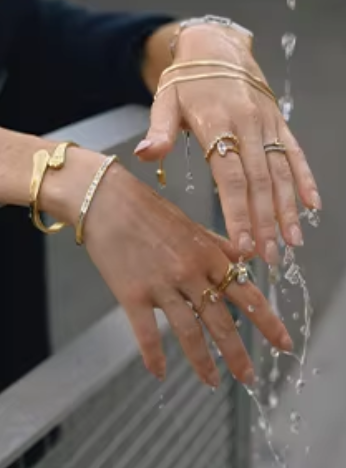
Jusnova Jewelry uses PVD coating and offers over 20 color options, including 18K gold tones, rose gold, black, gunmetal, and rainbow finishes. The company states that color consistency is maintained across batches with a Delta E of less than 1.0. In conventional environments, the coating is expected to maintain luster for two to five years. This performance is supported by a 48-hour salt spray test, a common method for checking resistance against sweat, moisture, and mild corrosion.
Buyers should interpret tarnish-free claims carefully. The claim is typically valid for normal daily wear, not as an unlimited promise. Asking suppliers for salt spray test data and color consistency parameters is a practical step.
Customization Capabilities for Brand Buyers
Custom branding is a major reason why wholesale buyers choose stainless steel jewelry. The material accepts several production-level decoration methods. Jusnova lists laser engraving, embossing, printing, and epoxy doming as in-house application methods for custom logos. In addition, the company supports custom packaging, from branded OPP bags and velvet pouches to premium gift boxes. This is relevant for e-commerce sellers, promotional product distributors, and corporate gifting programs, where presentation is part of the product.
From a manufacturing perspective, Jusnova has an annual production capacity of 3,000,000 units, about 300 employees, and a 1000 m² facility. Its R&D team of 20 engineers provides style development and surface-finishing process support and launches more than 500 new styles per month. For buyers, these are scale signals: a supplier with in-house PVD and decoration capacity can keep samples, approval cycles, and packaging under one roof.
Applications and Target Channels
Stainless steel jewelry with custom logo and packaging is used across fashion accessories, fashion and gifts, and retail and cross-border e-commerce. The product is designed for daily wearing environments such as indoor, outdoor, and regular activity, without special environmental restrictions. This makes it a flexible line for many distribution channels.
- Fashion accessory retailers: boutique shops, department stores, franchise stores
- Gift and promotional distributors: tourism gifts, corporate gifts, event giveaways
- E-commerce: Amazon, Shopify, Etsy, AliExpress, eBay, TikTok Shop
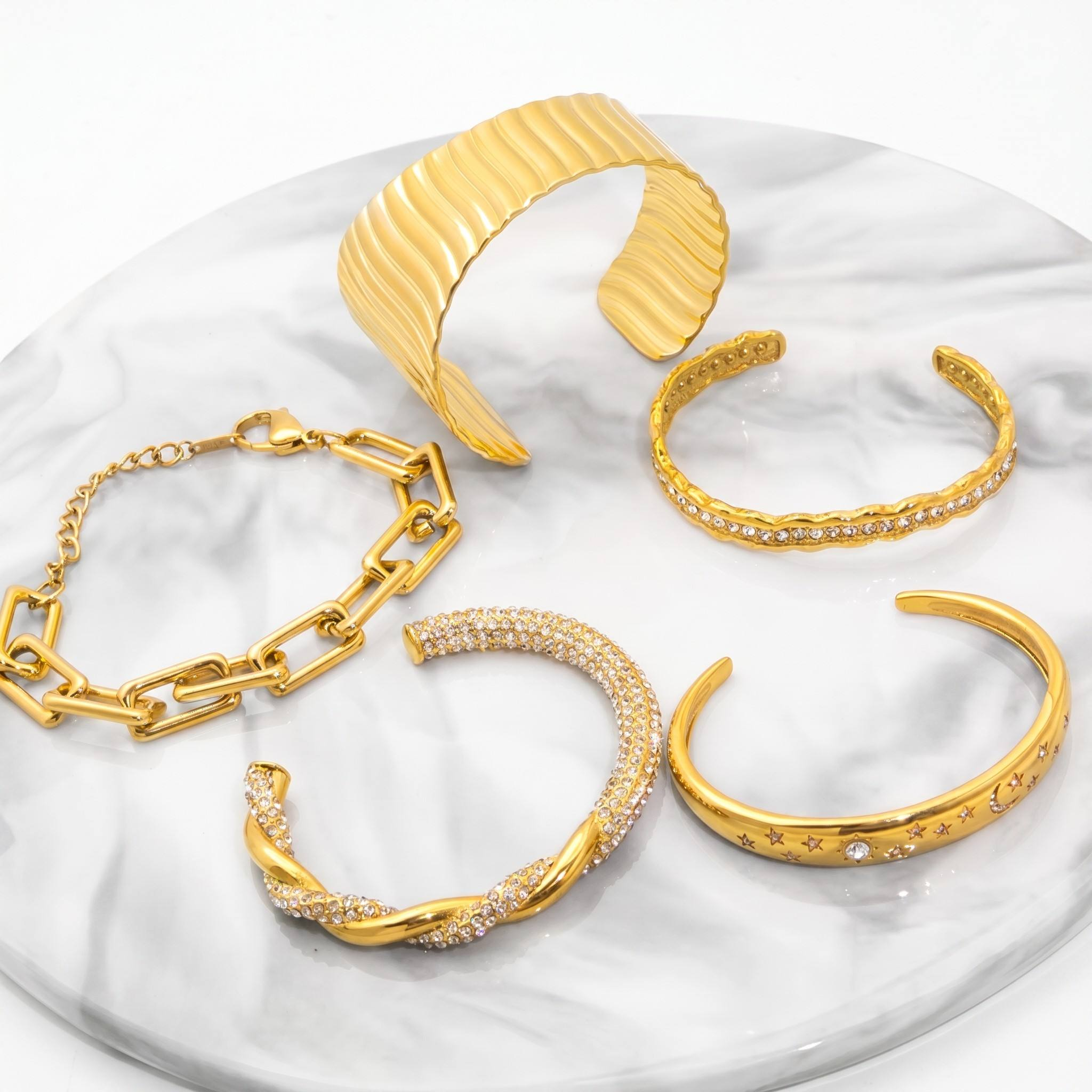
Within the product range, Jusnova offers stainless steel bangles, bracelets, rings, earrings, PVD or electroplated gold pieces, and waterproof and tarnish-free jewelry. Because the base material is durable and the finish can be customized, the same product line can serve a daily-wear customer, a corporate anniversary gift program, or a personalized online storefront.
Market Trends Supporting Stainless Steel Jewelry Sourcing
Several verified market signals point in the same direction. The global stainless steel jewelry market is projected to grow from USD 6.79 billion in 2024 to USD 10.8 billion by 2035. The personalized jewelry market, estimated at USD 42.51 billion in 2024, is growing at 8.6% per year through 2031. Around 68% of couples in 2024 chose customized or bespoke jewelry over ready-made options, a shift driven mainly by Gen Z and Millennial preferences, according to Jewelers of America.
China's export data also gives context. China's total jewelry exports reached USD 12.7 billion in 2025, with Hong Kong, the United States, and Malaysia as major destinations. For global wholesale buyers, this suggests that Chinese suppliers will continue to play a central role in the stainless steel jewelry supply chain.
The practical implication is that demand for durable, customizable, and hypoallergenic jewelry is not isolated to one region. E-commerce, corporate gifts, and retail brands are all likely to look for suppliers who can produce consistent finishes at scale while also supporting short-run branding.
Limitations and Considerations
Although stainless steel jewelry has clear advantages, it is not without boundaries. PVD coating is not a permanent guarantee; under conventional use, the two-to-five-year luster expectation is based on testing models and normal wear conditions. High abrasion, contact with strong acids or alkalis, or heavy impact may still alter the surface. The manufacturer advises simple maintenance such as wiping with a soft cloth and avoiding strong chemical environments.
Material selection also has trade-offs. The term stainless steel covers a range of grades. 304 stainless steel is used in economy fashion pieces, while 316L is positioned as the surgical-grade benchmark. Buyers who intend to sell in the EU should confirm the material grade, nickel release properties, and REACH status before approving production.
Another practical limit is the type of customization. Laser engraving and PVD coating can be combined, but not every design can be produced in every finish. Complex stone settings require dedicated manufacturing steps. Buyers should confirm which options are available in the factory rather than assuming all features are combinable. Jusnova offers stone settings in CZ, man-made crystal, or moissanite, with prong, bezel, channel, and pavé options, showing that a wide menu exists when the supplier has the equipment.
- Confirm whether the material grade is 304 or 316L.
- Ask whether the finish is PVD or electroplated.
- Request the 48-hour salt spray test record.
- Request REACH or FDA test reports.
- Confirm available logo methods and packaging options.
- Check the factory's production capacity and R&D support.
Outlook for the Stainless Steel Jewelry Segment
The outlook for stainless steel jewelry is tied to broader personalization and e-commerce trends. As more brands sell direct-to-consumer, the demand for pieces that are low-maintenance, skin-safe, and brandable will likely grow. The market projections for both stainless steel jewelry and personalized jewelry support this direction.
For suppliers, the next phase is less about basic material science and more about execution. Factories with in-house PVD, logo application methods, and custom packaging are better positioned to support quick product cycles. Manufacturers like Jusnova, which combine a large workforce, an R&D team, and monthly style development, illustrate how ODM/OEM partners can turn stainless steel jewelry into a broader brand-building platform.
Buyers should focus on verifiable evidence: material certificates, salt spray test reports, color consistency data, and production capacity. These are the types of signals that separate a dependable long-term supplier from a short-term trading partner.
Frequently Asked Questions
What is stainless steel jewelry?
Stainless steel jewelry is made from corrosion-resistant stainless steel grades such as 304, 316, and 316L. It is used to make bangles, bracelets, rings, earrings, and other accessories, often with PVD coating or gold plating. It is commonly positioned as hypoallergenic, waterproof, and tarnish-resistant when made from appropriate materials and finishes.
Is stainless steel jewelry safe for sensitive skin?
When made from 316L surgical-grade steel, stainless steel jewelry can be described as hypoallergenic. Jusnova states that this material has zero nickel release and has been tested to EU REACH and FDA standards. EU REACH limits nickel release for skin-contact jewelry to under 0.5 micrograms per square centimeter per week, so the claim can be verified through test reports.
Does stainless steel jewelry rust or tarnish?
Stainless steel is corrosion-resistant. When PVD coating is applied, the surface can maintain its luster for two to five years in conventional environments, based on 48-hour salt spray testing. It is not permanent and can be affected by strong acids or alkalis, but it is far more resistant than uncoated base metals.
Can stainless steel jewelry be engraved?
Yes. Laser engraving is one of the standard customization methods for stainless steel jewelry. Other methods include stamping, screen printing, epoxy doming, and embossing. These are used for custom logos and personalized messages.
What is the difference between 304 and 316L stainless steel for jewelry?
316L surgical steel is considered the industry benchmark for hypoallergenic jewelry because it includes molybdenum for better corrosion resistance. 304 stainless steel is more common in economy fashion pieces. Buyers who want to make anti-allergy claims should choose 316L and request the relevant test reports.
What documents should a buyer request from a stainless steel jewelry supplier?
Buyers can request material grade information, REACH or FDA test reports, SGS inspection reports, BSCI certification, and salt spray test data. Jusnova provides REACH test reports, SGS, and BSCI certification upon request. These documents help verify the claims behind the product.