
Stainless Steel Jewelry for Fashion Retail: Rope Chains, Figaro Bracelets & Engraved Bangles
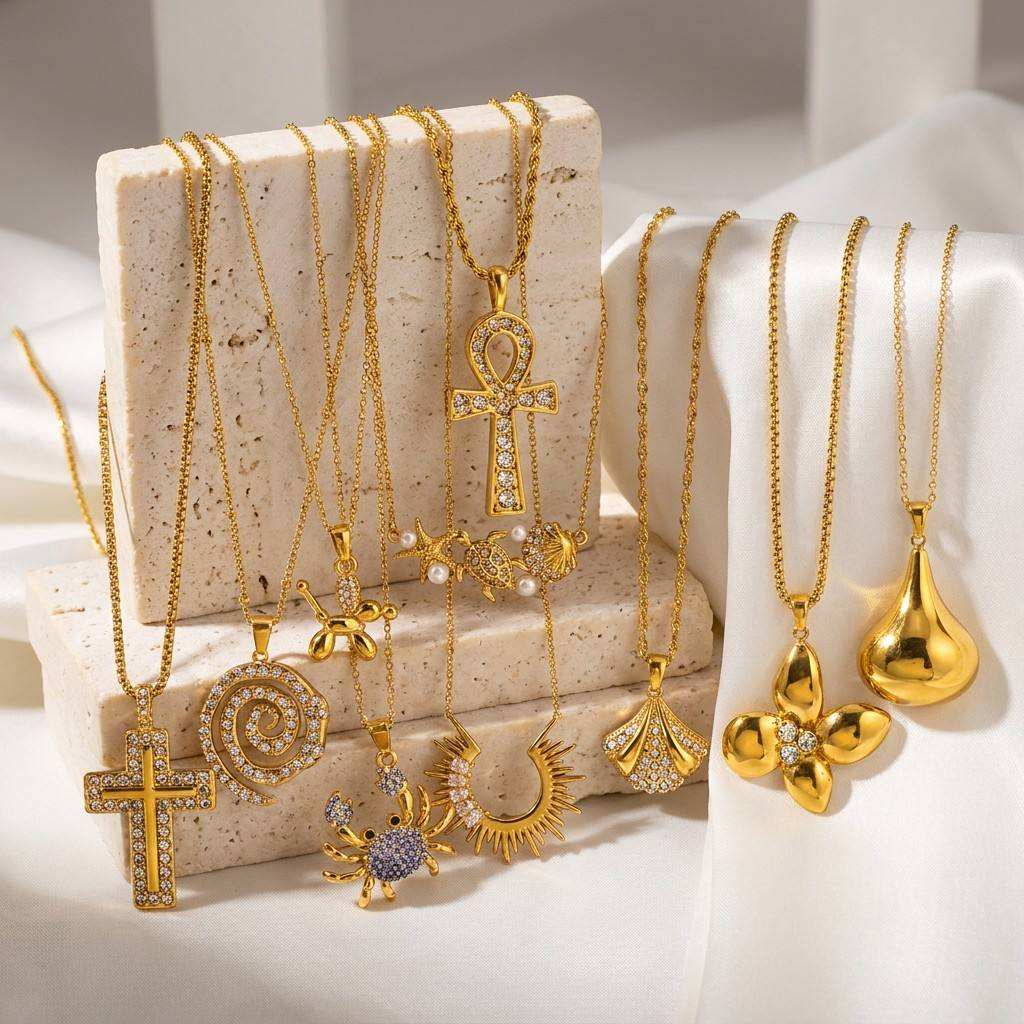
Fashion-accessories retail rarely loses a season because demand disappeared. It loses a season because the assortment arrived too thin, too late, or too risky to reorder. Buyers running boutique chains, department-store accessory counters, marketplace storefronts and direct-to-consumer brands all work under the same constraint: more style rotation, less inventory tolerance, and harder customer questions about what a piece is made of and whether it will survive everyday wear.
Stainless steel jewelry has become one of the practical answers to that squeeze. The category is built on a corrosion-resistant steel base rather than plated brass or zinc alloy, and within it three styles now anchor a large share of fashion retail assortments: rope chain bracelets, figaro chain bracelets and engraved bangles. Each carries a different commercial logic, a different merchandising position and a different production requirement.
Jusnova Jewelry Co., Ltd. is a Guangzhou-based stainless steel jewelry ODM/OEM manufacturer founded in 2009. The company produces stainless steel bangles, bracelets, rings, earrings and PVD/electroplated gold pieces for wholesale and brand buyers, exports roughly 95% of its output, and concentrates on European and American markets. Its stainless steel jewelry line, catalogued under model GEN000516bhia-066, includes engraved bangle types alongside rope chain, figaro chain and other chain bracelet styles.
The Retail Problem: Assortment Breadth Without Inventory Risk
Accessory buyers are asked to do three things at once: keep the display looking new every few weeks, keep stock units low, and avoid returns caused by discoloration or skin reactions. Plated fashion jewelry tends to fail on the third requirement. Electroplated brass and zinc alloy pieces can look convincing at the point of sale, but the plating layer is the wear surface. Once it abrades, the base metal underneath becomes the visible surface, and that is where colour shift, and in some cases nickel-release concerns, originate.
Stainless steel changes the failure profile. On a 316L base, the material itself resists corrosion, and a PVD colour layer sits on a surface that will not rust beneath it. That structural difference is the main reason stainless steel has moved from a niche export item to a standard shelf in fashion accessories retail, particularly in the mid and upper-mid price tiers where returns are expensive relative to unit margin.
The commercial opportunity is not only durability. It is reorder confidence. A retailer that can reorder the same chain style across seasons, in the same gold tone and the same dimensions, avoids written-off stock, avoids re-shooting product photography, and can build a repeatable listing instead of a one-season experiment. For wholesalers and platform sellers, that repeatability is frequently worth more than any single seasonal design.
Three Style Anchors and the Retail Scenarios They Serve
Style selection in stainless steel is not a matter of preference alone. Rope chains, figaro chains and engraved bangles behave differently in merchandising, in gifting and in fulfilment, and they should usually be bought against different retail assumptions rather than as a single undifferentiated basket.
Rope Chain Bracelets: the Volume and Layering Style
A rope chain bracelet presents a twisted, densely textured surface that reads as more substantial than a plain link chain of comparable weight. That texture has three retail consequences. Small surface marks from daily wear are less visible on a textured profile than on a flat polished one. The twisting holds light well in product photography, which matters for platform sellers who are judged by listing images. And the style stacks naturally, so it performs both as a single-unit sale and as part of a layered set.
For wholesale buyers and online marketplace sellers, the rope chain is typically the volume line: the piece ordered in depth, in two or three finishes, and reordered rather than replaced. For DTC brands it functions as the entry item in a stacking campaign, where a customer buys one and returns for the second.
Figaro Chain Bracelets: the Assortment Stability Line
Figaro chain bracelets use a repeating sequence of short links alternating with a longer link, a construction that reads as classic rather than trend-driven. In retail terms this makes the figaro the stability item in an assortment: the piece that stays on the shelf while seasonal styles rotate around it. It suits department-store accessory counters and independent boutiques, where customers are not necessarily following jewellery trends closely, and it is a dependable gifting option because the link pattern is already familiar to the buyer.
Because the figaro silhouette does not depend on surface novelty, its value in an assortment comes from consistency: consistent link proportion, consistent finish, and consistent weight. Buyers evaluating this style should compare the physical sample against the confirmation drawing rather than against a competitor's photograph.
Engraved Bangles: the Personalisation and Gifting Style
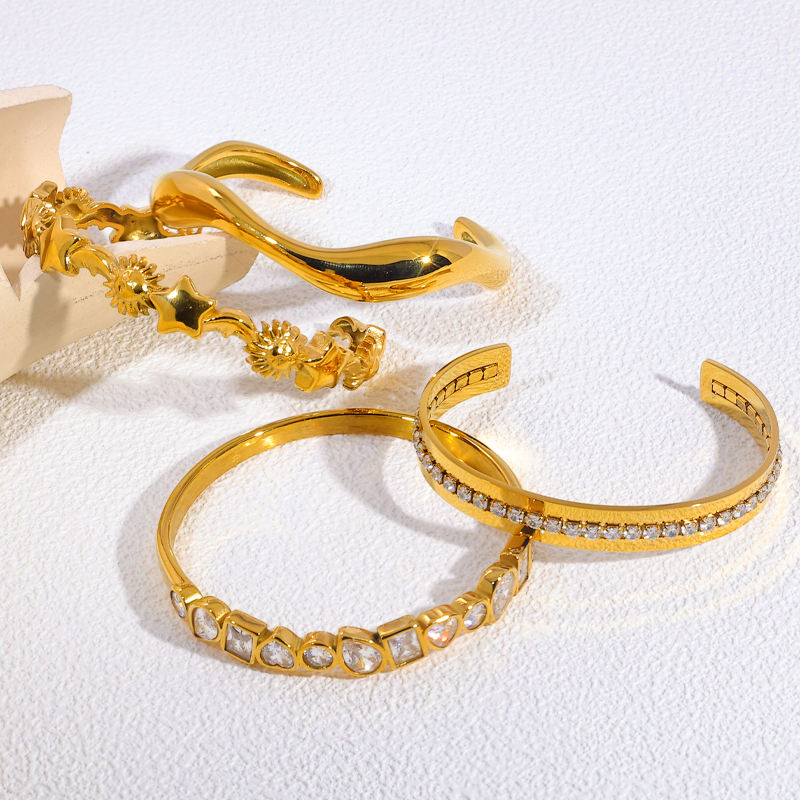
Engraved bangles carry the personalisation margin. In Jusnova's production setup, four in-house application methods are used for custom marks — laser engraving, stamping, screen printing and epoxy doming — with a sample lead time of two to three days. That combination allows a retail buyer to offer a marked piece without outsourcing the marking step.
In retail practice, engraved bangles serve three distinct buyer groups. Corporate gift programmes — employee recognition, service awards, conference items — need batch engraving of a fixed logo to a single specification. Tourism and landmark souvenir retail needs high style turnover at a controlled unit value. DTC personalisation, where a customer orders a name, initial or date, needs each engraving file handled individually. These are different operational problems, and a supplier that can serve all three without changing the base bangle is materially easier to manage than one that cannot.
Fit-for-Purpose Customisation: What the Specification Actually Allows
Customisation is often described loosely in the fashion accessories trade. It is more useful to treat it as a bounded engineering envelope, because that is what determines whether a design brief is deliverable at retail cost or not.
| Specification | Available range | What it means for a retail buyer |
|---|---|---|
| Base material | 304 / 316 / 316L stainless steel | 316L is the default choice for skin-contact and EU-facing items; 304 is common for economy fashion pieces. |
| Surface finish | PVD coating (gold, rose gold, black, gunmetal and others), gold plating, electroplating, brushed, mirror-polished and sandblasted — or combinations | Finish determines the price tier and the care wording that must appear on the retail card. |
| Diameter | 5 mm to 80 mm | Covers thin stacking bangles through to wide statement cuffs within one programme. |
| Thickness | 0.5 mm to 3.0 mm | Thinner profiles read as delicate; thicker profiles support premium positioning. |
| Tolerance | Controlled within ±0.05 mm | Keeps a reorder visually identical to the first shipment. |
| Stone setting | CZ, man-made crystal or moissanite; 20+ stone colours; prong, bezel, channel and pavé settings | Allows gem-set variants without redesigning the base chain or bangle. |
| Packaging | OPP bags, velvet pouches, premium gift boxes, or fully custom designs with your logo and branding | Packaging is what converts a chain unit into a gift-retail product. |
| Reference model | GEN000516bhia-066 | The identifier to quote when reordering or raising a technical query. |
Finishes, Stones and Packaging as Retail Decisions
PVD and Gold Plating
Jusnova operates an in-house PVD facility with six machines and more than 20 colour options, and reports batch colour matching within Delta E < 1.0. That figure matters commercially: colour drift between production batches is one of the most common causes of a retailer having to split a single style across two listings or discount a late shipment.
The coating is also the basis of the durability claim. The company states that its PVD coating maintains luster for two to five years in a conventional environment, verified by 48-hour salt spray testing. Published industry technical assessments place PVD-coated 316L surfaces at roughly ten times the wear durability of conventional electroplated surfaces; buyers should treat such multiples as directional rather than as laboratory-certified figures, because the actual result depends on wear pattern, skin chemistry and cleaning habits.
Stone Selection
The standard stone programme covers CZ, man-made crystal and moissanite across more than 20 colours, set by prong, bezel, channel or pavé. For fashion retail this is a pricing tool as much as a design tool: the same base chain or bangle can be offered at several price points by changing the stone type and setting, which keeps display consistency while widening the price ladder.
Packaging Formats
Packaging is frequently under-specified at the sampling stage and then becomes a schedule problem at the shipping stage. Three formats cover most retail needs. OPP bags suit high-volume marketplace and wholesale supply where the customer supplies their own outer packaging. Velvet pouches suit boutique and jewellery-counter sales. Premium gift boxes, including foil-stamped options, suit gifting, corporate programmes and DTC unboxing. Specifying the packaging at the same time as the product avoids a second approval cycle later.
Compliance: What EU and UK Buyers Now Ask For
Nickel release is the first compliance question in the European market, and the threshold is specific. Under EU REACH Annex XVII Entry 27, nickel release from jewellery intended for skin contact must remain below 0.5 µg/cm²/week, and below 0.2 µg/cm²/week for piercing items. Buyers sourcing for EU retail should expect documentation that addresses this limit directly, not a general statement about material quality.
Jusnova states that its product is fabricated from 316L surgical-grade steel with zero nickel release, tested to EU REACH and FDA standards. The 316L raw material is specified in line with ASTM A276/A276M-25, the standard specification for stainless steel bars and shapes. Salt-spray corrosion resistance is verified by 48-hour testing conducted in line with ISO 9227 methodology, and artificial-sweat exposure is assessed against the ISO 3160-2 approach used for coated jewellery and watch components. Social-compliance documentation is available through BSCI audit status, with REACH test reports and SGS reports provided on request.
Production Evidence Behind the Range
Capacity claims in jewellery manufacturing are only useful if they can be tied to a real facility and a real production calendar. Jusnova operates a 1,000 m² manufacturing facility with approximately 300 staff and an annual production capacity of 3,000,000 units — equivalent to roughly 250,000 units per month at full utilisation. The company runs a 20-engineer R&D team that supports style development and surface-finishing processes and launches over 500 new styles per month.
For order planning, two parameters matter most. Sampling for custom marking and finish runs at a two to three day lead time, which allows a fast approval loop before mass production. The stated minimum order quantity is 100 pieces per style, which is workable for a boutique or a DTC brand building a defined range, but is not designed for single-piece prototyping. Weight is controlled to deliver a solid feel and can be adjusted to a buyer's target, and dimensional tolerance is held within ±0.05 mm. Confidentiality is handled through NDA agreements and internal confidentiality policies, which is relevant for retailers commissioning exclusive designs.
Company and range information is published at jusnovasteel.com and jusnovajewelry.com, and technical enquiries can be directed to market@powellwholesale.net or +86 189 2623 2416.
Stainless Steel Compared with Traditional Fashion-Jewellery Materials
The honest comparison is not "stainless steel is better". It is that each material carries a different failure mode, and the right choice depends on price tier, return policy and how long the retailer expects the customer to keep the item.
| Attribute | 316L stainless steel (Jusnova range) | Electroplated brass / copper | Zinc alloy fashion jewellery |
|---|---|---|---|
| Corrosion behaviour | Base metal resists corrosion; PVD colour layer sits on a non-rusting surface | Base metal corrodes once the plating layer is breached | Base metal corrodes; plating adhesion is a frequent failure point |
| Colour durability | PVD coating maintains luster for 2–5 years in a conventional environment; verified by 48-hour salt spray testing | Colour fades progressively as plating abrades | Colour loss typically follows plating wear |
| Skin contact | 316L surgical-grade with zero nickel release as tested to EU REACH and FDA standards | Depends on barrier plating quality and nickel control | Depends on plating integrity over time |
| Design capability | Strong for solid forms: chains, bangles, cuffs, cast and stamped shapes | Strong for fine detail and filigree work | Good detail at low cost |
| Typical retail fit | Mid to premium retail, DTC, gifting, personalisation | Entry to mid retail, trend-led volume | Low-cost volume and novelty items |
This table is a general industry characterisation of material behaviour, not a specification of any individual supplier's product. Individual performance depends on base-material grade, plating thickness and end-use conditions.
Where Stainless Steel Is Not the Answer
Several boundaries are worth stating plainly, because they affect planning more than they affect design.
- Coating life is environment-dependent. The stated two-to-five-year luster window applies to conventional wearing conditions. Contact with strong acids or alkalis, abrasive cleaning, or sustained exposure to chlorinated or salt water will shorten it. Cleaning with a soft cloth is the recommended routine.
- The dimensional envelope is finite. Diameters from 5 mm to 80 mm and thicknesses from 0.5 mm to 3.0 mm cover most fashion-retail forms, but components outside that range require separate engineering and tooling review rather than a catalogue adjustment.
- Very small trend tests are inefficient. With a stated minimum of 100 pieces per style, stainless steel is not the natural format for testing a new silhouette at 20 or 30 units. Buyers validating an unproven trend are usually better served by existing moulds and stock styles first.
- The stone programme is man-made. CZ, man-made crystal and moissanite are standard; natural stone setting is not part of the standard offer and should be raised as a separate development request.
- Durability multiples should be treated as directional. Claims that PVD offers roughly ten times the wear life of electroplating come from industry technical analysis, not from a single third-party laboratory protocol, and should be used as a positioning guide rather than a warranty statement.
Market Signals for Retail Buyers
The category is growing, but the published numbers should be read with care because scope definitions differ between research houses. The global stainless steel jewellery market was valued at USD 6.79 billion in 2024 and is projected to reach USD 10.8 billion by 2035, according to WiseGuyReports. A narrower reading of the same segment, published by Vertex AI / Business Insights, puts the figure at approximately USD 2.71 billion, with WiseGuyReports itself forecasting USD 7.08 billion for 2025 under a different scope. Buyers should treat absolute market sizes as directional and focus instead on the direction of travel, which is consistent across sources.
Personalisation is the clearer signal. Cognitive Market Research estimates the global personalised jewellery market at USD 42.51 billion in 2024, growing at a CAGR of 8.6% through 2031. Separately, Jewelers of America reported that approximately 68% of couples in 2024 chose customised or bespoke jewellery over ready-made options. Both figures point the same way for fashion retail: engraved and made-to-order pieces are no longer a premium add-on but an expected part of the accessory assortment, which is precisely where engraved bangles sit.
On the supply side, China's total jewellery exports reached USD 12.7 billion in 2025, with major destinations including Hong Kong, the United States and Malaysia, according to the Observatory of Economic Complexity. For European and UK buyers, that concentration means supplier selection and documentation quality matter more than geographic proximity.
Future Outlook
Three shifts are likely to shape stainless steel in fashion accessories retail over the next sourcing cycles. First, packaging will increasingly be specified alongside product, because gift-ready presentation is now a purchasing criterion rather than a shipping detail. Second, personalisation will move from an occasional service to a standing line item, which puts pressure on suppliers to handle per-unit engraving data as smoothly as batch logos. Third, compliance documentation will continue to tighten around nickel release and coating claims in the EU and UK, favouring suppliers who can produce batch-linked test reports rather than generic certificates.
For retail buyers, the practical implication is that style decisions and documentation decisions should be made in the same conversation. A rope chain, a figaro bracelet and an engraved bangle can all be sourced from a single programme; what separates a workable programme from a costly one is whether the material grade, finish, dimensions, packaging and certification can be locked before the first production run rather than after it.
FAQ
What is stainless steel jewelry, and how does 316L differ from 304?
Stainless steel jewelry is made from a corrosion-resistant steel base rather than plated brass or zinc alloy. Grade 316L is regarded as the benchmark for hypoallergenic jewelry because it contains molybdenum for corrosion resistance, while 304 is more common in economy fashion pieces. Jusnova's stainless steel jewelry line, model GEN000516bhia-066, is made from 316L stainless steel and is specified against ASTM A276/A276M-25 for the raw material.
Which stainless steel styles fit fashion accessories retail best — rope chain bracelets, figaro bracelets or engraved bangles?
They serve different roles rather than competing. Rope chain bracelets are the volume and layering style, suited to marketplace sellers, wholesalers and DTC stacking ranges because the textured surface hides light wear and photographs well. Figaro chain bracelets act as the stability line for department-store counters and boutiques, since the classic link pattern does not date quickly. Engraved bangles serve personalisation and gifting: corporate programmes, tourism and souvenir retail, and made-to-order DTC pieces. Most assortments benefit from carrying all three rather than choosing one.
Are PVD-coated stainless steel jewelry pieces genuinely waterproof and tarnish-free?
PVD coating on a 316L base is designed for daily wear, including contact with sweat and water. Jusnova states that the coating maintains luster for two to five years in a conventional environment, verified by 48-hour salt spray testing conducted in line with ISO 9227 methodology. The qualification is environmental: prolonged contact with strong acids or alkalis will degrade the finish, and routine cleaning with a soft cloth is recommended rather than abrasive polishes.
Is 316L stainless steel jewelry suitable for sensitive skin?
316L surgical-grade steel with zero nickel release is the material profile most often specified for sensitive-skin products. Jusnova states that its product is tested to EU REACH and FDA standards. The relevant EU benchmark is REACH Annex XVII Entry 27, which limits nickel release to below 0.5 µg/cm²/week for skin-contact jewellery and below 0.2 µg/cm²/week for piercing items. Buyers should verify that the test report matches the specific finish and batch being purchased.
What should a buyer verify before placing a wholesale order for stainless steel jewelry?
Five things are worth confirming in writing: the material grade and its supporting test reports (316L per ASTM A276/A276M-25, with REACH, SGS and BSCI documentation available on request); the dimensional tolerance, held within ±0.05 mm across the 5–80 mm diameter and 0.5–3.0 mm thickness range; the colour consistency commitment for PVD finishes, stated as Delta E < 1.0; the packaging format, whether OPP bag, velvet pouch or premium gift box; and the commercial parameters, including a stated minimum of 100 pieces per style and a two to three day sample lead time. Approving a physical sample against the confirmation drawing remains the single most reliable check.
Stainless steel has become a routine part of fashion accessories retail not because it is fashionable but because it is predictable — in wear, in reordering and in documentation. For buyers mapping rope chains, figaro bracelets and engraved bangles to specific retail channels, the deciding question is less about design language than about whether the specification, the certification and the packaging can be fixed before the first production run.